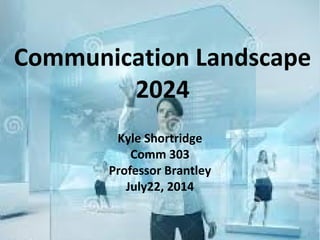
Communication Landscape
2024
Kyle Shortridge
Comm 303
Professor Brantley
July22, 2014
Today's researchers are already working
on the technologies of tomorrow
In the next ten years we’re
likely to see flexible,
transparent screens based on
organic light-emitting diode
(OLED) that will be used in
many more of our daily devices
Technology use in Appliances
• Embedded Galaxy Tab
Technology
With this technology in the
works, we’re sure to see it in
many kitchens in 10 years.
Boasting of a sliding cutting
board as well as integrated
Samsung Galaxy Tab technology
which delivers an interactive and
engaging kitchen experience
Smart TVs, smart windows, smart phones,
and now smart kitchen!
Diffusion of Innovations
• Technology has advanced so much in past few
decades and is not slowing down.
• Roger’s theory of Diffusion of Innovation explains
how, why and at what rate technology spreads in
our culture.
• Americans want their daily lives to be quick and
efficient, this is a part of our culture. In the next
10 years we are likely to see kitchens that
complete tasks more efficiently and effectively.
Technology in Transportation
Automobiles:
Future innovations in
technology in our vehicles
will involve wireless
communications:
•The mobile user interface will
prove pivotal in creating a
desired driver experience.
•wireless communication
technologies will be responsible
for vehicles that contain the
intelligence to read the road
conditions and act as a failsafe
for driver error.
Technology in Transportation
Continued…
By 2024 we will see fully autonomous vehicles!
• We will move from the current automated driver aids, such as,
emergency breaking systems, lane drifting alerts, blind spot
sensors and auto parking assists to technology doing all the work
for us
Sit back and enjoy the ride!
Principle of Relative Constancy
• This theory explains that a product that, at
first, seems unusual turns into something that
defines an industry.
• Car companies are testing self driving cars,
however in the next ten years there will likely
be one company that has the car available to
consumers. The company that has the self
driving car first, will be defined by this car.
Technology Advancements Social
Media
• Ten years down the line, one form of
social media, Facebook, will not be
defined by the people who are on it
now, but the people who are on it
then.
• Social media is often used for people
to be loved, respected and most
importantly, be independent, and
social media is the communication
platform that allows them to do this.
In order to win the support of future
users Facebook needs to adapt and
evolve.
• We are likely to see even more
advertising and buying available
through social media sites such as
Facebook in the future.
Uses and Gratification Theory
• This theory explains is an approach to understanding
why and how people actively seek out specific media
to satisfy specific needs.
• Often, people post to sites such as Facebook not only
to express themselves but to fulfill certain needs.
Facebook allows a person to receive the praise and
compliments they are often seeking
Summary
• Transparent displays that can work as shades? Check.
• Mirrors that act as displays? LG just did that in a
production model at CES, in a really smooth realization
too. flexible displays? Check- those are being sold now
too.
• Currently there's a polish and integration to
technology that is lacking, but all the base technologies
are already present and in products. What we will see
ten years from now will amaze us but with how
technology has advanced thus far, it will likely not
surprise us.
References
• Rogers, E. M. (2003). Diffusion of innovations
(5th edition). New York, NY: Free Press
• McCombs, M., & Nolan, J. (1992). The relative
constancy approach to consumer spending for
media. Journal of Media Economics, 5(2), 43-
52.
• Ruggiero, T. E. (2000). Uses and gratifications
theory in the 21st century. Mass
communication & society, 3(1), 3-37.

Communication landscape 2024-Kyle Shortridge

  • 1.
    Communication Landscape 2024 Kyle Shortridge Comm303 Professor Brantley July22, 2014
  • 2.
    Today's researchers arealready working on the technologies of tomorrow In the next ten years we’re likely to see flexible, transparent screens based on organic light-emitting diode (OLED) that will be used in many more of our daily devices
  • 3.
    Technology use inAppliances • Embedded Galaxy Tab Technology With this technology in the works, we’re sure to see it in many kitchens in 10 years. Boasting of a sliding cutting board as well as integrated Samsung Galaxy Tab technology which delivers an interactive and engaging kitchen experience Smart TVs, smart windows, smart phones, and now smart kitchen!
  • 4.
    Diffusion of Innovations •Technology has advanced so much in past few decades and is not slowing down. • Roger’s theory of Diffusion of Innovation explains how, why and at what rate technology spreads in our culture. • Americans want their daily lives to be quick and efficient, this is a part of our culture. In the next 10 years we are likely to see kitchens that complete tasks more efficiently and effectively.
  • 5.
    Technology in Transportation Automobiles: Futureinnovations in technology in our vehicles will involve wireless communications: •The mobile user interface will prove pivotal in creating a desired driver experience. •wireless communication technologies will be responsible for vehicles that contain the intelligence to read the road conditions and act as a failsafe for driver error.
  • 6.
    Technology in Transportation Continued… By2024 we will see fully autonomous vehicles! • We will move from the current automated driver aids, such as, emergency breaking systems, lane drifting alerts, blind spot sensors and auto parking assists to technology doing all the work for us
  • 7.
    Sit back andenjoy the ride!
  • 8.
    Principle of RelativeConstancy • This theory explains that a product that, at first, seems unusual turns into something that defines an industry. • Car companies are testing self driving cars, however in the next ten years there will likely be one company that has the car available to consumers. The company that has the self driving car first, will be defined by this car.
  • 9.
    Technology Advancements Social Media •Ten years down the line, one form of social media, Facebook, will not be defined by the people who are on it now, but the people who are on it then. • Social media is often used for people to be loved, respected and most importantly, be independent, and social media is the communication platform that allows them to do this. In order to win the support of future users Facebook needs to adapt and evolve. • We are likely to see even more advertising and buying available through social media sites such as Facebook in the future.
  • 10.
    Uses and GratificationTheory • This theory explains is an approach to understanding why and how people actively seek out specific media to satisfy specific needs. • Often, people post to sites such as Facebook not only to express themselves but to fulfill certain needs. Facebook allows a person to receive the praise and compliments they are often seeking
  • 11.
    Summary • Transparent displaysthat can work as shades? Check. • Mirrors that act as displays? LG just did that in a production model at CES, in a really smooth realization too. flexible displays? Check- those are being sold now too. • Currently there's a polish and integration to technology that is lacking, but all the base technologies are already present and in products. What we will see ten years from now will amaze us but with how technology has advanced thus far, it will likely not surprise us.
  • 12.
    References • Rogers, E.M. (2003). Diffusion of innovations (5th edition). New York, NY: Free Press • McCombs, M., & Nolan, J. (1992). The relative constancy approach to consumer spending for media. Journal of Media Economics, 5(2), 43- 52. • Ruggiero, T. E. (2000). Uses and gratifications theory in the 21st century. Mass communication & society, 3(1), 3-37.