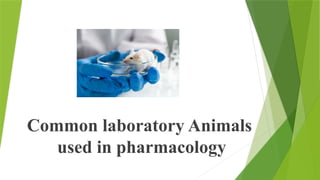
Common laboratory Animals
used in pharmacology
Presented by:- Vishnu Pratap Singh
Vivek Kumar
B.Pharma 2nd Year
Subject:- Pharmacology-1
Guided By:- Dr. Rashmi Tripathi
College of pharmacy (243)
(Approved By PCI , NEW DELHI, AKTU BTE LUCKNOW)
GWALIOR ROAD ROHTA Kl NEHAR, JAKHODA,
AGRA.U.P
CONTENT
 Aim
 Introduction
 HISTORY
 ANIMALS
 USES
 CLASSIFICATION
 Description
PHARMACOLOGY is the science which deals with study of drugs
EXPERIMENTAL PHARMACOLOGY: deals with effect of various
pharmacological agents studied on different animal species
AIMS :
• Find out the therapeutic agent suitable for human use
• Study the toxicity of the drugs
• Study the mechanism and site of action of drugs
Pharmacology
Discovery of new drugs or to study the actions of existing drugs
Preclinical Clinical
Two ways
1) Intact animal study —In vivo (in the living animal) Phase -1,2,3,4
2) isolated organ study — In vitro (in living part of animal)
INTRODUCTION
 Physiologically and Anatomically there is a similarity
between the humans and animals at organs and organ
systems, which function in a similar fashion.
 This similarity makes animals ideal models for the study
and development of products and techniques for humans.
 It was the use of animals in the laboratory that lead to the
discovery of the diptheria and polio vaccines, insulin for
the treatment of diabetes mellitus, heart valve
replacement , antibiotic therapy, manic-depressive drugs
and the list goes on and on.
HISTORICAL OVERVIEW
 Aristotle and Erasistratus are the first to use living animals in
experiments.
 Animal use in science has been developed not only in drug
discovery but also in surgical procedures.
 RAUDOLT BUCHHEIM founded the first experimental
pharmacology laboratory in his own house in 1849 in
Germany.
 IVAN PAVLOV is one of the most famous scientist used
animals for performing experiments in late 1800's.
CONT.... ..... ...
 The first animal protection law was proposed in British
parliament at 1822, promoted by Charles Darwin,
legislation for the protection and regulation of animals.
 The bill for protection law of animals has passed in the
year 1876.
 SIR RAM NATH CHOPRA in INDIA made the beginning
in pharmacological research of traditional drugs.
 The animal welfare board of INDIA was set up in
accordance with section 4 of the prevention of cruelty to
animal act 1960.
 From the 17th century there is a oppose to the use of
animals in research and the scientific community.
Medical advances achieved through animal
research
• 1796 - small pox vaccine —cow
• 1881 - anthrax vaccine — sheep
• 1885 - rabies vaccine — dog, rabbit
• 1942 - Rh factor discovered — monkey
• 1954 - polio vaccine developed — mouse, monkey
• 1970 - lithium approved — rat, Guinea pig
• 1984 - monoclonal antibodies developed — mice
• 2000 - brain signal transduction — mouse, rat
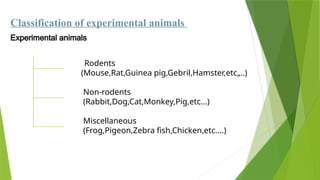
Classification of experimental animals
Experimental animals
Rodents
(Mouse,Rat,Guinea pig,Gebril,Hamster,etc„..)
Non-rodents
(Rabbit,Dog,Cat,Monkey,Pig,etc...)
Miscellaneous
(Frog,Pigeon,Zebra fish,Chicken,etc....)
MOUSE
 Biological Name : Mus musculus
 Strains
-C57BL/6 mice
-Balb/C mice
-Swiss albino mice(most commonly used)
 Adult weight : 20-25gm
 Suitable age for experiments : 1 month
Balb/C mice
Characteristics
-smallest
-cheap
-easy to handle
Advantages
-short gestation
period
-short lifespan
-small size
-low
maintenance cost
C57BL/6 mice
Experimental uses
• toxicological studies(acute & subacute)
• teratogenicity studies
• bioassay of insulin
• screening of analgesics & anticonvulsants
• screening of chemotherapeutic agents
• studies related to genetics and cancer research
• study of drugs acting on central nervous system
RAT
 Biological Name : Rattus norvegicus
 Strains
-Albino
-Sprague-Dawley
-Wistar Kyoto
- Long evans
 Adult weight : 200-250gm
absent, so oral drugs
can be given
• gall bladder & tonsil
are absent
• greater sensitivity to
most drugs
• because of the
absence of gall
bladder, there is a
continuous
flow of bile into the
intestine - used to
study of drugs
acting on bile,
cholesterol
reabsorption, etc.
• pancreas is diffuse -
difficult to produce
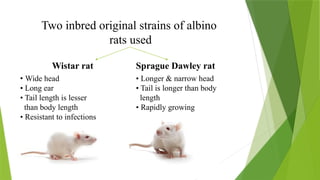
Two inbred original strains of albino
rats used
Wistar rat
• Wide head
• Long ear
• Tail length is lesser
than body length
• Resistant to infections
Sprague Dawley rat
• Longer & narrow head
• Tail is longer than body
length
• Rapidly growing
Long Evans rat
 black hooded rat
 cross between female
albino & wild animal
Spontaneous hypertensive rat
 For hypertension study and
CVS disease study
 Experimental uses
• Psychopharmacological studies
• Study pf analgesics and anticonvulsants
• Bioassay of various hormones such as insulin, oxytocin, etc.
• Study of estrus cycle, mating behavior & lactation
• Study on isolated tissue preparation
• Chronic study on blood pressure
• Gastric acid secretion studies
• Study of hepatotoxic compound
• Acute & chronic toxicity studies
• Study on mast cells
• Rat brain tissue is extensively employed in radio-receptor
studies
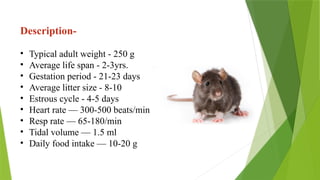
Description-
• Typical adult weight - 250 g
• Average life span - 2-3yrs.
• Gestation period - 21-23 days
• Average litter size - 8-10
• Estrous cycle - 4-5 days
• Heart rate — 300-500 beats/min
• Resp rate — 65-180/min
• Tidal volume — 1.5 ml
• Daily food intake — 10-20 g
Thank you

Common Laboratory Animals experiment ppt

  • 1.
  • 2.
    Presented by:- VishnuPratap Singh Vivek Kumar B.Pharma 2nd Year Subject:- Pharmacology-1 Guided By:- Dr. Rashmi Tripathi College of pharmacy (243) (Approved By PCI , NEW DELHI, AKTU BTE LUCKNOW) GWALIOR ROAD ROHTA Kl NEHAR, JAKHODA, AGRA.U.P
  • 3.
    CONTENT  Aim  Introduction HISTORY  ANIMALS  USES  CLASSIFICATION  Description
  • 4.
    PHARMACOLOGY is thescience which deals with study of drugs EXPERIMENTAL PHARMACOLOGY: deals with effect of various pharmacological agents studied on different animal species AIMS : • Find out the therapeutic agent suitable for human use • Study the toxicity of the drugs • Study the mechanism and site of action of drugs Pharmacology Discovery of new drugs or to study the actions of existing drugs Preclinical Clinical Two ways 1) Intact animal study —In vivo (in the living animal) Phase -1,2,3,4 2) isolated organ study — In vitro (in living part of animal)
  • 5.
    INTRODUCTION  Physiologically andAnatomically there is a similarity between the humans and animals at organs and organ systems, which function in a similar fashion.  This similarity makes animals ideal models for the study and development of products and techniques for humans.  It was the use of animals in the laboratory that lead to the discovery of the diptheria and polio vaccines, insulin for the treatment of diabetes mellitus, heart valve replacement , antibiotic therapy, manic-depressive drugs and the list goes on and on.
  • 6.
    HISTORICAL OVERVIEW  Aristotleand Erasistratus are the first to use living animals in experiments.  Animal use in science has been developed not only in drug discovery but also in surgical procedures.  RAUDOLT BUCHHEIM founded the first experimental pharmacology laboratory in his own house in 1849 in Germany.  IVAN PAVLOV is one of the most famous scientist used animals for performing experiments in late 1800's.
  • 7.
    CONT.... ..... ... The first animal protection law was proposed in British parliament at 1822, promoted by Charles Darwin, legislation for the protection and regulation of animals.  The bill for protection law of animals has passed in the year 1876.  SIR RAM NATH CHOPRA in INDIA made the beginning in pharmacological research of traditional drugs.  The animal welfare board of INDIA was set up in accordance with section 4 of the prevention of cruelty to animal act 1960.  From the 17th century there is a oppose to the use of animals in research and the scientific community.
  • 8.
    Medical advances achievedthrough animal research • 1796 - small pox vaccine —cow • 1881 - anthrax vaccine — sheep • 1885 - rabies vaccine — dog, rabbit • 1942 - Rh factor discovered — monkey • 1954 - polio vaccine developed — mouse, monkey • 1970 - lithium approved — rat, Guinea pig • 1984 - monoclonal antibodies developed — mice • 2000 - brain signal transduction — mouse, rat
  • 9.
    Classification of experimentalanimals Experimental animals Rodents (Mouse,Rat,Guinea pig,Gebril,Hamster,etc„..) Non-rodents (Rabbit,Dog,Cat,Monkey,Pig,etc...) Miscellaneous (Frog,Pigeon,Zebra fish,Chicken,etc....)
  • 10.
    MOUSE  Biological Name: Mus musculus  Strains -C57BL/6 mice -Balb/C mice -Swiss albino mice(most commonly used)  Adult weight : 20-25gm  Suitable age for experiments : 1 month Balb/C mice
  • 11.
    Characteristics -smallest -cheap -easy to handle Advantages -shortgestation period -short lifespan -small size -low maintenance cost C57BL/6 mice
  • 12.
    Experimental uses • toxicologicalstudies(acute & subacute) • teratogenicity studies • bioassay of insulin • screening of analgesics & anticonvulsants • screening of chemotherapeutic agents • studies related to genetics and cancer research • study of drugs acting on central nervous system
  • 14.
    RAT  Biological Name: Rattus norvegicus  Strains -Albino -Sprague-Dawley -Wistar Kyoto - Long evans  Adult weight : 200-250gm
  • 15.
    absent, so oraldrugs can be given • gall bladder & tonsil are absent • greater sensitivity to most drugs • because of the absence of gall bladder, there is a continuous flow of bile into the intestine - used to study of drugs acting on bile, cholesterol reabsorption, etc. • pancreas is diffuse - difficult to produce
  • 16.
    Two inbred originalstrains of albino rats used Wistar rat • Wide head • Long ear • Tail length is lesser than body length • Resistant to infections Sprague Dawley rat • Longer & narrow head • Tail is longer than body length • Rapidly growing
  • 17.
    Long Evans rat black hooded rat  cross between female albino & wild animal Spontaneous hypertensive rat  For hypertension study and CVS disease study
  • 18.
     Experimental uses •Psychopharmacological studies • Study pf analgesics and anticonvulsants • Bioassay of various hormones such as insulin, oxytocin, etc. • Study of estrus cycle, mating behavior & lactation • Study on isolated tissue preparation • Chronic study on blood pressure • Gastric acid secretion studies • Study of hepatotoxic compound • Acute & chronic toxicity studies • Study on mast cells • Rat brain tissue is extensively employed in radio-receptor studies
  • 19.
    Description- • Typical adultweight - 250 g • Average life span - 2-3yrs. • Gestation period - 21-23 days • Average litter size - 8-10 • Estrous cycle - 4-5 days • Heart rate — 300-500 beats/min • Resp rate — 65-180/min • Tidal volume — 1.5 ml • Daily food intake — 10-20 g
  • 35.