Common
Dosage Forms
and
Routes of
Administration-
III
LOCAL
 This refers to the application of a drug to an
area of the body for direct treatment. Usually
there is inefficient absorption (1-15%).
 High local tissue levels nevertheless
achievable, often higher than by systemic
route. Toxicity usually not a problem.
 DROPS
 Eye and nose drops are made isotonic to
avoid pain or discomfort.
 Ear drops are formulated as oily solutions to
coat and adhere to the aural cavity.
EYE DROPS
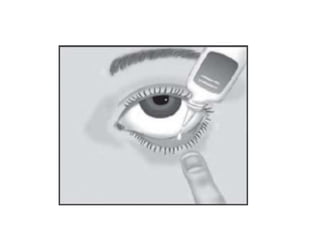
 They are aqueous or oily solutions for
instilling into conjunctival sac.
 They are used as anesthetics, anti infective
or anti inflammatory agents, miotics,
mydriatics and artificial tears.
 For example atropine sulphate (mydriatic),
pilocarpine nitrate (miotic), timolol maleate.
 ADVANTAGES
 1. Local effect at required place.
 2. Easy to apply.
 3. Drug interactions can be avoided.
 DISADVANTAGES
 1. It requires repeated application.
 2. Systemic effects can occur following
absorption.
 3. May cause irritation.
 4. Once seal is broken, should be used within
1 month.
EYE
OINTMEN
T
 They are semisolid preparations with a
greasy base, to be applied in the eye, e.g.
neomycin eye ointment, chloramphenicol
eye ointment, tetracycline eye ointment.
 ADVANTAGE
 They have longer duration of action.
 DISADVANTAGE
 Due to greasy base eyes may become sticky.
EAR
DROPS
 They are aqueous or oily solutions instilled in
the ear, e.g. wax softeners, sodium
bicarbonate.
 ADVANTAGE
 Avoid systemic side effect due to its local
action.
 DISADVANTAGE
 Local irritation can occur.
NASAL
DROPS
 They are aqueous solutions of drugs instilled
into the nose with a dropper, e.g.
Xylometazoline,ephedrine, etc.
 ADVANTAGE
 Local and quick action.
 DISADVANTAGES
 1. Absorption can occur producing systemic
effect.
 2. May cause local irritation.
NASAL
SPRAYS
 These are drugs or combinations of drugs
which by virtue of their high vapor pressure,
can be carried by an air current into nasal
passage and exert their effect, e.g.
 Beclomethasone, calcitonin, vasopressin, etc.
 ADVANTAGES
 1. Easy to use.
 2. It covers large surface area so quick
absorption.
 DISADVANTAGE
 Explosion may occur in hot environment as
the contents are under pressure.
SUPPOSITORIES
 A suppository is a drug delivery system that is
inserted either into the rectum (rectal
suppository), vagina (vaginal suppository) or
urethra (urethral suppository) where it dissolves.
 They are used to deliver both systemically
acting and locally acting medications.
 They are solid, uniformly medicated masses of
medicaments, e.g. glycerin, bisacodyl.
 ADVANTAGES
 1. Local application for systemic as well as local
effect
 2. Especially helpful for unconscious or in a
patient who can not take orally.
 DISADVANTAGES
 1. Inconvenient and some times irritant
 2. Aesthetic concerns
VAGINAL
PESSARIES
 It is the term applied to suppository shaped
medications for vaginal administration.
 This is a topical treatment and it is important
that the drug coats all the vagina mucosa.
 Vaginal medications whether in pessaries or
cream come with applicators which are
designed to reach the upper parts of the
vaginal canal.
 Vaginal preparations which are left in situ
are best used at night because the vagina
has no means of retention like sphincters
and the medication can run out.
 Vaginal tablet (Pessary) with applicator
 They are vaginal suppositories intended for
introduction into vagina, e.g. nystatin,
metronidazole.
OINTMENT
S
 These are lipid-based. They have a greasy
appearance and feel.
 The drug is trapped under the dressing and,
the layer of the skin is soften from sweating,
enabling the drug to penetrate deeply into
the tissues.
 Eye ointments are formulated to melt
quickly so that vision is not impaired.
 PASTES
 They have a very high powder content. They
are useful in protecting areas of skin from
moisture, being water repellent.
GEL AND
LOTIONS
 They are used on the hairy areas of the body.
Alcoholic gels or lotion are less messy than
ointments or creams, but the evaporation of
carrier is rapid, therefore, there is little
penetration of the drug JELLIES
 For urethral application
DUSTING
POWDER
 They are free flowing very fine powders
having particle size < 150 μm for external
use.
 They are used to treat superficial skin
conditions.
 They are sterilized by dry heat and supplied
in airtight glass or plastic jars with reclosable
perforated lid or sprinkler holes at top.
 Commonly used dusting powders are
purified talc, magnesium sulphide powder,
neomycin powder, sulphacetamide sodium,
sulphadiazine
powder.
 ADVANTAGES
 1. Systemic side effects of drugs are avoided
because of local application.
 2. It provides greater stability.
 DISADVANTAGE
 It requires repeated application.
LOTIONS
 They are liquid preparations meant for local
application to the skin or mucous membrane
without rubbing for providing soothing or
antiseptic effects.
 These medications are preferably supplied in
amber or blue coloured bottles to protect
them from sunlight, e.g. potassium
permanganate lotion (0.1%), cetrimide lotion
(1%), calamine lotion.
 ADVANTAGE
 Systemic side effects of drugs are avoided
because of local application.
 DISADVANTAGE
 Patient may experience a gritty feeling.
LINIMENT
S
 They are liquid or semiliquid preparations
intended for external application by rubbing
and may contain substances possessing
analgesic, rubefacient, soothing or
stimulating properties.
 They may be either emulsions or solutions,
e.g. liniment turpentine.
 ADVANTAGE
 Systemic side effects of drugs are avoided
because of local application.
 DISADVANTAGE
 Patient may experience a burning sensation.
OINTMENT
S
 They are semisolid preparations in a greasy
base used for external application by
inunction.
 They are of such consistency that they soften
but not necessarily melt when applied to the
skin, e.g. Whitfield's, salicylic acid, calamine
ointment.
 ADVANTAGES
 1. They increase the hydration of the skin.
 2. The duration of action is prolonged due to
occlusive dressing.
 DISADVANTAGES
 1. They stain the clothes.
 2. Inconvenient to the patient due to greasy
base.
CREAMS
 They are semi solid preparations consisting
of opaque emulsions for external use .
 The term cream is most frequently applied to
a soft cosmetic type of preparation.
 Creams are used in treatment of skin
conditions like eczema, pruritis as astringent,
emollient, and antiseptics.
 They are dispensed in collapsible metal or
plastic tubes, glass or plastic pots.
 ADVANTAGE
 They are cosmetically more acceptable due
to their less greasy nature.
 DISADVANTAGE
 They are easily washed out so requires
repetitive application.
SPRAYS
 They are preparations of drugs in aqueous,
alcoholic or glycerin containing media, e.g.
adhesive sprays.
 ADVANTAGE
 Easy to use and cover a larger surface area.
 DISADVANTAGE
 Explosion may occur in hot environment as
the contents are under pressure.
PAINTS
 They are simple solutions containing
medicaments in semisolid solvents like liquid
paraffin or glycerin, e.g. povidone iodine.
 ADVANTAGE
 Retain the medicament in situ for longer
period.
 DISADVANTAGE
 May cause staining and irritation.
Common Dosage Forms routine of administration 3.pptx

  • 1.
  • 2.
    LOCAL  This refersto the application of a drug to an area of the body for direct treatment. Usually there is inefficient absorption (1-15%).  High local tissue levels nevertheless achievable, often higher than by systemic route. Toxicity usually not a problem.  DROPS  Eye and nose drops are made isotonic to avoid pain or discomfort.  Ear drops are formulated as oily solutions to coat and adhere to the aural cavity.
  • 3.
    EYE DROPS  Theyare aqueous or oily solutions for instilling into conjunctival sac.  They are used as anesthetics, anti infective or anti inflammatory agents, miotics, mydriatics and artificial tears.  For example atropine sulphate (mydriatic), pilocarpine nitrate (miotic), timolol maleate.
  • 5.
     ADVANTAGES  1.Local effect at required place.  2. Easy to apply.  3. Drug interactions can be avoided.  DISADVANTAGES  1. It requires repeated application.  2. Systemic effects can occur following absorption.  3. May cause irritation.  4. Once seal is broken, should be used within 1 month.
  • 6.
    EYE OINTMEN T  They aresemisolid preparations with a greasy base, to be applied in the eye, e.g. neomycin eye ointment, chloramphenicol eye ointment, tetracycline eye ointment.  ADVANTAGE  They have longer duration of action.  DISADVANTAGE  Due to greasy base eyes may become sticky.
  • 7.
    EAR DROPS  They areaqueous or oily solutions instilled in the ear, e.g. wax softeners, sodium bicarbonate.  ADVANTAGE  Avoid systemic side effect due to its local action.  DISADVANTAGE  Local irritation can occur.
  • 8.
    NASAL DROPS  They areaqueous solutions of drugs instilled into the nose with a dropper, e.g. Xylometazoline,ephedrine, etc.  ADVANTAGE  Local and quick action.  DISADVANTAGES  1. Absorption can occur producing systemic effect.  2. May cause local irritation.
  • 9.
    NASAL SPRAYS  These aredrugs or combinations of drugs which by virtue of their high vapor pressure, can be carried by an air current into nasal passage and exert their effect, e.g.  Beclomethasone, calcitonin, vasopressin, etc.  ADVANTAGES  1. Easy to use.  2. It covers large surface area so quick absorption.  DISADVANTAGE  Explosion may occur in hot environment as the contents are under pressure.
  • 10.
    SUPPOSITORIES  A suppositoryis a drug delivery system that is inserted either into the rectum (rectal suppository), vagina (vaginal suppository) or urethra (urethral suppository) where it dissolves.  They are used to deliver both systemically acting and locally acting medications.  They are solid, uniformly medicated masses of medicaments, e.g. glycerin, bisacodyl.  ADVANTAGES  1. Local application for systemic as well as local effect  2. Especially helpful for unconscious or in a patient who can not take orally.  DISADVANTAGES  1. Inconvenient and some times irritant  2. Aesthetic concerns
  • 11.
    VAGINAL PESSARIES  It isthe term applied to suppository shaped medications for vaginal administration.  This is a topical treatment and it is important that the drug coats all the vagina mucosa.  Vaginal medications whether in pessaries or cream come with applicators which are designed to reach the upper parts of the vaginal canal.  Vaginal preparations which are left in situ are best used at night because the vagina has no means of retention like sphincters and the medication can run out.  Vaginal tablet (Pessary) with applicator  They are vaginal suppositories intended for introduction into vagina, e.g. nystatin, metronidazole.
  • 12.
    OINTMENT S  These arelipid-based. They have a greasy appearance and feel.  The drug is trapped under the dressing and, the layer of the skin is soften from sweating, enabling the drug to penetrate deeply into the tissues.  Eye ointments are formulated to melt quickly so that vision is not impaired.  PASTES  They have a very high powder content. They are useful in protecting areas of skin from moisture, being water repellent.
  • 13.
    GEL AND LOTIONS  Theyare used on the hairy areas of the body. Alcoholic gels or lotion are less messy than ointments or creams, but the evaporation of carrier is rapid, therefore, there is little penetration of the drug JELLIES  For urethral application
  • 14.
    DUSTING POWDER  They arefree flowing very fine powders having particle size < 150 μm for external use.  They are used to treat superficial skin conditions.  They are sterilized by dry heat and supplied in airtight glass or plastic jars with reclosable perforated lid or sprinkler holes at top.  Commonly used dusting powders are purified talc, magnesium sulphide powder, neomycin powder, sulphacetamide sodium, sulphadiazine powder.
  • 15.
     ADVANTAGES  1.Systemic side effects of drugs are avoided because of local application.  2. It provides greater stability.  DISADVANTAGE  It requires repeated application.
  • 16.
    LOTIONS  They areliquid preparations meant for local application to the skin or mucous membrane without rubbing for providing soothing or antiseptic effects.  These medications are preferably supplied in amber or blue coloured bottles to protect them from sunlight, e.g. potassium permanganate lotion (0.1%), cetrimide lotion (1%), calamine lotion.  ADVANTAGE  Systemic side effects of drugs are avoided because of local application.  DISADVANTAGE  Patient may experience a gritty feeling.
  • 17.
    LINIMENT S  They areliquid or semiliquid preparations intended for external application by rubbing and may contain substances possessing analgesic, rubefacient, soothing or stimulating properties.  They may be either emulsions or solutions, e.g. liniment turpentine.  ADVANTAGE  Systemic side effects of drugs are avoided because of local application.  DISADVANTAGE  Patient may experience a burning sensation.
  • 18.
    OINTMENT S  They aresemisolid preparations in a greasy base used for external application by inunction.  They are of such consistency that they soften but not necessarily melt when applied to the skin, e.g. Whitfield's, salicylic acid, calamine ointment.  ADVANTAGES  1. They increase the hydration of the skin.  2. The duration of action is prolonged due to occlusive dressing.  DISADVANTAGES  1. They stain the clothes.  2. Inconvenient to the patient due to greasy base.
  • 19.
    CREAMS  They aresemi solid preparations consisting of opaque emulsions for external use .  The term cream is most frequently applied to a soft cosmetic type of preparation.  Creams are used in treatment of skin conditions like eczema, pruritis as astringent, emollient, and antiseptics.  They are dispensed in collapsible metal or plastic tubes, glass or plastic pots.  ADVANTAGE  They are cosmetically more acceptable due to their less greasy nature.  DISADVANTAGE  They are easily washed out so requires repetitive application.
  • 20.
    SPRAYS  They arepreparations of drugs in aqueous, alcoholic or glycerin containing media, e.g. adhesive sprays.  ADVANTAGE  Easy to use and cover a larger surface area.  DISADVANTAGE  Explosion may occur in hot environment as the contents are under pressure.
  • 21.
    PAINTS  They aresimple solutions containing medicaments in semisolid solvents like liquid paraffin or glycerin, e.g. povidone iodine.  ADVANTAGE  Retain the medicament in situ for longer period.  DISADVANTAGE  May cause staining and irritation.