PANNASASTRA UNIVERSITY OF CAMBODIA
Interpersonal
communication in
Thailand’s Culture
Commitment to
Excellence
MEMBER
CONTENT
-Mr. Keo Song
-Ms. Keo Sovannary
-Ms. Saing Saranin
-Ven. Suong Sothun
-Ven. Voern Davin
-Introduction
-Communication with
foreigner
-Communication in school
-Communication in society
-Communication in Business
-Thai culture
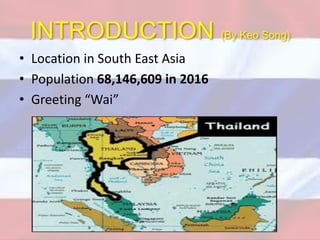
• Location in South East Asia
• Population 68,146,609 in 2016
• Greeting “Wai”
INTRODUCTION (By Keo Song)
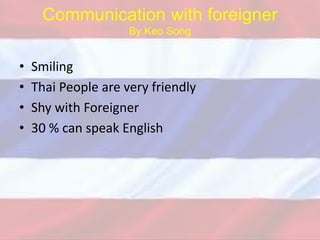
Communication with foreigner
By Keo Song
• Smiling
• Thai People are very friendly
• Shy with Foreigner
• 30 % can speak English
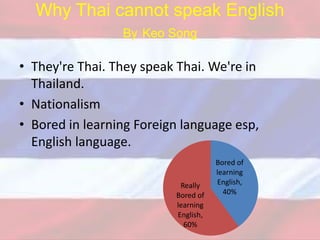
Why Thai cannot speak English
By Keo Song
• They're Thai. They speak Thai. We're in
Thailand.
• Nationalism
• Bored in learning Foreign language esp,
English language.
Bored of
learning
English,
40%
Really
Bored of
learning
English,
60%
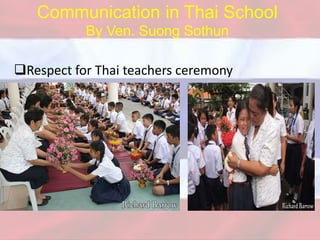
Communication in Thai School
By Ven. Suong Sothun
Respect for Thai teachers ceremony
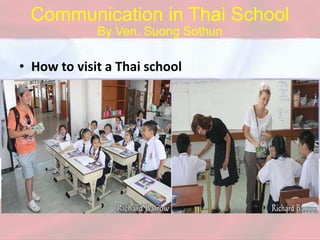
• How to visit a Thai school
Communication in Thai School
By Ven. Suong Sothun
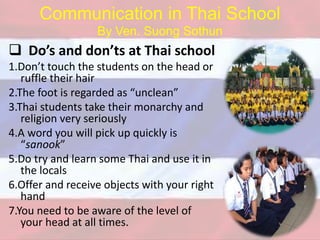
 Do’s and don’ts at Thai school
1.Don’t touch the students on the head or
ruffle their hair
2.The foot is regarded as “unclean”
3.Thai students take their monarchy and
religion very seriously
4.A word you will pick up quickly is
“sanook”
5.Do try and learn some Thai and use it in
the locals
6.Offer and receive objects with your right
hand
7.You need to be aware of the level of
your head at all times.
Communication in Thai School
By Ven. Suong Sothun
Communication in Thai School
By Ven. Suong Sothun
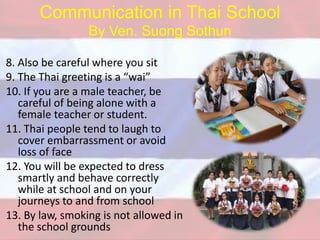
8. Also be careful where you sit
9. The Thai greeting is a “wai”
10. If you are a male teacher, be
careful of being alone with a
female teacher or student.
11. Thai people tend to laugh to
cover embarrassment or avoid
loss of face
12. You will be expected to dress
smartly and behave correctly
while at school and on your
journeys to and from school
13. By law, smoking is not allowed in
the school grounds
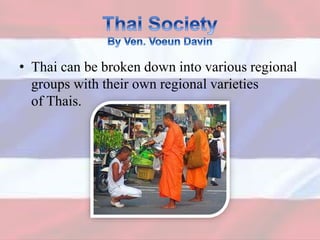
• Thai can be broken down into various regional
groups with their own regional varieties
of Thais.
These groups include Central Thai
That we have known as Bangkok or Krung Tep
Thais who are living in the central of Thailand
using the standard variety of the languages.
• The Isan , This part of Thailand, the people
who are living more closely related to the
standard Lao of Laos rather than the standard
Thai because the Isan people using their own
language and culture, We called Isan
languages. This part including “ Udonthani,
Ubunthani , Sisaket..Surin….etc.
• These group of people who are living at the
southern of Thailand. This part has become
more dominant due to official government
policy, which was designed to assimilate and
unify the disparate.
• The Lanna people live their lives with their
own cultures and languages ( Lanna language
or Pheasa Neou) as well. This part included
with Chiang Mai, Chiang Rai…ets.
• Using “Wai” for greeting with a Thai business
person
Communication in Business
By Keo Sovannary
Communication in Business
By Keo Sovannary
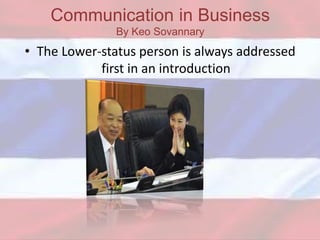
• The Lower-status person is always addressed
first in an introduction
Communication in Business
By Keo Sovannary
• Using word “ Khun” before given name
Ex: Anuwat (Given) + Wattapongsiri (Family) is Khun
Anuwat.
Communication in Business
By Keo Sovannary
• Business Meeting Etiquette
 Appointments are necessary and should be made
appointment as far in advance as possible
 Arriving at meeting on time
 Written material should be available in both English and
Thai
 Attending business meetings you should always dress
conservatively
Thai Culture
By Saing Saranin
Culture
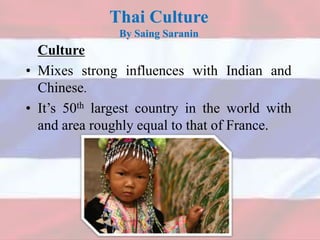
• Mixes strong influences with Indian and
Chinese.
• It’s 50th largest country in the world with
and area roughly equal to that of France.
Cultural Identity
By Saing Saranin
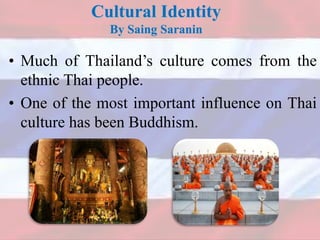
• Much of Thailand’s culture comes from the
ethnic Thai people.
• One of the most important influence on Thai
culture has been Buddhism.
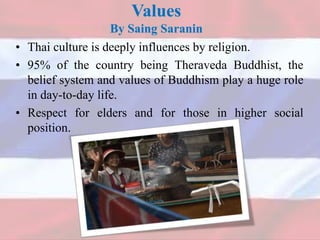
• Thai culture is deeply influences by religion.
• 95% of the country being Theraveda Buddhist, the
belief system and values of Buddhism play a huge role
in day-to-day life.
• Respect for elders and for those in higher social
position.
Values
By Saing Saranin
By Saing Saranin
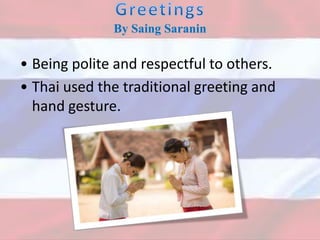
• Being polite and respectful to others.
• Thai used the traditional greeting and
hand gesture.
Thanks for your attention

Commmunication in thai culture

  • 1.
    PANNASASTRA UNIVERSITY OFCAMBODIA Interpersonal communication in Thailand’s Culture Commitment to Excellence
  • 2.
    MEMBER CONTENT -Mr. Keo Song -Ms.Keo Sovannary -Ms. Saing Saranin -Ven. Suong Sothun -Ven. Voern Davin -Introduction -Communication with foreigner -Communication in school -Communication in society -Communication in Business -Thai culture
  • 3.
    • Location inSouth East Asia • Population 68,146,609 in 2016 • Greeting “Wai” INTRODUCTION (By Keo Song)
  • 4.
    Communication with foreigner ByKeo Song • Smiling • Thai People are very friendly • Shy with Foreigner • 30 % can speak English
  • 5.
    Why Thai cannotspeak English By Keo Song • They're Thai. They speak Thai. We're in Thailand. • Nationalism • Bored in learning Foreign language esp, English language. Bored of learning English, 40% Really Bored of learning English, 60%
  • 6.
    Communication in ThaiSchool By Ven. Suong Sothun Respect for Thai teachers ceremony
  • 7.
    • How tovisit a Thai school Communication in Thai School By Ven. Suong Sothun
  • 8.
     Do’s anddon’ts at Thai school 1.Don’t touch the students on the head or ruffle their hair 2.The foot is regarded as “unclean” 3.Thai students take their monarchy and religion very seriously 4.A word you will pick up quickly is “sanook” 5.Do try and learn some Thai and use it in the locals 6.Offer and receive objects with your right hand 7.You need to be aware of the level of your head at all times. Communication in Thai School By Ven. Suong Sothun
  • 9.
    Communication in ThaiSchool By Ven. Suong Sothun 8. Also be careful where you sit 9. The Thai greeting is a “wai” 10. If you are a male teacher, be careful of being alone with a female teacher or student. 11. Thai people tend to laugh to cover embarrassment or avoid loss of face 12. You will be expected to dress smartly and behave correctly while at school and on your journeys to and from school 13. By law, smoking is not allowed in the school grounds
  • 10.
    • Thai canbe broken down into various regional groups with their own regional varieties of Thais.
  • 11.
    These groups includeCentral Thai That we have known as Bangkok or Krung Tep Thais who are living in the central of Thailand using the standard variety of the languages.
  • 12.
    • The Isan, This part of Thailand, the people who are living more closely related to the standard Lao of Laos rather than the standard Thai because the Isan people using their own language and culture, We called Isan languages. This part including “ Udonthani, Ubunthani , Sisaket..Surin….etc.
  • 13.
    • These groupof people who are living at the southern of Thailand. This part has become more dominant due to official government policy, which was designed to assimilate and unify the disparate. • The Lanna people live their lives with their own cultures and languages ( Lanna language or Pheasa Neou) as well. This part included with Chiang Mai, Chiang Rai…ets.
  • 14.
    • Using “Wai”for greeting with a Thai business person Communication in Business By Keo Sovannary
  • 15.
    Communication in Business ByKeo Sovannary • The Lower-status person is always addressed first in an introduction
  • 16.
    Communication in Business ByKeo Sovannary • Using word “ Khun” before given name Ex: Anuwat (Given) + Wattapongsiri (Family) is Khun Anuwat.
  • 17.
    Communication in Business ByKeo Sovannary • Business Meeting Etiquette  Appointments are necessary and should be made appointment as far in advance as possible  Arriving at meeting on time  Written material should be available in both English and Thai  Attending business meetings you should always dress conservatively
  • 18.
    Thai Culture By SaingSaranin Culture • Mixes strong influences with Indian and Chinese. • It’s 50th largest country in the world with and area roughly equal to that of France.
  • 19.
    Cultural Identity By SaingSaranin • Much of Thailand’s culture comes from the ethnic Thai people. • One of the most important influence on Thai culture has been Buddhism.
  • 20.
    • Thai cultureis deeply influences by religion. • 95% of the country being Theraveda Buddhist, the belief system and values of Buddhism play a huge role in day-to-day life. • Respect for elders and for those in higher social position. Values By Saing Saranin
  • 21.
    By Saing Saranin •Being polite and respectful to others. • Thai used the traditional greeting and hand gesture.
  • 22.
    Thanks for yourattention