Commercial & Open Source Software
Erick Watson
US Business & Marketing Organization
Microsoft Corporation
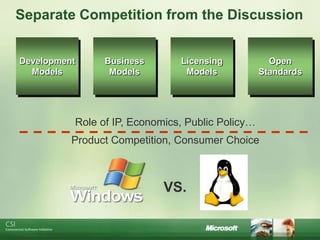
Separate Competition from the Discussion


Development     Business       Licensing            Open
  Models         Models         Models            Standards


          Role of IP, Economics, Public Policy…
          Product Competition, Consumer Choice


                            VS.
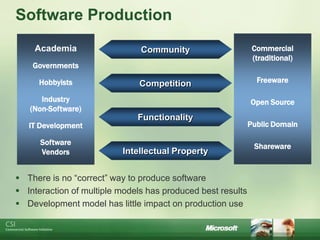
Software Production
    Academia                   Community                      Commercial
                                                              (traditional)
    Governments

     Hobbyists                 Competition                     Freeware

      Industry                                               Open Source
   (Non-Software)
                              Functionality
   IT Development                                            Public Domain

      Software                                                Shareware
      Vendors             Intellectual Property


 There is no “correct” way to produce software
 Interaction of multiple models has produced best results
 Development model has little impact on production use
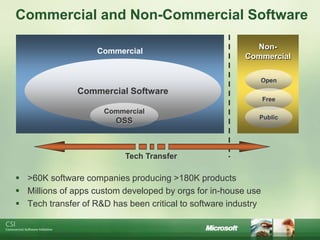
Commercial and Non-Commercial Software

                                                           Non-
                    Commercial
                                                         Commercial

                                                            Open
               Commercial Software
                                                                Free
                     Commercial
                                                            Public
                        OSS


                           Tech Transfer

 >60K software companies producing >180K products
 Millions of apps custom developed by orgs for in-house use
 Tech transfer of R&D has been critical to software industry
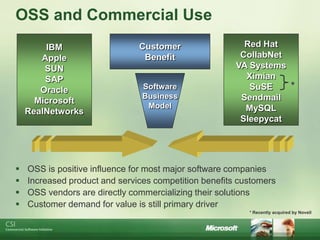
OSS and Commercial Use
        IBM                    Customer                  Red Hat
       Apple                    Benefit                 CollabNet
        SUN                                            VA Systems
        SAP                                              Ximian
                                Software                  SuSE    *
       Oracle
                                Business                Sendmail
      Microsoft
                                 Model                   MySQL
    RealNetworks
                                                        Sleepycat


   OSS is positive influence for most major software companies
   Increased product and services competition benefits customers
   OSS vendors are directly commercializing their solutions
   Customer demand for value is still primary driver
                                                          * Recently acquired by Novell
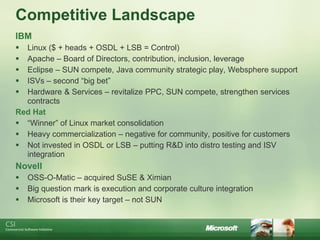
Competitive Landscape
IBM
 Linux ($ + heads + OSDL + LSB = Control)
 Apache – Board of Directors, contribution, inclusion, leverage
 Eclipse – SUN compete, Java community strategic play, Websphere support
 ISVs – second “big bet”
 Hardware & Services – revitalize PPC, SUN compete, strengthen services
  contracts
Red Hat
 “Winner” of Linux market consolidation
 Heavy commercialization – negative for community, positive for customers
 Not invested in OSDL or LSB – putting R&D into distro testing and ISV
  integration
Novell
   OSS-O-Matic – acquired SuSE & Ximian
   Big question mark is execution and corporate culture integration
   Microsoft is their key target – not SUN
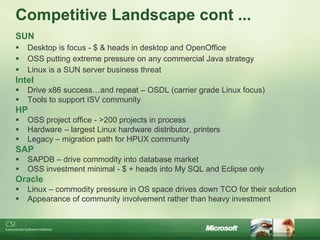
Competitive Landscape cont ...
SUN
   Desktop is focus - $ & heads in desktop and OpenOffice
   OSS putting extreme pressure on any commercial Java strategy
   Linux is a SUN server business threat
Intel
   Drive x86 success…and repeat – OSDL (carrier grade Linux focus)
   Tools to support ISV community
HP
   OSS project office - >200 projects in process
   Hardware – largest Linux hardware distributor, printers
   Legacy – migration path for HPUX community
SAP
   SAPDB – drive commodity into database market
   OSS investment minimal - $ + heads into My SQL and Eclipse only
Oracle
   Linux – commodity pressure in OS space drives down TCO for their solution
   Appearance of community involvement rather than heavy investment
Who/What To Watch
 MySQL – innovative business model, disruptive for Oracle
  & MS
 JBOSS – disruptive for IBM, BEA & MS
 MONO - .NET on Linux
 SAMBA – NT4 implications
 Eclipse – OSS IDE, commodity pressure in tools space
 OSDL – Linus lives there, core Linux direction
 Black Duck (and similar) – not OSS, but implication for
  litigious environment
www.microsoft.com/sharedsource
http://infoweb/sharedsource
http://linux
source@microsoft.com


© 2004 Microsoft Corporation. All rights reserved.
This presentation is for informational purposes only. Microsoft makes no warranties, express or implied, in this summary.

Commercial & Open Source Software

  • 1.
    Commercial & OpenSource Software Erick Watson US Business & Marketing Organization Microsoft Corporation
  • 2.
    Separate Competition fromthe Discussion Development Business Licensing Open Models Models Models Standards Role of IP, Economics, Public Policy… Product Competition, Consumer Choice VS.
  • 3.
    Software Production Academia Community Commercial (traditional) Governments Hobbyists Competition Freeware Industry Open Source (Non-Software) Functionality IT Development Public Domain Software Shareware Vendors Intellectual Property  There is no “correct” way to produce software  Interaction of multiple models has produced best results  Development model has little impact on production use
  • 4.
    Commercial and Non-CommercialSoftware Non- Commercial Commercial Open Commercial Software Free Commercial Public OSS Tech Transfer  >60K software companies producing >180K products  Millions of apps custom developed by orgs for in-house use  Tech transfer of R&D has been critical to software industry
  • 5.
    OSS and CommercialUse IBM Customer Red Hat Apple Benefit CollabNet SUN VA Systems SAP Ximian Software SuSE * Oracle Business Sendmail Microsoft Model MySQL RealNetworks Sleepycat  OSS is positive influence for most major software companies  Increased product and services competition benefits customers  OSS vendors are directly commercializing their solutions  Customer demand for value is still primary driver * Recently acquired by Novell
  • 6.
    Competitive Landscape IBM  Linux($ + heads + OSDL + LSB = Control)  Apache – Board of Directors, contribution, inclusion, leverage  Eclipse – SUN compete, Java community strategic play, Websphere support  ISVs – second “big bet”  Hardware & Services – revitalize PPC, SUN compete, strengthen services contracts Red Hat  “Winner” of Linux market consolidation  Heavy commercialization – negative for community, positive for customers  Not invested in OSDL or LSB – putting R&D into distro testing and ISV integration Novell  OSS-O-Matic – acquired SuSE & Ximian  Big question mark is execution and corporate culture integration  Microsoft is their key target – not SUN
  • 7.
    Competitive Landscape cont... SUN  Desktop is focus - $ & heads in desktop and OpenOffice  OSS putting extreme pressure on any commercial Java strategy  Linux is a SUN server business threat Intel  Drive x86 success…and repeat – OSDL (carrier grade Linux focus)  Tools to support ISV community HP  OSS project office - >200 projects in process  Hardware – largest Linux hardware distributor, printers  Legacy – migration path for HPUX community SAP  SAPDB – drive commodity into database market  OSS investment minimal - $ + heads into My SQL and Eclipse only Oracle  Linux – commodity pressure in OS space drives down TCO for their solution  Appearance of community involvement rather than heavy investment
  • 8.
    Who/What To Watch MySQL – innovative business model, disruptive for Oracle & MS  JBOSS – disruptive for IBM, BEA & MS  MONO - .NET on Linux  SAMBA – NT4 implications  Eclipse – OSS IDE, commodity pressure in tools space  OSDL – Linus lives there, core Linux direction  Black Duck (and similar) – not OSS, but implication for litigious environment
  • 9.
    www.microsoft.com/sharedsource http://infoweb/sharedsource http://linux source@microsoft.com © 2004 MicrosoftCorporation. All rights reserved. This presentation is for informational purposes only. Microsoft makes no warranties, express or implied, in this summary.