9th SECONDARY SCHOOL
of
PATRAS-Greece
School Year: 2016-17
«Commedia dell 'arte’s characters»
One by one appearing in the land of Italy...
They are the characters and masks of
Commedia dell'arte
that keep notes and brushes ...
PLACE AND TIME
TIME: about 1550 to the late 17th century.
CONTRACT OF COMMEDIA:
February 25, 1545 in Padua, eight men
drafted contract, where they decided play
comedies place to place.
PLACE: Italy.
Before Commedia emerged, various forms
of expression such as frottola, villanella,
canzonetta and madrigals.
THE NAME
Named «Commedia dell'arte»,
because it was a comedy, played by
professional actors.
The actors did everything: playing,
singing, dancing, or acrobat.
There was no text, but the actors
improvised.
The actors wore masks usually,
imitated and cause plenty of laughter.
CHARACTERS
1. Pantalone
Is one of the most important principal characters found
in commedia dell'arte. In one theory, his name derives
from Saint Pantaleon, a popular saint in Venice. The
other theory of where his name derives is from Venetian
merchants who were called Piantaleoni.
Pantalone characterized by extraordinary greed,
identified with "money" and is described as an old man,
hunched, miserable, stingy, but also intelligent, skillful
marketer, practical, and womanizing.
Wearing tight pants!
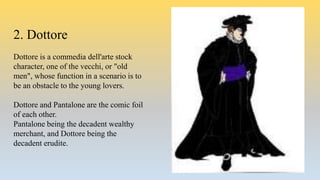
2. Dottore
Dottore is a commedia dell'arte stock
character, one of the vecchi, or "old
men", whose function in a scenario is to
be an obstacle to the young lovers.
Dottore and Pantalone are the comic foil
of each other.
Pantalone being the decadent wealthy
merchant, and Dottore being the
decadent erudite.
3. Harlequin
He is the slave.
One of the oldest versions of Harlequin, (15th
century) is the Trivelino or Trivelin, name
meaning «tatterdemalion».
The suit almost identical to Harlequin with
characteristic triangular patches, which were
replaced with moons, stars, circles and
triangles later.
Other names are: Truffa, Truffaldin or
Truffaldino, as found in works of Gozo and
Goldoni.
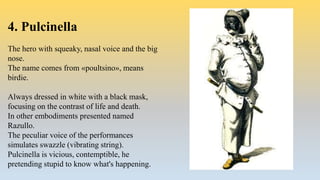
4. Pulcinella
The hero with squeaky, nasal voice and the big
nose.
The name comes from «poultsino», means
birdie.
Always dressed in white with a black mask,
focusing on the contrast of life and death.
In other embodiments presented named
Razullo.
The peculiar voice of the performances
simulates swazzle (vibrating string).
Pulcinella is vicious, contemptible, he
pretending stupid to know what's happening.
In some versions Pulcinella has
a brother, named Cucurucu.
As of Pulcinella, so the
Cucurucu’s name probably
comes from the sound of a bird
voice.
Cucurucu stars in comical
Madrigal: «Chichilichichì
Cucurucù», of Giovanni da
Nola, and «Chi Chi Li chi» of
Andrea Gabrieli.
4. Columbina
Her name comes from Colombina = little dove.
She’s the maid. Often is Harlequin’s mistress.
Cheeky and flirtatious, a soubrette, usually brightly
painted her eyes and holding a tambourine, to repel
"cute" erotic hassles of Pantalone.
Women at that time were not allowed to be the
primary part of the story being played on the stage,
but could be part of the action dance.
So, Columbine (referred to as Smeraldina) is
restless gossip that gives life, cheer and joy with her
scherzo and brio.
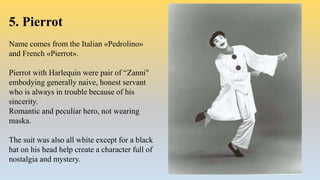
5. Pierrot
Name comes from the Italian «Pedrolino»
and French «Pierrot».
Pierrot with Harlequin were pair of “Zanni"
embodying generally naive, honest servant
who is always in trouble because of his
sincerity.
Romantic and peculiar hero, not wearing
maska.
The suit was also all white except for a black
hat on his head help create a character full of
nostalgia and mystery.
6. Brighella
Like Harlequin, Brighella’s native is from
Bergamo.
The suit is white with green braid, wide
shirt, baggy pants and baggy beret.
It has several Harlequin’s features but
Brighella is more boor, liar and less
clever.
7. Capitano
He most-likely was never a "Captain", but rather
appropriated the name for himself.
The Captain uses bravado and excessive shows of
manliness to hide his true cowardly nature.
He is often a braggart and a swaggerer who can
maintain his claims only by benefit of the fact that
none of the locals know him.
Ηis hometown is Naples.
Wearing black suit, wide-brimmed hat and holding
a huge sword.
Stands forever swaggering and excessive and
windbag but funky and dumb.
His mask has big nose!
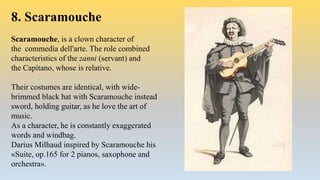
8. Scaramouche
Scaramouche, is a clown character of
the commedia dell'arte. The role combined
characteristics of the zanni (servant) and
the Capitano, whose is relative.
Their costumes are identical, with wide-
brimmed black hat with Scaramouche instead
sword, holding guitar, as he love the art of
music.
As a character, he is constantly exaggerated
words and windbag.
Darius Milhaud inspired by Scaramouche his
«Suite, op.165 for 2 pianos, saxophone and
orchestra».
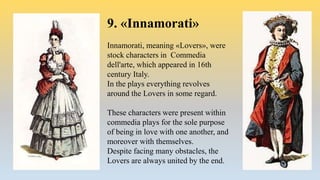
9. «Ιnnamorati»
Innamorati, meaning «Lovers», were
stock characters in Commedia
dell'arte, which appeared in 16th
century Italy.
In the plays everything revolves
around the Lovers in some regard.
These characters were present within
commedia plays for the sole purpose
of being in love with one another, and
moreover with themselves.
Despite facing many obstacles, the
Lovers are always united by the end.

9th SECONDARY SCHOOL of PATRAS: Commedia dell Arte's characters ELPIDA NOUSA

  • 1.
    9th SECONDARY SCHOOL of PATRAS-Greece SchoolYear: 2016-17 «Commedia dell 'arte’s characters»
  • 2.
    One by oneappearing in the land of Italy... They are the characters and masks of Commedia dell'arte that keep notes and brushes ...
  • 3.
    PLACE AND TIME TIME:about 1550 to the late 17th century. CONTRACT OF COMMEDIA: February 25, 1545 in Padua, eight men drafted contract, where they decided play comedies place to place. PLACE: Italy. Before Commedia emerged, various forms of expression such as frottola, villanella, canzonetta and madrigals.
  • 4.
    THE NAME Named «Commediadell'arte», because it was a comedy, played by professional actors. The actors did everything: playing, singing, dancing, or acrobat. There was no text, but the actors improvised. The actors wore masks usually, imitated and cause plenty of laughter.
  • 5.
    CHARACTERS 1. Pantalone Is oneof the most important principal characters found in commedia dell'arte. In one theory, his name derives from Saint Pantaleon, a popular saint in Venice. The other theory of where his name derives is from Venetian merchants who were called Piantaleoni. Pantalone characterized by extraordinary greed, identified with "money" and is described as an old man, hunched, miserable, stingy, but also intelligent, skillful marketer, practical, and womanizing. Wearing tight pants!
  • 6.
    2. Dottore Dottore isa commedia dell'arte stock character, one of the vecchi, or "old men", whose function in a scenario is to be an obstacle to the young lovers. Dottore and Pantalone are the comic foil of each other. Pantalone being the decadent wealthy merchant, and Dottore being the decadent erudite.
  • 7.
    3. Harlequin He isthe slave. One of the oldest versions of Harlequin, (15th century) is the Trivelino or Trivelin, name meaning «tatterdemalion». The suit almost identical to Harlequin with characteristic triangular patches, which were replaced with moons, stars, circles and triangles later. Other names are: Truffa, Truffaldin or Truffaldino, as found in works of Gozo and Goldoni.
  • 8.
    4. Pulcinella The herowith squeaky, nasal voice and the big nose. The name comes from «poultsino», means birdie. Always dressed in white with a black mask, focusing on the contrast of life and death. In other embodiments presented named Razullo. The peculiar voice of the performances simulates swazzle (vibrating string). Pulcinella is vicious, contemptible, he pretending stupid to know what's happening.
  • 9.
    In some versionsPulcinella has a brother, named Cucurucu. As of Pulcinella, so the Cucurucu’s name probably comes from the sound of a bird voice. Cucurucu stars in comical Madrigal: «Chichilichichì Cucurucù», of Giovanni da Nola, and «Chi Chi Li chi» of Andrea Gabrieli.
  • 10.
    4. Columbina Her namecomes from Colombina = little dove. She’s the maid. Often is Harlequin’s mistress. Cheeky and flirtatious, a soubrette, usually brightly painted her eyes and holding a tambourine, to repel "cute" erotic hassles of Pantalone. Women at that time were not allowed to be the primary part of the story being played on the stage, but could be part of the action dance. So, Columbine (referred to as Smeraldina) is restless gossip that gives life, cheer and joy with her scherzo and brio.
  • 11.
    5. Pierrot Name comesfrom the Italian «Pedrolino» and French «Pierrot». Pierrot with Harlequin were pair of “Zanni" embodying generally naive, honest servant who is always in trouble because of his sincerity. Romantic and peculiar hero, not wearing maska. The suit was also all white except for a black hat on his head help create a character full of nostalgia and mystery.
  • 12.
    6. Brighella Like Harlequin,Brighella’s native is from Bergamo. The suit is white with green braid, wide shirt, baggy pants and baggy beret. It has several Harlequin’s features but Brighella is more boor, liar and less clever.
  • 13.
    7. Capitano He most-likelywas never a "Captain", but rather appropriated the name for himself. The Captain uses bravado and excessive shows of manliness to hide his true cowardly nature. He is often a braggart and a swaggerer who can maintain his claims only by benefit of the fact that none of the locals know him. Ηis hometown is Naples. Wearing black suit, wide-brimmed hat and holding a huge sword. Stands forever swaggering and excessive and windbag but funky and dumb. His mask has big nose!
  • 14.
    8. Scaramouche Scaramouche, isa clown character of the commedia dell'arte. The role combined characteristics of the zanni (servant) and the Capitano, whose is relative. Their costumes are identical, with wide- brimmed black hat with Scaramouche instead sword, holding guitar, as he love the art of music. As a character, he is constantly exaggerated words and windbag. Darius Milhaud inspired by Scaramouche his «Suite, op.165 for 2 pianos, saxophone and orchestra».
  • 15.
    9. «Ιnnamorati» Innamorati, meaning«Lovers», were stock characters in Commedia dell'arte, which appeared in 16th century Italy. In the plays everything revolves around the Lovers in some regard. These characters were present within commedia plays for the sole purpose of being in love with one another, and moreover with themselves. Despite facing many obstacles, the Lovers are always united by the end.