Combustion Process
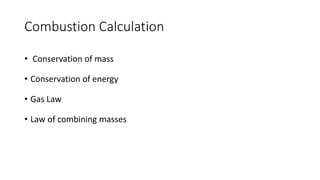
Combustion Calculation
• Conservation of mass
• Conservation of energy
• Gas Law
• Law of combining masses
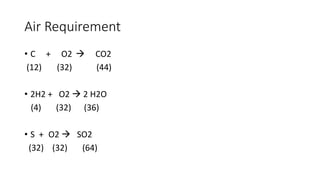
Air Requirement
• C + O2  CO2
(12) (32) (44)
• 2H2 + O2  2 H2O
(4) (32) (36)
• S + O2  SO2
(32) (32) (64)
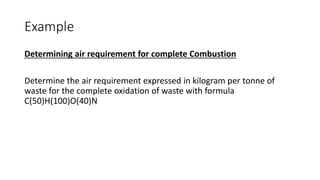
Example
Determining air requirement for complete Combustion
Determine the air requirement expressed in kilogram per tonne of
waste for the complete oxidation of waste with formula
C(50)H(100)O(40)N
Determining combustion heat balance
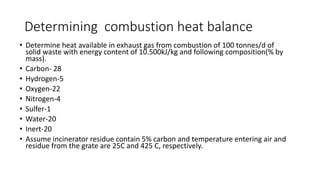
• Determine heat available in exhaust gas from combustion of 100 tonnes/d of
solid waste with energy content of 10.500kJ/kg and following composition(% by
mass).
• Carbon- 28
• Hydrogen-5
• Oxygen-22
• Nitrogen-4
• Sulfer-1
• Water-20
• Inert-20
• Assume incinerator residue contain 5% carbon and temperature entering air and
residue from the grate are 25C and 425 C, respectively.
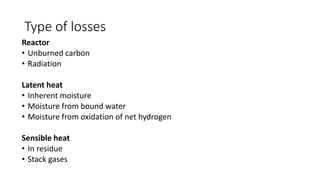
Type of losses
Reactor
• Unburned carbon
• Radiation
Latent heat
• Inherent moisture
• Moisture from bound water
• Moisture from oxidation of net hydrogen
Sensible heat
• In residue
• Stack gases

Combustion process.ppt

  • 1.
  • 2.
    Combustion Calculation • Conservationof mass • Conservation of energy • Gas Law • Law of combining masses
  • 3.
    Air Requirement • C+ O2  CO2 (12) (32) (44) • 2H2 + O2  2 H2O (4) (32) (36) • S + O2  SO2 (32) (32) (64)
  • 4.
    Example Determining air requirementfor complete Combustion Determine the air requirement expressed in kilogram per tonne of waste for the complete oxidation of waste with formula C(50)H(100)O(40)N
  • 5.
    Determining combustion heatbalance • Determine heat available in exhaust gas from combustion of 100 tonnes/d of solid waste with energy content of 10.500kJ/kg and following composition(% by mass). • Carbon- 28 • Hydrogen-5 • Oxygen-22 • Nitrogen-4 • Sulfer-1 • Water-20 • Inert-20 • Assume incinerator residue contain 5% carbon and temperature entering air and residue from the grate are 25C and 425 C, respectively.
  • 6.
    Type of losses Reactor •Unburned carbon • Radiation Latent heat • Inherent moisture • Moisture from bound water • Moisture from oxidation of net hydrogen Sensible heat • In residue • Stack gases