Ethics in Sports
By Danielle Stein
What is sportsmanship?
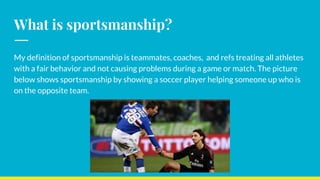
My definition of sportsmanship is teammates, coaches, and refs treating all athletes
with a fair behavior and not causing problems during a game or match. The picture
below shows sportsmanship by showing a soccer player helping someone up who is
on the opposite team.
Ethics--Owners and Coaches
There are many owners and coaches that show sportsmanship and also many that
do not. If they do show sportsmanship, they are teaching their players to act
responsively and to not fight against calls. If they do not show sportsmanship, most
of the time they want to fight for certain calls made and their players get called out
more for acting the incorrect way.
Ethics--Owners
Positive Sportsmanship:
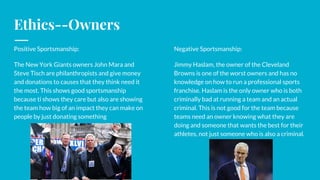
The New York Giants owners John Mara and
Steve Tisch are philanthropists and give money
and donations to causes that they think need it
the most. This shows good sportsmanship
because ti shows they care but also are showing
the team how big of an impact they can make on
people by just donating something
Negative Sportsmanship:
Jimmy Haslam, the owner of the Cleveland
Browns is one of the worst owners and has no
knowledge on how to run a professional sports
franchise. Haslam is the only owner who is both
criminally bad at running a team and an actual
criminal. This is not good for the team because
teams need an owner knowing what they are
doing and someone that wants the best for their
athletes, not just someone who is also a criminal.
Ethics--Coaches
Positive Sportsmanship:
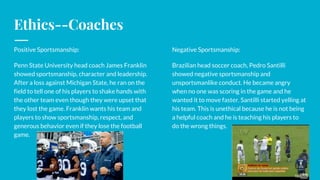
Penn State University head coach James Franklin
showed sportsmanship, character and leadership.
After a loss against Michigan State, he ran on the
field to tell one of his players to shake hands with
the other team even though they were upset that
they lost the game. Franklin wants his team and
players to show sportsmanship, respect, and
generous behavior even if they lose the football
game.
Negative Sportsmanship:
Brazilian head soccer coach, Pedro Santilli
showed negative sportsmanship and
unsportsmanlike conduct. He became angry
when no one was scoring in the game and he
wanted it to move faster. Santilli started yelling at
his team. This is unethical because he is not being
a helpful coach and he is teaching his players to
do the wrong things.
Ethics--Health and Safety
Athletes need to follow all rules to be safe throughout the entire game and/or
match. Additionally, the cannot be sick during the event and need to be following a
healthy diet and strengthening and conditioning to stay healthy.
There have been plenty of games where great athletes are playing even if they are
injured or sick which is not safe. If an athlete is already injured, it is a waste to keep
her/him in because no one wants to make it worse. An easy recover is the best so
they can be back in no time. If an athlete is sick, no coach wants to make their player
more sick or cause someone to sweat. Forcing yourself to sweat is worse when you
should have the person sweat through their sickness by staying in bed and napping.
Ethics--Health and Safety Examples
Two examples of athletes playing when sick or injured are:
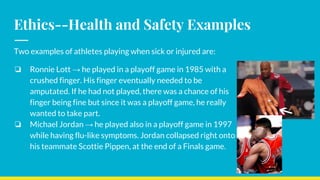
❏ Ronnie Lott → he played in a playoff game in 1985 with a
crushed finger. His finger eventually needed to be
amputated. If he had not played, there was a chance of his
finger being fine but since it was a playoff game, he really
wanted to take part.
❏ Michael Jordan → he played also in a playoff game in 1997
while having flu-like symptoms. Jordan collapsed right onto
his teammate Scottie Pippen, at the end of a Finals game.
Ethics--Athletes and Community
There are many athletes that want to improve communities, help others, and prove
to little youth athletes what is like to be a role model, and there are also other
athletes that hurt other people and think they can get away with it. The athletes that
help within communities are special, they want to make people happy, prove that
they can fight for anything if their mind is set to it. The athletes that hurt others
usually are found and have consequences. Many of been kicked off of teams and
served jail times and others have had to sit out of games--it all depends what they
did.
Ethics--Athletes and Community Examples
Examples of athletes that have both helped communities and
have hurt others:
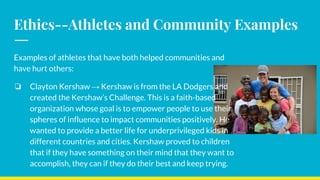
❏ Clayton Kershaw → Kershaw is from the LA Dodgers and
created the Kershaw’s Challenge. This is a faith-based
organization whose goal is to empower people to use their
spheres of influence to impact communities positively. He
wanted to provide a better life for underprivileged kids in
different countries and cities. Kershaw proved to children
that if they have something on their mind that they want to
accomplish, they can if they do their best and keep trying.
...continued Athletics and Community
examples
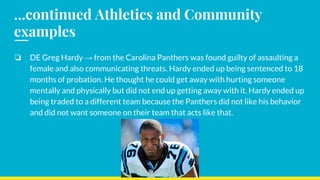
❏ DE Greg Hardy → from the Carolina Panthers was found guilty of assaulting a
female and also communicating threats. Hardy ended up being sentenced to 18
months of probation. He thought he could get away with hurting someone
mentally and physically but did not end up getting away with it. Hardy ended up
being traded to a different team because the Panthers did not like his behavior
and did not want someone on their team that acts like that.
Ethics--Fan Behavior
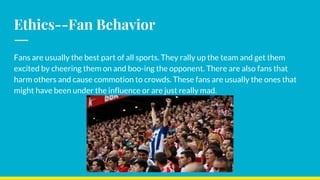
Fans are usually the best part of all sports. They rally up the team and get them
excited by cheering them on and boo-ing the opponent. There are also fans that
harm others and cause commotion to crowds. These fans are usually the ones that
might have been under the influence or are just really mad.
Conclusion
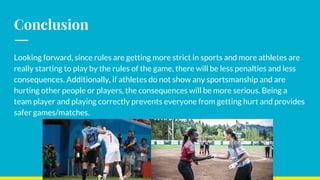
Looking forward, since rules are getting more strict in sports and more athletes are
really starting to play by the rules of the game, there will be less penalties and less
consequences. Additionally, if athletes do not show any sportsmanship and are
hurting other people or players, the consequences will be more serious. Being a
team player and playing correctly prevents everyone from getting hurt and provides
safer games/matches.
Work Cited
Brennan, Eamonn. “Brazilian Soccer Coach Punches Ref In The Face.” Brazilian Soccer Coach Punches Ref In The Face, 2009,
www.nbcmiami.com/news/sports/Brazilian-Soccer-Coach-Punches-Ref-In-The-Face.html.
Chu, Hau. “The Most Memorable Moments of Athletes Playing through Pain.” The Most Memorable Moments of Athletes Playing
through Pain, 2015, www.nydailynews.com/sports/athletes-played-pain-article-1.2391909.
Graziano, Dan. “New York Giants Ownership at a Glance.” New York Giants Ownership at a Glance, 2015,
www.espn.com/blog/new-york-giants/post/_/id/42015/new-york-giants-ownership-at-a-glance.
Insider, Business. “11 Examples Of Athletes Playing Through Extreme Injuries.” 11 Examples Of Athletes Playing Through Extreme
Injuries, 2013,
www.businessinsider.in/11-examples-of-athletes-playing-through-extreme-injuries/Ronnie-Lott-played-in-a-1985-playoff-game-with-a-cr
ushed-finger-that-eventually-had-to-be-amputated/slideshow/21135644.cms.
Jamail, Nathan. “Good Sportsmanship In Business.” Best Selling Author Nathan Jamail, 2019,
nathanjamail.com/good-sportsmanship-in-business/.
Kerr, Stephen. “Three Tips for Instilling Sportsmanship.” Little League, 2019,
www.littleleague.org/university/articles/three-tips-for-instilling-sportsmanship/.
...Continued
Kershawn, Clayton. “About Kershaw's Challenge.” About Kershaw's Challenge, 2018, www.kershawschallenge.com/about.
Press, Associated. “Browns Owner Jimmy Haslam Not Charged, but Looms Large in Pilot Flying J Fraud Trial.” Browns Owner Jimmy
Haslam Not Charged, but Looms Large in Pilot Flying J Fraud Trial, 2017,
www.cleveland.com/metro/2017/12/browns_owner_jimmy_haslam_not.html.
Samuels, Doug. “James Franklin Explains Why Huge Recruiting Weekends Can Be an ‘Organizational Nightmare.’” James Franklin
Explains Why Huge Recruiting Weekends Can Be an “Organizational Nightmare,” 2017,
footballscoop.com/news/james-franklin-explains-huge-recruiting-weekends-organizational-nightmare/.
Sports, Celeb. “Former Cowboys DE Greg Hardy Going To Therapy.” Former Cowboys DE Greg Hardy Going To Therapy,
celebnsports247.com/greg-hardy-going-therapy/.
Vaas, Lisa. “Naked Security SOPHOS.” Naked Security SOPHOS, 2017,
nakedsecurity.sophos.com/2017/04/28/sports-fans-protest-at-plans-to-scan-their-faces-as-they-head-for-the-match/.

8.3 sportsmanship case presentation

  • 1.
    Ethics in Sports ByDanielle Stein
  • 2.
    What is sportsmanship? Mydefinition of sportsmanship is teammates, coaches, and refs treating all athletes with a fair behavior and not causing problems during a game or match. The picture below shows sportsmanship by showing a soccer player helping someone up who is on the opposite team.
  • 3.
    Ethics--Owners and Coaches Thereare many owners and coaches that show sportsmanship and also many that do not. If they do show sportsmanship, they are teaching their players to act responsively and to not fight against calls. If they do not show sportsmanship, most of the time they want to fight for certain calls made and their players get called out more for acting the incorrect way.
  • 4.
    Ethics--Owners Positive Sportsmanship: The NewYork Giants owners John Mara and Steve Tisch are philanthropists and give money and donations to causes that they think need it the most. This shows good sportsmanship because ti shows they care but also are showing the team how big of an impact they can make on people by just donating something Negative Sportsmanship: Jimmy Haslam, the owner of the Cleveland Browns is one of the worst owners and has no knowledge on how to run a professional sports franchise. Haslam is the only owner who is both criminally bad at running a team and an actual criminal. This is not good for the team because teams need an owner knowing what they are doing and someone that wants the best for their athletes, not just someone who is also a criminal.
  • 5.
    Ethics--Coaches Positive Sportsmanship: Penn StateUniversity head coach James Franklin showed sportsmanship, character and leadership. After a loss against Michigan State, he ran on the field to tell one of his players to shake hands with the other team even though they were upset that they lost the game. Franklin wants his team and players to show sportsmanship, respect, and generous behavior even if they lose the football game. Negative Sportsmanship: Brazilian head soccer coach, Pedro Santilli showed negative sportsmanship and unsportsmanlike conduct. He became angry when no one was scoring in the game and he wanted it to move faster. Santilli started yelling at his team. This is unethical because he is not being a helpful coach and he is teaching his players to do the wrong things.
  • 6.
    Ethics--Health and Safety Athletesneed to follow all rules to be safe throughout the entire game and/or match. Additionally, the cannot be sick during the event and need to be following a healthy diet and strengthening and conditioning to stay healthy. There have been plenty of games where great athletes are playing even if they are injured or sick which is not safe. If an athlete is already injured, it is a waste to keep her/him in because no one wants to make it worse. An easy recover is the best so they can be back in no time. If an athlete is sick, no coach wants to make their player more sick or cause someone to sweat. Forcing yourself to sweat is worse when you should have the person sweat through their sickness by staying in bed and napping.
  • 7.
    Ethics--Health and SafetyExamples Two examples of athletes playing when sick or injured are: ❏ Ronnie Lott → he played in a playoff game in 1985 with a crushed finger. His finger eventually needed to be amputated. If he had not played, there was a chance of his finger being fine but since it was a playoff game, he really wanted to take part. ❏ Michael Jordan → he played also in a playoff game in 1997 while having flu-like symptoms. Jordan collapsed right onto his teammate Scottie Pippen, at the end of a Finals game.
  • 8.
    Ethics--Athletes and Community Thereare many athletes that want to improve communities, help others, and prove to little youth athletes what is like to be a role model, and there are also other athletes that hurt other people and think they can get away with it. The athletes that help within communities are special, they want to make people happy, prove that they can fight for anything if their mind is set to it. The athletes that hurt others usually are found and have consequences. Many of been kicked off of teams and served jail times and others have had to sit out of games--it all depends what they did.
  • 9.
    Ethics--Athletes and CommunityExamples Examples of athletes that have both helped communities and have hurt others: ❏ Clayton Kershaw → Kershaw is from the LA Dodgers and created the Kershaw’s Challenge. This is a faith-based organization whose goal is to empower people to use their spheres of influence to impact communities positively. He wanted to provide a better life for underprivileged kids in different countries and cities. Kershaw proved to children that if they have something on their mind that they want to accomplish, they can if they do their best and keep trying.
  • 10.
    ...continued Athletics andCommunity examples ❏ DE Greg Hardy → from the Carolina Panthers was found guilty of assaulting a female and also communicating threats. Hardy ended up being sentenced to 18 months of probation. He thought he could get away with hurting someone mentally and physically but did not end up getting away with it. Hardy ended up being traded to a different team because the Panthers did not like his behavior and did not want someone on their team that acts like that.
  • 11.
    Ethics--Fan Behavior Fans areusually the best part of all sports. They rally up the team and get them excited by cheering them on and boo-ing the opponent. There are also fans that harm others and cause commotion to crowds. These fans are usually the ones that might have been under the influence or are just really mad.
  • 12.
    Conclusion Looking forward, sincerules are getting more strict in sports and more athletes are really starting to play by the rules of the game, there will be less penalties and less consequences. Additionally, if athletes do not show any sportsmanship and are hurting other people or players, the consequences will be more serious. Being a team player and playing correctly prevents everyone from getting hurt and provides safer games/matches.
  • 13.
    Work Cited Brennan, Eamonn.“Brazilian Soccer Coach Punches Ref In The Face.” Brazilian Soccer Coach Punches Ref In The Face, 2009, www.nbcmiami.com/news/sports/Brazilian-Soccer-Coach-Punches-Ref-In-The-Face.html. Chu, Hau. “The Most Memorable Moments of Athletes Playing through Pain.” The Most Memorable Moments of Athletes Playing through Pain, 2015, www.nydailynews.com/sports/athletes-played-pain-article-1.2391909. Graziano, Dan. “New York Giants Ownership at a Glance.” New York Giants Ownership at a Glance, 2015, www.espn.com/blog/new-york-giants/post/_/id/42015/new-york-giants-ownership-at-a-glance. Insider, Business. “11 Examples Of Athletes Playing Through Extreme Injuries.” 11 Examples Of Athletes Playing Through Extreme Injuries, 2013, www.businessinsider.in/11-examples-of-athletes-playing-through-extreme-injuries/Ronnie-Lott-played-in-a-1985-playoff-game-with-a-cr ushed-finger-that-eventually-had-to-be-amputated/slideshow/21135644.cms. Jamail, Nathan. “Good Sportsmanship In Business.” Best Selling Author Nathan Jamail, 2019, nathanjamail.com/good-sportsmanship-in-business/. Kerr, Stephen. “Three Tips for Instilling Sportsmanship.” Little League, 2019, www.littleleague.org/university/articles/three-tips-for-instilling-sportsmanship/.
  • 14.
    ...Continued Kershawn, Clayton. “AboutKershaw's Challenge.” About Kershaw's Challenge, 2018, www.kershawschallenge.com/about. Press, Associated. “Browns Owner Jimmy Haslam Not Charged, but Looms Large in Pilot Flying J Fraud Trial.” Browns Owner Jimmy Haslam Not Charged, but Looms Large in Pilot Flying J Fraud Trial, 2017, www.cleveland.com/metro/2017/12/browns_owner_jimmy_haslam_not.html. Samuels, Doug. “James Franklin Explains Why Huge Recruiting Weekends Can Be an ‘Organizational Nightmare.’” James Franklin Explains Why Huge Recruiting Weekends Can Be an “Organizational Nightmare,” 2017, footballscoop.com/news/james-franklin-explains-huge-recruiting-weekends-organizational-nightmare/. Sports, Celeb. “Former Cowboys DE Greg Hardy Going To Therapy.” Former Cowboys DE Greg Hardy Going To Therapy, celebnsports247.com/greg-hardy-going-therapy/. Vaas, Lisa. “Naked Security SOPHOS.” Naked Security SOPHOS, 2017, nakedsecurity.sophos.com/2017/04/28/sports-fans-protest-at-plans-to-scan-their-faces-as-they-head-for-the-match/.