ITSM 7 – Why Customers are Excited Again About RemedyGlobal Capabilities and new featuresDavid Savino / CTO Column Technologies
CONTENTITSM History1Solution Evolution2Winning Capabilities3Interoperability45Questions and Answers
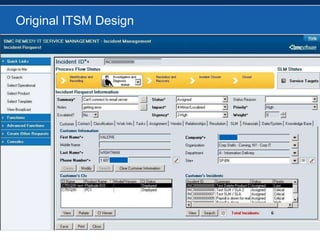
ITSM Design History		BMC overhauled it’s BMC Remedy ITSM offering with version 7.0Released in June 2006Heavy focus on ITILScorecard approach to features and functionsDesigned for a level 5 Service DeskMany users found the interface cumbersome
Original ITSM Design
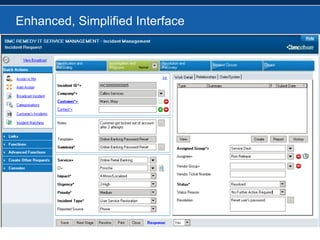
Enhanced, Simplified Interface
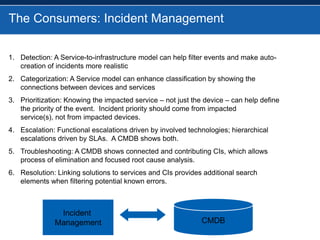
The Consumers: Incident Management Detection: A Service-to-infrastructure model can help filter events and make auto-creation of incidents more realisticCategorization: A Service model can enhance classification by showing the connections between devices and servicesPrioritization: Knowing the impacted service – not just the device – can help define the priority of the event.  Incident priority should come from impacted service(s), not from impacted devices.Escalation: Functional escalations driven by involved technologies; hierarchical escalations driven by SLAs.  A CMDB shows both.Troubleshooting: A CMDB shows connected and contributing CIs, which allows process of elimination and focused root cause analysis.Resolution: Linking solutions to services and CIs provides additional search elements when filtering potential known errors.CMDBIncident Management
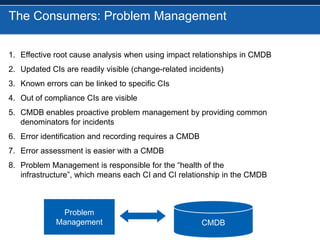
The Consumers: Problem Management Effective root cause analysis when using impact relationships in CMDBUpdated CIs are readily visible (change-related incidents)Known errors can be linked to specific CIsOut of compliance CIs are visibleCMDB enables proactive problem management by providing common denominators for incidentsError identification and recording requires a CMDBError assessment is easier with a CMDBProblem Management is responsible for the “health of the infrastructure”, which means each CI and CI relationship in the CMDBProblemManagementCMDB
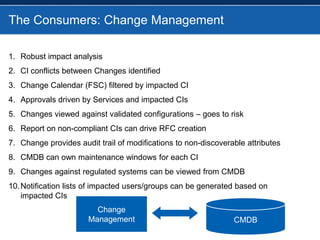
The Consumers: Change ManagementRobust impact analysisCI conflicts between Changes identifiedChange Calendar (FSC) filtered by impacted CIApprovals driven by Services and impacted CIsChanges viewed against validated configurations – goes to riskReport on non-compliant CIs can drive RFC creationChange provides audit trail of modifications to non-discoverable attributesCMDB can own maintenance windows for each CIChanges against regulated systems can be viewed from CMDBNotification lists of impacted users/groups can be generated based on impacted CIsChangeManagementCMDB
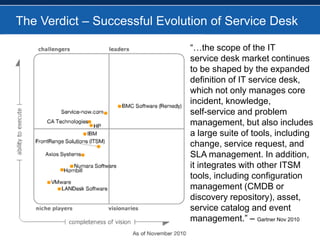
The Verdict – Successful Evolution of Service Desk“…the scope of the IT service desk market continues to be shaped by the expanded definition of IT service desk, which not only manages core incident, knowledge, self-service and problem management, but also includes a large suite of tools, including change, service request, and SLA management. In addition, it integrates with other ITSM tools, including configuration management (CMDB or discovery repository), asset, service catalog and event management.” – Gartner Nov 2010
Winning Capabilities of an Enterprise ITSM Suite Multi-language support, including double-byte characters.  Ability to support multiple code pages on a single server.  Challenges are:
 single language needed to escalate regional tickets
 interface labels are in local language, but data is not
 this is not a translation capability
 Localization features, including time zone offsets for SLA targets.
 Light, web enabled client
 SLA based on service, impacted technology, customer or IT group
 Cluster aware, highly available, fail over capable… on a model that does not charge for additional servers (blue pricing)
 Impact model (which can be visually inspected), fed by a discovery solution mapped to the CMDBMulti-tenancy and the MSP ModelFor Service Providers and Outsourcers, multi-tenancy is a profit accelerator that allows several clients on a single instance, allowing the reuse of floating and role based licenses.The security model is fairly clean.

Column itsm7 improvements_savino

  • 1.
    ITSM 7 –Why Customers are Excited Again About RemedyGlobal Capabilities and new featuresDavid Savino / CTO Column Technologies
  • 2.
    CONTENTITSM History1Solution Evolution2WinningCapabilities3Interoperability45Questions and Answers
  • 3.
    ITSM Design History BMCoverhauled it’s BMC Remedy ITSM offering with version 7.0Released in June 2006Heavy focus on ITILScorecard approach to features and functionsDesigned for a level 5 Service DeskMany users found the interface cumbersome
  • 4.
  • 5.
  • 6.
    The Consumers: IncidentManagement Detection: A Service-to-infrastructure model can help filter events and make auto-creation of incidents more realisticCategorization: A Service model can enhance classification by showing the connections between devices and servicesPrioritization: Knowing the impacted service – not just the device – can help define the priority of the event. Incident priority should come from impacted service(s), not from impacted devices.Escalation: Functional escalations driven by involved technologies; hierarchical escalations driven by SLAs. A CMDB shows both.Troubleshooting: A CMDB shows connected and contributing CIs, which allows process of elimination and focused root cause analysis.Resolution: Linking solutions to services and CIs provides additional search elements when filtering potential known errors.CMDBIncident Management
  • 7.
    The Consumers: ProblemManagement Effective root cause analysis when using impact relationships in CMDBUpdated CIs are readily visible (change-related incidents)Known errors can be linked to specific CIsOut of compliance CIs are visibleCMDB enables proactive problem management by providing common denominators for incidentsError identification and recording requires a CMDBError assessment is easier with a CMDBProblem Management is responsible for the “health of the infrastructure”, which means each CI and CI relationship in the CMDBProblemManagementCMDB
  • 8.
    The Consumers: ChangeManagementRobust impact analysisCI conflicts between Changes identifiedChange Calendar (FSC) filtered by impacted CIApprovals driven by Services and impacted CIsChanges viewed against validated configurations – goes to riskReport on non-compliant CIs can drive RFC creationChange provides audit trail of modifications to non-discoverable attributesCMDB can own maintenance windows for each CIChanges against regulated systems can be viewed from CMDBNotification lists of impacted users/groups can be generated based on impacted CIsChangeManagementCMDB
  • 9.
    The Verdict –Successful Evolution of Service Desk“…the scope of the IT service desk market continues to be shaped by the expanded definition of IT service desk, which not only manages core incident, knowledge, self-service and problem management, but also includes a large suite of tools, including change, service request, and SLA management. In addition, it integrates with other ITSM tools, including configuration management (CMDB or discovery repository), asset, service catalog and event management.” – Gartner Nov 2010
  • 10.
    Winning Capabilities ofan Enterprise ITSM Suite Multi-language support, including double-byte characters. Ability to support multiple code pages on a single server. Challenges are:
  • 11.
    single languageneeded to escalate regional tickets
  • 12.
    interface labelsare in local language, but data is not
  • 13.
    this isnot a translation capability
  • 14.
    Localization features,including time zone offsets for SLA targets.
  • 15.
    Light, webenabled client
  • 16.
    SLA basedon service, impacted technology, customer or IT group
  • 17.
    Cluster aware,highly available, fail over capable… on a model that does not charge for additional servers (blue pricing)
  • 18.
    Impact model(which can be visually inspected), fed by a discovery solution mapped to the CMDBMulti-tenancy and the MSP ModelFor Service Providers and Outsourcers, multi-tenancy is a profit accelerator that allows several clients on a single instance, allowing the reuse of floating and role based licenses.The security model is fairly clean.