Colorblindness and Color Vision Deficiency 
 
Colorblindness or color vision deficiency alters our ability to perceive certain colors.  There are many 
different types of colorblindness; some are more common in the population than others.   It is estimated 
that 10 – 12 % of the population has some type of color blindness. What is colorblindness and how does 
colorblindness affect ones daily life?  Many people confuse colorblindness with not being able to see any 
colors at all.  However, there are many different types of colorblindness, ranging from seeing in black and 
white to not seeing one particular hue in the spectrum.  
 
Lesson Objectives: 
   1. Learn the different types of colorblindness/ color vision deficiency and how color blindness affects 
      vision 
   2. Learn the genetic basis for colorblindness/ color vision deficiency (see Biology Frameworks 3.5) 
   3. Use Punnett square to determine probabilities for a genotypes and phenotypes (see Biology 
      Frameworks 3.6) 
 
Pre­activity Questions: 
 
1.  How important is seeing color to you in your daily life?  What things would be difficult to see without 
color? 


2.  Are you or do you know someone who is “colorblind”? 


3.  If so, what are your experiences seeing colors or have you ever asked a colorblind/color vision 
deficient person what difficulties that they have with colors? 
(Are there particular colors that you have difficulty with?  What do you/they “see” instead of that color?) 


4.  What do you think are some of the difficulties that people with colorblindness face? 


5.  List the common types of colorblindness, if any, that you are familiar with?  Do you know any famous 
people who have colorblindness? 


Discussion I:  A visit to the Optometrist: Testing for colorblindness 
 
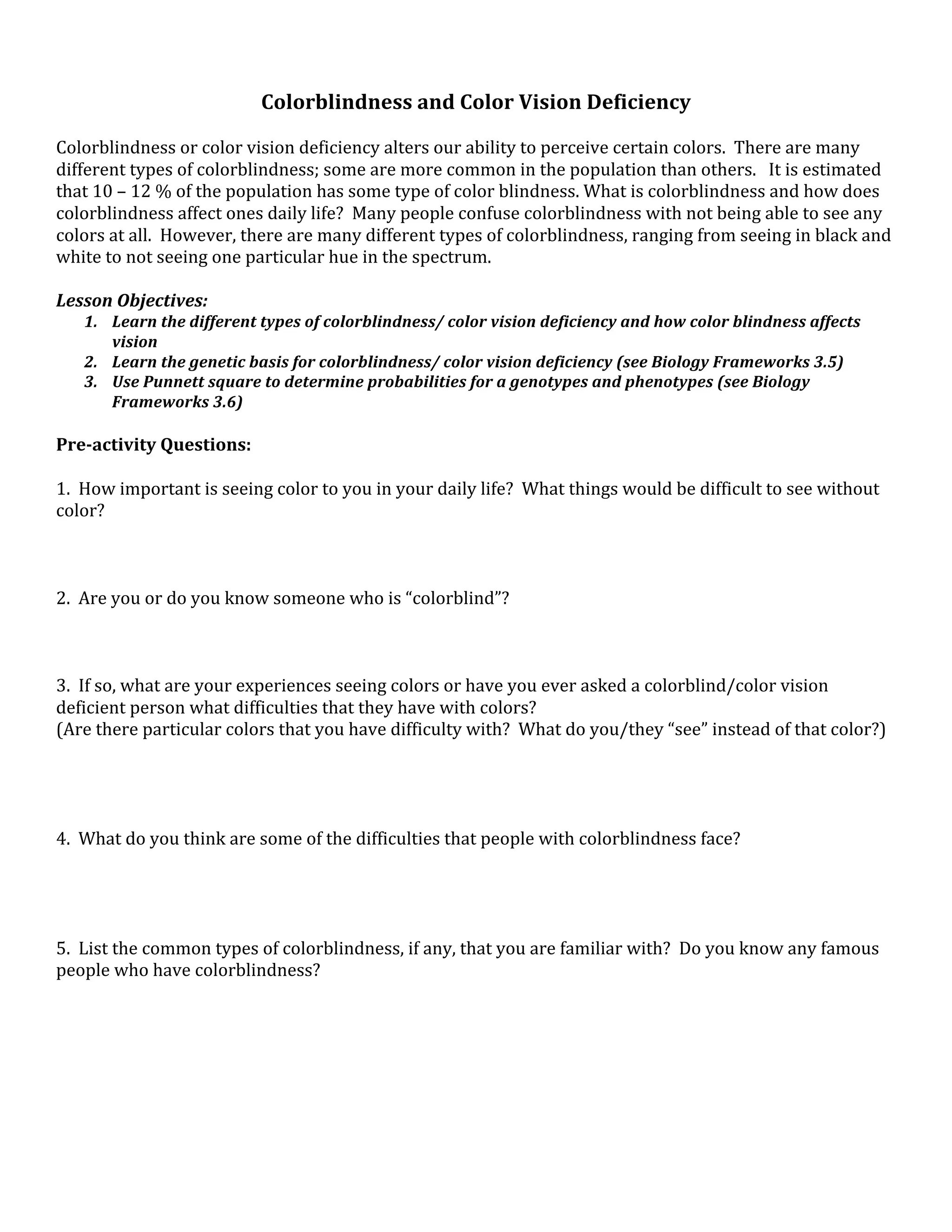
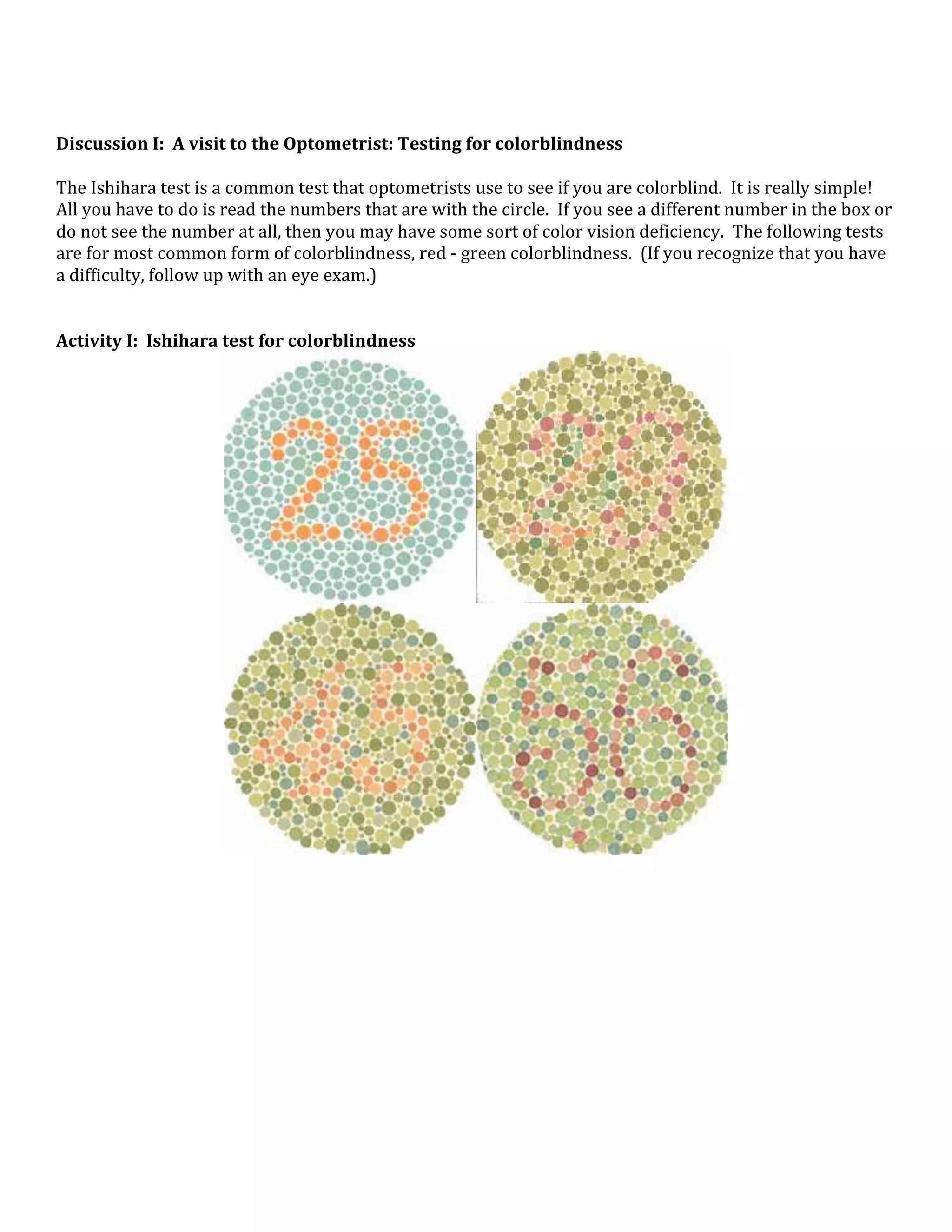
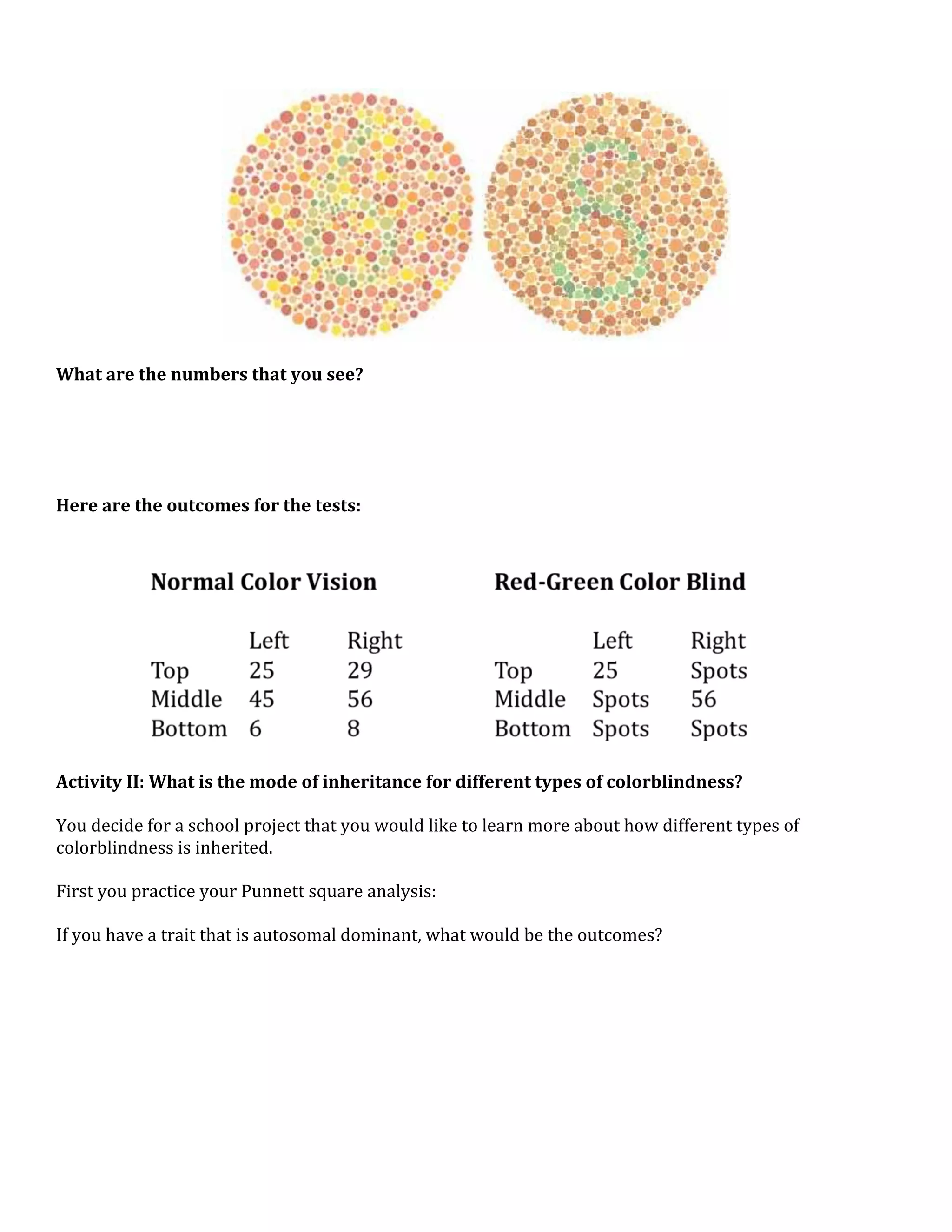
The Ishihara test is a common test that optometrists use to see if you are colorblind.  It is really simple!  
All you have to do is read the numbers that are with the circle.  If you see a different number in the box or 
do not see the number at all, then you may have some sort of color vision deficiency.  The following tests 
are for most common form of colorblindness, red ‐ green colorblindness.  (If you recognize that you have 
a difficulty, follow up with an eye exam.)   
 
 
Activity I:  Ishihara test for colorblindness 


What are the numbers that you see?   


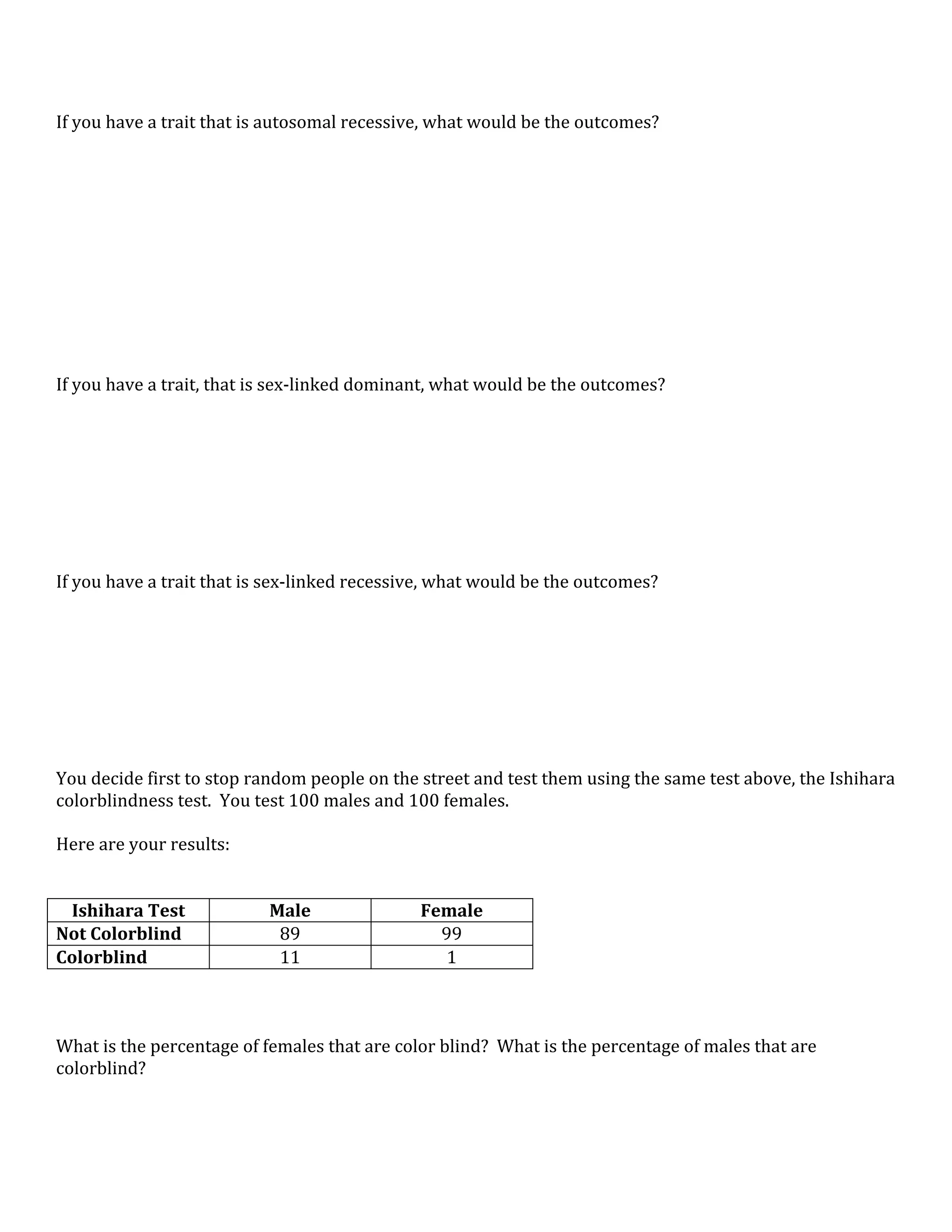
Here are the outcomes for the tests: 


Activity II: What is the mode of inheritance for different types of colorblindness? 
 
You decide for a school project that you would like to learn more about how different types of 
colorblindness is inherited.  
 
First you practice your Punnett square analysis: 
 
If you have a trait that is autosomal dominant, what would be the outcomes? 


If you have a trait that is autosomal recessive, what would be the outcomes? 


If you have a trait, that is sex‐linked dominant, what would be the outcomes? 


If you have a trait that is sex‐linked recessive, what would be the outcomes? 


You decide first to stop random people on the street and test them using the same test above, the Ishihara 
colorblindness test.  You test 100 males and 100 females.   
 
Here are your results:   
 
 
   Ishihara Test              Male                Female 
Not Colorblind                  89                  99 
Colorblind                      11                  1 


What is the percentage of females that are color blind?  What is the percentage of males that are 
colorblind? 
 
 
Based on your observations, can you predict the mode of inheritance of colorblindness?   


You decide that you need more information so you visit a geneticist, who is analyzing the family 
tree of parents who want to know if their child is at risk for colorblindness.   


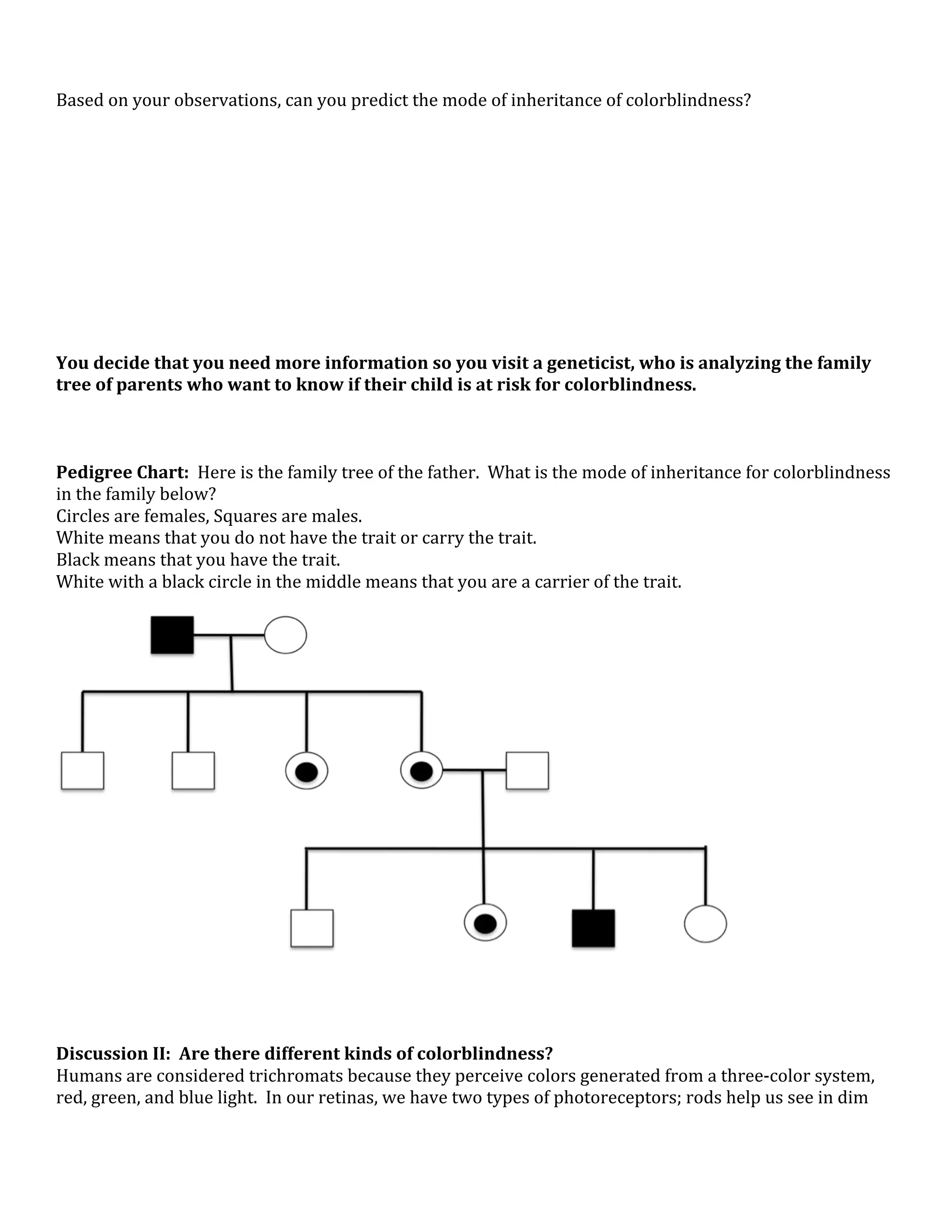
Pedigree Chart:  Here is the family tree of the father.  What is the mode of inheritance for colorblindness 
in the family below? 
Circles are females, Squares are males. 
White means that you do not have the trait or carry the trait. 
Black means that you have the trait. 
White with a black circle in the middle means that you are a carrier of the trait. 


Discussion II:  Are there different kinds of colorblindness?  
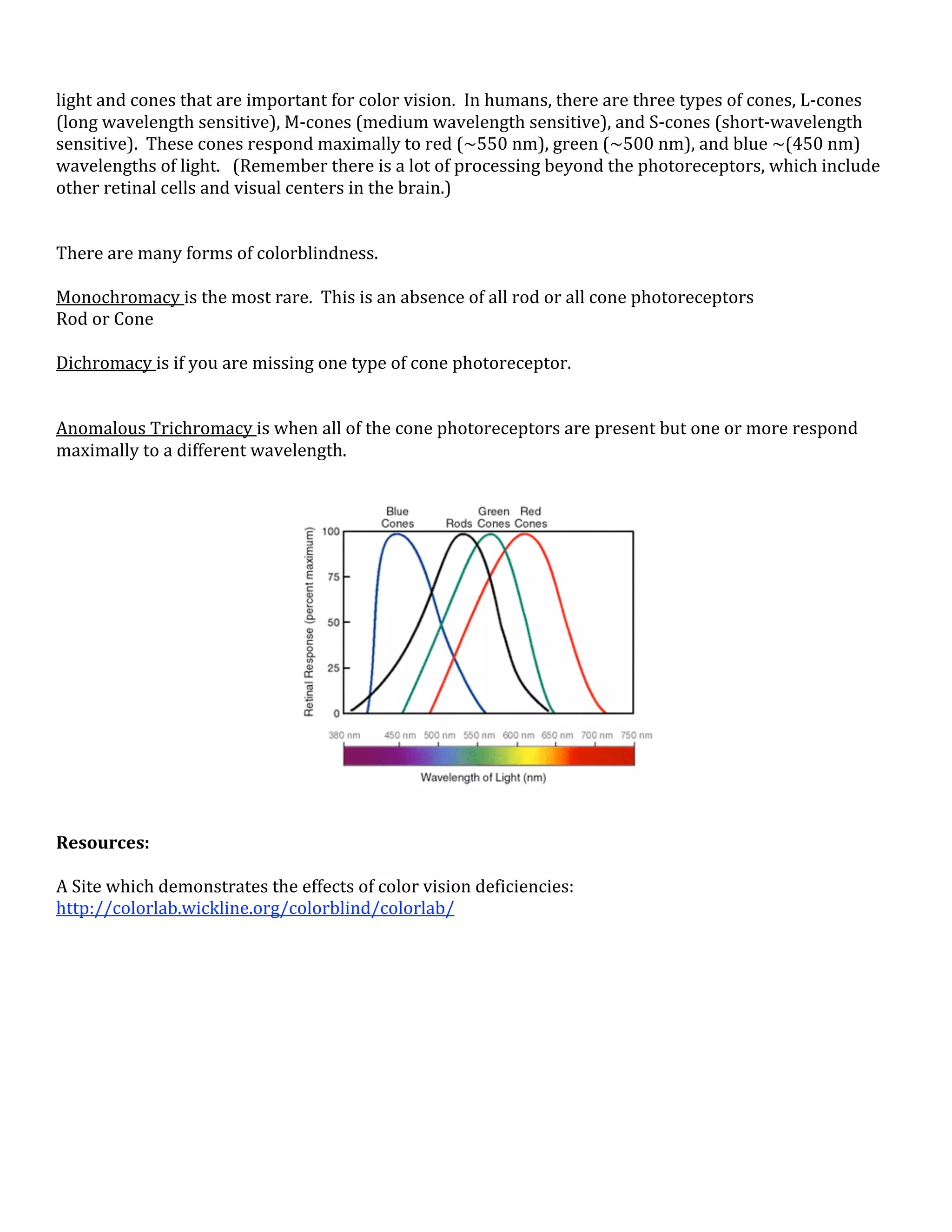
Humans are considered trichromats because they perceive colors generated from a three‐color system, 
red, green, and blue light.  In our retinas, we have two types of photoreceptors; rods help us see in dim 
light and cones that are important for color vision.  In humans, there are three types of cones, L‐cones 
(long wavelength sensitive), M‐cones (medium wavelength sensitive), and S‐cones (short‐wavelength 
sensitive).  These cones respond maximally to red (~550 nm), green (~500 nm), and blue ~(450 nm) 
wavelengths of light.   (Remember there is a lot of processing beyond the photoreceptors, which include 
other retinal cells and visual centers in the brain.)  
 
 
There are many forms of colorblindness. 
 
Monochromacy is the most rare.  This is an absence of all rod or all cone photoreceptors 
Rod or Cone 
 
Dichromacy is if you are missing one type of cone photoreceptor. 
 
 
Anomalous Trichromacy is when all of the cone photoreceptors are present but one or more respond 
maximally to a different wavelength. 


Resources: 
 
A Site which demonstrates the effects of color vision deficiencies: 
http://colorlab.wickline.org/colorblind/colorlab/ 


Color blindness activity