Colonial Period In American Literature
Colonial Period 1607-1765
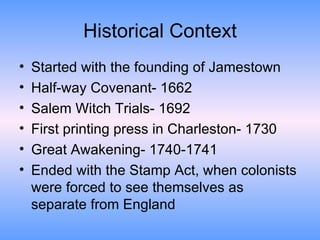
Historical Context Started with the founding of Jamestown Half-way Covenant- 1662 Salem Witch Trials- 1692 First printing press in Charleston- 1730 Great Awakening- 1740-1741 Ended with the Stamp Act, when colonists were forced to see themselves as separate from England
Major Authors and Works Edward Taylor- religious poetry Jonathan Edwards- religious and philosophical treatises ( Sinners in the Hands of an Angry God) Benjamin Franklin-  Poor Richard’s Almanac Anne Bradstreet-  The Tenth Muse, Lately Sprung Up in America Bay Psalm Book (first book printed in America)
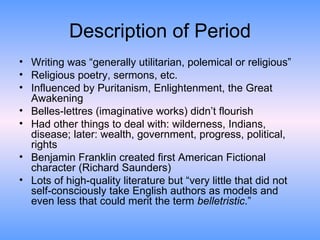
Description of Period Writing was “generally utilitarian, polemical or religious” Religious poetry, sermons, etc. Influenced by Puritanism, Enlightenment, the Great Awakening Belles-lettres (imaginative works) didn’t flourish Had other things to deal with: wilderness, Indians, disease; later: wealth, government, progress, political, rights Benjamin Franklin created first American Fictional character (Richard Saunders) Lots of high-quality literature but “very little that did not self-consciously take English authors as models and even less that could merit the term  belletristic .”
Major Groups, Schools, and Movements A lack of creative writing stymied the development of groups, schools, and movements Great Awakening ministers wrote sermons William Byrd wrote cavalier descriptions about life in Virginia and North Carolina “Newspapers and almanacs flourished”
Literary Themes and Terms Literature tended to follow religious and philosophical themes Enlightenment Puritans Almanacs Cavalier- light-hearted, graceful, melodious, influenced by Classical Latin, occasionally licentious, cynical, epigrammatic, witty Very few belles-lettres- imaginative works
Overview Colonial Period 1607-1765 Taylor, Edwards, Franklin, Bradstreet Sinners ,  Poor Richard ,  Tenth Muse ,  Bay Psalter Newspapers, Almanacs, Enlightenment, Great Awakening Religion, Philosophy PURITANS, ENLIGHTENMENT, ALMANACS, BELLES-LETTRES

Colonial period

  • 1.
    Colonial Period InAmerican Literature
  • 2.
  • 3.
    Historical Context Startedwith the founding of Jamestown Half-way Covenant- 1662 Salem Witch Trials- 1692 First printing press in Charleston- 1730 Great Awakening- 1740-1741 Ended with the Stamp Act, when colonists were forced to see themselves as separate from England
  • 4.
    Major Authors andWorks Edward Taylor- religious poetry Jonathan Edwards- religious and philosophical treatises ( Sinners in the Hands of an Angry God) Benjamin Franklin- Poor Richard’s Almanac Anne Bradstreet- The Tenth Muse, Lately Sprung Up in America Bay Psalm Book (first book printed in America)
  • 5.
    Description of PeriodWriting was “generally utilitarian, polemical or religious” Religious poetry, sermons, etc. Influenced by Puritanism, Enlightenment, the Great Awakening Belles-lettres (imaginative works) didn’t flourish Had other things to deal with: wilderness, Indians, disease; later: wealth, government, progress, political, rights Benjamin Franklin created first American Fictional character (Richard Saunders) Lots of high-quality literature but “very little that did not self-consciously take English authors as models and even less that could merit the term belletristic .”
  • 6.
    Major Groups, Schools,and Movements A lack of creative writing stymied the development of groups, schools, and movements Great Awakening ministers wrote sermons William Byrd wrote cavalier descriptions about life in Virginia and North Carolina “Newspapers and almanacs flourished”
  • 7.
    Literary Themes andTerms Literature tended to follow religious and philosophical themes Enlightenment Puritans Almanacs Cavalier- light-hearted, graceful, melodious, influenced by Classical Latin, occasionally licentious, cynical, epigrammatic, witty Very few belles-lettres- imaginative works
  • 8.
    Overview Colonial Period1607-1765 Taylor, Edwards, Franklin, Bradstreet Sinners , Poor Richard , Tenth Muse , Bay Psalter Newspapers, Almanacs, Enlightenment, Great Awakening Religion, Philosophy PURITANS, ENLIGHTENMENT, ALMANACS, BELLES-LETTRES