Life After High School
Your Plan, Your future!
You ALL are Capable!

How do you make
YOUR
Dreams a Reality?
You ALL are Capable!

You Need More Than
YOUR
HS Diploma!!
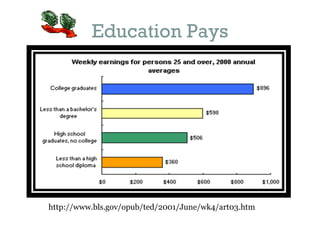
Education Pays

http://www.bls.gov/opub/ted/2001/June/wk4/art03.htm
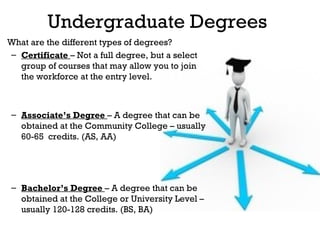
Undergraduate Degrees
What are the different types of degrees?
– Certificate – Not a full degree, but a select
group of courses that may allow you to join
the workforce at the entry level.

– Associate’s Degree – A degree that can be
obtained at the Community College – usually
60-65 credits. (AS, AA)

– Bachelor’s Degree – A degree that can be
obtained at the College or University Level –
usually 120-128 credits. (BS, BA)
Graduate Degrees
What are the different types of graduate degrees?
– Master’s Degree – An additional degree obtained after a
Bachelor’s Degree. Usually an additional two years. (MSN, MBA)
– Doctorate – A professional degree obtained after three -four
additional years of college. (MD, DDS, DVM, PhD)
**Remember, this is stage 2 of Life
After High School! You must
complete your
Undergraduate
degree FIRST! **
Military
The military can train you for a job/career and can offer
tuition assistance.
Things to consider:
• Joining the military is a big decision- most challenging
and rewarding
• Requires discussion among family, friends, and trusted
advisors.
• What are your personal goals and interests?
• Are you willing to make the commitment?
• Have you been fully informed?
• How will joining the military help you in the future?
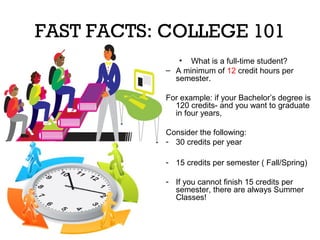
FAST FACTS: COLLEGE 101
• What is a full-time student?
– A minimum of 12 credit hours per
semester.
For example: if your Bachelor’s degree is
120 credits- and you want to graduate
in four years,
Consider the following:
- 30 credits per year
- 15 credits per semester ( Fall/Spring)
- If you cannot finish 15 credits per
semester, there are always Summer
Classes!
FAST FACTS: COLLEGE
101
Community College: A GREAT START!
Chance to improve your GPA
Save time, money
Must HAVE a plan if you want a bachelor’s degree!

College
An institution offering a Bachelor Degree and
possibly a few graduate degrees.

University
An educational institution offering Bachelor, Master
and/or Doctorate Degrees.
College 101: Major vs. Minor?
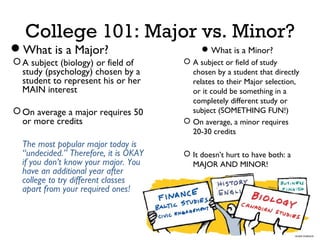
What is a Major?
 A subject (biology) or field of
study (psychology) chosen by a
student to represent his or her
MAIN interest
 On average a major requires 50
or more credits
The most popular major today is
“undecided.” Therefore, it is OKAY
if you don’t know your major. You
have an additional year after
college to try different classes
apart from your required ones!

 What is a Minor?
 A subject or field of study
chosen by a student that directly
relates to their Major selection,
or it could be something in a
completely different study or
subject (SOMETHING FUN!)
 On average, a minor requires
20-30 credits
 It doesn’t hurt to have both: a
MAJOR AND MINOR!
How To Be Successful in College

• The Secret…Shhh!
– Good Time Management
• For every hour in class, expect 2
hours of homework
– Full time student (at least 12 credit
hours) should expect about 20-24 hours
of homework weekly

•
•
•
•
•

Time for studying!
Time for fun- Social Life is a must!
ASK FOR HELP if you need it
Get involved in clubs, organizations!
It all counts to put on your resume!
When Do I Decide?
• May 1st is the
NATIONAL deadline
to make a nonrefundable deposit to
hold your spot – but
don’t wait that late.
– Once you send in a
deposit you can select
your housing and
arrange for
orientation.
Paying for College
• FAFSA = Free Application for Federal
Student Aid
– Complete the form online in JanuaryFebruary of your senior year. And every
year before March 1st while you are in
college.
– www.fafsa.ed.gov
Paying for College
• SCHOLARSHIPS = your time and effort
There is ATLEAST
one scholarship out
there for
EVERYONE!
-Speak to your
guidance counselors,
college counselors,
-Come to the
SASF/AIM! for more
information on how to
apply for
scholarships!

Sasf.Aim Life After High School

  • 1.
    Life After HighSchool Your Plan, Your future!
  • 2.
    You ALL areCapable! How do you make YOUR Dreams a Reality?
  • 3.
    You ALL areCapable! You Need More Than YOUR HS Diploma!!
  • 4.
  • 5.
    Undergraduate Degrees What arethe different types of degrees? – Certificate – Not a full degree, but a select group of courses that may allow you to join the workforce at the entry level. – Associate’s Degree – A degree that can be obtained at the Community College – usually 60-65 credits. (AS, AA) – Bachelor’s Degree – A degree that can be obtained at the College or University Level – usually 120-128 credits. (BS, BA)
  • 6.
    Graduate Degrees What arethe different types of graduate degrees? – Master’s Degree – An additional degree obtained after a Bachelor’s Degree. Usually an additional two years. (MSN, MBA) – Doctorate – A professional degree obtained after three -four additional years of college. (MD, DDS, DVM, PhD) **Remember, this is stage 2 of Life After High School! You must complete your Undergraduate degree FIRST! **
  • 7.
    Military The military cantrain you for a job/career and can offer tuition assistance. Things to consider: • Joining the military is a big decision- most challenging and rewarding • Requires discussion among family, friends, and trusted advisors. • What are your personal goals and interests? • Are you willing to make the commitment? • Have you been fully informed? • How will joining the military help you in the future?
  • 8.
    FAST FACTS: COLLEGE101 • What is a full-time student? – A minimum of 12 credit hours per semester. For example: if your Bachelor’s degree is 120 credits- and you want to graduate in four years, Consider the following: - 30 credits per year - 15 credits per semester ( Fall/Spring) - If you cannot finish 15 credits per semester, there are always Summer Classes!
  • 9.
    FAST FACTS: COLLEGE 101 CommunityCollege: A GREAT START! Chance to improve your GPA Save time, money Must HAVE a plan if you want a bachelor’s degree! College An institution offering a Bachelor Degree and possibly a few graduate degrees. University An educational institution offering Bachelor, Master and/or Doctorate Degrees.
  • 10.
    College 101: Majorvs. Minor? What is a Major?  A subject (biology) or field of study (psychology) chosen by a student to represent his or her MAIN interest  On average a major requires 50 or more credits The most popular major today is “undecided.” Therefore, it is OKAY if you don’t know your major. You have an additional year after college to try different classes apart from your required ones!  What is a Minor?  A subject or field of study chosen by a student that directly relates to their Major selection, or it could be something in a completely different study or subject (SOMETHING FUN!)  On average, a minor requires 20-30 credits  It doesn’t hurt to have both: a MAJOR AND MINOR!
  • 11.
    How To BeSuccessful in College • The Secret…Shhh! – Good Time Management • For every hour in class, expect 2 hours of homework – Full time student (at least 12 credit hours) should expect about 20-24 hours of homework weekly • • • • • Time for studying! Time for fun- Social Life is a must! ASK FOR HELP if you need it Get involved in clubs, organizations! It all counts to put on your resume!
  • 12.
    When Do IDecide? • May 1st is the NATIONAL deadline to make a nonrefundable deposit to hold your spot – but don’t wait that late. – Once you send in a deposit you can select your housing and arrange for orientation.
  • 13.
    Paying for College •FAFSA = Free Application for Federal Student Aid – Complete the form online in JanuaryFebruary of your senior year. And every year before March 1st while you are in college. – www.fafsa.ed.gov
  • 14.
    Paying for College •SCHOLARSHIPS = your time and effort There is ATLEAST one scholarship out there for EVERYONE! -Speak to your guidance counselors, college counselors, -Come to the SASF/AIM! for more information on how to apply for scholarships!