THE
GUIDE
A College Admissions and Financial Aid Guide For All Students
Updated: 01/01/2022
Produced by Fair Opportunity Project, an organization of top college students, advisors,
admissions officers, and high school counselors driven to increase access to college.
2 MIT License Copyright © 2022 Fair Opportunity Project
TABLE OF CONTENTS
SECTION 1: THE COLLEGE APPLICATION 7
Chapter 1: College Application Timeline 7
Chapter 2: Starting Your College Search 9
Chapter 3: Standardized Tests 11
Chapter 4: Creating a College List 13
Chapter 5: Organizing the Application 14
Chapter 6: Letters of Recommendation 16
Chapter 7: The Application 17
Chapter 8: Writing Your Essays 21
Chapter 9: Your Interview 26
Chapter 10: Update Letters 28
Chapter 11: Post Submission 31
SECTION 2: AFFORDING COLLEGE 33
Chapter 12: Financial Aid 33
Chapter 13: Scholarships 35
SECTION 3: BEFORE THE COLLEGE APPLICATION 37
Chapter 14: Timeline Before College Applications 37
Chapter 15: Choosing High School Courses 39
Chapter 16: Taking Initiative and Starting Projects 41
Chapter 17: Summer Experiences 45
SECTION 4: ESSAYS THAT WORKED 46
Chapter 18: Experience Essays 46
Chapter 19: Reflection Essays 48
Chapter 20: Strict Prompt Essays 55
Chapter 21: Short Responses 57
SECTION 5: FEEDBACK AND ADDITIONAL TOOLS 59
SUPPLEMENT: CHANGES DUE TO COVID-19 60
3 MIT License Copyright © 2022 Fair Opportunity Project
Mentorship Program
The idea of Fair Opportunity Project is simple: to level the playing field of college admissions in
America. Our goal is to provide free college advising—of the highest quality—to every high school
student in America. 
Working with college students and college advising experts across the country,
we’re excited to offer virtual one-to-one mentoring for students in the US and abroad. Sign up to
find out more or find a mentor from your hometown today!
Mentorship (bit.ly/MentorshipPage)
FairOpportunityX
Our virtual course launched in April 2020 in partnership with Harvard University’s LabXchange. The
goal of this cluster is to help high school students navigate the U.S. college application and
financial aid process by offering practical information, advice, and tools. The cluster helps students
make important decisions by offering accurate information and opportunities for self-reflection. The
course turns this guide into digestible videos that students can view in any sequence.
LabXChange (https://bit.ly/FOPLabX)
Virtual Office Hours
Have a question about your college applications? Our team is here to help! We offer weekly virtual
office hours to answer your questions about this guide, our other resources, or any part of your
application process. Sign up for a 15-minute slot, no charge.
Office Hours (bit.ly/FOPOfficeHours)
College Essay Review
Do you need help with a college essay? Our team now offers free college essay reviews. Submit
yours via the link below and our expert team will give you some actionable feedback on your draft.
College Essay Review (bit.ly/FOPEssayReview)
4 MIT License Copyright © 2022 Fair Opportunity Project
Acknowledgments
Fair Opportunity Project is built on the generous contributions of numerous college
students who wrote, edited, and submitted college essays to The FOP Guide. We are deeply grateful to the
advisors who supported and endorsed Fair Opportunity Project, and without whom the project would not
have reached nearly as many students, if any at all:
● Richard Barth (CEO, KIPP Foundation)
● Michael Brown (CEO, City Year)
● Marquitta Speller (Executive Director for Secondary and Collegiate Programs, The Harlem Children’s
Zone)
● Stephanie Khurana (Managing Director, Draper Richards Kaplan Foundation)
● Katherine K. Merseth (Founder, Harvard Teacher Fellows)
● Ruth Rathblott (CEO, Harlem Education Activities Fund)
● Elissa Salas (CEO, College Track)
● Thomas Willis (CEO, Cornerstone Charter Schools)
● Sugeni Perez-Sadler (Senior Director, College and Career Planning at NYC Department of Education)
Fair Opportunity Project is also deeply thankful for the generosity of the Patterson Joint Unified School
District under the leadership of Superintendent Philip Alfano. Through his efforts and generous donation of
translating services, the valuable contents and resources of “The FOP Guide” can now reach a
Spanish-speaking audience. Eric Ramirez volunteered his artistic talent to redesign Fair Opportunity Project’s
identity, guide, and website. Our dedicated all-volunteer team helps us expand our resources and our reach,
with the Guide now in seven languages and accessed by students in every state and across the globe.
Thank you,
The FOP Team
Cole Scanlon, Luke Heine, Dr. Sam Sokolsky-Tifft, Spencer Wilson, Miranda Rizzolo, Stephen Colon, Altynay
Linstrum, Dr. Carole Trone, Lucas Chu, Zoë Zizzo, Hüseyin Atakan Keskin, Mahmoud Badawy
5 MIT License Copyright © 2022 Fair Opportunity Project
In Brief
The college application process is an exciting time that provides an opportunity to
consider different futures. But it’s also difficult and complicated. High school seniors fill
out applications not just to demonstrate who they are as students but also to show who
they are as individuals. Colleges evaluate applicants on many characteristics that are
often subjective, hard to define, and difficult to cultivate.
We put this together because we care. This guide is about getting you the information
you need to put your best foot forward, no matter where you apply.
The fact is that millions of dollars are spent each year on college consultants who are
excellent at doing exactly that: helping those who pay them get into college.
Approximately one-third (bit.ly/PrivateConsults) of all college applicants hire private
admissions consultants to assist them with college applications, and these services can
range from hundreds to tens of thousands of dollars, all with the sole purpose of
increasing the chances of successful college admissions. If you’re not in this elite crowd,
your go-to resource may be the counselor at your high school. Since the average public
high school student-to-school counselor ratio is 424-to-1 (bit.ly/CounselorRatio), many
students miss out on valuable help and information.
We wanted to do something about that.
Pulling together a team of students from around the world, we’ve written this free digital
book with the best information out there to help you succeed, regardless of your
geographic or socioeconomic background. We know that affording college matters as
much as an acceptance; our guide reviews how to approach the financials of college as
well.
While this may sound bold, we’ve already done it. This guide is an updated, expanded
iteration of a manual written by FOP co-founder Luke Heine that was sent to every
publicly listed superintendent, principal, and counselor in nine Midwestern
states—representing two million kids. The FOP Guide has been tailored to feedback from
the 200 rural high school counselors and numerous students who used the guide with
overwhelmingly positive results, and many more beyond.
We’re here to help you succeed, to give you the best resources all in one location. That
includes free SAT prep platforms, scholarship websites, college application timelines, and
essays that worked.
Please print, email, and distribute this guide with abandon.
6 MIT License Copyright © 2022 Fair Opportunity Project
Section 1: The College Application
SECTION 1: THE
COLLEGE APPLICATION
The college application is a complex process that requires a lot of planning, time, and effort. This guide is all
about prepping you to control the college application process and find the scholarships and aid you need.
Doing so requires a deep understanding of the elements of the college application, what matters in a college
application, and how to present yourself to schools. We’ll never lose sight of the reality that college is
expensive, and have dedicated ourselves to collecting resources you can use to reduce the cost.
Remember: this guide is for you. Print it, highlight it, write all over it—do whatever you need to identify the
information that helps you. Take advantage of all of the free resources we mention here, and use them in the
way that’s best for you.
Chapter 1: College Application Timeline
Sophomore Year/Sophomore Summer
1. Start preparing for standardized tests. Although much of high school happens
before you take the first standardized test of your application, the formal college
application really starts with your first standardized test. During sophomore year and
sophomore summer, you should start preparing for any standardized tests you need
to take to apply to certain colleges or scholarships. Preparation can include taking the
Practice Scholastic Assessment Test (PSAT) (bit.ly/ThePSAT), going through SAT
(bit.ly/TheSATSite) /ACT (bit.ly/TheACTSite) prep materials (available both online and in
bookstores), taking a SAT/ACT prep course (see this list (bit.ly/CollegeVinePrep)),
or finding a tutor. Free online peer tutors can be found via Discord through
organizations like Summit Tutoring (bit.ly/SummitTutoring) or via websites like Kara Tutoring.
(bit.ly/KaraTutor) By beginning to prepare, you improve your chances at success. Practice leads to
results!
2. Get to know your school counselor. The Common Application (bit.ly/CommonAppApply), and
most colleges require a letter of recommendation from your school counselor.
Many students do not get to know their school counselor, and therefore
end up with a bland recommendation. Making time to meet with and befriend
your counselor will go a long way in helping you succeed in high school and
when applying to college.
Junior Year
1. Sign up and take standardized tests. Sign up to take your first SAT/ACT tests in
between October and January. You should aim to be able to take at least two SAT/
ACT tests during your junior year. According to the ACT, most retakers improve their
score. Chapter 3 includes in-depth information about taking and affording
standardized tests.
2. Get to know your teachers. Participate by answering questions, asking questions,
and talking to them after class. Teachers are good sources of advice and strong role
models, and they will write letters of recommendation when your college applications
begin.
3. Meet with your school counselor. Your school counselor will often be your go-to
person for answers regarding where you can pick up your transcript, where you can
request fee waivers, and much more. Schedule a meeting with your school counselor
and start an ongoing conversation about the college application process.
4. Sign-up for our free mentorship program! (bit.ly/MentorshipPage) You can sign up anytime,
but we prioritize students in the spring of their junior year or fall of their senior year.
7 MIT License Copyright © 2022 Fair Opportunity Project
Section 1: The College Application
Junior Summer
1. Create a working college list. Start making a list of colleges. The list doesn’t
have to be long—a list of ten or fifteen is great, but more is welcome. This
process involves researching each college, its affordability, and its application
requirements. Chapter 2 and Chapter 4 have much more information on this
process.
2. Consider writers for your letters of recommendation. During junior summer, you
should start thinking about whom you will ask for letters of recommendation.
Chapter 6 goes into this subject in more detail.
3. Create a student resume. This gives you the chance to brag about yourself. This
is not the place to be modest, or shy! This area is meant to highlight all that
you’ve done. List all of your honors, achievements, initiatives, awards, etc. This
will be extremely helpful to your recommenders later on, and you may even be
able to send it to certain colleges. In addition, don’t hesitate to include places
where you’ve worked. Resumes are just ways to assert who you are, and
admissions counselors love seeing whether you scooped ice cream or took your
turn at lawn mowing. GoodCV (bit.ly/GoodCVSite) and LiveCareer (bit.ly/LiveCareer) are
resume generators. Microsoft Word also offers a resume template. (bit.ly/MSResumeTemplate)
4. Start writing college essays. Start brainstorming topics, maybe even writing
an early draft. The essay is a significant part of the college application and
requires a fair amount of time and effort—get as much done as you can during
the summer! We describe the process of writing a college essay and how you
should approach it in Chapter 8. Look to Section 4 for successful college
essays.
5. Make a scholarship list. An important part of affording college is applying to
scholarships. Although some scholarship deadlines are in the fall, many are in the
spring. Apply for those that are available, and start making a list of those that are
due in the spring, with their respective deadlines. We’ve included lots of valuable
information about scholarships in Chapter 13.
Senior Fall
1. Meet with your high school counselor. Schedule a meeting with your college
counselor (or CAP advisor) to go over your working college list and the college
application process.
2. Finalize SAT/ACT Tests. By senior fall, you should be finishing up
standardized tests. Make sure to check the standardized test submission
guidelines for each college. Certain schools require tests that others don’t!
3. College application. Work on completing your college applications during senior
fall. Deadlines are sometimes as early as October. We’ll get to more important
information about the different parts of the college application in Chapter 7.
4. Apply for scholarships. While you wait for college admissions results, you
shouldn’t let ‘senioritis’ hit quite yet. Even if you get into the college of your
dreams, you need to be able to afford it. There are literally thousands of
scholarships for high school seniors that serve this exact purpose. Apply for
scholarships on your list from the fall, and continue using websites with lists of
scholarships.
8 MIT License Copyright © 2022 Fair Opportunity Project
Section 1: The College Application
Resources:
Khan Academy's College Application Timeline (bit.ly/KhanMasterTimeline)
College Decision Dates Calendar (bit.ly/SampleDecisionDates) (from a Reddit post) (bit.ly/RedditSample)
A Student’s Sample College Application Timeline (bit.ly/SampleCollegeTimeline)
Chapter 2: Starting Your College Search
The college search is an involved process, but it gives you a chance to sample a variety of schools to find
what fits you best. The college search can be exciting, but it can also be very stressful.
Don’t let the sticker price scare you away from any college—there are numerous ways to make college
affordable which we cover in detail in Section 3. In addition, there’s a lot of bad information out there on the
expense of college. So before you cross off your dream college due to cost, put that thought to the side and
discern what really matters to you in an academic setting. If you want to attend an undergraduate school,
here are some questions to start asking as you begin the college search.
In deciding where to apply, first consider your values. Do you value being close to home, or would you prefer
to go elsewhere? Are you looking for schools with strong resources in your favorite subject, or are you
looking for a school with a lot of potential choices? Perhaps you can find both. What about the size of the
school? Is your main concern finding the sweet spot between affording college and getting a quality
education? The key point in determining what you want is to listen to what you actually care about.
Considering what’s important to you—and what isn’t—is a good way to gain clarity about what you actually
want from your educational experience. It can be helpful to write down the qualities you value next to aspects
you would prefer to avoid. Take this opportunity to break out of what you ‘should’ do and reflect upon what
you really want. Once you have narrowed in on things you value, put them on paper and revisit them through
the application process. Here are some of the things to consider while reflecting on what you want out of
your college experience:
Academics: What are the academic programs that interest you most? Do you
want a school with a liberal arts curriculum? Are you potentially interested in
academic research? What sort of academic atmosphere do you want during your
college experience? Would you prefer professors who are highly esteemed in their
field, or professors who are eager to sit and talk to undergraduates for hours—are
there places that offer both? Do you prefer large classes or smaller seminars?
Location: Do you want to be close to your family or far away? Do you prefer a
rural, urban, or suburban setting? Do you care about the location’s climate? Do you
want to be near the mountains, the coast, or perhaps both? The difference in lifestyle
and extracurriculars in a snowy place versus a sunny place is remarkable.
Size: Do you want a close-knit college experience where everyone knows, or
knows of, everyone else? Or, do you want to attend a big school so you’ll always
have the chance to meet new people?
Public/Private: Do you have a preference for public or private schools? Public
schools tend to have more students from that state than private schools—is that a
plus or a minus?
9 MIT License Copyright © 2022 Fair Opportunity Project
Section 1: The College Application
Housing: Do you want to live on campus all four years? Would living off campus in the
surrounding area be affordable? Is it more expensive to be on campus, relying
on the school’s housing and meal plan?
Social life: Do you want to attend a school with prominent Greek life (fraternities and
sororities)? Do you want a school that has more of a social scene on campus or off
campus? How do you like to spend your weekends? Do you want your peers to come from
similar geographic areas, share political/religious views, or be of the same
gender/race/ethnicity as you? Do you want to go to a place that prides itself on a diverse
student body?
Food: Do you require specific dietary or religious needs? Does the quality of the school’s
dining halls make a difference to you?
Athletics: Is a strong school athletic program important to you? Do you want a lively,
sports-crazed atmosphere? Are you uninterested in or put off by sports?
Extracurriculars: Are there certain clubs or extracurricular activities that you want to join?
Do you want to play intramural sports?
Finances: How much can you and your family realistically afford to spend per year on your
college education?
Before you decide on colleges that best match your family’s financial preferences, you should think deeply,
consider all of these questions, and sketch out the characteristics of your ideal college experience. Then look
to the many financial resources that are out there that could make that experience a reality.
We will discuss matching personal preferences with what colleges have to offer and the process of creating
the college list in Chapter 4.
Resources:
College Navigator Search Tool (bit.ly/CollegeNavigatorTool)
College Board Big Future College Search (bit.ly/TheCollegeSearch)
College Greenlight College Profiles (bit.ly/CollegeGreenLight)
Niche Your Best Fit Colleges (bit.ly/NicheBestColleges)
10 MIT License Copyright © 2022 Fair Opportunity Project
Section 1: The College Application
Chapter 3: Standardized Tests
No matter where you want to apply, you’ll likely have to submit test scores for at least one standardized test.
The reality is that standardized tests are often a significant component of an application and a comparison of
your scores with accepted students’ scores should be a factor as you make a college list (Chapter 4). With
thousands of applicants from around the world, standardized tests offer an imperfect way to assess
academic ability. Always keep in mind that these tests don’t determine how ‘smart’ you are, just how good
you are at taking that particular test, and—as with anything—you’ll get better the more you study.
The requirements for standardized tests depend on the school. Some schools require an SAT or ACT score
(note that the College Board discontinued SAT Subject Tests in January 2021). But over 1,500 schools pride
themselves on not requiring standardized test scores, like those on this list (bit.ly/TestOptionalList), and that
number has grown this year with the pandemic (see our supplement beginning on page 60 for more details).
So, make sure to see if the schools you want to attend actually require the SAT/ACT. Assuming you take a
standardized test, many students take the SAT/ACT more than once, largely to improve their score. Research
(​
​
bit.ly/RetestACT) has found that more than half of students improve their scores when taking a standardized
test for the second time. As you start making your college list (Chapter 4), learn the standardized testing
requirements for each college on your list.
ACT and SAT
The two major standardized tests for college admissions in the United States are the ACT and the SAT.
Schools may require one or the other, but never both. Neither test is regarded as more impressive or
“legitimate” than the other.
The tests, however, do cover different topics and use different structures. Kaplan (bit.ly/KaplanACTorSAT)
offers a nice breakdown of the differences between the two tests. Notably, the ACT has a science section,
while the SAT does not. The tests are designed to stay pretty constant in terms of what each test includes.
However, the SAT was recently changed significantly (​
​
bit.ly/SATChanges), and the optional SAT Essay
section was discontinued as of June 2021. We recommend taking practice tests of both and seeing which
fits you best.
If the price for either test is a barrier, there are fee waivers accessible via both companies’ websites, and
many schools offer a free testing service. Testing is held around the school year and dates vary annually, so
head to either test’s website to check when the tests are being offered and when to sign up. Register for the
test early, as registration closes a good time ahead of the actual test. You’ll be required to submit a photo
using the online tool and to bring a photo ID on test day. These tests are typically offered every month or
every other month. The testing dates are available on the College Board website (bit.ly/RegistrationForSAT)
for the SAT and ACT website (bit.ly/RegistrationForACT) for the ACT.
Preparation
If you’re choosing between taking a prep class or using a book, we’d go with a book every time as it
increases the amount of time you spend actually solving problems. It’s a lot like weightlifting. Sure, you can
pay for a fitness coach, but only the number of reps you do will help you put on muscle. Make sure to
practice taking timed tests—limited time is one of the hardest parts of the SAT and ACT. That said, if you are
stuck on a concept or need a more structured study routine, an SAT tutor or regular SAT study course could
help boost your score.
11 MIT License Copyright © 2022 Fair Opportunity Project
Section 1: The College Application
We recommend using a preparation book written by the makers of the test because those books most
accurately reflect the questions and format of the actual tests. The SAT is written by the College Board, so for
a flavor of the test check out “The Official SAT Study Guide” (bit.ly/OfficialSAT) and the free online version.
(bit.ly/SATStudy) The ACT is written by ACT, Inc., so for that test, we recommend “The Actual ACT Prep
Guide.” (bit.ly/OfficialACT) Other prep books could provide additional tips that the makers of the tests might
be hesitant to provide, such as how many probability questions you can expect on the math section, or why
you should skip hard questions, or why standardized tests are flawed to your advantage. Princeton Review’s
“ACT Prep” (​
​
bit.ly/ACTPrepAmazon) is one of our favorites.
If purchasing prep books presents a financial challenge, go to a local bookstore or school/public library, and
use the preparation books there. Many schools and local libraries have a college prep bookshelf, so take
advantage of them. You can always ask to borrow books from friends or classmates. You could even create a
study pool for the standardized test of your choice. There are tons of online resources for standardized tests
as well. Khan Academy (bit.ly/KhanAcademySite) is an excellent, free resource for standardized test
preparation.
When you do practice problems or take practice tests, the focus should be on trying to improve. No one
needs to know your practice scores, and you aren’t trying to impress anyone. If you are unsure about a
question and guess correctly, don’t just forget about it! After each practice test you take, go back and review
any questions that you guessed on, got wrong, or had any doubts about. The more you reflect on your
practice tests, the more you can identify your weaknesses and do better next time. For example, if you go
over your math sections for the ACT/SAT, you might notice that you need to work on geometry more.
Focusing your efforts on where you have room to improve will help you achieve the best possible scores.
Submitting Your Scores
For the ACT and SAT, you can take both tests more than once and can usually just report your highest total
score to the school, referred to as your “superscore”—your highest possible score in each section of the test.
If your top reading score is from a March test, and your top math score is from a June test, you’ll have to
send the entire test scores for both tests. The colleges will tabulate your “superscore” by recording the best
scores of each subject. Although “superscoring” may seem like a good idea, enabling you to really focus in
on one subject, it isn’t always: some schools (e.g. Pomona College, the UC schools, or Sacred Heart
University) will require you to report all your test scores. Therefore, if you report that you’ve taken the ACT
nine times and did poorly on eight of them, the admission committee will also see this record.
Both the ACT and SAT provide score submission options, where test-takers can write in colleges where
they’d like to send scores before they take the test, sometimes for free or reduced cost. The free side of this
is great. That said, the danger is that if you bomb a standardized test, that score is sent straight to the
college you want to impress; if you don’t select a college, your test won’t be sent, but you’ll have to pay for
submitting your score later via the online tool where you registered.
In sum, see what tests your schools ask for, write them down in a spreadsheet (see Chapter 5), and then start
studying for the tests that you need to take, one subject at a time. Your goal is to get these tests out of the
way with good scores ASAP so that you can devote time to the more nuanced portions of the application
instead of having to be worried about retaking your standardized tests.
Resources:
Princeton Review's Overview of ACT vs. SAT (bit.ly/SATandACTcompare)
Khan Academy’s SAT Prep (bit.ly/SATPrepKhan)
Should I Apply Test-Optional? (from College Transitions) (bit.ly/TestOptionalQs)
12 MIT License Copyright © 2022 Fair Opportunity Project
Section 1: The College Application
Chapter 4: Creating a College List
As the timeline stated, students should start finalizing their college list by the beginning of their senior year.
The ‘fit’ of what a student wants from college and what the college provides is a huge part of a fulfilling
college experience. College rankings can be helpful in finding colleges to which you may want to apply, but
there is no ‘fit’ element to them. Thus, it would be unwise to simply rely on college rankings to apply to
schools. The first step in creating a college list is to reflect on what you want out of the college experience.
Make a list and write this down. Go back to Chapter 2 for some of the important questions surrounding your
ideal college experience.
Now it’s time to match your ideal college experience to what different colleges have to offer. Think about
what you want, and then use the following resources to find out where you’ll find the best college fit. Dive
deeply into learning what each college is like, and figure out whether it matches what you want from your
college experience. In addition to the hyperlinked resources below, the Additional Tools section of this guide
includes a brief questionnaire created by Roy Gamse and published by The Washington Post to help you
think about what type of schools interest you.
1. College Board College Search (bit.ly/TheCollegeSearch) - A search engine in which you can
apply filters to a list of colleges to find ones that best match your preferences.
2. Fiske Guide (bit.ly/FiskeGuideCollege) - A guide of over 300 colleges that provides a
straightforward, insider look into colleges. If purchasing the book is difficult, we’d
recommend skimming or reading the book at a bookstore over several days.
3. Edmit (bit.ly/EdmitMe) - A resource for personalized, easy-to-understand pricing of colleges plus
data on average post-grad earnings of students and other outcomes. Tuition estimates
are a lot more accurate than other tools because Edmit uses your financial/academic profile
for estimates and recommendations. Heads up: there is a premium (read: paid) version, but
we recommend the 100% free account that provides data/estimates for 2,000+ colleges.
4. CampusReel (bit.ly/CampusReel) - A video and VR platform that gives a sense of a college’s vibe
through authentic videos shot by real students on different college campuses. It’s
also great to get a sense of the look and feel of a campus, and to see what a
day-in-the-life is like for some students at a particular college.
5. Niche (bit.ly/NicheBestColleges) - Allows you to get ratings on dorm quality, food, and
social life through students submitting their own feedback. As students submit
the scores, you will get imperfect information since students will likely be biased.
With that in mind, you might still get some useful insight.
When you’re making a college list, make sure to have a balance between safety, match, and reach schools.
Safety schools are schools where you’re likely to get accepted. A reach school is a school that is a stretch to
get accepted, meaning it might be hard to get into or has admission standards (GPA, test scores, etc.) that
are a bit above yours. A match school has standards between the safety schools and reach schools. Use the
average SAT/ACT scores and GPAs of admitted students for each college as a guide for whether the school
is a safety, match, or reach. Importantly, the schools that interest you will have varying acceptance rates.
Viewing schools as difficulty levels, you should strive to get a variety of acceptance rates so that if your more
difficult schools don’t work out, you still have options that excite you. By diversifying, you won’t have all your
eggs in one basket. We recommend having one or two schools on your college list where you know you can
gain acceptance, some match schools, and a couple of reach schools. It is important not to count yourself
out from any school because you think the difficulty level might be too high. We can’t stress this enough.
You’re guaranteed to not be accepted to the colleges you don’t apply to. Even if you get a rejection
letter—we all got our fair share—you can know you challenged yourself, and you won’t regret not applying.
Resources:
College Visit Checklist Worksheet (​
​
bit.ly/CollegeProsCons)
College Comparison Chart (bit.ly/CollegeComparisonChart)
13 MIT License Copyright © 2022 Fair Opportunity Project
Tufts College Search Spreadsheet Example (bit.ly/TuftsSearch)
Section 1: The College Application
Chapter 5: Organizing the Application
Throughout the college application process, it is critical that you be organized to stay on top of deadlines and
requirements. You also need sufficient time to prepare applications. Here are the tools that our writers found
the most helpful:
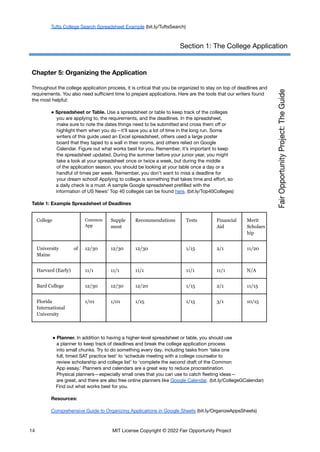
● Spreadsheet or Table. Use a spreadsheet or table to keep track of the colleges
you are applying to, the requirements, and the deadlines. In the spreadsheet,
make sure to note the dates things need to be submitted and cross them off or
highlight them when you do—it’ll save you a lot of time in the long run. Some
writers of this guide used an Excel spreadsheet, others used a large poster
board that they taped to a wall in their rooms, and others relied on Google
Calendar. Figure out what works best for you. Remember, it’s important to keep
the spreadsheet updated. During the summer before your junior year, you might
take a look at your spreadsheet once or twice a week, but during the middle
of the application season, you should be looking at your table once a day or a
handful of times per week. Remember, you don’t want to miss a deadline for
your dream school! Applying to college is something that takes time and effort, so
a daily check is a must. A sample Google spreadsheet prefilled with the
information of US News’ Top 40 colleges can be found here. (bit.ly/Top40Colleges)
Table 1: Example Spreadsheet of Deadlines
College Common
App
Supple
ment
Recommendations Tests Financial
Aid
Merit
Scholars
hip
University of
Maine
12/30 12/30 12/30 1/15 2/1 11/20
Harvard (Early) 11/1 11/1 11/1 11/1 11/1 N/A
Bard College 12/30 12/30 12/20 1/15 2/1 11/15
Florida
International
University
1/01 1/01 1/15 1/15 3/1 10/15
● Planner. In addition to having a higher-level spreadsheet or table, you should use
a planner to keep track of deadlines and break the college application process
into small chunks. Try to do something every day, including tasks from ‘take one
full, timed SAT practice test’ to ‘schedule meeting with a college counselor to
review scholarship and college list’ to ‘complete the second draft of the Common
App essay.’ Planners and calendars are a great way to reduce procrastination.
Physical planners—especially small ones that you can use to catch fleeting ideas—
are great, and there are also free online planners like Google Calendar. (bit.ly/CollegeGCalendar)
Find out what works best for you.
Resources:
Comprehensive Guide to Organizing Applications in Google Sheets (bit.ly/OrganizeAppsSheets)
14 MIT License Copyright © 2022 Fair Opportunity Project
Detailed Google Sheet to Organize College Applications (from Reddit) (​
​
bit.ly/OrganizerCollegeApps)
15 MIT License Copyright © 2022 Fair Opportunity Project
Section 1: The College Application
Chapter 6: Letters of Recommendation
The letter of recommendation is another chance for colleges to learn more about you as a person—similar to
your college essays—but this time from a second-hand perspective. The recommendation should either
deepen and complement an existing element of your application or add an entirely new element into the mix.
Most colleges require two recommendation letters from faculty and a letter from your representative
counselor. Make sure you’re getting your recommenders all the information they need and are setting them
up for success. In the preceding version of the Common App, the company allowed the submission of a
resume or an activities sheet—a sheet that detailed all of the things that you did in school. While the
Common App now has no place to upload an activities sheet, creating one allows you to detail the honors,
awards, and accomplishments that you can submit to your recommenders. Recommenders will generally
write about their experiences knowing you, but an activities sheet can help make their job easier of
highlighting what a great student and person you are. If you don’t send them an activities sheet, send them
something else or have a chat with your recommender. All the while, be grateful. Teachers don’t get paid
extra to write letters of recommendation, so make sure that they know you’re appreciative and thankful.
Who To Ask
At the very least, ask those teachers who will write favorably of you. Next, consider how the perspective of
the letter will add to your application. Colleges often ask for two academic letters of recommendation and
one optional non-academic letter of recommendation, so there is a strategizing element. Here are some
considerations:
1. Consider teachers who teach higher-level courses. Letters of recommendations
should typically come from teachers the student had during junior year for this
very reason. That way the teacher can also speak to how you are as a student
now, or how you’ve grown as a student since freshman year.
2. Consider asking a teacher in a subject you enjoy. If you have a strong passion in
a certain subject, we recommend asking a teacher in that subject to write a letter.
If you’re deeply interested in mathematics, a letter of recommendation from a
math teacher would further expand your proclaimed and demonstrated interest in
math.
3. Consider teachers who can provide insight into who you are at a personal or
social level. Teachers who served as sponsors of clubs in which you were
involved might be able to provide this perspective, as could a teacher you get along
with well who knows you.
4. Especially if optional letters of recommendation are allowed, ask an advisor,
mentor, coach, or boss to give the college a well-rounded look of who you are.
How to Ask
Ask if the recommender would be willing to write a strong letter of recommendation on your behalf. It’s best
to do this in person, and the recommender should be the sort of person you are comfortable asking in
person. It is also a good idea to ask during the very beginning of senior fall or during junior summer via email.
This gives the recommender plenty of time to write a refined recommendation letter and allows you to avoid
the request rush from other students closer to the deadline. A good rule of thumb is that a recommender
should have at least a month to write the letter, but the more time you give, the better!
When asking your teacher for a recommendation letter, we highly recommend requesting a meeting with your
teacher to discuss your application and how you plan to frame yourself as an applicant. Though some
teachers prefer to work independently and may already have an idea of what they plan to write for your letter,
many teachers find it helpful to have as much information about you as possible and hear how you view
yourself as a student and an applicant. This meeting ensures that both you and your recommender are on the
same page and helps your teacher craft a letter that fits with your application.
16 MIT License Copyright © 2022 Fair Opportunity Project
Section 1: The College Application
While an activities sheet can be helpful in giving a recommender a place to start, be sure to choose teachers
who know you well enough that they can say more about you than just what extracurriculars you participated
in. A strong letter of recommendation will also speak to your character, work ethic, and personality. After
getting the O.K. from your recommenders, it’s smart to check in to see how the letters are coming along and
to ask whether they would like any additional information. Again, your job is to make your recommender’s job
easy, which is why it’s important to create your activities sheet before you begin.
Thank You Notes
Teachers are not getting paid to write recommendation letters and are often asked by more than one student.
To express gratitude, be cool. Write a thank you note. A handwritten thank you note, though simple, is a
touching gesture that your recommenders will appreciate.
Resources:
Advice on Getting Standout Recommendation Letters (from Reddit) (bit.ly/RecommendationAdvice)
Chapter 7: The Application
Now that you have a list of schools you’d be excited to go to and have asked your teachers if they’d be
willing to write a letter for you, track down what is needed to apply for admissions. Find out whether they
accept the Common Application or whether they have their own application—we’ll go over what this
means—when they need test scores submitted, what tests they require, and what questions their
supplements ask. Setting aside plenty of time to work on the application and the college essays is truly worth
the investment: it can yield acceptance into the college of your dreams, win you merit scholarships, and save
you and your family tens of thousands of dollars.
Types of Decisions
Early Action - Early action allows you to apply to a school early, meaning that you’ll hear back sooner about
your status as an applicant. Early deadlines can help break up your college application workload with two
different deadlines—typically November for Early Action and January for Regular Admissions. Some schools
offer exclusive/restrictive early action, which means that you can apply early to that school but not to any
other school. Other schools’ restrictive early action processes allow you to also apply for public and
international schools. Regardless, the advantage of early action is that whether or not you’re accepted to
your early action school, you can still apply regular decision to other schools afterward. Early action shows
the college that you’re deeply interested in their school, increasing your likelihood of acceptance, but leaves
you the flexibility to still go to another school if you wish. Also, if you’re waitlisted, you then get another round
at regular decision during which the admissions officers will consider your application again.
Early Decision - Though they sound alike, early decision is different from early action: in early decision you
sign a contract saying that you will attend the school if you are accepted. If you’re totally invested in a school
and know for sure that’s where you want to go—regardless of how much financial aid you’ll receive—then go
for it! If not, or if you want to wait to see what your financial aid is before making a decision, then hold off.
Statistically, the acceptance rates for early action and early decision are higher than for regular decision,
although college counselors will say that this is a result of more qualified applicants applying. Early decision
is the most extreme signal to a college that they are your perfect school though, which undoubtedly helps
your chances of getting in, even if the competition is intense.
17 MIT License Copyright © 2022 Fair Opportunity Project
Section 1: The College Application
Rolling Admission - Rolling admission means that the school will take qualified applicants until the class is
filled. You can apply any time after a certain date and will hear back within a particular number of weeks on
your status. Most US colleges operate on a rolling admission basis. As always, it’s a benefit to apply early.
Regular Decision - This is the final and most normal opportunity to apply for a school. Make sure you get
your applications in before this deadline so you don’t have to worry about it. Most of your applications will be
regular decision if not rolling admission.
Transcript
Colleges will want to see how you used your time in high school, examining your course load and grades.
Usually colleges will weigh the high school junior and sophomore years with more clout than freshman year,
as they understand that the adjustment period to high school can be hard. Overall, colleges are mindful of
trends in your transcript, so don’t be too worried about an individual poor grade or two; if possible, have your
school counselor speak to why the dip may have occurred in the recommendation letter. Colleges you apply
to will want to see your high school performance up to senior winter, and if you’re accepted into the school
and then accept the offer, often to spring. Stop by your counselor’s office to drop off a list of the colleges
you’ve applied to, probably via a spreadsheet or table, so that your counselor knows where to send your
transcript. Colleges will weigh your academic performance relative to the opportunities available at your
school and not against the opportunities of other students from other schools.
Mid-Year Report
If you have applied to a school with an early deadline then you will also need to submit a transcript at the
halfway point of your senior year. This report will include your grades from the first half of your senior year.
Don’t forget it, and don’t catch senioritis too soon.
Final Report
After you’ve been accepted to college, you will need to submit a transcript reflecting your entire time in high
school, including your confirmation of high school graduation.
ACT/SAT
See the ACT/SAT sections in Chapter 3 for more details. These tests provide a way for colleges to compare
an extremely diverse and talented application pool directly. You must send scores to each school via the
College Board (bit.ly/CollegeBoardSite) or ACT website (bit.ly/TheACTSite). After you have submitted your
online application, make sure that the schools you’ve applied to also have your necessary test scores. If you
didn’t send these through the score report when you took your test, then head to either the College Board or
ACT website, login through the account that you’ve created, and select the schools that need your test
scores for either test to then send them. This costs some money, but there are need-based fee waivers
available.
Recommendation Letters
Having given your recommenders plenty of time, you now must make sure that your recommenders submit
the information to your respective school before the application date ends either by mailing them or through a
third-party submission software that your school may use. Teachers are human too, so stay in touch with
them to make sure they’re on top of it.
18 MIT License Copyright © 2022 Fair Opportunity Project
Section 1: The College Application
Common App
The Common App is a universal application meant to remove a lot of the redundancy of filling out
applications for many schools: essentially, it centralizes information so you don’t have to re-enter it every
time. The nice thing about the Common App is that most colleges accept it. It asks, among other things, for
personal information, extracurricular activities, honors and awards, test scores, courses, and essays. This
gives the admissions committee an idea of how you spent your time during high school, as well as your
personal and family background. Fill out the Common App as instructed on the Common App website
(bit.ly/CommonAppApply).
Although the Common App has been the most common universal application to apply to college, there are
many other application platforms, such as the Coalition for College Application (bit.ly/CoalitionCollege).
Some colleges have school-specific applications, meaning that you need to fill out an entire application just
to apply to that school. Do your research and find out how to apply to each college via the College Board
website. Just about every application will include, at the very least, family information, extracurricular
activities, honors and awards, tests scores, courses, and an essay. While the Coalition App is used by over
150 colleges and universities, the Common App is used by over 900. Because it is the most common, that is
what we will focus on in our guide.
Common App Essay
The Common App essay is a blanket personal statement intended to act as a way for the committee to get to
know you and what matters to you. Check out Chapter 8 for more detailed information on the Common App
Essay.
Supplement Essay(s)
Supplement essays are a way for a college to hear your thoughts on a question or prompt they pose. Again,
we have much more information about the supplement essay(s) in Chapter 8.
Optional Essay
Some schools have optional essays included in the student application. While schools say these are optional,
if you’re passionate about the school, do them anyway. An additional essay demonstrates interest in the
school and gives admissions officers even greater insight into who you are.
Additional Materials
If you’re applying to a music or art program, you may also have the opportunity to submit additional
information, like a recording or art portfolio.
School Specific Applications
Some schools will have individual applications and will not employ the Common App. These schools are
usually public universities. In this case, you will likely have to resubmit much of the information that you filled
out in the Common App.
Merit Scholarship Deadlines
If merit aid is offered, you’ll find it listed under financial aid. We will go through what merit aid means, but
know that applying for it will usually require additional essays.
19 MIT License Copyright © 2022 Fair Opportunity Project
Section 1: The College Application
FAFSA
The FAFSA is a federal financial aid form that you are required to fill out regardless of the type of school you
attend. FAFSA stands for “Free Application for Federal Student Aid”--it’s free to fill out and submit, so don’t
fall for the scams that try and charge you for it. It is a form created by the government to determine how
much government financial aid you are eligible to receive and whether you are eligible for grants, work study,
and/or unsubsidized or subsidized loans such as the Perkins (discontinued) and Stafford loans. In order to
find out how much aid the government will actually give you, sit down with your parents or guardians and fill
out the FAFSA together (basically you’ll have to provide information on your family’s financial assets and
wealth in order to gauge need). It can be confusing to make sense of what the FAFSA is, what sorts of
student aid/loans it deals with, and much more. There’s a post, called the FAFSA Guide (bit.ly/GuideFAFSA)
that does a good job at clearing away some of that confusion. It can be easy to make a mistake filling out
these forms, so check out this article (bit.ly/MistakesFAFSA) by the Florida College Access Network (FCAN)
on avoiding the most common mistakes students make in completing the FAFSA.
CSS Profile
The CSS Profile is a supplement for the FAFSA. Many private colleges are need-aware—the admissions
committee takes into account how much financial aid you need while making a decision on your application.
If you are accepted into a private college that offers need-blind, need-based financial aid, the college will
have to assess how much financial aid you need after accepting you. The tool that many colleges use to
assess aid is the CSS Profile (bit.ly/ApplyCSS), which collects your family’s income and assets through a
secure portal. Make sure to include the CSS Profile as a requirement in the spreadsheet next to all your
colleges that have need-based aid. The profile will charge you $25 for the first college you apply to and $16
for all following colleges. Importantly, colleges judge need and weigh the ability to pay differently. The CSS
Profile is a way for private schools to run your data through their need estimator algorithms.
End of Year Transcript Submit
At the end of the year, after you’ve decided where you’ll go to college, you also need to mail in an
end-of-year transcript to your school.
Resources:
Early Action vs. Regular Decision Myths (from Peterson’s) (bit.ly/EarlyActionInfo)
Pros and Cons of Using the Common App (from CollegeRaptor) (bit.ly/InfoCommonApp)
FAFSA Tips & Common Mistakes (bit.ly/TipsFAFSA)
Common Questions (and Answers) about the FAFSA Process (https://bit.ly/FAFSAQuestions)
Everything You Need to Know About Transcripts (from Niche) (bit.ly/TranscriptsInfo)
20 MIT License Copyright © 2022 Fair Opportunity Project
Section 1: The College Application
Chapter 8: The College Essay
Hey you! Yeah, you! You can write an amazing college essay (or essays), and it only takes being yourself and
a bit of time and thought. In reality, this is one of the most dreaded parts of the college application process,
but it doesn’t have to be. In fact, the writing process can be an intellectually and personally meaningful
experience. It is an opportunity to reflect on how far you’ve come and on where you would like to go next.
Keep these few things in mind:
1. The essay is the first opportunity for the admissions committee to hear from,
and not hear about, you. That’s exciting. Colleges don’t admit a list of
accomplishments; they admit human beings. This is your chance to put the
‘human’ into the rest of your application and show admissions officers a bit more
about yourself.
2. Unlike other parts of the application (transcripts, test scores, extracurriculars) that
are set in stone by the time you get around to applying, you can tweak and
improve the essay right up to the deadline.
3. You are the world’s foremost expert on the subject of the essay: you!
The college essay is used by admissions departments primarily for three reasons:
1. To evaluate students’ writing ability, with specific focus on developing a logical
and coherent essay structure with persuasive and well-written sentences.
2. To learn more about the student through the topic and content of the essay.
3. To see what the student would contribute to the college’s student body.
While there are many ways to write a successful college essay, each essay should engage with all of the
three areas above. We’ve included helpful tips and information in this section to clarify how students should
approach writing their college essays.
We’ve compiled college essays that were part of successful college applications to top schools. These can
be found in Section IV. But just like flipping right away to the answers of standardized tests is not the best
practice, don’t cheat yourself. Read the rest of this section, and spend some time thinking about what you
might write before skipping to these finished essays. Don’t forget to jot down your ideas along the way!
Types of College Essays
Common Application Essay:
This essay is part of the Common Application and is strictly limited to 650 words. The Common App essay is
sent to every school a student applies to through the Common App, making it even more important that this
be an excellent essay. Here are a few pointers:
1. The Common App essay is the top brick of the pyramid that is your application. It
should frame and give direction to your application by placing your scores,
classes, references, and grades within a single narrative: this is who you are and
where you are going.
21 MIT License Copyright © 2022 Fair Opportunity Project
Section 1: The College Application
2. It is often the first thing an admissions officer reads in your application. With that
in mind, your Common App essay should be intriguing, persuasive, and
well-written. It should excite the admissions officer about reading the rest of your
application.
3. The Common App essay is a place to be you. If a school denies you for who you
are, then you probably don’t want to go there anyway.
4. Your Common App will be sent to every school you apply to through the
Common App, so make sure that your essay is not directed at any particular
school.
An excellent reference guide on the college essay is provided by Yale. We highly recommend checking it out
for further advice. (bit.ly/YaleAdvice)
Supplemental Essay:
Many schools that you apply to will require school-specific supplemental essays. Think of these as additional
narratives of who you are as a person that refine, complicate and expand the profile you’ve sketched in the
Common App essay. Again, a few pointers:
1. Avoid significant overlap between your Common App essay and your
supplements. You only have the eyes and ears of admissions officers for a limited
amount of time. And the 650 words of the Common App could never capture
your infinite richness and complexity. So you might use the supplemental essay
to show a different dimension of yourself.
2. This is a great time to highlight your specific interest in the school to which you
are applying. Study the individual school’s websites, become an expert on their
school, and then demonstrate your expertise. For example, if you are passionate
about journalism, you could tell a college why you are interested in exploring their
journalism program. If you are interested in a particular area of study or in the
work of a particular academic, you could express your desire to work with a
particular department or professor. Schools accept applicants that they
believe will take great advantage of the resources they offer.
3. Supplemental essay questions vary. Some colleges ask slightly strange
questions to give students an opportunity to demonstrate their creativity while
others ask more standard questions like “Why X College or University?”
Remember: each component of the application should offer an additional snapshot of you.
The Topic
Selecting the essay topic is one of the hardest parts of writing a college essay. Try a few of these things:
1. Start by thinking about topics that you want to write about. These are most
likely to represent some important aspect of yourself. Even without any words on
the page, the topic of a part-time job as a youth soccer referee implies that the
student is probably responsible. An essay about family can indicate that family
is an important part of the student’s life. Select a topic that reflects what
is important to you. If you are blanking on a topic, just spend a few minutes
22 MIT License Copyright © 2022 Fair Opportunity Project
Section 1: The College Application
jotting down whatever ideas come to mind for a potential essay. They don’t
have to be perfect, or even complete. Then revisit your ideas another time with a
fresh perspective.
2. Don’t worry too much about what others are writing. There is no one way to write
about, let alone to have, a meaningful experience, role, person or reflection.
Avoid copying successful past essays. And, equally, avoid steering clear of so-
called “clichéd topics” like playing on a sports team or writing about a late
grandparent, unless you can inject some novelty into the subject. In the end,
admissions officers just want to read about what you find important and
meaningful.
3. Don’t be afraid to abandon a topic and find something that works even better.
Often, the success or the failure of an idea is revealed in the writing. It is
completely natural and expected for your essay to undergo many shifts and
changes.
4. Successful essays won’t necessarily add another bullet point demonstrating
academic or extracurricular success. The activities and honors list will do this
for you. Instead, focus on deepening the image the admissions committee has of
you and your character. Some of the most compelling essays are written as
stories, and might describe a relationship, a meaningful time of your life, or an
interest that has had an impact on you.
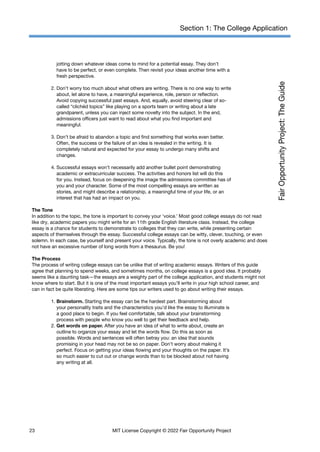
The Tone
In addition to the topic, the tone is important to convey your ‘voice.’ Most good college essays do not read
like dry, academic papers you might write for an 11th grade English literature class. Instead, the college
essay is a chance for students to demonstrate to colleges that they can write, while presenting certain
aspects of themselves through the essay. Successful college essays can be witty, clever, touching, or even
solemn. In each case, be yourself and present your voice. Typically, the tone is not overly academic and does
not have an excessive number of long words from a thesaurus. Be you!
The Process
The process of writing college essays can be unlike that of writing academic essays. Writers of this guide
agree that planning to spend weeks, and sometimes months, on college essays is a good idea. It probably
seems like a daunting task—the essays are a weighty part of the college application, and students might not
know where to start. But it is one of the most important essays you’ll write in your high school career, and
can in fact be quite liberating. Here are some tips our writers used to go about writing their essays.
1. Brainstorm. Starting the essay can be the hardest part. Brainstorming about
your personality traits and the characteristics you’d like the essay to illuminate is
a good place to begin. If you feel comfortable, talk about your brainstorming
process with people who know you well to get their feedback and help.
2. Get words on paper. After you have an idea of what to write about, create an
outline to organize your essay and let the words flow. Do this as soon as
possible. Words and sentences will often betray you: an idea that sounds
promising in your head may not be so on paper. Don’t worry about making it
perfect. Focus on getting your ideas flowing and your thoughts on the paper. It’s
so much easier to cut out or change words than to be blocked about not having
any writing at all.
23 MIT License Copyright © 2022 Fair Opportunity Project
Section 1: The College Application
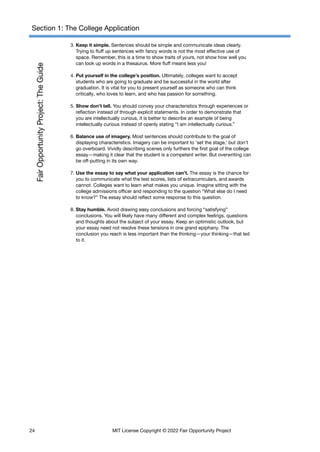
3. Keep it simple. Sentences should be simple and communicate ideas clearly.
Trying to fluff up sentences with fancy words is not the most effective use of
space. Remember, this is a time to show traits of yours, not show how well you
can look up words in a thesaurus. More fluff means less you!
4. Put yourself in the college’s position. Ultimately, colleges want to accept
students who are going to graduate and be successful in the world after
graduation. It is vital for you to present yourself as someone who can think
critically, who loves to learn, and who has passion for something.
5. Show don’t tell. You should convey your characteristics through experiences or
reflection instead of through explicit statements. In order to demonstrate that
you are intellectually curious, it is better to describe an example of being
intellectually curious instead of openly stating “I am intellectually curious.”
6. Balance use of imagery. Most sentences should contribute to the goal of
displaying characteristics. Imagery can be important to ‘set the stage,’ but don’t
go overboard. Vividly describing scenes only furthers the first goal of the college
essay—making it clear that the student is a competent writer. But overwriting can
be off-putting in its own way.
7. Use the essay to say what your application can’t. The essay is the chance for
you to communicate what the test scores, lists of extracurriculars, and awards
cannot. Colleges want to learn what makes you unique. Imagine sitting with the
college admissions officer and responding to the question “What else do I need
to know?” The essay should reflect some response to this question.
8. Stay humble. Avoid drawing easy conclusions and forcing “satisfying”
conclusions. You will likely have many different and complex feelings, questions
and thoughts about the subject of your essay. Keep an optimistic outlook, but
your essay need not resolve these tensions in one grand epiphany. The
conclusion you reach is less important than the thinking—your thinking—that led
to it.
24 MIT License Copyright © 2022 Fair Opportunity Project
Section 1: The College Application
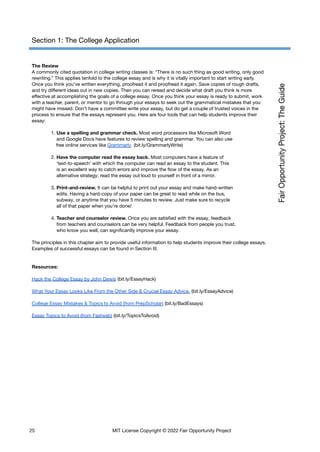
The Review
A commonly cited quotation in college writing classes is: “There is no such thing as good writing, only good
rewriting.” This applies tenfold to the college essay and is why it is vitally important to start writing early.
Once you think you’ve written everything, proofread it and proofread it again. Save copies of rough drafts,
and try different ideas out in new copies. Then you can reread and decide what draft you think is more
effective at accomplishing the goals of a college essay. Once you think your essay is ready to submit, work
with a teacher, parent, or mentor to go through your essays to seek out the grammatical mistakes that you
might have missed. Don’t have a committee write your essay, but do get a couple of trusted voices in the
process to ensure that the essays represent you. Here are four tools that can help students improve their
essay:
1. Use a spelling and grammar check. Most word processors like Microsoft Word
and Google Docs have features to review spelling and grammar. You can also use
free online services like Grammarly. (bit.ly/GrammarlyWrite)
2. Have the computer read the essay back. Most computers have a feature of
‘text-to-speech’ with which the computer can read an essay to the student. This
is an excellent way to catch errors and improve the flow of the essay. As an
alternative strategy, read the essay out loud to yourself in front of a mirror.
3. Print-and-review. It can be helpful to print out your essay and make hand-written
edits. Having a hard-copy of your paper can be great to read while on the bus,
subway, or anytime that you have 5 minutes to review. Just make sure to recycle
all of that paper when you’re done!
4. Teacher and counselor review. Once you are satisfied with the essay, feedback
from teachers and counselors can be very helpful. Feedback from people you trust,
who know you well, can significantly improve your essay.
The principles in this chapter aim to provide useful information to help students improve their college essays.
Examples of successful essays can be found in Section III.
Resources:
Hack the College Essay by John Dewis (bit.ly/EssayHack)
What Your Essay Looks Like From the Other Side & Crucial Essay Advice. (bit.ly/EssayAdvice)
College Essay Mistakes & Topics to Avoid (from PrepScholar) (bit.ly/BadEssays)
Essay Topics to Avoid (from Fastweb) (bit.ly/TopicsToAvoid)
25 MIT License Copyright © 2022 Fair Opportunity Project
Section 1: The College Application
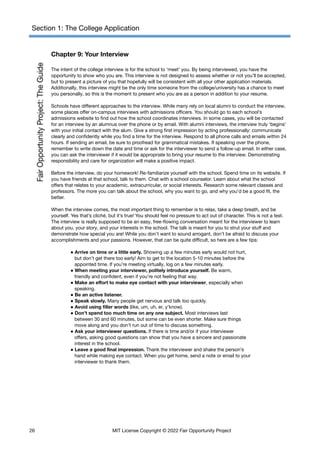
Chapter 9: Your Interview
The intent of the college interview is for the school to ‘meet’ you. By being interviewed, you have the
opportunity to show who you are. This interview is not designed to assess whether or not you’ll be accepted,
but to present a picture of you that hopefully will be consistent with all your other application materials.
Additionally, this interview might be the only time someone from the college/university has a chance to meet
you personally, so this is the moment to present who you are as a person in addition to your resume.
Schools have different approaches to the interview. While many rely on local alumni to conduct the interview,
some places offer on-campus interviews with admissions officers. You should go to each school’s
admissions website to find out how the school coordinates interviews. In some cases, you will be contacted
for an interview by an alumnus over the phone or by email. With alumni interviews, the interview truly ‘begins’
with your initial contact with the alum. Give a strong first impression by acting professionally: communicate
clearly and confidently while you find a time for the interview. Respond to all phone calls and emails within 24
hours. If sending an email, be sure to proofread for grammatical mistakes. If speaking over the phone,
remember to write down the date and time or ask for the interviewer to send a follow-up email. In either case,
you can ask the interviewer if it would be appropriate to bring your resume to the interview. Demonstrating
responsibility and care for organization will make a positive impact.
Before the interview, do your homework! Re-familiarize yourself with the school. Spend time on its website. If
you have friends at that school, talk to them. Chat with a school counselor. Learn about what the school
offers that relates to your academic, extracurricular, or social interests. Research some relevant classes and
professors. The more you can talk about the school, why you want to go, and why you’d be a good fit, the
better.
When the interview comes, the most important thing to remember is to relax, take a deep breath, and be
yourself. Yes that’s cliché, but it’s true! You should feel no pressure to act out of character. This is not a test.
The interview is really supposed to be an easy, free-flowing conversation meant for the interviewer to learn
about you, your story, and your interests in the school. The talk is meant for you to strut your stuff and
demonstrate how special you are! While you don’t want to sound arrogant, don’t be afraid to discuss your
accomplishments and your passions. However, that can be quite difficult, so here are a few tips:
● Arrive on time or a little early. Showing up a few minutes early would not hurt,
but don’t get there too early! Aim to get to the location 5-10 minutes before the
appointed time. If you’re meeting virtually, log on a few minutes early.
● When meeting your interviewer, politely introduce yourself. Be warm,
friendly and confident, even if you’re not feeling that way.
● Make an effort to make eye contact with your interviewer, especially when
speaking.
● Be an active listener.
● Speak slowly. Many people get nervous and talk too quickly.
● Avoid using filler words (like, um, uh, er, y’know).
● Don’t spend too much time on any one subject. Most interviews last
between 30 and 60 minutes, but some can be even shorter. Make sure things
move along and you don’t run out of time to discuss something.
● Ask your interviewer questions. If there is time and/or if your interviewer
offers, asking good questions can show that you have a sincere and passionate
interest in the school.
● Leave a good final impression. Thank the interviewer and shake the person’s
hand while making eye contact. When you get home, send a note or email to your
interviewer to thank them.
26 MIT License Copyright © 2022 Fair Opportunity Project
Section 1: The College Application
Again, the interview should be viewed as it is: a chat about you and about a college or university you hope to
attend with an adult who wants to get to know you. Remember, these people are either volunteering their
time or getting paid to do this, so they really enjoy it!
If this makes you nervous, then practice! Ask a friend or a school counselor or a family member. Practicing
will help. If you don’t have anyone to practice with, then consider the following questions on your own:
● Why do you want to go to X University?
● What do you want to study at X College?
● What are some of the extracurricular activities you do?
● Why do you do them?
● What is your favorite book, and why?
● Who is someone you look up to? Why?
After the interview, the interviewers fill out a form about the experience considering how you’d do at the
school.
What to Wear
Unless told otherwise, wear business casual attire for the interview. Be comfortable in your clothing, and
adjust your attire based on the venue of the interview. Try to avoid t-shirts, shorts or torn clothing. Start with
what’s already in your closet, but you can also check your local Goodwill or thrift store, or see if your school
or nearby organizations do clothing drives. Here is a website with more information on "business casual."
(bit.ly/InterviewWhatToWear)
What to Bring
If your interviewer asks you to bring a resume, then make sure to have it on hand. It’s usually best to bring
the resume in a professional-looking folder, manila, or something else (your interviewer might also ask you to
email your resume in advance). In addition, bring a pen and paper to take notes for yourself.
Questions to Ask
Although the interviewers will inevitably ask you some questions, most interviewers will save time at the end
of your meeting for you to ask questions. Come prepared with a question or two to ask the interviewer that
reflects your familiarity with the school. Be able to ask the interviewer about some interest of yours and how it
is covered at the school (e.g. studying abroad, club sports, theater productions, internships, a particular area
of study). Moreover, everyone likes to talk about themselves, so if this is an alumni interview, feel free to ask
about the interviewer’s experiences at the school. Here are some possible questions:
1. What were you involved in at X University?
2. Do you stay in touch with friends from college?
3. Who were your favorite professors?
4. What did you do during high school?
5. What was your favorite class at X University?
6. Do you have a favorite book or book recommendations?
7. What was a favorite memory from your time in college?
Resources:
How to Prepare for an Interview (from Reddit) (bit.ly/RedditInterviewPrep)
FairOpportunityX: Perspective on the College Interview (bit.ly/LabXInterview)
College Interview Practice Questions and Strategies (from the College Board) (bit.ly/InterviewPracticeQs)
27 MIT License Copyright © 2022 Fair Opportunity Project
Section 1: The College Application
Thank You Note
As an act of courtesy, it is nice to send each interviewer a thank you note, usually within 24 hours of the
interview. It should be a handwritten note or well-written email. You should thank the interviewer for meeting
with you, refer to something that happened during the conversation, and express how excited you are about
attending the school. Here is a rough example of a thank you note, to be amended to your own personal
voice:
Dear Ms. Smith,
Thank you for interviewing me on Tuesday afternoon. I really enjoyed speaking to you about your experiences
at the University of Chicago and particularly liked your story of meeting Milton Friedman. I still can’t believe
you got to chat with him. I also appreciated your book recommendation. I’ve already ordered Catch-22 and
look forward to reading it over the next few weeks.
Our conversation confirmed why I’m so excited about going to the University of Chicago. I will let you know of
my admissions result as soon as I am notified.
Thanks again!
Sincerely,
Luke Heine
Resources:
How to Write a College Interview Thank You Email (from InterviewFocus) (bit.ly/InterviewThankYou)
Chapter 10: Update Letters
If something worthwhile occurs between when you submit your application and when they notify you of your
admissions results, we suggest writing a letter to the colleges to which you’re applying to update them and
let them know that you’re still seriously considering attending the school if accepted. We recommend doing
this after application submission, and of course before decision day. It is useful to send the colleges that you
applied to an update letter during early November for Early Admissions and during mid-February for regular
admissions.
What to update colleges on:
1. Extracurriculars
2. New projects
3. Awards
4. Acceptances at other schools—let them know you’re wanted!
28 MIT License Copyright © 2022 Fair Opportunity Project
Section 1: The College Application
Example Update Letter #1
Luke Heine
Cloquet Senior High
Cloquet, MN, 55720
Regular Decision February Update
Greetings Ms. Rogers,
As promised, this is the update to my previous letter for inclusion in my application. As I’m sure you
also have quite the “to-do-list,” I kept it short for your convenience, not because of a lack of interest. Before
you even begin, thanks for your time. It means a lot!
Since our last conversation, as far as scholarships go, I was fortunate enough to earn the Minnesota
High School League’s Arts, Athletics, and Academics award (awarded to students excelling in all those
subjects) for Section 7AA. This is the first time anyone from my school has won it in eight years, and—as I am
advancing to state in the competition—I cautiously hope to be the first individual ever from Cloquet to win
Minnesota. We’ll see what comes of it.
Additionally, I won Northern Minnesota’s “Most Valuable Student Award” through the Elks Society,
so I’ll also have the opportunity to compete for state in that. On a side note, the AXA Achievement Awards
has not yet separated their national winners from their finalists, so I unfortunately have no news or updates on
that end. I wish I did!
Avoiding the information expressed through my midterm transcript (I think you will like what you see),
I want to spend the rest of this letter quickly updating you on this year’s Northland Frisbee Invite, the
non-profit Ultimate Frisbee Tournament I run. So far, I’ve reserved nine fields, signed another DJ for the event,
distributed 500 of the 1,500 stickers, and poured hours into working on the website. As far as the website
goes, except for a few aesthetic tweaks (while it may work for Nike, I think our site has too many greyscale
hues), it’s completed. Also, some friends got the Twitter integration working, so, when officially launched, one
can simply attach #northlandfrisbee to a tweet, and it will transfer all tagged content to our website’s
homepage. Finally, as far as other NFI developments go, I’m now working on shirt, poster, and banner
designs, opening up another contest for local artists, and gearing up to sign sponsors.
It should be a busy spring, but I’m sure you know how that goes. Thanks for your time. And, I hope
to see you next fall.
Sincerely,
Luke
29 MIT License Copyright © 2022 Fair Opportunity Project
Section 1: The College Application
Example Update Letter #2
Dear Mr. Curtis,
I am writing this letter to express my genuine interest in attending Ohio Wesleyan University next fall.
Since I submitted my application in December, I have undertaken more responsibilities and
continued to focus on my academic success. Backpacks for Peru, an organization I founded to contribute to
my older sister’s community service mission trips, has become a nonprofit corporation and will become an
annual event. As Co-Captain of my varsity tennis team, I have led my team to a 2nd place ranking in our
district, a 9th place ranking in the state, and a qualification for the state championship tournament. I am also
now an Opinions Editor for our school’s student-run website, StudentConnect, and I have qualified for FBLA
States in economics after I took my district’s economics test on January 16th. Furthermore, I was just notified
that I am a Coca-Cola Scholars Program Finalist (selected out of 90,000 applicants and 2,200 semi-finalists).
All the while, I have excelled in my IB requirements—a 4,000 word Extended Essay (I wrote mine on death
imagery in T.S. Eliot’s poetry) and various IB internal assessments—while, as evident in my mid-year report,
earning straight “A’s” for the first two semesters.
Ohio Wesleyan is my top-choice school. Ohio Wesleyan’s mathematics program is ideal for me
because its strong faculty, notably Professor Jackson and Professor Dietrich, would offer me chances to learn
and research under pioneers in the fields. This program, paired with Ohio Wesleyan’s flexible curriculum,
would enable me to combine complex mathematics and a broad foundation in the liberal arts. However, most
importantly, the people there will embolden me to learn through interaction—discussions that are intellectually
stimulating, vitalizing, and passionate.
I hope to act on my sincere desire to be a part of, and contribute to, Ohio Wesleyan’s dynamic
campus next fall.
Thank you for your consideration! Please contact me if there are any questions about my application.
Kind Regards,
Alice
Ohio Wesleyan Hopeful ‘18
Resources:
How to Write a Great Letter of Continued Interest (from College Essay Guy) (bit.ly/ContinuedInterest)
College Confidential: Should I Update Colleges? (bit.ly/AchievementUpdate)
30 MIT License Copyright © 2022 Fair Opportunity Project
Section 1: The College Application
Chapter 11: Post Submission
Once you have submitted your application, you’ll eventually hear from the colleges. Acceptance or rejection
are straightforward outcomes, but what do you do about the waitlist? If you get on the waitlist, it is best to
not get your hopes up too high, but do opt to be further considered. Students do get in off the waitlist, but
assuming that you won’t get in means a pleasant surprise rather than an unexpected disappointment. If you
are placed on a waitlist, we recommend sending a letter to the school saying that you’re still invested and
seriously considering attending if the school grants you admission.
If you are accepted to multiple schools, and the school you want to attend didn’t give you the aid that you
were looking for, don’t be shy about letting your school know that you’ve been accepted at other universities
that—if true—have given you better aid. A simple letter like this could be worth thousands of extra dollars in
aid.
How to Decide
Choosing the college you’ll attend can no doubt be difficult when given multiple acceptances. But it’s a good
problem to have!
Make sure you have an idea of what each school will cost you. Know that financial aid packages are rarely
static: if you don’t feel the aid offered meets your need, remember that students who appeal to the school
have been known to receive more generous allotments. Though it’s not entirely common, admissions officers
have the ability to increase a students’ aid package, especially if, for instance, a family has received a higher
offer from a comparable school or if a family’s situation has changed in some way. Keep this in mind as you
evaluate your offers during the month of April. Admissions and financial aid officers should be readily
available to field questions and discuss your personal financial situation.
Refer back to the original list of values you created before you started working on your applications in order
to reevaluate your options. Think about the reasons you have for pursuing a college education, what you plan
to do with your degree, and which institution would prepare you the best to achieve your goals. With this
information on hand, many find it helpful to think about where you would regret not going most, as that may
give you insight on where you’d like to go.
For many, however, the “correct” choice can’t be found on a spreadsheet or list. It is often, at its core, a gut
decision. Where you’d most want to spend the next four years of your life is often a very personal decision,
one only you can make for yourself. There is no right or wrong set of criteria for choosing the college that is
best for you; pay attention to the advice of those closest to you (but don’t be afraid to disregard it!). Through
your hard work, you’ve earned your right to a decision only you can make.
One of the best ways to tease out what “feels right” is attending the admitted students' days at the schools
to which you were admitted. A number of colleges and universities host multi-day programs on campus with
the purpose of selling admitted students (you) on the experience they have to offer. You should definitely
attend these programs if you can. Call the school to see if it offers financial aid for the travel cost. It’s
important to keep in mind that these programs are primarily focused on selling you on the school. Be sure to
enjoy yourself as you collect information by visiting classes, speaking with professors, and talking to students
about their experiences. Even if you already visited as a prospective student/applicant, often being on
campus as an admitted student has an entirely different feel to it. Your experiences at admitted students
weekends will likely aid in your search for the right college.
31 MIT License Copyright © 2022 Fair Opportunity Project
Section 1: The College Application
One somewhat odd yet extremely effective method of choosing the school that feels right is listening to your
gut when people whom you don’t know well give you advice on where to go. When we receive advice from
those whom we respect and who know us well (e.g. parents, teachers, mentors and friends), they tend to
have inherent biases and ideas of what’s best for us that may not line up with our true feelings. It’s often easy
to agree with these people in the moment, even though they may not know what’s best for us. Listening to
your gut when you hear the advice of total strangers (the people you meet touring schools, friends of friends
who hear about your decision) can often be a good way of assessing your deep-seated feelings about where
you would be happiest. Often, your off-the-cuff reaction to the advice you’ve been given is a good indicator
of where you at your gut level feel you belong.
Know that any decision you make might feel right in the moment, and wrong the next day or over the summer
after senior year. Accept this as an inevitability. Every institution has its pros and cons; you’re bound to feel
unhappy about some things at the institution you do choose, and miss out on some of the great offerings at
the one you don’t. However, as many students report, if you go with your gut decision, you’ll almost certainly
feel you made the right decision in the end.
Reflecting on the College Application Process
Now that you’re finished with your college applications and decisions, don’t forget to take a moment to
reflect and appreciate all that this process has given you. You were a very different person when you first
began looking at colleges! Though the process is often thought of as a chore thrust upon stressed-out 17-
and 18-year-olds, it’s important to recognize how much of a learning and growing experience it can be. You
should feel a sense of accomplishment for all that you’ve achieved and all that you’ve learned about yourself
along the way.
After Decision
After you’ve accepted where you’re attending, many schools will have you make a deposit to confirm your
place in the class. Just make this date, and you’ll be fine. Upon acceptance to some universities, they may
also ask you to do placement tests for your own guidance of what classes to take. Do them, and you’ll be
fine.
Do a First Year Program
In addition, you may have the opportunity to attend a pre-orientation program. Many college students write
that their pre-orientation program was one of the best things they’ve ever done. It will set you up with a great
group of friends right out of the gate.
Connect, Don’t Compare
Once you’re in college you’ll find people dramatically different from you and better than you in many different
things. Instead of feeling intimidated, recognize that having other students more skilled in areas than you is a
tremendous opportunity for you all to learn from each other. While connecting instead of comparing with your
peers may seem like obvious advice now, make sure to keep it in mind when you enter college. Your peers
will probably be the best experience of your college process, so make sure that you embrace them.
Explore
When you get to school, try a bunch of different things and don’t be afraid to quit the ones that don’t capture
your interest. As a freshman, you’re going to be hit by all sorts of information about joining clubs or getting
involved in activities. Explore all that may interest you, but feel free to cut them as soon as you feel you’re not
getting a lot out of it. By doing this you’ll meet a variety of people from all different types of backgrounds,
who can become close friends even if you choose not to stick with the activity. This is your time to sample
what’s possible; enjoy it!
Resources:
How to Write a Financial Aid Appeal Letter & Examples (from College Essay Guy) (bit.ly/AidAppealTips)
10 Steps to Choosing the Right College (from US News) (bit.ly/RightCollege10Steps)
How to Choose a College (from CollegeRaptor) (bit.ly/ChooseACollege)
32 MIT License Copyright © 2022 Fair Opportunity Project
Section 2: Affording College
SECTION 2: AFFORDING
COLLEGE
College is expensive...but there are ways to make it affordable. As the cost of college has skyrocketed, being
able to afford your dream school has become paramount in the application process. In order to do so,
students should use a mix of institutional, outside, and federal aid, and understand that a college will rarely
cost you what they advertise. Some of the most affordable schools—Harvard, Stanford—initially appear
obscenely expensive, but despite an annual cost of ~$60,000, 90% of U.S. students would find Harvard’s
financial aid makes college more affordable than their public option. You should tap into as many resources
as possible to get funding for college, and we’re here to help you understand and find them.
Chapter 12: Financial Aid
The most common resource to afford college is financial aid. This is a combination of money that the
government agrees to pay and the amount the college you’ll be attending agrees to subsidize for your
education. Nailing down how much a university costs will require understanding the tools that are available,
but in order to do that, you need to understand the types of aid offered.
Institutional Aid for College
1. Need. Need aid is given by a university to ensure that a student can attend.
Some schools, especially private colleges and universities, will note that they
meet students’ financial needs through need-based aid, meaning that if you are
accepted to that school, the school will assess your need through financial
statements, usually submitted through the FAFSA (bit.ly/ApplyFSA) and sometimes the
CSS/Financial Aid Profile, (https://bit.ly/ApplyCSS) and will fully provide the aid that you’re
deemed to need. Be cautious, though. Definitions of ‘full need’ vary dramatically per school.
Luckily, you can get an assessment of how much they cost through a need-based calculator
(covered later in this guide). Many of these schools also employ ‘need-blind’
admittance, meaning that the school does not weigh your ability to pay for
tuition in the application process. Need-blind financial aid packages also assume
that you’ll be working over the summer and school year and factor those
earnings into their award amounts.
2. Merit. Many schools, public and private, offer merit aid that is given to students
based on their academic qualifications or ability to meet some desired outcome.
This is analogous to a traditional scholarship where, because a student does ‘X’
exceptionally well, the school will give them ‘Y’ (hence, merit). A good example of
this is the University of Alabama, which offers a full-tuition scholarship to in-state
students who have scored over a 30 on the ACT or a 1360 on the SAT and have a
GPA over 3.5. (bit.ly/UniAlabamaFullScholarship) Merit aid may be automatically awarded or
applied for through separate applications. Make sure you know whether merit aid is offered at
your schools so that you don’t miss the deadlines—usually, they are accessible through the
financial aid portion of a college’s website.
3. Federal Aid. Depending on family income, federal financial options exist for
students. Aid can come in the form of grants, work study awards, or loans. Stafford Loans are
subsidized government student loans which your FAFSA financial aid report will determine
whether you’re eligible to receive. “Subsidized” loans are better than “unsubsidized” loans
because the government will pay the interest on a subsidized loan as long as you are enrolled at
least half-time and meet other eligibility requirements. For more information on federal aid, see the
following section. Also, here is a helpful resource. (bit.ly/FAFSAunpacked)
33 MIT License Copyright © 2022 Fair Opportunity Project
Section 2: Affording College
4. Student Loans. As you might have heard, student debt (acquired through student loans) is on the
rise. You want to try very hard to not take out loans beyond what you can repay after graduation!
Graduating with a large amount of debt can present a huge burden, especially when you consider
what you want to do after graduation. There are two types of loans: subsidized and unsubsidized.
I. Subsidized Loans – These are loans that are subsidized by the federal government,
meaning that the interest payments on them are very low (which is better for you). It is
preferable to pay for college through scholarships and merit aid, but this is your best bet if
you really need to take out a loan. As an undergraduate, you have a federal lending limit for
these loans ranging from $5,500 to $12,500 per year. (bit.ly/SubsidizedLoans) These loans
offer additional protections as well and have an interest rate of 3.73% with a 1.057%
origination fee for 2021-2022. (bit.ly/LoanInterestCalculator)
II. Unsubsidized Loans – These are loans offered by the federal government and private
companies that have no subsidy, meaning that they have a higher interest rate and an
immediate repayment schedule. Really, really try to avoid these! Make sure that you talk to
your college counselor and do plenty of research before you (we hope you don’t) take out
an unsubsidized loan. If you do have to go down this route, here are some options:
A. Parent PLUS Loans - Once you hit your lending limit, you'll likely turn to Parent PLUS
loans. These loans are not subsidized by the federal government and can be more
costly depending on your situation. They are also easier to get for those with low credit
scores. The interest rate does not vary on an individual basis, and is 6.28% for
2021-2022 with a 4.228% origination fee. (bit.ly/ParentPlusInfo)
B. Private Loans - These loans should only be used after you hit your federal
undergraduate limit and begin weighing your other options. If you don't need to take
out more loans, don't. If you end up needing a Parent PLUS or additional loan,
research collective bargaining platforms like Juno, which negotiate with loan providers
to get fixed rates down with no origination fee. (bit.ly/JunoLoans)
5. Scholarships. This is usually private, outside aid, often to study a specific subject. Make sure to
apply for local scholarships either posted at your guidance office or showcased online and in
newspapers, as your chances of winning are significantly higher. The next chapter is all about
scholarships.
Finding a College’s Price
As you won’t usually pay the full price that a university costs, understanding the types of institutional financial
aid will help decode a college’s actual price. Every school is required to offer a net price calculator with which
students can input their family’s assets and get a rough approximation of what they’ll pay. We strongly advise
that you do this as it may surprise you what you’ll owe! If a school offers need-based aid, also assess
whether the school offers merit aid that you can apply to receive. Oftentimes merit aid applications have
different deadlines from regular applications, so make sure to confirm those ahead of time. To double check
what you’ll approximately be paying, the US Department of Education has set up college cost calculators
that allow students to see the mean price of cost, debt, and graduation indexed per school. Our
recommendation is to use both the colleges’ calculators and the government’s assessment for a good,
although imperfect, estimate. Finally, remember to tally up the cost of applying to schools. To get a total cost
upfront, add $16 to each application for the CSS Profile, ~$12 if you choose to independently submit an ACT
or SAT score, up to $85 per college application, and ~$5 for each transcript submission (if your high school
charges you to submit transcripts).
If application fees are a barrier to you, waivers are offered through the College Board and also through some
colleges. In addition, the SAT and ACT have fee waivers for special circumstances. Speak to your college
counselors, and if you are eligible they can approve you for free SAT or ACT tests. While applying to college
can be expensive, it’s a fantastic investment. With a well-put-together application, a degree at your dream
school can often lead to a higher lifetime income.
After understanding what merit- and need-based aid you can expect to receive, put your tentative aid down
in the spreadsheet next to the colleges that you’ve selected. If a school is too expensive for you, feel no
remorse in cutting it from your application list. You may notice that we’re living and dying by an organized
spreadsheet—for good reason. Writing out as much as you can will prevent you from stressing out, forgetting
things, and putting yourself in the way of your own success.
34 MIT License Copyright © 2022 Fair Opportunity Project
Section 2: Affording College
Get Away from Bad Aid Information
There’s a lot of poor information out there on college expenses, most notably on the Ivy League, which has
some of the best financial aid in the nation. For one of our writers, it was less expensive to go to Harvard than
the University of Minnesota—as it would be for 90% of Americans. Other private schools are known for
strong financial aid programs; here’s a list of schools ranging from Rice University to Mount Holyoke College,
all of which meet full financial need. If these schools don’t align with your interests, here’s another list of 50
schools ranked according to ability to serve applicants whose families earn less than $48,000. Generally,
public universities have much lower tuition fees for in-state students, making higher education possible and
affordable. In addition, many states have in-state tuition reciprocity with neighboring states, and some even
have international reciprocity: for example between Minnesota and Manitoba. You should think a bit about
the return on investment in education via tools like Edmit, referred to in Chapter 4. The point is to seek out
the facts yourself using tools like the college cost calculator and the free resource College Navigator—you’ll
thank yourself later.
Resources:
College Scorecard (College Cost Calculator) (bit.ly/ScorecardCollege)
Schools Covering 100% Tuition (bit.ly/100NeedMet)
Best Financial Aid Programs (bit.ly/BestCollegesList)
Edmit (Financial Help Throughout the Application Process) (bit.ly/EdmitMe)
College Navigator (School Information Lookup Tool) (bit.ly/CollegeNavigatorTool)
Tuition Tracker: Revealing the True Cost of College (bit.ly/TuitionTracker)
Types of Federal Loans (bit.ly/FederalLoanTypes)
How to Make College Cheaper (from US News) (bit.ly/CheaperCollege)
Yearly Financial Aid Checklists for Students & Families (https://bit.ly/PrepareForCollegeChecklist)
Chapter 13: Scholarships
Many students fail to take advantage of the many scholarships out there. Invest the time into completing
scholarship applications: though sometimes burdensome, they can provide a significant return. There is
compelling evidence that students who have the time and motivation to frequent scholarship-finding
websites receive more scholarship money. Nationally, 8% of undergraduates receive private scholarships
worth an average of $2,800, but 50% of Niche users report that scholarships cover most of their tuition.
1. Apply Early. College is expensive. Many students don’t realize how expensive
college is until they get their financial aid package, after they find out which
colleges accepted them (usually between February and April). Students might
start scrambling to apply for scholarships to afford their school, but this is
sometimes too late. Many scholarship deadlines might have passed, and those
that are left are more competitive since many other students are also scrambling.
Start looking for scholarships during your junior summer and continue throughout
the college application process. Keep a running list of scholarships you find.
2. Use Scholarship Searchers: There are many websites that compile lists of
scholarships for students. A list of hundreds of scholarships can be quickly
compiled by simply putting in some basic information. Going Merry is a site
we recommend that is a sort of Common App for scholarships—you can apply
for a bunch at once. Our other favorite sites to find scholarships include
College Greenlight, Chegg Scholarships (previously Zinch) and Fastweb.
35 MIT License Copyright © 2022 Fair Opportunity Project
3. Talk to Your Counselor: Some of the best scholarships are those offered
by local organizations for students from specific high schools. Some have very
few applicants, especially the scholarships that require essays or
recommendations. One of our writers applied for a scholarship, and everyone who
applied received some amount of money! College counselors often have lists of local
scholarships—talk to them to find out more.
4. Ask Older Students. They’ve been through it, so learn from them what to apply
for. Your peers may be your best resources. Or find a Fair Opportunity Project Mentor!
Section 2: Affording College
5. Increase Your Odds. Even if you are only selected for one out of 50 scholarship
applications you fill out, many scholarships are for $1,000 or more, making it a
worthy time investment. Make an Excel sheet of scholarships and their
application deadlines. Try your best to apply to as many scholarships as you can.
6. Reuse Essays. There is no harm in reusing parts of your college essays or
other essays for scholarships. Filling out scholarship applications becomes easier
as you submit more because you’ll have more essays and information to reuse.
Resources:
Niche (Find the School That’s Right For You) (bit.ly/NicheUsers)
Going Merry (Scholarship & Financial Aid Search) (bit.ly/GoingMerryAid)
College Greenlight (College & Scholarship Search) (bit.ly/CollegeGreenLight)
Chegg (Scholarship Search) (bit.ly/ScholarshipsChegg)
FastWeb (Scholarship Search) (bit.ly/FastWebScholarships)
Help Writing a Financial Aid Appeal Letter (from SwiftStudent) (bit.ly/StudentSwift)
Tuition Fit (Compare Your Financial Aid Offer to Other Students') (bit.ly/TuitionFit)
36 MIT License Copyright © 2022 Fair Opportunity Project
Section 3: Before the College Application
Section 3: Before the
College Application
This section is a little different from the others as it applies mostly to students not yet applying to college. For
those frantically filling out their application, writing college essays, or otherwise already fully immersed in the
college application process, feel free to skip Section III or pass it along to a younger sibling. Feel no guilt if
you didn't do what we recommend because, if you haven’t yet submitted your college application, there’s still
plenty you can do.
Section 3 is all about what students can do, from the start of high school to right before they start their
college application, to improve their chances of successful admissions. We’ll dive into choosing challenging
classes, starting projects, planning rewarding summer experiences, and much more.
Chapter 14: Timeline Before College Applications
The purpose of this chapter is to briefly sketch out a timeline of concrete steps you should take to prepare
yourself for the admissions process and improve your admittance chances before you start applying.
Freshman Year
The first year in high school is an excellent chance for you to get acclimated to high school (it can be scary,
we know). Freshman year is a time of transition. For most students, this is a period of flux – a new school,
new students, and also new possibilities and demands. Here are some concrete tips:
1. Explore interests. High school is an excellent time for you to try new subjects,
clubs and opportunities. We recommend that you get involved at school or
in your community. Try new things! This is a great time to figure out what you
like and what activities get you excited.
2. Take some cool classes. Exploration during freshman year should extend to
classes as well. Seek out classes that interest and challenge you, as doing so will
prepare you to take higher-level courses in the future (which is also great for
college applications).
3. Have fun! High school can be tough, but when done right it can be fun and
rewarding. Consider how you might make high school more rewarding.
Sophomore Year
Okay, now that you’ve found your niche and got in the groove of high school,here’s some direct advice for
your second year.
1. Narrow involvement. Sophomore year is a great chance to start becoming more
deeply involved in a passion or hobby. Consider joining or starting a club at your
high school. If you want to start a new club, talk with some friends and ask a
teacher for help.
2. Get involved in your community. There is a shift in the facets of your life admissions
officers are taking into account when looking at your application. Activities like community
service, volunteer work, and contributing at home are becoming much more important
characteristics for prospective students.
Section 3: Before the College Application
37 MIT License Copyright © 2022 Fair Opportunity Project
3. Consider ways to take initiative. Taking initiative is an excellent way to demonstrate
responsibility and passion. Initiative can take on different forms at different levels; it
could be pushing yourself to get good grades,organizing a food drive, volunteering at your local
place of worship, directing a play– just make sure you are passionate about what you are doing.
4. Take challenging courses. By sophomore year, you should start taking more
challenging courses, especially in subjects of interest. Sophomore year is a
period in which you should continue exploring challenging and meaningful
academic opportunities.
Junior Year
You’re an upperclassman now and starting to realize that you’ll one day graduate. It’s also time to start
thinking more about what you’re going to do after high school.
1. Push yourself academically. Junior year is arguably the most important year
academically. Take challenging classes, get good grades, and do well in the
end-of-course exams, if offered, such as the AP exams.
2. Continue taking initiative or run for a board position. By the end of junior year, find
some way to demonstrate initiative on your own or through an existing
organization. Don’t do it just to do it. Think about clubs, passions, or
organizations that you’ve found most fulfilling and find ways to get even more
involved. If there is a niche you are interested in or problem you want to solve,
consider starting something on your own or with peers. It’s about quality and
passion more than quantity when it comes to extracurricular activities, especially
those that you start on your own.
3. Consider the PSAT and the PLAN. The PSAT (Preliminary SAT), also known as
the NMSQT (National Merit Scholar Qualifying Test), is a standardized test that
is issued during the junior year in many high schools across America. It’s not
considered necessary for college application, but if you score high on it – in
comparison to other students in your state – you’ll be considered a National
Merit Scholar (NMS). Many colleges offer scholarships and tuition breaks for
NMS’s. It is also something that you can do sophomore year that you can list on
your resume. The PLAN test is the ACT’s version of the practice test. While high
scores don’t result in any perks like the PSAT’s NMS, the test is an effective way
for students to get an idea what they could work on for the actual ACT. Depending
how you do on these exams, taking time over the summer to prepare for the actual
test can be beneficial if you want to boost your score.
4. Win the standardized testing game. Junior year should also include taking
standardized tests, such as APs, SATs, and ACTs. Although tedious, it is vital to
methodically approach standardized testing and gain help where needed (lots on
standardized tests in Chapter 3).
38 MIT License Copyright © 2022 Fair Opportunity Project
Section 3: Before the College Application
5. Visit some colleges. Visiting every college you apply to, or even one of them,
isn’t necessary to get a good sense of what each school is like. It’s also really
expensive. There are many resources that can provide insight into what being
a student at a particular college is like (much more on this in Chapter 2 and
Chapter 4). Still, visiting some schools can give you a better sense of what
college is all about generally and, very stereotypically, could be a chance to bond
with a parent through a college road trip! If you’re interested in college visits,
there are many fly-in programs that students can apply for to go on free college
trips.
6. Plan for junior year summer. Try not to sit at home, hanging out during junior
summer. Examples include volunteering, researching, getting a job, starting a
project, and much more (see Chapter 17).
Resources
How to get involved in your community (bit.ly/PsychCentralCommunity)
Choosing the right club(s) for you (bit.ly/CollegeXPress)
How many/which AP courses to take (bit.ly/HowManyAPs)
Sneak peek at college life (bit.ly/CampusReel)
Chapter 15: Choosing High School Courses
Colleges want to see that you are taking full advantage of the academic resources available to you.
Ultimately, a college is investing in admitted students with the hope that they will similarly take advantage of
the academic offerings in college. What is considered ‘taking full advantage of a school’s resources,’ though,
varies from school to school. For example, a 6,000-student high school in Los Angeles will likely have more
on-campus academic offerings than a much smaller rural school in Maine. College admissions officers take
these differences in context into account and consider how students challenge themselves given the
opportunities that they have.
Colleges also look for both breadth and depth in high school academics, two areas exemplified by ‘round’ or
‘pointy’ applicants. Round students have taken advantage of a wide range of academic opportunities, as
provided above. Pointy students, however, have developed deep expertise or talent in some skill or subject
matter. Colleges may look for students in the latter category who use their academic exposure to deepen
knowledge. For example, a student who loves writing, takes high-level English courses, writes at the school
paper, or runs a poetry workshop might be considered a pointy student. Think about which types you most
closely identify with. It is perfectly fine to be a pointy student, but taking and doing well in a variety of classes
still holds merit.
Don’t fear: there are many ways in which you can further challenge yourself academically if you go to a high
school with few high-level course offerings.
Here are some suggestions.
1. Self-Study for AP Exams. Any student can choose to self-study for Advanced
Placement (AP) exams. If your school doesn't offer AP Calculus, for instance,
you can choose to self-study from a prep book and take the AP test anyways.
This is a great way for you to demonstrate to colleges that you are not only
capable academically (if you do well on the test) but also proactive in taking
advantage of academic opportunities. There is little risk in taking additional AP
tests because you choose which scores to send to colleges and which not to.
Taking an AP exam costs $96, but the AP offers fee waivers based on student
needs.
39 MIT License Copyright © 2022 Fair Opportunity Project
Section 3: Before the College Application
2. Think about summer school or summer programs. Taking classes over the
summer is a great way to learn the fundamentals of a particular course or
subject. Classes tend to be smaller and more relaxed so there’s greater attention
from teachers to help you understand the subject. Many college students also
take summer classes to get ahead for the upcoming year.
3. Online Courses. There are many online platforms through which students can
take additional courses. Many school districts and states provide most of these
online courses for free, but some may cost money. Again, success in these
courses, in the form of good grades, communicates to colleges that you are
capable and proactive. Be sure to talk to your counselor before signing up for an
online course—some of them are for credit and appear on students’ high
school transcripts (preferred) while others are for a certificate of completion (also
valuable). You can also take courses just for your own interest or to prepare for
the following year. In addition to online courses offered by districts and states,
consider taking courses through platforms such as Coursera and EdX, which
offer versions of courses found at some of the best colleges around the
country.
Here are some free learning resources that could be useful for general learning:
a. Khan Academy
b. Codecademy
c. Coursera
d. EdX (Includes HarvardX, MITX, ColumbiaX)
e. Udacity
f. MIT OpenCourseWare
g. Bento.io
h. Stanford Online
i. Duolingo
j. Hack Club
k. ThinkerAnalytix
4. Taking courses at a local college or community college. As in the case of online
courses, students can challenge themselves by taking courses at local colleges.
Again, some school districts offer these courses for free while others present
costs to the student. College courses can be taken during the school year as a
sort of extracurricular or taken during the summer. Taking higher-level courses of
interest at a community college can convey genuine interest in a subject and
proactivity—two characteristics that colleges value greatly. If you do well in the
courses, it also demonstrates that you are ready for college-level classes. Again,
check-in with your counselor to see if the credits from your college courses can
transfer to your transcript.
Once you have selected and enrolled in your classes, you should consider a couple other factors. First, do as
well as you can in the classes in which you enroll. While colleges look for rigor in your course selection, they
also look for excellence in your achievement in those classes—so do not overschedule yourself. When it
comes to choosing classes, take the classes that pique your interest and that you think will excite you. If you
really enjoy art, photography, shop, or environmental science, try and take those courses. Ultimately,
colleges look for applicants who are both challenging themselves and engaging deeply with the material in
their classes. You don’t need to take every course available or only high-level classes, but taking ones in
which you can do well will go a long way in showing that you are ready for college.
Resources
All about summer school (bit.ly/PrepScholar)
An opinion about round vs. pointy students (bit.ly/CollegeSpy)
40 MIT License Copyright © 2022 Fair Opportunity Project
Section 3: Before the College Application
Chapter 16: Taking Initiative and Starting Projects
In January of 2016, a report was released by the admissions deans and other top representatives of some of
the nation’s colleges and universities entitled “Turning the Tide: Inspiring Concern for Others and the
Common Good through College Admissions.” This report was created with the goal of reshaping and
restructuring the college admission process nationwide to put higher emphasis on student activity that works
towards the common good. So what does this mean for you? Get involved in your community – help others,
volunteer your time, and do whatever you can to make the world a better place for everyone. As a student,
this is where you can take your initiative.
Colleges value self-starters who take initiative. They want the sort of students that identify problems and
work to solve them. Many colleges receive applications from students with high GPAs. What you do outside
of class can help make you stand out amongst other applicants. Taking initiative teaches you a lot about
yourself and can help you explore your interests outside of the classroom. Here are two ways in which this
can be done:
1. Initiative within an existing organization. You don’t have to reinvent the wheel
every time: take initiative as a member of an existing organization by creating
a new project or event. For instance, you could create a National Honor Society
(NHS) tutoring program as an NHS member, or launch a new division or column
for the existing school newspaper.
2. Independent Initiative. Alternatively, you could start something completely new.
This could be in the form of starting a new club, founding a non-profit
organization, starting a business, helping the elderly in your community, writing
a book, shooting videos, making dresses out of yogurt cups—really anything
about which you’re passionate.
Do something that interests you! Take initiative by starting something that you actually care about. If you
don’t have a passion towards the project you’re running, you’re less likely to do a good job. Focus on the
things you enjoy and execute on them. Don’t just do projects in order to get into college. Do them because
you care about the issue at hand. Believe it or not, this genuine interest is often detectable by admissions
officers. It’s easy for colleges to see through projects that are done just to present them. Do something that
you care about and, if you want, start something new with a group of peers or a faculty member. Remember,
high school is about your development: explore the areas that interest you and don’t count yourself out. Give
yourself the chance to grow.
Suggestions on How to Begin your Project
Here’s some advice that may be helpful.
1. Do some preliminary research and brainstorming. Figure out what subjects
you’re super interested in. What makes you happy? What do you want to see
changed in your community? In your city? In the world? Don’t be afraid to dream
big, but make sure you understand the time and effort it takes to complete a
project and do it well. Decide whether this will be a project just by yourself or if
you’d like to form a partnership with your friends, family, or faculty members.
41 MIT License Copyright © 2022 Fair Opportunity Project
Section 3: Before the College Application
2. Figure out where you’ll get your resources. Every project will cost money, time,
or both, so it is important that you budget a project before starting. If your project
will cost money, make yourself a budget using a spreadsheet, and figure out what
sources of funding are available to you. Does your school offer some kind of fund
for projects? Is there a charity or group in your community that offers funding for
local initiatives? Will your parents be willing to pay for your project? Consider these
things carefully. Running out of money halfway through your project could be
disastrous! If instead you decide to start a project that will not cost any money,
the project will definitely cost you time. Make sure that you’ll be able to manage
schoolwork, sports, and other extracurricular activities while undertaking this project.
Many students have been known to come under a lot of stress while trying to get
their projects started, and this can lead to them lowering their GPA or losing their
positions on sports teams. There is always an opportunity cost to starting a project.
Make sure you know what you’re giving up by starting one.
3. Create a timeline of major deadlines. Many people start a project, get
sidetracked along the way, and never ended up completing it. A good way to avoid
procrastination and deviation is to plan out your project’s timeline before it starts.
That way, you know what work needs to be done for the week, and you’ll get a
general sense of how much time you’ll need to devote so that you can manage
your time wisely. Time management is one of the most important skills in college.
Being able to learn how to manage your time this early in your career will help you
out a lot in the future.
4. Measure and record. Keep track of everything you do. Recordkeeping not only
gives you a resource that you can look back on if you don’t remember what you
did a certain day, but also allows you to measure the impact that you have had
and to easily transfer your project to another person should they be willing to
continue the project. Keep track of when you finish each part of your project.
Take note of which person showed up to each of your events (and keep track of
who bailed). Measure how many people’s lives you’ve changed. Knowing how
many people you’ve affected with your project is a great way to understand the
impact you’ve made in your community.
5. If there are problems, don’t stress. Restart. Sometime during your project you
might run into some issues. You might run out of funding, one of your friends
might have bailed on a volunteering event, or you could be super stressed out
because of an upcoming exam. Don’t stress. At the end of the day, your project
is optional. You’re doing it because you care deeply about a certain cause. If
some things have to be cut because funding dried up, so be it. If your friend bails
on you, understand that people will bail on you again in the future. The point of
a project is not just to complete your initiative but also to learn from the
experience. That means learning skills like problem solving, managing people, and
picking up the pieces and starting again if a project fails. Use this time to become a
better person and to learn valuable skills in your career.
42 MIT License Copyright © 2022 Fair Opportunity Project
Section 3: Before the College Application
6. Finish your project and reflect. Reflection is key. Take a few breaths, rest easy
knowing you’ve done a great job, but always come back and see how everything
worked out. Did you accomplish more or less than you wanted to accomplish?
What did you learn along the way? Did the project make you a better person? Do
you have any tips for the next person starting a similar project? Reflect on your
experience and feel satisfied with the impact it had on you.
Make the Initiative Presentable
After you have taken initiative to start a project that you care about, it’s wise to make it presentable. There are
many ways to do this, giving a college greater insight into your project and its legitimacy.
1. Name the project. This might go without saying, but you should create a name
for the project. This is useful generally but especially when presenting it to college
admissions officers. The ‘San Jose Hospital Book Drive’ seems more official and
legitimate than ‘the book drive for the patients of San Jose Hospital’.
2. Create a website. If possible, create a website for their project or ask a
tech-savvy friend for a favor—which is also not a bad life lesson. The link to
the website can easily be included in college applications, giving admissions
officers a chance to look at pictures of a project or learn about it in greater detail.
Websites add huge amounts of validity to whatever you’re doing typically making
them a good investment.
3. Get press coverage. Oftentimes an initiative will get coverage from local or school
news because of its value or impact. However, it doesn’t necessarily hurt to
reach out to media sources that might be interested in covering your project.
4. Consider engaging your community. Let your friends be your force multipliers.
Initiatives that engage your friends, family, and community in meaningful ways
oftentimes can be more enjoyable and have better results. There’s no reason why
you shouldn’t let some of the people with whom you’re closest get involved.
5. Ask your recommender to mention your project in their recommendation letter.
Colleges take recommendation letters seriously. A great way to get your
initiative noticed is to have your teacher mention it in his/her letter of
recommendation. Make sure that your recommender mentions the impact your
project had on your community or school.
43 MIT License Copyright © 2022 Fair Opportunity Project
Section 3: Before the College Application
Questions from the Interviewer
Many colleges offer alumni or on-campus interviews, which we detail in Chapter 9. It is likely that your
interviewer will ask you about projects you care about, participate in, or founded. When sitting down and
explaining your project or initiative to a college interviewer, be prepared for some questions once you finish
talking about your experience. Interviewers will want to probe your story to check if it is truthful and to make
sure you’re really passionate about it. Some things they may ask you include:
● Tell me about a project or initiative you helped start.
● Tell me why you’re passionate about this initiative.
● Was it difficult to balance your time with other extracurriculars?
● Tell me about a time during your project that you wanted to quit, but
decided to push forward?
● What was the most difficult part of your initiative?
● Tell me about a time during your project that you got into a disagreement
with another member?
Some of these questions may have been easy for you to answer, but others may have been quite difficult.
You won’t have a lot of time to think and reminisce on your project, so it is highly recommended that you
know the answers to these questions before you head into your interview. Knowing answers to questions like
these is part of the reason why reflection is so important!
Resources
Inspiration for projects (bit.ly/MindMica)
Even more project ideas! (bit.ly/LiveBoldBloom)
Quick tips for designing your project’s website (https://bit.ly/HomSweet)
44 MIT License Copyright © 2022 Fair Opportunity Project
Section 3: Before the College Application
Chapter 17: Summer Experiences
The summer is an excellent time to pursue your interests. Deliberately choosing how you spend your
several-month summer break can demonstrate to colleges a lot about who you are and what you like.
Summers rock! Be a kid, have fun, hang out with friends and family, but also think about how you can
continue learning during your summers. There are endless ways you can spend the high school summers,
but here are some common ones.
1. Working. Working is an awesome opportunity to demonstrate character and
responsibility. Most of our authors held summer jobs, including as a mover and a
Wendy’s fry cook. Don’t be afraid to list your work experience on your
application. It shows commitment, responsibility, and perseverance. As a high school
student, you can find work/internship opportunities on platforms like EZEduTunity.
2. Shadowing. Shadowing at the vets, doctor offices, or any profession allows an
excellent opportunity to explore your possibilities. Email or call professionals of
interest in your area and ask if they would be happy to offer a shadowing
experience–whether half a day, a full day, or longer–to a proactive and
interested student.
3. Summer school. As mentioned before, summer school can be a wonderful
opportunity to engage with subjects in a relaxed environment while also raising
your GPA.
4. Volunteering. Volunteering at an organization of interest is a great way to give
back to your community, demonstrate interest, and productively spend a
summer break.
5. Volunteering abroad. You’ve probably seen it: pictures of a high school student
building a house in a rural village in a developing country. There is a lot of merit
here, but the experience—and especially those experiences achieved through
more formal programs—may be a lot less valuable than they appear to be.
College admissions officers know that many of these programs are expensive
and only accessible to those with the resources. Students won’t be at a
disadvantage for not taking part in such programs, but will be if they don’t find
another way to grow from their summers.
6. College programs. Like volunteering abroad, college programs are typically
expensive and many students can’t afford them. However, taking or auditing
college classes or getting involved with a professor’s research over the summer
is a fantastic way to get research experience, find out more about yourself, and
distinguish your application. Email professors.
7. Research. Demonstrate academic interest by pursuing research at a local college
or research institute. This can be a good way to learn about a topic of interest or
a potential career path.
Resources
More information about shadowing and how to ask for a shadowing opportunity (bit.ly/JobShadowTips)
How to write an email to a researcher asking for an internship (bit.ly/ColdEmailCollege)
45 MIT License Copyright © 2022 Fair Opportunity Project
Section 4: Essays That Worked - From Common App to Supplements
Section 4: Essays That
Worked
Plagiarism in any form is prohibited. Colleges are aware that these essays are released to the general public.
College essays, both common app essays and supplement essays, can take a variety of forms. We’ve
grouped them into four types of essays: experience, reflection, strict prompt, and short response. We
recommend writing the first couple drafts of your essays first, and then using these examples as inspiration
for how to structure and set the tone of your essays.
Chapter 18: Experience Essays
Common App Essay 1: Shifting Gears
I gestured to the sunglasses. “Nice pull,” a Turkish rider exhaled while passing. I tucked in behind. Six Pentair
and Target jerseys fluttered in my shadow. Their time to “pull,” to face the faceless prairie winds, would come.
Mine just passed. The switch-grass quilt rippled under the sky, and my thoughts soon spun faster under my
helmet than my wheels.
And so, there I was again—looking down a gravel driveway, my cheering mom and dad holding Band-Aids
and disassembled training-wheels. I remembered years later peering into a dusty garage and seeing a rusty,
cobwebbed road bike in the corner. It was beautiful. I remembered repair manuals, greasy fingers, and my
first sun-drenched ride. My hands clenched. I remembered counting Christmas money, studying the newly
broken frame, and rolling my bike into a dark garage.
A Pentair rider swept by and relieved the Turkish rider who now drank from his water bottle. I checked my
odometer and the riders behind yet to pull. With sweat cascading down my face and my legs feeling bitter, I
cuddled back within my mind, going back five years to my doctor’s office. I heard two knocks. Dr. Rogers
few strands of hair waved hello as he bustled into the room. After my first physicals inevitable awkwardness,
Dr. Rogers signed my sport forms, asked about school, and then mentioned he saw me biking. He smiled
when my hands jumped to describe my self-repaired 1973 Schwinn Traveler but frowned as I revealed its
current condition. Dr. Rogers nodded slowly, found his feet, and said, “It’ll work out.” Later that night, I got a
call. My doctor disassembled his winter bike-trainer and now had a bike to spare—if, adding a clinical touch,
I wore a helmet.
The next day, I walked into my doctor’s white, organized garage and saw a crush-blue 1987 Cannondale. It
was beautiful. After explaining clip-in pedals and giving me bike shorts and shoes, Dr. Rogers added, “While
it’s not the fastest bike, it’ll get you out the door.” I looked up, shook my head, and grinned. That night, the
bike leaned against my bed.
My doctor gave me an opportunity. I seized it. My mornings filled with dusty sunglasses, hot pavement, and
cool wind. I guzzled gallons of water, devoured books like Super Foods Rx and The Cycling Training Bible,
and stationary-biked in the winter. Throughout it all, if I ever had a question or needed advice, my doctor was
there—a hand on my shoulder. Four years later, I was here: cycling 150 miles across Minnesota with
sponsors on my back and a bike under my feet. The line leader gestured. I looked over my shoulder. No one.
Just a black ribbon of pavement and one man’s trust. Had it really been that long? Grabbing a last swig of
water, I tightened my helmet and paused. I touched it again. Changing gears, I surged to the front of the
pace-line and faced the winds anew.
46 MIT License Copyright © 2022 Fair Opportunity Project
Section 4: Essays That Worked - From Common App to Supplements
Yale Supplement Essay 1: Of Jumpsuits and Hot Tubs
When I saw it, I knew. One April day I glimpsed the future—well, actually the past. There, folded upon a
garage sale table, beckoned a fluorescent orange and pink nylon jumpsuit: size, women’s medium. Although
immobile, I heard its swishes. Two dollars later, I welcomed in my new track warm-ups. Yale, in this time
together, I am loosening up the tie. I have a confession. If you invite me to your New Haven pagoda, you are
inviting an all-around character. The stories are true. I like some peculiar things. I snowshoe at night, go to
operas, build winter shelters, and pet stingrays before prom night. That said, however, I am dead serious
about education. While hopefully conveyed through the rest of my application, I genuinely love learning. My
favorite book at age five was a DK rocks and mineral identification guide; at age nine I planned on
revolutionizing the world’s energy market with hydrogen — I later conducted basement electrolysis much to
the concern of my Hindenburg-leery mom; and in fifth grade, I pondered harnessing the power of black
holes.
I love ideas and information, but I also relish having fun through them. In short, I like to laugh, especially at
myself. This can be accomplished through taping “Krebs-” over the “Bi” in a “Bicycles only” sign or by
wearing a sombrero, water-wings, and aviators while hot tubbing with Minnesota’s brightest at State
Knowledge Bowl. Regardless, I make sure to loosen up with some flair, a theme apparent in the now named
“Gym-Class Experiment.”
Raising hands and walking in line are second-nature to students. They conform. Frighteningly, many conform
without thinking. Curious of how deep this acceptance went, one day I enacted a tongue-in-cheek inquiry.
Excusing myself early to gym class, I greeted everyone entering the locker room with a whispered “Hey
dude.” The class slowly trickled in past my locker and greetings. Soon, a usually boisterous group of boys
were not only speaking in whispers but also enforcing the quasi-rule upon each other. I was humored and
amazed. Upon lacing up my shoes, I turned around and asked, “Why are you whispering?” I walked out,
leaving my peers thinking and watching for lemming syndrome the rest of the day.
Something happened when I wore my 1980’s-esque jumpsuit to track. At first, I received a smattering of odd
looks, high-fives, and ogling—embarrassingly enough, I soon discovered they were partially
see-through—but the next meet I attended, I started seeing similar jumpsuits. In fact, every consecutive meet
after my suit’s debut, more jumpsuits kept popping up. Eventually, even my entire cross-country team set
aside a day to raid local Goodwills and Savers looking for duplicates. If you accept me to Yale, you are
getting more than just a hard-working man who loves learning and life’s humor. You are getting a true
character, an individual, a man who starts Northern Minnesotan track-meet fads with a fluorescent orange
and pink nylon jumpsuit: size, women’s medium.
Brown Supplement
Essay 1
I clumsily stumble down the hill, trying to avoid the erratic potholes that litter my path. I inhale a combination
of smoke from a cooking fire, goat dung and the indescribably fresh air of Botswana. Living with a host family
for a month in the small southern town of Mogobane, I had learned how to pluck a chicken, make maguini,
wash my clothes in a river, and speak basic Setswana. I was wise with this new knowledge, and proud. Next
to me my host sister glides gracefully down the same hill I was having so much trouble with. It was a few
nights before I was due to leave, and she was taking me to her favorite path in the surrounding mountains.
She raises an arm to grab a tree branch, and I notice a small bracelet on her arm. It was the only thing close
to jewelry she owned. It was a bright, vibrant yellow, and stood out against her dark skin. “Refilwe!” I exclaim,
“Your bracelet is wonderful.” She smiled bashfully. Shyly she looks in my tangled hair and says seriously,
“And Keaton, your hair clip is montle.” Beautiful. It had been a gift from my father back in England, and
although cheap, was one of my most prized possessions. I thank her, touch the silver clasp in my hair and
continue walking.
47 MIT License Copyright © 2022 Fair Opportunity Project
Section 4: Essays That Worked - From Common App to Supplements
In the flash of the next days, I am gathering my stuff from the cramped rooms I had shared with my family of
eighteen people. With tears in our eyes, we give final hugs and bittersweet goodbyes. I leave the sparse
room, my sleeping mat, the grubby door frame, and walk down the dirt road to the edge of the village, taking
one last glance at the haphazard tin structure that had been my home. Boarding the bus, I open my bag and
see a glimpse of something familiar: the bright yellow bracelet. I remembered when Refilwe had told me,
“Never forget the sosologa we share.” Sosologa in Setswana, according to her, meant bond. As I now look
down at the vivid yellow blur, I knew I had learned something far more important than how to cook. I had
learned how to love people who were strangers. I had learned that sometimes the smallest gifts are the ones
that mean the most. I had learned that life is about the connections we make, and the impressions we leave. I
know, indubitably, that I will live my life to the drum beat of this mantra. As humans, global awareness and
the relationships it brings is the most important thing we have. As I put the bracelet over my wrist I smile,
knowing that my silver hair clip was on my sister’s bed, waiting for her to find it.
Chapter 19: Reflection Essays
Amherst Supplement Essay 1: Hands
Who are those scoundrels? It’s a crisp autumn day, and you’re in the woods. You’re going for a walk,
enjoying the smells, breeze, and rustling trees— the tapestry of fall. Maybe you’re walking your dog, or who
knows, maybe you’re one of those iconoclastic cat-walkers. Regardless, you see it: the soda bottles,
sandwich wrappers, and plastic bags. Besides the obvious question of who eats a Big Mac in the middle of
the woods, who just drops their trash? This selfish act infuriates me.
JFK didn’t give his Frost Library speech about littering, but we’re describing the same ethos. Squandering
your education is selfish. It means taking the convenient route and disregarding what you leave behind. If JFK
and I were walking our dogs (or cats) together, I know we would take the time to bend over and clean up the
trash we encounter. It concerns me that some people won’t.
It’s perplexing how “wood trash” is perpetually wet. When I emerge from the woods with milk jugs, candy
wrappers, and the occasional T-shirt—all dripping water—people always ask, “Why did you pick that up?”
My favorite response is, “I have hands.” If you don’t pick it up, who will? Amherst’s education is top-notch,
but if you attend and only use that knowledge to enrich yourself . . . now that’s a waste. I want to attend
Amherst not only for my B.A., but so I can clean up more than my neighborhood’s messes. Someday, when
I’m working around the clock on some far-out, low-success probability, but phenomenally important drug or
product, and my colleague takes me aside and asks, “Luke, why are you doing this?” I’ll smile to myself. This
time, instead of saying “I have hands,” I want to answer, “Because I went to Amherst.”
Harvard Supplement
Essay 2
As I raised my flag and kept my face stern, fans gave disgruntled gestures and the attacking player burst out
in protest. I stood firm. After all, I was the referee. The attacker was offsides and it was my job to make the
call. Having once been in the cleats of those young soccer players, I understand how important a referee’s
call is to them. As a child, I chased the black and white object in a shapeless mass of Gatorade-drugged
players. Now, I am a whistle-bearing symbol of authority, dedicated to make the right call. As a referee I
experience the pressure that comes with power. I make game-altering calls and garner criticism from
notorious soccer moms. But at the core, my only goal is to be fair.
My belief in fairness seems be infused in everything I do. Whether I ensure that tryouts for my varsity soccer
team give all potential players a fair chance or vote for a “chick-flick” so that my two sisters achieve a
majority on movie night, my moral compass is my guide.
48 MIT License Copyright © 2022 Fair Opportunity Project
Section 4: Essays That Worked - From Common App to Supplements
With great enthusiasm, I strive to serve those I represent. As class president, I embrace being the brunt of
jokes when conducting random sample surveys of my classmates’ preferences for activities. I eagerly have
taken on leadership positions where I can act on my potential to positively affect others. But through my
fervor to serve, my ideal view of power was corrupted.
Power can be flawed. In my school, in my community, and in the news, I see others in positions of authority,
acting unjustly and impacting others. Small, exclusive oligarchies control large, motley factions of people.
Why should I have the means to make decisions and be handed a shiny, silver whistle? I can make mistakes.
I can make the wrong call. But I can matter. In retrospect, I understand the magnitude of mere moments
wherein the course of my life and the lives of those around me was irrefutably, if infinitesimally, altered: a
suggestion on a way to analyze The Wasteland in class, a musing over coffee with my friends to organize a
charity run for a sports program in Dakar, a mother’s judgment that I will finally have my own room, a decision
to blow my whistle during a casual soccer game at my local youth center. These moments, similar in that
each encompassed a seemingly arbitrary decision, but different in that each decision resulted in some force
that sent the future onto a different trajectory, remind me that even the smallest exertions of power have
consequences and rewards. And my moments define me.
I think back on the times when I wore an unflattering yellow shirt and ran up and down the same line but
never actually got anywhere. As a soccer referee, I learned the importance of accountability and proper use
of power. I now recognize that fairness can be achieved one blown whistle at a time, if only I stop and reflect.
Harvard Supplement Essay 3
Had I set up a bank account five years ago and charged twenty dollars every time someone asked me, “Why
Chinese?”, I probably could have covered all the airfare for my six trips to China. The $24,000 answer: it’s a
blend of reasons—the direction our world is heading, over 1.3 billion more people with whom I can
communicate, a deeper understanding of a 5,000-year history and culture, and a love of the language itself.
My studies convinced me that fluent Chinese and an understanding of the culture are imperative for future
business success. I’ve experienced the immediate connection that speaking unaccented Mandarin builds
with native speakers and studied the ways an American can unintentionally offend someone purely by her
unfamiliarity with the Chinese culture. Living, breathing, thinking, studying, and speaking Chinese non-stop
opened so many possibilities.
I never foresaw all the opportunities studying Chinese would provide. For four years, I’ve been the rare
non-Asian employee at a Chinese restaurant. My love of music led me to participate in Chinese karaoke
competitions, the finals of which had audiences of over 1,000 people. I also performed at numerous other
events in Dallas, Boston, and multiple cities in China. In the summers of 2011 and 2012, I taught English in
two Chinese lower schools and took many students on weeklong camps to other cities.
Managing to keep 100 children under control and safe in Beijing, one of the most populous cities in the
world, is no small task. Five years ago, I had no clue that I would be “Googleable” (and “Baidu-able”) under
my legal name and my Chinese name by the time I finished my freshman year.
All of these experiences combined do not equal working as a special news correspondent for China Central
Television (CCTV), China’s only national TV station. I spent three days interviewing nearly 100 Olympic
athletes prior to the London games during my sophomore year. Although I conducted the interviews in
English, I introduced each athlete in Chinese and my questions were pertinent to Chinese spectators.
Throughout my junior year, I continued to work for CCTV, traveling to Houston for the Rockets’ (NBA)
weekend home games and some weekday games. In addition to interviewing fans and filming short clips in
Chinese about special circumstances surrounding the games, I joined other (mostly male) reporters and
marched into the locker room after the games—cameraman in tow—to interview Jeremy Lin, James Harden,
and other players.
49 MIT License Copyright © 2022 Fair Opportunity Project
Section 4: Essays That Worked - From Common App to Supplements
The toughest part always came at the end of the night: after the game, my manager would write a paragraph
comprised almost entirely of new words and phonetically-translated names, give me about 15 minutes to
memorize it, and then shoot a few takes in which I had to say the entire paragraph in Chinese from memory
at media speed (which is faster than day-to-day language).
Over the course of these past five years, I have learned so much more than the Chinese language itself. I
picked up the idiosyncrasies of Chinese mannerisms. When faced with eating lamb brain, I immersed myself
in local cultures and traditions and tried it. I learned to bargain and haggle the price of an item well below the
price shopkeepers typically offer Caucasians and discovered that sticking to values, morals, and goals
transcends language barriers as readily as a smile. My love of, passion for, and—yes— obsession with China
led me to spend 42 weeks in Chinese immersion. While I don’t currently have the $24,000 in my pocket, I do
have years of Chinese cultural and linguistic experience, and I’m proud that teachers and classmates regard
me as a viable source of insight into China.
Pomona Supplement Essay 1
Waking up every morning, I slowly–arguably too slowly–turn off the Mishka Reggae song that is set as my
alarm, drag my half asleep bundle of limbs to the kitchen to make a Cuban coffee (American just doesn’t cut
it anymore), and then get dressed for the day. Then, I have the freedom to choose which shoes I wear, and
though this may seem like an inconsequential decision, it is actually instrumental in defining my day. My
soccer cleats, muddy, with tape around the sole to counteract the effects of my abnormally wide feet, enable
me to do what I love most in the world, besides eating my sister’s chocolate chip cookies, and bragging to
my brother about a victorious ping pong series. In these cleats, I can run forever (as long as I remain in the
lines of a soccer field), and can challenge anyone (as long as they’re wearing shinguards).
While wearing my soccer cleats, I sprint to the end line regardless of where the coach’s eyes fall and I stay
after practice to work on my goal shot, just because I know I can improve. The individual accomplishment
that comes with setting personal goals is balanced with the support of teammates who inspire loyalty and are
there to fall back on. Paradoxically, my most difficult challenges, playing tough in the summer heat, is
rewarded with the camaraderie and friendships that come from sharing hardship.
Then, there are my athletic shoes. In these shoes I have had adventures. From biking through the everglades,
to hiking up mountains, to paddle-boarding in the bay, the ripped, dirt-sodden, and hole-infested pair of
kicks allows me to meet my natural inclination to explore the world. In these shoes I have learned that
intellectual stimulation is not limited to the classroom. While one can learn the atomic makeup of leaves, and
the process of photosynthesis, only through first hand experience can one feel the creases and the wrinkles
of the plant, and see the leaves in their natural environment.
Sitting next to the athletic shoes, are a valuable, unparalleled, and custom-made pair of flip flops from Gap
(bought during the 2 for $10 deal). I have learned that after soccer, chocolate chip cookies and victory in ping
pong, the next best feeling in the world is having time. These flip flops remind me that life is not all about
assignments and deadlines; it is also about reflection and friendships. When I slip off my flip flops to join a
pick up beach volleyball game, the goal is not to win, but to laugh. In my flip flops, I stroll (I don’t hike or run),
to yoga where I listen to my heartbeat and feel myself breathe.
The good life is having the freedom to choose—to choose which shoes will define the day, knowing that all
three have value and purpose. Whether I choose to spend the day feeding my body, my mind or my soul, my
shoes will take me there.
50 MIT License Copyright © 2022 Fair Opportunity Project
Section 4: Essays That Worked - From Common App to Supplements
Common App Essay 2
“Order! Order!” the judge screamed, banging his gavel on the wooden panel. “The defendant is guilty! She
will share!” It was all very professional...except for the fact that the judge was my little brother, the gavel was
a ruler and the wooded panel was the floor of our living room. Regardless, the ruling hurt. After having my
own room for a couple years, I was being ordered to share a room again, with my little sister. Living in a small
house with four siblings, I knew this was inevitable, but it was still a shock when the news was handed down
by the authorities. My siblings gleefully helped move my books, music and bed into my new abode. They
painted over my old aquamarine walls, with a pleasant and decidedly masculine beige.
The first few weeks of room sharing didn’t go well. My little sister and I argued over mess and floor space.
Something had to be done. I bought four doors, and spent a rainy afternoon hinging them together. Their new
folding pattern obscured their original purpose and what was left was our new room divider and purveyor of
peace and sanity.
My doors have since become a veritable journal. A photo of my best friend and me camping is propped
beside a schedule of next month’s meteor showers. Schedules of music festivals I’ve been to are
push-pinned next to flyers from protests I have attended and helped plan. A picture of my high school varsity
soccer team is next to photo-booth pictures taken when I was one of four chosen to fly to Tallahassee with
the Youth Advisory Committee to petition the governor about the importance of education. Notes to myself
are written haphazardly across my whiteboard. Commands such as “See” are scribbled above film such as
The Bicycle Thief and “Read” hovers over Pirsig’s “Zen and the Art of Motorcycle Maintenance ” and
Hawking’s “The Grand Design.” A picture drawn for me by a disabled camper at Shake-A-Leg Miami where I
volunteer, overlaps a picture drawn of me by my friend, an aspiring artist. She drew me bald, but with a big
heart. A photo of my host family in Botswana is partially covered by a painting of the autumn leaves done by
a young artist from the town where I grew up. A medal from the half marathon I ran last year with my two
younger brothers and my scuba diving certification card are tucked beside index cards where I had written
SAT words. Though I finished taking the standardized tests months ago, I still rotate the cards often imagining
how I will speckle the “erudite” words into tomorrow’s conversations. My record player, an old, beat up thing,
rests against my doors with the aged vinyls leaning against its wooden cabinet. Amongst the records is my
favorite Fleetwood Mac album, the one I listen to every time I need to study. Tucked under the cabinet are my
black boots, never worn in public, mind you, but perfect for stomping to the beats of “Go Your Own Way.”
As I lie in bed at night, looking at my colorful, life-affirming doors, my sister, lying in her bed just a few feet
away, asks me in a voice out of the darkness, how was my day? Though the building of my doors was initially
meant to be an act of self-preservation and protection of my privacy, I now understand they served their real
purpose so much better than I could have ever hoped. My doors are in fact an opening–to my passions, my
mistakes, my accomplishments and my wishes. They connect me to people a thousand miles distant, and to
those sitting just a doors width away. “My day was great Syd. How was yours?”
Harvard Supplement Essay 4
In late summer before my Junior year, I nervously arrived with four of my soccer teammates for my debut at
my first big high school party. Everyone knew us when we showed up en masse in our team jerseys. As
people laughed and joked, the unfamiliar garage loft became friendlier. When beers were passed around, I
swallowed hard but took one, hoping I didn’t look as inexperienced as I felt. I tried to relax and join in the
boisterous storytelling. The joy came to a screeching halt when we heard footsteps on the stairs. I had never
really felt despair until hearing 15 half-empty beer bottles collectively hitting the floor. The party had been
busted by the police.
51 MIT License Copyright © 2022 Fair Opportunity Project
Section 4: Essays That Worked - From Common App to Supplements
How could I have been so stupid? Poor judgment and curiosity cost me four games of my varsity soccer
season, my captainship, the respect of my team, and, perhaps worst of all, the trust of my parents. Until this
time, I had always seen myself as someone who tried to make good choices based on my personal values.
When the seniors offered to cover up my drinking and take the hit for me, I thanked them but had to face the
music myself. I needed to regain my reputation for integrity, and with it, my self-respect.
Despite my desire to hide in my bedroom, I dragged myself to the next practice to speak personally to my
coach. I felt like a pariah. Segregated from the practice and alone, since the other suspended players
decided not to show up, I faced my teammates’ disdainful stares during water breaks, heard their whispers,
and feared the difficult meeting with my mentor. Because I had a track record of avoiding drinking and
partying, my teammates were disappointed that I had let my selfishness come before the interests of the
team. The wrenching conversation with the coach and my apologies to each player as well as to my parents
were the first steps towards healing. For two weeks I was demoted to practicing with the second squad,
sitting on the bench during games, and wishing I could be of use as we lost four straight. Once I resumed
playing, I worked diligently to redeem myself by being a positive voice in spite of a lackluster season, and I
used the pain of humiliation as motivation to play harder.
Months later, my zany dentist offered to teach me to juggle following a routine cleaning. I did not expect an
epiphany about the soccer incident to come from Dr. Marty’s lesson. Yet every time the ball missed my hand,
he repeated the same phrase, “Focus on the toss; don’t worry about the catch.” This metaphor crystallized
what I learned about myself that fall: I’m human and that means I’ll make mistakes. What counts most is my
willingness to repair what I have broken. There is nothing like cleaning up a mess you have made to keep you
from making similar ones in the future.
Common App Essay 3
Becoming certified as a youth referee at the age of twelve gave me many things: independence at a time
when boundaries seemed tight, a position of authority where I could act justly, and a little bit of cash on the
side. All of these newfound benefits enabled me to mature, grow as an individual, yada yada yada. . . Most
importantly, though, becoming a certified referee gave me the ability to “card” my four siblings. For nearly
three years after I earned my certification, I carried around my yellow card for “cautions” such as reckless
behavior (spilling cheerios), dissent by word or action (disagreement about Sunday night television), and
entering or reentering the field of play without the referee’s permission (they learned to knock). The red card,
although rare in my household of somewhat evenly tempered players, was necessary on a few occasions
including violent conduct (wrestling matches over shower turns), and receiving a second caution in the same
game/day (“I already told you once!”). While the cards were ditched by my fifteenth birthday, I realize that as
the middle child in a family of five, those cards have metaphorically allowed me to see the world as a place to
achieve balance.
Because I played soccer from an early age, I was able to recognize the weight of my decisions as a referee.
Knowing the rules and recalling the power of having the whistle gave me insight. I learned when to bow to
another’s authority, when to respond with reason and when to react with passionate intensity because justice
was not being done. These lessons have translated to my life off of the soccer field. As captain of the school
volleyball team, I achieve the balance between team player and team leader. As President of Support our
Sports club, I facilitate student involvement at the school’s extracurricular events, but recognize the
importance of my academic responsibilities. I lead chants and paint faces but spend half time under the
bleachers reading Hosseini’s The Kite Runner. At home, my family looks to me, the fulcrum between pairs of
siblings to determine who rides shotgun, or who empties the dishwasher, while my mom is at work. I have
learned the importance of taking turns, embracing various perspectives and bringing my own basketball to
the court if I want to take a shot.
52 MIT License Copyright © 2022 Fair Opportunity Project
Section 4: Essays That Worked - From Common App to Supplements
Though there are distinct moments in my life when I feel empowered, I have also learned that blowing the
metaphorical whistle too often diminishes authority. Sometimes, everyone just needs to “play on.” It is during
these moments of restraint that I learn the most. Whether learning from my political theory teacher that our
governmental system has a unique way of rewarding those with skewed moral standpoints or from my vegan
little sister that my consumer choices can impact the animal industry, I know that when I actively listen, I have
the chance to grow. Even the man on the bus bench taught me that, “It always comes if you wait”—a lesson
that has served its useful purpose many times. The trick is to know the difference. Mere active listening could
not raise over $20,000 to build a fresh-water well in a small village in Senegal or start a school-wide polo shirt
drive for students who can’t afford school uniforms. It is the learning followed by the action that gets results.
So, I have become a man of balance. A student and an athlete, a curious intellectual and an active doer, one
who strives for spiritual peace and one who hopes to make a change in this material world, and of course, a
player and a referee. Seeing the world through filters of yellow and red has allowed me to identify need and
then act justly. Thankfully, the physical infraction cards are no longer necessary, except of course for real
soccer games, and tense games of monopoly.
Harvard Supplement Essay 5
I have known three fathers in my life, and, no, my mother has not been married multiple times. Each of my
fathers has fostered my growth in different ways and helped me understand what being a man really means.
My father, Kenny, is a man of vast intelligence and genuine curiosity about the world. He has been my
academic role model, encouraging me to set high standards for myself because I strive to emulate his
achievements. Along with nurturing my intellectual pursuits, he is largely responsible for my international
interests. In the 1980s, he founded an organization that sends high school and college students abroad for
intensive community service work. I grew up hearing his tales of exotic countries from his extensive travels,
visiting with him some of the villages where students lived, seeing the community centers and school
classrooms they left as their legacies, and dreaming of exploring foreign countries on my own. Eventually, I
became one of these students myself.
My second father (Papí) is Galo, an Ecuadorian orange-picker by trade, who is master of his own world.
Within a ten-mile radius of his town, Rio Blanco, he knows everything. When we walked around, he would
greet everyone by name, asking about the well-being of family members or the yield of a certain crop. Galo
built his own house, doing the carpentry and construction himself. He could identify almost all the flora in the
area, picking berries from bushes and popping them in his mouth or carefully avoiding contact with
poisonous plants. Yet there was a vast gap in Galo’s knowledge: the farther from his circle, the less he knew.
On a map, for example, he could not identify the United States, nor his continent, or even his own country.
Galo is a man whose knowledge is a mile wide but twenty miles deep. This type of wisdom contrasts greatly
to that of my father, whose wisdom is twenty miles wide but only a few miles deep. Papí schooled me in the
value of knowing a lot about a little and the usefulness of mastering specific disciplines.
My third father (Papá) is Carlos, a Peruvian farmer, who is a man of contagious joy. His face is worn from 62
years of strenuous work but wonderfully wrinkled with each kind smile. Basking in the loving comfort of his
wise, soft smile for twenty straight days, I relished the moments that made him chuckle: a joke about our pig,
Api Senca, or my great struggle to chop a single piece of wood. Instead of my habit of trying to think my way
through problems or search for answers in the world around me, Carlos taught me to look within. His ease
with his feelings encouraged me to rely more on my emotional signals and to be more conscious of the
present. I affectionately recall walking with him early each morning into the cornfields in silence to gather
stalks to feed the guinea pigs. Though the work on his farm may have been monotonous, he has a zest for
being a part of the cycle of life. Each morning as he plopped the large pile of grass and cornstalks on the
floor and the guinea pigs scrambled to eat, he would have a large grin. For as long as I can remember, my
dad Kenny has sent me to sleep each night with a Jewish blessing about peace. Paradoxically, I felt the
words of that prayer most deeply while strolling in the fields with Carlos. The dad who raised me has taught
me about knowing the mind and the importance of broad intellectual pursuits. Galo taught me about being
attuned with my environment and the value of swimming deeply in narrow channels. Carlos taught me about
knowing the heart and the necessity for passion and compassion in order to be a whole person. One showed
me how to go out into the real world, one to focus on the natural world, and one to be open to the inner
world.
53 MIT License Copyright © 2022 Fair Opportunity Project
Section 4: Essays That Worked - From Common App to Supplements
Common App Essay 4: Bees, Banjos, and Bus Drivers
Allergic to bees but standing in an industrial bee yard, I reconsidered the wisdom of the deal I had struck. I
hoped risking a case of hives to move a block of hives was worth the banjo lessons I had bartered for.
My adventure began on a wet April afternoon just before stepping off the school bus. I turned to the driver, a
neighbor but a stranger, noticing for the first time that behind his beard he was missing a tooth. I sheepishly
approached. “I heard that you play the banjo; would you be willing to teach me?”
“I’d love to. How do you feel about trading labor for lessons?” Now, I’m the sort of person who loves a deal,
and I’ve never shied away from manual labor. Three days later I was sitting in his kitchen. Our conversation
got to the reason he needed help: Andrew had Lyme disease. Due to the severity of his sickness, he could
not lift heavy objects without his arms becoming numb. We agreed that in return for banjo lessons, I would, in
essence, be his arms while working in the bee yards.
Days later, I found myself wading through flooded bee yards carrying fifty pound colonies and pounding
T-posts deep into the rocky Vermont soil. Over the hours spent sweating and grunting, Andrew and I would
chat. He spoke about his love for dairy farming and the tragedy that he experienced when the Lyme disease
forced him to sell out. Along with teaching me about bee husbandry as we worked, he would report on his
daughter’s progress as a Scottish dancer and his son’s latest song on the ukulele. All along, I helped the
apiary grow by doing what Andrew had trouble with, and when time allowed, Andrew showed me how to
pluck a few tunes.
As my summer of bees ended, I thanked myself for having had the courage to ask a complete stranger for
lessons. I have gained many things from Andrew: I can jam with an old time band, I know that an Italian
queen bee will produce more mild mannered offspring than her Australian counterparts, I know what it looks
like when a skunk is eating bees from a hive at night. While valuable, these lessons are not what I cherish
most from my experience with Andrew. By learning about Andrew’s struggles with Lyme disease and his
passions for beekeeping, I learned that reaching out to a stranger can be unexpectedly rewarding. Recently, I
delivered pie pumpkins to Andrew, just to have a conversation with a friend.
Common App Essay 5
Now here I am in the Marquesas, surrounded by droning flies and the scent of washed up sewage. Clumps of
dirt inch deeper under my fingernails, while charcoal trickles down my perspiration-slick arms. On my first
day, the walls of the pit seemed terrifyingly close to collapsing inward, but now, just a week later, they feel
like a muddy embrace. Six weeks into my first-ever archaeological dig, this hole on Hanamiai Valley’s rocky
beach in the most remote archipelago in French Polynesia, has become my home, and the cramp in my
upper arm has come to feel like an old friend.
Perhaps even more exciting than unearthing archaic pearl-shell fish hooks and urchin spine abraders buried
soundly in the earth was discovering the living, breathing history all around me. I was awed by the community
and kindred spirit that permeated the village, the rigorous handshakes Marquesans never failed to give one
another and the greetings each morning of “Kaoha! Hia Moe?” (“Hello! Still sleepy?”) as warm as the deep
tan sand. Our neighbors let themselves freely into our home, exhorting us to do the same, and children
chased each other through the back entry and out the front, revealing that doors have no true purpose in a
Marquesan home. The barrier between exterior and interior, between personal and communal, between you
and me, had none of the rigidity I felt back home. I fell in love with this blurred conception of identity and
personal space.
When I was asked to curate our “Treasures of Hanamiai” exhibit at the Tahuata Museum, I wanted to capture
that openness and dim the boundaries between spectator and spectacle. I had spent two years working at
the Metropolitan Museum but did not want the stiff, Western formality of “Do Not Touch” to pervade this
exhibit. I both literally and figuratively removed the glass encasement and replaced it with a “Touchez-moi!”
sign. I filled the space with paepae rocks that could provide both tactile stimulation and cultural significance
to curious visitors. I wanted the collective consciousness and shared experience that pervades Marquesan
culture to seep into the often-constricted space of a museum.
54 MIT License Copyright © 2022 Fair Opportunity Project
Section 4: Essays That Worked - From Common App to Supplements
When I finally arrived home, I tried to bring the Marquesan spirit with me. I thought of how I, as Senior Class
President, could instill a rapport among my peers and foster the same close-knit supportive community I saw
in the Vaitahu valley. I wondered whether a friendly hello could have the same cathartic power in New York as
it did in that tiny Marquesan hamlet of two hundred inhabitants, coincidentally around the size of my senior
class. How could I provide an emphasis on the present when the natural tendency for seniors is to look
towards the nebulous future?
Admittedly, my goal of bringing a wave of community through an ocean of self-absorption is a great
challenge. Just as one illustration, at the start of the year, I attempted to establish a committee to create a
“senior statement” to biweekly inform seniors of what their peers were up to. My idea was vetoed because
other than me no student was willing to commit his or her time to this community project. Rather than allow
myself to get flustered, a reaction that would have been natural only a year ago, I think of what I learned in
the Marquesas.
“We on Marquesan time,” the locals liked to say to remind us to appreciate the current moment as it was
rather than be upset with what it was not. I want to carry that Marquesan attitude with me wherever I go,
banish any “ne touchez pas” sign that negative energy can bring, and do whatever I can to build and keep
connections with those around me despite time flowing as continuously as the Marquesan ocean.
Chapter 20: Strict Prompt Essays
University of Michigan Supplement Essay 1
Everyone belongs to many different communities and/or groups defined by (among other things) shared
geography, religion, ethnicity, income, cuisine, interest, race, ideology, or intellectual heritage. Choose one of
the communities to which you belong, and describe that community and your place within it.
“Vota Por Cole Scanlon Para Presidente” was stretched across the cafeteria wall. Campaigning for class
president, I made sure to address a population that makes up over 80% of my urban school. I had to learn to
assimilate.
I have not always been a part of the Latino culture. Living in England, I was subject to few Latino influences.
In Miami, where Cinco de Mayo is more celebrated than the Fourth of July, I had to adapt. I was the
English-”gringo” unfamiliar with my community’s dominant culture. Whether requiring a translator for my
Peruvian soccer coach’s halftime speech or not understanding conversation in my school’s hallways, I
became eager to join the culture of my peers.
During my culture quest I was not graded on my ability to greet my friend’s mother in Spanish or tested on
my mastery of the “one cheek kiss.” I would not pass the AP Spanish test, but does that really matter? I can
skillfully order a “café con leche” from the local Cuban restaurant and can shout “¡Pasa la linea!” during my
soccer game. Instead of a textbook, the people of “Little Havana” helped me learn. There is a lot of
knowledge outside of the classroom, and one way to learn it is to experience it. Each time I become anxious
about grades or test scores, I remind myself that some of the most profound lessons come without a
sparkling sticker, a red pen, or a pat on the back.
55 MIT License Copyright © 2022 Fair Opportunity Project
Section 4: Essays That Worked - From Common App to Supplements
University of Chicago Supplement Essay 1: Where’s Waldo?
These testimonies were acquired from a C.I.A. black base operating in the lower Polochic Valley, Guatemala.
Translations provided by Luke Heine.
Jose Joquin (Gang Member, 1990-1998): He was terrible. His eyes were cold moons, hard, lacking soul.
When I left, he knew; his eyes knew. They weren’t eyes of man but of demon! I remember the things he did...
he was a demon (sobbing). You must understand. I grew up in Bogota poor, real poor—ya’ know. It was a
way out. This day in January, I needed to do it. I knew he was in town. I saw the hats. The men always wear
them. He says they offer safety, but they’re really just maize sacks. I was young, a different man then. The
fields burned in the South. I had to do it. There was no future! They were going to Mexico. Had I known what
I do now, I would have never... but I didn’t, O.K.! Look, I don’t know what he’s doing now. But—I’m not sure if
you’d want to either.
Pueblo Muri (Street Vendor, 2001) Fools! The man you seek is invisible. He goes by many names, seeing
much. His skin is pale and as long as his clothes are banded with the sap of the Bignonia Chica, you’ll find
rocks talking (local expression) before you find him. The bands protect him. You will never understand (spits).
Alex Quinn (Financier, 1989-1991): Excuse me, but I invest for numerous clients. I should not be punished for
doing a successful job. Shorting stocks is not a felony, although, perhaps that escapes your reason. Not
shorting Marubeni (a Korean company investing heavily in Columbian fields) would be financial folly. Plus, it
was my client’s request. Yes, I’ve heard the controversy, but I didn’t know of his involvement with burning.
Sir, I assure you, I had no personal connection with the man—trust me. I found him quite repulsive in reality. I
invited him to a shareholder meeting—a gesture I do for all clients. Don’t overthink that. Anyways, black-tie
event mind you, the man showed up wearing jeans. A positive bore at dinner, he said nothing: quite flat,
didn’t even take off his hat. He simply wore this self-assured smile—like he knew something. He always had
that look, like he knew something. . . Anyways, that’s where I last saw him. The man even made me pick up
the check—probably smiled about that as well.
Testimonies 33-35
***
Pancho Walnado, [codename WALDO], is suspected of running Juarez’s notorious narcotics gang “Chicos
Rayas” or Striped Boys. His location is suspected to be within the city, although his exact location is
unknown. WALDO suffers metabolic myopia, a genetic disease, which limits his homeostasis and muscle
control. As a result, he has been seen using a cane to assist with walking and frequently wears a sweater and
hat to maintain body heat. WALDO follows Mayan superstitions, including striping his upper-garments with
Bignonia Chica dye obtained from trees native to the Yucatan. WALDO has been uncontained since the early
80’s and is suspected of crop burning, stock fixing, and drug trafficking. He remains at large.
University of Chicago Supplement Essay 2
How does one compare apples and oranges?
“Wait...so we weren’t meant to eat the fruit? Maybe next time you should give us objects that are not juicy,
delicious and necessary for our survival!” To literally contrast oranges and apples, we must use our most
primitive biological needs first. Before we quantify, qualify, and surgically dissect the spherical foods on the
lab table, we must first ask an important question: “Is anyone hungry?”
Surely once the intermittent growling of stomachs has ceased, we may dive into realms of inquiry such as
“What chemical interaction gives oranges their acidity?” and “Would Newton have also proposed the Laws of
Gravity if it was an orange, rather than an apple, that had accelerated downward at 9.81m/s2 and struck him
on the head?” I may spend hours wondering about such questions, only until, however, a lack of food
overpowers such thoughts. After all, apples and oranges are food and could be initially compared based on
their nutritional values. Vitamin C? Fiber? All important, of course. Whether scurvy-stricken sailors on a long
ocean voyage or my three-year-old self pleading for a cookie instead of fruit for my afternoon snack, apples
and oranges serve a purpose. The nutrients provided by each are literally the fuel for thought processes that
allow intellectual inquiry. To better understand the essay question, I decided to philosophize. I took refuge
from the tropical Florida sun under the shade of an orange tree and wondered what makes each unique.
56 MIT License Copyright © 2022 Fair Opportunity Project
Section 4: Essays That Worked - From Common App to Supplements
Holding an orange I had carefully plucked from the tree and a Granny Smith Apple I had bought at a local
produce market, I realized a shallow contrast. They weigh about the same, but the apple is smooth and waxy
while the orange is pimpled and coarse. What I was doing immediately felt unnatural. Food is not meant to be
analyzed like colored shapes in kindergarten. The act of eating is so personal, cultural, and meaningful that
treating food so objectively is scandalous.
So, I consumed, not one, but both fruits, and the satisfied bliss transcended into wondering: “Why does the
apple get all the love?” Adam and Eve were sinfully fond of the fruit, and folklore speech claims that it keeps
away those pesky doctors. Apples hoard the spotlight, and isn’t that all people care about nowadays? Maybe
people obsess over apples rather than oranges because of their character profile. Apples are rigid, plain yet
comfortable, stern, and conservative. The tropical, colorful, energetic, profile of the orange might be too
“wild” for many. Or maybe the alphabet dictates people’s preference. We learn the word “apple” before
“orange” so this hierarchy of fruit is implanted in our minds at an early age. On that topic, is the orange really
so insignificant that it can’t have a more original name? I could even trace the mentioning of apples to
Thomas Edison and Abraham Lincoln who both lived amongst apple trees during crisp winters rather than
gulping hot, humid air in tropical regions. Was it the apple that provided the inspiration for innovation and
courage? Was the absence of the orange somehow prescriptive?
I think it is less about their physical characteristics and cultural implications and more about their symbolic
value. My musings had borne fruit. I realized, in fact, that the substance accompanied with the two fruits is
evident in my own life. Oranges, with their tropical, bursting flavor, symbolize the fast-paced, vivid, energetic
life that I have experienced in Miami since I moved here from England. It’s not better or worse than my prior
home, just different. I embrace changes, though, and one must create a balance between apples and
oranges, between continental and tropical climates, between needed seriousness and colorful fun. I lived
“apple” in England and then “orange” in Miami. I’m ready for a return from the squishy orange to the crunchy
apple. Illinois does harvest apples right?
Chapter 21: Short Responses
Harvard Short Response 1
Please briefly elaborate on one of your extracurricular activities or work experiences that was particularly
meaningful to you. (About 150 words)
As a Miami Pro Soccer Camp counselor, I did many undesirable jobs such as carrying water coolers and
washing neon pinnies. The most rewarding aspect of the camp, however, was coaching a small team of
five-year-olds. Eduardo, my most easily distracted player, was enthusiastic about animals but not soccer. To
get him interested, I adapted my coaching at the expense of a little self-humiliation. I created a drill in which
the kids tried to hit me with a soccer ball. If they did, I would imitate an animal of their choice. That year, The
Funny Monkeys, or the team whose coach agreed to wear a tutu if they won the championship, became the
soccer camp champions. After the game, Eduardo gave me a dinosaur keychain, my trophy, which still
swings from my backpack.
Yale Short Responses 1
What in particular about Yale has influenced your decision to apply? (Please answer in 100 words or less.)
I have always found selecting my curriculum stressful. I feel grief for the alluring classes I have to leave out.
To make amends, I took summer courses and explored topics independently. At Yale, I can “shop” for my
classes, unbounded by contrived commitment. There, I would also be sparked into intellectual thought in the
Bass library and on the Yale soccer field. In each intellectually infused environment, I would be inspired by
the Yalies who are fueled by inquiry, ignited by an intense desire to learn, and, like me, carefully choose what
to immerse themselves in next.
57 MIT License Copyright © 2022 Fair Opportunity Project
Section 4: Essays That Worked - From Common App to Supplements
Please respond in 150 characters (roughly 25 words) or fewer to each of the questions below:
You have been granted a free weekend next month. How will you spend it?
I would drive to the Florida Keys to scuba dive in the limpid water and to provoke myself into thought reading
an issue of The Economist on the beach.
What is something about which you have changed your mind in the last three years?
My SOS Club’s Bodypaint Squad messily painted “C-A-V-A-L-I-E-R-S-!-!-!-!” on their stomachs. I now know
that you can’t have too many characters.
What is the best piece of advice you have received while in high school?
“Don’t worry about the grades. Understand what you learn, pursue your passions with energy, and the
grades will come.”
-Mr. XX
What do you wish you were better at being or doing?
Ironically, I am the Sweethearts Dance Team Captain and a rather awkward dancer. I want to lead with groovy
dance moves as well as with my demeanor.
What is a learning experience, in or out of the classroom, that has had a significant impact on you?
Since learning about National Public Radio’s podcasts, I listen to Marketplace Money or All Things
Considered while riding my bike to and from school.
Brown Short Response 1
It was my friend Arnold’s birthday. I had picked him up, and we had spent the day at the mall, playing video
games, drinking vanilla milkshakes and watching the latest Disney movie, “Brave.” Arnold had just turned 23
years old. As a boy with autism,----- . As I pulled into the trailer that he called home – that he shared with his
three brothers and parents, I stepped out of the car to say hello to his family. His mother gave me a hug and
then turned. “Family day of birth photos!” she exclaimed, in a thick Spanish accent. I grinned and held out my
hands for the camera, ready to take a picture of their entire family together on Arnold’s birthday, but she
waved my hand away. “You in photo.” I bashfully stood next to Arnold and smiled for the picture. She ran
inside to get her other sons and her husband, and soon we were taking posed shots on their front porch. She
put the timer on self-snap and ran to join us in the picture. The huge lanky boy with autism put his hand on
my shoulder as he grinned blissfully into the camera. It flashed once and I felt a wave of love for this family. I
had barely known them a few months ago. The next weekend, as I knocked on the door to pick up Arnold for
a day at the park, I noticed something new in their living room. A framed photo of the Lopez family, and in the
middle was me, grinning widely.
Brown Short Response 2
Tell us where you have lived-and for how long-since you were born; whether you’ve always lived in the same
place, or perhaps in a variety of places.
Born in the boiling humidity of Miami to two American parents, I spent the first three years of my life speaking
Spanish before English, thanks to my Cuban nanny who would look after me while my parents were working.
By the time I had turned three, I was on a plane to the English countryside. I grew up in the idyllic town of
Dorking, Surrey, just 45 minutes outside of London. It was small town, and even though London was a short
train ride away, everyone knew each other’s name on the street. We were always the American family, the
ones who made pancakes and lighted fireworks on the fourth of July. After living in England for 8 years, my
mother, my siblings and I packed up and moved back to Miami. Living in America since aged 11, here we are
the British ones. The ones who had the accents and said the strange words like “lorry” and “tube.” I love
being able to connect to two cultures and I know I have a home in both places.
58 MIT License Copyright © 2022 Fair Opportunity Project
Section 5: Feedback
SECTION 5:
FEEDBACK
Fair Opportunity Project has one mission: to get the most valuable information about college admissions and
financial aid to students, for free, especially to those who would benefit most from this information. The
FOP’s Guide is good, really good—it’s been read, reviewed, and evaluated by dozens of students, advisors,
high school counselors, college counselors, and admissions officers. We think we’ve made this the most
comprehensive college guide, but we want to keep making it better, especially as the process of applying to
college and financial aid changes.
If you have critiques, edits, comments, or any other feedback please submit them here. (bit.ly/FeedbackFOP)
ADDITIONAL TOOLS
We also want to provide an evolving list of other free resources that can help you along your journey to
getting into and affording the best school for you. Many are mentioned along the way, but here are some of
the most important ones, all in one place.
Fair Opportunity Project Mentoring (bit.ly/MentorshipPage)
Khan Academy: College Admissions (bit.ly/KhanAcademyCollege)
bigfuture by the College Board (bit.ly/BigFutureCollegeboard)
The Complete Guide to College Admissions by Accredited Schools (bit.ly/AccreditedSchoolsCollege)
What types of colleges fit your personality and goals by the Washington Post (bit.ly/CollegeTypeFit)
Starting An After-School Coding Club by Hack Club (bit.ly/HackClub)
Make Me a Freshman: Free Website for Organizing Requirements (bit.ly/MakeMeAFreshman)
Going Merry: Scholarship Marketplace and Common App (bit.ly/GoingMerryAid)
EZEduTunity: A platform for internships for high school students (bit.ly/ezEdTunity)
CollegePoint (bit.ly/CollegePoint)
College Greenlight (bit.ly/CollegeGreenLight)
59 MIT License Copyright © 2022 Fair Opportunity Project
SUPPLEMENT:
CHANGES DUE TO COVID-19
We know applying to college is even more stressful and uncertain given the COVID-19 pandemic. We’ve
compiled a few of the most important changes to the 2021-2022 application process here, but please do not
hesitate to reach out to us if you have more specific questions. Remember that you can sign up for Office
Hours on our website, and you can always email info@fairoppotunityproject.org. If you join our mentorship
program (bit.ly/MentorshipPage), your mentor is ready to help you navigate these uncertainties.
Your College Search
Given the pandemic, many colleges are no longer offering on-campus info sessions, tours, or visits. However,
colleges have increased their virtual offerings, including online campus tours, webinars, info sessions, Q&As,
and more. These offerings are a great way to learn more about a school and demonstrate your interest—and
they’re 100% free! Check out each college on your list to see what kind of online resources they offer, and sign
up to join info sessions right from home, at school, or at your public library.
Resources:
The Value of Virtual College Admissions Info Sessions (bit.ly/VirtualAdmissionsInfo)
How to Make the Most of Virtual College Tours (from IvyWise) (bit.ly/IvyWiseTours)
A College Confidential Directory of Virtual Campus Tours (bit.ly/CollegeConfidentialTours)
NACAC's Virtual National College Fairs (bit.ly/FairsNACAC)
Standardized Tests
Many schools have paused their standardized test requirements through the 2021-2022 application cycle, and
some have removed these requirements altogether. Go to the website of each college on your list, and carefully
check their updated requirements, as well as the test requirements of any scholarships or special programs
you might want to apply for. Some colleges still require scores in certain circumstances (such as to qualify for
merit scholarships).
Generally, colleges’ new test policies fall into one of three categories:
1. Test-Optional: You do not have to submit test scores, but you may. If you have already taken the SAT/ACT,
some of these schools encourage you to send your scores. If your scores are above the average scores of
previously admitted students, you should send them—they may boost your application.
2. Test-Blind: These schools have decided not to consider test scores at all, even if you submit them. There is no
need to send any scores to these schools.
3. Test-Flexible: These schools are mostly test-optional but require you to fulfill certain other requirements in place
of test scores (for instance, having a certain GPA).
If you still want or need to take the SAT/ACT, tests are still taking place most months. However, testing centers
may have reduced capacity and may close unexpectedly. Try to sign up as early as possible in case last-minute
closures or cancellations occur, and check the email address you use to sign up frequently for updates. For
test center closures in your area, see SAT Test Center Closings (bit.ly/TestCentersClosed) or ACT Cancelled
and Rescheduled Test Centers. (bit.ly/ACTcenters)
60 MIT License Copyright © 2022 Fair Opportunity Project
Resources:
Should I Apply Test-Optional? (from College Transitions) (bit.ly/TestOptionalQs)
Fair Test's List of Test-Optional Schools (bit.ly/TestOptionalList) and List of Test-Blind Schools
(bit.ly/TestBlindList)
Spark Admissions' List of Test-Optional, Test-Blind, and Test-Flexible Schools for 2021-2022
(bit.ly/TestBlind22)
Writing Your Essays
In an admissions cycle where many traditional factors have been disrupted, admissions officers will be giving
even more weight to your essays. The great news is, this is an element of your applications you have total
control over! Start early, and don’t forget to ask a trusted teacher or mentor to read over your writing.
When it comes to topics, you may be tempted to write your Common App essay about your experience during
the COVID-19 pandemic. However, our general advice is to avoid coronavirus-related topics in your college
essay. This essay is your chance to show colleges your unique voice, personality, and identity, and there are
likely many other topics that will be more personal to you than COVID-19.
There might be some exceptions to this rule—maybe you have a unique or personally significant story related
to COVID-19, or maybe COVID-19 is a supporting character in a positive essay about a project or passion
that’s really important to you. However, if you’ve had a similar experience to most of your friends and peers—or
if the pandemic’s impact on you is better suited to the COVID-19 question (see below)—we’d avoid this topic
for your main essay.
The COVID-19 Question
If the COVID-19 pandemic has had a significant impact on you, the best place to discuss that is in the
Common App’s added 250-word COVID-19 question. (The Coalition App offers a similar 300-word COVID-19
question.)
According to the Common App’s FAQ (bit.ly/CovidCA), possible topics for this question might include:
● Illness or loss within your family or support network
● Employment or housing disruptions within your family
● Food insecurity
● Toll on mental and emotional health
● New obligations such as part-time work or care for siblings or family members
● Availability of computer or internet access required to continue your studies
● Access to a safe and quiet study space
● A new direction for your major or career interests
Note that this prompt is optional and geared toward students who have faced difficult circumstances during the
pandemic (or who have discovered a significant new interest or career direction). If this is you, take advantage of
this space to share your story. There is no need to be creative here—you can focus on the facts. If you do not have
something important to share, you can feel free to skip this question.
There is also a COVID-19 question for school counselors on both the Common App and the Coalition App. Here,
your counselor will detail any school-related adjustments in response to COVID-19 (such as changes to grading or
academic requirements), so you do not need to address these in your own application.
Resources:
A Guide to Writing the COVID-19 Question (from Forbes) (bit.ly/ForbesEssay)
61 MIT License Copyright © 2022 Fair Opportunity Project
Letters of Recommendation
If you spent some or all of the last two years in virtual classes, you may not have gotten to know your teachers as
well as you would in a typical year. Colleges are well aware of this; however, without test scores or typical
academic requirements, colleges are relying on letters of recommendation to give them needed information about
what you’re like in the classroom.
First, whether your classes are virtual or in-person, get to know your teachers as much as you can. This might
mean participating in class discussions (even the awkward Zoom ones!), staying a few minutes after class to ask a
question, or emailing/meeting with your teacher outside of class. Your teachers have been struggling with the
changes to schooling over the past year and a half too, and most of them would love to take a few extra minutes
to talk about their subjects or get to know their students.
When it comes to choosing your recommenders, we usually advise asking teachers who taught you junior year.
However, sophomore year teachers you are close with or who taught you in a subject you love are perfectly fine. If
you are a rising senior and don’t feel you made strong enough connections with your teachers last year, work on
building relationships with your teachers this fall. While senior year teachers have less time to get to know you, if
you ask early, they usually will be happy to write a letter for you. At the end of the day, ask the teachers who know
you the best and can speak to who you are as both a student and a human being.
Regardless of grade level, sending your teachers information about your activities, your interests, and why you
liked their subject is more important than ever. Remind them of specific contributions you made in their class, and
give them a fuller picture of who you are outside the classroom.
Finally, when permitted, don’t forget you can submit an optional letter of recommendation from someone you are
close with (a coach, mentor, elective teacher, boss, etc.). These letters can supplement recommendations from
teachers who might not know you as well.
Resources:
Advice on Recommendation Letters during the Pandemic (from US News) (bit.ly/CovidRecs)
Interviews
If you receive an interview from a college, it is likely to be over the phone or a video chat this year. The good news
about this is that you can interview from anywhere in the world. Do your best to find a quiet space where you can
chat for 30-60 minutes and (if you will be on video) where there is enough light to see you clearly. Make sure
whatever device you will be using is fully charged and that you know what platform or phone number you will be
using to join the meeting. If you run into technical difficulties, stay calm and let your interviewer know. If you’re
worried about your internet connection, see if you can borrow a classroom at school or a conference room at your
public library or local community center. You can also ask your interviewer if you can speak over the phone instead
of online.
Otherwise, all of the advice we offer in Section I, Chapter 9 still holds true. Be a few minutes early, be polite and
friendly, and wear business casual clothing (from the waist up, at least!). Try to look at or close to your camera so
that you can “make eye contact” and show interest in the conversation, and be prepared to answer questions
about your application and your interest in the college.
Resources:
Virtual College Interview Tips (from College Vine) (bit.ly/TipsCollegeInterview)
Your Step by Step Guide to Online Interviews (from Reddit) (bit.ly/StepByStepInterview)
62 MIT License Copyright © 2022 Fair Opportunity Project
Activities
The pandemic put many traditional activities on hold, affecting not only your Common App Activity List but also
your topic choices for supplement essays. As schools return to in-person learning and activities resume, get back
to the things you love. But if you’re worried about a “gap” in your involvement over the last year and a half, we
have a few suggestions:
1. Virtual still counts. Did your club move to virtual meetings or plan online events? Did your singing group
rehearse or perform over Zoom? Did your soccer team organize workouts you could do from your bedroom? Did
you tutor classmates or younger students online? You can still talk about all of these activities on your
applications, even if they looked a little different. If you’re still learning virtually (or activities are still on hold in your
community), take the initiative to get involved from home. Join a school club or help an existing one move online.
Take a free online class on Coursera (bit.ly/CourseraClasses) or EdX (bit.ly/EdXClasses), search for virtual
internships (bit.ly/CheggHS) you can do after school, or join one of the many volunteer opportunities
(bit.ly/NSVolunteers) that exist entirely online (you can also try websites like Idealist (bit.ly/IdealistVolunteers) and
Points of Light (bit.ly/POLVolunteers)).
2. Be creative. Did you take on new care-taking responsibilities for someone in your family? Did you drop
off groceries for your neighbors or help babysit? Have you started any new hobbies, like learning to cook or
writing poetry? All of these count as activities. Colleges just want to see what your interests are and that you’re a
thoughtful member of your community.
3. Your health matters most. Don’t be too stressed if you weren’t able to get involved outside of school. At
the end of the day, your number one priority should be your health—mental and physical. Remember that you can
use the COVID-19 question to talk about any extenuating circumstances, and feel free to get in touch with us if
you need advice about how to explain your situation.
Resources:
Extracurriculars in a COVID-19 World (bit.ly/CovidExtracurriculars)
How Coronavirus is Upending High School Activities (from US News) (bit.ly/CovidSchoolActivities)
Financial Aid
During the pandemic, affording college has become more complicated and uncertain for many students. No
matter what, make sure you fill out the FAFSA, preferably as soon as possible after it opens on October 1 (this
gives you the highest chance of receiving aid, some of which is first-come, first-served (bit.ly/FinAidCNBC)).
FAFSA applications have been declining, often because students and families do not think they will qualify for
enough aid, but according to a spokeswoman from education lender Sallie Mae “nearly all who apply will qualify
for something.” (bit.ly/CovidFinancialAid)
The FAFSA asks for tax forms from two years earlier (this year, you and your family will submit forms from 2019). If
your financial circumstances have been affected by the pandemic and these forms no longer reflect your
economic situation, don’t worry! According to the FAFSA application website (bit.ly/FAFSAcircumstances), you
should still submit the FAFSA, and then reach out to the Financial Aid Office at each school on your list to share
your situation and find out their process for aid appeals or special circumstances. This process typically entails
writing a formal letter or filling out an online form explaining how your circumstances have changed, along with
providing documentation of these changes. Financial Aid Offices expect these appeals, especially given the
impacts of COVID-19, so don’t be shy about inquiring. You can appeal both before and after you receive an official
financial aid award from a school, but we recommend starting the process early.
Resources:
COVID-19 Impacts on Financial Aid (from College Covered) (bit.ly/CovidFinances)
How to Appeal Your Financial Aid Award (from Discover) (bit.ly/AppealFA)
How to Get More Financial Aid Amid the Pandemic (from CNBC) (bit.ly/CovidMoreFA)
63 MIT License Copyright © 2022 Fair Opportunity Project
General Tips
How to Create a Strong Application in the COVID-19 Era (from Ohio Wesleyan Admissions) (bit.ly/StrongApps)
4 Ways to Stand Out When Applying to College During COVID-19 (from College Data) (bit.ly/StandOutApps)
64 MIT License Copyright © 2022 Fair Opportunity Project

FOP Guide [010122]

  • 1.
    THE GUIDE A College Admissionsand Financial Aid Guide For All Students
  • 2.
    Updated: 01/01/2022 Produced byFair Opportunity Project, an organization of top college students, advisors, admissions officers, and high school counselors driven to increase access to college. 2 MIT License Copyright © 2022 Fair Opportunity Project
  • 3.
    TABLE OF CONTENTS SECTION1: THE COLLEGE APPLICATION 7 Chapter 1: College Application Timeline 7 Chapter 2: Starting Your College Search 9 Chapter 3: Standardized Tests 11 Chapter 4: Creating a College List 13 Chapter 5: Organizing the Application 14 Chapter 6: Letters of Recommendation 16 Chapter 7: The Application 17 Chapter 8: Writing Your Essays 21 Chapter 9: Your Interview 26 Chapter 10: Update Letters 28 Chapter 11: Post Submission 31 SECTION 2: AFFORDING COLLEGE 33 Chapter 12: Financial Aid 33 Chapter 13: Scholarships 35 SECTION 3: BEFORE THE COLLEGE APPLICATION 37 Chapter 14: Timeline Before College Applications 37 Chapter 15: Choosing High School Courses 39 Chapter 16: Taking Initiative and Starting Projects 41 Chapter 17: Summer Experiences 45 SECTION 4: ESSAYS THAT WORKED 46 Chapter 18: Experience Essays 46 Chapter 19: Reflection Essays 48 Chapter 20: Strict Prompt Essays 55 Chapter 21: Short Responses 57 SECTION 5: FEEDBACK AND ADDITIONAL TOOLS 59 SUPPLEMENT: CHANGES DUE TO COVID-19 60 3 MIT License Copyright © 2022 Fair Opportunity Project
  • 4.
    Mentorship Program The ideaof Fair Opportunity Project is simple: to level the playing field of college admissions in America. Our goal is to provide free college advising—of the highest quality—to every high school student in America. 
Working with college students and college advising experts across the country, we’re excited to offer virtual one-to-one mentoring for students in the US and abroad. Sign up to find out more or find a mentor from your hometown today! Mentorship (bit.ly/MentorshipPage) FairOpportunityX Our virtual course launched in April 2020 in partnership with Harvard University’s LabXchange. The goal of this cluster is to help high school students navigate the U.S. college application and financial aid process by offering practical information, advice, and tools. The cluster helps students make important decisions by offering accurate information and opportunities for self-reflection. The course turns this guide into digestible videos that students can view in any sequence. LabXChange (https://bit.ly/FOPLabX) Virtual Office Hours Have a question about your college applications? Our team is here to help! We offer weekly virtual office hours to answer your questions about this guide, our other resources, or any part of your application process. Sign up for a 15-minute slot, no charge. Office Hours (bit.ly/FOPOfficeHours) College Essay Review Do you need help with a college essay? Our team now offers free college essay reviews. Submit yours via the link below and our expert team will give you some actionable feedback on your draft. College Essay Review (bit.ly/FOPEssayReview) 4 MIT License Copyright © 2022 Fair Opportunity Project
  • 5.
    Acknowledgments Fair Opportunity Projectis built on the generous contributions of numerous college students who wrote, edited, and submitted college essays to The FOP Guide. We are deeply grateful to the advisors who supported and endorsed Fair Opportunity Project, and without whom the project would not have reached nearly as many students, if any at all: ● Richard Barth (CEO, KIPP Foundation) ● Michael Brown (CEO, City Year) ● Marquitta Speller (Executive Director for Secondary and Collegiate Programs, The Harlem Children’s Zone) ● Stephanie Khurana (Managing Director, Draper Richards Kaplan Foundation) ● Katherine K. Merseth (Founder, Harvard Teacher Fellows) ● Ruth Rathblott (CEO, Harlem Education Activities Fund) ● Elissa Salas (CEO, College Track) ● Thomas Willis (CEO, Cornerstone Charter Schools) ● Sugeni Perez-Sadler (Senior Director, College and Career Planning at NYC Department of Education) Fair Opportunity Project is also deeply thankful for the generosity of the Patterson Joint Unified School District under the leadership of Superintendent Philip Alfano. Through his efforts and generous donation of translating services, the valuable contents and resources of “The FOP Guide” can now reach a Spanish-speaking audience. Eric Ramirez volunteered his artistic talent to redesign Fair Opportunity Project’s identity, guide, and website. Our dedicated all-volunteer team helps us expand our resources and our reach, with the Guide now in seven languages and accessed by students in every state and across the globe. Thank you, The FOP Team Cole Scanlon, Luke Heine, Dr. Sam Sokolsky-Tifft, Spencer Wilson, Miranda Rizzolo, Stephen Colon, Altynay Linstrum, Dr. Carole Trone, Lucas Chu, Zoë Zizzo, Hüseyin Atakan Keskin, Mahmoud Badawy 5 MIT License Copyright © 2022 Fair Opportunity Project
  • 6.
    In Brief The collegeapplication process is an exciting time that provides an opportunity to consider different futures. But it’s also difficult and complicated. High school seniors fill out applications not just to demonstrate who they are as students but also to show who they are as individuals. Colleges evaluate applicants on many characteristics that are often subjective, hard to define, and difficult to cultivate. We put this together because we care. This guide is about getting you the information you need to put your best foot forward, no matter where you apply. The fact is that millions of dollars are spent each year on college consultants who are excellent at doing exactly that: helping those who pay them get into college. Approximately one-third (bit.ly/PrivateConsults) of all college applicants hire private admissions consultants to assist them with college applications, and these services can range from hundreds to tens of thousands of dollars, all with the sole purpose of increasing the chances of successful college admissions. If you’re not in this elite crowd, your go-to resource may be the counselor at your high school. Since the average public high school student-to-school counselor ratio is 424-to-1 (bit.ly/CounselorRatio), many students miss out on valuable help and information. We wanted to do something about that. Pulling together a team of students from around the world, we’ve written this free digital book with the best information out there to help you succeed, regardless of your geographic or socioeconomic background. We know that affording college matters as much as an acceptance; our guide reviews how to approach the financials of college as well. While this may sound bold, we’ve already done it. This guide is an updated, expanded iteration of a manual written by FOP co-founder Luke Heine that was sent to every publicly listed superintendent, principal, and counselor in nine Midwestern states—representing two million kids. The FOP Guide has been tailored to feedback from the 200 rural high school counselors and numerous students who used the guide with overwhelmingly positive results, and many more beyond. We’re here to help you succeed, to give you the best resources all in one location. That includes free SAT prep platforms, scholarship websites, college application timelines, and essays that worked. Please print, email, and distribute this guide with abandon. 6 MIT License Copyright © 2022 Fair Opportunity Project
  • 7.
    Section 1: TheCollege Application SECTION 1: THE COLLEGE APPLICATION The college application is a complex process that requires a lot of planning, time, and effort. This guide is all about prepping you to control the college application process and find the scholarships and aid you need. Doing so requires a deep understanding of the elements of the college application, what matters in a college application, and how to present yourself to schools. We’ll never lose sight of the reality that college is expensive, and have dedicated ourselves to collecting resources you can use to reduce the cost. Remember: this guide is for you. Print it, highlight it, write all over it—do whatever you need to identify the information that helps you. Take advantage of all of the free resources we mention here, and use them in the way that’s best for you. Chapter 1: College Application Timeline Sophomore Year/Sophomore Summer 1. Start preparing for standardized tests. Although much of high school happens before you take the first standardized test of your application, the formal college application really starts with your first standardized test. During sophomore year and sophomore summer, you should start preparing for any standardized tests you need to take to apply to certain colleges or scholarships. Preparation can include taking the Practice Scholastic Assessment Test (PSAT) (bit.ly/ThePSAT), going through SAT (bit.ly/TheSATSite) /ACT (bit.ly/TheACTSite) prep materials (available both online and in bookstores), taking a SAT/ACT prep course (see this list (bit.ly/CollegeVinePrep)), or finding a tutor. Free online peer tutors can be found via Discord through organizations like Summit Tutoring (bit.ly/SummitTutoring) or via websites like Kara Tutoring. (bit.ly/KaraTutor) By beginning to prepare, you improve your chances at success. Practice leads to results! 2. Get to know your school counselor. The Common Application (bit.ly/CommonAppApply), and most colleges require a letter of recommendation from your school counselor. Many students do not get to know their school counselor, and therefore end up with a bland recommendation. Making time to meet with and befriend your counselor will go a long way in helping you succeed in high school and when applying to college. Junior Year 1. Sign up and take standardized tests. Sign up to take your first SAT/ACT tests in between October and January. You should aim to be able to take at least two SAT/ ACT tests during your junior year. According to the ACT, most retakers improve their score. Chapter 3 includes in-depth information about taking and affording standardized tests. 2. Get to know your teachers. Participate by answering questions, asking questions, and talking to them after class. Teachers are good sources of advice and strong role models, and they will write letters of recommendation when your college applications begin. 3. Meet with your school counselor. Your school counselor will often be your go-to person for answers regarding where you can pick up your transcript, where you can request fee waivers, and much more. Schedule a meeting with your school counselor and start an ongoing conversation about the college application process. 4. Sign-up for our free mentorship program! (bit.ly/MentorshipPage) You can sign up anytime, but we prioritize students in the spring of their junior year or fall of their senior year. 7 MIT License Copyright © 2022 Fair Opportunity Project
  • 8.
    Section 1: TheCollege Application Junior Summer 1. Create a working college list. Start making a list of colleges. The list doesn’t have to be long—a list of ten or fifteen is great, but more is welcome. This process involves researching each college, its affordability, and its application requirements. Chapter 2 and Chapter 4 have much more information on this process. 2. Consider writers for your letters of recommendation. During junior summer, you should start thinking about whom you will ask for letters of recommendation. Chapter 6 goes into this subject in more detail. 3. Create a student resume. This gives you the chance to brag about yourself. This is not the place to be modest, or shy! This area is meant to highlight all that you’ve done. List all of your honors, achievements, initiatives, awards, etc. This will be extremely helpful to your recommenders later on, and you may even be able to send it to certain colleges. In addition, don’t hesitate to include places where you’ve worked. Resumes are just ways to assert who you are, and admissions counselors love seeing whether you scooped ice cream or took your turn at lawn mowing. GoodCV (bit.ly/GoodCVSite) and LiveCareer (bit.ly/LiveCareer) are resume generators. Microsoft Word also offers a resume template. (bit.ly/MSResumeTemplate) 4. Start writing college essays. Start brainstorming topics, maybe even writing an early draft. The essay is a significant part of the college application and requires a fair amount of time and effort—get as much done as you can during the summer! We describe the process of writing a college essay and how you should approach it in Chapter 8. Look to Section 4 for successful college essays. 5. Make a scholarship list. An important part of affording college is applying to scholarships. Although some scholarship deadlines are in the fall, many are in the spring. Apply for those that are available, and start making a list of those that are due in the spring, with their respective deadlines. We’ve included lots of valuable information about scholarships in Chapter 13. Senior Fall 1. Meet with your high school counselor. Schedule a meeting with your college counselor (or CAP advisor) to go over your working college list and the college application process. 2. Finalize SAT/ACT Tests. By senior fall, you should be finishing up standardized tests. Make sure to check the standardized test submission guidelines for each college. Certain schools require tests that others don’t! 3. College application. Work on completing your college applications during senior fall. Deadlines are sometimes as early as October. We’ll get to more important information about the different parts of the college application in Chapter 7. 4. Apply for scholarships. While you wait for college admissions results, you shouldn’t let ‘senioritis’ hit quite yet. Even if you get into the college of your dreams, you need to be able to afford it. There are literally thousands of scholarships for high school seniors that serve this exact purpose. Apply for scholarships on your list from the fall, and continue using websites with lists of scholarships. 8 MIT License Copyright © 2022 Fair Opportunity Project
  • 9.
    Section 1: TheCollege Application Resources: Khan Academy's College Application Timeline (bit.ly/KhanMasterTimeline) College Decision Dates Calendar (bit.ly/SampleDecisionDates) (from a Reddit post) (bit.ly/RedditSample) A Student’s Sample College Application Timeline (bit.ly/SampleCollegeTimeline) Chapter 2: Starting Your College Search The college search is an involved process, but it gives you a chance to sample a variety of schools to find what fits you best. The college search can be exciting, but it can also be very stressful. Don’t let the sticker price scare you away from any college—there are numerous ways to make college affordable which we cover in detail in Section 3. In addition, there’s a lot of bad information out there on the expense of college. So before you cross off your dream college due to cost, put that thought to the side and discern what really matters to you in an academic setting. If you want to attend an undergraduate school, here are some questions to start asking as you begin the college search. In deciding where to apply, first consider your values. Do you value being close to home, or would you prefer to go elsewhere? Are you looking for schools with strong resources in your favorite subject, or are you looking for a school with a lot of potential choices? Perhaps you can find both. What about the size of the school? Is your main concern finding the sweet spot between affording college and getting a quality education? The key point in determining what you want is to listen to what you actually care about. Considering what’s important to you—and what isn’t—is a good way to gain clarity about what you actually want from your educational experience. It can be helpful to write down the qualities you value next to aspects you would prefer to avoid. Take this opportunity to break out of what you ‘should’ do and reflect upon what you really want. Once you have narrowed in on things you value, put them on paper and revisit them through the application process. Here are some of the things to consider while reflecting on what you want out of your college experience: Academics: What are the academic programs that interest you most? Do you want a school with a liberal arts curriculum? Are you potentially interested in academic research? What sort of academic atmosphere do you want during your college experience? Would you prefer professors who are highly esteemed in their field, or professors who are eager to sit and talk to undergraduates for hours—are there places that offer both? Do you prefer large classes or smaller seminars? Location: Do you want to be close to your family or far away? Do you prefer a rural, urban, or suburban setting? Do you care about the location’s climate? Do you want to be near the mountains, the coast, or perhaps both? The difference in lifestyle and extracurriculars in a snowy place versus a sunny place is remarkable. Size: Do you want a close-knit college experience where everyone knows, or knows of, everyone else? Or, do you want to attend a big school so you’ll always have the chance to meet new people? Public/Private: Do you have a preference for public or private schools? Public schools tend to have more students from that state than private schools—is that a plus or a minus? 9 MIT License Copyright © 2022 Fair Opportunity Project
  • 10.
    Section 1: TheCollege Application Housing: Do you want to live on campus all four years? Would living off campus in the surrounding area be affordable? Is it more expensive to be on campus, relying on the school’s housing and meal plan? Social life: Do you want to attend a school with prominent Greek life (fraternities and sororities)? Do you want a school that has more of a social scene on campus or off campus? How do you like to spend your weekends? Do you want your peers to come from similar geographic areas, share political/religious views, or be of the same gender/race/ethnicity as you? Do you want to go to a place that prides itself on a diverse student body? Food: Do you require specific dietary or religious needs? Does the quality of the school’s dining halls make a difference to you? Athletics: Is a strong school athletic program important to you? Do you want a lively, sports-crazed atmosphere? Are you uninterested in or put off by sports? Extracurriculars: Are there certain clubs or extracurricular activities that you want to join? Do you want to play intramural sports? Finances: How much can you and your family realistically afford to spend per year on your college education? Before you decide on colleges that best match your family’s financial preferences, you should think deeply, consider all of these questions, and sketch out the characteristics of your ideal college experience. Then look to the many financial resources that are out there that could make that experience a reality. We will discuss matching personal preferences with what colleges have to offer and the process of creating the college list in Chapter 4. Resources: College Navigator Search Tool (bit.ly/CollegeNavigatorTool) College Board Big Future College Search (bit.ly/TheCollegeSearch) College Greenlight College Profiles (bit.ly/CollegeGreenLight) Niche Your Best Fit Colleges (bit.ly/NicheBestColleges) 10 MIT License Copyright © 2022 Fair Opportunity Project
  • 11.
    Section 1: TheCollege Application Chapter 3: Standardized Tests No matter where you want to apply, you’ll likely have to submit test scores for at least one standardized test. The reality is that standardized tests are often a significant component of an application and a comparison of your scores with accepted students’ scores should be a factor as you make a college list (Chapter 4). With thousands of applicants from around the world, standardized tests offer an imperfect way to assess academic ability. Always keep in mind that these tests don’t determine how ‘smart’ you are, just how good you are at taking that particular test, and—as with anything—you’ll get better the more you study. The requirements for standardized tests depend on the school. Some schools require an SAT or ACT score (note that the College Board discontinued SAT Subject Tests in January 2021). But over 1,500 schools pride themselves on not requiring standardized test scores, like those on this list (bit.ly/TestOptionalList), and that number has grown this year with the pandemic (see our supplement beginning on page 60 for more details). So, make sure to see if the schools you want to attend actually require the SAT/ACT. Assuming you take a standardized test, many students take the SAT/ACT more than once, largely to improve their score. Research (​ ​ bit.ly/RetestACT) has found that more than half of students improve their scores when taking a standardized test for the second time. As you start making your college list (Chapter 4), learn the standardized testing requirements for each college on your list. ACT and SAT The two major standardized tests for college admissions in the United States are the ACT and the SAT. Schools may require one or the other, but never both. Neither test is regarded as more impressive or “legitimate” than the other. The tests, however, do cover different topics and use different structures. Kaplan (bit.ly/KaplanACTorSAT) offers a nice breakdown of the differences between the two tests. Notably, the ACT has a science section, while the SAT does not. The tests are designed to stay pretty constant in terms of what each test includes. However, the SAT was recently changed significantly (​ ​ bit.ly/SATChanges), and the optional SAT Essay section was discontinued as of June 2021. We recommend taking practice tests of both and seeing which fits you best. If the price for either test is a barrier, there are fee waivers accessible via both companies’ websites, and many schools offer a free testing service. Testing is held around the school year and dates vary annually, so head to either test’s website to check when the tests are being offered and when to sign up. Register for the test early, as registration closes a good time ahead of the actual test. You’ll be required to submit a photo using the online tool and to bring a photo ID on test day. These tests are typically offered every month or every other month. The testing dates are available on the College Board website (bit.ly/RegistrationForSAT) for the SAT and ACT website (bit.ly/RegistrationForACT) for the ACT. Preparation If you’re choosing between taking a prep class or using a book, we’d go with a book every time as it increases the amount of time you spend actually solving problems. It’s a lot like weightlifting. Sure, you can pay for a fitness coach, but only the number of reps you do will help you put on muscle. Make sure to practice taking timed tests—limited time is one of the hardest parts of the SAT and ACT. That said, if you are stuck on a concept or need a more structured study routine, an SAT tutor or regular SAT study course could help boost your score. 11 MIT License Copyright © 2022 Fair Opportunity Project
  • 12.
    Section 1: TheCollege Application We recommend using a preparation book written by the makers of the test because those books most accurately reflect the questions and format of the actual tests. The SAT is written by the College Board, so for a flavor of the test check out “The Official SAT Study Guide” (bit.ly/OfficialSAT) and the free online version. (bit.ly/SATStudy) The ACT is written by ACT, Inc., so for that test, we recommend “The Actual ACT Prep Guide.” (bit.ly/OfficialACT) Other prep books could provide additional tips that the makers of the tests might be hesitant to provide, such as how many probability questions you can expect on the math section, or why you should skip hard questions, or why standardized tests are flawed to your advantage. Princeton Review’s “ACT Prep” (​ ​ bit.ly/ACTPrepAmazon) is one of our favorites. If purchasing prep books presents a financial challenge, go to a local bookstore or school/public library, and use the preparation books there. Many schools and local libraries have a college prep bookshelf, so take advantage of them. You can always ask to borrow books from friends or classmates. You could even create a study pool for the standardized test of your choice. There are tons of online resources for standardized tests as well. Khan Academy (bit.ly/KhanAcademySite) is an excellent, free resource for standardized test preparation. When you do practice problems or take practice tests, the focus should be on trying to improve. No one needs to know your practice scores, and you aren’t trying to impress anyone. If you are unsure about a question and guess correctly, don’t just forget about it! After each practice test you take, go back and review any questions that you guessed on, got wrong, or had any doubts about. The more you reflect on your practice tests, the more you can identify your weaknesses and do better next time. For example, if you go over your math sections for the ACT/SAT, you might notice that you need to work on geometry more. Focusing your efforts on where you have room to improve will help you achieve the best possible scores. Submitting Your Scores For the ACT and SAT, you can take both tests more than once and can usually just report your highest total score to the school, referred to as your “superscore”—your highest possible score in each section of the test. If your top reading score is from a March test, and your top math score is from a June test, you’ll have to send the entire test scores for both tests. The colleges will tabulate your “superscore” by recording the best scores of each subject. Although “superscoring” may seem like a good idea, enabling you to really focus in on one subject, it isn’t always: some schools (e.g. Pomona College, the UC schools, or Sacred Heart University) will require you to report all your test scores. Therefore, if you report that you’ve taken the ACT nine times and did poorly on eight of them, the admission committee will also see this record. Both the ACT and SAT provide score submission options, where test-takers can write in colleges where they’d like to send scores before they take the test, sometimes for free or reduced cost. The free side of this is great. That said, the danger is that if you bomb a standardized test, that score is sent straight to the college you want to impress; if you don’t select a college, your test won’t be sent, but you’ll have to pay for submitting your score later via the online tool where you registered. In sum, see what tests your schools ask for, write them down in a spreadsheet (see Chapter 5), and then start studying for the tests that you need to take, one subject at a time. Your goal is to get these tests out of the way with good scores ASAP so that you can devote time to the more nuanced portions of the application instead of having to be worried about retaking your standardized tests. Resources: Princeton Review's Overview of ACT vs. SAT (bit.ly/SATandACTcompare) Khan Academy’s SAT Prep (bit.ly/SATPrepKhan) Should I Apply Test-Optional? (from College Transitions) (bit.ly/TestOptionalQs) 12 MIT License Copyright © 2022 Fair Opportunity Project
  • 13.
    Section 1: TheCollege Application Chapter 4: Creating a College List As the timeline stated, students should start finalizing their college list by the beginning of their senior year. The ‘fit’ of what a student wants from college and what the college provides is a huge part of a fulfilling college experience. College rankings can be helpful in finding colleges to which you may want to apply, but there is no ‘fit’ element to them. Thus, it would be unwise to simply rely on college rankings to apply to schools. The first step in creating a college list is to reflect on what you want out of the college experience. Make a list and write this down. Go back to Chapter 2 for some of the important questions surrounding your ideal college experience. Now it’s time to match your ideal college experience to what different colleges have to offer. Think about what you want, and then use the following resources to find out where you’ll find the best college fit. Dive deeply into learning what each college is like, and figure out whether it matches what you want from your college experience. In addition to the hyperlinked resources below, the Additional Tools section of this guide includes a brief questionnaire created by Roy Gamse and published by The Washington Post to help you think about what type of schools interest you. 1. College Board College Search (bit.ly/TheCollegeSearch) - A search engine in which you can apply filters to a list of colleges to find ones that best match your preferences. 2. Fiske Guide (bit.ly/FiskeGuideCollege) - A guide of over 300 colleges that provides a straightforward, insider look into colleges. If purchasing the book is difficult, we’d recommend skimming or reading the book at a bookstore over several days. 3. Edmit (bit.ly/EdmitMe) - A resource for personalized, easy-to-understand pricing of colleges plus data on average post-grad earnings of students and other outcomes. Tuition estimates are a lot more accurate than other tools because Edmit uses your financial/academic profile for estimates and recommendations. Heads up: there is a premium (read: paid) version, but we recommend the 100% free account that provides data/estimates for 2,000+ colleges. 4. CampusReel (bit.ly/CampusReel) - A video and VR platform that gives a sense of a college’s vibe through authentic videos shot by real students on different college campuses. It’s also great to get a sense of the look and feel of a campus, and to see what a day-in-the-life is like for some students at a particular college. 5. Niche (bit.ly/NicheBestColleges) - Allows you to get ratings on dorm quality, food, and social life through students submitting their own feedback. As students submit the scores, you will get imperfect information since students will likely be biased. With that in mind, you might still get some useful insight. When you’re making a college list, make sure to have a balance between safety, match, and reach schools. Safety schools are schools where you’re likely to get accepted. A reach school is a school that is a stretch to get accepted, meaning it might be hard to get into or has admission standards (GPA, test scores, etc.) that are a bit above yours. A match school has standards between the safety schools and reach schools. Use the average SAT/ACT scores and GPAs of admitted students for each college as a guide for whether the school is a safety, match, or reach. Importantly, the schools that interest you will have varying acceptance rates. Viewing schools as difficulty levels, you should strive to get a variety of acceptance rates so that if your more difficult schools don’t work out, you still have options that excite you. By diversifying, you won’t have all your eggs in one basket. We recommend having one or two schools on your college list where you know you can gain acceptance, some match schools, and a couple of reach schools. It is important not to count yourself out from any school because you think the difficulty level might be too high. We can’t stress this enough. You’re guaranteed to not be accepted to the colleges you don’t apply to. Even if you get a rejection letter—we all got our fair share—you can know you challenged yourself, and you won’t regret not applying. Resources: College Visit Checklist Worksheet (​ ​ bit.ly/CollegeProsCons) College Comparison Chart (bit.ly/CollegeComparisonChart) 13 MIT License Copyright © 2022 Fair Opportunity Project
  • 14.
    Tufts College SearchSpreadsheet Example (bit.ly/TuftsSearch) Section 1: The College Application Chapter 5: Organizing the Application Throughout the college application process, it is critical that you be organized to stay on top of deadlines and requirements. You also need sufficient time to prepare applications. Here are the tools that our writers found the most helpful: ● Spreadsheet or Table. Use a spreadsheet or table to keep track of the colleges you are applying to, the requirements, and the deadlines. In the spreadsheet, make sure to note the dates things need to be submitted and cross them off or highlight them when you do—it’ll save you a lot of time in the long run. Some writers of this guide used an Excel spreadsheet, others used a large poster board that they taped to a wall in their rooms, and others relied on Google Calendar. Figure out what works best for you. Remember, it’s important to keep the spreadsheet updated. During the summer before your junior year, you might take a look at your spreadsheet once or twice a week, but during the middle of the application season, you should be looking at your table once a day or a handful of times per week. Remember, you don’t want to miss a deadline for your dream school! Applying to college is something that takes time and effort, so a daily check is a must. A sample Google spreadsheet prefilled with the information of US News’ Top 40 colleges can be found here. (bit.ly/Top40Colleges) Table 1: Example Spreadsheet of Deadlines College Common App Supple ment Recommendations Tests Financial Aid Merit Scholars hip University of Maine 12/30 12/30 12/30 1/15 2/1 11/20 Harvard (Early) 11/1 11/1 11/1 11/1 11/1 N/A Bard College 12/30 12/30 12/20 1/15 2/1 11/15 Florida International University 1/01 1/01 1/15 1/15 3/1 10/15 ● Planner. In addition to having a higher-level spreadsheet or table, you should use a planner to keep track of deadlines and break the college application process into small chunks. Try to do something every day, including tasks from ‘take one full, timed SAT practice test’ to ‘schedule meeting with a college counselor to review scholarship and college list’ to ‘complete the second draft of the Common App essay.’ Planners and calendars are a great way to reduce procrastination. Physical planners—especially small ones that you can use to catch fleeting ideas— are great, and there are also free online planners like Google Calendar. (bit.ly/CollegeGCalendar) Find out what works best for you. Resources: Comprehensive Guide to Organizing Applications in Google Sheets (bit.ly/OrganizeAppsSheets) 14 MIT License Copyright © 2022 Fair Opportunity Project
  • 15.
    Detailed Google Sheetto Organize College Applications (from Reddit) (​ ​ bit.ly/OrganizerCollegeApps) 15 MIT License Copyright © 2022 Fair Opportunity Project
  • 16.
    Section 1: TheCollege Application Chapter 6: Letters of Recommendation The letter of recommendation is another chance for colleges to learn more about you as a person—similar to your college essays—but this time from a second-hand perspective. The recommendation should either deepen and complement an existing element of your application or add an entirely new element into the mix. Most colleges require two recommendation letters from faculty and a letter from your representative counselor. Make sure you’re getting your recommenders all the information they need and are setting them up for success. In the preceding version of the Common App, the company allowed the submission of a resume or an activities sheet—a sheet that detailed all of the things that you did in school. While the Common App now has no place to upload an activities sheet, creating one allows you to detail the honors, awards, and accomplishments that you can submit to your recommenders. Recommenders will generally write about their experiences knowing you, but an activities sheet can help make their job easier of highlighting what a great student and person you are. If you don’t send them an activities sheet, send them something else or have a chat with your recommender. All the while, be grateful. Teachers don’t get paid extra to write letters of recommendation, so make sure that they know you’re appreciative and thankful. Who To Ask At the very least, ask those teachers who will write favorably of you. Next, consider how the perspective of the letter will add to your application. Colleges often ask for two academic letters of recommendation and one optional non-academic letter of recommendation, so there is a strategizing element. Here are some considerations: 1. Consider teachers who teach higher-level courses. Letters of recommendations should typically come from teachers the student had during junior year for this very reason. That way the teacher can also speak to how you are as a student now, or how you’ve grown as a student since freshman year. 2. Consider asking a teacher in a subject you enjoy. If you have a strong passion in a certain subject, we recommend asking a teacher in that subject to write a letter. If you’re deeply interested in mathematics, a letter of recommendation from a math teacher would further expand your proclaimed and demonstrated interest in math. 3. Consider teachers who can provide insight into who you are at a personal or social level. Teachers who served as sponsors of clubs in which you were involved might be able to provide this perspective, as could a teacher you get along with well who knows you. 4. Especially if optional letters of recommendation are allowed, ask an advisor, mentor, coach, or boss to give the college a well-rounded look of who you are. How to Ask Ask if the recommender would be willing to write a strong letter of recommendation on your behalf. It’s best to do this in person, and the recommender should be the sort of person you are comfortable asking in person. It is also a good idea to ask during the very beginning of senior fall or during junior summer via email. This gives the recommender plenty of time to write a refined recommendation letter and allows you to avoid the request rush from other students closer to the deadline. A good rule of thumb is that a recommender should have at least a month to write the letter, but the more time you give, the better! When asking your teacher for a recommendation letter, we highly recommend requesting a meeting with your teacher to discuss your application and how you plan to frame yourself as an applicant. Though some teachers prefer to work independently and may already have an idea of what they plan to write for your letter, many teachers find it helpful to have as much information about you as possible and hear how you view yourself as a student and an applicant. This meeting ensures that both you and your recommender are on the same page and helps your teacher craft a letter that fits with your application. 16 MIT License Copyright © 2022 Fair Opportunity Project
  • 17.
    Section 1: TheCollege Application While an activities sheet can be helpful in giving a recommender a place to start, be sure to choose teachers who know you well enough that they can say more about you than just what extracurriculars you participated in. A strong letter of recommendation will also speak to your character, work ethic, and personality. After getting the O.K. from your recommenders, it’s smart to check in to see how the letters are coming along and to ask whether they would like any additional information. Again, your job is to make your recommender’s job easy, which is why it’s important to create your activities sheet before you begin. Thank You Notes Teachers are not getting paid to write recommendation letters and are often asked by more than one student. To express gratitude, be cool. Write a thank you note. A handwritten thank you note, though simple, is a touching gesture that your recommenders will appreciate. Resources: Advice on Getting Standout Recommendation Letters (from Reddit) (bit.ly/RecommendationAdvice) Chapter 7: The Application Now that you have a list of schools you’d be excited to go to and have asked your teachers if they’d be willing to write a letter for you, track down what is needed to apply for admissions. Find out whether they accept the Common Application or whether they have their own application—we’ll go over what this means—when they need test scores submitted, what tests they require, and what questions their supplements ask. Setting aside plenty of time to work on the application and the college essays is truly worth the investment: it can yield acceptance into the college of your dreams, win you merit scholarships, and save you and your family tens of thousands of dollars. Types of Decisions Early Action - Early action allows you to apply to a school early, meaning that you’ll hear back sooner about your status as an applicant. Early deadlines can help break up your college application workload with two different deadlines—typically November for Early Action and January for Regular Admissions. Some schools offer exclusive/restrictive early action, which means that you can apply early to that school but not to any other school. Other schools’ restrictive early action processes allow you to also apply for public and international schools. Regardless, the advantage of early action is that whether or not you’re accepted to your early action school, you can still apply regular decision to other schools afterward. Early action shows the college that you’re deeply interested in their school, increasing your likelihood of acceptance, but leaves you the flexibility to still go to another school if you wish. Also, if you’re waitlisted, you then get another round at regular decision during which the admissions officers will consider your application again. Early Decision - Though they sound alike, early decision is different from early action: in early decision you sign a contract saying that you will attend the school if you are accepted. If you’re totally invested in a school and know for sure that’s where you want to go—regardless of how much financial aid you’ll receive—then go for it! If not, or if you want to wait to see what your financial aid is before making a decision, then hold off. Statistically, the acceptance rates for early action and early decision are higher than for regular decision, although college counselors will say that this is a result of more qualified applicants applying. Early decision is the most extreme signal to a college that they are your perfect school though, which undoubtedly helps your chances of getting in, even if the competition is intense. 17 MIT License Copyright © 2022 Fair Opportunity Project
  • 18.
    Section 1: TheCollege Application Rolling Admission - Rolling admission means that the school will take qualified applicants until the class is filled. You can apply any time after a certain date and will hear back within a particular number of weeks on your status. Most US colleges operate on a rolling admission basis. As always, it’s a benefit to apply early. Regular Decision - This is the final and most normal opportunity to apply for a school. Make sure you get your applications in before this deadline so you don’t have to worry about it. Most of your applications will be regular decision if not rolling admission. Transcript Colleges will want to see how you used your time in high school, examining your course load and grades. Usually colleges will weigh the high school junior and sophomore years with more clout than freshman year, as they understand that the adjustment period to high school can be hard. Overall, colleges are mindful of trends in your transcript, so don’t be too worried about an individual poor grade or two; if possible, have your school counselor speak to why the dip may have occurred in the recommendation letter. Colleges you apply to will want to see your high school performance up to senior winter, and if you’re accepted into the school and then accept the offer, often to spring. Stop by your counselor’s office to drop off a list of the colleges you’ve applied to, probably via a spreadsheet or table, so that your counselor knows where to send your transcript. Colleges will weigh your academic performance relative to the opportunities available at your school and not against the opportunities of other students from other schools. Mid-Year Report If you have applied to a school with an early deadline then you will also need to submit a transcript at the halfway point of your senior year. This report will include your grades from the first half of your senior year. Don’t forget it, and don’t catch senioritis too soon. Final Report After you’ve been accepted to college, you will need to submit a transcript reflecting your entire time in high school, including your confirmation of high school graduation. ACT/SAT See the ACT/SAT sections in Chapter 3 for more details. These tests provide a way for colleges to compare an extremely diverse and talented application pool directly. You must send scores to each school via the College Board (bit.ly/CollegeBoardSite) or ACT website (bit.ly/TheACTSite). After you have submitted your online application, make sure that the schools you’ve applied to also have your necessary test scores. If you didn’t send these through the score report when you took your test, then head to either the College Board or ACT website, login through the account that you’ve created, and select the schools that need your test scores for either test to then send them. This costs some money, but there are need-based fee waivers available. Recommendation Letters Having given your recommenders plenty of time, you now must make sure that your recommenders submit the information to your respective school before the application date ends either by mailing them or through a third-party submission software that your school may use. Teachers are human too, so stay in touch with them to make sure they’re on top of it. 18 MIT License Copyright © 2022 Fair Opportunity Project
  • 19.
    Section 1: TheCollege Application Common App The Common App is a universal application meant to remove a lot of the redundancy of filling out applications for many schools: essentially, it centralizes information so you don’t have to re-enter it every time. The nice thing about the Common App is that most colleges accept it. It asks, among other things, for personal information, extracurricular activities, honors and awards, test scores, courses, and essays. This gives the admissions committee an idea of how you spent your time during high school, as well as your personal and family background. Fill out the Common App as instructed on the Common App website (bit.ly/CommonAppApply). Although the Common App has been the most common universal application to apply to college, there are many other application platforms, such as the Coalition for College Application (bit.ly/CoalitionCollege). Some colleges have school-specific applications, meaning that you need to fill out an entire application just to apply to that school. Do your research and find out how to apply to each college via the College Board website. Just about every application will include, at the very least, family information, extracurricular activities, honors and awards, tests scores, courses, and an essay. While the Coalition App is used by over 150 colleges and universities, the Common App is used by over 900. Because it is the most common, that is what we will focus on in our guide. Common App Essay The Common App essay is a blanket personal statement intended to act as a way for the committee to get to know you and what matters to you. Check out Chapter 8 for more detailed information on the Common App Essay. Supplement Essay(s) Supplement essays are a way for a college to hear your thoughts on a question or prompt they pose. Again, we have much more information about the supplement essay(s) in Chapter 8. Optional Essay Some schools have optional essays included in the student application. While schools say these are optional, if you’re passionate about the school, do them anyway. An additional essay demonstrates interest in the school and gives admissions officers even greater insight into who you are. Additional Materials If you’re applying to a music or art program, you may also have the opportunity to submit additional information, like a recording or art portfolio. School Specific Applications Some schools will have individual applications and will not employ the Common App. These schools are usually public universities. In this case, you will likely have to resubmit much of the information that you filled out in the Common App. Merit Scholarship Deadlines If merit aid is offered, you’ll find it listed under financial aid. We will go through what merit aid means, but know that applying for it will usually require additional essays. 19 MIT License Copyright © 2022 Fair Opportunity Project
  • 20.
    Section 1: TheCollege Application FAFSA The FAFSA is a federal financial aid form that you are required to fill out regardless of the type of school you attend. FAFSA stands for “Free Application for Federal Student Aid”--it’s free to fill out and submit, so don’t fall for the scams that try and charge you for it. It is a form created by the government to determine how much government financial aid you are eligible to receive and whether you are eligible for grants, work study, and/or unsubsidized or subsidized loans such as the Perkins (discontinued) and Stafford loans. In order to find out how much aid the government will actually give you, sit down with your parents or guardians and fill out the FAFSA together (basically you’ll have to provide information on your family’s financial assets and wealth in order to gauge need). It can be confusing to make sense of what the FAFSA is, what sorts of student aid/loans it deals with, and much more. There’s a post, called the FAFSA Guide (bit.ly/GuideFAFSA) that does a good job at clearing away some of that confusion. It can be easy to make a mistake filling out these forms, so check out this article (bit.ly/MistakesFAFSA) by the Florida College Access Network (FCAN) on avoiding the most common mistakes students make in completing the FAFSA. CSS Profile The CSS Profile is a supplement for the FAFSA. Many private colleges are need-aware—the admissions committee takes into account how much financial aid you need while making a decision on your application. If you are accepted into a private college that offers need-blind, need-based financial aid, the college will have to assess how much financial aid you need after accepting you. The tool that many colleges use to assess aid is the CSS Profile (bit.ly/ApplyCSS), which collects your family’s income and assets through a secure portal. Make sure to include the CSS Profile as a requirement in the spreadsheet next to all your colleges that have need-based aid. The profile will charge you $25 for the first college you apply to and $16 for all following colleges. Importantly, colleges judge need and weigh the ability to pay differently. The CSS Profile is a way for private schools to run your data through their need estimator algorithms. End of Year Transcript Submit At the end of the year, after you’ve decided where you’ll go to college, you also need to mail in an end-of-year transcript to your school. Resources: Early Action vs. Regular Decision Myths (from Peterson’s) (bit.ly/EarlyActionInfo) Pros and Cons of Using the Common App (from CollegeRaptor) (bit.ly/InfoCommonApp) FAFSA Tips & Common Mistakes (bit.ly/TipsFAFSA) Common Questions (and Answers) about the FAFSA Process (https://bit.ly/FAFSAQuestions) Everything You Need to Know About Transcripts (from Niche) (bit.ly/TranscriptsInfo) 20 MIT License Copyright © 2022 Fair Opportunity Project
  • 21.
    Section 1: TheCollege Application Chapter 8: The College Essay Hey you! Yeah, you! You can write an amazing college essay (or essays), and it only takes being yourself and a bit of time and thought. In reality, this is one of the most dreaded parts of the college application process, but it doesn’t have to be. In fact, the writing process can be an intellectually and personally meaningful experience. It is an opportunity to reflect on how far you’ve come and on where you would like to go next. Keep these few things in mind: 1. The essay is the first opportunity for the admissions committee to hear from, and not hear about, you. That’s exciting. Colleges don’t admit a list of accomplishments; they admit human beings. This is your chance to put the ‘human’ into the rest of your application and show admissions officers a bit more about yourself. 2. Unlike other parts of the application (transcripts, test scores, extracurriculars) that are set in stone by the time you get around to applying, you can tweak and improve the essay right up to the deadline. 3. You are the world’s foremost expert on the subject of the essay: you! The college essay is used by admissions departments primarily for three reasons: 1. To evaluate students’ writing ability, with specific focus on developing a logical and coherent essay structure with persuasive and well-written sentences. 2. To learn more about the student through the topic and content of the essay. 3. To see what the student would contribute to the college’s student body. While there are many ways to write a successful college essay, each essay should engage with all of the three areas above. We’ve included helpful tips and information in this section to clarify how students should approach writing their college essays. We’ve compiled college essays that were part of successful college applications to top schools. These can be found in Section IV. But just like flipping right away to the answers of standardized tests is not the best practice, don’t cheat yourself. Read the rest of this section, and spend some time thinking about what you might write before skipping to these finished essays. Don’t forget to jot down your ideas along the way! Types of College Essays Common Application Essay: This essay is part of the Common Application and is strictly limited to 650 words. The Common App essay is sent to every school a student applies to through the Common App, making it even more important that this be an excellent essay. Here are a few pointers: 1. The Common App essay is the top brick of the pyramid that is your application. It should frame and give direction to your application by placing your scores, classes, references, and grades within a single narrative: this is who you are and where you are going. 21 MIT License Copyright © 2022 Fair Opportunity Project
  • 22.
    Section 1: TheCollege Application 2. It is often the first thing an admissions officer reads in your application. With that in mind, your Common App essay should be intriguing, persuasive, and well-written. It should excite the admissions officer about reading the rest of your application. 3. The Common App essay is a place to be you. If a school denies you for who you are, then you probably don’t want to go there anyway. 4. Your Common App will be sent to every school you apply to through the Common App, so make sure that your essay is not directed at any particular school. An excellent reference guide on the college essay is provided by Yale. We highly recommend checking it out for further advice. (bit.ly/YaleAdvice) Supplemental Essay: Many schools that you apply to will require school-specific supplemental essays. Think of these as additional narratives of who you are as a person that refine, complicate and expand the profile you’ve sketched in the Common App essay. Again, a few pointers: 1. Avoid significant overlap between your Common App essay and your supplements. You only have the eyes and ears of admissions officers for a limited amount of time. And the 650 words of the Common App could never capture your infinite richness and complexity. So you might use the supplemental essay to show a different dimension of yourself. 2. This is a great time to highlight your specific interest in the school to which you are applying. Study the individual school’s websites, become an expert on their school, and then demonstrate your expertise. For example, if you are passionate about journalism, you could tell a college why you are interested in exploring their journalism program. If you are interested in a particular area of study or in the work of a particular academic, you could express your desire to work with a particular department or professor. Schools accept applicants that they believe will take great advantage of the resources they offer. 3. Supplemental essay questions vary. Some colleges ask slightly strange questions to give students an opportunity to demonstrate their creativity while others ask more standard questions like “Why X College or University?” Remember: each component of the application should offer an additional snapshot of you. The Topic Selecting the essay topic is one of the hardest parts of writing a college essay. Try a few of these things: 1. Start by thinking about topics that you want to write about. These are most likely to represent some important aspect of yourself. Even without any words on the page, the topic of a part-time job as a youth soccer referee implies that the student is probably responsible. An essay about family can indicate that family is an important part of the student’s life. Select a topic that reflects what is important to you. If you are blanking on a topic, just spend a few minutes 22 MIT License Copyright © 2022 Fair Opportunity Project
  • 23.
    Section 1: TheCollege Application jotting down whatever ideas come to mind for a potential essay. They don’t have to be perfect, or even complete. Then revisit your ideas another time with a fresh perspective. 2. Don’t worry too much about what others are writing. There is no one way to write about, let alone to have, a meaningful experience, role, person or reflection. Avoid copying successful past essays. And, equally, avoid steering clear of so- called “clichéd topics” like playing on a sports team or writing about a late grandparent, unless you can inject some novelty into the subject. In the end, admissions officers just want to read about what you find important and meaningful. 3. Don’t be afraid to abandon a topic and find something that works even better. Often, the success or the failure of an idea is revealed in the writing. It is completely natural and expected for your essay to undergo many shifts and changes. 4. Successful essays won’t necessarily add another bullet point demonstrating academic or extracurricular success. The activities and honors list will do this for you. Instead, focus on deepening the image the admissions committee has of you and your character. Some of the most compelling essays are written as stories, and might describe a relationship, a meaningful time of your life, or an interest that has had an impact on you. The Tone In addition to the topic, the tone is important to convey your ‘voice.’ Most good college essays do not read like dry, academic papers you might write for an 11th grade English literature class. Instead, the college essay is a chance for students to demonstrate to colleges that they can write, while presenting certain aspects of themselves through the essay. Successful college essays can be witty, clever, touching, or even solemn. In each case, be yourself and present your voice. Typically, the tone is not overly academic and does not have an excessive number of long words from a thesaurus. Be you! The Process The process of writing college essays can be unlike that of writing academic essays. Writers of this guide agree that planning to spend weeks, and sometimes months, on college essays is a good idea. It probably seems like a daunting task—the essays are a weighty part of the college application, and students might not know where to start. But it is one of the most important essays you’ll write in your high school career, and can in fact be quite liberating. Here are some tips our writers used to go about writing their essays. 1. Brainstorm. Starting the essay can be the hardest part. Brainstorming about your personality traits and the characteristics you’d like the essay to illuminate is a good place to begin. If you feel comfortable, talk about your brainstorming process with people who know you well to get their feedback and help. 2. Get words on paper. After you have an idea of what to write about, create an outline to organize your essay and let the words flow. Do this as soon as possible. Words and sentences will often betray you: an idea that sounds promising in your head may not be so on paper. Don’t worry about making it perfect. Focus on getting your ideas flowing and your thoughts on the paper. It’s so much easier to cut out or change words than to be blocked about not having any writing at all. 23 MIT License Copyright © 2022 Fair Opportunity Project
  • 24.
    Section 1: TheCollege Application 3. Keep it simple. Sentences should be simple and communicate ideas clearly. Trying to fluff up sentences with fancy words is not the most effective use of space. Remember, this is a time to show traits of yours, not show how well you can look up words in a thesaurus. More fluff means less you! 4. Put yourself in the college’s position. Ultimately, colleges want to accept students who are going to graduate and be successful in the world after graduation. It is vital for you to present yourself as someone who can think critically, who loves to learn, and who has passion for something. 5. Show don’t tell. You should convey your characteristics through experiences or reflection instead of through explicit statements. In order to demonstrate that you are intellectually curious, it is better to describe an example of being intellectually curious instead of openly stating “I am intellectually curious.” 6. Balance use of imagery. Most sentences should contribute to the goal of displaying characteristics. Imagery can be important to ‘set the stage,’ but don’t go overboard. Vividly describing scenes only furthers the first goal of the college essay—making it clear that the student is a competent writer. But overwriting can be off-putting in its own way. 7. Use the essay to say what your application can’t. The essay is the chance for you to communicate what the test scores, lists of extracurriculars, and awards cannot. Colleges want to learn what makes you unique. Imagine sitting with the college admissions officer and responding to the question “What else do I need to know?” The essay should reflect some response to this question. 8. Stay humble. Avoid drawing easy conclusions and forcing “satisfying” conclusions. You will likely have many different and complex feelings, questions and thoughts about the subject of your essay. Keep an optimistic outlook, but your essay need not resolve these tensions in one grand epiphany. The conclusion you reach is less important than the thinking—your thinking—that led to it. 24 MIT License Copyright © 2022 Fair Opportunity Project
  • 25.
    Section 1: TheCollege Application The Review A commonly cited quotation in college writing classes is: “There is no such thing as good writing, only good rewriting.” This applies tenfold to the college essay and is why it is vitally important to start writing early. Once you think you’ve written everything, proofread it and proofread it again. Save copies of rough drafts, and try different ideas out in new copies. Then you can reread and decide what draft you think is more effective at accomplishing the goals of a college essay. Once you think your essay is ready to submit, work with a teacher, parent, or mentor to go through your essays to seek out the grammatical mistakes that you might have missed. Don’t have a committee write your essay, but do get a couple of trusted voices in the process to ensure that the essays represent you. Here are four tools that can help students improve their essay: 1. Use a spelling and grammar check. Most word processors like Microsoft Word and Google Docs have features to review spelling and grammar. You can also use free online services like Grammarly. (bit.ly/GrammarlyWrite) 2. Have the computer read the essay back. Most computers have a feature of ‘text-to-speech’ with which the computer can read an essay to the student. This is an excellent way to catch errors and improve the flow of the essay. As an alternative strategy, read the essay out loud to yourself in front of a mirror. 3. Print-and-review. It can be helpful to print out your essay and make hand-written edits. Having a hard-copy of your paper can be great to read while on the bus, subway, or anytime that you have 5 minutes to review. Just make sure to recycle all of that paper when you’re done! 4. Teacher and counselor review. Once you are satisfied with the essay, feedback from teachers and counselors can be very helpful. Feedback from people you trust, who know you well, can significantly improve your essay. The principles in this chapter aim to provide useful information to help students improve their college essays. Examples of successful essays can be found in Section III. Resources: Hack the College Essay by John Dewis (bit.ly/EssayHack) What Your Essay Looks Like From the Other Side & Crucial Essay Advice. (bit.ly/EssayAdvice) College Essay Mistakes & Topics to Avoid (from PrepScholar) (bit.ly/BadEssays) Essay Topics to Avoid (from Fastweb) (bit.ly/TopicsToAvoid) 25 MIT License Copyright © 2022 Fair Opportunity Project
  • 26.
    Section 1: TheCollege Application Chapter 9: Your Interview The intent of the college interview is for the school to ‘meet’ you. By being interviewed, you have the opportunity to show who you are. This interview is not designed to assess whether or not you’ll be accepted, but to present a picture of you that hopefully will be consistent with all your other application materials. Additionally, this interview might be the only time someone from the college/university has a chance to meet you personally, so this is the moment to present who you are as a person in addition to your resume. Schools have different approaches to the interview. While many rely on local alumni to conduct the interview, some places offer on-campus interviews with admissions officers. You should go to each school’s admissions website to find out how the school coordinates interviews. In some cases, you will be contacted for an interview by an alumnus over the phone or by email. With alumni interviews, the interview truly ‘begins’ with your initial contact with the alum. Give a strong first impression by acting professionally: communicate clearly and confidently while you find a time for the interview. Respond to all phone calls and emails within 24 hours. If sending an email, be sure to proofread for grammatical mistakes. If speaking over the phone, remember to write down the date and time or ask for the interviewer to send a follow-up email. In either case, you can ask the interviewer if it would be appropriate to bring your resume to the interview. Demonstrating responsibility and care for organization will make a positive impact. Before the interview, do your homework! Re-familiarize yourself with the school. Spend time on its website. If you have friends at that school, talk to them. Chat with a school counselor. Learn about what the school offers that relates to your academic, extracurricular, or social interests. Research some relevant classes and professors. The more you can talk about the school, why you want to go, and why you’d be a good fit, the better. When the interview comes, the most important thing to remember is to relax, take a deep breath, and be yourself. Yes that’s cliché, but it’s true! You should feel no pressure to act out of character. This is not a test. The interview is really supposed to be an easy, free-flowing conversation meant for the interviewer to learn about you, your story, and your interests in the school. The talk is meant for you to strut your stuff and demonstrate how special you are! While you don’t want to sound arrogant, don’t be afraid to discuss your accomplishments and your passions. However, that can be quite difficult, so here are a few tips: ● Arrive on time or a little early. Showing up a few minutes early would not hurt, but don’t get there too early! Aim to get to the location 5-10 minutes before the appointed time. If you’re meeting virtually, log on a few minutes early. ● When meeting your interviewer, politely introduce yourself. Be warm, friendly and confident, even if you’re not feeling that way. ● Make an effort to make eye contact with your interviewer, especially when speaking. ● Be an active listener. ● Speak slowly. Many people get nervous and talk too quickly. ● Avoid using filler words (like, um, uh, er, y’know). ● Don’t spend too much time on any one subject. Most interviews last between 30 and 60 minutes, but some can be even shorter. Make sure things move along and you don’t run out of time to discuss something. ● Ask your interviewer questions. If there is time and/or if your interviewer offers, asking good questions can show that you have a sincere and passionate interest in the school. ● Leave a good final impression. Thank the interviewer and shake the person’s hand while making eye contact. When you get home, send a note or email to your interviewer to thank them. 26 MIT License Copyright © 2022 Fair Opportunity Project
  • 27.
    Section 1: TheCollege Application Again, the interview should be viewed as it is: a chat about you and about a college or university you hope to attend with an adult who wants to get to know you. Remember, these people are either volunteering their time or getting paid to do this, so they really enjoy it! If this makes you nervous, then practice! Ask a friend or a school counselor or a family member. Practicing will help. If you don’t have anyone to practice with, then consider the following questions on your own: ● Why do you want to go to X University? ● What do you want to study at X College? ● What are some of the extracurricular activities you do? ● Why do you do them? ● What is your favorite book, and why? ● Who is someone you look up to? Why? After the interview, the interviewers fill out a form about the experience considering how you’d do at the school. What to Wear Unless told otherwise, wear business casual attire for the interview. Be comfortable in your clothing, and adjust your attire based on the venue of the interview. Try to avoid t-shirts, shorts or torn clothing. Start with what’s already in your closet, but you can also check your local Goodwill or thrift store, or see if your school or nearby organizations do clothing drives. Here is a website with more information on "business casual." (bit.ly/InterviewWhatToWear) What to Bring If your interviewer asks you to bring a resume, then make sure to have it on hand. It’s usually best to bring the resume in a professional-looking folder, manila, or something else (your interviewer might also ask you to email your resume in advance). In addition, bring a pen and paper to take notes for yourself. Questions to Ask Although the interviewers will inevitably ask you some questions, most interviewers will save time at the end of your meeting for you to ask questions. Come prepared with a question or two to ask the interviewer that reflects your familiarity with the school. Be able to ask the interviewer about some interest of yours and how it is covered at the school (e.g. studying abroad, club sports, theater productions, internships, a particular area of study). Moreover, everyone likes to talk about themselves, so if this is an alumni interview, feel free to ask about the interviewer’s experiences at the school. Here are some possible questions: 1. What were you involved in at X University? 2. Do you stay in touch with friends from college? 3. Who were your favorite professors? 4. What did you do during high school? 5. What was your favorite class at X University? 6. Do you have a favorite book or book recommendations? 7. What was a favorite memory from your time in college? Resources: How to Prepare for an Interview (from Reddit) (bit.ly/RedditInterviewPrep) FairOpportunityX: Perspective on the College Interview (bit.ly/LabXInterview) College Interview Practice Questions and Strategies (from the College Board) (bit.ly/InterviewPracticeQs) 27 MIT License Copyright © 2022 Fair Opportunity Project
  • 28.
    Section 1: TheCollege Application Thank You Note As an act of courtesy, it is nice to send each interviewer a thank you note, usually within 24 hours of the interview. It should be a handwritten note or well-written email. You should thank the interviewer for meeting with you, refer to something that happened during the conversation, and express how excited you are about attending the school. Here is a rough example of a thank you note, to be amended to your own personal voice: Dear Ms. Smith, Thank you for interviewing me on Tuesday afternoon. I really enjoyed speaking to you about your experiences at the University of Chicago and particularly liked your story of meeting Milton Friedman. I still can’t believe you got to chat with him. I also appreciated your book recommendation. I’ve already ordered Catch-22 and look forward to reading it over the next few weeks. Our conversation confirmed why I’m so excited about going to the University of Chicago. I will let you know of my admissions result as soon as I am notified. Thanks again! Sincerely, Luke Heine Resources: How to Write a College Interview Thank You Email (from InterviewFocus) (bit.ly/InterviewThankYou) Chapter 10: Update Letters If something worthwhile occurs between when you submit your application and when they notify you of your admissions results, we suggest writing a letter to the colleges to which you’re applying to update them and let them know that you’re still seriously considering attending the school if accepted. We recommend doing this after application submission, and of course before decision day. It is useful to send the colleges that you applied to an update letter during early November for Early Admissions and during mid-February for regular admissions. What to update colleges on: 1. Extracurriculars 2. New projects 3. Awards 4. Acceptances at other schools—let them know you’re wanted! 28 MIT License Copyright © 2022 Fair Opportunity Project
  • 29.
    Section 1: TheCollege Application Example Update Letter #1 Luke Heine Cloquet Senior High Cloquet, MN, 55720 Regular Decision February Update Greetings Ms. Rogers, As promised, this is the update to my previous letter for inclusion in my application. As I’m sure you also have quite the “to-do-list,” I kept it short for your convenience, not because of a lack of interest. Before you even begin, thanks for your time. It means a lot! Since our last conversation, as far as scholarships go, I was fortunate enough to earn the Minnesota High School League’s Arts, Athletics, and Academics award (awarded to students excelling in all those subjects) for Section 7AA. This is the first time anyone from my school has won it in eight years, and—as I am advancing to state in the competition—I cautiously hope to be the first individual ever from Cloquet to win Minnesota. We’ll see what comes of it. Additionally, I won Northern Minnesota’s “Most Valuable Student Award” through the Elks Society, so I’ll also have the opportunity to compete for state in that. On a side note, the AXA Achievement Awards has not yet separated their national winners from their finalists, so I unfortunately have no news or updates on that end. I wish I did! Avoiding the information expressed through my midterm transcript (I think you will like what you see), I want to spend the rest of this letter quickly updating you on this year’s Northland Frisbee Invite, the non-profit Ultimate Frisbee Tournament I run. So far, I’ve reserved nine fields, signed another DJ for the event, distributed 500 of the 1,500 stickers, and poured hours into working on the website. As far as the website goes, except for a few aesthetic tweaks (while it may work for Nike, I think our site has too many greyscale hues), it’s completed. Also, some friends got the Twitter integration working, so, when officially launched, one can simply attach #northlandfrisbee to a tweet, and it will transfer all tagged content to our website’s homepage. Finally, as far as other NFI developments go, I’m now working on shirt, poster, and banner designs, opening up another contest for local artists, and gearing up to sign sponsors. It should be a busy spring, but I’m sure you know how that goes. Thanks for your time. And, I hope to see you next fall. Sincerely, Luke 29 MIT License Copyright © 2022 Fair Opportunity Project
  • 30.
    Section 1: TheCollege Application Example Update Letter #2 Dear Mr. Curtis, I am writing this letter to express my genuine interest in attending Ohio Wesleyan University next fall. Since I submitted my application in December, I have undertaken more responsibilities and continued to focus on my academic success. Backpacks for Peru, an organization I founded to contribute to my older sister’s community service mission trips, has become a nonprofit corporation and will become an annual event. As Co-Captain of my varsity tennis team, I have led my team to a 2nd place ranking in our district, a 9th place ranking in the state, and a qualification for the state championship tournament. I am also now an Opinions Editor for our school’s student-run website, StudentConnect, and I have qualified for FBLA States in economics after I took my district’s economics test on January 16th. Furthermore, I was just notified that I am a Coca-Cola Scholars Program Finalist (selected out of 90,000 applicants and 2,200 semi-finalists). All the while, I have excelled in my IB requirements—a 4,000 word Extended Essay (I wrote mine on death imagery in T.S. Eliot’s poetry) and various IB internal assessments—while, as evident in my mid-year report, earning straight “A’s” for the first two semesters. Ohio Wesleyan is my top-choice school. Ohio Wesleyan’s mathematics program is ideal for me because its strong faculty, notably Professor Jackson and Professor Dietrich, would offer me chances to learn and research under pioneers in the fields. This program, paired with Ohio Wesleyan’s flexible curriculum, would enable me to combine complex mathematics and a broad foundation in the liberal arts. However, most importantly, the people there will embolden me to learn through interaction—discussions that are intellectually stimulating, vitalizing, and passionate. I hope to act on my sincere desire to be a part of, and contribute to, Ohio Wesleyan’s dynamic campus next fall. Thank you for your consideration! Please contact me if there are any questions about my application. Kind Regards, Alice Ohio Wesleyan Hopeful ‘18 Resources: How to Write a Great Letter of Continued Interest (from College Essay Guy) (bit.ly/ContinuedInterest) College Confidential: Should I Update Colleges? (bit.ly/AchievementUpdate) 30 MIT License Copyright © 2022 Fair Opportunity Project
  • 31.
    Section 1: TheCollege Application Chapter 11: Post Submission Once you have submitted your application, you’ll eventually hear from the colleges. Acceptance or rejection are straightforward outcomes, but what do you do about the waitlist? If you get on the waitlist, it is best to not get your hopes up too high, but do opt to be further considered. Students do get in off the waitlist, but assuming that you won’t get in means a pleasant surprise rather than an unexpected disappointment. If you are placed on a waitlist, we recommend sending a letter to the school saying that you’re still invested and seriously considering attending if the school grants you admission. If you are accepted to multiple schools, and the school you want to attend didn’t give you the aid that you were looking for, don’t be shy about letting your school know that you’ve been accepted at other universities that—if true—have given you better aid. A simple letter like this could be worth thousands of extra dollars in aid. How to Decide Choosing the college you’ll attend can no doubt be difficult when given multiple acceptances. But it’s a good problem to have! Make sure you have an idea of what each school will cost you. Know that financial aid packages are rarely static: if you don’t feel the aid offered meets your need, remember that students who appeal to the school have been known to receive more generous allotments. Though it’s not entirely common, admissions officers have the ability to increase a students’ aid package, especially if, for instance, a family has received a higher offer from a comparable school or if a family’s situation has changed in some way. Keep this in mind as you evaluate your offers during the month of April. Admissions and financial aid officers should be readily available to field questions and discuss your personal financial situation. Refer back to the original list of values you created before you started working on your applications in order to reevaluate your options. Think about the reasons you have for pursuing a college education, what you plan to do with your degree, and which institution would prepare you the best to achieve your goals. With this information on hand, many find it helpful to think about where you would regret not going most, as that may give you insight on where you’d like to go. For many, however, the “correct” choice can’t be found on a spreadsheet or list. It is often, at its core, a gut decision. Where you’d most want to spend the next four years of your life is often a very personal decision, one only you can make for yourself. There is no right or wrong set of criteria for choosing the college that is best for you; pay attention to the advice of those closest to you (but don’t be afraid to disregard it!). Through your hard work, you’ve earned your right to a decision only you can make. One of the best ways to tease out what “feels right” is attending the admitted students' days at the schools to which you were admitted. A number of colleges and universities host multi-day programs on campus with the purpose of selling admitted students (you) on the experience they have to offer. You should definitely attend these programs if you can. Call the school to see if it offers financial aid for the travel cost. It’s important to keep in mind that these programs are primarily focused on selling you on the school. Be sure to enjoy yourself as you collect information by visiting classes, speaking with professors, and talking to students about their experiences. Even if you already visited as a prospective student/applicant, often being on campus as an admitted student has an entirely different feel to it. Your experiences at admitted students weekends will likely aid in your search for the right college. 31 MIT License Copyright © 2022 Fair Opportunity Project
  • 32.
    Section 1: TheCollege Application One somewhat odd yet extremely effective method of choosing the school that feels right is listening to your gut when people whom you don’t know well give you advice on where to go. When we receive advice from those whom we respect and who know us well (e.g. parents, teachers, mentors and friends), they tend to have inherent biases and ideas of what’s best for us that may not line up with our true feelings. It’s often easy to agree with these people in the moment, even though they may not know what’s best for us. Listening to your gut when you hear the advice of total strangers (the people you meet touring schools, friends of friends who hear about your decision) can often be a good way of assessing your deep-seated feelings about where you would be happiest. Often, your off-the-cuff reaction to the advice you’ve been given is a good indicator of where you at your gut level feel you belong. Know that any decision you make might feel right in the moment, and wrong the next day or over the summer after senior year. Accept this as an inevitability. Every institution has its pros and cons; you’re bound to feel unhappy about some things at the institution you do choose, and miss out on some of the great offerings at the one you don’t. However, as many students report, if you go with your gut decision, you’ll almost certainly feel you made the right decision in the end. Reflecting on the College Application Process Now that you’re finished with your college applications and decisions, don’t forget to take a moment to reflect and appreciate all that this process has given you. You were a very different person when you first began looking at colleges! Though the process is often thought of as a chore thrust upon stressed-out 17- and 18-year-olds, it’s important to recognize how much of a learning and growing experience it can be. You should feel a sense of accomplishment for all that you’ve achieved and all that you’ve learned about yourself along the way. After Decision After you’ve accepted where you’re attending, many schools will have you make a deposit to confirm your place in the class. Just make this date, and you’ll be fine. Upon acceptance to some universities, they may also ask you to do placement tests for your own guidance of what classes to take. Do them, and you’ll be fine. Do a First Year Program In addition, you may have the opportunity to attend a pre-orientation program. Many college students write that their pre-orientation program was one of the best things they’ve ever done. It will set you up with a great group of friends right out of the gate. Connect, Don’t Compare Once you’re in college you’ll find people dramatically different from you and better than you in many different things. Instead of feeling intimidated, recognize that having other students more skilled in areas than you is a tremendous opportunity for you all to learn from each other. While connecting instead of comparing with your peers may seem like obvious advice now, make sure to keep it in mind when you enter college. Your peers will probably be the best experience of your college process, so make sure that you embrace them. Explore When you get to school, try a bunch of different things and don’t be afraid to quit the ones that don’t capture your interest. As a freshman, you’re going to be hit by all sorts of information about joining clubs or getting involved in activities. Explore all that may interest you, but feel free to cut them as soon as you feel you’re not getting a lot out of it. By doing this you’ll meet a variety of people from all different types of backgrounds, who can become close friends even if you choose not to stick with the activity. This is your time to sample what’s possible; enjoy it! Resources: How to Write a Financial Aid Appeal Letter & Examples (from College Essay Guy) (bit.ly/AidAppealTips) 10 Steps to Choosing the Right College (from US News) (bit.ly/RightCollege10Steps) How to Choose a College (from CollegeRaptor) (bit.ly/ChooseACollege) 32 MIT License Copyright © 2022 Fair Opportunity Project
  • 33.
    Section 2: AffordingCollege SECTION 2: AFFORDING COLLEGE College is expensive...but there are ways to make it affordable. As the cost of college has skyrocketed, being able to afford your dream school has become paramount in the application process. In order to do so, students should use a mix of institutional, outside, and federal aid, and understand that a college will rarely cost you what they advertise. Some of the most affordable schools—Harvard, Stanford—initially appear obscenely expensive, but despite an annual cost of ~$60,000, 90% of U.S. students would find Harvard’s financial aid makes college more affordable than their public option. You should tap into as many resources as possible to get funding for college, and we’re here to help you understand and find them. Chapter 12: Financial Aid The most common resource to afford college is financial aid. This is a combination of money that the government agrees to pay and the amount the college you’ll be attending agrees to subsidize for your education. Nailing down how much a university costs will require understanding the tools that are available, but in order to do that, you need to understand the types of aid offered. Institutional Aid for College 1. Need. Need aid is given by a university to ensure that a student can attend. Some schools, especially private colleges and universities, will note that they meet students’ financial needs through need-based aid, meaning that if you are accepted to that school, the school will assess your need through financial statements, usually submitted through the FAFSA (bit.ly/ApplyFSA) and sometimes the CSS/Financial Aid Profile, (https://bit.ly/ApplyCSS) and will fully provide the aid that you’re deemed to need. Be cautious, though. Definitions of ‘full need’ vary dramatically per school. Luckily, you can get an assessment of how much they cost through a need-based calculator (covered later in this guide). Many of these schools also employ ‘need-blind’ admittance, meaning that the school does not weigh your ability to pay for tuition in the application process. Need-blind financial aid packages also assume that you’ll be working over the summer and school year and factor those earnings into their award amounts. 2. Merit. Many schools, public and private, offer merit aid that is given to students based on their academic qualifications or ability to meet some desired outcome. This is analogous to a traditional scholarship where, because a student does ‘X’ exceptionally well, the school will give them ‘Y’ (hence, merit). A good example of this is the University of Alabama, which offers a full-tuition scholarship to in-state students who have scored over a 30 on the ACT or a 1360 on the SAT and have a GPA over 3.5. (bit.ly/UniAlabamaFullScholarship) Merit aid may be automatically awarded or applied for through separate applications. Make sure you know whether merit aid is offered at your schools so that you don’t miss the deadlines—usually, they are accessible through the financial aid portion of a college’s website. 3. Federal Aid. Depending on family income, federal financial options exist for students. Aid can come in the form of grants, work study awards, or loans. Stafford Loans are subsidized government student loans which your FAFSA financial aid report will determine whether you’re eligible to receive. “Subsidized” loans are better than “unsubsidized” loans because the government will pay the interest on a subsidized loan as long as you are enrolled at least half-time and meet other eligibility requirements. For more information on federal aid, see the following section. Also, here is a helpful resource. (bit.ly/FAFSAunpacked) 33 MIT License Copyright © 2022 Fair Opportunity Project
  • 34.
    Section 2: AffordingCollege 4. Student Loans. As you might have heard, student debt (acquired through student loans) is on the rise. You want to try very hard to not take out loans beyond what you can repay after graduation! Graduating with a large amount of debt can present a huge burden, especially when you consider what you want to do after graduation. There are two types of loans: subsidized and unsubsidized. I. Subsidized Loans – These are loans that are subsidized by the federal government, meaning that the interest payments on them are very low (which is better for you). It is preferable to pay for college through scholarships and merit aid, but this is your best bet if you really need to take out a loan. As an undergraduate, you have a federal lending limit for these loans ranging from $5,500 to $12,500 per year. (bit.ly/SubsidizedLoans) These loans offer additional protections as well and have an interest rate of 3.73% with a 1.057% origination fee for 2021-2022. (bit.ly/LoanInterestCalculator) II. Unsubsidized Loans – These are loans offered by the federal government and private companies that have no subsidy, meaning that they have a higher interest rate and an immediate repayment schedule. Really, really try to avoid these! Make sure that you talk to your college counselor and do plenty of research before you (we hope you don’t) take out an unsubsidized loan. If you do have to go down this route, here are some options: A. Parent PLUS Loans - Once you hit your lending limit, you'll likely turn to Parent PLUS loans. These loans are not subsidized by the federal government and can be more costly depending on your situation. They are also easier to get for those with low credit scores. The interest rate does not vary on an individual basis, and is 6.28% for 2021-2022 with a 4.228% origination fee. (bit.ly/ParentPlusInfo) B. Private Loans - These loans should only be used after you hit your federal undergraduate limit and begin weighing your other options. If you don't need to take out more loans, don't. If you end up needing a Parent PLUS or additional loan, research collective bargaining platforms like Juno, which negotiate with loan providers to get fixed rates down with no origination fee. (bit.ly/JunoLoans) 5. Scholarships. This is usually private, outside aid, often to study a specific subject. Make sure to apply for local scholarships either posted at your guidance office or showcased online and in newspapers, as your chances of winning are significantly higher. The next chapter is all about scholarships. Finding a College’s Price As you won’t usually pay the full price that a university costs, understanding the types of institutional financial aid will help decode a college’s actual price. Every school is required to offer a net price calculator with which students can input their family’s assets and get a rough approximation of what they’ll pay. We strongly advise that you do this as it may surprise you what you’ll owe! If a school offers need-based aid, also assess whether the school offers merit aid that you can apply to receive. Oftentimes merit aid applications have different deadlines from regular applications, so make sure to confirm those ahead of time. To double check what you’ll approximately be paying, the US Department of Education has set up college cost calculators that allow students to see the mean price of cost, debt, and graduation indexed per school. Our recommendation is to use both the colleges’ calculators and the government’s assessment for a good, although imperfect, estimate. Finally, remember to tally up the cost of applying to schools. To get a total cost upfront, add $16 to each application for the CSS Profile, ~$12 if you choose to independently submit an ACT or SAT score, up to $85 per college application, and ~$5 for each transcript submission (if your high school charges you to submit transcripts). If application fees are a barrier to you, waivers are offered through the College Board and also through some colleges. In addition, the SAT and ACT have fee waivers for special circumstances. Speak to your college counselors, and if you are eligible they can approve you for free SAT or ACT tests. While applying to college can be expensive, it’s a fantastic investment. With a well-put-together application, a degree at your dream school can often lead to a higher lifetime income. After understanding what merit- and need-based aid you can expect to receive, put your tentative aid down in the spreadsheet next to the colleges that you’ve selected. If a school is too expensive for you, feel no remorse in cutting it from your application list. You may notice that we’re living and dying by an organized spreadsheet—for good reason. Writing out as much as you can will prevent you from stressing out, forgetting things, and putting yourself in the way of your own success. 34 MIT License Copyright © 2022 Fair Opportunity Project
  • 35.
    Section 2: AffordingCollege Get Away from Bad Aid Information There’s a lot of poor information out there on college expenses, most notably on the Ivy League, which has some of the best financial aid in the nation. For one of our writers, it was less expensive to go to Harvard than the University of Minnesota—as it would be for 90% of Americans. Other private schools are known for strong financial aid programs; here’s a list of schools ranging from Rice University to Mount Holyoke College, all of which meet full financial need. If these schools don’t align with your interests, here’s another list of 50 schools ranked according to ability to serve applicants whose families earn less than $48,000. Generally, public universities have much lower tuition fees for in-state students, making higher education possible and affordable. In addition, many states have in-state tuition reciprocity with neighboring states, and some even have international reciprocity: for example between Minnesota and Manitoba. You should think a bit about the return on investment in education via tools like Edmit, referred to in Chapter 4. The point is to seek out the facts yourself using tools like the college cost calculator and the free resource College Navigator—you’ll thank yourself later. Resources: College Scorecard (College Cost Calculator) (bit.ly/ScorecardCollege) Schools Covering 100% Tuition (bit.ly/100NeedMet) Best Financial Aid Programs (bit.ly/BestCollegesList) Edmit (Financial Help Throughout the Application Process) (bit.ly/EdmitMe) College Navigator (School Information Lookup Tool) (bit.ly/CollegeNavigatorTool) Tuition Tracker: Revealing the True Cost of College (bit.ly/TuitionTracker) Types of Federal Loans (bit.ly/FederalLoanTypes) How to Make College Cheaper (from US News) (bit.ly/CheaperCollege) Yearly Financial Aid Checklists for Students & Families (https://bit.ly/PrepareForCollegeChecklist) Chapter 13: Scholarships Many students fail to take advantage of the many scholarships out there. Invest the time into completing scholarship applications: though sometimes burdensome, they can provide a significant return. There is compelling evidence that students who have the time and motivation to frequent scholarship-finding websites receive more scholarship money. Nationally, 8% of undergraduates receive private scholarships worth an average of $2,800, but 50% of Niche users report that scholarships cover most of their tuition. 1. Apply Early. College is expensive. Many students don’t realize how expensive college is until they get their financial aid package, after they find out which colleges accepted them (usually between February and April). Students might start scrambling to apply for scholarships to afford their school, but this is sometimes too late. Many scholarship deadlines might have passed, and those that are left are more competitive since many other students are also scrambling. Start looking for scholarships during your junior summer and continue throughout the college application process. Keep a running list of scholarships you find. 2. Use Scholarship Searchers: There are many websites that compile lists of scholarships for students. A list of hundreds of scholarships can be quickly compiled by simply putting in some basic information. Going Merry is a site we recommend that is a sort of Common App for scholarships—you can apply for a bunch at once. Our other favorite sites to find scholarships include College Greenlight, Chegg Scholarships (previously Zinch) and Fastweb. 35 MIT License Copyright © 2022 Fair Opportunity Project
  • 36.
    3. Talk toYour Counselor: Some of the best scholarships are those offered by local organizations for students from specific high schools. Some have very few applicants, especially the scholarships that require essays or recommendations. One of our writers applied for a scholarship, and everyone who applied received some amount of money! College counselors often have lists of local scholarships—talk to them to find out more. 4. Ask Older Students. They’ve been through it, so learn from them what to apply for. Your peers may be your best resources. Or find a Fair Opportunity Project Mentor! Section 2: Affording College 5. Increase Your Odds. Even if you are only selected for one out of 50 scholarship applications you fill out, many scholarships are for $1,000 or more, making it a worthy time investment. Make an Excel sheet of scholarships and their application deadlines. Try your best to apply to as many scholarships as you can. 6. Reuse Essays. There is no harm in reusing parts of your college essays or other essays for scholarships. Filling out scholarship applications becomes easier as you submit more because you’ll have more essays and information to reuse. Resources: Niche (Find the School That’s Right For You) (bit.ly/NicheUsers) Going Merry (Scholarship & Financial Aid Search) (bit.ly/GoingMerryAid) College Greenlight (College & Scholarship Search) (bit.ly/CollegeGreenLight) Chegg (Scholarship Search) (bit.ly/ScholarshipsChegg) FastWeb (Scholarship Search) (bit.ly/FastWebScholarships) Help Writing a Financial Aid Appeal Letter (from SwiftStudent) (bit.ly/StudentSwift) Tuition Fit (Compare Your Financial Aid Offer to Other Students') (bit.ly/TuitionFit) 36 MIT License Copyright © 2022 Fair Opportunity Project
  • 37.
    Section 3: Beforethe College Application Section 3: Before the College Application This section is a little different from the others as it applies mostly to students not yet applying to college. For those frantically filling out their application, writing college essays, or otherwise already fully immersed in the college application process, feel free to skip Section III or pass it along to a younger sibling. Feel no guilt if you didn't do what we recommend because, if you haven’t yet submitted your college application, there’s still plenty you can do. Section 3 is all about what students can do, from the start of high school to right before they start their college application, to improve their chances of successful admissions. We’ll dive into choosing challenging classes, starting projects, planning rewarding summer experiences, and much more. Chapter 14: Timeline Before College Applications The purpose of this chapter is to briefly sketch out a timeline of concrete steps you should take to prepare yourself for the admissions process and improve your admittance chances before you start applying. Freshman Year The first year in high school is an excellent chance for you to get acclimated to high school (it can be scary, we know). Freshman year is a time of transition. For most students, this is a period of flux – a new school, new students, and also new possibilities and demands. Here are some concrete tips: 1. Explore interests. High school is an excellent time for you to try new subjects, clubs and opportunities. We recommend that you get involved at school or in your community. Try new things! This is a great time to figure out what you like and what activities get you excited. 2. Take some cool classes. Exploration during freshman year should extend to classes as well. Seek out classes that interest and challenge you, as doing so will prepare you to take higher-level courses in the future (which is also great for college applications). 3. Have fun! High school can be tough, but when done right it can be fun and rewarding. Consider how you might make high school more rewarding. Sophomore Year Okay, now that you’ve found your niche and got in the groove of high school,here’s some direct advice for your second year. 1. Narrow involvement. Sophomore year is a great chance to start becoming more deeply involved in a passion or hobby. Consider joining or starting a club at your high school. If you want to start a new club, talk with some friends and ask a teacher for help. 2. Get involved in your community. There is a shift in the facets of your life admissions officers are taking into account when looking at your application. Activities like community service, volunteer work, and contributing at home are becoming much more important characteristics for prospective students. Section 3: Before the College Application 37 MIT License Copyright © 2022 Fair Opportunity Project
  • 38.
    3. Consider waysto take initiative. Taking initiative is an excellent way to demonstrate responsibility and passion. Initiative can take on different forms at different levels; it could be pushing yourself to get good grades,organizing a food drive, volunteering at your local place of worship, directing a play– just make sure you are passionate about what you are doing. 4. Take challenging courses. By sophomore year, you should start taking more challenging courses, especially in subjects of interest. Sophomore year is a period in which you should continue exploring challenging and meaningful academic opportunities. Junior Year You’re an upperclassman now and starting to realize that you’ll one day graduate. It’s also time to start thinking more about what you’re going to do after high school. 1. Push yourself academically. Junior year is arguably the most important year academically. Take challenging classes, get good grades, and do well in the end-of-course exams, if offered, such as the AP exams. 2. Continue taking initiative or run for a board position. By the end of junior year, find some way to demonstrate initiative on your own or through an existing organization. Don’t do it just to do it. Think about clubs, passions, or organizations that you’ve found most fulfilling and find ways to get even more involved. If there is a niche you are interested in or problem you want to solve, consider starting something on your own or with peers. It’s about quality and passion more than quantity when it comes to extracurricular activities, especially those that you start on your own. 3. Consider the PSAT and the PLAN. The PSAT (Preliminary SAT), also known as the NMSQT (National Merit Scholar Qualifying Test), is a standardized test that is issued during the junior year in many high schools across America. It’s not considered necessary for college application, but if you score high on it – in comparison to other students in your state – you’ll be considered a National Merit Scholar (NMS). Many colleges offer scholarships and tuition breaks for NMS’s. It is also something that you can do sophomore year that you can list on your resume. The PLAN test is the ACT’s version of the practice test. While high scores don’t result in any perks like the PSAT’s NMS, the test is an effective way for students to get an idea what they could work on for the actual ACT. Depending how you do on these exams, taking time over the summer to prepare for the actual test can be beneficial if you want to boost your score. 4. Win the standardized testing game. Junior year should also include taking standardized tests, such as APs, SATs, and ACTs. Although tedious, it is vital to methodically approach standardized testing and gain help where needed (lots on standardized tests in Chapter 3). 38 MIT License Copyright © 2022 Fair Opportunity Project
  • 39.
    Section 3: Beforethe College Application 5. Visit some colleges. Visiting every college you apply to, or even one of them, isn’t necessary to get a good sense of what each school is like. It’s also really expensive. There are many resources that can provide insight into what being a student at a particular college is like (much more on this in Chapter 2 and Chapter 4). Still, visiting some schools can give you a better sense of what college is all about generally and, very stereotypically, could be a chance to bond with a parent through a college road trip! If you’re interested in college visits, there are many fly-in programs that students can apply for to go on free college trips. 6. Plan for junior year summer. Try not to sit at home, hanging out during junior summer. Examples include volunteering, researching, getting a job, starting a project, and much more (see Chapter 17). Resources How to get involved in your community (bit.ly/PsychCentralCommunity) Choosing the right club(s) for you (bit.ly/CollegeXPress) How many/which AP courses to take (bit.ly/HowManyAPs) Sneak peek at college life (bit.ly/CampusReel) Chapter 15: Choosing High School Courses Colleges want to see that you are taking full advantage of the academic resources available to you. Ultimately, a college is investing in admitted students with the hope that they will similarly take advantage of the academic offerings in college. What is considered ‘taking full advantage of a school’s resources,’ though, varies from school to school. For example, a 6,000-student high school in Los Angeles will likely have more on-campus academic offerings than a much smaller rural school in Maine. College admissions officers take these differences in context into account and consider how students challenge themselves given the opportunities that they have. Colleges also look for both breadth and depth in high school academics, two areas exemplified by ‘round’ or ‘pointy’ applicants. Round students have taken advantage of a wide range of academic opportunities, as provided above. Pointy students, however, have developed deep expertise or talent in some skill or subject matter. Colleges may look for students in the latter category who use their academic exposure to deepen knowledge. For example, a student who loves writing, takes high-level English courses, writes at the school paper, or runs a poetry workshop might be considered a pointy student. Think about which types you most closely identify with. It is perfectly fine to be a pointy student, but taking and doing well in a variety of classes still holds merit. Don’t fear: there are many ways in which you can further challenge yourself academically if you go to a high school with few high-level course offerings. Here are some suggestions. 1. Self-Study for AP Exams. Any student can choose to self-study for Advanced Placement (AP) exams. If your school doesn't offer AP Calculus, for instance, you can choose to self-study from a prep book and take the AP test anyways. This is a great way for you to demonstrate to colleges that you are not only capable academically (if you do well on the test) but also proactive in taking advantage of academic opportunities. There is little risk in taking additional AP tests because you choose which scores to send to colleges and which not to. Taking an AP exam costs $96, but the AP offers fee waivers based on student needs. 39 MIT License Copyright © 2022 Fair Opportunity Project
  • 40.
    Section 3: Beforethe College Application 2. Think about summer school or summer programs. Taking classes over the summer is a great way to learn the fundamentals of a particular course or subject. Classes tend to be smaller and more relaxed so there’s greater attention from teachers to help you understand the subject. Many college students also take summer classes to get ahead for the upcoming year. 3. Online Courses. There are many online platforms through which students can take additional courses. Many school districts and states provide most of these online courses for free, but some may cost money. Again, success in these courses, in the form of good grades, communicates to colleges that you are capable and proactive. Be sure to talk to your counselor before signing up for an online course—some of them are for credit and appear on students’ high school transcripts (preferred) while others are for a certificate of completion (also valuable). You can also take courses just for your own interest or to prepare for the following year. In addition to online courses offered by districts and states, consider taking courses through platforms such as Coursera and EdX, which offer versions of courses found at some of the best colleges around the country. Here are some free learning resources that could be useful for general learning: a. Khan Academy b. Codecademy c. Coursera d. EdX (Includes HarvardX, MITX, ColumbiaX) e. Udacity f. MIT OpenCourseWare g. Bento.io h. Stanford Online i. Duolingo j. Hack Club k. ThinkerAnalytix 4. Taking courses at a local college or community college. As in the case of online courses, students can challenge themselves by taking courses at local colleges. Again, some school districts offer these courses for free while others present costs to the student. College courses can be taken during the school year as a sort of extracurricular or taken during the summer. Taking higher-level courses of interest at a community college can convey genuine interest in a subject and proactivity—two characteristics that colleges value greatly. If you do well in the courses, it also demonstrates that you are ready for college-level classes. Again, check-in with your counselor to see if the credits from your college courses can transfer to your transcript. Once you have selected and enrolled in your classes, you should consider a couple other factors. First, do as well as you can in the classes in which you enroll. While colleges look for rigor in your course selection, they also look for excellence in your achievement in those classes—so do not overschedule yourself. When it comes to choosing classes, take the classes that pique your interest and that you think will excite you. If you really enjoy art, photography, shop, or environmental science, try and take those courses. Ultimately, colleges look for applicants who are both challenging themselves and engaging deeply with the material in their classes. You don’t need to take every course available or only high-level classes, but taking ones in which you can do well will go a long way in showing that you are ready for college. Resources All about summer school (bit.ly/PrepScholar) An opinion about round vs. pointy students (bit.ly/CollegeSpy) 40 MIT License Copyright © 2022 Fair Opportunity Project
  • 41.
    Section 3: Beforethe College Application Chapter 16: Taking Initiative and Starting Projects In January of 2016, a report was released by the admissions deans and other top representatives of some of the nation’s colleges and universities entitled “Turning the Tide: Inspiring Concern for Others and the Common Good through College Admissions.” This report was created with the goal of reshaping and restructuring the college admission process nationwide to put higher emphasis on student activity that works towards the common good. So what does this mean for you? Get involved in your community – help others, volunteer your time, and do whatever you can to make the world a better place for everyone. As a student, this is where you can take your initiative. Colleges value self-starters who take initiative. They want the sort of students that identify problems and work to solve them. Many colleges receive applications from students with high GPAs. What you do outside of class can help make you stand out amongst other applicants. Taking initiative teaches you a lot about yourself and can help you explore your interests outside of the classroom. Here are two ways in which this can be done: 1. Initiative within an existing organization. You don’t have to reinvent the wheel every time: take initiative as a member of an existing organization by creating a new project or event. For instance, you could create a National Honor Society (NHS) tutoring program as an NHS member, or launch a new division or column for the existing school newspaper. 2. Independent Initiative. Alternatively, you could start something completely new. This could be in the form of starting a new club, founding a non-profit organization, starting a business, helping the elderly in your community, writing a book, shooting videos, making dresses out of yogurt cups—really anything about which you’re passionate. Do something that interests you! Take initiative by starting something that you actually care about. If you don’t have a passion towards the project you’re running, you’re less likely to do a good job. Focus on the things you enjoy and execute on them. Don’t just do projects in order to get into college. Do them because you care about the issue at hand. Believe it or not, this genuine interest is often detectable by admissions officers. It’s easy for colleges to see through projects that are done just to present them. Do something that you care about and, if you want, start something new with a group of peers or a faculty member. Remember, high school is about your development: explore the areas that interest you and don’t count yourself out. Give yourself the chance to grow. Suggestions on How to Begin your Project Here’s some advice that may be helpful. 1. Do some preliminary research and brainstorming. Figure out what subjects you’re super interested in. What makes you happy? What do you want to see changed in your community? In your city? In the world? Don’t be afraid to dream big, but make sure you understand the time and effort it takes to complete a project and do it well. Decide whether this will be a project just by yourself or if you’d like to form a partnership with your friends, family, or faculty members. 41 MIT License Copyright © 2022 Fair Opportunity Project
  • 42.
    Section 3: Beforethe College Application 2. Figure out where you’ll get your resources. Every project will cost money, time, or both, so it is important that you budget a project before starting. If your project will cost money, make yourself a budget using a spreadsheet, and figure out what sources of funding are available to you. Does your school offer some kind of fund for projects? Is there a charity or group in your community that offers funding for local initiatives? Will your parents be willing to pay for your project? Consider these things carefully. Running out of money halfway through your project could be disastrous! If instead you decide to start a project that will not cost any money, the project will definitely cost you time. Make sure that you’ll be able to manage schoolwork, sports, and other extracurricular activities while undertaking this project. Many students have been known to come under a lot of stress while trying to get their projects started, and this can lead to them lowering their GPA or losing their positions on sports teams. There is always an opportunity cost to starting a project. Make sure you know what you’re giving up by starting one. 3. Create a timeline of major deadlines. Many people start a project, get sidetracked along the way, and never ended up completing it. A good way to avoid procrastination and deviation is to plan out your project’s timeline before it starts. That way, you know what work needs to be done for the week, and you’ll get a general sense of how much time you’ll need to devote so that you can manage your time wisely. Time management is one of the most important skills in college. Being able to learn how to manage your time this early in your career will help you out a lot in the future. 4. Measure and record. Keep track of everything you do. Recordkeeping not only gives you a resource that you can look back on if you don’t remember what you did a certain day, but also allows you to measure the impact that you have had and to easily transfer your project to another person should they be willing to continue the project. Keep track of when you finish each part of your project. Take note of which person showed up to each of your events (and keep track of who bailed). Measure how many people’s lives you’ve changed. Knowing how many people you’ve affected with your project is a great way to understand the impact you’ve made in your community. 5. If there are problems, don’t stress. Restart. Sometime during your project you might run into some issues. You might run out of funding, one of your friends might have bailed on a volunteering event, or you could be super stressed out because of an upcoming exam. Don’t stress. At the end of the day, your project is optional. You’re doing it because you care deeply about a certain cause. If some things have to be cut because funding dried up, so be it. If your friend bails on you, understand that people will bail on you again in the future. The point of a project is not just to complete your initiative but also to learn from the experience. That means learning skills like problem solving, managing people, and picking up the pieces and starting again if a project fails. Use this time to become a better person and to learn valuable skills in your career. 42 MIT License Copyright © 2022 Fair Opportunity Project
  • 43.
    Section 3: Beforethe College Application 6. Finish your project and reflect. Reflection is key. Take a few breaths, rest easy knowing you’ve done a great job, but always come back and see how everything worked out. Did you accomplish more or less than you wanted to accomplish? What did you learn along the way? Did the project make you a better person? Do you have any tips for the next person starting a similar project? Reflect on your experience and feel satisfied with the impact it had on you. Make the Initiative Presentable After you have taken initiative to start a project that you care about, it’s wise to make it presentable. There are many ways to do this, giving a college greater insight into your project and its legitimacy. 1. Name the project. This might go without saying, but you should create a name for the project. This is useful generally but especially when presenting it to college admissions officers. The ‘San Jose Hospital Book Drive’ seems more official and legitimate than ‘the book drive for the patients of San Jose Hospital’. 2. Create a website. If possible, create a website for their project or ask a tech-savvy friend for a favor—which is also not a bad life lesson. The link to the website can easily be included in college applications, giving admissions officers a chance to look at pictures of a project or learn about it in greater detail. Websites add huge amounts of validity to whatever you’re doing typically making them a good investment. 3. Get press coverage. Oftentimes an initiative will get coverage from local or school news because of its value or impact. However, it doesn’t necessarily hurt to reach out to media sources that might be interested in covering your project. 4. Consider engaging your community. Let your friends be your force multipliers. Initiatives that engage your friends, family, and community in meaningful ways oftentimes can be more enjoyable and have better results. There’s no reason why you shouldn’t let some of the people with whom you’re closest get involved. 5. Ask your recommender to mention your project in their recommendation letter. Colleges take recommendation letters seriously. A great way to get your initiative noticed is to have your teacher mention it in his/her letter of recommendation. Make sure that your recommender mentions the impact your project had on your community or school. 43 MIT License Copyright © 2022 Fair Opportunity Project
  • 44.
    Section 3: Beforethe College Application Questions from the Interviewer Many colleges offer alumni or on-campus interviews, which we detail in Chapter 9. It is likely that your interviewer will ask you about projects you care about, participate in, or founded. When sitting down and explaining your project or initiative to a college interviewer, be prepared for some questions once you finish talking about your experience. Interviewers will want to probe your story to check if it is truthful and to make sure you’re really passionate about it. Some things they may ask you include: ● Tell me about a project or initiative you helped start. ● Tell me why you’re passionate about this initiative. ● Was it difficult to balance your time with other extracurriculars? ● Tell me about a time during your project that you wanted to quit, but decided to push forward? ● What was the most difficult part of your initiative? ● Tell me about a time during your project that you got into a disagreement with another member? Some of these questions may have been easy for you to answer, but others may have been quite difficult. You won’t have a lot of time to think and reminisce on your project, so it is highly recommended that you know the answers to these questions before you head into your interview. Knowing answers to questions like these is part of the reason why reflection is so important! Resources Inspiration for projects (bit.ly/MindMica) Even more project ideas! (bit.ly/LiveBoldBloom) Quick tips for designing your project’s website (https://bit.ly/HomSweet) 44 MIT License Copyright © 2022 Fair Opportunity Project
  • 45.
    Section 3: Beforethe College Application Chapter 17: Summer Experiences The summer is an excellent time to pursue your interests. Deliberately choosing how you spend your several-month summer break can demonstrate to colleges a lot about who you are and what you like. Summers rock! Be a kid, have fun, hang out with friends and family, but also think about how you can continue learning during your summers. There are endless ways you can spend the high school summers, but here are some common ones. 1. Working. Working is an awesome opportunity to demonstrate character and responsibility. Most of our authors held summer jobs, including as a mover and a Wendy’s fry cook. Don’t be afraid to list your work experience on your application. It shows commitment, responsibility, and perseverance. As a high school student, you can find work/internship opportunities on platforms like EZEduTunity. 2. Shadowing. Shadowing at the vets, doctor offices, or any profession allows an excellent opportunity to explore your possibilities. Email or call professionals of interest in your area and ask if they would be happy to offer a shadowing experience–whether half a day, a full day, or longer–to a proactive and interested student. 3. Summer school. As mentioned before, summer school can be a wonderful opportunity to engage with subjects in a relaxed environment while also raising your GPA. 4. Volunteering. Volunteering at an organization of interest is a great way to give back to your community, demonstrate interest, and productively spend a summer break. 5. Volunteering abroad. You’ve probably seen it: pictures of a high school student building a house in a rural village in a developing country. There is a lot of merit here, but the experience—and especially those experiences achieved through more formal programs—may be a lot less valuable than they appear to be. College admissions officers know that many of these programs are expensive and only accessible to those with the resources. Students won’t be at a disadvantage for not taking part in such programs, but will be if they don’t find another way to grow from their summers. 6. College programs. Like volunteering abroad, college programs are typically expensive and many students can’t afford them. However, taking or auditing college classes or getting involved with a professor’s research over the summer is a fantastic way to get research experience, find out more about yourself, and distinguish your application. Email professors. 7. Research. Demonstrate academic interest by pursuing research at a local college or research institute. This can be a good way to learn about a topic of interest or a potential career path. Resources More information about shadowing and how to ask for a shadowing opportunity (bit.ly/JobShadowTips) How to write an email to a researcher asking for an internship (bit.ly/ColdEmailCollege) 45 MIT License Copyright © 2022 Fair Opportunity Project
  • 46.
    Section 4: EssaysThat Worked - From Common App to Supplements Section 4: Essays That Worked Plagiarism in any form is prohibited. Colleges are aware that these essays are released to the general public. College essays, both common app essays and supplement essays, can take a variety of forms. We’ve grouped them into four types of essays: experience, reflection, strict prompt, and short response. We recommend writing the first couple drafts of your essays first, and then using these examples as inspiration for how to structure and set the tone of your essays. Chapter 18: Experience Essays Common App Essay 1: Shifting Gears I gestured to the sunglasses. “Nice pull,” a Turkish rider exhaled while passing. I tucked in behind. Six Pentair and Target jerseys fluttered in my shadow. Their time to “pull,” to face the faceless prairie winds, would come. Mine just passed. The switch-grass quilt rippled under the sky, and my thoughts soon spun faster under my helmet than my wheels. And so, there I was again—looking down a gravel driveway, my cheering mom and dad holding Band-Aids and disassembled training-wheels. I remembered years later peering into a dusty garage and seeing a rusty, cobwebbed road bike in the corner. It was beautiful. I remembered repair manuals, greasy fingers, and my first sun-drenched ride. My hands clenched. I remembered counting Christmas money, studying the newly broken frame, and rolling my bike into a dark garage. A Pentair rider swept by and relieved the Turkish rider who now drank from his water bottle. I checked my odometer and the riders behind yet to pull. With sweat cascading down my face and my legs feeling bitter, I cuddled back within my mind, going back five years to my doctor’s office. I heard two knocks. Dr. Rogers few strands of hair waved hello as he bustled into the room. After my first physicals inevitable awkwardness, Dr. Rogers signed my sport forms, asked about school, and then mentioned he saw me biking. He smiled when my hands jumped to describe my self-repaired 1973 Schwinn Traveler but frowned as I revealed its current condition. Dr. Rogers nodded slowly, found his feet, and said, “It’ll work out.” Later that night, I got a call. My doctor disassembled his winter bike-trainer and now had a bike to spare—if, adding a clinical touch, I wore a helmet. The next day, I walked into my doctor’s white, organized garage and saw a crush-blue 1987 Cannondale. It was beautiful. After explaining clip-in pedals and giving me bike shorts and shoes, Dr. Rogers added, “While it’s not the fastest bike, it’ll get you out the door.” I looked up, shook my head, and grinned. That night, the bike leaned against my bed. My doctor gave me an opportunity. I seized it. My mornings filled with dusty sunglasses, hot pavement, and cool wind. I guzzled gallons of water, devoured books like Super Foods Rx and The Cycling Training Bible, and stationary-biked in the winter. Throughout it all, if I ever had a question or needed advice, my doctor was there—a hand on my shoulder. Four years later, I was here: cycling 150 miles across Minnesota with sponsors on my back and a bike under my feet. The line leader gestured. I looked over my shoulder. No one. Just a black ribbon of pavement and one man’s trust. Had it really been that long? Grabbing a last swig of water, I tightened my helmet and paused. I touched it again. Changing gears, I surged to the front of the pace-line and faced the winds anew. 46 MIT License Copyright © 2022 Fair Opportunity Project
  • 47.
    Section 4: EssaysThat Worked - From Common App to Supplements Yale Supplement Essay 1: Of Jumpsuits and Hot Tubs When I saw it, I knew. One April day I glimpsed the future—well, actually the past. There, folded upon a garage sale table, beckoned a fluorescent orange and pink nylon jumpsuit: size, women’s medium. Although immobile, I heard its swishes. Two dollars later, I welcomed in my new track warm-ups. Yale, in this time together, I am loosening up the tie. I have a confession. If you invite me to your New Haven pagoda, you are inviting an all-around character. The stories are true. I like some peculiar things. I snowshoe at night, go to operas, build winter shelters, and pet stingrays before prom night. That said, however, I am dead serious about education. While hopefully conveyed through the rest of my application, I genuinely love learning. My favorite book at age five was a DK rocks and mineral identification guide; at age nine I planned on revolutionizing the world’s energy market with hydrogen — I later conducted basement electrolysis much to the concern of my Hindenburg-leery mom; and in fifth grade, I pondered harnessing the power of black holes. I love ideas and information, but I also relish having fun through them. In short, I like to laugh, especially at myself. This can be accomplished through taping “Krebs-” over the “Bi” in a “Bicycles only” sign or by wearing a sombrero, water-wings, and aviators while hot tubbing with Minnesota’s brightest at State Knowledge Bowl. Regardless, I make sure to loosen up with some flair, a theme apparent in the now named “Gym-Class Experiment.” Raising hands and walking in line are second-nature to students. They conform. Frighteningly, many conform without thinking. Curious of how deep this acceptance went, one day I enacted a tongue-in-cheek inquiry. Excusing myself early to gym class, I greeted everyone entering the locker room with a whispered “Hey dude.” The class slowly trickled in past my locker and greetings. Soon, a usually boisterous group of boys were not only speaking in whispers but also enforcing the quasi-rule upon each other. I was humored and amazed. Upon lacing up my shoes, I turned around and asked, “Why are you whispering?” I walked out, leaving my peers thinking and watching for lemming syndrome the rest of the day. Something happened when I wore my 1980’s-esque jumpsuit to track. At first, I received a smattering of odd looks, high-fives, and ogling—embarrassingly enough, I soon discovered they were partially see-through—but the next meet I attended, I started seeing similar jumpsuits. In fact, every consecutive meet after my suit’s debut, more jumpsuits kept popping up. Eventually, even my entire cross-country team set aside a day to raid local Goodwills and Savers looking for duplicates. If you accept me to Yale, you are getting more than just a hard-working man who loves learning and life’s humor. You are getting a true character, an individual, a man who starts Northern Minnesotan track-meet fads with a fluorescent orange and pink nylon jumpsuit: size, women’s medium. Brown Supplement Essay 1 I clumsily stumble down the hill, trying to avoid the erratic potholes that litter my path. I inhale a combination of smoke from a cooking fire, goat dung and the indescribably fresh air of Botswana. Living with a host family for a month in the small southern town of Mogobane, I had learned how to pluck a chicken, make maguini, wash my clothes in a river, and speak basic Setswana. I was wise with this new knowledge, and proud. Next to me my host sister glides gracefully down the same hill I was having so much trouble with. It was a few nights before I was due to leave, and she was taking me to her favorite path in the surrounding mountains. She raises an arm to grab a tree branch, and I notice a small bracelet on her arm. It was the only thing close to jewelry she owned. It was a bright, vibrant yellow, and stood out against her dark skin. “Refilwe!” I exclaim, “Your bracelet is wonderful.” She smiled bashfully. Shyly she looks in my tangled hair and says seriously, “And Keaton, your hair clip is montle.” Beautiful. It had been a gift from my father back in England, and although cheap, was one of my most prized possessions. I thank her, touch the silver clasp in my hair and continue walking. 47 MIT License Copyright © 2022 Fair Opportunity Project
  • 48.
    Section 4: EssaysThat Worked - From Common App to Supplements In the flash of the next days, I am gathering my stuff from the cramped rooms I had shared with my family of eighteen people. With tears in our eyes, we give final hugs and bittersweet goodbyes. I leave the sparse room, my sleeping mat, the grubby door frame, and walk down the dirt road to the edge of the village, taking one last glance at the haphazard tin structure that had been my home. Boarding the bus, I open my bag and see a glimpse of something familiar: the bright yellow bracelet. I remembered when Refilwe had told me, “Never forget the sosologa we share.” Sosologa in Setswana, according to her, meant bond. As I now look down at the vivid yellow blur, I knew I had learned something far more important than how to cook. I had learned how to love people who were strangers. I had learned that sometimes the smallest gifts are the ones that mean the most. I had learned that life is about the connections we make, and the impressions we leave. I know, indubitably, that I will live my life to the drum beat of this mantra. As humans, global awareness and the relationships it brings is the most important thing we have. As I put the bracelet over my wrist I smile, knowing that my silver hair clip was on my sister’s bed, waiting for her to find it. Chapter 19: Reflection Essays Amherst Supplement Essay 1: Hands Who are those scoundrels? It’s a crisp autumn day, and you’re in the woods. You’re going for a walk, enjoying the smells, breeze, and rustling trees— the tapestry of fall. Maybe you’re walking your dog, or who knows, maybe you’re one of those iconoclastic cat-walkers. Regardless, you see it: the soda bottles, sandwich wrappers, and plastic bags. Besides the obvious question of who eats a Big Mac in the middle of the woods, who just drops their trash? This selfish act infuriates me. JFK didn’t give his Frost Library speech about littering, but we’re describing the same ethos. Squandering your education is selfish. It means taking the convenient route and disregarding what you leave behind. If JFK and I were walking our dogs (or cats) together, I know we would take the time to bend over and clean up the trash we encounter. It concerns me that some people won’t. It’s perplexing how “wood trash” is perpetually wet. When I emerge from the woods with milk jugs, candy wrappers, and the occasional T-shirt—all dripping water—people always ask, “Why did you pick that up?” My favorite response is, “I have hands.” If you don’t pick it up, who will? Amherst’s education is top-notch, but if you attend and only use that knowledge to enrich yourself . . . now that’s a waste. I want to attend Amherst not only for my B.A., but so I can clean up more than my neighborhood’s messes. Someday, when I’m working around the clock on some far-out, low-success probability, but phenomenally important drug or product, and my colleague takes me aside and asks, “Luke, why are you doing this?” I’ll smile to myself. This time, instead of saying “I have hands,” I want to answer, “Because I went to Amherst.” Harvard Supplement Essay 2 As I raised my flag and kept my face stern, fans gave disgruntled gestures and the attacking player burst out in protest. I stood firm. After all, I was the referee. The attacker was offsides and it was my job to make the call. Having once been in the cleats of those young soccer players, I understand how important a referee’s call is to them. As a child, I chased the black and white object in a shapeless mass of Gatorade-drugged players. Now, I am a whistle-bearing symbol of authority, dedicated to make the right call. As a referee I experience the pressure that comes with power. I make game-altering calls and garner criticism from notorious soccer moms. But at the core, my only goal is to be fair. My belief in fairness seems be infused in everything I do. Whether I ensure that tryouts for my varsity soccer team give all potential players a fair chance or vote for a “chick-flick” so that my two sisters achieve a majority on movie night, my moral compass is my guide. 48 MIT License Copyright © 2022 Fair Opportunity Project
  • 49.
    Section 4: EssaysThat Worked - From Common App to Supplements With great enthusiasm, I strive to serve those I represent. As class president, I embrace being the brunt of jokes when conducting random sample surveys of my classmates’ preferences for activities. I eagerly have taken on leadership positions where I can act on my potential to positively affect others. But through my fervor to serve, my ideal view of power was corrupted. Power can be flawed. In my school, in my community, and in the news, I see others in positions of authority, acting unjustly and impacting others. Small, exclusive oligarchies control large, motley factions of people. Why should I have the means to make decisions and be handed a shiny, silver whistle? I can make mistakes. I can make the wrong call. But I can matter. In retrospect, I understand the magnitude of mere moments wherein the course of my life and the lives of those around me was irrefutably, if infinitesimally, altered: a suggestion on a way to analyze The Wasteland in class, a musing over coffee with my friends to organize a charity run for a sports program in Dakar, a mother’s judgment that I will finally have my own room, a decision to blow my whistle during a casual soccer game at my local youth center. These moments, similar in that each encompassed a seemingly arbitrary decision, but different in that each decision resulted in some force that sent the future onto a different trajectory, remind me that even the smallest exertions of power have consequences and rewards. And my moments define me. I think back on the times when I wore an unflattering yellow shirt and ran up and down the same line but never actually got anywhere. As a soccer referee, I learned the importance of accountability and proper use of power. I now recognize that fairness can be achieved one blown whistle at a time, if only I stop and reflect. Harvard Supplement Essay 3 Had I set up a bank account five years ago and charged twenty dollars every time someone asked me, “Why Chinese?”, I probably could have covered all the airfare for my six trips to China. The $24,000 answer: it’s a blend of reasons—the direction our world is heading, over 1.3 billion more people with whom I can communicate, a deeper understanding of a 5,000-year history and culture, and a love of the language itself. My studies convinced me that fluent Chinese and an understanding of the culture are imperative for future business success. I’ve experienced the immediate connection that speaking unaccented Mandarin builds with native speakers and studied the ways an American can unintentionally offend someone purely by her unfamiliarity with the Chinese culture. Living, breathing, thinking, studying, and speaking Chinese non-stop opened so many possibilities. I never foresaw all the opportunities studying Chinese would provide. For four years, I’ve been the rare non-Asian employee at a Chinese restaurant. My love of music led me to participate in Chinese karaoke competitions, the finals of which had audiences of over 1,000 people. I also performed at numerous other events in Dallas, Boston, and multiple cities in China. In the summers of 2011 and 2012, I taught English in two Chinese lower schools and took many students on weeklong camps to other cities. Managing to keep 100 children under control and safe in Beijing, one of the most populous cities in the world, is no small task. Five years ago, I had no clue that I would be “Googleable” (and “Baidu-able”) under my legal name and my Chinese name by the time I finished my freshman year. All of these experiences combined do not equal working as a special news correspondent for China Central Television (CCTV), China’s only national TV station. I spent three days interviewing nearly 100 Olympic athletes prior to the London games during my sophomore year. Although I conducted the interviews in English, I introduced each athlete in Chinese and my questions were pertinent to Chinese spectators. Throughout my junior year, I continued to work for CCTV, traveling to Houston for the Rockets’ (NBA) weekend home games and some weekday games. In addition to interviewing fans and filming short clips in Chinese about special circumstances surrounding the games, I joined other (mostly male) reporters and marched into the locker room after the games—cameraman in tow—to interview Jeremy Lin, James Harden, and other players. 49 MIT License Copyright © 2022 Fair Opportunity Project
  • 50.
    Section 4: EssaysThat Worked - From Common App to Supplements The toughest part always came at the end of the night: after the game, my manager would write a paragraph comprised almost entirely of new words and phonetically-translated names, give me about 15 minutes to memorize it, and then shoot a few takes in which I had to say the entire paragraph in Chinese from memory at media speed (which is faster than day-to-day language). Over the course of these past five years, I have learned so much more than the Chinese language itself. I picked up the idiosyncrasies of Chinese mannerisms. When faced with eating lamb brain, I immersed myself in local cultures and traditions and tried it. I learned to bargain and haggle the price of an item well below the price shopkeepers typically offer Caucasians and discovered that sticking to values, morals, and goals transcends language barriers as readily as a smile. My love of, passion for, and—yes— obsession with China led me to spend 42 weeks in Chinese immersion. While I don’t currently have the $24,000 in my pocket, I do have years of Chinese cultural and linguistic experience, and I’m proud that teachers and classmates regard me as a viable source of insight into China. Pomona Supplement Essay 1 Waking up every morning, I slowly–arguably too slowly–turn off the Mishka Reggae song that is set as my alarm, drag my half asleep bundle of limbs to the kitchen to make a Cuban coffee (American just doesn’t cut it anymore), and then get dressed for the day. Then, I have the freedom to choose which shoes I wear, and though this may seem like an inconsequential decision, it is actually instrumental in defining my day. My soccer cleats, muddy, with tape around the sole to counteract the effects of my abnormally wide feet, enable me to do what I love most in the world, besides eating my sister’s chocolate chip cookies, and bragging to my brother about a victorious ping pong series. In these cleats, I can run forever (as long as I remain in the lines of a soccer field), and can challenge anyone (as long as they’re wearing shinguards). While wearing my soccer cleats, I sprint to the end line regardless of where the coach’s eyes fall and I stay after practice to work on my goal shot, just because I know I can improve. The individual accomplishment that comes with setting personal goals is balanced with the support of teammates who inspire loyalty and are there to fall back on. Paradoxically, my most difficult challenges, playing tough in the summer heat, is rewarded with the camaraderie and friendships that come from sharing hardship. Then, there are my athletic shoes. In these shoes I have had adventures. From biking through the everglades, to hiking up mountains, to paddle-boarding in the bay, the ripped, dirt-sodden, and hole-infested pair of kicks allows me to meet my natural inclination to explore the world. In these shoes I have learned that intellectual stimulation is not limited to the classroom. While one can learn the atomic makeup of leaves, and the process of photosynthesis, only through first hand experience can one feel the creases and the wrinkles of the plant, and see the leaves in their natural environment. Sitting next to the athletic shoes, are a valuable, unparalleled, and custom-made pair of flip flops from Gap (bought during the 2 for $10 deal). I have learned that after soccer, chocolate chip cookies and victory in ping pong, the next best feeling in the world is having time. These flip flops remind me that life is not all about assignments and deadlines; it is also about reflection and friendships. When I slip off my flip flops to join a pick up beach volleyball game, the goal is not to win, but to laugh. In my flip flops, I stroll (I don’t hike or run), to yoga where I listen to my heartbeat and feel myself breathe. The good life is having the freedom to choose—to choose which shoes will define the day, knowing that all three have value and purpose. Whether I choose to spend the day feeding my body, my mind or my soul, my shoes will take me there. 50 MIT License Copyright © 2022 Fair Opportunity Project
  • 51.
    Section 4: EssaysThat Worked - From Common App to Supplements Common App Essay 2 “Order! Order!” the judge screamed, banging his gavel on the wooden panel. “The defendant is guilty! She will share!” It was all very professional...except for the fact that the judge was my little brother, the gavel was a ruler and the wooded panel was the floor of our living room. Regardless, the ruling hurt. After having my own room for a couple years, I was being ordered to share a room again, with my little sister. Living in a small house with four siblings, I knew this was inevitable, but it was still a shock when the news was handed down by the authorities. My siblings gleefully helped move my books, music and bed into my new abode. They painted over my old aquamarine walls, with a pleasant and decidedly masculine beige. The first few weeks of room sharing didn’t go well. My little sister and I argued over mess and floor space. Something had to be done. I bought four doors, and spent a rainy afternoon hinging them together. Their new folding pattern obscured their original purpose and what was left was our new room divider and purveyor of peace and sanity. My doors have since become a veritable journal. A photo of my best friend and me camping is propped beside a schedule of next month’s meteor showers. Schedules of music festivals I’ve been to are push-pinned next to flyers from protests I have attended and helped plan. A picture of my high school varsity soccer team is next to photo-booth pictures taken when I was one of four chosen to fly to Tallahassee with the Youth Advisory Committee to petition the governor about the importance of education. Notes to myself are written haphazardly across my whiteboard. Commands such as “See” are scribbled above film such as The Bicycle Thief and “Read” hovers over Pirsig’s “Zen and the Art of Motorcycle Maintenance ” and Hawking’s “The Grand Design.” A picture drawn for me by a disabled camper at Shake-A-Leg Miami where I volunteer, overlaps a picture drawn of me by my friend, an aspiring artist. She drew me bald, but with a big heart. A photo of my host family in Botswana is partially covered by a painting of the autumn leaves done by a young artist from the town where I grew up. A medal from the half marathon I ran last year with my two younger brothers and my scuba diving certification card are tucked beside index cards where I had written SAT words. Though I finished taking the standardized tests months ago, I still rotate the cards often imagining how I will speckle the “erudite” words into tomorrow’s conversations. My record player, an old, beat up thing, rests against my doors with the aged vinyls leaning against its wooden cabinet. Amongst the records is my favorite Fleetwood Mac album, the one I listen to every time I need to study. Tucked under the cabinet are my black boots, never worn in public, mind you, but perfect for stomping to the beats of “Go Your Own Way.” As I lie in bed at night, looking at my colorful, life-affirming doors, my sister, lying in her bed just a few feet away, asks me in a voice out of the darkness, how was my day? Though the building of my doors was initially meant to be an act of self-preservation and protection of my privacy, I now understand they served their real purpose so much better than I could have ever hoped. My doors are in fact an opening–to my passions, my mistakes, my accomplishments and my wishes. They connect me to people a thousand miles distant, and to those sitting just a doors width away. “My day was great Syd. How was yours?” Harvard Supplement Essay 4 In late summer before my Junior year, I nervously arrived with four of my soccer teammates for my debut at my first big high school party. Everyone knew us when we showed up en masse in our team jerseys. As people laughed and joked, the unfamiliar garage loft became friendlier. When beers were passed around, I swallowed hard but took one, hoping I didn’t look as inexperienced as I felt. I tried to relax and join in the boisterous storytelling. The joy came to a screeching halt when we heard footsteps on the stairs. I had never really felt despair until hearing 15 half-empty beer bottles collectively hitting the floor. The party had been busted by the police. 51 MIT License Copyright © 2022 Fair Opportunity Project
  • 52.
    Section 4: EssaysThat Worked - From Common App to Supplements How could I have been so stupid? Poor judgment and curiosity cost me four games of my varsity soccer season, my captainship, the respect of my team, and, perhaps worst of all, the trust of my parents. Until this time, I had always seen myself as someone who tried to make good choices based on my personal values. When the seniors offered to cover up my drinking and take the hit for me, I thanked them but had to face the music myself. I needed to regain my reputation for integrity, and with it, my self-respect. Despite my desire to hide in my bedroom, I dragged myself to the next practice to speak personally to my coach. I felt like a pariah. Segregated from the practice and alone, since the other suspended players decided not to show up, I faced my teammates’ disdainful stares during water breaks, heard their whispers, and feared the difficult meeting with my mentor. Because I had a track record of avoiding drinking and partying, my teammates were disappointed that I had let my selfishness come before the interests of the team. The wrenching conversation with the coach and my apologies to each player as well as to my parents were the first steps towards healing. For two weeks I was demoted to practicing with the second squad, sitting on the bench during games, and wishing I could be of use as we lost four straight. Once I resumed playing, I worked diligently to redeem myself by being a positive voice in spite of a lackluster season, and I used the pain of humiliation as motivation to play harder. Months later, my zany dentist offered to teach me to juggle following a routine cleaning. I did not expect an epiphany about the soccer incident to come from Dr. Marty’s lesson. Yet every time the ball missed my hand, he repeated the same phrase, “Focus on the toss; don’t worry about the catch.” This metaphor crystallized what I learned about myself that fall: I’m human and that means I’ll make mistakes. What counts most is my willingness to repair what I have broken. There is nothing like cleaning up a mess you have made to keep you from making similar ones in the future. Common App Essay 3 Becoming certified as a youth referee at the age of twelve gave me many things: independence at a time when boundaries seemed tight, a position of authority where I could act justly, and a little bit of cash on the side. All of these newfound benefits enabled me to mature, grow as an individual, yada yada yada. . . Most importantly, though, becoming a certified referee gave me the ability to “card” my four siblings. For nearly three years after I earned my certification, I carried around my yellow card for “cautions” such as reckless behavior (spilling cheerios), dissent by word or action (disagreement about Sunday night television), and entering or reentering the field of play without the referee’s permission (they learned to knock). The red card, although rare in my household of somewhat evenly tempered players, was necessary on a few occasions including violent conduct (wrestling matches over shower turns), and receiving a second caution in the same game/day (“I already told you once!”). While the cards were ditched by my fifteenth birthday, I realize that as the middle child in a family of five, those cards have metaphorically allowed me to see the world as a place to achieve balance. Because I played soccer from an early age, I was able to recognize the weight of my decisions as a referee. Knowing the rules and recalling the power of having the whistle gave me insight. I learned when to bow to another’s authority, when to respond with reason and when to react with passionate intensity because justice was not being done. These lessons have translated to my life off of the soccer field. As captain of the school volleyball team, I achieve the balance between team player and team leader. As President of Support our Sports club, I facilitate student involvement at the school’s extracurricular events, but recognize the importance of my academic responsibilities. I lead chants and paint faces but spend half time under the bleachers reading Hosseini’s The Kite Runner. At home, my family looks to me, the fulcrum between pairs of siblings to determine who rides shotgun, or who empties the dishwasher, while my mom is at work. I have learned the importance of taking turns, embracing various perspectives and bringing my own basketball to the court if I want to take a shot. 52 MIT License Copyright © 2022 Fair Opportunity Project
  • 53.
    Section 4: EssaysThat Worked - From Common App to Supplements Though there are distinct moments in my life when I feel empowered, I have also learned that blowing the metaphorical whistle too often diminishes authority. Sometimes, everyone just needs to “play on.” It is during these moments of restraint that I learn the most. Whether learning from my political theory teacher that our governmental system has a unique way of rewarding those with skewed moral standpoints or from my vegan little sister that my consumer choices can impact the animal industry, I know that when I actively listen, I have the chance to grow. Even the man on the bus bench taught me that, “It always comes if you wait”—a lesson that has served its useful purpose many times. The trick is to know the difference. Mere active listening could not raise over $20,000 to build a fresh-water well in a small village in Senegal or start a school-wide polo shirt drive for students who can’t afford school uniforms. It is the learning followed by the action that gets results. So, I have become a man of balance. A student and an athlete, a curious intellectual and an active doer, one who strives for spiritual peace and one who hopes to make a change in this material world, and of course, a player and a referee. Seeing the world through filters of yellow and red has allowed me to identify need and then act justly. Thankfully, the physical infraction cards are no longer necessary, except of course for real soccer games, and tense games of monopoly. Harvard Supplement Essay 5 I have known three fathers in my life, and, no, my mother has not been married multiple times. Each of my fathers has fostered my growth in different ways and helped me understand what being a man really means. My father, Kenny, is a man of vast intelligence and genuine curiosity about the world. He has been my academic role model, encouraging me to set high standards for myself because I strive to emulate his achievements. Along with nurturing my intellectual pursuits, he is largely responsible for my international interests. In the 1980s, he founded an organization that sends high school and college students abroad for intensive community service work. I grew up hearing his tales of exotic countries from his extensive travels, visiting with him some of the villages where students lived, seeing the community centers and school classrooms they left as their legacies, and dreaming of exploring foreign countries on my own. Eventually, I became one of these students myself. My second father (Papí) is Galo, an Ecuadorian orange-picker by trade, who is master of his own world. Within a ten-mile radius of his town, Rio Blanco, he knows everything. When we walked around, he would greet everyone by name, asking about the well-being of family members or the yield of a certain crop. Galo built his own house, doing the carpentry and construction himself. He could identify almost all the flora in the area, picking berries from bushes and popping them in his mouth or carefully avoiding contact with poisonous plants. Yet there was a vast gap in Galo’s knowledge: the farther from his circle, the less he knew. On a map, for example, he could not identify the United States, nor his continent, or even his own country. Galo is a man whose knowledge is a mile wide but twenty miles deep. This type of wisdom contrasts greatly to that of my father, whose wisdom is twenty miles wide but only a few miles deep. Papí schooled me in the value of knowing a lot about a little and the usefulness of mastering specific disciplines. My third father (Papá) is Carlos, a Peruvian farmer, who is a man of contagious joy. His face is worn from 62 years of strenuous work but wonderfully wrinkled with each kind smile. Basking in the loving comfort of his wise, soft smile for twenty straight days, I relished the moments that made him chuckle: a joke about our pig, Api Senca, or my great struggle to chop a single piece of wood. Instead of my habit of trying to think my way through problems or search for answers in the world around me, Carlos taught me to look within. His ease with his feelings encouraged me to rely more on my emotional signals and to be more conscious of the present. I affectionately recall walking with him early each morning into the cornfields in silence to gather stalks to feed the guinea pigs. Though the work on his farm may have been monotonous, he has a zest for being a part of the cycle of life. Each morning as he plopped the large pile of grass and cornstalks on the floor and the guinea pigs scrambled to eat, he would have a large grin. For as long as I can remember, my dad Kenny has sent me to sleep each night with a Jewish blessing about peace. Paradoxically, I felt the words of that prayer most deeply while strolling in the fields with Carlos. The dad who raised me has taught me about knowing the mind and the importance of broad intellectual pursuits. Galo taught me about being attuned with my environment and the value of swimming deeply in narrow channels. Carlos taught me about knowing the heart and the necessity for passion and compassion in order to be a whole person. One showed me how to go out into the real world, one to focus on the natural world, and one to be open to the inner world. 53 MIT License Copyright © 2022 Fair Opportunity Project
  • 54.
    Section 4: EssaysThat Worked - From Common App to Supplements Common App Essay 4: Bees, Banjos, and Bus Drivers Allergic to bees but standing in an industrial bee yard, I reconsidered the wisdom of the deal I had struck. I hoped risking a case of hives to move a block of hives was worth the banjo lessons I had bartered for. My adventure began on a wet April afternoon just before stepping off the school bus. I turned to the driver, a neighbor but a stranger, noticing for the first time that behind his beard he was missing a tooth. I sheepishly approached. “I heard that you play the banjo; would you be willing to teach me?” “I’d love to. How do you feel about trading labor for lessons?” Now, I’m the sort of person who loves a deal, and I’ve never shied away from manual labor. Three days later I was sitting in his kitchen. Our conversation got to the reason he needed help: Andrew had Lyme disease. Due to the severity of his sickness, he could not lift heavy objects without his arms becoming numb. We agreed that in return for banjo lessons, I would, in essence, be his arms while working in the bee yards. Days later, I found myself wading through flooded bee yards carrying fifty pound colonies and pounding T-posts deep into the rocky Vermont soil. Over the hours spent sweating and grunting, Andrew and I would chat. He spoke about his love for dairy farming and the tragedy that he experienced when the Lyme disease forced him to sell out. Along with teaching me about bee husbandry as we worked, he would report on his daughter’s progress as a Scottish dancer and his son’s latest song on the ukulele. All along, I helped the apiary grow by doing what Andrew had trouble with, and when time allowed, Andrew showed me how to pluck a few tunes. As my summer of bees ended, I thanked myself for having had the courage to ask a complete stranger for lessons. I have gained many things from Andrew: I can jam with an old time band, I know that an Italian queen bee will produce more mild mannered offspring than her Australian counterparts, I know what it looks like when a skunk is eating bees from a hive at night. While valuable, these lessons are not what I cherish most from my experience with Andrew. By learning about Andrew’s struggles with Lyme disease and his passions for beekeeping, I learned that reaching out to a stranger can be unexpectedly rewarding. Recently, I delivered pie pumpkins to Andrew, just to have a conversation with a friend. Common App Essay 5 Now here I am in the Marquesas, surrounded by droning flies and the scent of washed up sewage. Clumps of dirt inch deeper under my fingernails, while charcoal trickles down my perspiration-slick arms. On my first day, the walls of the pit seemed terrifyingly close to collapsing inward, but now, just a week later, they feel like a muddy embrace. Six weeks into my first-ever archaeological dig, this hole on Hanamiai Valley’s rocky beach in the most remote archipelago in French Polynesia, has become my home, and the cramp in my upper arm has come to feel like an old friend. Perhaps even more exciting than unearthing archaic pearl-shell fish hooks and urchin spine abraders buried soundly in the earth was discovering the living, breathing history all around me. I was awed by the community and kindred spirit that permeated the village, the rigorous handshakes Marquesans never failed to give one another and the greetings each morning of “Kaoha! Hia Moe?” (“Hello! Still sleepy?”) as warm as the deep tan sand. Our neighbors let themselves freely into our home, exhorting us to do the same, and children chased each other through the back entry and out the front, revealing that doors have no true purpose in a Marquesan home. The barrier between exterior and interior, between personal and communal, between you and me, had none of the rigidity I felt back home. I fell in love with this blurred conception of identity and personal space. When I was asked to curate our “Treasures of Hanamiai” exhibit at the Tahuata Museum, I wanted to capture that openness and dim the boundaries between spectator and spectacle. I had spent two years working at the Metropolitan Museum but did not want the stiff, Western formality of “Do Not Touch” to pervade this exhibit. I both literally and figuratively removed the glass encasement and replaced it with a “Touchez-moi!” sign. I filled the space with paepae rocks that could provide both tactile stimulation and cultural significance to curious visitors. I wanted the collective consciousness and shared experience that pervades Marquesan culture to seep into the often-constricted space of a museum. 54 MIT License Copyright © 2022 Fair Opportunity Project
  • 55.
    Section 4: EssaysThat Worked - From Common App to Supplements When I finally arrived home, I tried to bring the Marquesan spirit with me. I thought of how I, as Senior Class President, could instill a rapport among my peers and foster the same close-knit supportive community I saw in the Vaitahu valley. I wondered whether a friendly hello could have the same cathartic power in New York as it did in that tiny Marquesan hamlet of two hundred inhabitants, coincidentally around the size of my senior class. How could I provide an emphasis on the present when the natural tendency for seniors is to look towards the nebulous future? Admittedly, my goal of bringing a wave of community through an ocean of self-absorption is a great challenge. Just as one illustration, at the start of the year, I attempted to establish a committee to create a “senior statement” to biweekly inform seniors of what their peers were up to. My idea was vetoed because other than me no student was willing to commit his or her time to this community project. Rather than allow myself to get flustered, a reaction that would have been natural only a year ago, I think of what I learned in the Marquesas. “We on Marquesan time,” the locals liked to say to remind us to appreciate the current moment as it was rather than be upset with what it was not. I want to carry that Marquesan attitude with me wherever I go, banish any “ne touchez pas” sign that negative energy can bring, and do whatever I can to build and keep connections with those around me despite time flowing as continuously as the Marquesan ocean. Chapter 20: Strict Prompt Essays University of Michigan Supplement Essay 1 Everyone belongs to many different communities and/or groups defined by (among other things) shared geography, religion, ethnicity, income, cuisine, interest, race, ideology, or intellectual heritage. Choose one of the communities to which you belong, and describe that community and your place within it. “Vota Por Cole Scanlon Para Presidente” was stretched across the cafeteria wall. Campaigning for class president, I made sure to address a population that makes up over 80% of my urban school. I had to learn to assimilate. I have not always been a part of the Latino culture. Living in England, I was subject to few Latino influences. In Miami, where Cinco de Mayo is more celebrated than the Fourth of July, I had to adapt. I was the English-”gringo” unfamiliar with my community’s dominant culture. Whether requiring a translator for my Peruvian soccer coach’s halftime speech or not understanding conversation in my school’s hallways, I became eager to join the culture of my peers. During my culture quest I was not graded on my ability to greet my friend’s mother in Spanish or tested on my mastery of the “one cheek kiss.” I would not pass the AP Spanish test, but does that really matter? I can skillfully order a “café con leche” from the local Cuban restaurant and can shout “¡Pasa la linea!” during my soccer game. Instead of a textbook, the people of “Little Havana” helped me learn. There is a lot of knowledge outside of the classroom, and one way to learn it is to experience it. Each time I become anxious about grades or test scores, I remind myself that some of the most profound lessons come without a sparkling sticker, a red pen, or a pat on the back. 55 MIT License Copyright © 2022 Fair Opportunity Project
  • 56.
    Section 4: EssaysThat Worked - From Common App to Supplements University of Chicago Supplement Essay 1: Where’s Waldo? These testimonies were acquired from a C.I.A. black base operating in the lower Polochic Valley, Guatemala. Translations provided by Luke Heine. Jose Joquin (Gang Member, 1990-1998): He was terrible. His eyes were cold moons, hard, lacking soul. When I left, he knew; his eyes knew. They weren’t eyes of man but of demon! I remember the things he did... he was a demon (sobbing). You must understand. I grew up in Bogota poor, real poor—ya’ know. It was a way out. This day in January, I needed to do it. I knew he was in town. I saw the hats. The men always wear them. He says they offer safety, but they’re really just maize sacks. I was young, a different man then. The fields burned in the South. I had to do it. There was no future! They were going to Mexico. Had I known what I do now, I would have never... but I didn’t, O.K.! Look, I don’t know what he’s doing now. But—I’m not sure if you’d want to either. Pueblo Muri (Street Vendor, 2001) Fools! The man you seek is invisible. He goes by many names, seeing much. His skin is pale and as long as his clothes are banded with the sap of the Bignonia Chica, you’ll find rocks talking (local expression) before you find him. The bands protect him. You will never understand (spits). Alex Quinn (Financier, 1989-1991): Excuse me, but I invest for numerous clients. I should not be punished for doing a successful job. Shorting stocks is not a felony, although, perhaps that escapes your reason. Not shorting Marubeni (a Korean company investing heavily in Columbian fields) would be financial folly. Plus, it was my client’s request. Yes, I’ve heard the controversy, but I didn’t know of his involvement with burning. Sir, I assure you, I had no personal connection with the man—trust me. I found him quite repulsive in reality. I invited him to a shareholder meeting—a gesture I do for all clients. Don’t overthink that. Anyways, black-tie event mind you, the man showed up wearing jeans. A positive bore at dinner, he said nothing: quite flat, didn’t even take off his hat. He simply wore this self-assured smile—like he knew something. He always had that look, like he knew something. . . Anyways, that’s where I last saw him. The man even made me pick up the check—probably smiled about that as well. Testimonies 33-35 *** Pancho Walnado, [codename WALDO], is suspected of running Juarez’s notorious narcotics gang “Chicos Rayas” or Striped Boys. His location is suspected to be within the city, although his exact location is unknown. WALDO suffers metabolic myopia, a genetic disease, which limits his homeostasis and muscle control. As a result, he has been seen using a cane to assist with walking and frequently wears a sweater and hat to maintain body heat. WALDO follows Mayan superstitions, including striping his upper-garments with Bignonia Chica dye obtained from trees native to the Yucatan. WALDO has been uncontained since the early 80’s and is suspected of crop burning, stock fixing, and drug trafficking. He remains at large. University of Chicago Supplement Essay 2 How does one compare apples and oranges? “Wait...so we weren’t meant to eat the fruit? Maybe next time you should give us objects that are not juicy, delicious and necessary for our survival!” To literally contrast oranges and apples, we must use our most primitive biological needs first. Before we quantify, qualify, and surgically dissect the spherical foods on the lab table, we must first ask an important question: “Is anyone hungry?” Surely once the intermittent growling of stomachs has ceased, we may dive into realms of inquiry such as “What chemical interaction gives oranges their acidity?” and “Would Newton have also proposed the Laws of Gravity if it was an orange, rather than an apple, that had accelerated downward at 9.81m/s2 and struck him on the head?” I may spend hours wondering about such questions, only until, however, a lack of food overpowers such thoughts. After all, apples and oranges are food and could be initially compared based on their nutritional values. Vitamin C? Fiber? All important, of course. Whether scurvy-stricken sailors on a long ocean voyage or my three-year-old self pleading for a cookie instead of fruit for my afternoon snack, apples and oranges serve a purpose. The nutrients provided by each are literally the fuel for thought processes that allow intellectual inquiry. To better understand the essay question, I decided to philosophize. I took refuge from the tropical Florida sun under the shade of an orange tree and wondered what makes each unique. 56 MIT License Copyright © 2022 Fair Opportunity Project
  • 57.
    Section 4: EssaysThat Worked - From Common App to Supplements Holding an orange I had carefully plucked from the tree and a Granny Smith Apple I had bought at a local produce market, I realized a shallow contrast. They weigh about the same, but the apple is smooth and waxy while the orange is pimpled and coarse. What I was doing immediately felt unnatural. Food is not meant to be analyzed like colored shapes in kindergarten. The act of eating is so personal, cultural, and meaningful that treating food so objectively is scandalous. So, I consumed, not one, but both fruits, and the satisfied bliss transcended into wondering: “Why does the apple get all the love?” Adam and Eve were sinfully fond of the fruit, and folklore speech claims that it keeps away those pesky doctors. Apples hoard the spotlight, and isn’t that all people care about nowadays? Maybe people obsess over apples rather than oranges because of their character profile. Apples are rigid, plain yet comfortable, stern, and conservative. The tropical, colorful, energetic, profile of the orange might be too “wild” for many. Or maybe the alphabet dictates people’s preference. We learn the word “apple” before “orange” so this hierarchy of fruit is implanted in our minds at an early age. On that topic, is the orange really so insignificant that it can’t have a more original name? I could even trace the mentioning of apples to Thomas Edison and Abraham Lincoln who both lived amongst apple trees during crisp winters rather than gulping hot, humid air in tropical regions. Was it the apple that provided the inspiration for innovation and courage? Was the absence of the orange somehow prescriptive? I think it is less about their physical characteristics and cultural implications and more about their symbolic value. My musings had borne fruit. I realized, in fact, that the substance accompanied with the two fruits is evident in my own life. Oranges, with their tropical, bursting flavor, symbolize the fast-paced, vivid, energetic life that I have experienced in Miami since I moved here from England. It’s not better or worse than my prior home, just different. I embrace changes, though, and one must create a balance between apples and oranges, between continental and tropical climates, between needed seriousness and colorful fun. I lived “apple” in England and then “orange” in Miami. I’m ready for a return from the squishy orange to the crunchy apple. Illinois does harvest apples right? Chapter 21: Short Responses Harvard Short Response 1 Please briefly elaborate on one of your extracurricular activities or work experiences that was particularly meaningful to you. (About 150 words) As a Miami Pro Soccer Camp counselor, I did many undesirable jobs such as carrying water coolers and washing neon pinnies. The most rewarding aspect of the camp, however, was coaching a small team of five-year-olds. Eduardo, my most easily distracted player, was enthusiastic about animals but not soccer. To get him interested, I adapted my coaching at the expense of a little self-humiliation. I created a drill in which the kids tried to hit me with a soccer ball. If they did, I would imitate an animal of their choice. That year, The Funny Monkeys, or the team whose coach agreed to wear a tutu if they won the championship, became the soccer camp champions. After the game, Eduardo gave me a dinosaur keychain, my trophy, which still swings from my backpack. Yale Short Responses 1 What in particular about Yale has influenced your decision to apply? (Please answer in 100 words or less.) I have always found selecting my curriculum stressful. I feel grief for the alluring classes I have to leave out. To make amends, I took summer courses and explored topics independently. At Yale, I can “shop” for my classes, unbounded by contrived commitment. There, I would also be sparked into intellectual thought in the Bass library and on the Yale soccer field. In each intellectually infused environment, I would be inspired by the Yalies who are fueled by inquiry, ignited by an intense desire to learn, and, like me, carefully choose what to immerse themselves in next. 57 MIT License Copyright © 2022 Fair Opportunity Project
  • 58.
    Section 4: EssaysThat Worked - From Common App to Supplements Please respond in 150 characters (roughly 25 words) or fewer to each of the questions below: You have been granted a free weekend next month. How will you spend it? I would drive to the Florida Keys to scuba dive in the limpid water and to provoke myself into thought reading an issue of The Economist on the beach. What is something about which you have changed your mind in the last three years? My SOS Club’s Bodypaint Squad messily painted “C-A-V-A-L-I-E-R-S-!-!-!-!” on their stomachs. I now know that you can’t have too many characters. What is the best piece of advice you have received while in high school? “Don’t worry about the grades. Understand what you learn, pursue your passions with energy, and the grades will come.” -Mr. XX What do you wish you were better at being or doing? Ironically, I am the Sweethearts Dance Team Captain and a rather awkward dancer. I want to lead with groovy dance moves as well as with my demeanor. What is a learning experience, in or out of the classroom, that has had a significant impact on you? Since learning about National Public Radio’s podcasts, I listen to Marketplace Money or All Things Considered while riding my bike to and from school. Brown Short Response 1 It was my friend Arnold’s birthday. I had picked him up, and we had spent the day at the mall, playing video games, drinking vanilla milkshakes and watching the latest Disney movie, “Brave.” Arnold had just turned 23 years old. As a boy with autism,----- . As I pulled into the trailer that he called home – that he shared with his three brothers and parents, I stepped out of the car to say hello to his family. His mother gave me a hug and then turned. “Family day of birth photos!” she exclaimed, in a thick Spanish accent. I grinned and held out my hands for the camera, ready to take a picture of their entire family together on Arnold’s birthday, but she waved my hand away. “You in photo.” I bashfully stood next to Arnold and smiled for the picture. She ran inside to get her other sons and her husband, and soon we were taking posed shots on their front porch. She put the timer on self-snap and ran to join us in the picture. The huge lanky boy with autism put his hand on my shoulder as he grinned blissfully into the camera. It flashed once and I felt a wave of love for this family. I had barely known them a few months ago. The next weekend, as I knocked on the door to pick up Arnold for a day at the park, I noticed something new in their living room. A framed photo of the Lopez family, and in the middle was me, grinning widely. Brown Short Response 2 Tell us where you have lived-and for how long-since you were born; whether you’ve always lived in the same place, or perhaps in a variety of places. Born in the boiling humidity of Miami to two American parents, I spent the first three years of my life speaking Spanish before English, thanks to my Cuban nanny who would look after me while my parents were working. By the time I had turned three, I was on a plane to the English countryside. I grew up in the idyllic town of Dorking, Surrey, just 45 minutes outside of London. It was small town, and even though London was a short train ride away, everyone knew each other’s name on the street. We were always the American family, the ones who made pancakes and lighted fireworks on the fourth of July. After living in England for 8 years, my mother, my siblings and I packed up and moved back to Miami. Living in America since aged 11, here we are the British ones. The ones who had the accents and said the strange words like “lorry” and “tube.” I love being able to connect to two cultures and I know I have a home in both places. 58 MIT License Copyright © 2022 Fair Opportunity Project
  • 59.
    Section 5: Feedback SECTION5: FEEDBACK Fair Opportunity Project has one mission: to get the most valuable information about college admissions and financial aid to students, for free, especially to those who would benefit most from this information. The FOP’s Guide is good, really good—it’s been read, reviewed, and evaluated by dozens of students, advisors, high school counselors, college counselors, and admissions officers. We think we’ve made this the most comprehensive college guide, but we want to keep making it better, especially as the process of applying to college and financial aid changes. If you have critiques, edits, comments, or any other feedback please submit them here. (bit.ly/FeedbackFOP) ADDITIONAL TOOLS We also want to provide an evolving list of other free resources that can help you along your journey to getting into and affording the best school for you. Many are mentioned along the way, but here are some of the most important ones, all in one place. Fair Opportunity Project Mentoring (bit.ly/MentorshipPage) Khan Academy: College Admissions (bit.ly/KhanAcademyCollege) bigfuture by the College Board (bit.ly/BigFutureCollegeboard) The Complete Guide to College Admissions by Accredited Schools (bit.ly/AccreditedSchoolsCollege) What types of colleges fit your personality and goals by the Washington Post (bit.ly/CollegeTypeFit) Starting An After-School Coding Club by Hack Club (bit.ly/HackClub) Make Me a Freshman: Free Website for Organizing Requirements (bit.ly/MakeMeAFreshman) Going Merry: Scholarship Marketplace and Common App (bit.ly/GoingMerryAid) EZEduTunity: A platform for internships for high school students (bit.ly/ezEdTunity) CollegePoint (bit.ly/CollegePoint) College Greenlight (bit.ly/CollegeGreenLight) 59 MIT License Copyright © 2022 Fair Opportunity Project
  • 60.
    SUPPLEMENT: CHANGES DUE TOCOVID-19 We know applying to college is even more stressful and uncertain given the COVID-19 pandemic. We’ve compiled a few of the most important changes to the 2021-2022 application process here, but please do not hesitate to reach out to us if you have more specific questions. Remember that you can sign up for Office Hours on our website, and you can always email info@fairoppotunityproject.org. If you join our mentorship program (bit.ly/MentorshipPage), your mentor is ready to help you navigate these uncertainties. Your College Search Given the pandemic, many colleges are no longer offering on-campus info sessions, tours, or visits. However, colleges have increased their virtual offerings, including online campus tours, webinars, info sessions, Q&As, and more. These offerings are a great way to learn more about a school and demonstrate your interest—and they’re 100% free! Check out each college on your list to see what kind of online resources they offer, and sign up to join info sessions right from home, at school, or at your public library. Resources: The Value of Virtual College Admissions Info Sessions (bit.ly/VirtualAdmissionsInfo) How to Make the Most of Virtual College Tours (from IvyWise) (bit.ly/IvyWiseTours) A College Confidential Directory of Virtual Campus Tours (bit.ly/CollegeConfidentialTours) NACAC's Virtual National College Fairs (bit.ly/FairsNACAC) Standardized Tests Many schools have paused their standardized test requirements through the 2021-2022 application cycle, and some have removed these requirements altogether. Go to the website of each college on your list, and carefully check their updated requirements, as well as the test requirements of any scholarships or special programs you might want to apply for. Some colleges still require scores in certain circumstances (such as to qualify for merit scholarships). Generally, colleges’ new test policies fall into one of three categories: 1. Test-Optional: You do not have to submit test scores, but you may. If you have already taken the SAT/ACT, some of these schools encourage you to send your scores. If your scores are above the average scores of previously admitted students, you should send them—they may boost your application. 2. Test-Blind: These schools have decided not to consider test scores at all, even if you submit them. There is no need to send any scores to these schools. 3. Test-Flexible: These schools are mostly test-optional but require you to fulfill certain other requirements in place of test scores (for instance, having a certain GPA). If you still want or need to take the SAT/ACT, tests are still taking place most months. However, testing centers may have reduced capacity and may close unexpectedly. Try to sign up as early as possible in case last-minute closures or cancellations occur, and check the email address you use to sign up frequently for updates. For test center closures in your area, see SAT Test Center Closings (bit.ly/TestCentersClosed) or ACT Cancelled and Rescheduled Test Centers. (bit.ly/ACTcenters) 60 MIT License Copyright © 2022 Fair Opportunity Project
  • 61.
    Resources: Should I ApplyTest-Optional? (from College Transitions) (bit.ly/TestOptionalQs) Fair Test's List of Test-Optional Schools (bit.ly/TestOptionalList) and List of Test-Blind Schools (bit.ly/TestBlindList) Spark Admissions' List of Test-Optional, Test-Blind, and Test-Flexible Schools for 2021-2022 (bit.ly/TestBlind22) Writing Your Essays In an admissions cycle where many traditional factors have been disrupted, admissions officers will be giving even more weight to your essays. The great news is, this is an element of your applications you have total control over! Start early, and don’t forget to ask a trusted teacher or mentor to read over your writing. When it comes to topics, you may be tempted to write your Common App essay about your experience during the COVID-19 pandemic. However, our general advice is to avoid coronavirus-related topics in your college essay. This essay is your chance to show colleges your unique voice, personality, and identity, and there are likely many other topics that will be more personal to you than COVID-19. There might be some exceptions to this rule—maybe you have a unique or personally significant story related to COVID-19, or maybe COVID-19 is a supporting character in a positive essay about a project or passion that’s really important to you. However, if you’ve had a similar experience to most of your friends and peers—or if the pandemic’s impact on you is better suited to the COVID-19 question (see below)—we’d avoid this topic for your main essay. The COVID-19 Question If the COVID-19 pandemic has had a significant impact on you, the best place to discuss that is in the Common App’s added 250-word COVID-19 question. (The Coalition App offers a similar 300-word COVID-19 question.) According to the Common App’s FAQ (bit.ly/CovidCA), possible topics for this question might include: ● Illness or loss within your family or support network ● Employment or housing disruptions within your family ● Food insecurity ● Toll on mental and emotional health ● New obligations such as part-time work or care for siblings or family members ● Availability of computer or internet access required to continue your studies ● Access to a safe and quiet study space ● A new direction for your major or career interests Note that this prompt is optional and geared toward students who have faced difficult circumstances during the pandemic (or who have discovered a significant new interest or career direction). If this is you, take advantage of this space to share your story. There is no need to be creative here—you can focus on the facts. If you do not have something important to share, you can feel free to skip this question. There is also a COVID-19 question for school counselors on both the Common App and the Coalition App. Here, your counselor will detail any school-related adjustments in response to COVID-19 (such as changes to grading or academic requirements), so you do not need to address these in your own application. Resources: A Guide to Writing the COVID-19 Question (from Forbes) (bit.ly/ForbesEssay) 61 MIT License Copyright © 2022 Fair Opportunity Project
  • 62.
    Letters of Recommendation Ifyou spent some or all of the last two years in virtual classes, you may not have gotten to know your teachers as well as you would in a typical year. Colleges are well aware of this; however, without test scores or typical academic requirements, colleges are relying on letters of recommendation to give them needed information about what you’re like in the classroom. First, whether your classes are virtual or in-person, get to know your teachers as much as you can. This might mean participating in class discussions (even the awkward Zoom ones!), staying a few minutes after class to ask a question, or emailing/meeting with your teacher outside of class. Your teachers have been struggling with the changes to schooling over the past year and a half too, and most of them would love to take a few extra minutes to talk about their subjects or get to know their students. When it comes to choosing your recommenders, we usually advise asking teachers who taught you junior year. However, sophomore year teachers you are close with or who taught you in a subject you love are perfectly fine. If you are a rising senior and don’t feel you made strong enough connections with your teachers last year, work on building relationships with your teachers this fall. While senior year teachers have less time to get to know you, if you ask early, they usually will be happy to write a letter for you. At the end of the day, ask the teachers who know you the best and can speak to who you are as both a student and a human being. Regardless of grade level, sending your teachers information about your activities, your interests, and why you liked their subject is more important than ever. Remind them of specific contributions you made in their class, and give them a fuller picture of who you are outside the classroom. Finally, when permitted, don’t forget you can submit an optional letter of recommendation from someone you are close with (a coach, mentor, elective teacher, boss, etc.). These letters can supplement recommendations from teachers who might not know you as well. Resources: Advice on Recommendation Letters during the Pandemic (from US News) (bit.ly/CovidRecs) Interviews If you receive an interview from a college, it is likely to be over the phone or a video chat this year. The good news about this is that you can interview from anywhere in the world. Do your best to find a quiet space where you can chat for 30-60 minutes and (if you will be on video) where there is enough light to see you clearly. Make sure whatever device you will be using is fully charged and that you know what platform or phone number you will be using to join the meeting. If you run into technical difficulties, stay calm and let your interviewer know. If you’re worried about your internet connection, see if you can borrow a classroom at school or a conference room at your public library or local community center. You can also ask your interviewer if you can speak over the phone instead of online. Otherwise, all of the advice we offer in Section I, Chapter 9 still holds true. Be a few minutes early, be polite and friendly, and wear business casual clothing (from the waist up, at least!). Try to look at or close to your camera so that you can “make eye contact” and show interest in the conversation, and be prepared to answer questions about your application and your interest in the college. Resources: Virtual College Interview Tips (from College Vine) (bit.ly/TipsCollegeInterview) Your Step by Step Guide to Online Interviews (from Reddit) (bit.ly/StepByStepInterview) 62 MIT License Copyright © 2022 Fair Opportunity Project
  • 63.
    Activities The pandemic putmany traditional activities on hold, affecting not only your Common App Activity List but also your topic choices for supplement essays. As schools return to in-person learning and activities resume, get back to the things you love. But if you’re worried about a “gap” in your involvement over the last year and a half, we have a few suggestions: 1. Virtual still counts. Did your club move to virtual meetings or plan online events? Did your singing group rehearse or perform over Zoom? Did your soccer team organize workouts you could do from your bedroom? Did you tutor classmates or younger students online? You can still talk about all of these activities on your applications, even if they looked a little different. If you’re still learning virtually (or activities are still on hold in your community), take the initiative to get involved from home. Join a school club or help an existing one move online. Take a free online class on Coursera (bit.ly/CourseraClasses) or EdX (bit.ly/EdXClasses), search for virtual internships (bit.ly/CheggHS) you can do after school, or join one of the many volunteer opportunities (bit.ly/NSVolunteers) that exist entirely online (you can also try websites like Idealist (bit.ly/IdealistVolunteers) and Points of Light (bit.ly/POLVolunteers)). 2. Be creative. Did you take on new care-taking responsibilities for someone in your family? Did you drop off groceries for your neighbors or help babysit? Have you started any new hobbies, like learning to cook or writing poetry? All of these count as activities. Colleges just want to see what your interests are and that you’re a thoughtful member of your community. 3. Your health matters most. Don’t be too stressed if you weren’t able to get involved outside of school. At the end of the day, your number one priority should be your health—mental and physical. Remember that you can use the COVID-19 question to talk about any extenuating circumstances, and feel free to get in touch with us if you need advice about how to explain your situation. Resources: Extracurriculars in a COVID-19 World (bit.ly/CovidExtracurriculars) How Coronavirus is Upending High School Activities (from US News) (bit.ly/CovidSchoolActivities) Financial Aid During the pandemic, affording college has become more complicated and uncertain for many students. No matter what, make sure you fill out the FAFSA, preferably as soon as possible after it opens on October 1 (this gives you the highest chance of receiving aid, some of which is first-come, first-served (bit.ly/FinAidCNBC)). FAFSA applications have been declining, often because students and families do not think they will qualify for enough aid, but according to a spokeswoman from education lender Sallie Mae “nearly all who apply will qualify for something.” (bit.ly/CovidFinancialAid) The FAFSA asks for tax forms from two years earlier (this year, you and your family will submit forms from 2019). If your financial circumstances have been affected by the pandemic and these forms no longer reflect your economic situation, don’t worry! According to the FAFSA application website (bit.ly/FAFSAcircumstances), you should still submit the FAFSA, and then reach out to the Financial Aid Office at each school on your list to share your situation and find out their process for aid appeals or special circumstances. This process typically entails writing a formal letter or filling out an online form explaining how your circumstances have changed, along with providing documentation of these changes. Financial Aid Offices expect these appeals, especially given the impacts of COVID-19, so don’t be shy about inquiring. You can appeal both before and after you receive an official financial aid award from a school, but we recommend starting the process early. Resources: COVID-19 Impacts on Financial Aid (from College Covered) (bit.ly/CovidFinances) How to Appeal Your Financial Aid Award (from Discover) (bit.ly/AppealFA) How to Get More Financial Aid Amid the Pandemic (from CNBC) (bit.ly/CovidMoreFA) 63 MIT License Copyright © 2022 Fair Opportunity Project
  • 64.
    General Tips How toCreate a Strong Application in the COVID-19 Era (from Ohio Wesleyan Admissions) (bit.ly/StrongApps) 4 Ways to Stand Out When Applying to College During COVID-19 (from College Data) (bit.ly/StandOutApps) 64 MIT License Copyright © 2022 Fair Opportunity Project