Joint Opinion Relation Detection 
Using One-Class Deep Neural Network 
COLING 2014 reading @ Komachi Lab 
Komachi Lab. M1 Peinan ZHANG
Abstract & Introduction 
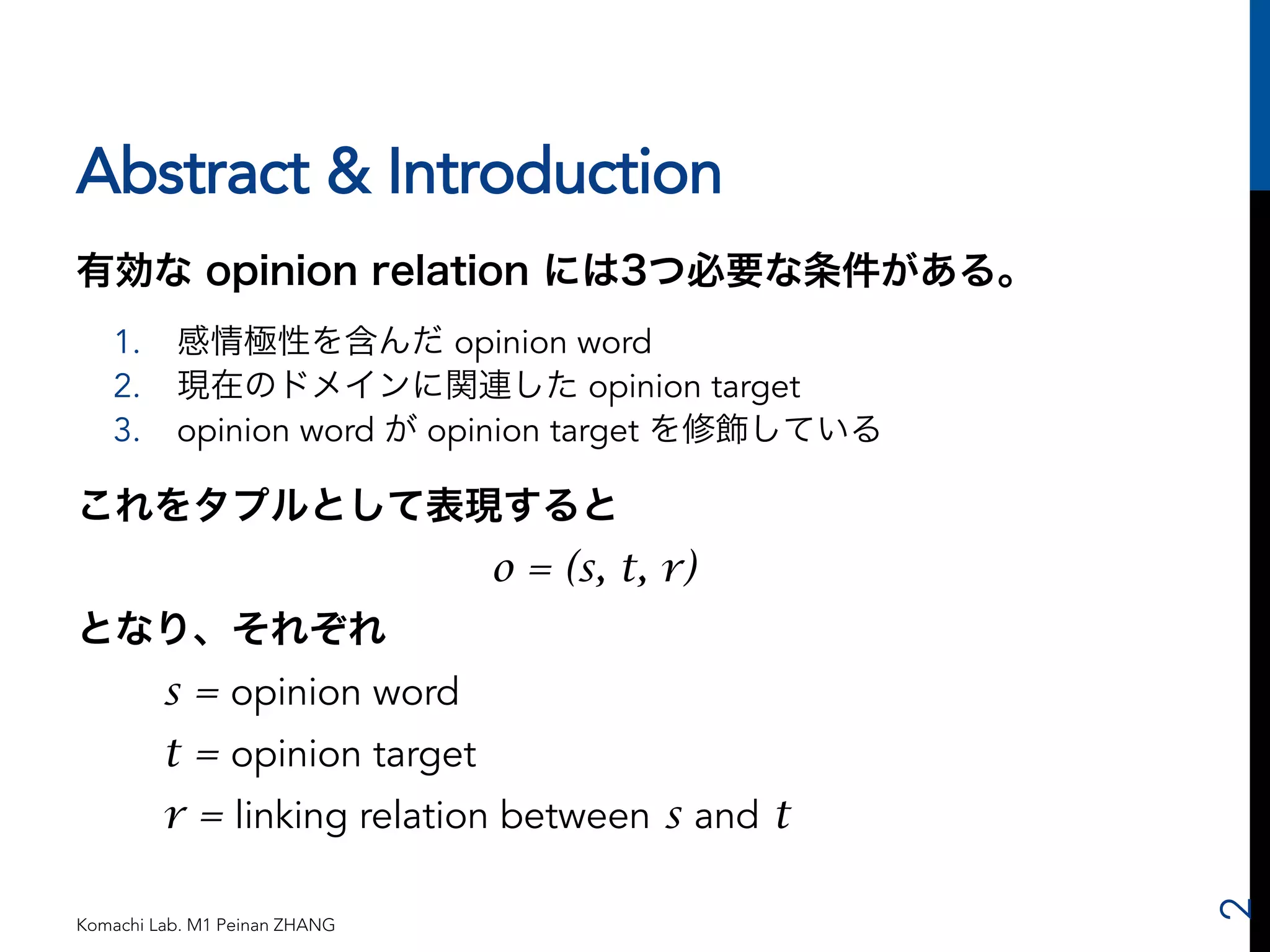
有効な opinion relation には3つ必要な条件がある。 
1. 感情極性を含んだ opinion word 
2. 現在のドメインに関連した opinion target 
3. opinion word が opinion target を修飾している 
これをタプルとして表現すると 
Komachi Lab. M1 Peinan ZHANG 
o = (s, t, r) 
となり、それぞれ 
s = opinion word 
t = opinion target 
r = linking relation between s and t 
2
Assumption 1 
Terms are likely to have linking relation with the seed 
terms are believed to be opinion words or opinion 
targets. 
seed terms とのリンクを持つ単語は opinion words 
もしくは opinion targets である。 
Komachi Lab. M1 Peinan ZHANG 
3
Abstract & Introduction 
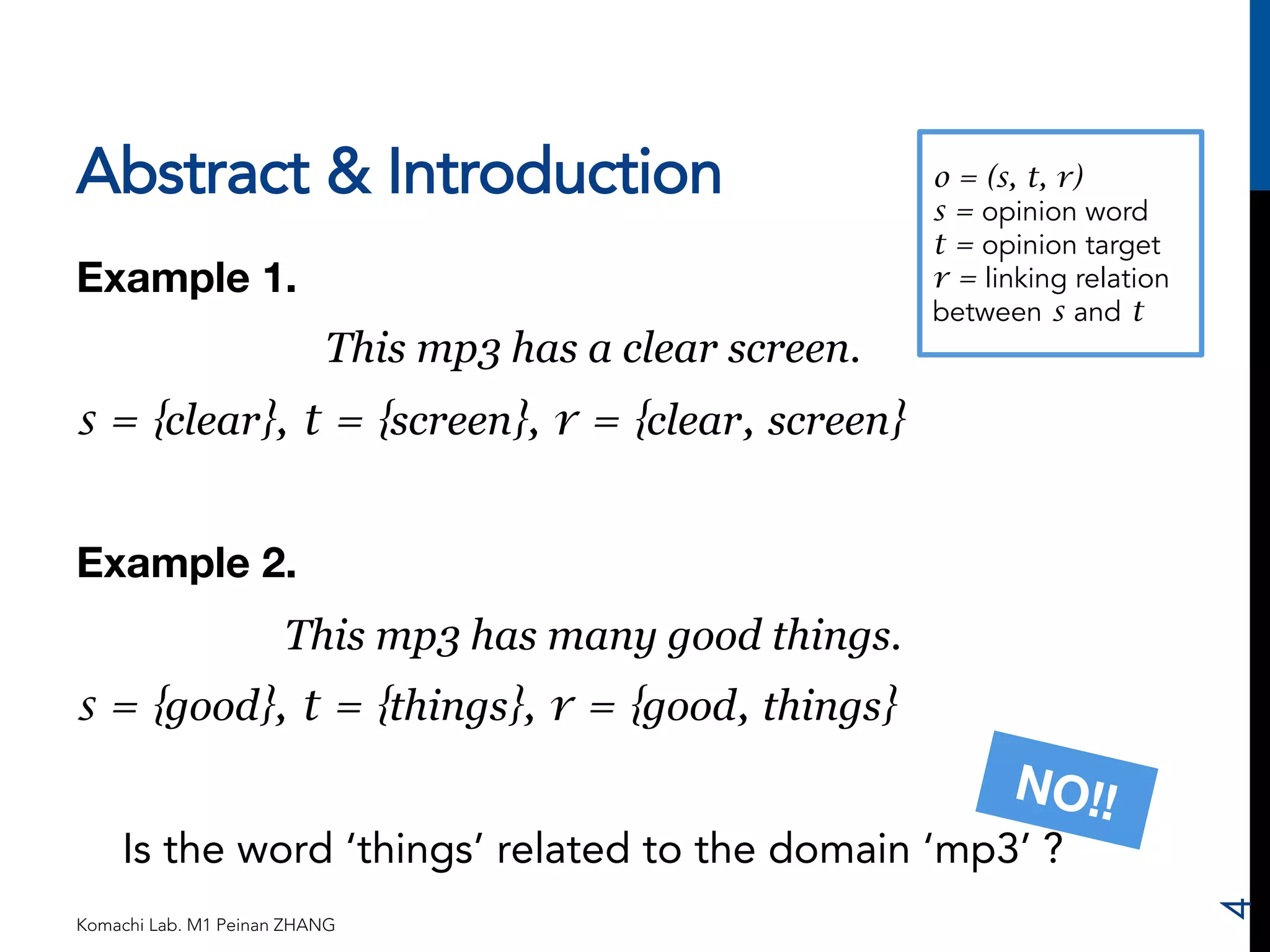
Example 1. 
This mp3 has a clear screen. 
s = {clear}, t = {screen}, r = {clear, screen} 
Example 2. 
This mp3 has many good things. 
s = {good}, t = {things}, r = {good, things} 
o = (s, t, r) 
s = opinion word 
t = opinion target 
r = linking relation 
between s and t 
Is the word ‘things’ related to the domain ‘mp3’ ? 
Komachi Lab. M1 Peinan ZHANG 
4 
NO!!
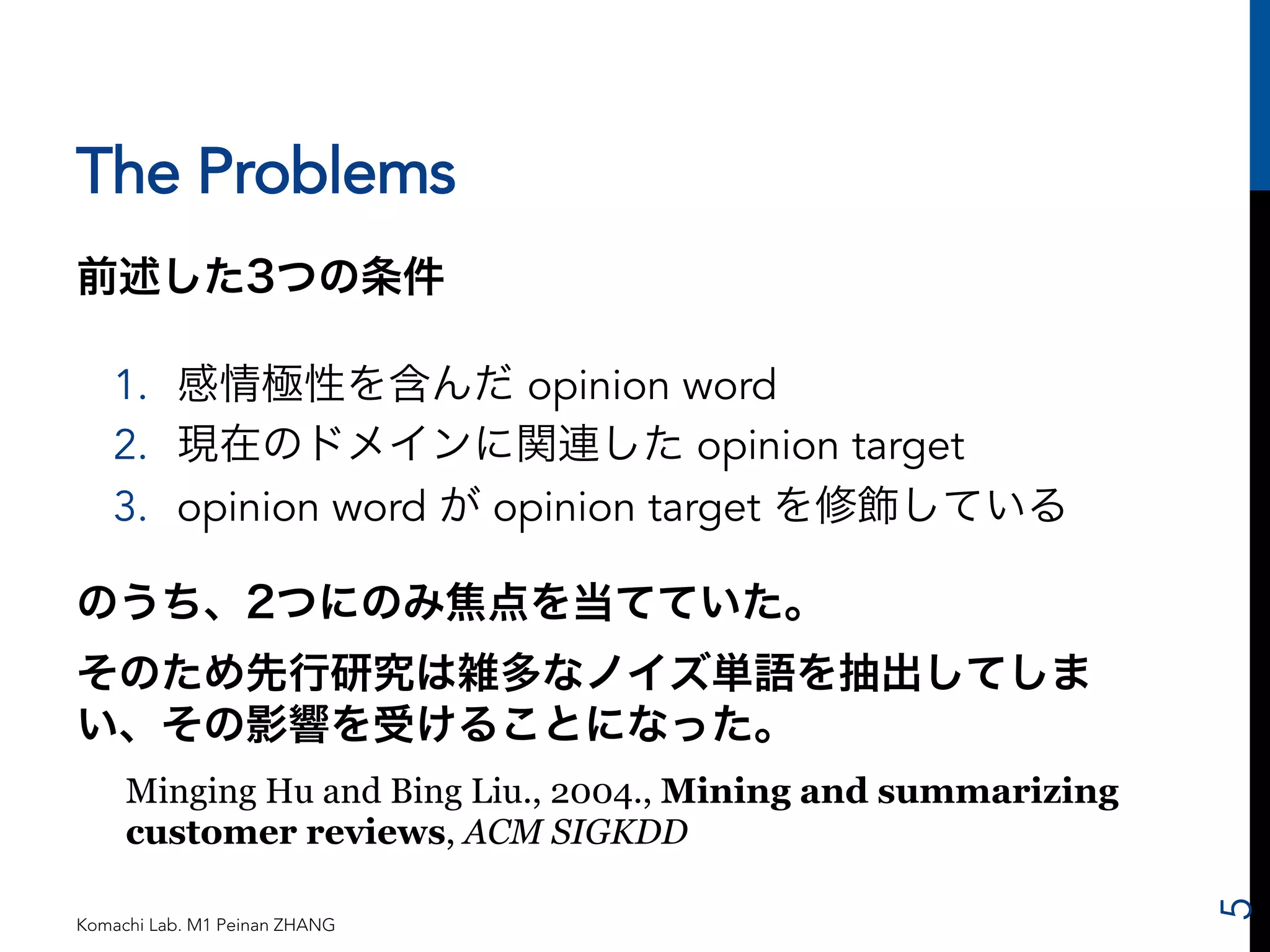
The Problems 
前述した3つの条件 
1. 感情極性を含んだ opinion word 
2. 現在のドメインに関連した opinion target 
3. opinion word が opinion target を修飾している 
のうち、2つにのみ焦点を当てていた。 
そのため先行研究は雑多なノイズ単語を抽出してしま 
い、その影響を受けることになった。 
Minging Hu and Bing Liu., 2004., Mining and summarizing 
customer reviews, ACM SIGKDD 
Komachi Lab. M1 Peinan ZHANG 
5
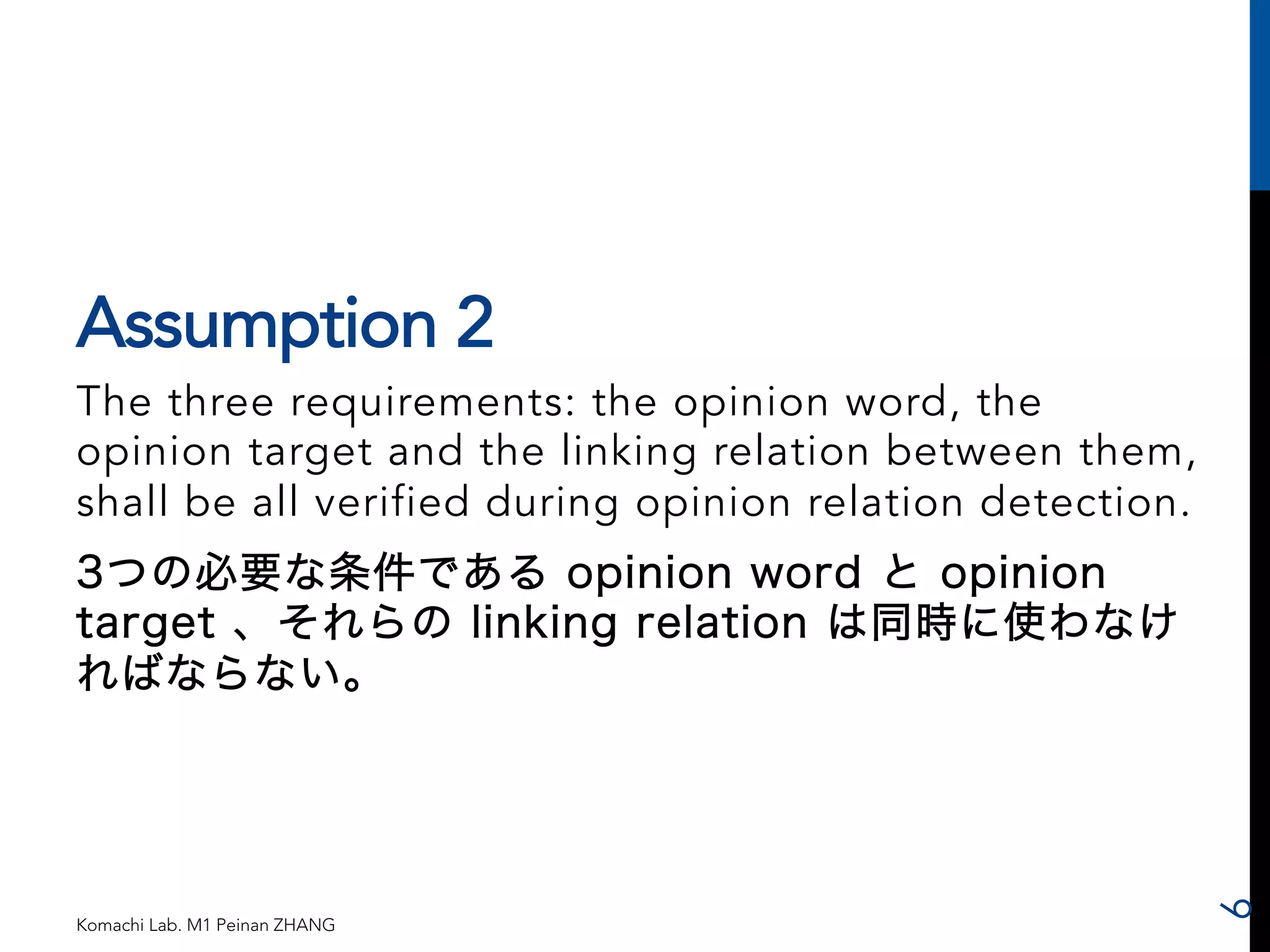
Assumption 2 
The three requirements: the opinion word, the 
opinion target and the linking relation between them, 
shall be all verified during opinion relation detection. 
3つの必要な条件である opinion word と opinion 
target 、それらの linking relation は同時に使わなけ 
ればならない。 
Komachi Lab. M1 Peinan ZHANG 
6
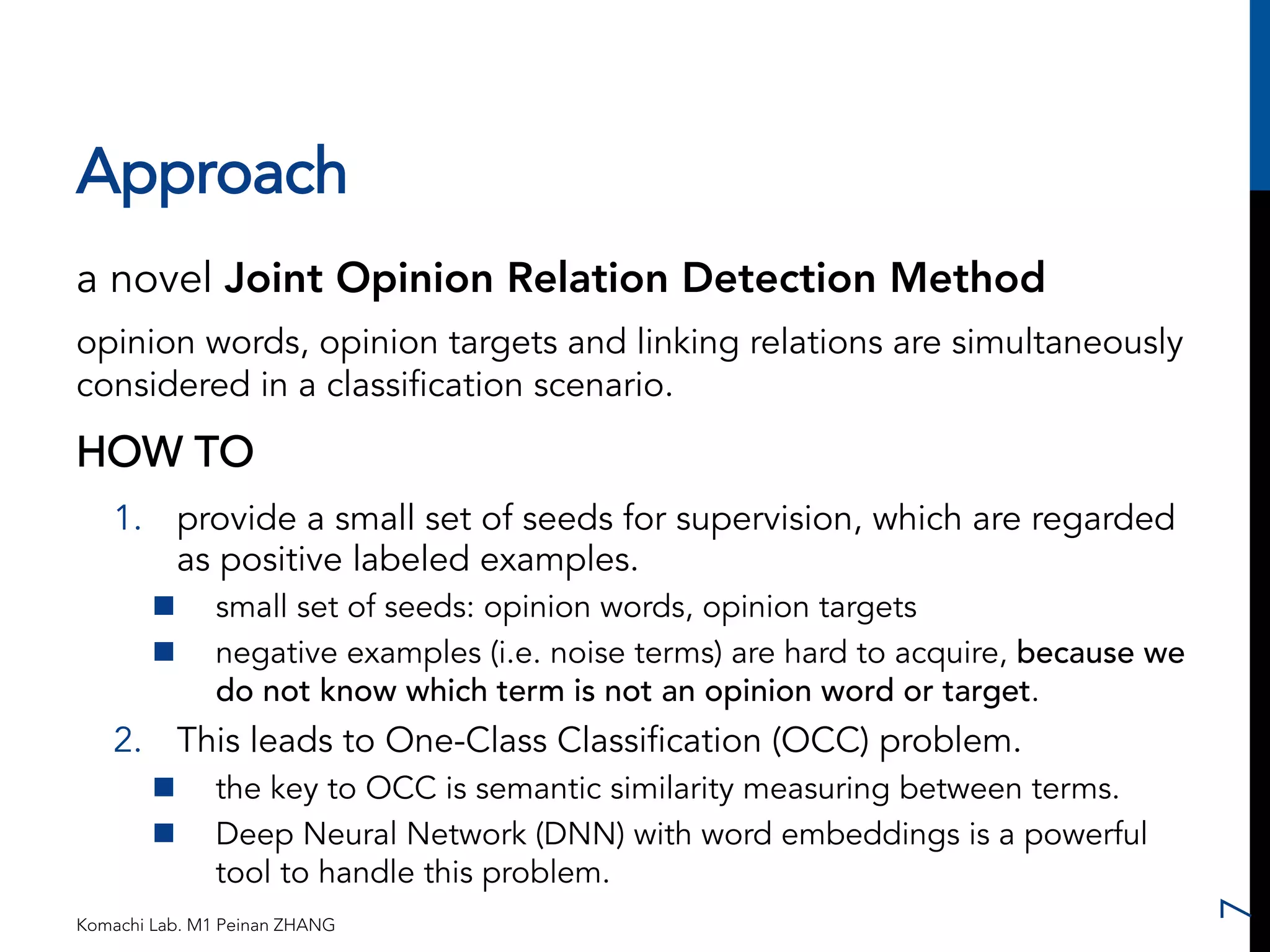
Approach 
a novel Joint Opinion Relation Detection Method 
opinion words, opinion targets and linking relations are simultaneously 
considered in a classification scenario. 
HOW TO 
1. provide a small set of seeds for supervision, which are regarded 
as positive labeled examples. 
n small set of seeds: opinion words, opinion targets 
n negative examples (i.e. noise terms) are hard to acquire, because we 
do not know which term is not an opinion word or target. 
2. This leads to One-Class Classification (OCC) problem. 
n the key to OCC is semantic similarity measuring between terms. 
n Deep Neural Network (DNN) with word embeddings is a powerful 
tool to handle this problem. 
Komachi Lab. M1 Peinan ZHANG 
7
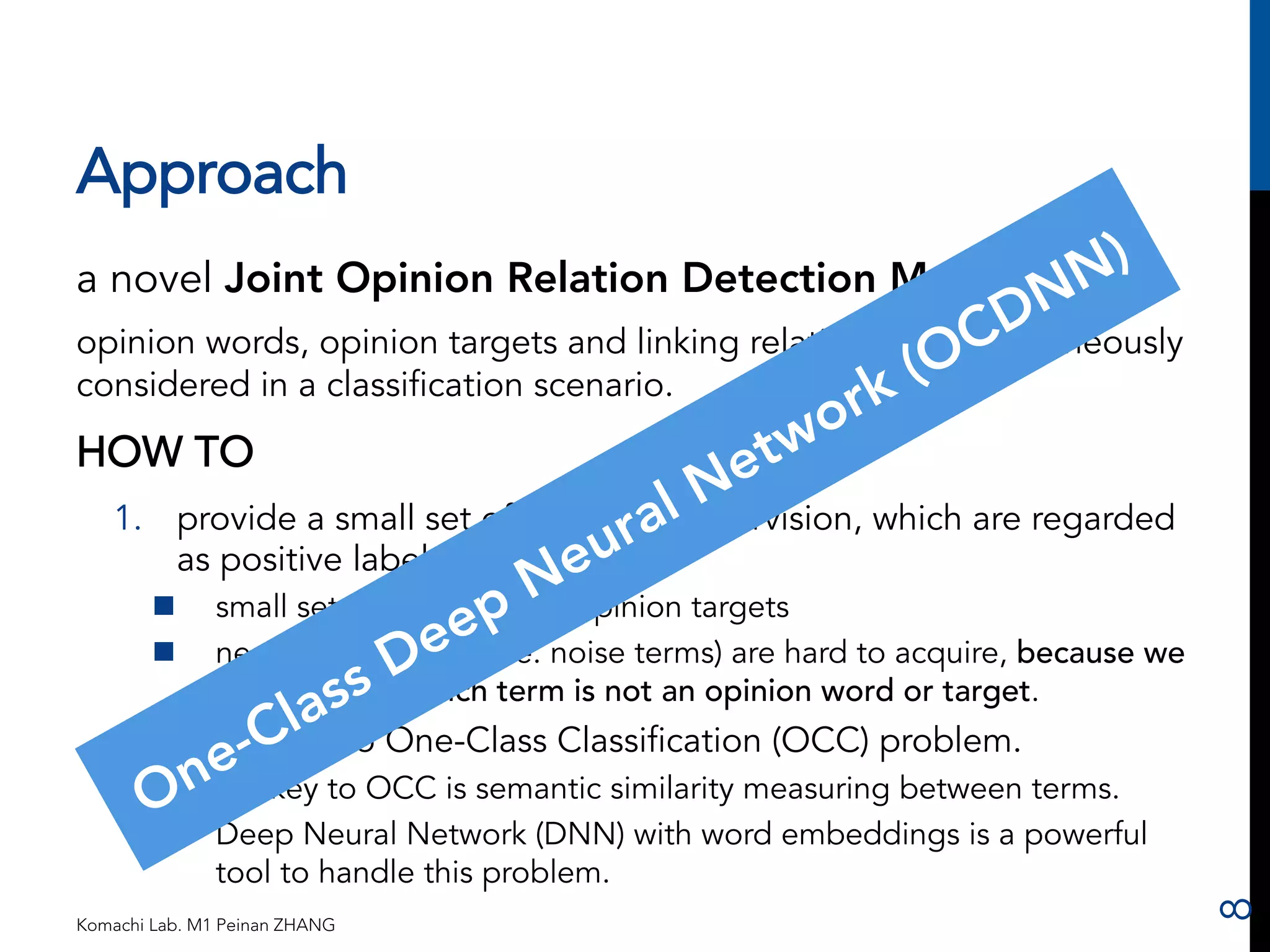
Approach 
a novel Joint Opinion Relation Detection Method 
opinion words, opinion targets and linking relations are simultaneously 
considered in a classification scenario. 
HOW TO 
1. provide a small set of seeds for supervision, which are regarded 
as positive labeled examples. 
n small set: opinion words, opinion targets 
n negative examples (i.e. noise terms) are hard to acquire, because we 
do not know which term is not an opinion word or target. 
2. This leads to One-Class Classification (OCC) problem. 
n the key to OCC is semantic similarity measuring between terms. 
n Deep Neural Network (DNN) with word embeddings is a powerful 
tool to handle this problem. 
Komachi Lab. M1 Peinan ZHANG 
8
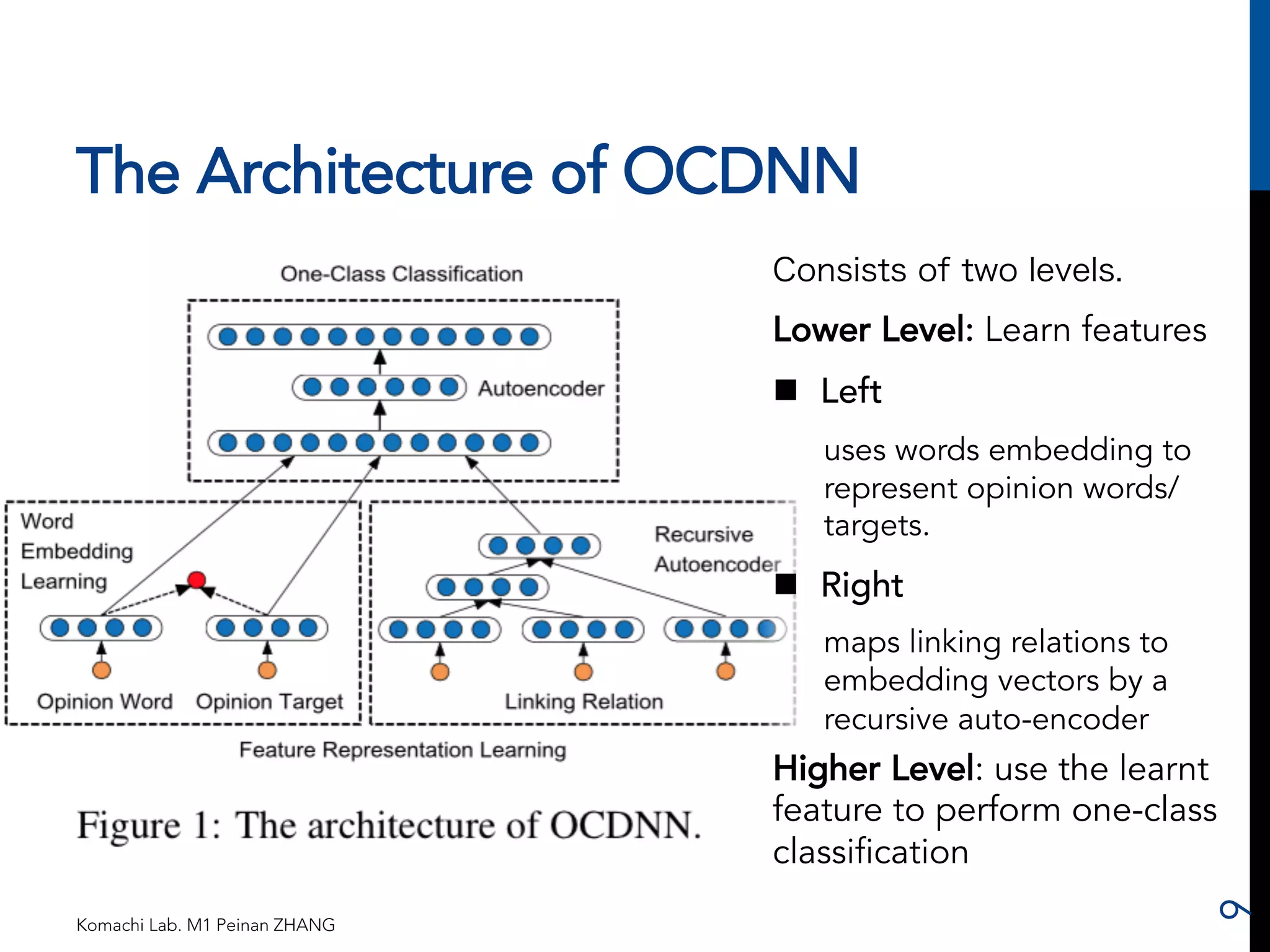
The Architecture of OCDNN 
Komachi Lab. M1 Peinan ZHANG 
9 
Consists of two levels. 
Lower Level: Learn features 
n Left 
uses words embedding to 
represent opinion words/ 
targets. 
n Right 
maps linking relations to 
embedding vectors by a 
recursive auto-encoder 
Higher Level: use the learnt 
feature to perform one-class 
classification
Outline 
1. Abstract & Introduction 
2. Approach 
3. The Architecture of OCDNN 
1. Generate Opinion Seeds 
2. Generate Opinion Relation Candidates 
3. Represent Words 
4. Represent Linking Relation 
5. One-Class Classification 
4. Datasets & Experiments 
5. Conclusion 
Komachi Lab. M1 Peinan ZHANG 
10
Outline 
1. Abstract & Introduction 
2. Approach 
3. The Architecture of OCDNN 
1. Generate Opinion Seeds 
2. Generate Opinion Relation Candidates 
3. Represent Words 
4. Represent Linking Relation 
5. One-Class Classification 
4. Datasets & Experiments 
5. Conclusion 
Komachi Lab. M1 Peinan ZHANG 
11
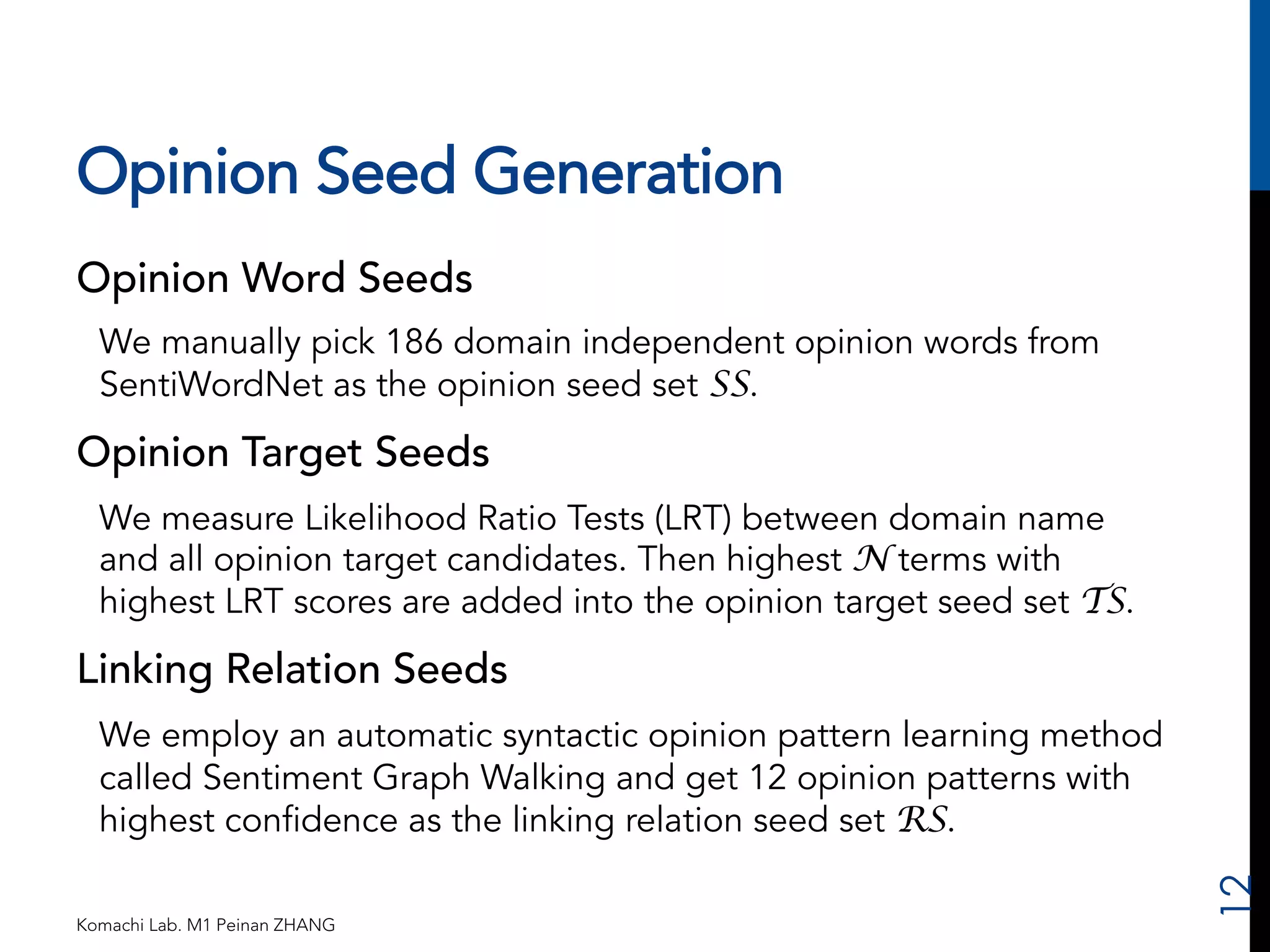
Opinion Seed Generation 
Opinion Word Seeds 
We manually pick 186 domain independent opinion words from 
SentiWordNet as the opinion seed set SS. 
Opinion Target Seeds 
We measure Likelihood Ratio Tests (LRT) between domain name 
and all opinion target candidates. Then highest N terms with 
highest LRT scores are added into the opinion target seed set TS. 
Linking Relation Seeds 
We employ an automatic syntactic opinion pattern learning method 
called Sentiment Graph Walking and get 12 opinion patterns with 
highest confidence as the linking relation seed set RS. 
Komachi Lab. M1 Peinan ZHANG 
12
Opinion Relation Candidate Generation 
Opinion Word Candidates: 
p adjectives or verbs 
Opinion Target Candidates: 
p noun or noun phrases 
Opinion Relation Candidates: 
p get dependency tree of a sentence using Stanford Parser 
p the shortest dependency path between a c_s and a c_t is 
taken as a c_r 
p to avoid introducing too many noise candidates, we 
constrain that there are at most 4 terms in a c_r 
Komachi Lab. M1 Peinan ZHANG 
13
Word Representation by 
Word Embedding Learning 
Words are embedded into a hyperspace, where 2 words 
that are more semantically similar to each other are 
located closer. (something like word2vec) 
See more in the paper below, 
Ronan Collobert et al., 2011., Natural language processing 
(almost) from scratch, Journal of Machine Learning Research 
Komachi Lab. M1 Peinan ZHANG 
14
Linking Relation Representation by 
Using Recursive Auto-encoder 
Goal: represent the linking relation between an opinion 
word and an opinion target by a n-element vector as we do 
during word representation. 
We combined embedding vectors of words in a linking 
relation by a recursive auto-encoder according to syntactic 
dependency structure. 
Komachi Lab. M1 Peinan ZHANG 
15
Linking Relation Representation by 
Using Recursive Auto-encoder 
Komachi Lab. M1 Peinan ZHANG 
1. c_s と c_t との間の係 
り受け関係を取ってくる。 
2. c_s と c_t をそれぞれ 
[SC] と [ST] に置き換え 
る。 
3. 点線内を3層からなる 
auto-encoder とし、2つ 
の n-element vector を 
中間層で1つの n-element 
vector に圧縮す 
る(下式)。 
4. W を入力と出力のユー 
クリッド距離が最小にな 
るまで更新していく。 
16 
Example. too loud to listen to the player
One-Class Classification for 
Opinion Relation Detection 
We represent an opinion relation candidate c_o by a vector 
v_o=[v_s; v_t; v_r], and this vector v_o is to feed to 
upper level auto-encoder. 
For opinion relation detection, error scores that are smaller 
than a threshold theta are classified as positive. 
To estimate theta, we need to introduce a positive 
proportion (pp) score as follows, 
Komachi Lab. M1 Peinan ZHANG 
17
Opinion Target Expansion 
We apply bootstrapping to iteratively expand opinion 
targets seeds. 
p because the vocabulary of seed set is limited, which cannot fully 
represent the distribution of opinion targets. 
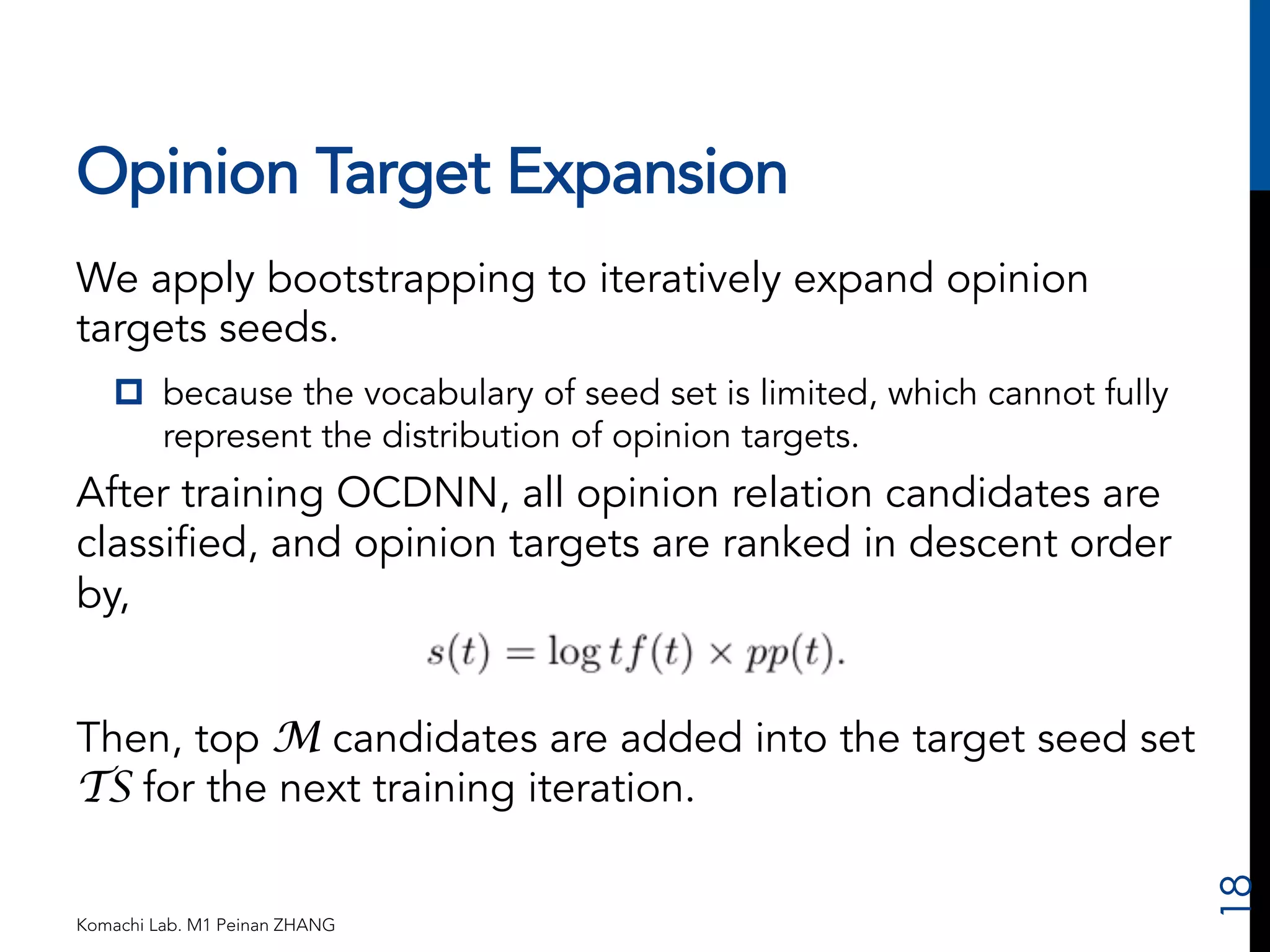
After training OCDNN, all opinion relation candidates are 
classified, and opinion targets are ranked in descent order 
by, 
Then, top M candidates are added into the target seed set 
TS for the next training iteration. 
Komachi Lab. M1 Peinan ZHANG 
18
Datasets 
Datasets 
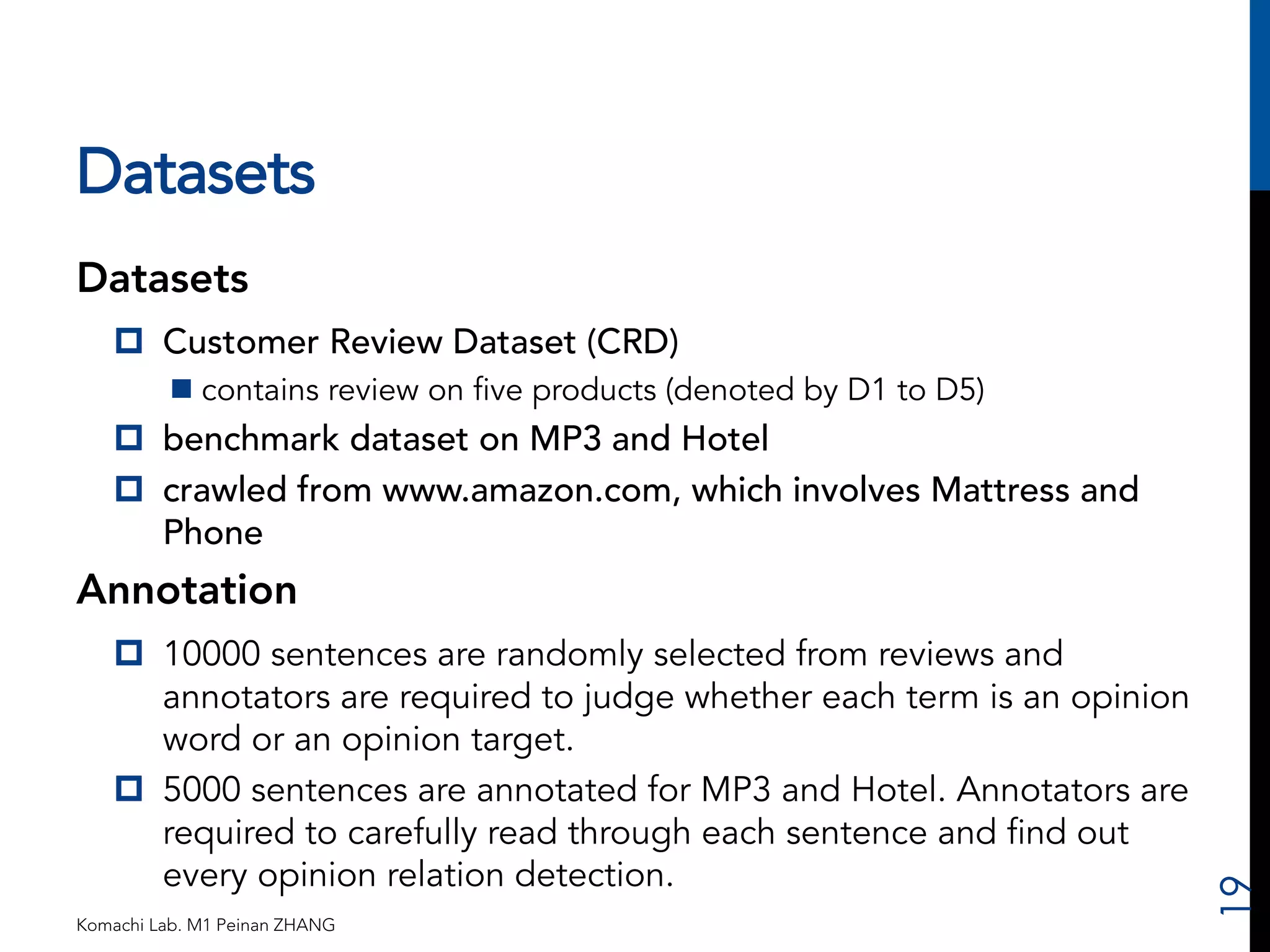
p Customer Review Dataset (CRD) 
n contains review on five products (denoted by D1 to D5) 
p benchmark dataset on MP3 and Hotel 
p crawled from www.amazon.com, which involves Mattress and 
Phone 
Annotation 
p 10000 sentences are randomly selected from reviews and 
annotators are required to judge whether each term is an opinion 
word or an opinion target. 
p 5000 sentences are annotated for MP3 and Hotel. Annotators are 
required to carefully read through each sentence and find out 
every opinion relation detection. 
Komachi Lab. M1 Peinan ZHANG 
19
Evaluation Settings 
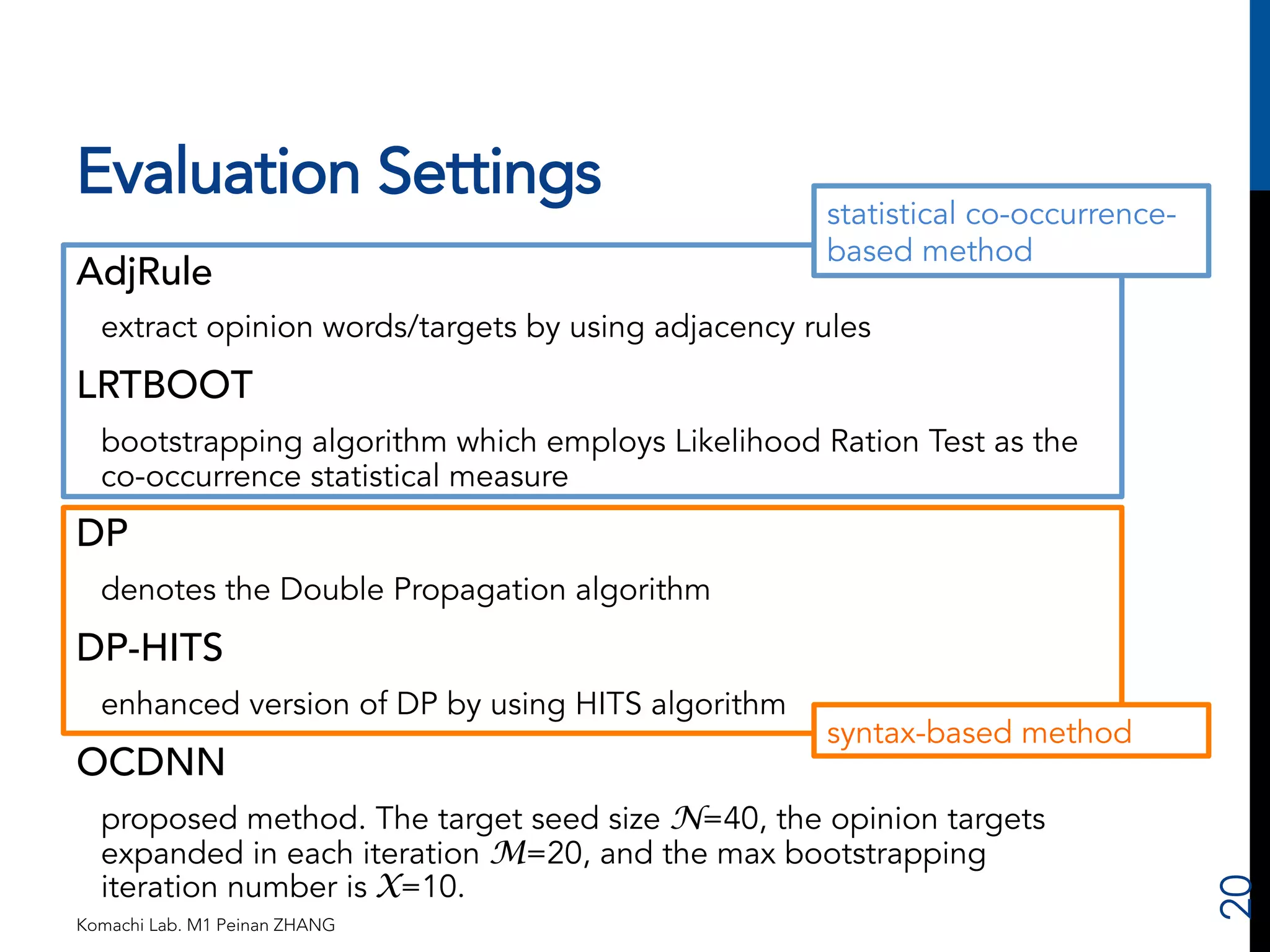
AdjRule 
extract opinion words/targets by using adjacency rules 
LRTBOOT 
bootstrapping algorithm which employs Likelihood Ration Test as the 
co-occurrence statistical measure 
DP 
denotes the Double Propagation algorithm 
DP-HITS 
enhanced version of DP by using HITS algorithm 
OCDNN 
proposed method. The target seed size N=40, the opinion targets 
expanded in each iteration M=20, and the max bootstrapping 
iteration number is X=10. 
Komachi Lab. M1 Peinan ZHANG 
20 
statistical co-occurrence-based 
method 
syntax-based method
Experiments 
DP-HITS does not extract opinion words so their results for 
opinion words are not taken into account. 
Komachi Lab. M1 Peinan ZHANG 
21
Experiments 
Komachi Lab. M1 Peinan ZHANG 
22
Experiments 
Komachi Lab. M1 Peinan ZHANG 
23 
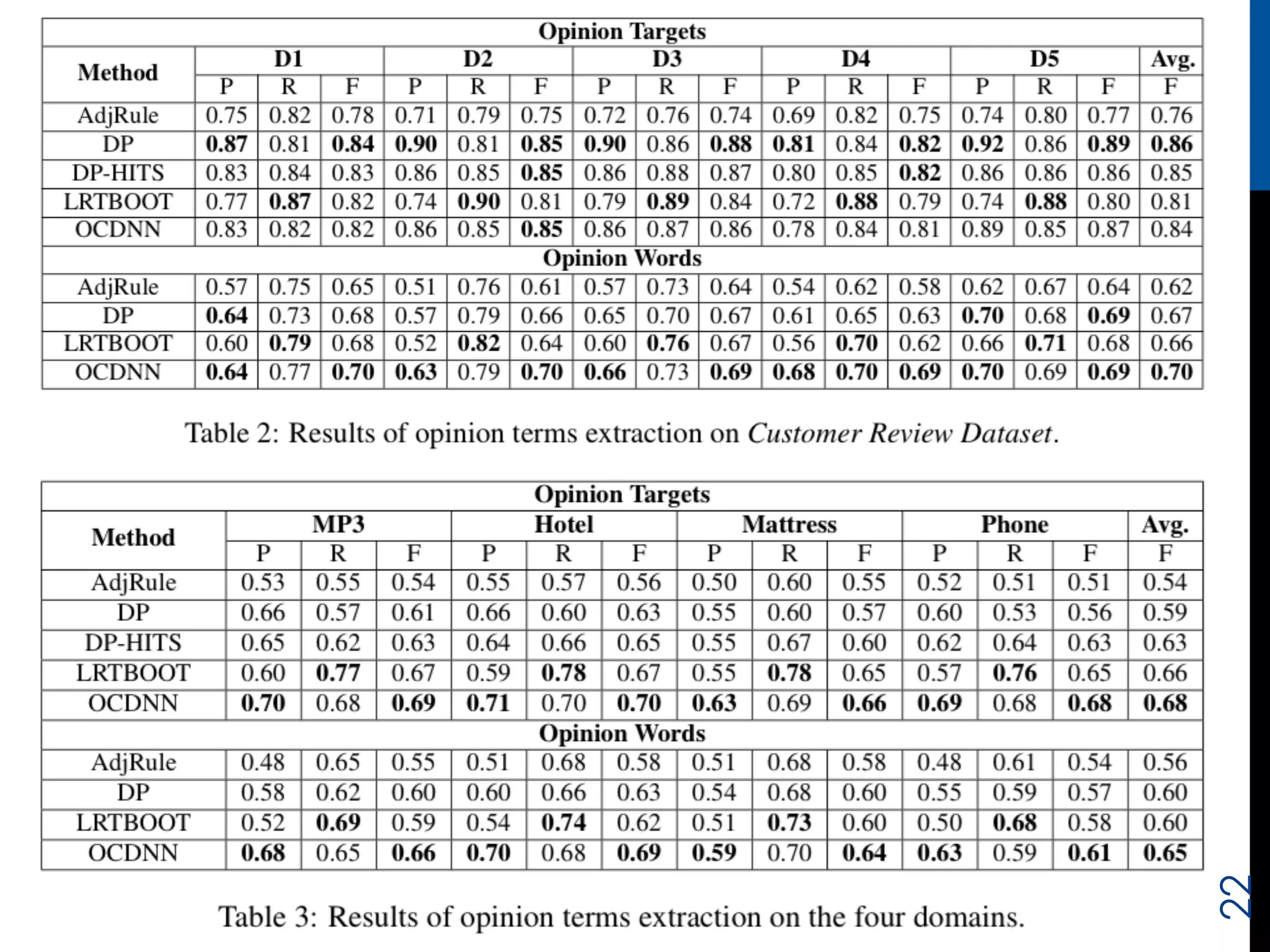
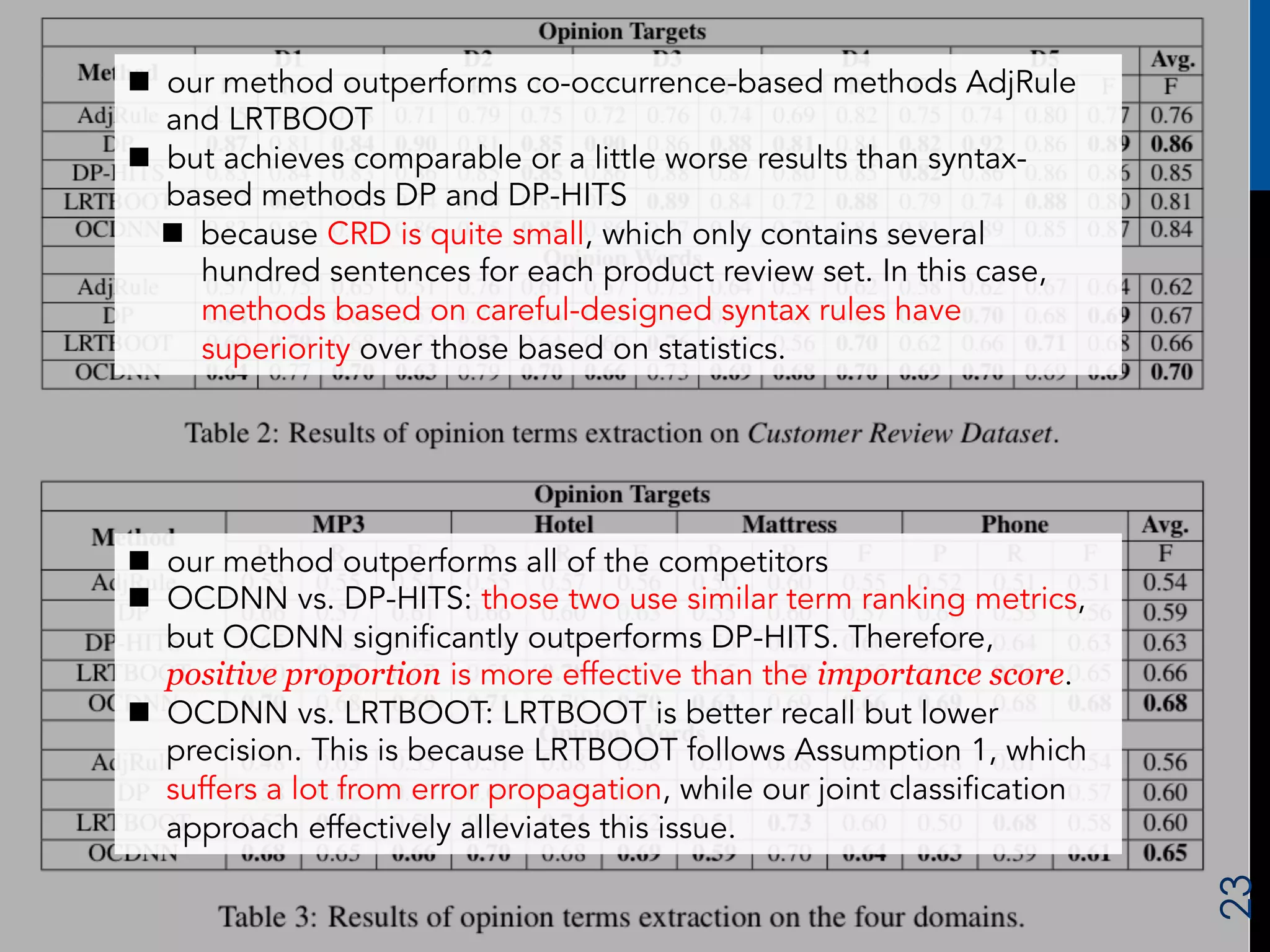
n our method outperforms co-occurrence-based methods AdjRule 
and LRTBOOT 
n but achieves comparable or a little worse results than syntax-based 
methods DP and DP-HITS 
n because CRD is quite small, which only contains several 
hundred sentences for each product review set. In this case, 
methods based on careful-designed syntax rules have 
superiority over those based on statistics. 
n our method outperforms all of the competitors 
n OCDNN vs. DP-HITS: those two use similar term ranking metrics, 
but OCDNN significantly outperforms DP-HITS. Therefore, 
positive proportion is more effective than the importance score. 
n OCDNN vs. LRTBOOT: LRTBOOT is better recall but lower 
precision. This is because LRTBOOT follows Assumption 1, which 
suffers a lot from error propagation, while our joint classification 
approach effectively alleviates this issue.
Assumption 1 vs. Assumption 2 
Komachi Lab. M1 Peinan ZHANG 
24
Komachi Lab. M1 Peinan ZHANG 
25 
Assumption 1 vs. Assumption 2 
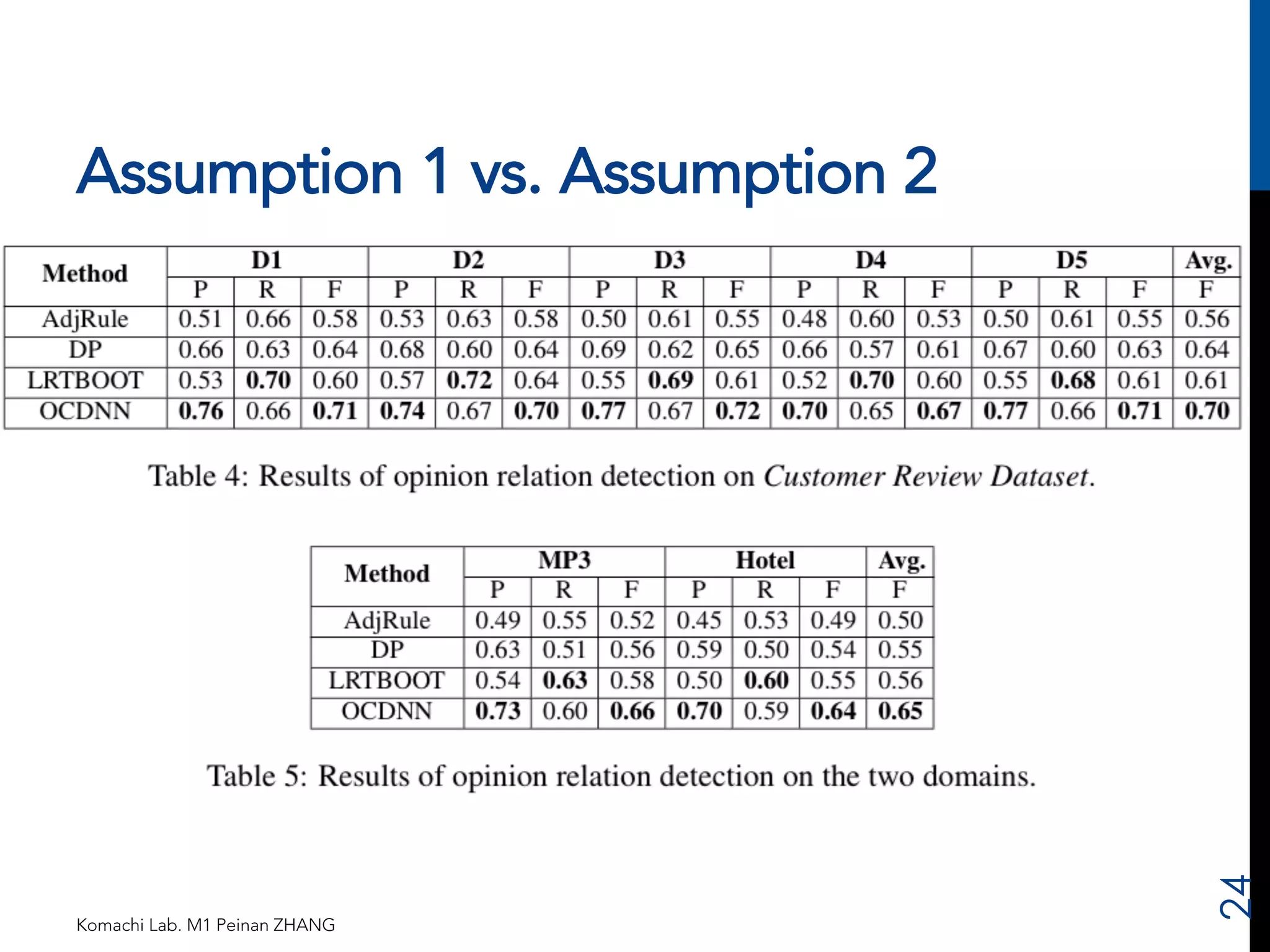
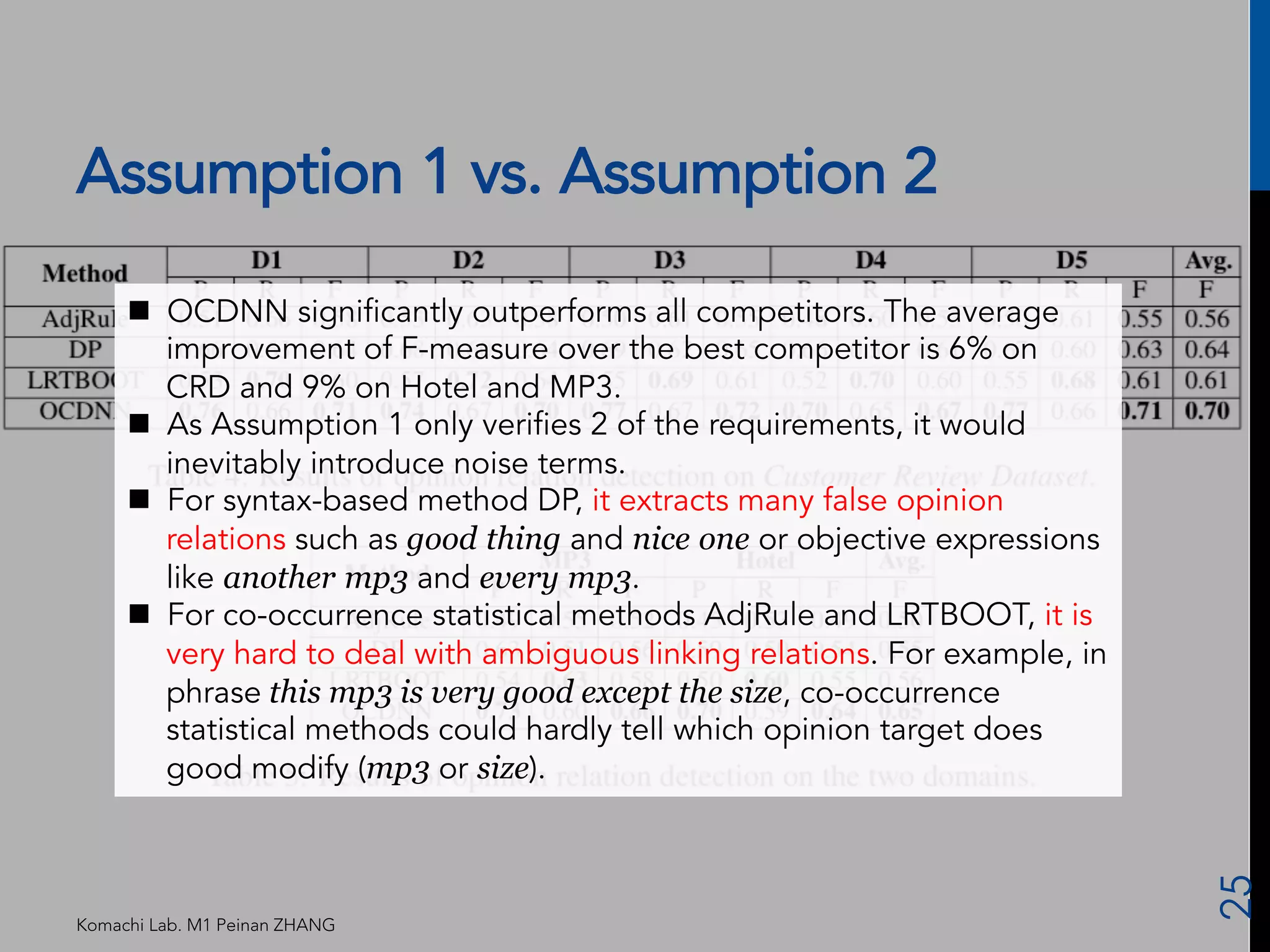
n OCDNN significantly outperforms all competitors. The average 
improvement of F-measure over the best competitor is 6% on 
CRD and 9% on Hotel and MP3. 
n As Assumption 1 only verifies 2 of the requirements, it would 
inevitably introduce noise terms. 
n For syntax-based method DP, it extracts many false opinion 
relations such as good thing and nice one or objective expressions 
like another mp3 and every mp3. 
n For co-occurrence statistical methods AdjRule and LRTBOOT, it is 
very hard to deal with ambiguous linking relations. For example, in 
phrase this mp3 is very good except the size, co-occurrence 
statistical methods could hardly tell which opinion target does 
good modify (mp3 or size).
Conclusion 
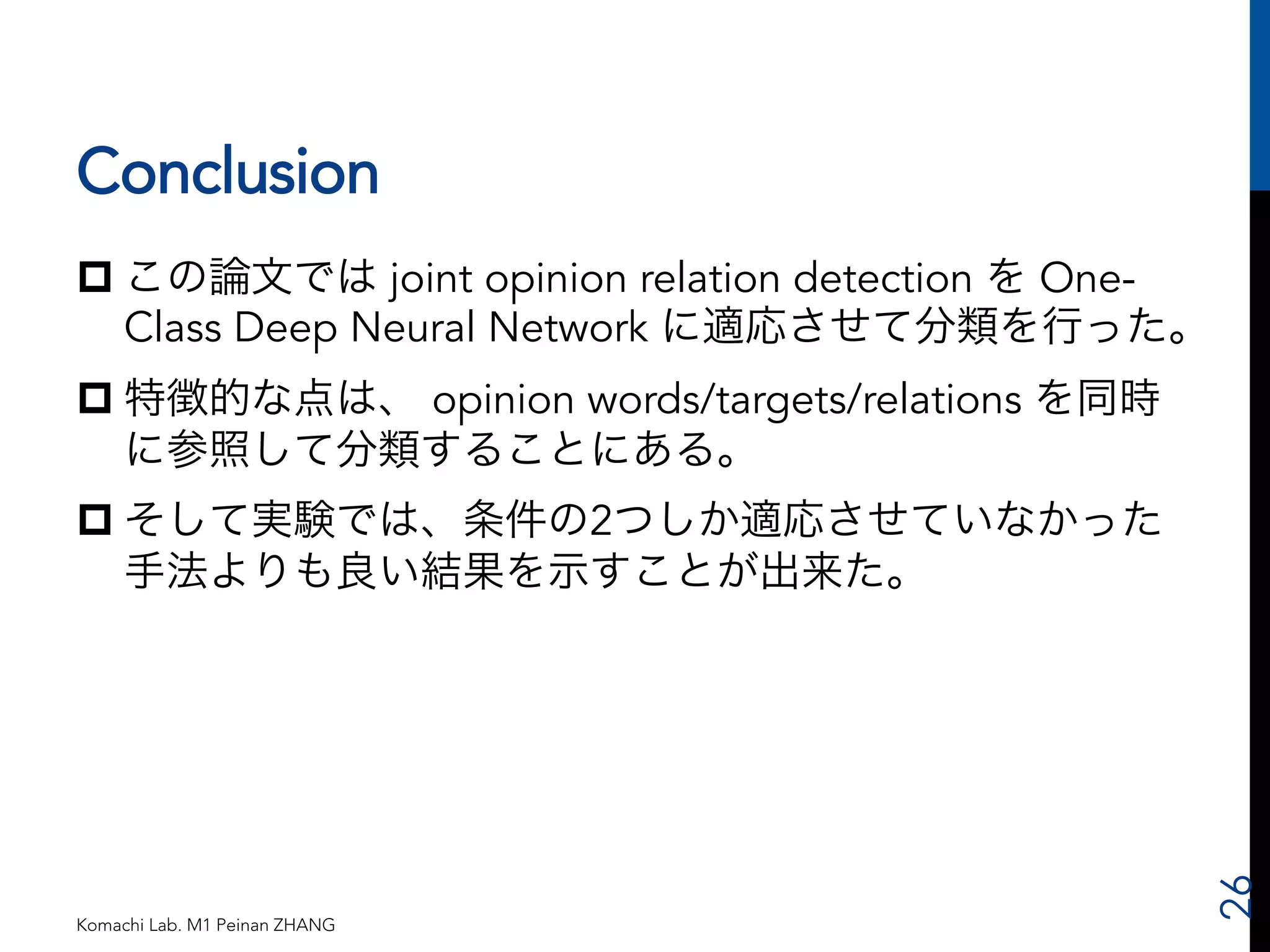
p この論文では joint opinion relation detection を One- 
Class Deep Neural Network に適応させて分類を行った。 
p 特徴的な点は、 opinion words/targets/relations を同時 
に参照して分類することにある。 
p そして実験では、条件の2つしか適応させていなかった 
手法よりも良い結果を示すことが出来た。 
Komachi Lab. M1 Peinan ZHANG 
26
Conclusion 
1. Abstract & Introduction 
2. Approach 
3. The Architecture of OCDNN 
1. Generate Opinion Seeds 
2. Generate Opinion Relation Candidates 
3. Represent Words 
4. Represent Linking Relation 
5. One-Class Classification 
4. Datasets & Experiments 
5. Conclusion 
Komachi Lab. M1 Peinan ZHANG 
27

COLING 2014: Joint Opinion Relation Detection Using One-Class Deep Neural Network

  • 1.
    Joint Opinion RelationDetection Using One-Class Deep Neural Network COLING 2014 reading @ Komachi Lab Komachi Lab. M1 Peinan ZHANG
  • 2.
    Abstract & Introduction 有効な opinion relation には3つ必要な条件がある。 1. 感情極性を含んだ opinion word 2. 現在のドメインに関連した opinion target 3. opinion word が opinion target を修飾している これをタプルとして表現すると Komachi Lab. M1 Peinan ZHANG o = (s, t, r) となり、それぞれ s = opinion word t = opinion target r = linking relation between s and t 2
  • 3.
    Assumption 1 Termsare likely to have linking relation with the seed terms are believed to be opinion words or opinion targets. seed terms とのリンクを持つ単語は opinion words もしくは opinion targets である。 Komachi Lab. M1 Peinan ZHANG 3
  • 4.
    Abstract & Introduction Example 1. This mp3 has a clear screen. s = {clear}, t = {screen}, r = {clear, screen} Example 2. This mp3 has many good things. s = {good}, t = {things}, r = {good, things} o = (s, t, r) s = opinion word t = opinion target r = linking relation between s and t Is the word ‘things’ related to the domain ‘mp3’ ? Komachi Lab. M1 Peinan ZHANG 4 NO!!
  • 5.
    The Problems 前述した3つの条件 1. 感情極性を含んだ opinion word 2. 現在のドメインに関連した opinion target 3. opinion word が opinion target を修飾している のうち、2つにのみ焦点を当てていた。 そのため先行研究は雑多なノイズ単語を抽出してしま い、その影響を受けることになった。 Minging Hu and Bing Liu., 2004., Mining and summarizing customer reviews, ACM SIGKDD Komachi Lab. M1 Peinan ZHANG 5
  • 6.
    Assumption 2 Thethree requirements: the opinion word, the opinion target and the linking relation between them, shall be all verified during opinion relation detection. 3つの必要な条件である opinion word と opinion target 、それらの linking relation は同時に使わなけ ればならない。 Komachi Lab. M1 Peinan ZHANG 6
  • 7.
    Approach a novelJoint Opinion Relation Detection Method opinion words, opinion targets and linking relations are simultaneously considered in a classification scenario. HOW TO 1. provide a small set of seeds for supervision, which are regarded as positive labeled examples. n small set of seeds: opinion words, opinion targets n negative examples (i.e. noise terms) are hard to acquire, because we do not know which term is not an opinion word or target. 2. This leads to One-Class Classification (OCC) problem. n the key to OCC is semantic similarity measuring between terms. n Deep Neural Network (DNN) with word embeddings is a powerful tool to handle this problem. Komachi Lab. M1 Peinan ZHANG 7
  • 8.
    Approach a novelJoint Opinion Relation Detection Method opinion words, opinion targets and linking relations are simultaneously considered in a classification scenario. HOW TO 1. provide a small set of seeds for supervision, which are regarded as positive labeled examples. n small set: opinion words, opinion targets n negative examples (i.e. noise terms) are hard to acquire, because we do not know which term is not an opinion word or target. 2. This leads to One-Class Classification (OCC) problem. n the key to OCC is semantic similarity measuring between terms. n Deep Neural Network (DNN) with word embeddings is a powerful tool to handle this problem. Komachi Lab. M1 Peinan ZHANG 8
  • 9.
    The Architecture ofOCDNN Komachi Lab. M1 Peinan ZHANG 9 Consists of two levels. Lower Level: Learn features n Left uses words embedding to represent opinion words/ targets. n Right maps linking relations to embedding vectors by a recursive auto-encoder Higher Level: use the learnt feature to perform one-class classification
  • 10.
    Outline 1. Abstract& Introduction 2. Approach 3. The Architecture of OCDNN 1. Generate Opinion Seeds 2. Generate Opinion Relation Candidates 3. Represent Words 4. Represent Linking Relation 5. One-Class Classification 4. Datasets & Experiments 5. Conclusion Komachi Lab. M1 Peinan ZHANG 10
  • 11.
    Outline 1. Abstract& Introduction 2. Approach 3. The Architecture of OCDNN 1. Generate Opinion Seeds 2. Generate Opinion Relation Candidates 3. Represent Words 4. Represent Linking Relation 5. One-Class Classification 4. Datasets & Experiments 5. Conclusion Komachi Lab. M1 Peinan ZHANG 11
  • 12.
    Opinion Seed Generation Opinion Word Seeds We manually pick 186 domain independent opinion words from SentiWordNet as the opinion seed set SS. Opinion Target Seeds We measure Likelihood Ratio Tests (LRT) between domain name and all opinion target candidates. Then highest N terms with highest LRT scores are added into the opinion target seed set TS. Linking Relation Seeds We employ an automatic syntactic opinion pattern learning method called Sentiment Graph Walking and get 12 opinion patterns with highest confidence as the linking relation seed set RS. Komachi Lab. M1 Peinan ZHANG 12
  • 13.
    Opinion Relation CandidateGeneration Opinion Word Candidates: p adjectives or verbs Opinion Target Candidates: p noun or noun phrases Opinion Relation Candidates: p get dependency tree of a sentence using Stanford Parser p the shortest dependency path between a c_s and a c_t is taken as a c_r p to avoid introducing too many noise candidates, we constrain that there are at most 4 terms in a c_r Komachi Lab. M1 Peinan ZHANG 13
  • 14.
    Word Representation by Word Embedding Learning Words are embedded into a hyperspace, where 2 words that are more semantically similar to each other are located closer. (something like word2vec) See more in the paper below, Ronan Collobert et al., 2011., Natural language processing (almost) from scratch, Journal of Machine Learning Research Komachi Lab. M1 Peinan ZHANG 14
  • 15.
    Linking Relation Representationby Using Recursive Auto-encoder Goal: represent the linking relation between an opinion word and an opinion target by a n-element vector as we do during word representation. We combined embedding vectors of words in a linking relation by a recursive auto-encoder according to syntactic dependency structure. Komachi Lab. M1 Peinan ZHANG 15
  • 16.
    Linking Relation Representationby Using Recursive Auto-encoder Komachi Lab. M1 Peinan ZHANG 1. c_s と c_t との間の係 り受け関係を取ってくる。 2. c_s と c_t をそれぞれ [SC] と [ST] に置き換え る。 3. 点線内を3層からなる auto-encoder とし、2つ の n-element vector を 中間層で1つの n-element vector に圧縮す る(下式)。 4. W を入力と出力のユー クリッド距離が最小にな るまで更新していく。 16 Example. too loud to listen to the player
  • 17.
    One-Class Classification for Opinion Relation Detection We represent an opinion relation candidate c_o by a vector v_o=[v_s; v_t; v_r], and this vector v_o is to feed to upper level auto-encoder. For opinion relation detection, error scores that are smaller than a threshold theta are classified as positive. To estimate theta, we need to introduce a positive proportion (pp) score as follows, Komachi Lab. M1 Peinan ZHANG 17
  • 18.
    Opinion Target Expansion We apply bootstrapping to iteratively expand opinion targets seeds. p because the vocabulary of seed set is limited, which cannot fully represent the distribution of opinion targets. After training OCDNN, all opinion relation candidates are classified, and opinion targets are ranked in descent order by, Then, top M candidates are added into the target seed set TS for the next training iteration. Komachi Lab. M1 Peinan ZHANG 18
  • 19.
    Datasets Datasets pCustomer Review Dataset (CRD) n contains review on five products (denoted by D1 to D5) p benchmark dataset on MP3 and Hotel p crawled from www.amazon.com, which involves Mattress and Phone Annotation p 10000 sentences are randomly selected from reviews and annotators are required to judge whether each term is an opinion word or an opinion target. p 5000 sentences are annotated for MP3 and Hotel. Annotators are required to carefully read through each sentence and find out every opinion relation detection. Komachi Lab. M1 Peinan ZHANG 19
  • 20.
    Evaluation Settings AdjRule extract opinion words/targets by using adjacency rules LRTBOOT bootstrapping algorithm which employs Likelihood Ration Test as the co-occurrence statistical measure DP denotes the Double Propagation algorithm DP-HITS enhanced version of DP by using HITS algorithm OCDNN proposed method. The target seed size N=40, the opinion targets expanded in each iteration M=20, and the max bootstrapping iteration number is X=10. Komachi Lab. M1 Peinan ZHANG 20 statistical co-occurrence-based method syntax-based method
  • 21.
    Experiments DP-HITS doesnot extract opinion words so their results for opinion words are not taken into account. Komachi Lab. M1 Peinan ZHANG 21
  • 22.
    Experiments Komachi Lab.M1 Peinan ZHANG 22
  • 23.
    Experiments Komachi Lab.M1 Peinan ZHANG 23 n our method outperforms co-occurrence-based methods AdjRule and LRTBOOT n but achieves comparable or a little worse results than syntax-based methods DP and DP-HITS n because CRD is quite small, which only contains several hundred sentences for each product review set. In this case, methods based on careful-designed syntax rules have superiority over those based on statistics. n our method outperforms all of the competitors n OCDNN vs. DP-HITS: those two use similar term ranking metrics, but OCDNN significantly outperforms DP-HITS. Therefore, positive proportion is more effective than the importance score. n OCDNN vs. LRTBOOT: LRTBOOT is better recall but lower precision. This is because LRTBOOT follows Assumption 1, which suffers a lot from error propagation, while our joint classification approach effectively alleviates this issue.
  • 24.
    Assumption 1 vs.Assumption 2 Komachi Lab. M1 Peinan ZHANG 24
  • 25.
    Komachi Lab. M1Peinan ZHANG 25 Assumption 1 vs. Assumption 2 n OCDNN significantly outperforms all competitors. The average improvement of F-measure over the best competitor is 6% on CRD and 9% on Hotel and MP3. n As Assumption 1 only verifies 2 of the requirements, it would inevitably introduce noise terms. n For syntax-based method DP, it extracts many false opinion relations such as good thing and nice one or objective expressions like another mp3 and every mp3. n For co-occurrence statistical methods AdjRule and LRTBOOT, it is very hard to deal with ambiguous linking relations. For example, in phrase this mp3 is very good except the size, co-occurrence statistical methods could hardly tell which opinion target does good modify (mp3 or size).
  • 26.
    Conclusion p この論文ではjoint opinion relation detection を One- Class Deep Neural Network に適応させて分類を行った。 p 特徴的な点は、 opinion words/targets/relations を同時 に参照して分類することにある。 p そして実験では、条件の2つしか適応させていなかった 手法よりも良い結果を示すことが出来た。 Komachi Lab. M1 Peinan ZHANG 26
  • 27.
    Conclusion 1. Abstract& Introduction 2. Approach 3. The Architecture of OCDNN 1. Generate Opinion Seeds 2. Generate Opinion Relation Candidates 3. Represent Words 4. Represent Linking Relation 5. One-Class Classification 4. Datasets & Experiments 5. Conclusion Komachi Lab. M1 Peinan ZHANG 27