Guided By,
Mrs. Gauri M. Dhopavkar
Presented By,
Ritikesh Bhaskarwar Vimal Shah
Ashwin Borkar Shashil Pohankar
Department of ComputerTechnology
YESHWANTRAO CHAVAN COLLEGE OF ENGINEERING,
Nagpur
(An Autonomous Institution Affiliated to RashtrasantTukadoji Maharaj Nagpur University)
Natural language processing
 Natural language processing (NLP) is a
field of computer science, artificial
intelligence, and linguistics concerned
with the interactions between computers
and human (natural) languages.
 Natural Language Processing (NLP) is the
computerized approach to analysing text
that is based on both a set of theories and
a set of technologies
POS Tagging :
 Part-of-Speech (POS) tagging is the
process of assigning a part-of-speech like
noun, verb, pronoun or other lexical class
marker to each word in a sentence.
 After POS tags are identified, the next
step is chunking, which involves dividing
sentences into non-overlapping non-
recursive phrases.
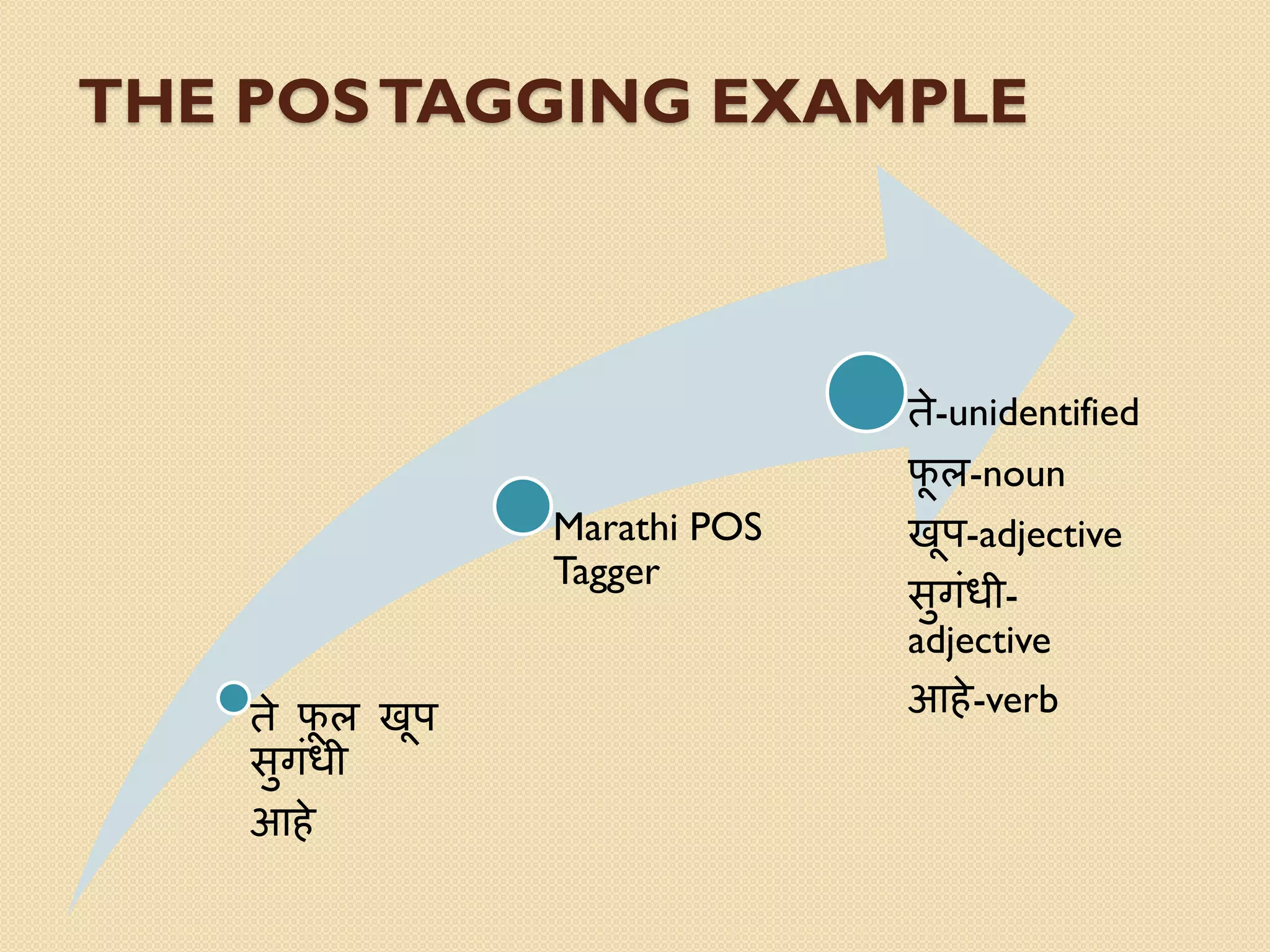
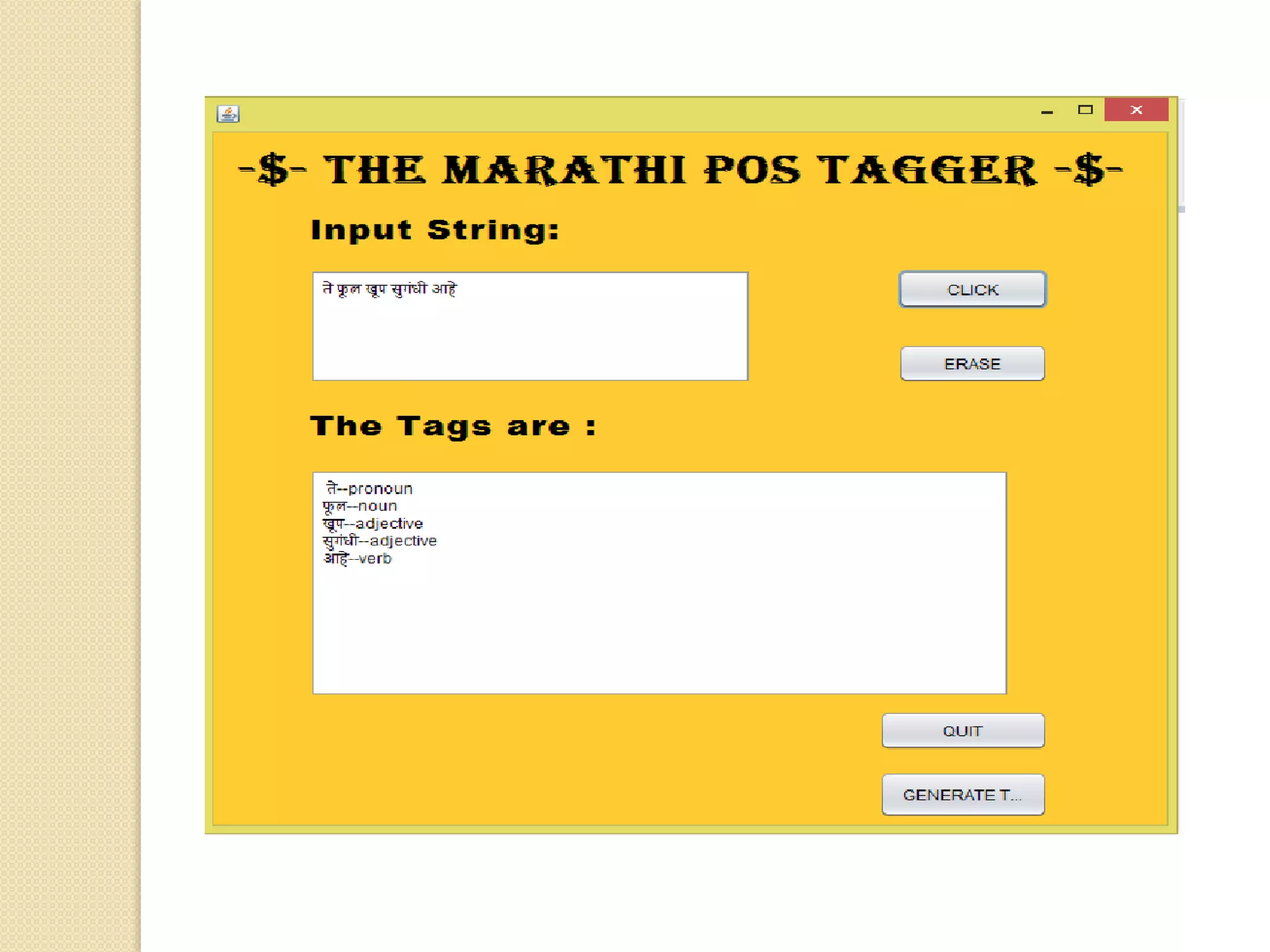
ते फू ल खूप
सुगंधी
आहे
Marathi POS
Tagger
ते-unidentified
फू ल-noun
खूप-adjective
सुगंधी-
adjective
आहे-verb
THE POSTAGGING EXAMPLE
Need of Marathi POS Tagging :
 Lack of significant tools for Indian
languages
 Dependence of other NLP activities on
POS tagging
 Failure of existing techniques on Indian
Languages
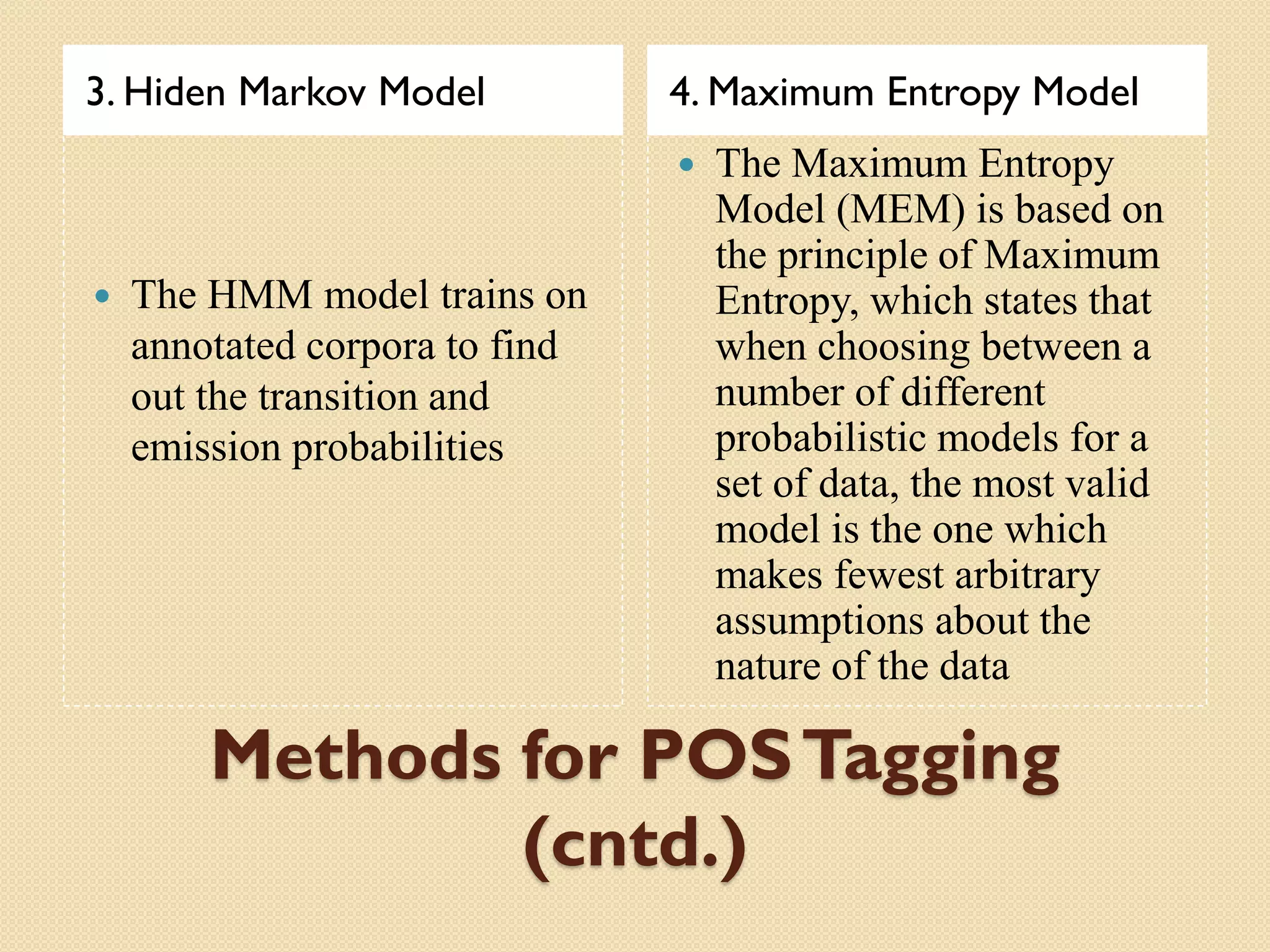
Overview of
POS tagging
Methods for POSTagging
1.Rule Based 2.Stochastic
 The rule based POS tagging
models apply a set of hand
written rules and use
contextual information to
assign POS tags to words.
 A stochastic approach
includes frequency,
probability or statistics. The
simplest stochastic
approach finds out the most
frequently used tag for a
specific word in the
annotated training data and
uses this information to tag
that word in the
unannotated text.
Methods for POSTagging
(cntd.)
3. Hiden Markov Model 4. Maximum Entropy Model
 The HMM model trains on
annotated corpora to find
out the transition and
emission probabilities
 The Maximum Entropy
Model (MEM) is based on
the principle of Maximum
Entropy, which states that
when choosing between a
number of different
probabilistic models for a
set of data, the most valid
model is the one which
makes fewest arbitrary
assumptions about the
nature of the data
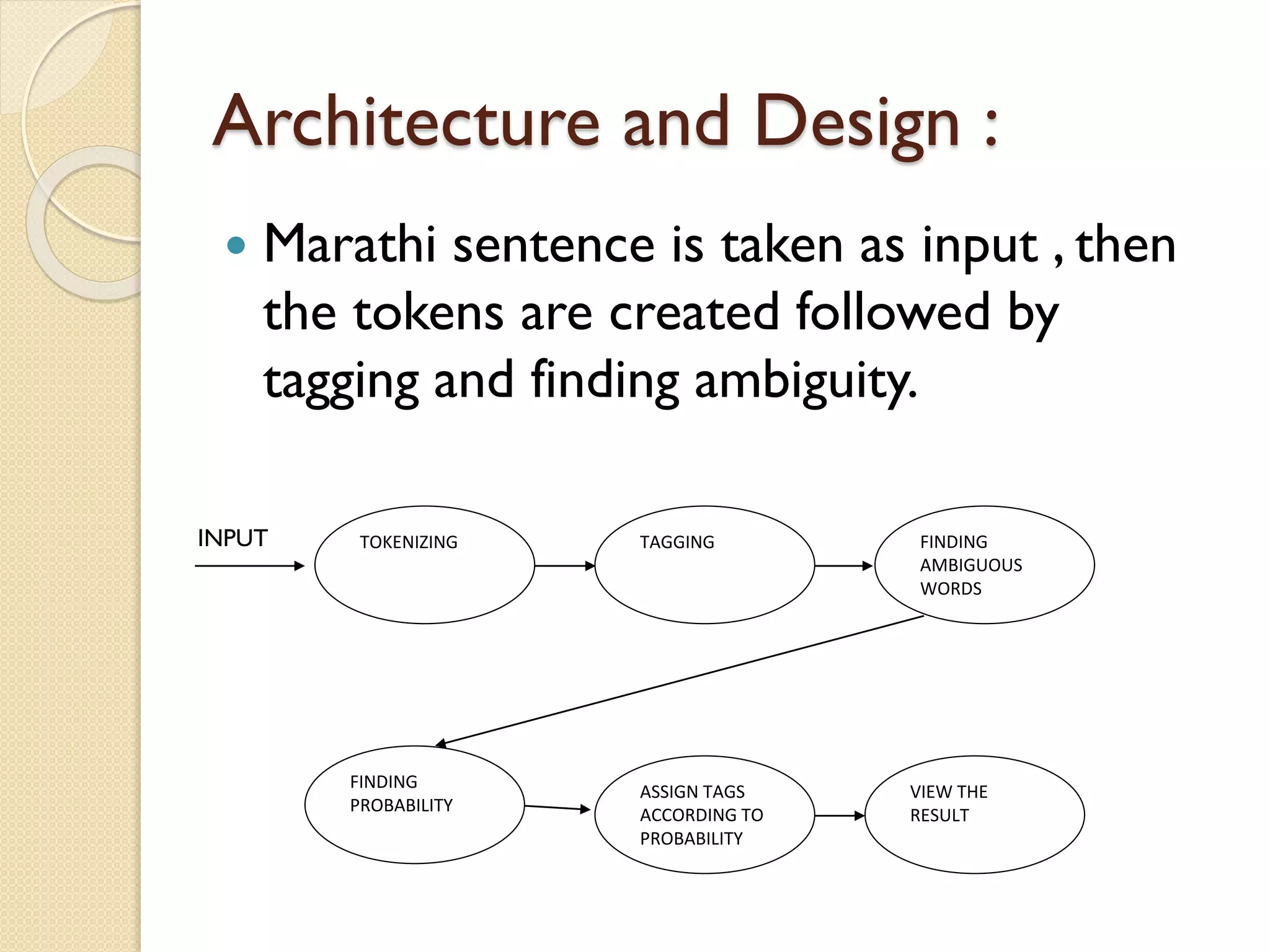
Architecture and Design :
 Marathi sentence is taken as input , then
the tokens are created followed by
tagging and finding ambiguity.
TOKENIZING TAGGING FINDING
AMBIGUOUS
WORDS
FINDING
PROBABILITY
ASSIGN TAGS
ACCORDING TO
PROBABILITY
VIEW THE
RESULT
INPUT
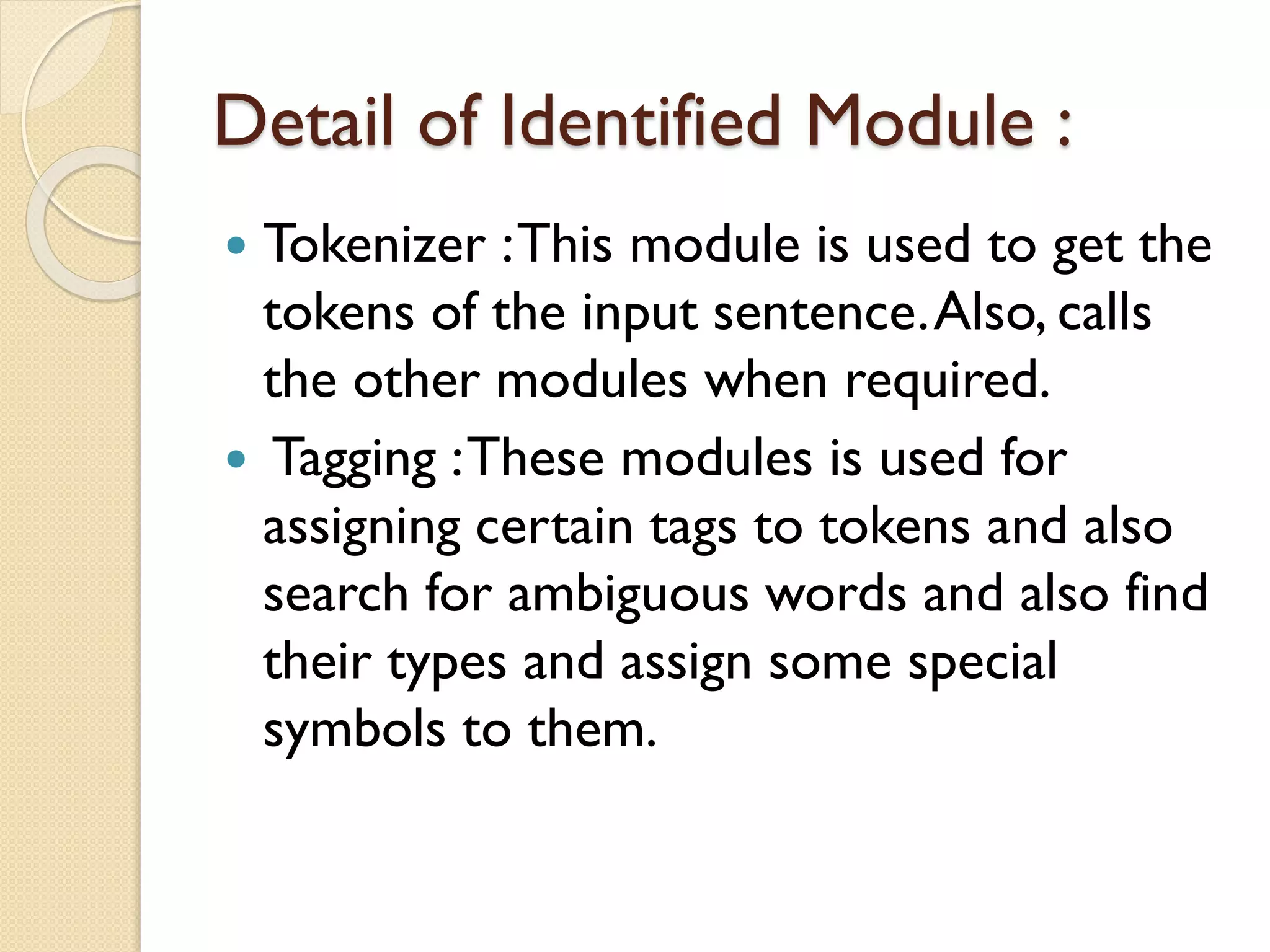
Detail of Identified Module :
 Tokenizer :This module is used to get the
tokens of the input sentence.Also, calls
the other modules when required.
 Tagging :These modules is used for
assigning certain tags to tokens and also
search for ambiguous words and also find
their types and assign some special
symbols to them.
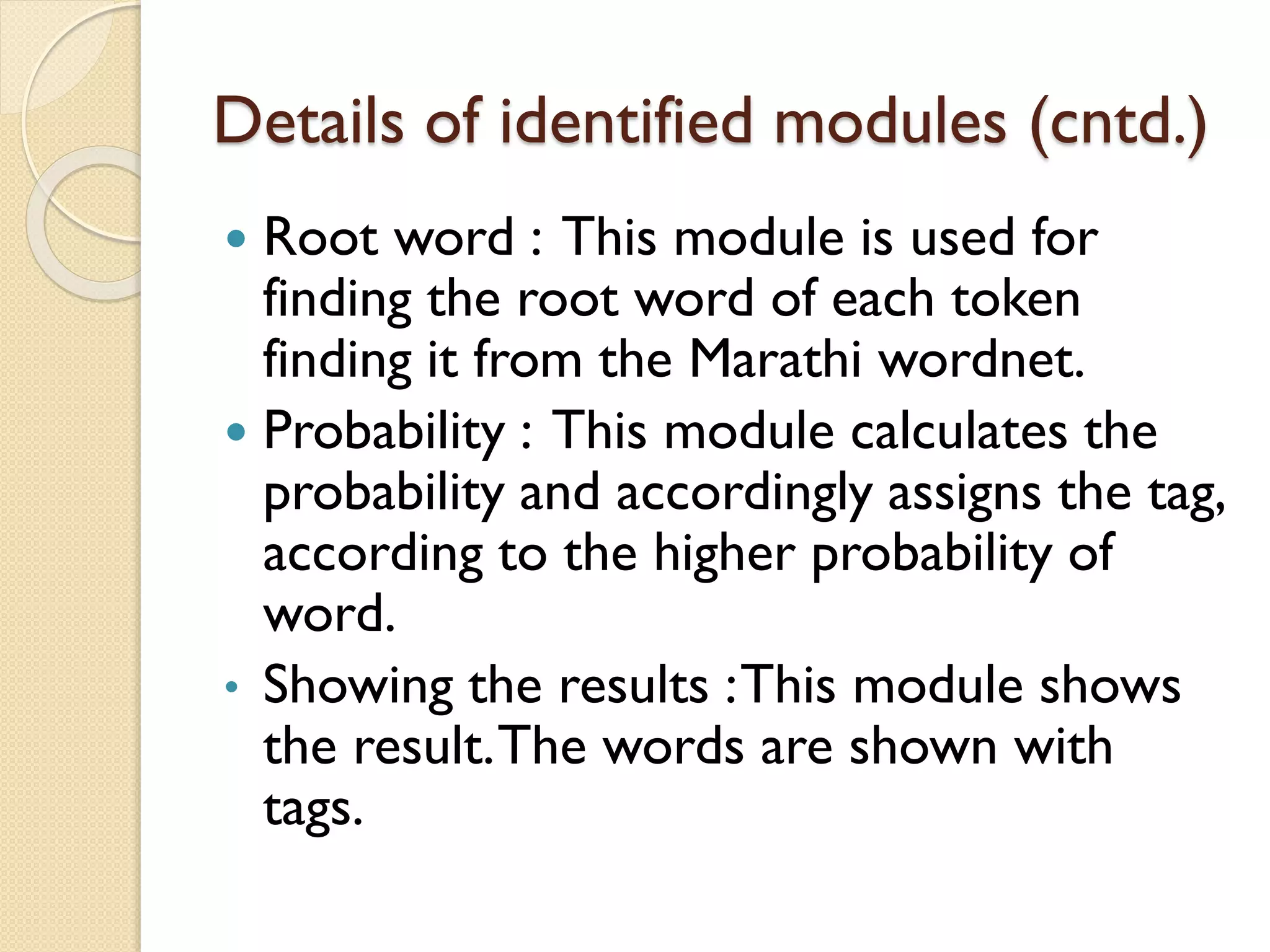
Details of identified modules (cntd.)
 Root word : This module is used for
finding the root word of each token
finding it from the Marathi wordnet.
 Probability : This module calculates the
probability and accordingly assigns the tag,
according to the higher probability of
word.
• Showing the results :This module shows
the result.The words are shown with
tags.
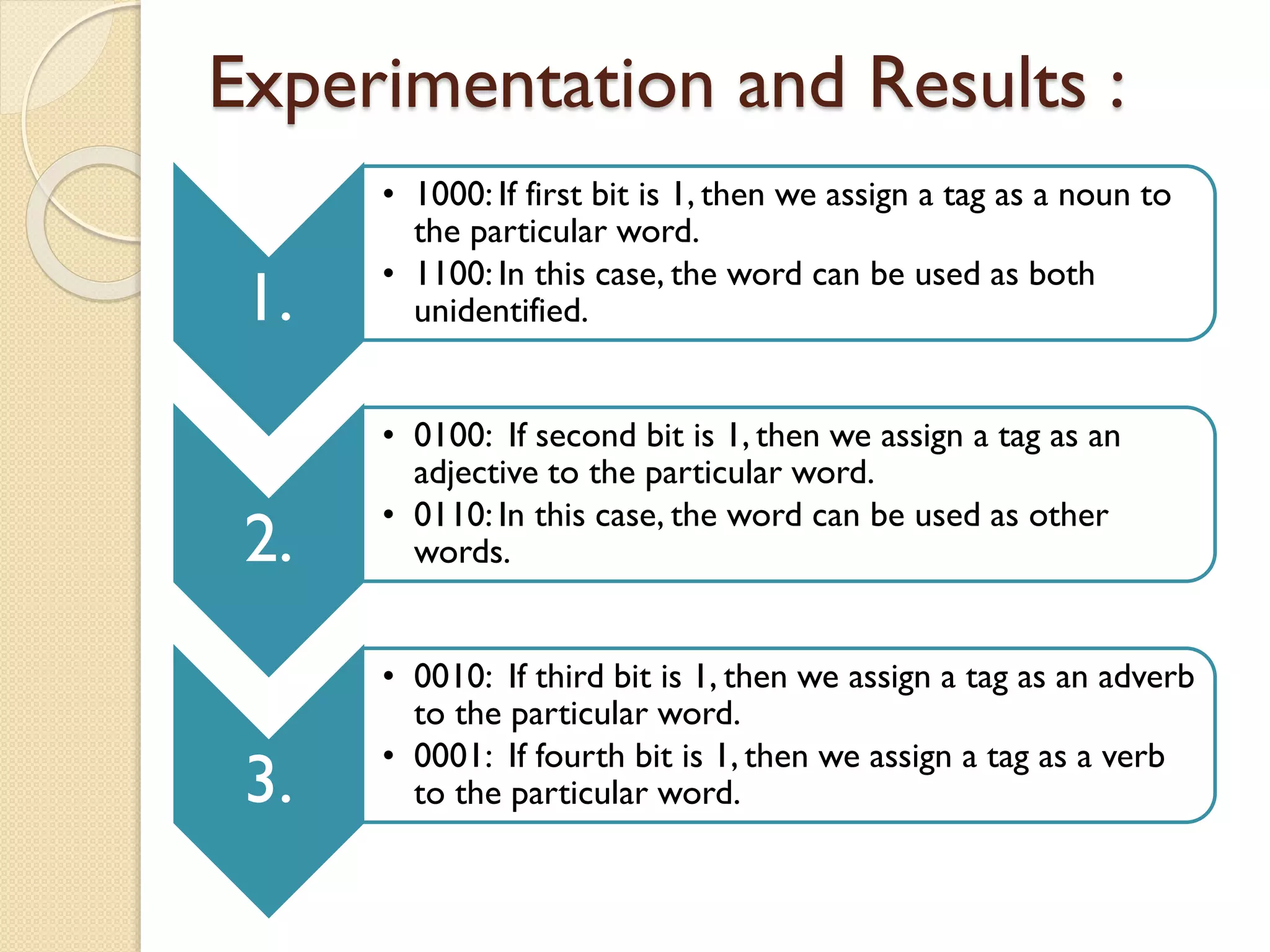
Experimentation and Results :
1.
• 1000: If first bit is 1, then we assign a tag as a noun to
the particular word.
• 1100: In this case, the word can be used as both
unidentified.
2.
• 0100: If second bit is 1, then we assign a tag as an
adjective to the particular word.
• 0110: In this case, the word can be used as other
words.
3.
• 0010: If third bit is 1, then we assign a tag as an adverb
to the particular word.
• 0001: If fourth bit is 1, then we assign a tag as a verb
to the particular word.
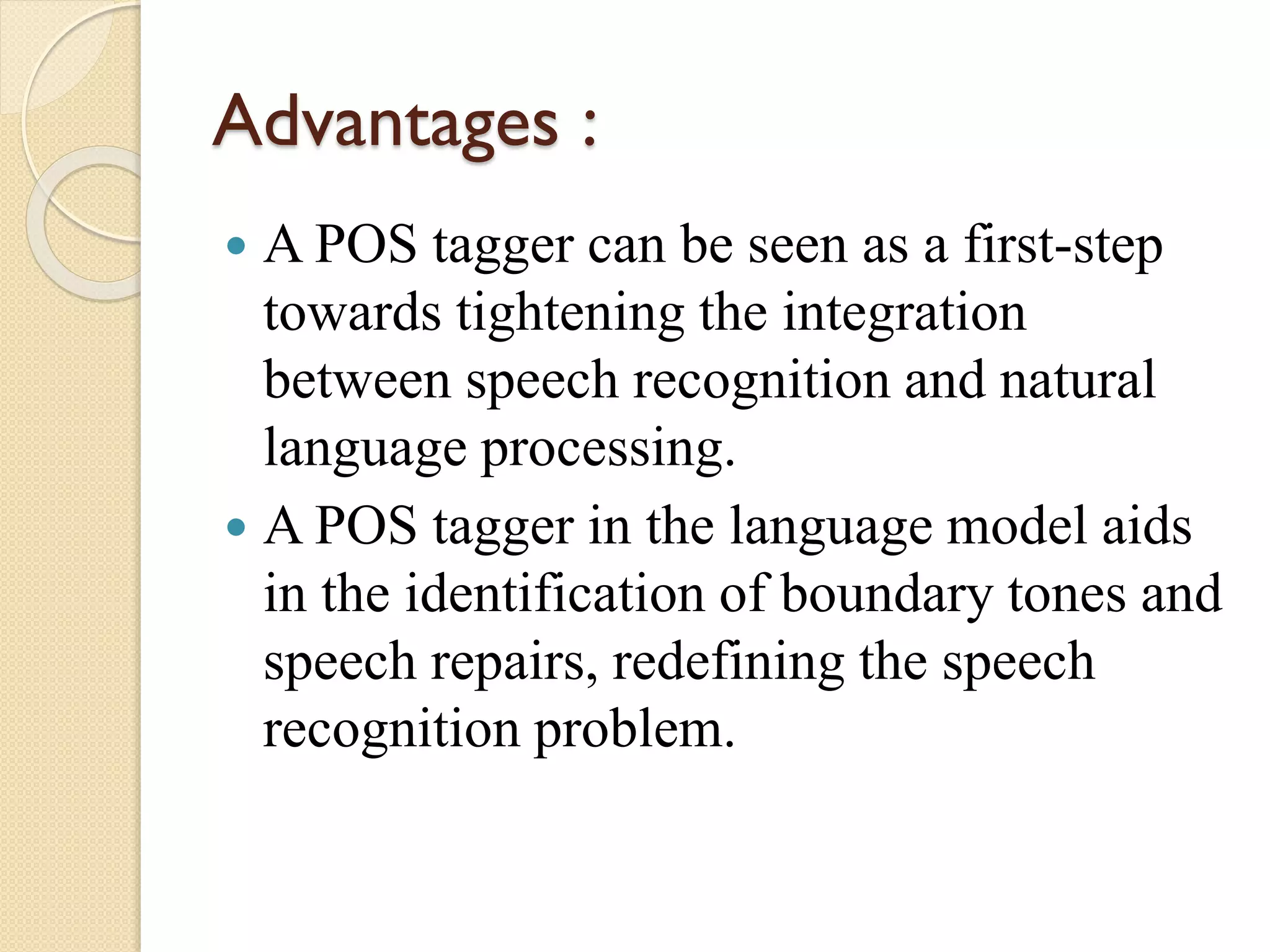
Advantages :
 A POS tagger can be seen as a first-step
towards tightening the integration
between speech recognition and natural
language processing.
 A POS tagger in the language model aids
in the identification of boundary tones and
speech repairs, redefining the speech
recognition problem.
Advantages (cntd.):
 A typical NLP system consists of
tokenization, sentence delimitation, part-of-
speech (POS) tagging, phrase chunking,
parsing, and concept mapping. As one of the
initial steps, POS tagging determines the part
of speech for each token in a sentence.
 Managers, educators, Trainers, Sales people
are able to accurately assess the needs of a
group, improves questioning techniques thus
improving their skills to achieve more
consistent results.
Limitations :
 User Cannot enter more than one sentence
i.e. cannot enter paragraph.
 It is not able to detect and report the gender
of the word i.e. Morphological analysis in
not done.
 When ambiguity is encountered it is
searched for the POS of the ambiguous word
if it contains less or no word with the correct
POS and there are more number of words for
other POS then it shows incorrect POS for
the ambiguous word.
Applications :
 Information Retrieval
 Speech synthesis
 Word Sense Disambiguation (WSD)
 Machine Translation (MT)
-Text to Text
-Speech to Speech
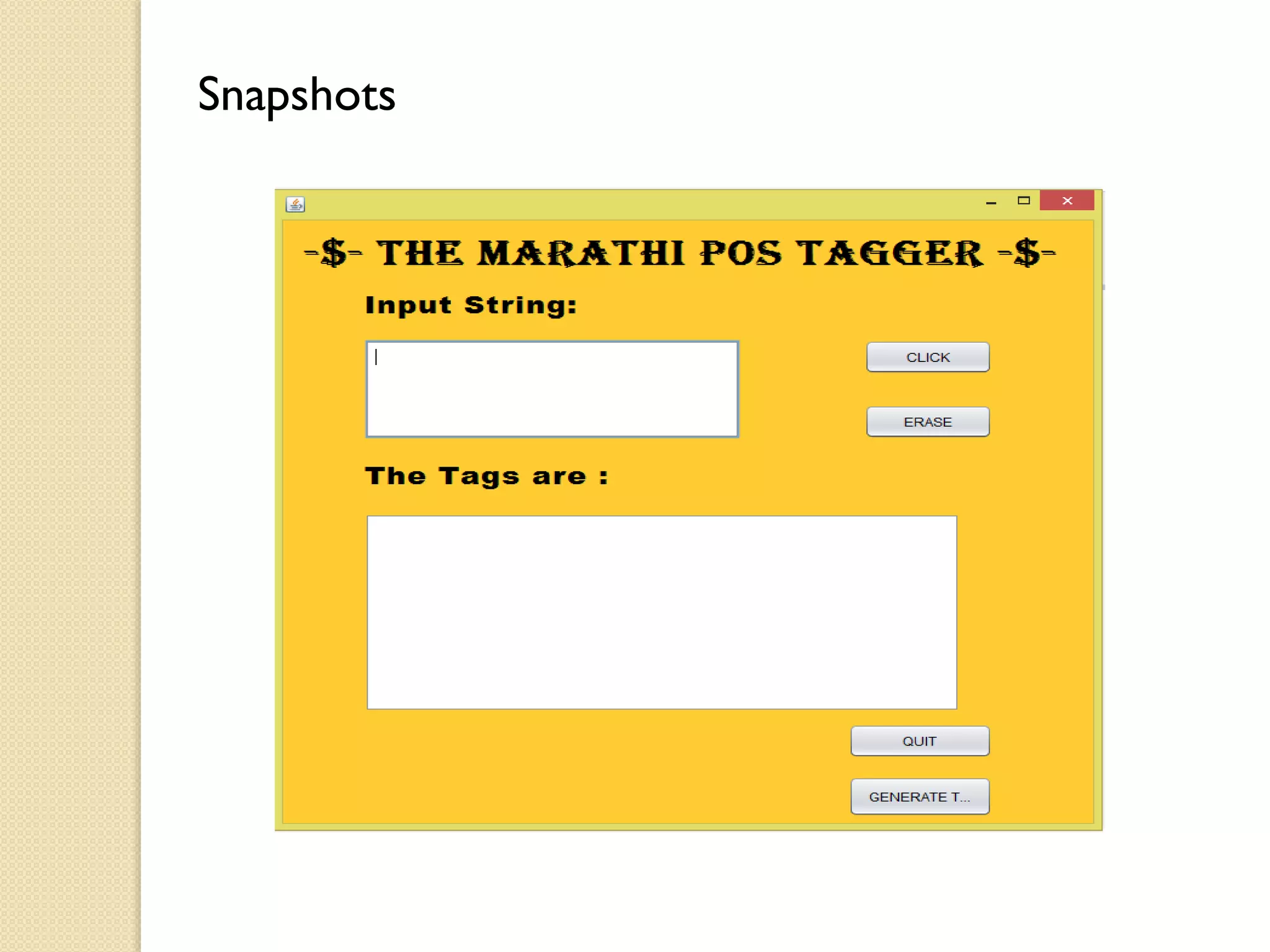
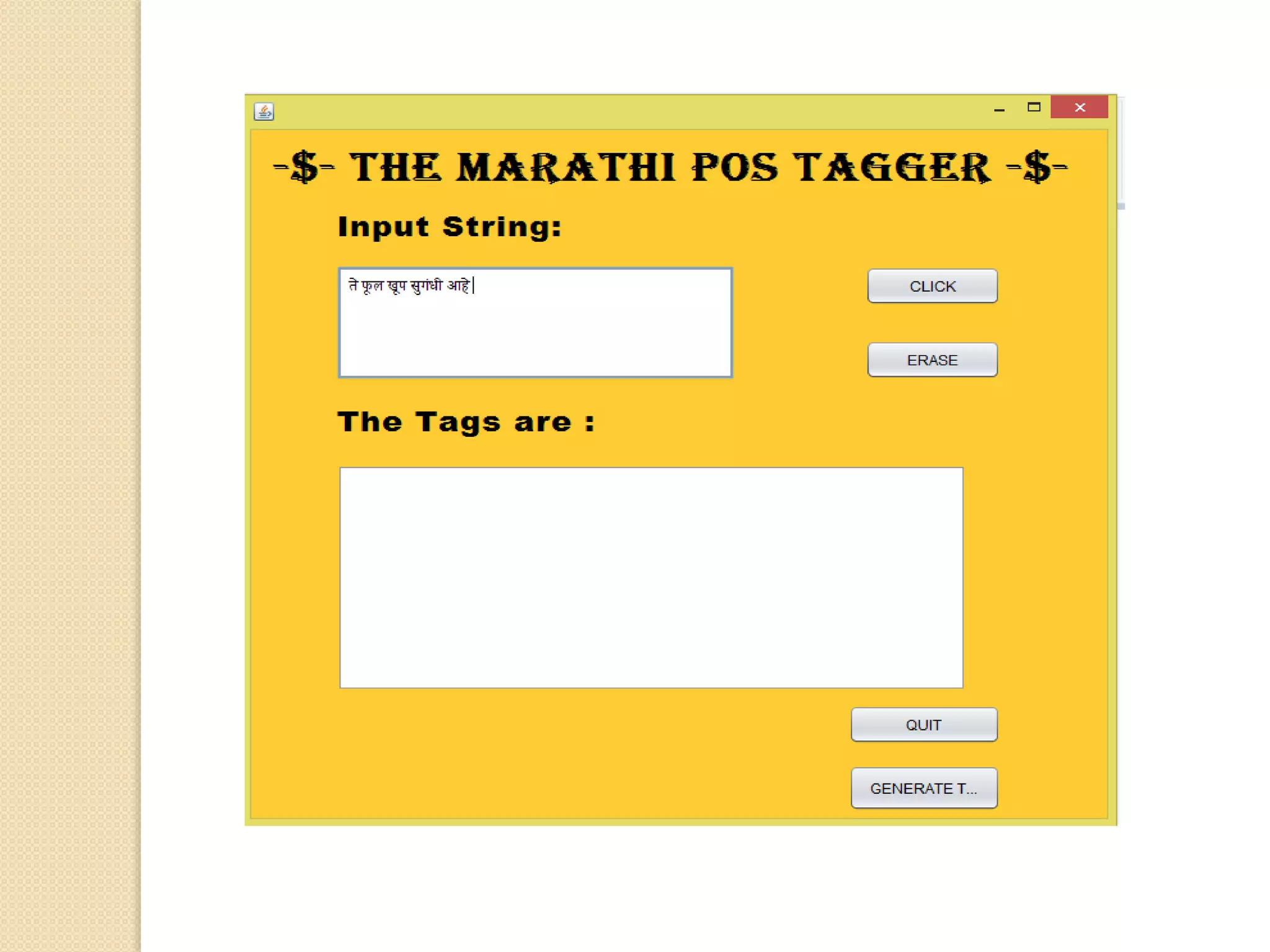
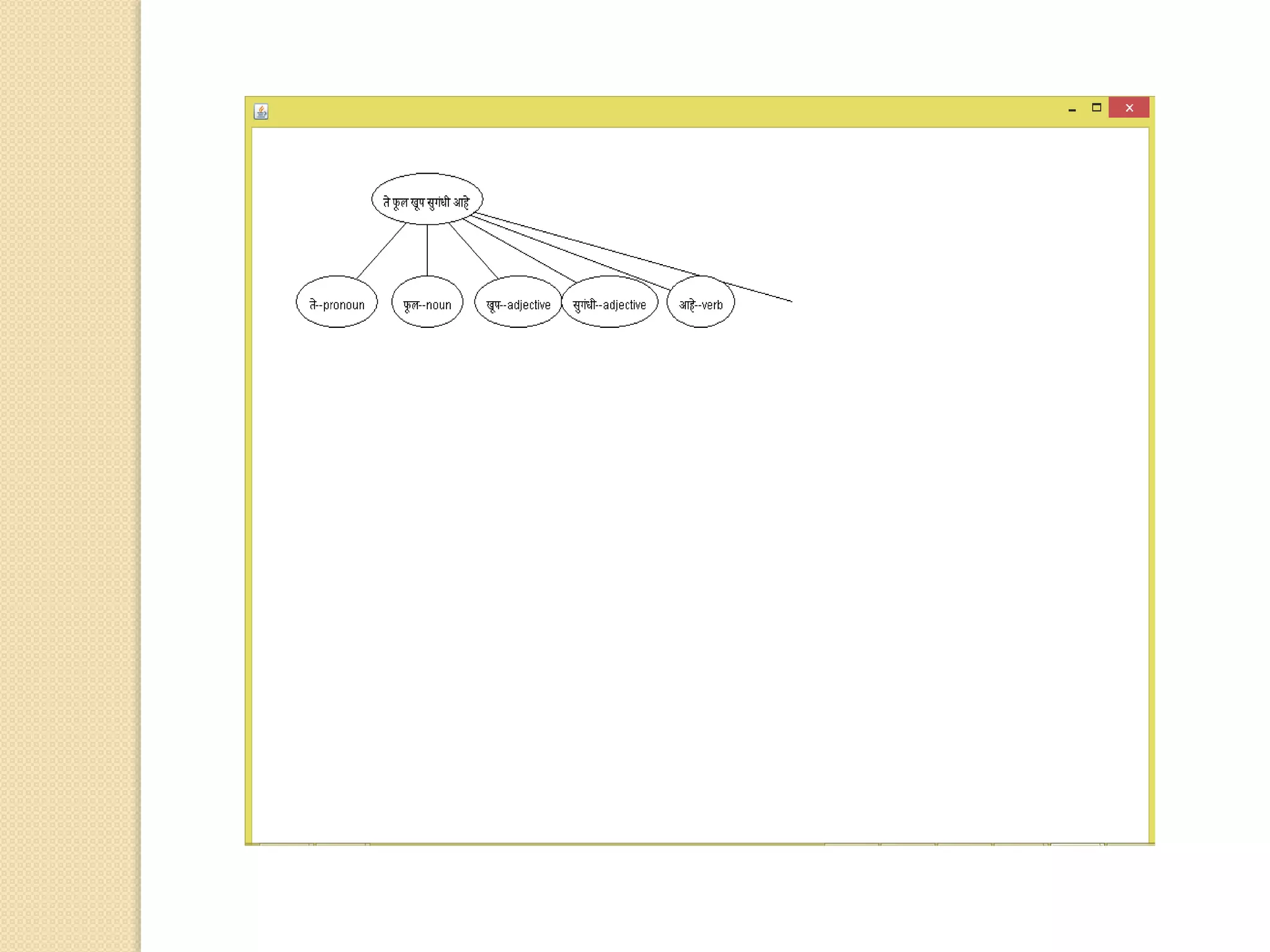
Snapshots
Conclusion and Future Scope :
 The POS tagger described here is very
simple and efficient for automatic tagging,
but the morphological complexity of the
Marathi make it hard.The performance of
the current system is good and result
achieved by this method are excellent. In
future we wish to improve the accuracy
our system by adding more tagged
sentence in our training corpus.

Presentation1

  • 1.
    Guided By, Mrs. GauriM. Dhopavkar Presented By, Ritikesh Bhaskarwar Vimal Shah Ashwin Borkar Shashil Pohankar
  • 2.
    Department of ComputerTechnology YESHWANTRAOCHAVAN COLLEGE OF ENGINEERING, Nagpur (An Autonomous Institution Affiliated to RashtrasantTukadoji Maharaj Nagpur University)
  • 3.
    Natural language processing Natural language processing (NLP) is a field of computer science, artificial intelligence, and linguistics concerned with the interactions between computers and human (natural) languages.  Natural Language Processing (NLP) is the computerized approach to analysing text that is based on both a set of theories and a set of technologies
  • 5.
    POS Tagging : Part-of-Speech (POS) tagging is the process of assigning a part-of-speech like noun, verb, pronoun or other lexical class marker to each word in a sentence.  After POS tags are identified, the next step is chunking, which involves dividing sentences into non-overlapping non- recursive phrases.
  • 6.
    ते फू लखूप सुगंधी आहे Marathi POS Tagger ते-unidentified फू ल-noun खूप-adjective सुगंधी- adjective आहे-verb THE POSTAGGING EXAMPLE
  • 7.
    Need of MarathiPOS Tagging :  Lack of significant tools for Indian languages  Dependence of other NLP activities on POS tagging  Failure of existing techniques on Indian Languages
  • 8.
  • 9.
    Methods for POSTagging 1.RuleBased 2.Stochastic  The rule based POS tagging models apply a set of hand written rules and use contextual information to assign POS tags to words.  A stochastic approach includes frequency, probability or statistics. The simplest stochastic approach finds out the most frequently used tag for a specific word in the annotated training data and uses this information to tag that word in the unannotated text.
  • 10.
    Methods for POSTagging (cntd.) 3.Hiden Markov Model 4. Maximum Entropy Model  The HMM model trains on annotated corpora to find out the transition and emission probabilities  The Maximum Entropy Model (MEM) is based on the principle of Maximum Entropy, which states that when choosing between a number of different probabilistic models for a set of data, the most valid model is the one which makes fewest arbitrary assumptions about the nature of the data
  • 11.
    Architecture and Design:  Marathi sentence is taken as input , then the tokens are created followed by tagging and finding ambiguity. TOKENIZING TAGGING FINDING AMBIGUOUS WORDS FINDING PROBABILITY ASSIGN TAGS ACCORDING TO PROBABILITY VIEW THE RESULT INPUT
  • 12.
    Detail of IdentifiedModule :  Tokenizer :This module is used to get the tokens of the input sentence.Also, calls the other modules when required.  Tagging :These modules is used for assigning certain tags to tokens and also search for ambiguous words and also find their types and assign some special symbols to them.
  • 13.
    Details of identifiedmodules (cntd.)  Root word : This module is used for finding the root word of each token finding it from the Marathi wordnet.  Probability : This module calculates the probability and accordingly assigns the tag, according to the higher probability of word. • Showing the results :This module shows the result.The words are shown with tags.
  • 14.
    Experimentation and Results: 1. • 1000: If first bit is 1, then we assign a tag as a noun to the particular word. • 1100: In this case, the word can be used as both unidentified. 2. • 0100: If second bit is 1, then we assign a tag as an adjective to the particular word. • 0110: In this case, the word can be used as other words. 3. • 0010: If third bit is 1, then we assign a tag as an adverb to the particular word. • 0001: If fourth bit is 1, then we assign a tag as a verb to the particular word.
  • 15.
    Advantages :  APOS tagger can be seen as a first-step towards tightening the integration between speech recognition and natural language processing.  A POS tagger in the language model aids in the identification of boundary tones and speech repairs, redefining the speech recognition problem.
  • 16.
    Advantages (cntd.):  Atypical NLP system consists of tokenization, sentence delimitation, part-of- speech (POS) tagging, phrase chunking, parsing, and concept mapping. As one of the initial steps, POS tagging determines the part of speech for each token in a sentence.  Managers, educators, Trainers, Sales people are able to accurately assess the needs of a group, improves questioning techniques thus improving their skills to achieve more consistent results.
  • 17.
    Limitations :  UserCannot enter more than one sentence i.e. cannot enter paragraph.  It is not able to detect and report the gender of the word i.e. Morphological analysis in not done.  When ambiguity is encountered it is searched for the POS of the ambiguous word if it contains less or no word with the correct POS and there are more number of words for other POS then it shows incorrect POS for the ambiguous word.
  • 18.
    Applications :  InformationRetrieval  Speech synthesis  Word Sense Disambiguation (WSD)  Machine Translation (MT) -Text to Text -Speech to Speech
  • 19.
  • 23.
    Conclusion and FutureScope :  The POS tagger described here is very simple and efficient for automatic tagging, but the morphological complexity of the Marathi make it hard.The performance of the current system is good and result achieved by this method are excellent. In future we wish to improve the accuracy our system by adding more tagged sentence in our training corpus.