Research Opportunities, Applications and Trends in
Natural Language Processing (NLP)
Dr. Shreyas Rao
Associate Professor & Research Coordinator, Dept. of CSE,
Sahyadri College of Engineering and Management
Webinar on NLP 1
Center of Excellence in Artificial Intelligence & Machine Learning
Dept. of CSE, SCEM
Presents
10-12-2021 Webinar on NLP 2
1. Basics of NLP
2. NLP Research & Models
3. NLP Applications
4. Key Research and Project Opportunities
Contents of the Webinar
10-12-2021 Webinar on NLP 3
Natural Language Processing
 NLP stands for Natural Language Processing
 Subfield of Computer Science, Human language
(Linguistics), and Artificial Intelligence
 It is the technology that is used by machines to
understand, analyze, manipulate, and interpret
human's languages.
10-12-2021 Webinar on NLP 4
Basics of NLP
 Users can provide two kinds of input to Machine –> Text or Speech
 Machine has to first understand the human speech in order to act on it
Examples:
 User types a message “Sahyadri College Mangalore ” in Google Search
 User tells Alexa “Play me Kishore Kumar Songs”
In both the examples, Machine should understand the Syntax, Semantics,
Context and Intent of the statement, in order to provide a favorable reply.
10-12-2021 Webinar on NLP 5
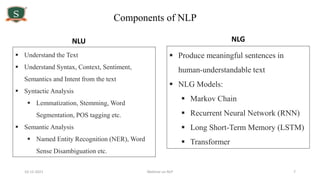
Components of NLP
Understands the
Human Speech
Process and Action
10-12-2021 Webinar on NLP 6
Components of NLP
 Understand the Text
 Understand Syntax, Context, Sentiment,
Semantics and Intent from the text
 Syntactic Analysis
 Lemmatization, Stemming, Word
Segmentation, POS tagging etc.
 Semantic Analysis
 Named Entity Recognition (NER), Word
Sense Disambiguation etc.
 Produce meaningful sentences in
human-understandable text
 NLG Models:
 Markov Chain
 Recurrent Neural Network (RNN)
 Long Short-Term Memory (LSTM)
 Transformer
NLU NLG
10-12-2021 Webinar on NLP 7
Components of NLP
 Understand the Text
 Understand Syntax, Context, Sentiment,
Semantics and Intent from the text
 Syntactic Analysis
 Lemmatization, Stemming, Word
Segmentation, POS tagging etc.
 Semantic Analysis
 Named Entity Recognition (NER), Word
Sense Disambiguation etc.
 Produce meaningful sentences in
human-understandable text
 NLG Models:
 Markov Chain
 Recurrent Neural Network (RNN)
 Long Short-Term Memory (LSTM)
 Transformer
NLU NLG
10-12-2021 Webinar on NLP 8
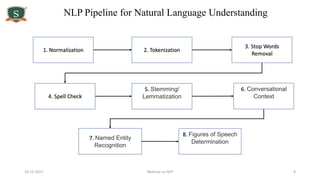
NLP Pipeline for Natural Language Understanding
1. Normalization 2. Tokenization
3. Stop Words
Removal
4. Spell Check
5. Stemming/
Lemmatization
6. Conversational
Context
7. Named Entity
Recognition
8. Figures of Speech
Determination
10-12-2021 Webinar on NLP 9
Tools for Natural Language Understanding
 Sample Python Program to demonstrate NLU (NLP Pipeline) using NLTK
 Stanford CoreNLP Parser (Python)
 NLTK – Natural Language Toolkit (Python)
 SpaCy (Python)
 Apache OpenNLP (opensource Java Library)
10-12-2021 Webinar on NLP 10
NLP - RESEARCH
Sl. No Task Model
1 Word Encoding Neural Network
2 Sentence Encoding, Next word prediction, Learn
language
Recurrent Neural Network (RNN)
LSTM (Long Short-Term Memory)
3 Language Translation Encoder-Decoder
4 Translation, Text Generation, Text Summarization,
Text Paraphrasing, Text Classification, Language
Translation
Transformers
(Transfer Learning)
10-12-2021 Webinar on NLP 11
1. Neural Network
Word2Vec using Neural Networks
Disadvantages:
Word embedding captures meaning of words
How about sentences?
10-12-2021 Webinar on NLP 12
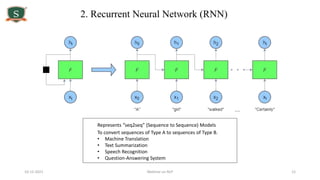
2. Recurrent Neural Network (RNN)
Represents “seq2seq” (Sequence to Sequence) Models
To convert sequences of Type A to sequences of Type B.
• Machine Translation
• Text Summarization
• Speech Recognition
• Question-Answering System
10-12-2021 Webinar on NLP 13
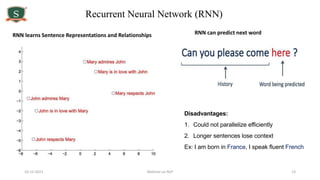
Recurrent Neural Network (RNN)
RNN learns Sentence Representations and Relationships RNN can predict next word
Disadvantages:
1. Could not parallelize efficiently
2. Longer sentences lose context
Ex: I am born in France, I speak fluent French
10-12-2021 Webinar on NLP 14
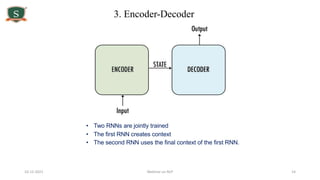
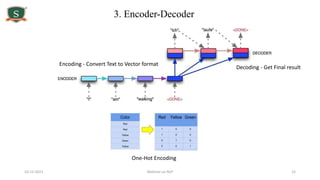
3. Encoder-Decoder
• Two RNNs are jointly trained
• The first RNN creates context
• The second RNN uses the final context of the first RNN.
10-12-2021 Webinar on NLP 15
3. Encoder-Decoder
Encoding - Convert Text to Vector format
One-Hot Encoding
Decoding - Get Final result
10-12-2021 Webinar on NLP 16
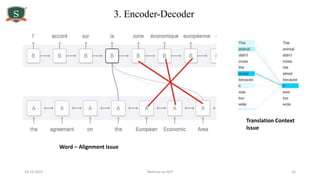
3. Encoder-Decoder
Word – Alignment Issue
Translation Context
Issue
10-12-2021 Webinar on NLP 17
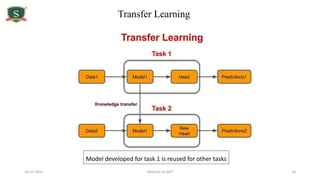
4. Transfer Learning
Transfer learning is a deep-learning technique where a model is first pre-
trained on a data-rich task before being fine-tuned on a downstream task, has
emerged as a powerful technique in natural language processing (NLP).
The effectiveness of transfer learning has given rise to a diversity of
approaches, methodology, and practice.
10-12-2021 Webinar on NLP 18
Transfer Learning
Model developed for task 1 is reused for other tasks
10-12-2021 Webinar on NLP 19
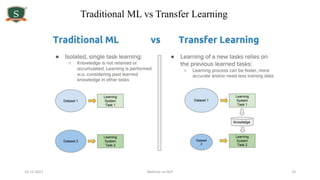
Traditional ML vs Transfer Learning
10-12-2021 Webinar on NLP 20
Transformers
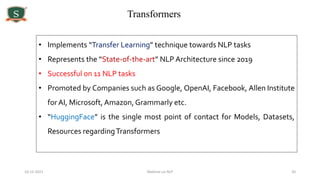
• Implements “Transfer Learning” technique towards NLP tasks
• Represents the “State-of-the-art” NLP Architecture since 2019
• Successful on 11 NLP tasks
• Promoted by Companies such as Google, OpenAI, Facebook, Allen Institute
forAI, Microsoft, Amazon,Grammarly etc.
• “HuggingFace” is the single most point of contact for Models, Datasets,
Resources regardingTransformers
10-12-2021 Webinar on NLP 21
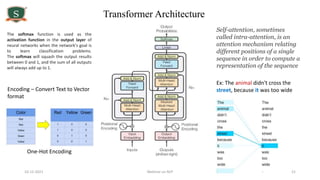
Transformer Architecture
Ex: The animal didn't cross the
street, because it was too wide
Self-attention, sometimes
called intra-attention, is an
attention mechanism relating
different positions of a single
sequence in order to compute a
representation of the sequence
Encoding – Convert Text to Vector
format
One-Hot Encoding
The softmax function is used as the
activation function in the output layer of
neural networks when the network's goal is
to learn classification problems.
The softmax will squash the output results
between 0 and 1, and the sum of all outputs
will always add up to 1.
10-12-2021 Webinar on NLP 22
Transformer Architecture
German
English
10-12-2021 Webinar on NLP 23
Transformer Models
Sl. No Transformer Model Company & Info
1 BERT (Bidirectional Encoder Representations from Transformers)
BERT Base - 12 encoder & 768 hidden layers
BERT Large - 24 encoder & 1024 hidden layers
Google
Pre-trained on unlabeled data extracted
from BookCorpus with 800M words and
English Wikipedia with 2500M words
Machine Translation, Question Answering
2 GPT (Generative Pre-trained Transformer)
GPT-2 -> Trained for 1.5B parameters for a dataset of 8 Million Web
Pages
GPT-3 -> Trained on 570GB of text from Textbooks and Wikipedia
GPT-NEO -> Open source version of GPT-3
OpenAI (Co-founder Elon Musk)
Text Generation or Word prediction,
question answering, summarization
3 T5 (Text-To-Text-Transfer-Transformer Model) Question Answering, Language Translation
4 RoBERTa (Robustly Optimized BERT Pretraining Approach)
Trained on 360GB of text
Facebook
Multi-class Text Classification
All these models support Deep Learning Libraries TensorFlow (Google) and PyTorch
(Facebook)
10-12-2021 Webinar on NLP 24
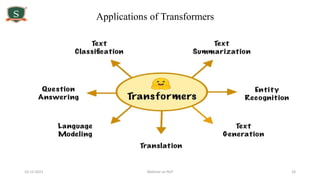
Applications of Transformers
10-12-2021 Webinar on NLP 25
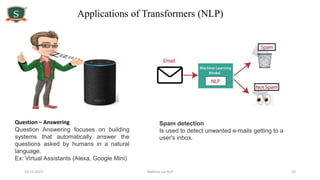
Applications of Transformers (NLP)
Question – Answering
Question Answering focuses on building
systems that automatically answer the
questions asked by humans in a natural
language.
Ex: Virtual Assistants (Alexa, Google Mini)
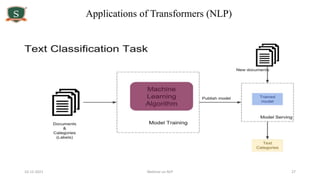
Spam detection
Is used to detect unwanted e-mails getting to a
user's inbox.
10-12-2021 Webinar on NLP 26
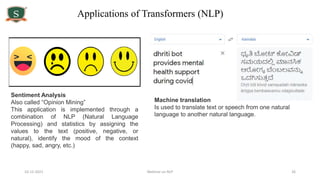
Sentiment Analysis
Also called “Opinion Mining”
This application is implemented through a
combination of NLP (Natural Language
Processing) and statistics by assigning the
values to the text (positive, negative, or
natural), identify the mood of the context
(happy, sad, angry, etc.)
Machine translation
Is used to translate text or speech from one natural
language to another natural language.
Applications of Transformers (NLP)
10-12-2021 Webinar on NLP 27
Applications of Transformers (NLP)
10-12-2021 Webinar on NLP 28
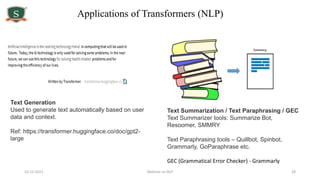
Text Generation
Used to generate text automatically based on user
data and context.
Ref: https://transformer.huggingface.co/doc/gpt2-
large
Text Summarization / Text Paraphrasing / GEC
Text Summarizer tools: Summarize Bot,
Resoomer, SMMRY
Text Paraphrasing tools – Quillbot, Spinbot,
Grammarly, GoParaphrase etc.
GEC (Grammatical Error Checker) - Grammarly
Applications of Transformers (NLP)
A Chatbot is an Artificial intelligence (AI) software that can simulate a
conversation (or a chat) with a user in Natural Language (Text or Voice) through
messaging applications, websites, mobile apps or through the telephone.
10-12-2021 Webinar on NLP 29
Chatbot (Most popular Use Case for NLP)
Chatbot Market Size and Trends
10-12-2021 Webinar on NLP 30
Chatbot Framework and Tools
Popular Frameworks Popular Tools
(No Code)
10-12-2021 Webinar on NLP 31
Chatbot Ecosystem
Multi-Channel
Digital Voice
Text
Website Chat
FB Messenger
WhatsApp
Google Assistant
Mobile App
Car / TV
Google Home
Alexa
NLP Engine
Chatbot
Custom Response
Normal Response
FAQs
Document
Intent Action
Microservice
External APIs
(JSON API)
Conversation Management
Fulfillment
Support Integration
Webhook
Request
Webhook
Response
Request
Response
Request
Response
Pattern Matching
(AIML)
Multinomial
Naive Bayes
NLU
Intent Matching
Entity Recognition
Context
Management
Dialog Workflow
10-12-2021 Webinar on NLP 32
Dhriti – Mental Health Resource Chatbot
Link - https://app.engati.com/static/standalone/bot.html?bot_key=889d005935e7437b
 Dhriti means ‘Vision’, ‘Firmness’, ‘Perseverance’, ‘Patience’, ‘Determination’
 Corona Second Wave has affected millions of people in India physically, mentally and
emotionally.
 Dhriti Bot provides “resources related to Mental Health” that can help people cope up
with the pandemic and gives them HOPE to move ahead with positivity and enthusiasm.
 Bot caters to Dakshina Kannada and Bangalore regions.
 Bot is multi-lingual and supports English, Kannada and Hindi languages.
10-12-2021 Webinar on NLP 33
Dhriti – Mental Health Resource Chatbot
Features of the bot
Helpline (Suicide, Alcohol De-addiction, General)
Directory of Mental Health Therapists (Counsellors, Psychologists and Psychiatrists)
Grief Counselling Support
Mental Health Apps (Anxiety, Depression, OCD, Addictions etc.)
Techniques for Mental Wellbeing (Yoga, Meditation, Pranayama)
Social Wellbeing (Recreational Apps & Support Groups)
General Covid Information (Symptoms, Prevention, Vaccination, Social Distance etc.)
10-12-2021 Webinar on NLP 34
Key Research Opportunities
Researchers / M.Tech Students
1. Select a NLPTask to conduct research
2. Review state-of-the-art literature inTransformers based on the task
3. Review appropriateTransformer Models (T5, BERT, GPT-2)
4. Contribute in Dataset and/or Model Fine-Tuning for various domains such
as Healthcare, Agriculture, Banking etc.
5. Involve in Chatbot / Virtual Assistant research (Fine tuning of NLU, NLP
pipeline, Models etc.)
10-12-2021 Webinar on NLP 35
Key Project Opportunities
B.Tech / M.Tech Students
1. Select a NLPTask and preferably a domain
2. Get open source datasets from Kaggle / HuggingFace portal OR build own
dataset
3. Use the existingTransformer Model to complete the task and get output
4. Fine-tune the models, if required
5. Provide a good UI for showcasing the results
6. Develop a Chatbot based on domain requirements
10-12-2021 Webinar on NLP 36

Natural Language Processing - Research and Application Trends

  • 1.
    Research Opportunities, Applicationsand Trends in Natural Language Processing (NLP) Dr. Shreyas Rao Associate Professor & Research Coordinator, Dept. of CSE, Sahyadri College of Engineering and Management Webinar on NLP 1 Center of Excellence in Artificial Intelligence & Machine Learning Dept. of CSE, SCEM Presents
  • 2.
    10-12-2021 Webinar onNLP 2 1. Basics of NLP 2. NLP Research & Models 3. NLP Applications 4. Key Research and Project Opportunities Contents of the Webinar
  • 3.
    10-12-2021 Webinar onNLP 3 Natural Language Processing  NLP stands for Natural Language Processing  Subfield of Computer Science, Human language (Linguistics), and Artificial Intelligence  It is the technology that is used by machines to understand, analyze, manipulate, and interpret human's languages.
  • 4.
    10-12-2021 Webinar onNLP 4 Basics of NLP  Users can provide two kinds of input to Machine –> Text or Speech  Machine has to first understand the human speech in order to act on it Examples:  User types a message “Sahyadri College Mangalore ” in Google Search  User tells Alexa “Play me Kishore Kumar Songs” In both the examples, Machine should understand the Syntax, Semantics, Context and Intent of the statement, in order to provide a favorable reply.
  • 5.
    10-12-2021 Webinar onNLP 5 Components of NLP Understands the Human Speech Process and Action
  • 6.
    10-12-2021 Webinar onNLP 6 Components of NLP  Understand the Text  Understand Syntax, Context, Sentiment, Semantics and Intent from the text  Syntactic Analysis  Lemmatization, Stemming, Word Segmentation, POS tagging etc.  Semantic Analysis  Named Entity Recognition (NER), Word Sense Disambiguation etc.  Produce meaningful sentences in human-understandable text  NLG Models:  Markov Chain  Recurrent Neural Network (RNN)  Long Short-Term Memory (LSTM)  Transformer NLU NLG
  • 7.
    10-12-2021 Webinar onNLP 7 Components of NLP  Understand the Text  Understand Syntax, Context, Sentiment, Semantics and Intent from the text  Syntactic Analysis  Lemmatization, Stemming, Word Segmentation, POS tagging etc.  Semantic Analysis  Named Entity Recognition (NER), Word Sense Disambiguation etc.  Produce meaningful sentences in human-understandable text  NLG Models:  Markov Chain  Recurrent Neural Network (RNN)  Long Short-Term Memory (LSTM)  Transformer NLU NLG
  • 8.
    10-12-2021 Webinar onNLP 8 NLP Pipeline for Natural Language Understanding 1. Normalization 2. Tokenization 3. Stop Words Removal 4. Spell Check 5. Stemming/ Lemmatization 6. Conversational Context 7. Named Entity Recognition 8. Figures of Speech Determination
  • 9.
    10-12-2021 Webinar onNLP 9 Tools for Natural Language Understanding  Sample Python Program to demonstrate NLU (NLP Pipeline) using NLTK  Stanford CoreNLP Parser (Python)  NLTK – Natural Language Toolkit (Python)  SpaCy (Python)  Apache OpenNLP (opensource Java Library)
  • 10.
    10-12-2021 Webinar onNLP 10 NLP - RESEARCH Sl. No Task Model 1 Word Encoding Neural Network 2 Sentence Encoding, Next word prediction, Learn language Recurrent Neural Network (RNN) LSTM (Long Short-Term Memory) 3 Language Translation Encoder-Decoder 4 Translation, Text Generation, Text Summarization, Text Paraphrasing, Text Classification, Language Translation Transformers (Transfer Learning)
  • 11.
    10-12-2021 Webinar onNLP 11 1. Neural Network Word2Vec using Neural Networks Disadvantages: Word embedding captures meaning of words How about sentences?
  • 12.
    10-12-2021 Webinar onNLP 12 2. Recurrent Neural Network (RNN) Represents “seq2seq” (Sequence to Sequence) Models To convert sequences of Type A to sequences of Type B. • Machine Translation • Text Summarization • Speech Recognition • Question-Answering System
  • 13.
    10-12-2021 Webinar onNLP 13 Recurrent Neural Network (RNN) RNN learns Sentence Representations and Relationships RNN can predict next word Disadvantages: 1. Could not parallelize efficiently 2. Longer sentences lose context Ex: I am born in France, I speak fluent French
  • 14.
    10-12-2021 Webinar onNLP 14 3. Encoder-Decoder • Two RNNs are jointly trained • The first RNN creates context • The second RNN uses the final context of the first RNN.
  • 15.
    10-12-2021 Webinar onNLP 15 3. Encoder-Decoder Encoding - Convert Text to Vector format One-Hot Encoding Decoding - Get Final result
  • 16.
    10-12-2021 Webinar onNLP 16 3. Encoder-Decoder Word – Alignment Issue Translation Context Issue
  • 17.
    10-12-2021 Webinar onNLP 17 4. Transfer Learning Transfer learning is a deep-learning technique where a model is first pre- trained on a data-rich task before being fine-tuned on a downstream task, has emerged as a powerful technique in natural language processing (NLP). The effectiveness of transfer learning has given rise to a diversity of approaches, methodology, and practice.
  • 18.
    10-12-2021 Webinar onNLP 18 Transfer Learning Model developed for task 1 is reused for other tasks
  • 19.
    10-12-2021 Webinar onNLP 19 Traditional ML vs Transfer Learning
  • 20.
    10-12-2021 Webinar onNLP 20 Transformers • Implements “Transfer Learning” technique towards NLP tasks • Represents the “State-of-the-art” NLP Architecture since 2019 • Successful on 11 NLP tasks • Promoted by Companies such as Google, OpenAI, Facebook, Allen Institute forAI, Microsoft, Amazon,Grammarly etc. • “HuggingFace” is the single most point of contact for Models, Datasets, Resources regardingTransformers
  • 21.
    10-12-2021 Webinar onNLP 21 Transformer Architecture Ex: The animal didn't cross the street, because it was too wide Self-attention, sometimes called intra-attention, is an attention mechanism relating different positions of a single sequence in order to compute a representation of the sequence Encoding – Convert Text to Vector format One-Hot Encoding The softmax function is used as the activation function in the output layer of neural networks when the network's goal is to learn classification problems. The softmax will squash the output results between 0 and 1, and the sum of all outputs will always add up to 1.
  • 22.
    10-12-2021 Webinar onNLP 22 Transformer Architecture German English
  • 23.
    10-12-2021 Webinar onNLP 23 Transformer Models Sl. No Transformer Model Company & Info 1 BERT (Bidirectional Encoder Representations from Transformers) BERT Base - 12 encoder & 768 hidden layers BERT Large - 24 encoder & 1024 hidden layers Google Pre-trained on unlabeled data extracted from BookCorpus with 800M words and English Wikipedia with 2500M words Machine Translation, Question Answering 2 GPT (Generative Pre-trained Transformer) GPT-2 -> Trained for 1.5B parameters for a dataset of 8 Million Web Pages GPT-3 -> Trained on 570GB of text from Textbooks and Wikipedia GPT-NEO -> Open source version of GPT-3 OpenAI (Co-founder Elon Musk) Text Generation or Word prediction, question answering, summarization 3 T5 (Text-To-Text-Transfer-Transformer Model) Question Answering, Language Translation 4 RoBERTa (Robustly Optimized BERT Pretraining Approach) Trained on 360GB of text Facebook Multi-class Text Classification All these models support Deep Learning Libraries TensorFlow (Google) and PyTorch (Facebook)
  • 24.
    10-12-2021 Webinar onNLP 24 Applications of Transformers
  • 25.
    10-12-2021 Webinar onNLP 25 Applications of Transformers (NLP) Question – Answering Question Answering focuses on building systems that automatically answer the questions asked by humans in a natural language. Ex: Virtual Assistants (Alexa, Google Mini) Spam detection Is used to detect unwanted e-mails getting to a user's inbox.
  • 26.
    10-12-2021 Webinar onNLP 26 Sentiment Analysis Also called “Opinion Mining” This application is implemented through a combination of NLP (Natural Language Processing) and statistics by assigning the values to the text (positive, negative, or natural), identify the mood of the context (happy, sad, angry, etc.) Machine translation Is used to translate text or speech from one natural language to another natural language. Applications of Transformers (NLP)
  • 27.
    10-12-2021 Webinar onNLP 27 Applications of Transformers (NLP)
  • 28.
    10-12-2021 Webinar onNLP 28 Text Generation Used to generate text automatically based on user data and context. Ref: https://transformer.huggingface.co/doc/gpt2- large Text Summarization / Text Paraphrasing / GEC Text Summarizer tools: Summarize Bot, Resoomer, SMMRY Text Paraphrasing tools – Quillbot, Spinbot, Grammarly, GoParaphrase etc. GEC (Grammatical Error Checker) - Grammarly Applications of Transformers (NLP)
  • 29.
    A Chatbot isan Artificial intelligence (AI) software that can simulate a conversation (or a chat) with a user in Natural Language (Text or Voice) through messaging applications, websites, mobile apps or through the telephone. 10-12-2021 Webinar on NLP 29 Chatbot (Most popular Use Case for NLP) Chatbot Market Size and Trends
  • 30.
    10-12-2021 Webinar onNLP 30 Chatbot Framework and Tools Popular Frameworks Popular Tools (No Code)
  • 31.
    10-12-2021 Webinar onNLP 31 Chatbot Ecosystem Multi-Channel Digital Voice Text Website Chat FB Messenger WhatsApp Google Assistant Mobile App Car / TV Google Home Alexa NLP Engine Chatbot Custom Response Normal Response FAQs Document Intent Action Microservice External APIs (JSON API) Conversation Management Fulfillment Support Integration Webhook Request Webhook Response Request Response Request Response Pattern Matching (AIML) Multinomial Naive Bayes NLU Intent Matching Entity Recognition Context Management Dialog Workflow
  • 32.
    10-12-2021 Webinar onNLP 32 Dhriti – Mental Health Resource Chatbot Link - https://app.engati.com/static/standalone/bot.html?bot_key=889d005935e7437b  Dhriti means ‘Vision’, ‘Firmness’, ‘Perseverance’, ‘Patience’, ‘Determination’  Corona Second Wave has affected millions of people in India physically, mentally and emotionally.  Dhriti Bot provides “resources related to Mental Health” that can help people cope up with the pandemic and gives them HOPE to move ahead with positivity and enthusiasm.  Bot caters to Dakshina Kannada and Bangalore regions.  Bot is multi-lingual and supports English, Kannada and Hindi languages.
  • 33.
    10-12-2021 Webinar onNLP 33 Dhriti – Mental Health Resource Chatbot Features of the bot Helpline (Suicide, Alcohol De-addiction, General) Directory of Mental Health Therapists (Counsellors, Psychologists and Psychiatrists) Grief Counselling Support Mental Health Apps (Anxiety, Depression, OCD, Addictions etc.) Techniques for Mental Wellbeing (Yoga, Meditation, Pranayama) Social Wellbeing (Recreational Apps & Support Groups) General Covid Information (Symptoms, Prevention, Vaccination, Social Distance etc.)
  • 34.
    10-12-2021 Webinar onNLP 34 Key Research Opportunities Researchers / M.Tech Students 1. Select a NLPTask to conduct research 2. Review state-of-the-art literature inTransformers based on the task 3. Review appropriateTransformer Models (T5, BERT, GPT-2) 4. Contribute in Dataset and/or Model Fine-Tuning for various domains such as Healthcare, Agriculture, Banking etc. 5. Involve in Chatbot / Virtual Assistant research (Fine tuning of NLU, NLP pipeline, Models etc.)
  • 35.
    10-12-2021 Webinar onNLP 35 Key Project Opportunities B.Tech / M.Tech Students 1. Select a NLPTask and preferably a domain 2. Get open source datasets from Kaggle / HuggingFace portal OR build own dataset 3. Use the existingTransformer Model to complete the task and get output 4. Fine-tune the models, if required 5. Provide a good UI for showcasing the results 6. Develop a Chatbot based on domain requirements
  • 36.

Editor's Notes

  • #7 Lexical ambiguity – Presence of two or more possible meanings within a single word. Ex: Bank can refer to river bank or bank like ICICI or SBI Syntactical ambiguity (structural or grammatical ambiguity) – presence of two or more meanings within a single sentence Referential ambiguity -
  • #8 Lexical ambiguity – Presence of two or more possible meanings within a single word. Ex: Bank can refer to river bank or bank like ICICI or SBI Syntactical ambiguity (structural or grammatical ambiguity) – presence of two or more meanings within a single sentence Referential ambiguity -