Social TV, Forecasting and Innovation Why didn’t we foresee the rise of social TV? Presentation for the European Creative Business Network conference “IPTV and Beyond,” Bristol, March 2011 Colin Donald Director www.futurescape.tv
Overview Social TV: a synthesis of TV and social networking 1. Transforming the medium of TV 2. A radical shift in power for the TV industry 3. How does social TV power manifest itself? Forecasting and Innovation 4. The future of TV as seen from 1995 5. What we didn’t foresee in 1995 – social TV 6. Why didn’t we anticipate it? 7. Implications for forecasting and innovation
1. Social TV – transforming the medium of television
The social TV revolution Social TV – the biggest change in television since it was invented Qualitatively different from improvements to TV: colour, satellite, HD, 3D – all forms of better TV Audiences engaging with television via second screens (eg laptops) and connected TV systems Transforms medium and industry Gives social networks significant commercial roles in the TV business Why did we not foresee this major development?
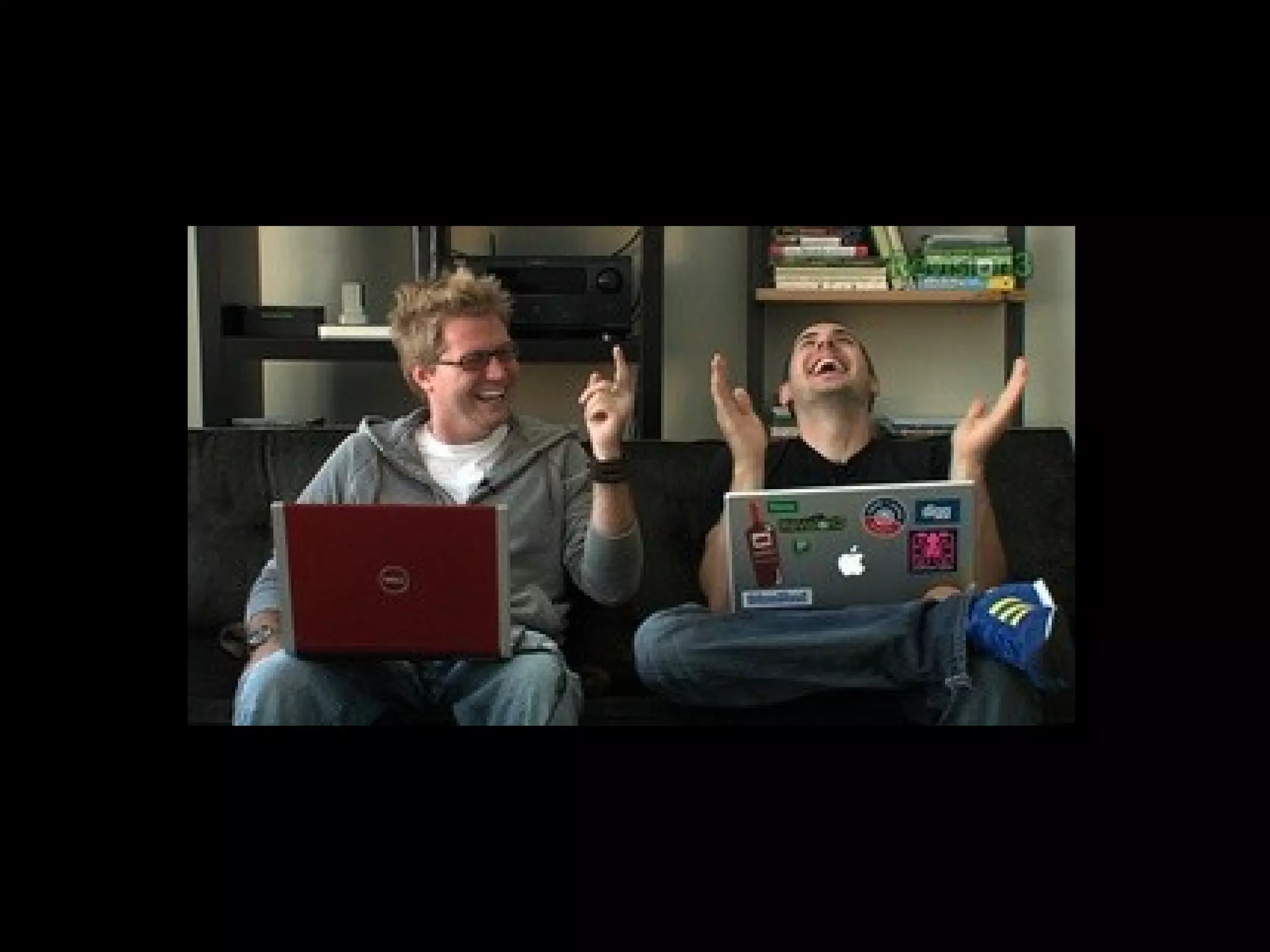
What is social TV? Enabling technologies + viewer behaviour have significant business impact on TV industry People talk 24/7 about television on Facebook and Twitter Discuss, criticise, recommend and share it
 
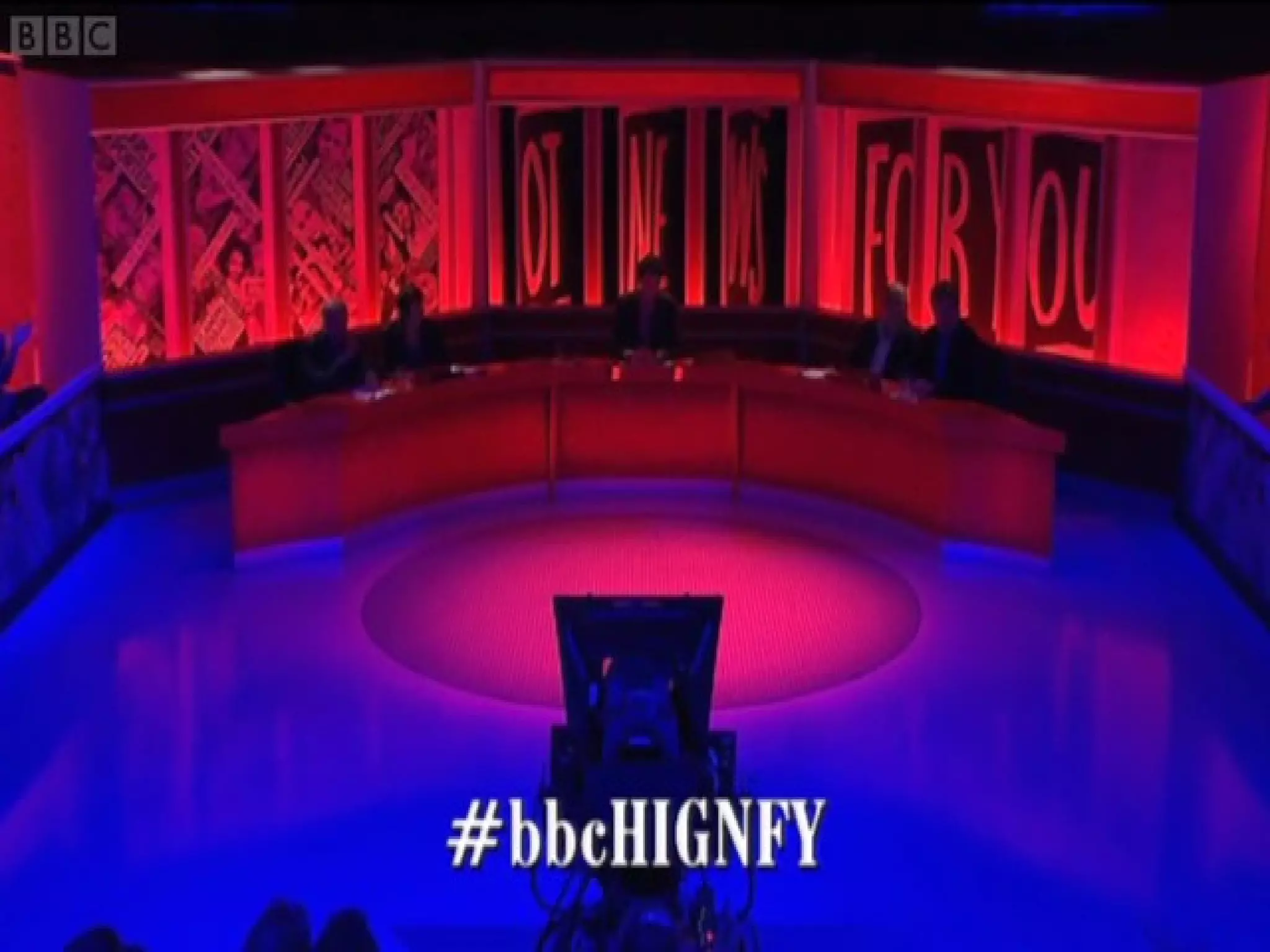
Broadcasters embrace it BBC using on-air Twitter hashtags so  people will discuss its shows Have I Got News For You
 
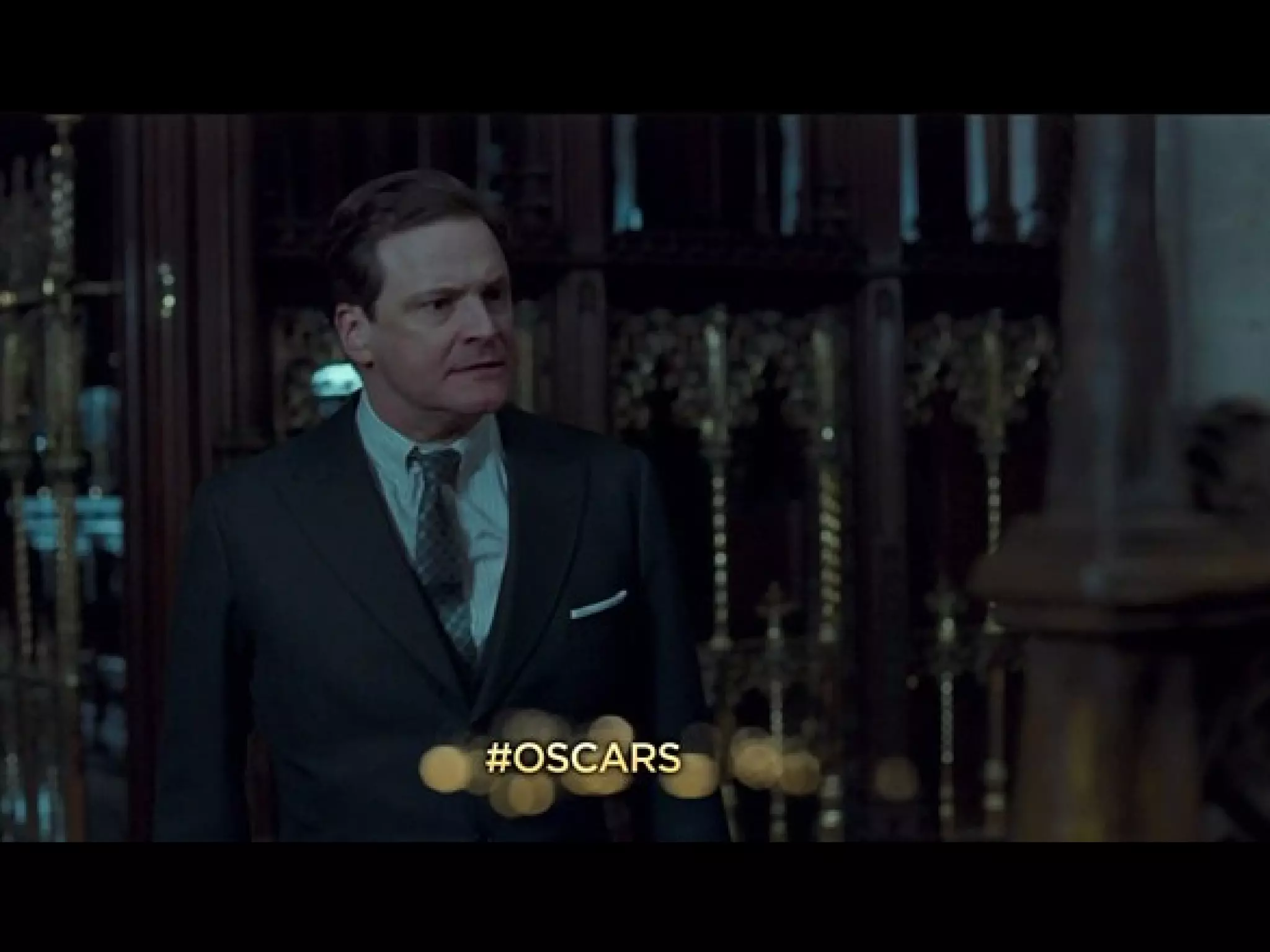
Broadcasters embrace it The official Oscars hashtag Host James Franco actually tweeting during the live show
 
 
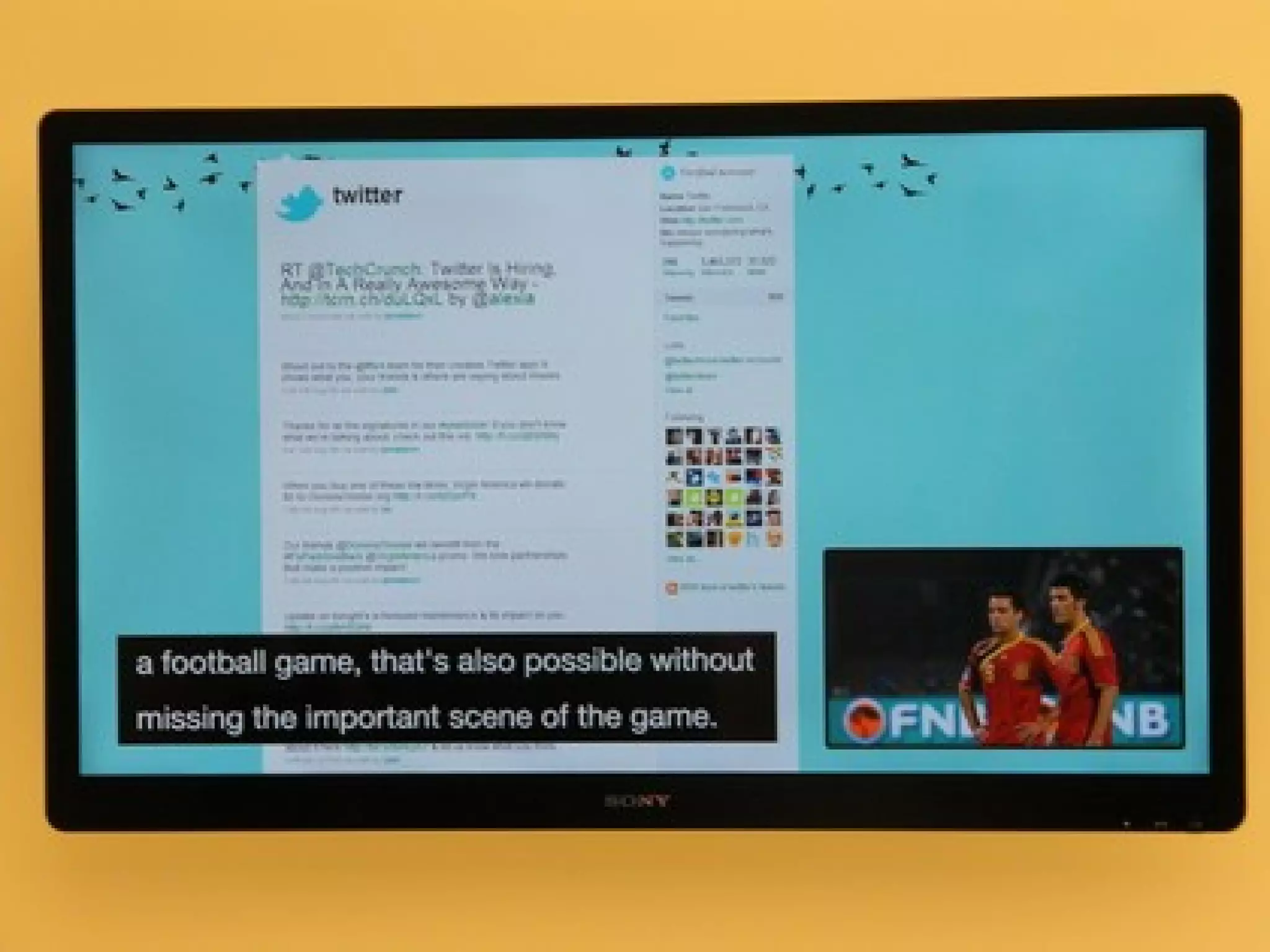
Connected TVs enable social TV New connected TV sets and services are integrating social activity Twitter in a Sony Google TV
 
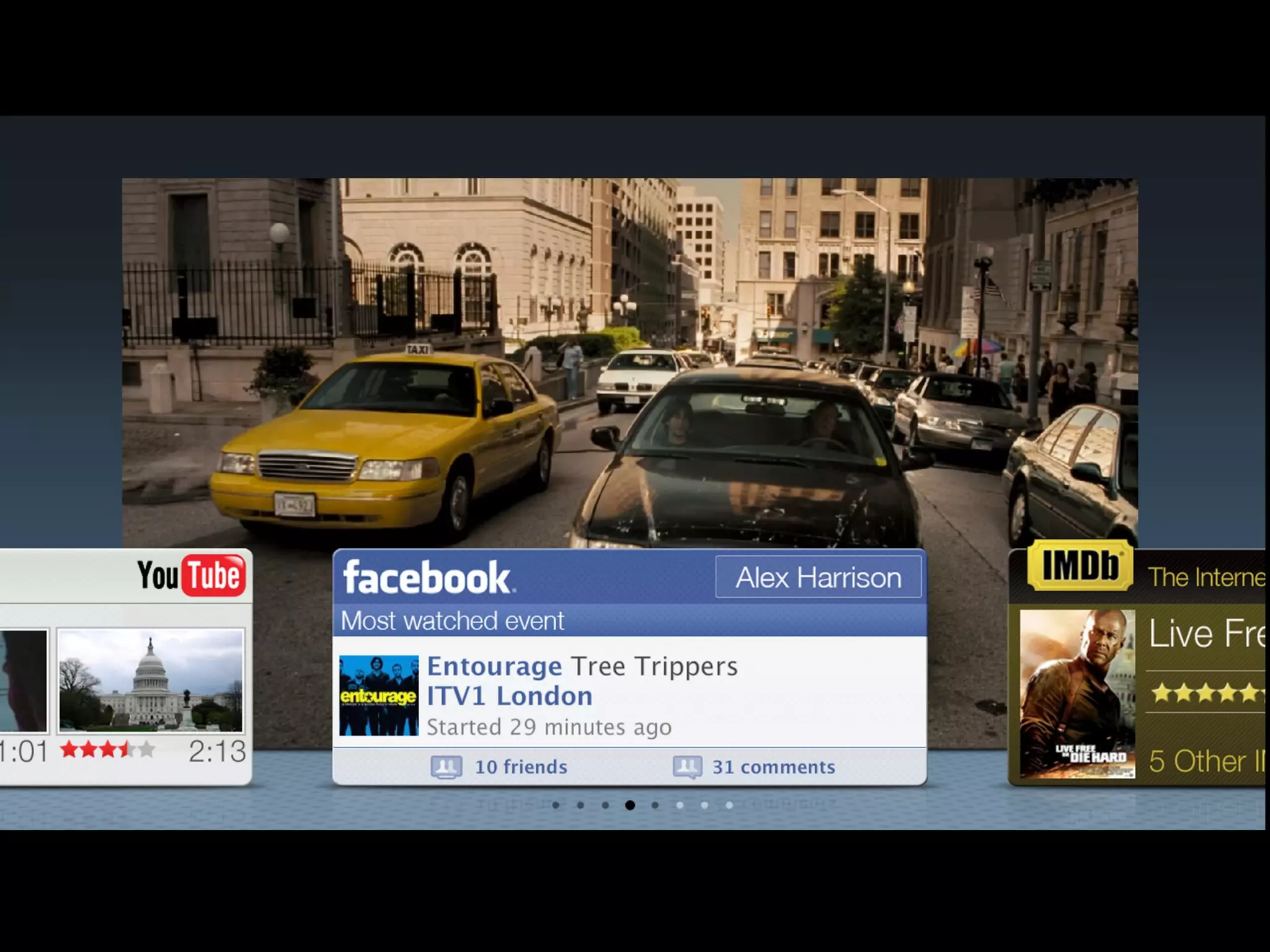
Social TV in EPGs Social functionality integrated into set-top box middleware NDS prototype EPG lets you share your viewing via Facebook within EPG
 
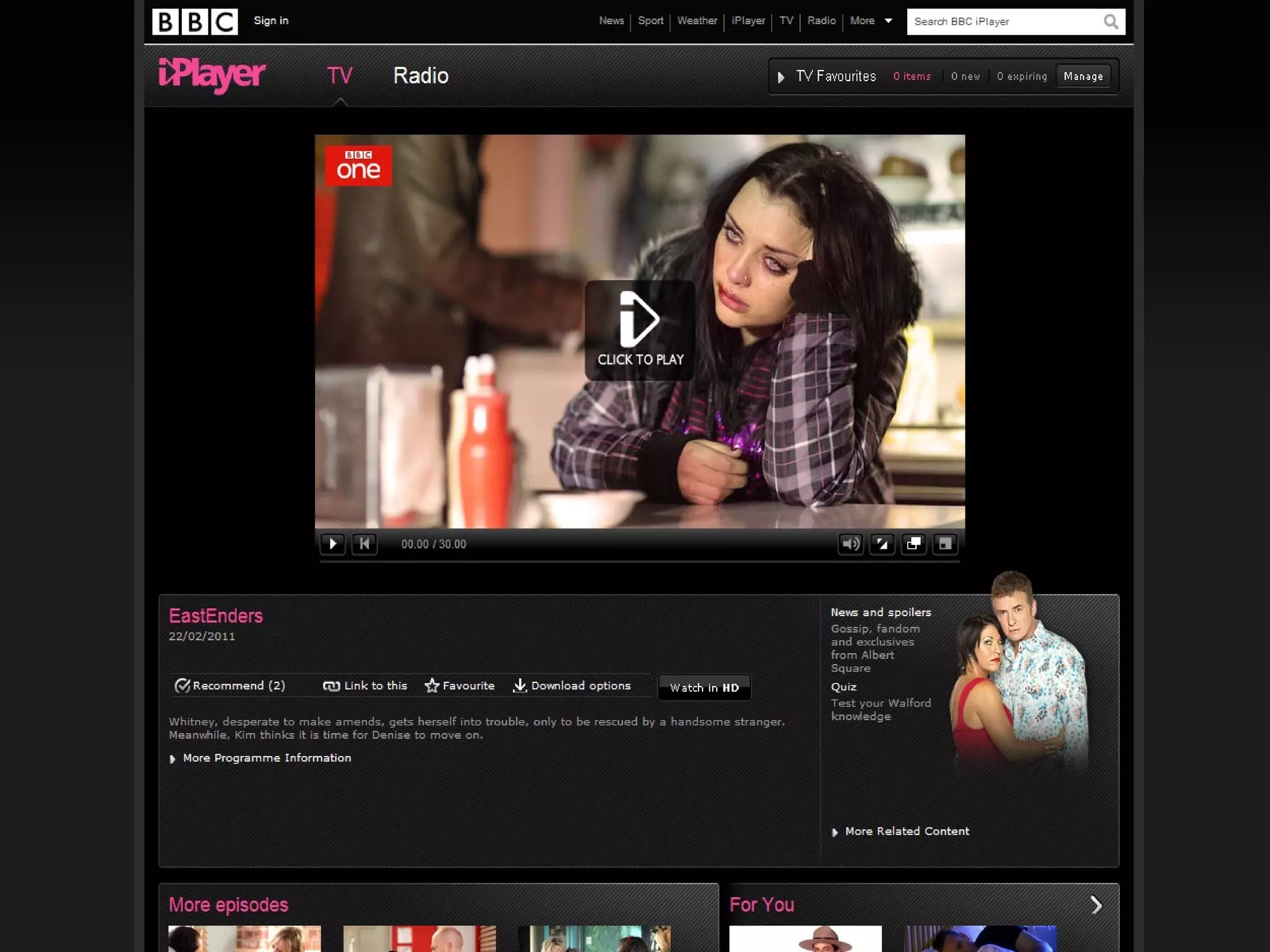
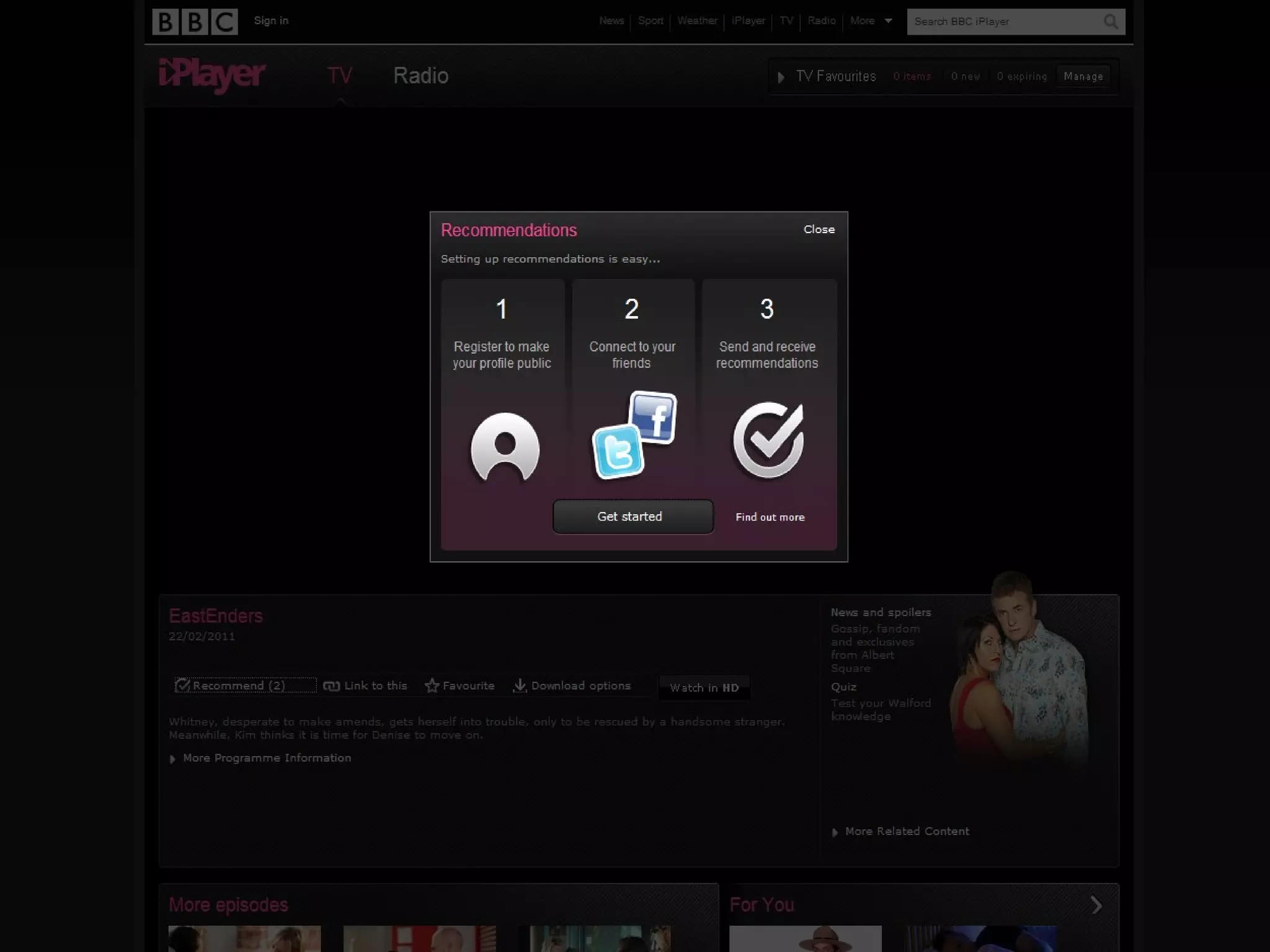
Social TV and online TV Similar integration with broadcasters’ online video players BBC iPlayer using Facebook and Twitter for viewers to recommend shows
 
 
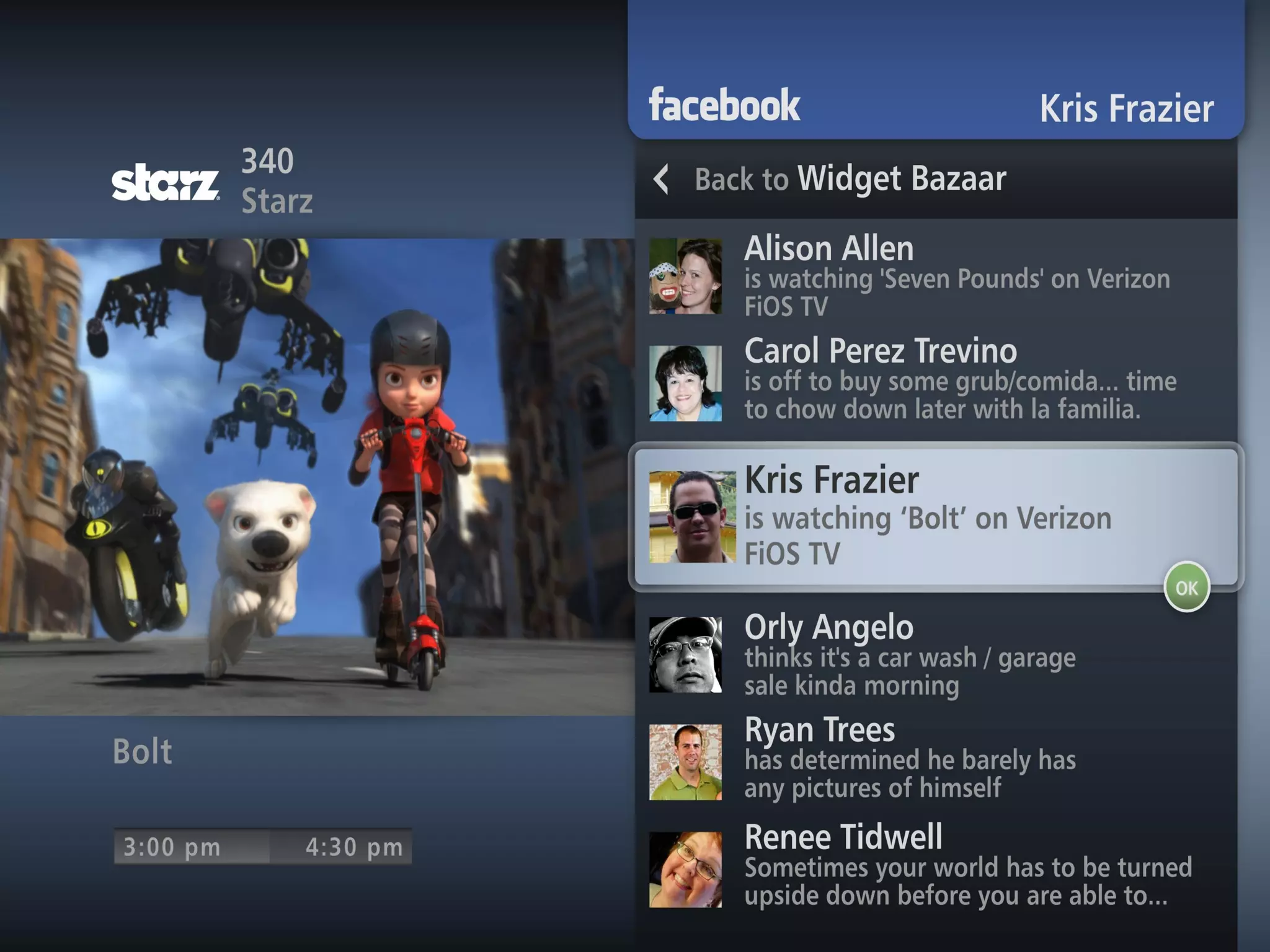
Social TV via pay-TV platforms Social TV increasingly available via cable, satellite and IPTV Facebook integration from American IPTV operator Verizon FiOS
 
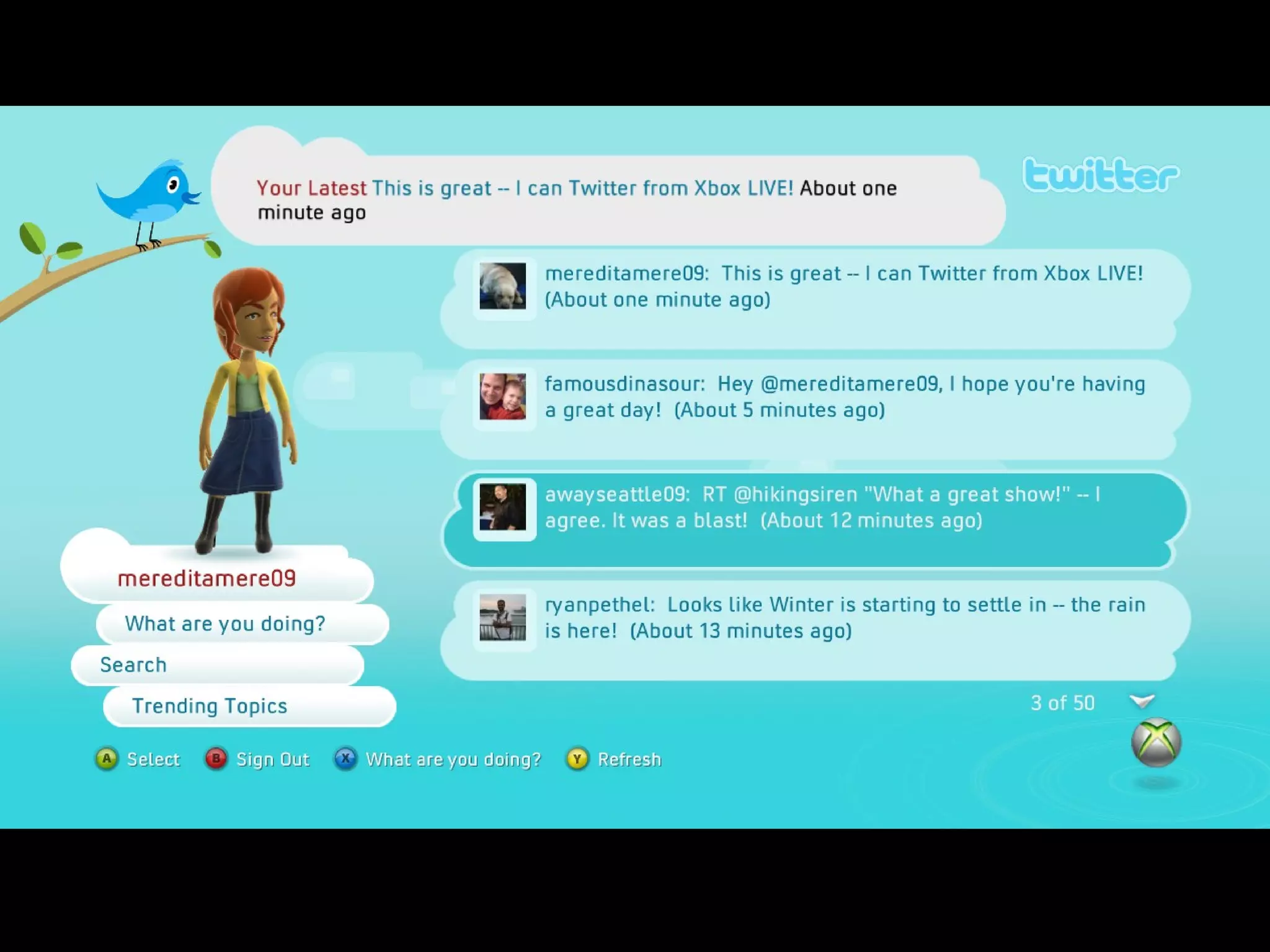
Social TV via consoles Social networking through game consoles No shortage of ways viewers can participate in new era of social TV
 
How big is social TV? Facebook and Twitter user numbers comparable to  biggest  TV audiences Two-screen usage widespread
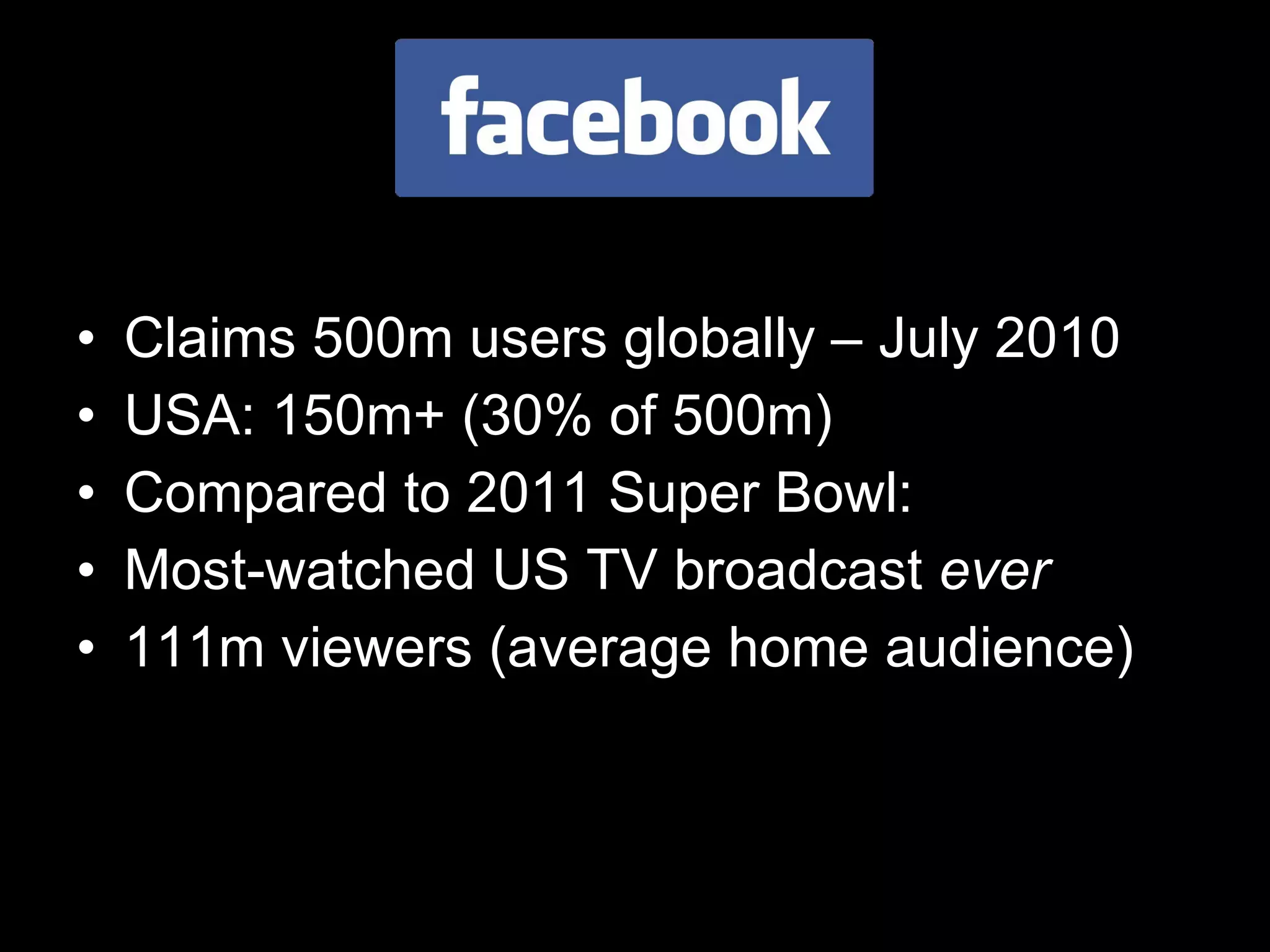
Claims 500m users globally – July 2010 USA: 150m+ (30% of 500m) Compared to 2011 Super Bowl: Most-watched US TV broadcast  ever 111m viewers (average home audience)
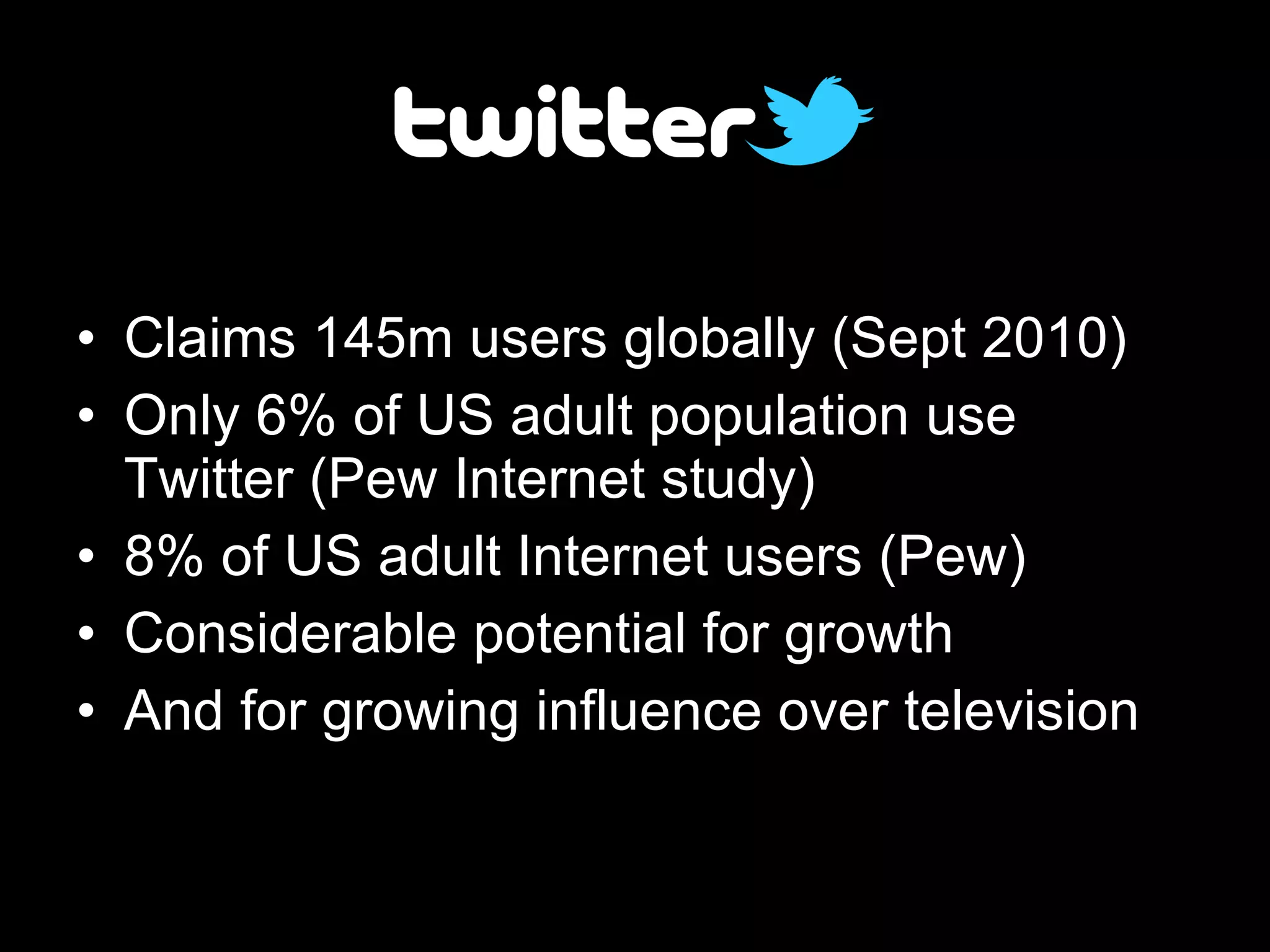
Claims 145m users globally (Sept 2010) Only 6% of US adult population use Twitter (Pew Internet study) 8% of US adult Internet users (Pew) Considerable potential for growth And for growing influence over television
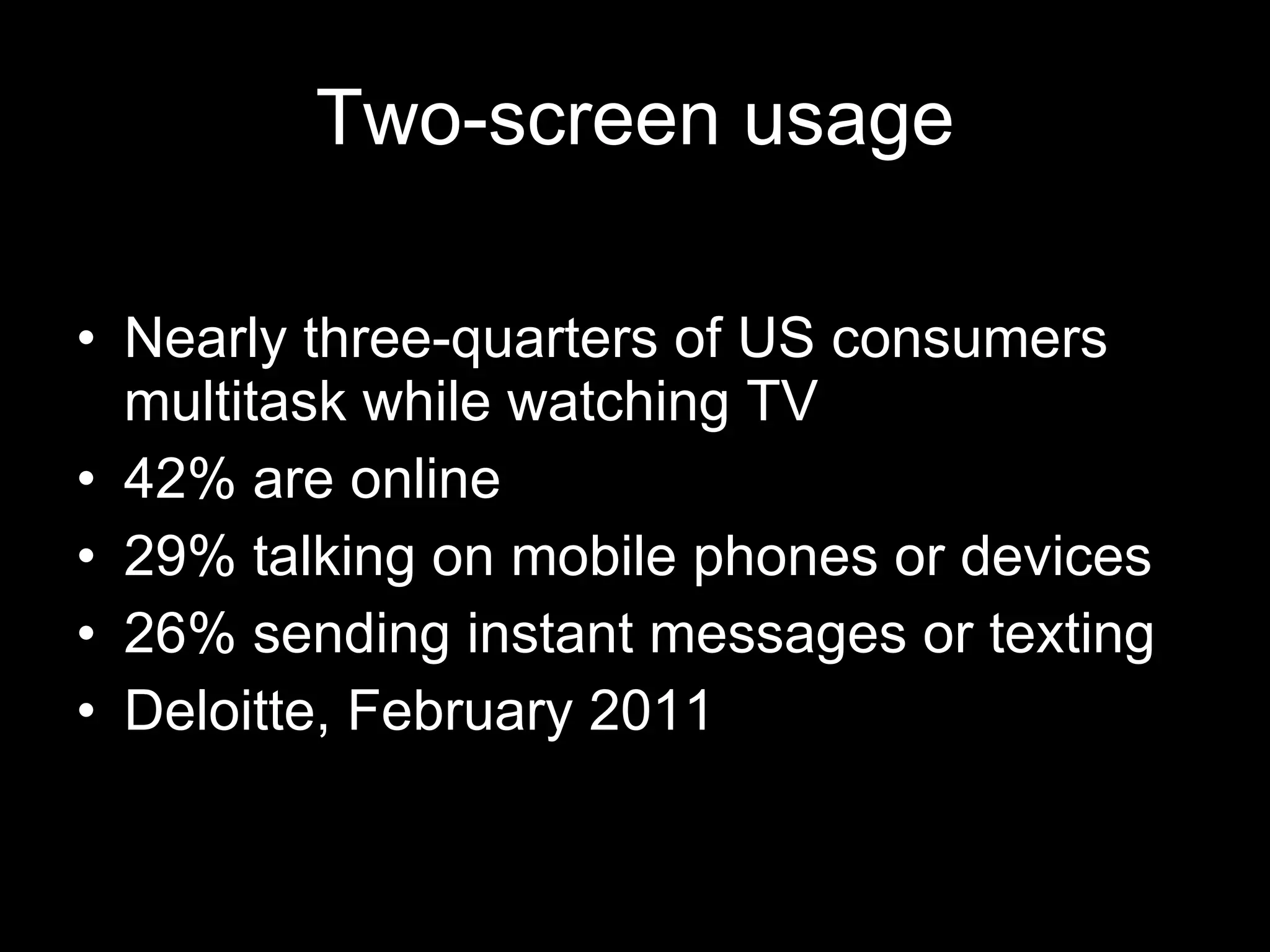
Two-screen usage Nearly three-quarters of US consumers multitask while watching TV 42% are online  29% talking on mobile phones or devices  26% sending instant messages or texting Deloitte, February 2011
2. Social TV – a radical shift in power for the TV industry
Two-screen viewing and Internet TVs give social activity considerable influence over the television industry
Social activity gives more power to the companies facilitating it
 
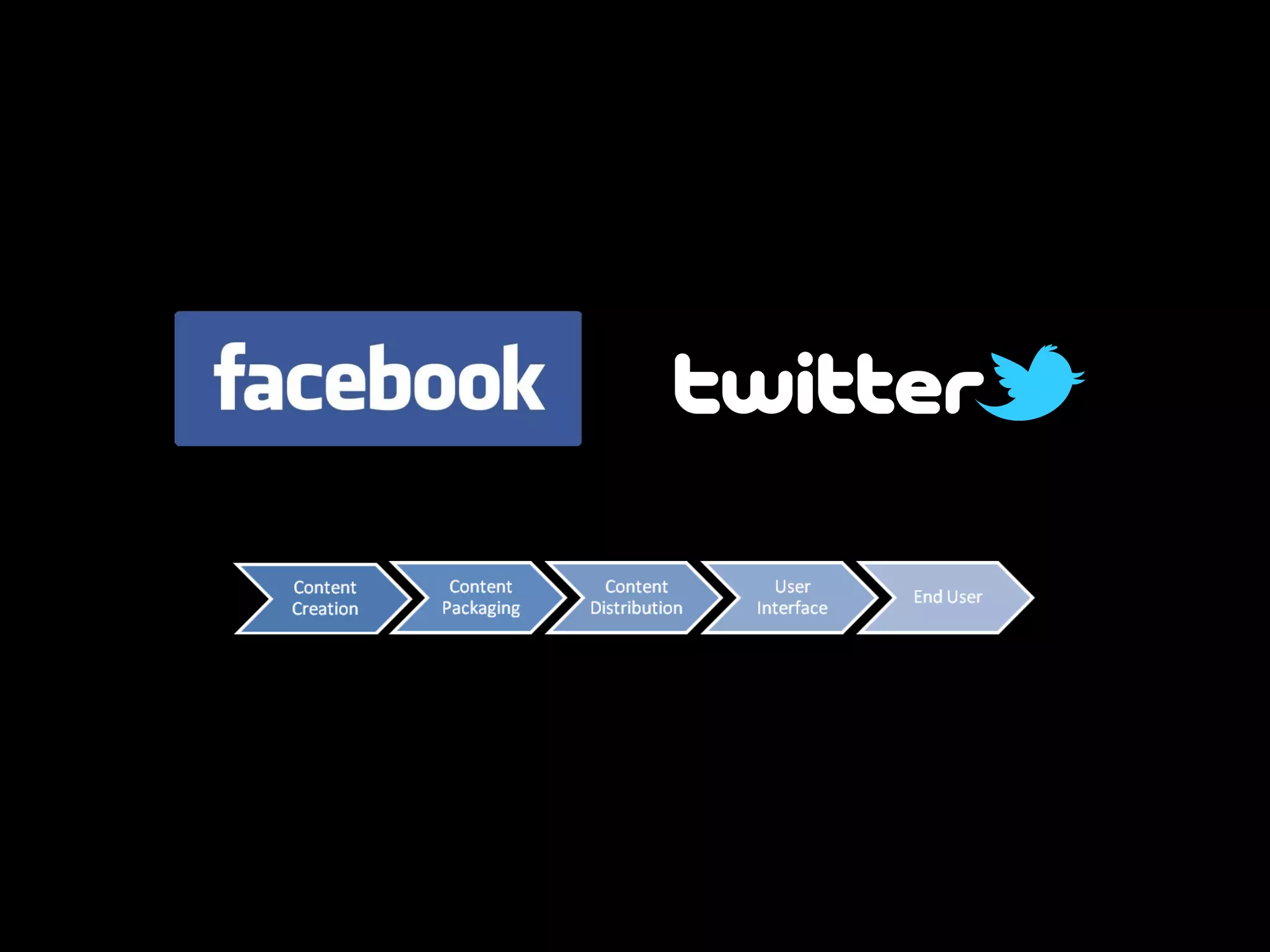
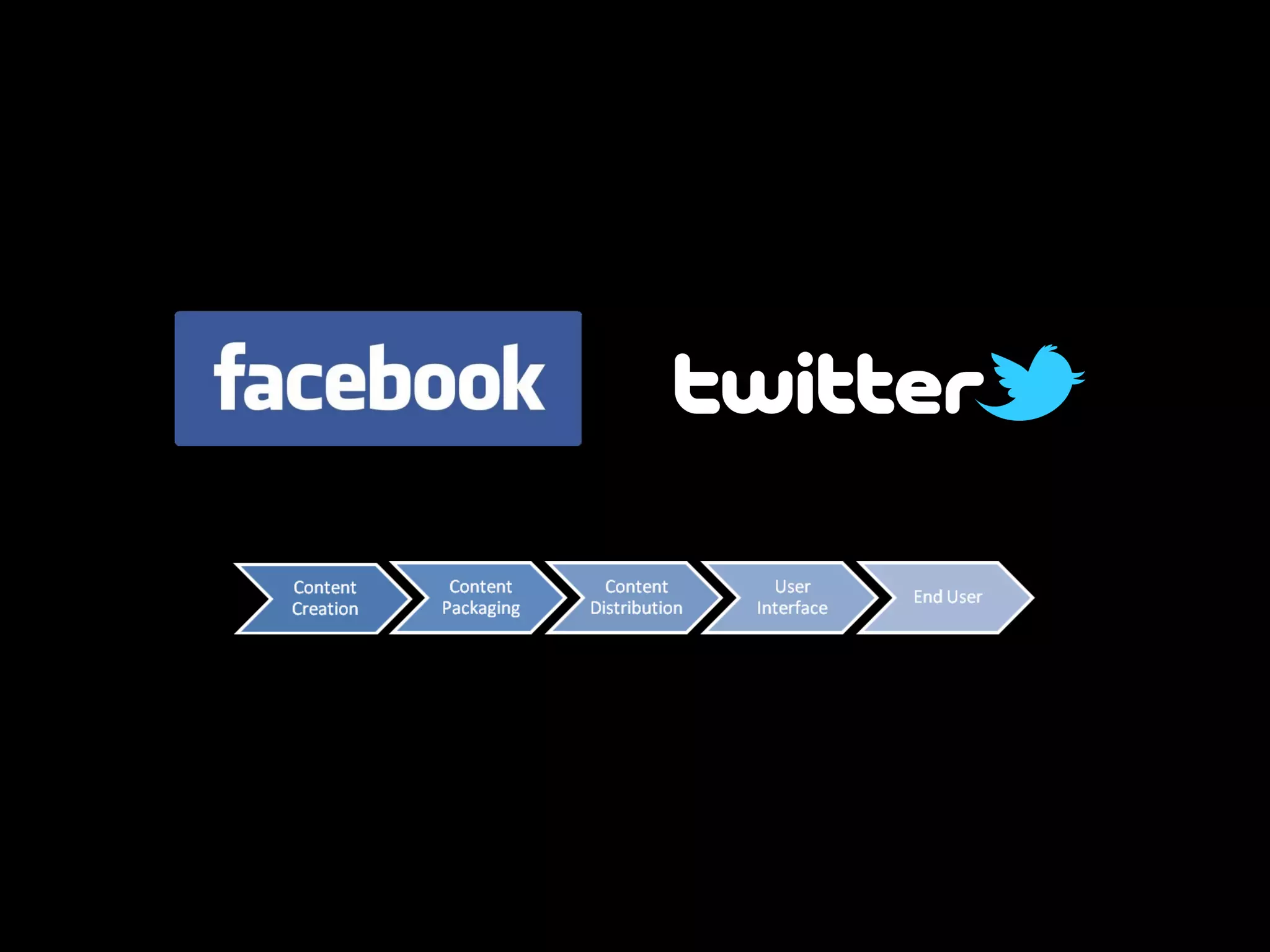
Facebook and Twitter are now major players in global television
Without making a single programme
Without broadcasting a single TV channel
 
3. How does social TV power manifest itself?
Impact on Viewing Distribution Production Revenue
Impact on Viewing – people discussing shows can increase audience size and engagement
Impact on Viewing – people discussing shows can increase audience size and engagement Distribution – social networks becoming alternative distribution to cable or satellite
Impact on Viewing – people discussing shows can increase audience size and engagement Distribution – social networks becoming alternative distribution to cable or satellite Production – bringing the audience into the production process
Impact on Viewing – people discussing shows can increase audience size and engagement Distribution – social networks becoming alternative distribution to cable or satellite Production – bringing the audience into the production process Revenue – social networks enable audience pay-to-participate
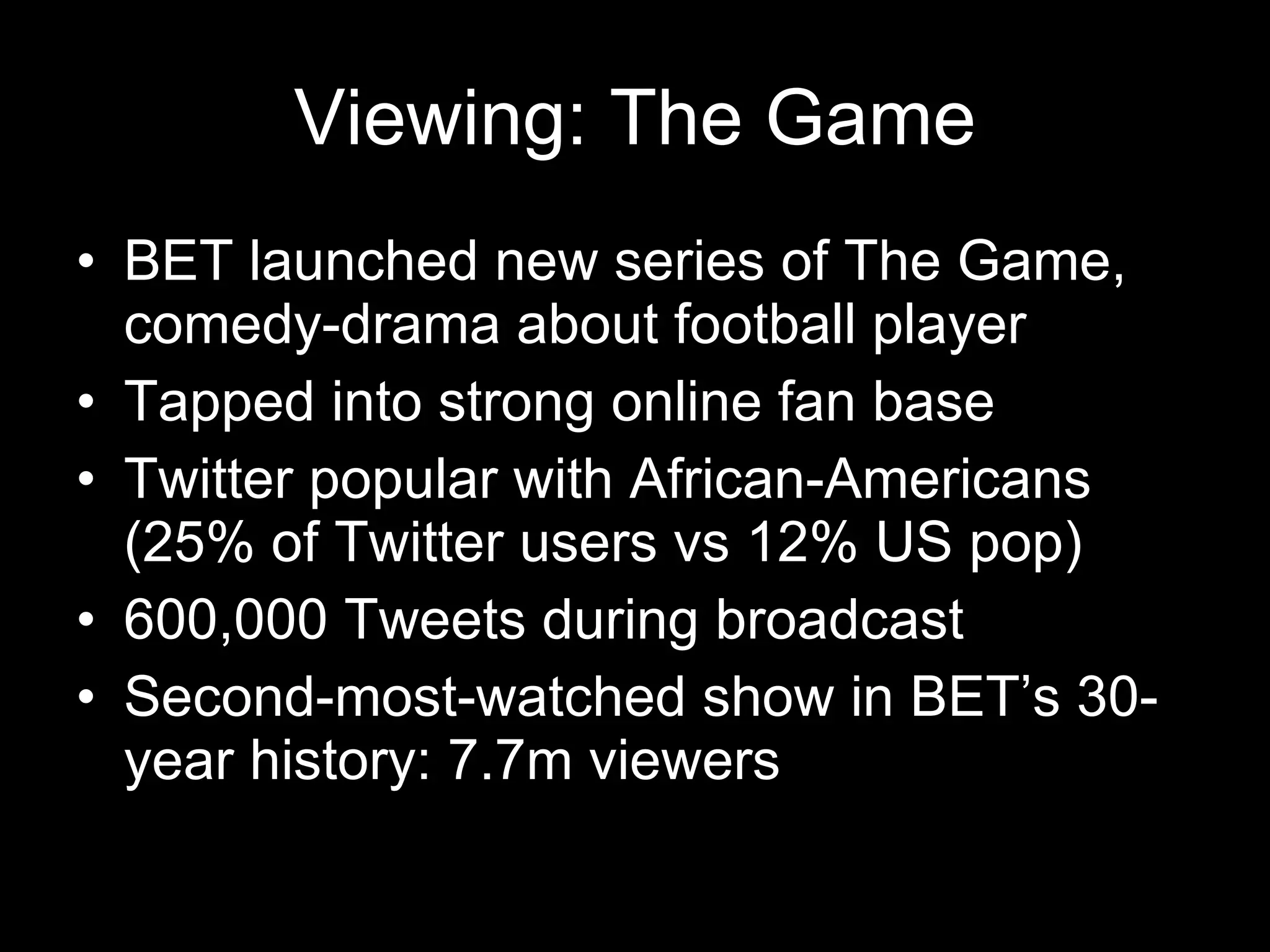
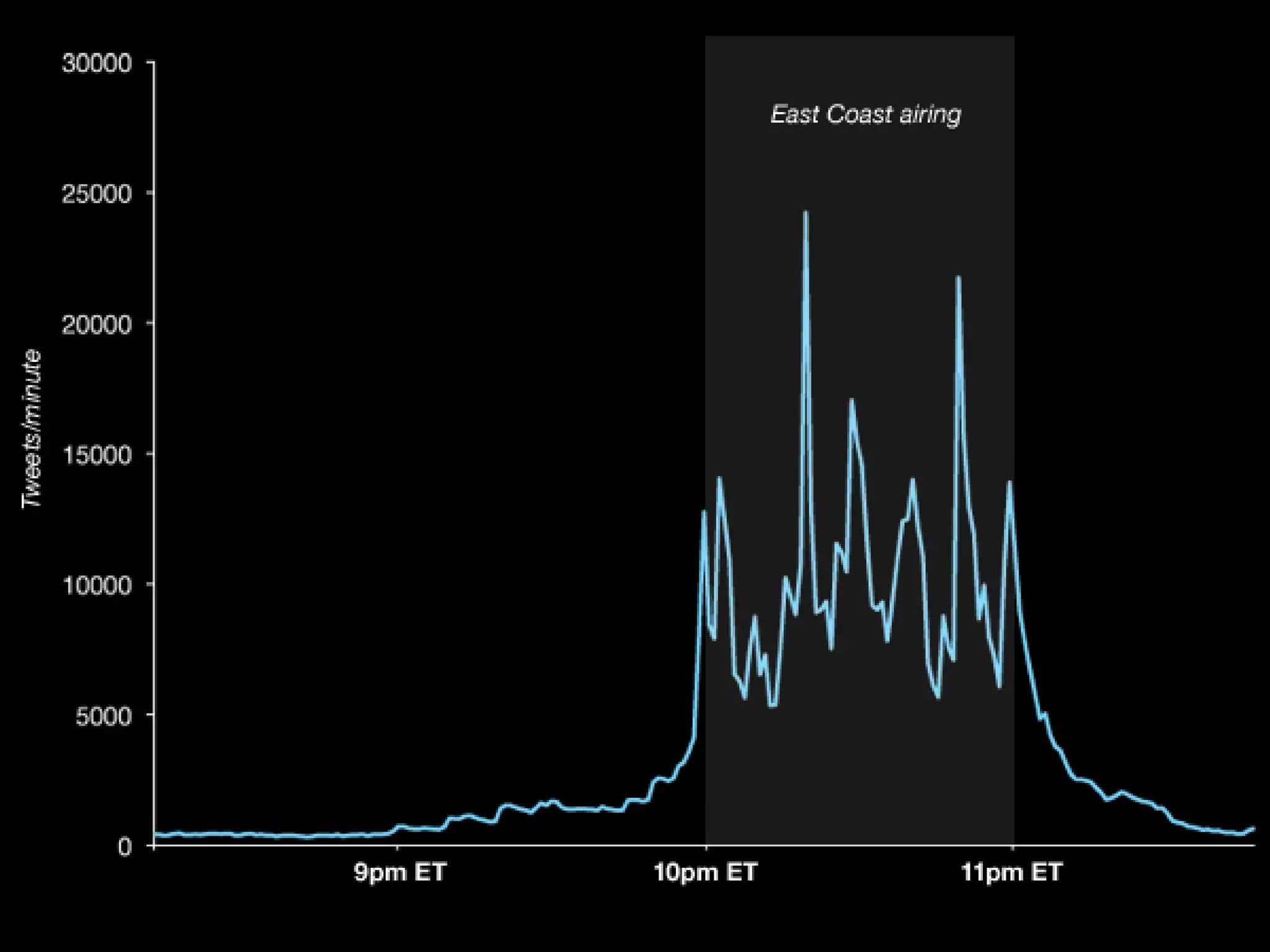
Viewing: The Game BET launched new series of The Game, comedy-drama about football player Tapped into strong online fan base Twitter popular with African-Americans (25% of Twitter users vs 12% US pop) 600,000 Tweets during broadcast Second-most-watched show in BET’s 30-year history: 7.7m viewers
 
Distribution: movies via Facebook Warner Bros deal with Facebook to rent movies to Facebook users, March 2011 First title: The Dark Knight (no. 7 of all-time box-office grossers) Uses Facebook credits payment system Costs 30 credits ($3) for 48-hour access Successful trial – more titles added: Inception, Harry Potter
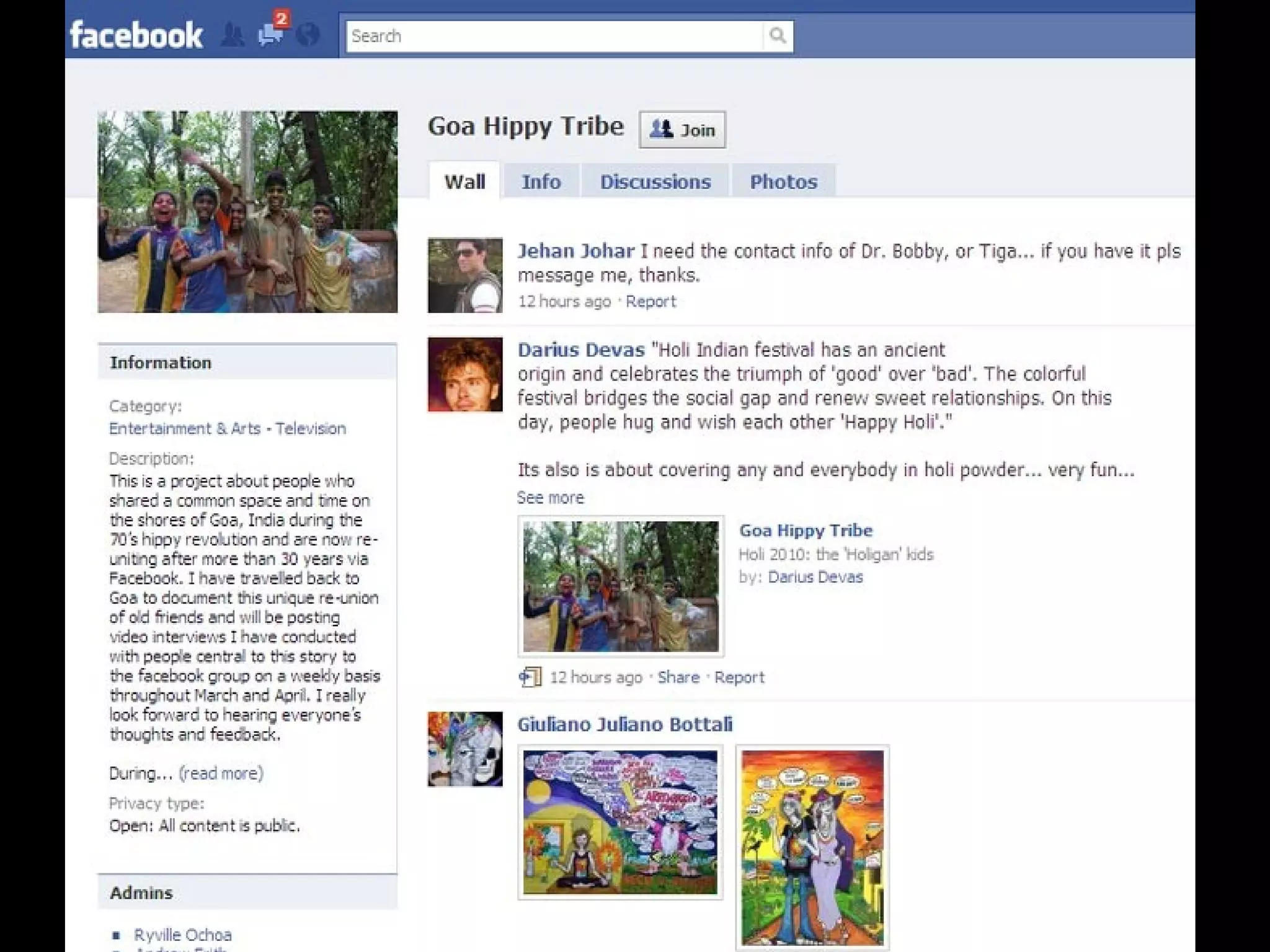
Production: Goa Hippy Tribe Documentary on history of hippies in Goa Social media commission by Australian broadcaster SBS, with Screen Australia Filmmaker Darius Devas set up Facebook group to contact interviewees Group discussion gave him feedback Short video episodes released through the Facebook group page
 
Revenue: X Factor voting X Factor in talks with Facebook Will use Facebook credits for paid voting Similar to phone voting X Factor to receive split of revenue To launch in time for autumn TV season
Television can benefit from social networks
However…
Facebook CTO predicts Social networks will disrupt media – just like gaming
 
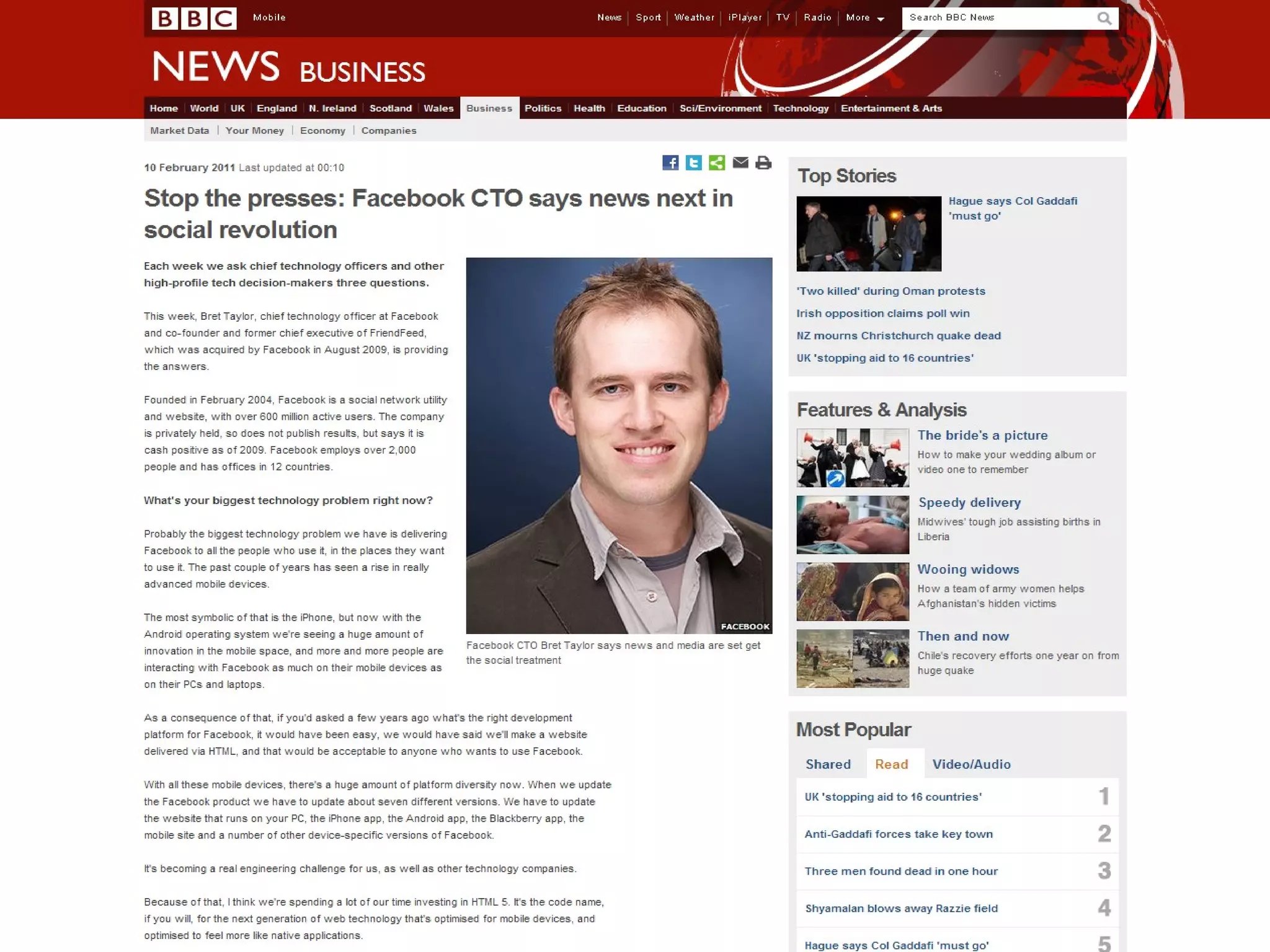
Facebook CTO predicts “ We haven't seen tons of other industries as impacted as games by Facebook, and we think that the next big change is seeing the next few industries being disrupted by social platforms in the same way gaming has been.” “ It's probably going to be orientated around media or news, because they are so social. When you watch a television show with your friend, it's such an engaging social activity.” BBC interview with Facebook CTO Bret Taylor, 10 February 2011
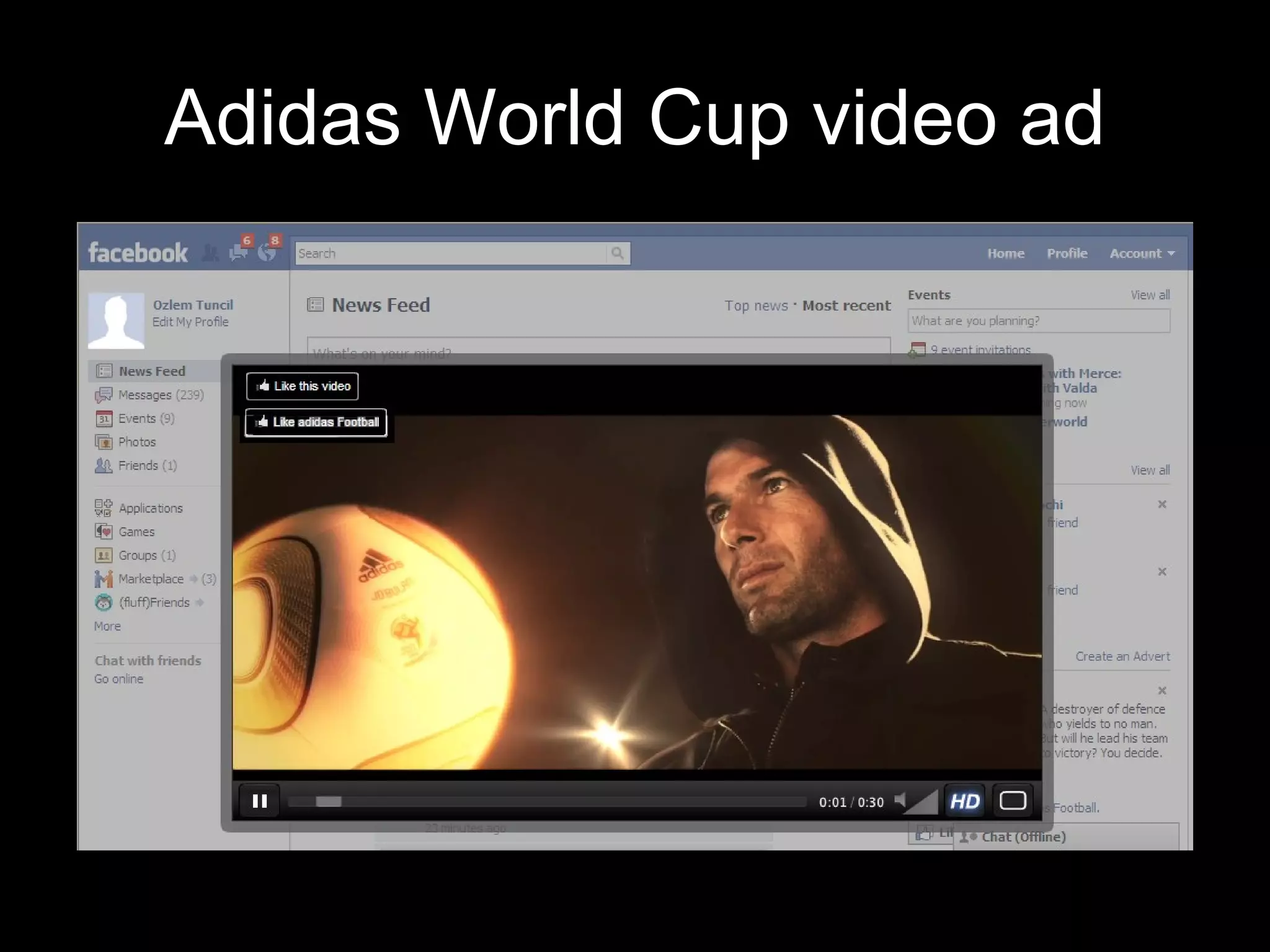
Facebook and Twitter can compete for ad revenue, too
With socially-targeted  advertising
Adidas World Cup video ad
Why did we not foresee this  social TV revolution in television?
And what does this mean for forecasting and innovation?
Forecasting and Innovation
4. The future of TV as seen from 1995
1995 Netscape went public, sparking off the dotcom boom I was launching first Web sites for UK satellite TV channels A year when the new media future was actually taking shape
Why the future seen from1995? Moving house, reshelving books This one caught my eye The future of TV From 1995
Television at the Crossroads Authors were international design experts, working with young designers at Philips Speculative essays Concept artwork Prototype TV designs Scenario photos of homes of the future
 
Television at the Crossroads So what was the future of TV in 1995? Key essay Roadside Romance: TV Marries Computer on the Electronic Highway
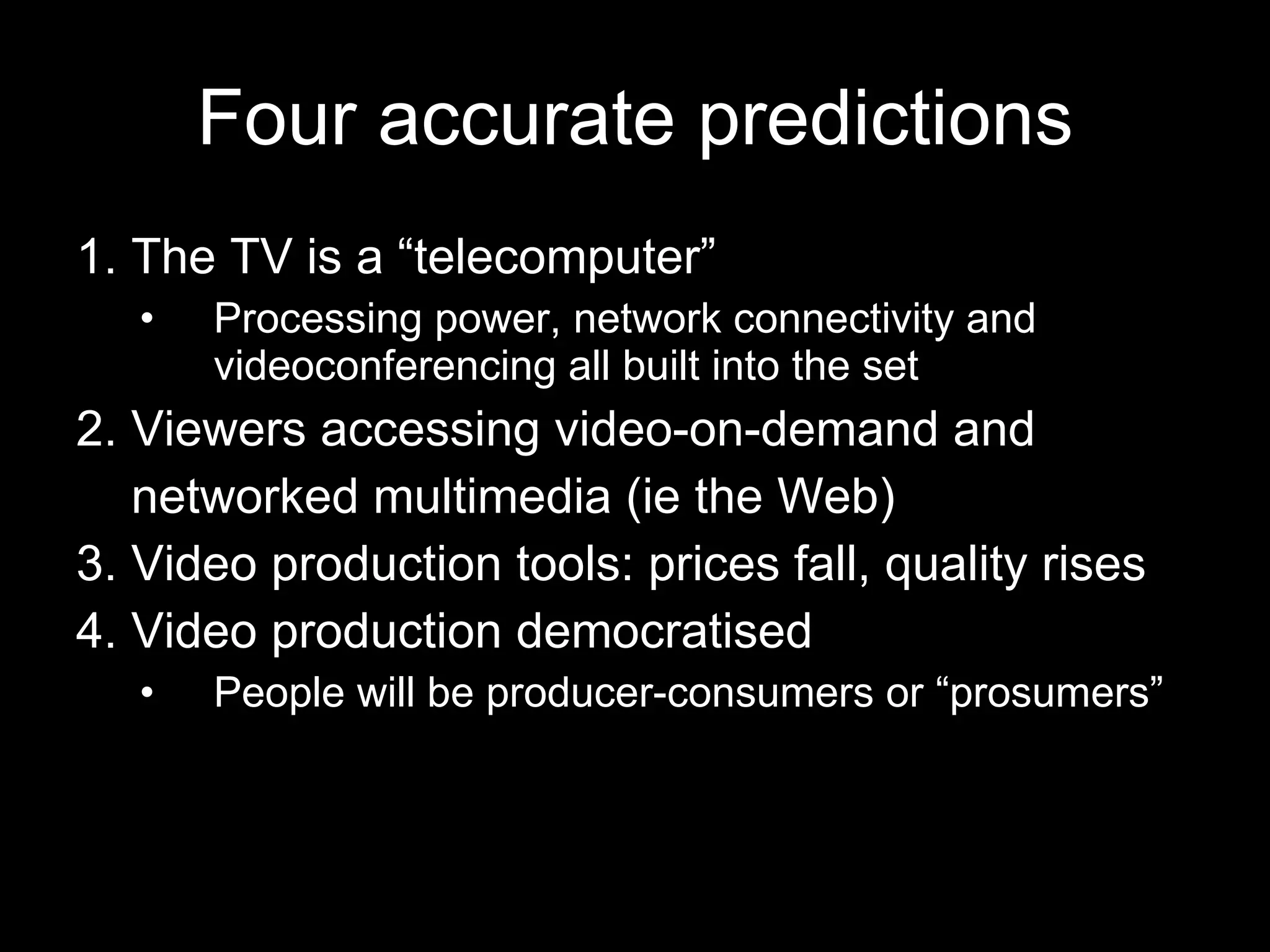
Four accurate predictions 1. The TV is a “telecomputer” Processing power, network connectivity and videoconferencing all built into the set 2. Viewers accessing video-on-demand and networked multimedia (ie the Web) 3. Video production tools: prices fall, quality rises 4. Video production democratised People will be producer-consumers or “prosumers”
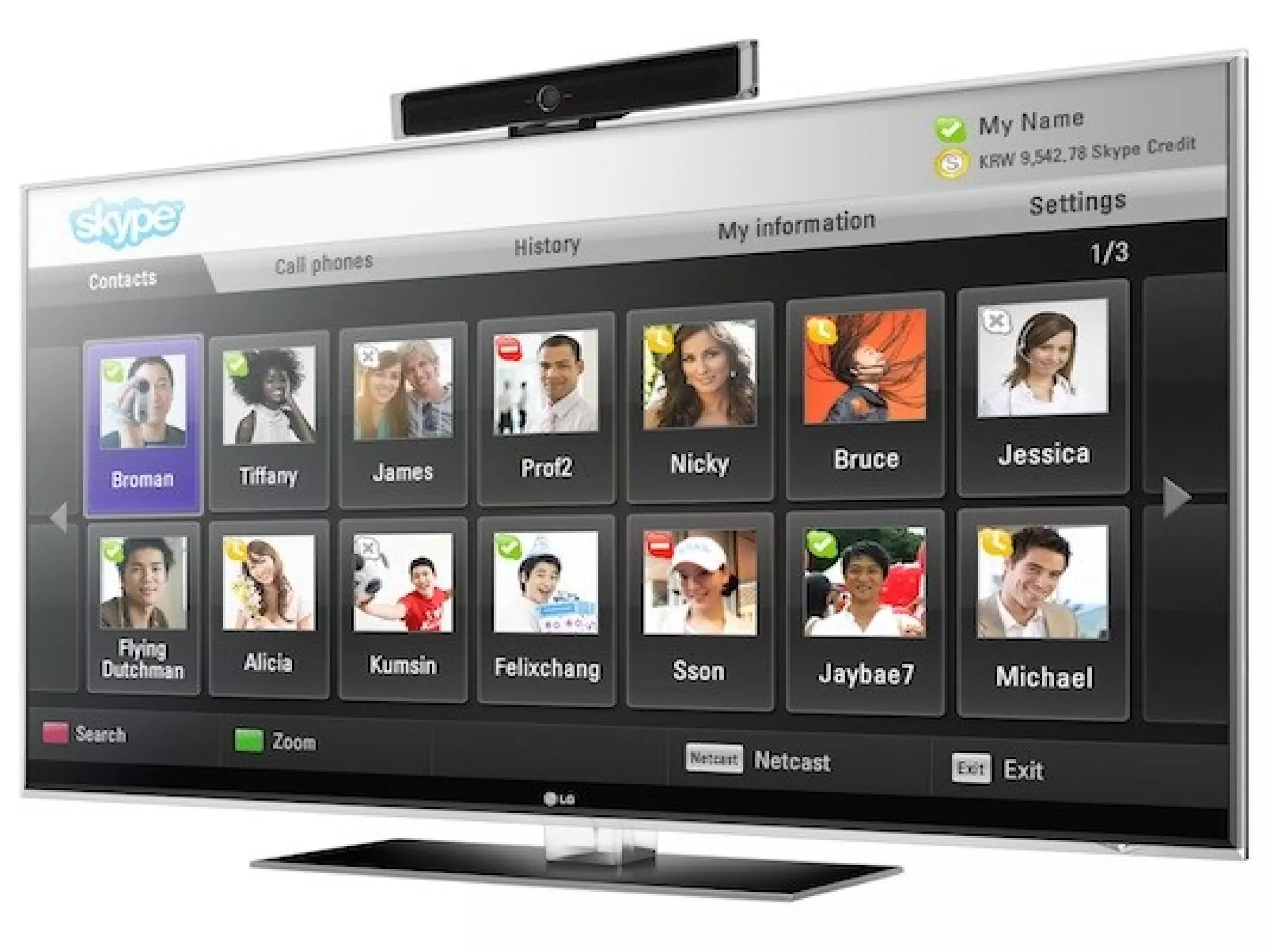
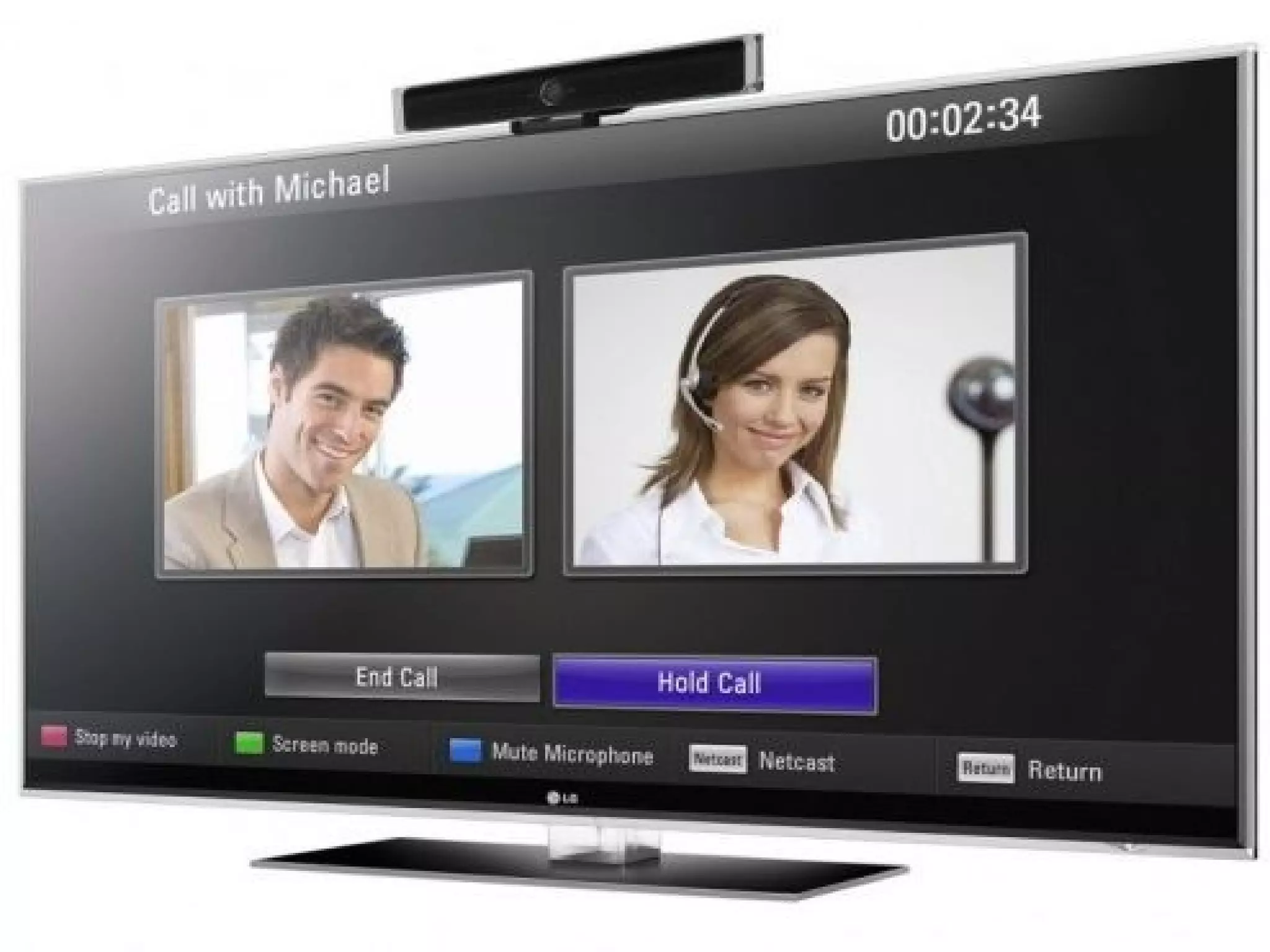
The TV is a “telecomputer” 2011 TV set full of silicon, particularly Google TV Internet connection will soon be standard feature for all flat screens And you can now buy a Skype videoconferencing TV from LG and Panasonic
 
 
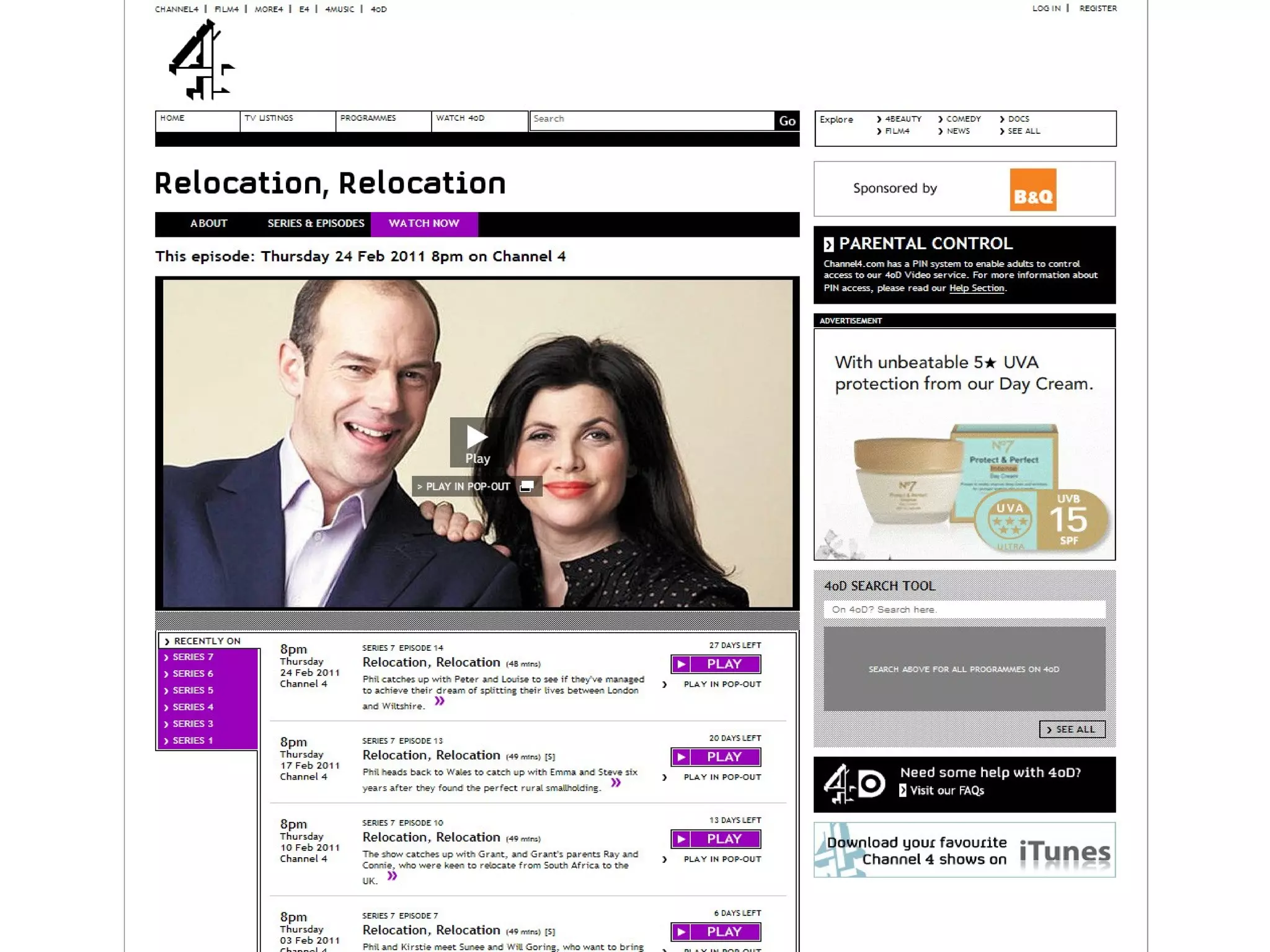
VOD and networked multimedia VOD is ubiquitous “Networked multimedia” is the Web 4oD in the Channel 4 Web site
 
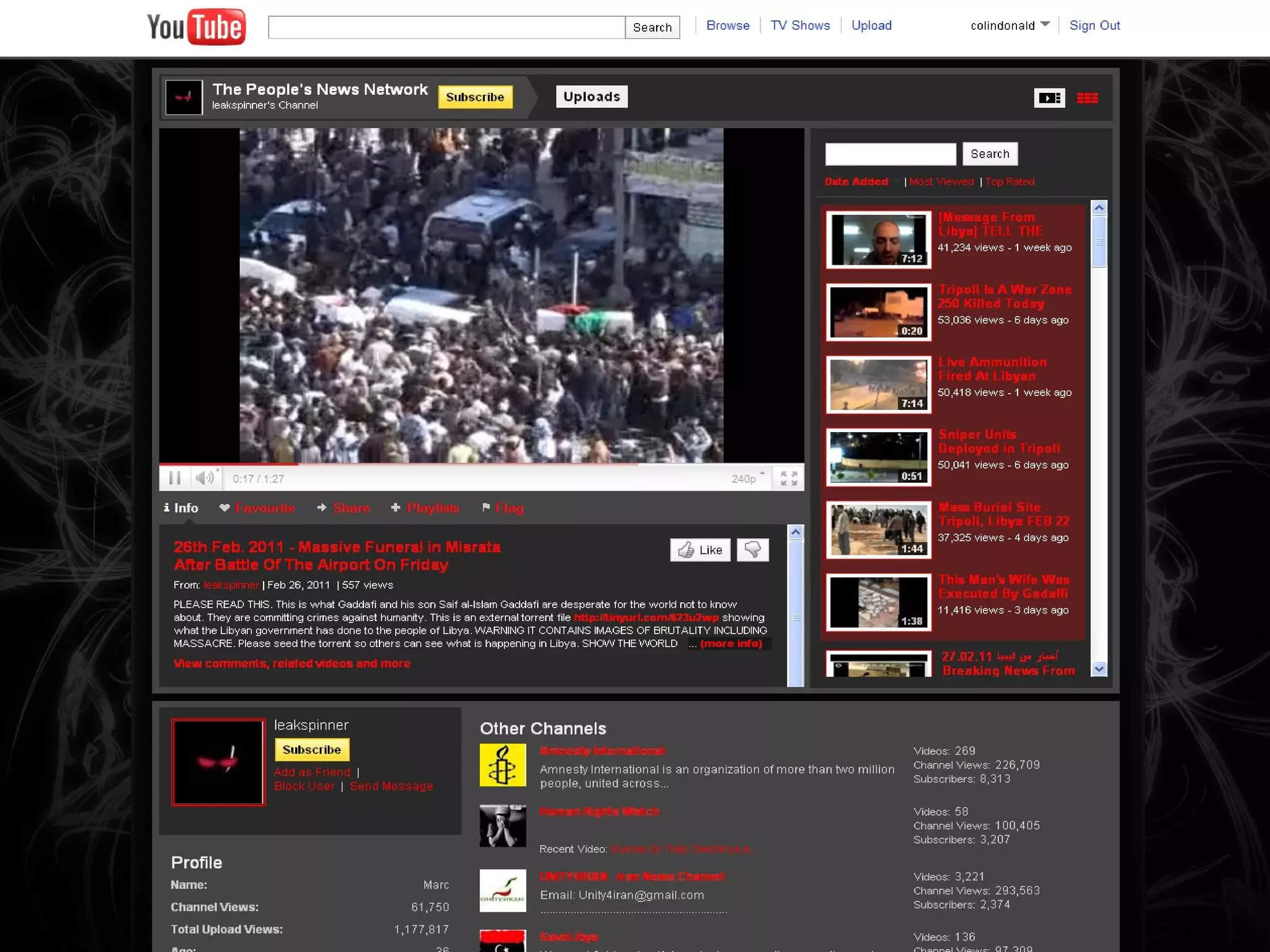
Cheap video tools democratise production “ Prosumers” taking on new role, as highly effective political activists in Middle East Libya: from smartphones to YouTube to broadcast TV
 
5. What we didn’t foresee in 1995 – social TV
What we didn’t foresee in 1995  An Internet social sphere that is democratised – and also thoroughly  commercialised
 
What we didn’t foresee in 1995  Massive social networking companies that affect the entire TV value chain
 
What we didn’t foresee in 1995  The emergence of social TV and its major implications for viewers and the TV industry
What we didn’t foresee in 1995   And that much of social TV has its roots outside the TV industry
6. Why didn’t we anticipate it?
The blind spot Innovation coming from outside the TV industry and combining three factors: 1. People’s needs – for self-expression and socialising 2. Money – massive investment creating huge companies to meet those needs  3. Data – how the Internet enabled data to be integrated in so many novel ways
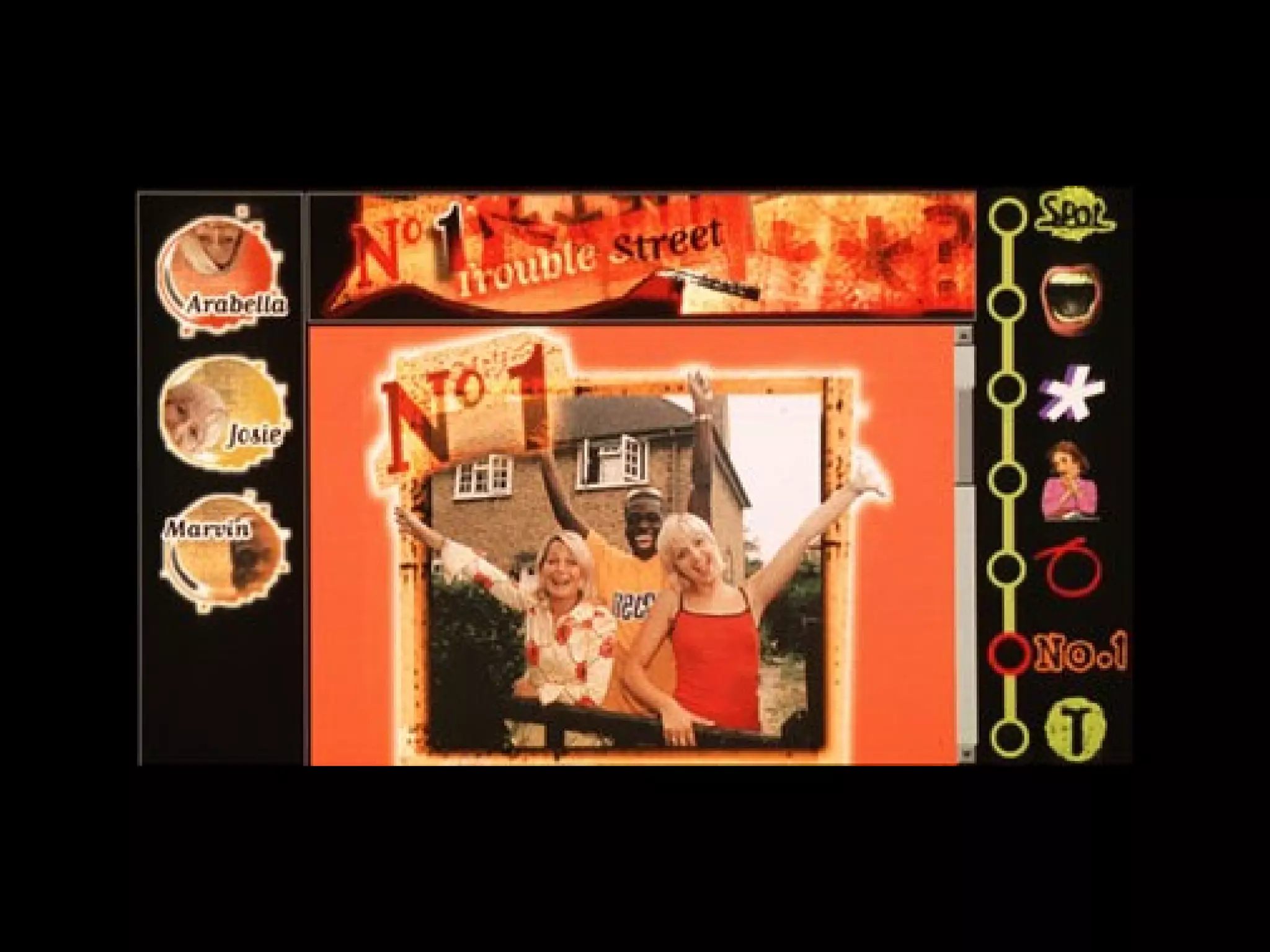
People’s social needs Broadcasters did appreciate social needs TV Web sites I launched had forums Viewers talked to each other and to the channel Trouble TV site: mouth icon for forums
 
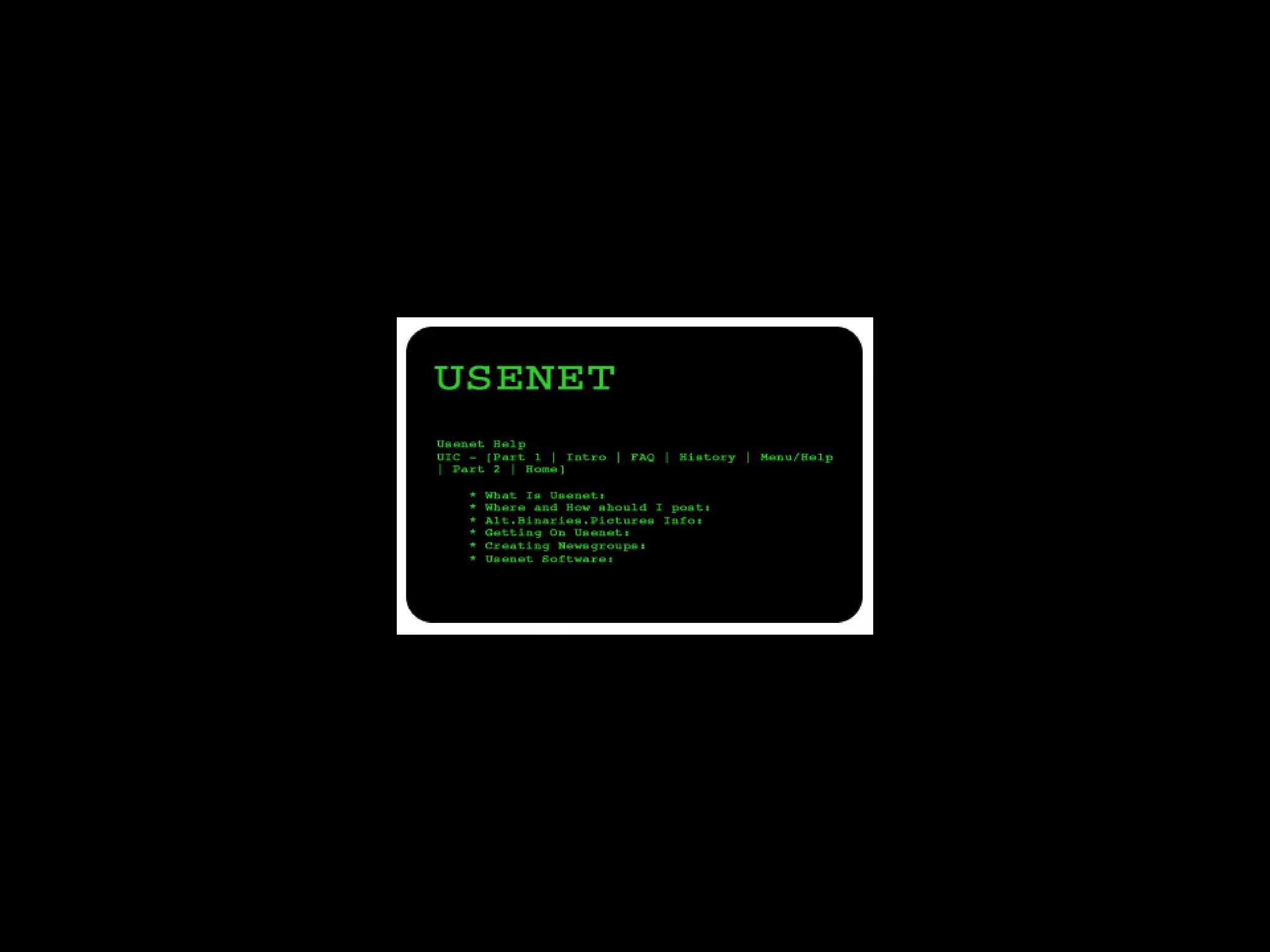
People’s social needs But the main Internet social arena in 1995 was thoroughly  non-commercial
 
People’s social needs But the main Internet social arena in 1995 was thoroughly  non-commercial Unclear if commercial social businesses could even succeed on the Internet AOL, CompuServe just launching Web access in 1995
Money The major social innovation and aggregation came from outside television In successive generations of well-funded, fast-moving Internet start ups


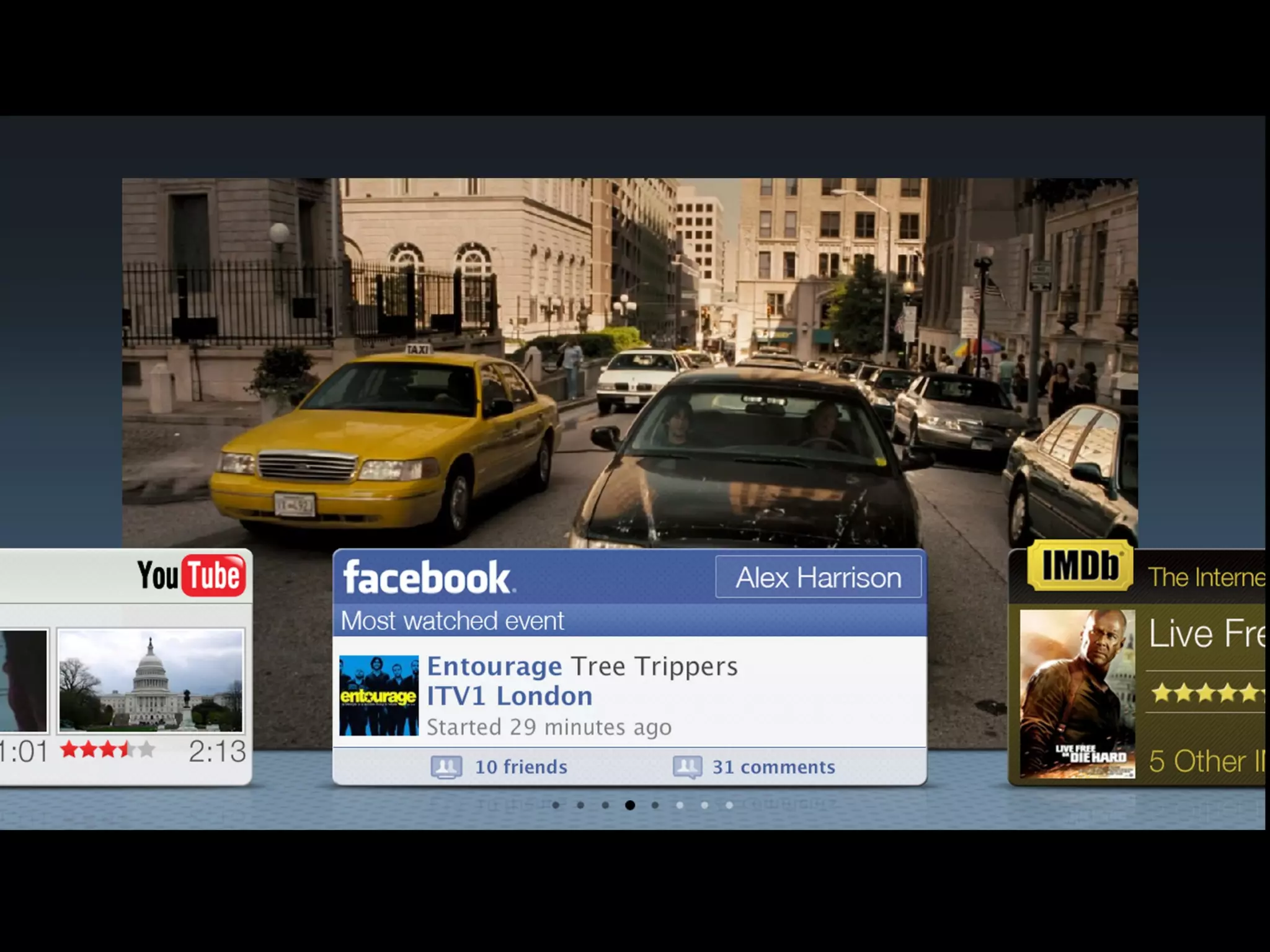
Data The Internet has enabled data to be integrated in many novel ways Including connected TV systems
 
The future of social TV from 2011 In 2011, we can’t easily see the long-term impact of social media integration with TV But key elements in shaping the future of social TV remain: People’s social needs and behaviour Internet start-ups Innovation with data
7. Implications for forecasting and innovation
How can we generalise from the experience of forecasting the future of TV?
Forecasting and blind spots Focused on the future of television – but not how the TV industry might be disrupted in the future Focused on linear improvement – but the future always includes non-linear disruption Linear improvements did take place – HD TV But significant discontinuous change came from outside the TV industry – rise of social networks
Remedies for blind spots Actively look for sources of discontinuous change and disruption Particularly external innovation – outside own sector / country / continent Engage in more cross-company / sector / country information exchange and innovation collaboration
The future of television For more Futurescape analysis on the future of television and social media, see our white paper “ How Connected Television Transforms the Business of TV” www.futurescape.tv
Colin Donald [email_address] www.futurescape.tv

Colin donald ECBN presentation

  • 1.
    Social TV, Forecastingand Innovation Why didn’t we foresee the rise of social TV? Presentation for the European Creative Business Network conference “IPTV and Beyond,” Bristol, March 2011 Colin Donald Director www.futurescape.tv
  • 2.
    Overview Social TV:a synthesis of TV and social networking 1. Transforming the medium of TV 2. A radical shift in power for the TV industry 3. How does social TV power manifest itself? Forecasting and Innovation 4. The future of TV as seen from 1995 5. What we didn’t foresee in 1995 – social TV 6. Why didn’t we anticipate it? 7. Implications for forecasting and innovation
  • 3.
    1. Social TV– transforming the medium of television
  • 4.
    The social TVrevolution Social TV – the biggest change in television since it was invented Qualitatively different from improvements to TV: colour, satellite, HD, 3D – all forms of better TV Audiences engaging with television via second screens (eg laptops) and connected TV systems Transforms medium and industry Gives social networks significant commercial roles in the TV business Why did we not foresee this major development?
  • 5.
    What is socialTV? Enabling technologies + viewer behaviour have significant business impact on TV industry People talk 24/7 about television on Facebook and Twitter Discuss, criticise, recommend and share it
  • 6.
  • 7.
    Broadcasters embrace itBBC using on-air Twitter hashtags so people will discuss its shows Have I Got News For You
  • 8.
  • 9.
    Broadcasters embrace itThe official Oscars hashtag Host James Franco actually tweeting during the live show
  • 10.
  • 11.
  • 12.
    Connected TVs enablesocial TV New connected TV sets and services are integrating social activity Twitter in a Sony Google TV
  • 13.
  • 14.
    Social TV inEPGs Social functionality integrated into set-top box middleware NDS prototype EPG lets you share your viewing via Facebook within EPG
  • 15.
  • 16.
    Social TV andonline TV Similar integration with broadcasters’ online video players BBC iPlayer using Facebook and Twitter for viewers to recommend shows
  • 17.
  • 18.
  • 19.
    Social TV viapay-TV platforms Social TV increasingly available via cable, satellite and IPTV Facebook integration from American IPTV operator Verizon FiOS
  • 20.
  • 21.
    Social TV viaconsoles Social networking through game consoles No shortage of ways viewers can participate in new era of social TV
  • 22.
  • 23.
    How big issocial TV? Facebook and Twitter user numbers comparable to biggest TV audiences Two-screen usage widespread
  • 24.
    Claims 500m usersglobally – July 2010 USA: 150m+ (30% of 500m) Compared to 2011 Super Bowl: Most-watched US TV broadcast ever 111m viewers (average home audience)
  • 25.
    Claims 145m usersglobally (Sept 2010) Only 6% of US adult population use Twitter (Pew Internet study) 8% of US adult Internet users (Pew) Considerable potential for growth And for growing influence over television
  • 26.
    Two-screen usage Nearlythree-quarters of US consumers multitask while watching TV 42% are online 29% talking on mobile phones or devices 26% sending instant messages or texting Deloitte, February 2011
  • 27.
    2. Social TV– a radical shift in power for the TV industry
  • 28.
    Two-screen viewing andInternet TVs give social activity considerable influence over the television industry
  • 29.
    Social activity givesmore power to the companies facilitating it
  • 30.
  • 31.
    Facebook and Twitterare now major players in global television
  • 32.
    Without making asingle programme
  • 33.
    Without broadcasting asingle TV channel
  • 34.
  • 35.
    3. How doessocial TV power manifest itself?
  • 36.
    Impact on ViewingDistribution Production Revenue
  • 37.
    Impact on Viewing– people discussing shows can increase audience size and engagement
  • 38.
    Impact on Viewing– people discussing shows can increase audience size and engagement Distribution – social networks becoming alternative distribution to cable or satellite
  • 39.
    Impact on Viewing– people discussing shows can increase audience size and engagement Distribution – social networks becoming alternative distribution to cable or satellite Production – bringing the audience into the production process
  • 40.
    Impact on Viewing– people discussing shows can increase audience size and engagement Distribution – social networks becoming alternative distribution to cable or satellite Production – bringing the audience into the production process Revenue – social networks enable audience pay-to-participate
  • 41.
    Viewing: The GameBET launched new series of The Game, comedy-drama about football player Tapped into strong online fan base Twitter popular with African-Americans (25% of Twitter users vs 12% US pop) 600,000 Tweets during broadcast Second-most-watched show in BET’s 30-year history: 7.7m viewers
  • 42.
  • 43.
    Distribution: movies viaFacebook Warner Bros deal with Facebook to rent movies to Facebook users, March 2011 First title: The Dark Knight (no. 7 of all-time box-office grossers) Uses Facebook credits payment system Costs 30 credits ($3) for 48-hour access Successful trial – more titles added: Inception, Harry Potter
  • 44.
    Production: Goa HippyTribe Documentary on history of hippies in Goa Social media commission by Australian broadcaster SBS, with Screen Australia Filmmaker Darius Devas set up Facebook group to contact interviewees Group discussion gave him feedback Short video episodes released through the Facebook group page
  • 45.
  • 46.
    Revenue: X Factorvoting X Factor in talks with Facebook Will use Facebook credits for paid voting Similar to phone voting X Factor to receive split of revenue To launch in time for autumn TV season
  • 47.
    Television can benefitfrom social networks
  • 48.
  • 49.
    Facebook CTO predictsSocial networks will disrupt media – just like gaming
  • 50.
  • 51.
    Facebook CTO predicts“ We haven't seen tons of other industries as impacted as games by Facebook, and we think that the next big change is seeing the next few industries being disrupted by social platforms in the same way gaming has been.” “ It's probably going to be orientated around media or news, because they are so social. When you watch a television show with your friend, it's such an engaging social activity.” BBC interview with Facebook CTO Bret Taylor, 10 February 2011
  • 52.
    Facebook and Twittercan compete for ad revenue, too
  • 53.
  • 54.
  • 55.
    Why did wenot foresee this social TV revolution in television?
  • 56.
    And what doesthis mean for forecasting and innovation?
  • 57.
  • 58.
    4. The futureof TV as seen from 1995
  • 59.
    1995 Netscape wentpublic, sparking off the dotcom boom I was launching first Web sites for UK satellite TV channels A year when the new media future was actually taking shape
  • 60.
    Why the futureseen from1995? Moving house, reshelving books This one caught my eye The future of TV From 1995
  • 61.
    Television at theCrossroads Authors were international design experts, working with young designers at Philips Speculative essays Concept artwork Prototype TV designs Scenario photos of homes of the future
  • 62.
  • 63.
    Television at theCrossroads So what was the future of TV in 1995? Key essay Roadside Romance: TV Marries Computer on the Electronic Highway
  • 64.
    Four accurate predictions1. The TV is a “telecomputer” Processing power, network connectivity and videoconferencing all built into the set 2. Viewers accessing video-on-demand and networked multimedia (ie the Web) 3. Video production tools: prices fall, quality rises 4. Video production democratised People will be producer-consumers or “prosumers”
  • 65.
    The TV isa “telecomputer” 2011 TV set full of silicon, particularly Google TV Internet connection will soon be standard feature for all flat screens And you can now buy a Skype videoconferencing TV from LG and Panasonic
  • 66.
  • 67.
  • 68.
    VOD and networkedmultimedia VOD is ubiquitous “Networked multimedia” is the Web 4oD in the Channel 4 Web site
  • 69.
  • 70.
    Cheap video toolsdemocratise production “ Prosumers” taking on new role, as highly effective political activists in Middle East Libya: from smartphones to YouTube to broadcast TV
  • 71.
  • 72.
    5. What wedidn’t foresee in 1995 – social TV
  • 73.
    What we didn’tforesee in 1995 An Internet social sphere that is democratised – and also thoroughly commercialised
  • 74.
  • 75.
    What we didn’tforesee in 1995 Massive social networking companies that affect the entire TV value chain
  • 76.
  • 77.
    What we didn’tforesee in 1995 The emergence of social TV and its major implications for viewers and the TV industry
  • 78.
    What we didn’tforesee in 1995 And that much of social TV has its roots outside the TV industry
  • 79.
    6. Why didn’twe anticipate it?
  • 80.
    The blind spotInnovation coming from outside the TV industry and combining three factors: 1. People’s needs – for self-expression and socialising 2. Money – massive investment creating huge companies to meet those needs 3. Data – how the Internet enabled data to be integrated in so many novel ways
  • 81.
    People’s social needsBroadcasters did appreciate social needs TV Web sites I launched had forums Viewers talked to each other and to the channel Trouble TV site: mouth icon for forums
  • 82.
  • 83.
    People’s social needsBut the main Internet social arena in 1995 was thoroughly non-commercial
  • 84.
  • 85.
    People’s social needsBut the main Internet social arena in 1995 was thoroughly non-commercial Unclear if commercial social businesses could even succeed on the Internet AOL, CompuServe just launching Web access in 1995
  • 86.
    Money The majorsocial innovation and aggregation came from outside television In successive generations of well-funded, fast-moving Internet start ups
  • 87.
  • 88.
  • 89.
  • 90.
  • 91.
    Data The Internethas enabled data to be integrated in many novel ways Including connected TV systems
  • 92.
  • 93.
    The future ofsocial TV from 2011 In 2011, we can’t easily see the long-term impact of social media integration with TV But key elements in shaping the future of social TV remain: People’s social needs and behaviour Internet start-ups Innovation with data
  • 94.
    7. Implications forforecasting and innovation
  • 95.
    How can wegeneralise from the experience of forecasting the future of TV?
  • 96.
    Forecasting and blindspots Focused on the future of television – but not how the TV industry might be disrupted in the future Focused on linear improvement – but the future always includes non-linear disruption Linear improvements did take place – HD TV But significant discontinuous change came from outside the TV industry – rise of social networks
  • 97.
    Remedies for blindspots Actively look for sources of discontinuous change and disruption Particularly external innovation – outside own sector / country / continent Engage in more cross-company / sector / country information exchange and innovation collaboration
  • 98.
    The future oftelevision For more Futurescape analysis on the future of television and social media, see our white paper “ How Connected Television Transforms the Business of TV” www.futurescape.tv
  • 99.
    Colin Donald [email_address]www.futurescape.tv