PRESENTATION CONTENTS:-
• Company background
• U.S. toothbrush market
• Product segments
• Consumer behavior
• Competition
• The Precision Marketing mix
• Conclusion
THE NEED TO STUDY THIS CASE:-
• To analyze the Consumer Behavior of that
time period.
• To get a deep understanding of how CP
achieved this position in market.
• To summarize the profits gained by the
company.
• To understand the market competition faced
by the Colgate Precision Toothbrush.
WHAT IS COLGATE PRECISION:-
• A new product, toothbrush launched by CP in
August 1992 .
• Developed over a period of 3 years SUSAN
STEINBERG (Precision Product Manager).
• The person who managed the entire product
development process.
• Responsible for recommending the
POSITIONING , BRANDING and
COMMUNICATION strategies.
PEOPLE INVOLVED IN
NEW PRODUCT
LAUNCH:-
• Susan Steinberg – Product Manager
• Nigel Burton – Division General Manager
• Ruben Mark – CP’s C.E.O.
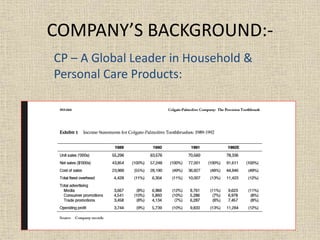
COMPANY’S BACKGROUND:-
CP – A Global Leader in Household &
Personal Care Products:
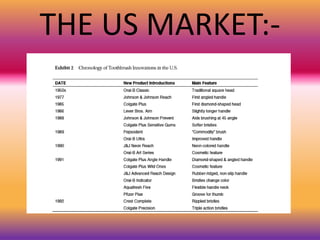
THE US MARKET:-
THE FIVE YEAR
PLAN:-
• To launch new products .
• To continue focus on CORE CONSUMER
PRODUCTS.
• To improve efficiency in manufacturing &
distribution.
• To enter into new geographic markets.
CONSUMER BEHAVIOUR:-
CP’s Consumer Research indicated that the Baby
Boom Generation Consumers were NOW
becoming more CONCERNED about the HEALTH
OF THEIR GUMS AS OPPOSED TO CAVITY
PREVENTION and were WILLING TO PAY A
PREMIUM FOR NEW PRODUCTS ADRESSING
THIS ISSUE.
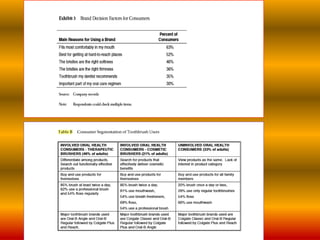
PRODUCT SEGMENTATION
PRODUCT
SEGMENTATION:-
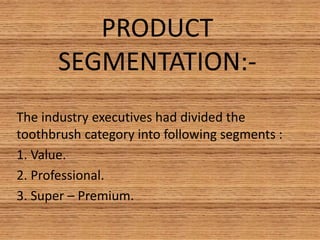
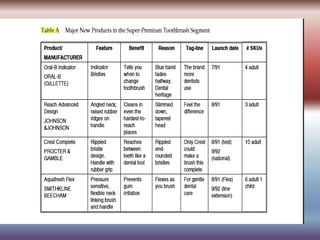
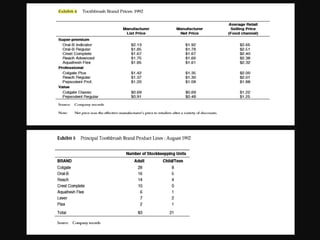
The industry executives had divided the
toothbrush category into following segments :
1. Value.
2. Professional.
3. Super – Premium.
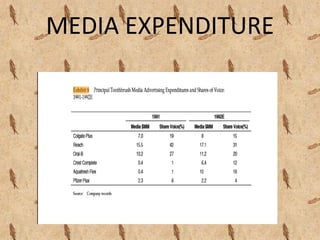
MEDIA EXPENDITURE
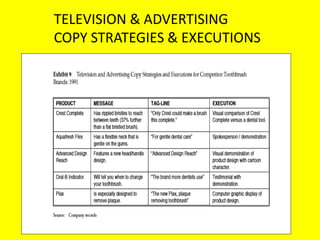
TELEVISION & ADVERTISING
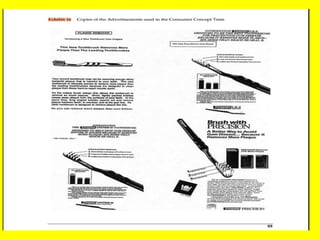
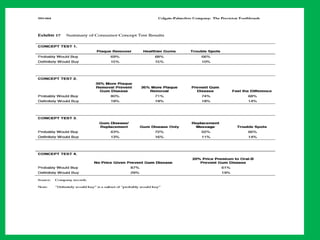
COPY STRATEGIES & EXECUTIONS
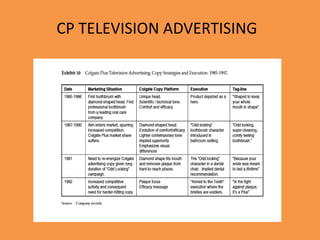
CP TELEVISION ADVERTISING
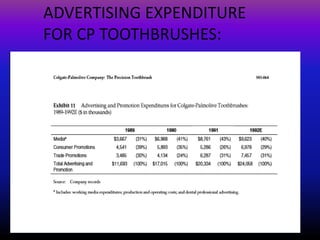
ADVERTISING EXPENDITURE
FOR CP TOOTHBRUSHES:
DISTRIBUTION
DISTRIBUTION
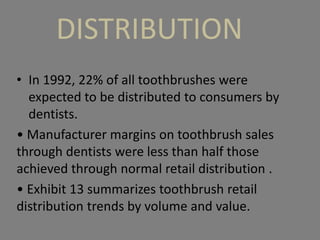
• In 1992, 22% of all toothbrushes were
expected to be distributed to consumers by
dentists.
• Manufacturer margins on toothbrush sales
through dentists were less than half those
achieved through normal retail distribution .
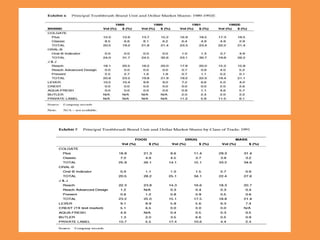
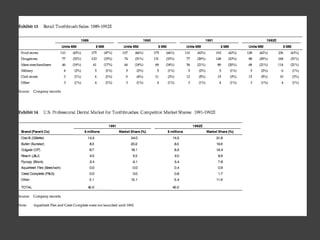
• Exhibit 13 summarizes toothbrush retail
distribution trends by volume and value.
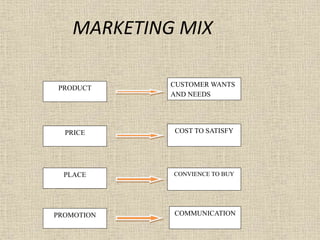
PRODUCT CUSTOMER WANTS
AND NEEDS
PRICE COST TO SATISFY
PLACE CONVIENCE TO BUY
PROMOTION COMMUNICATION
MARKETING MIX
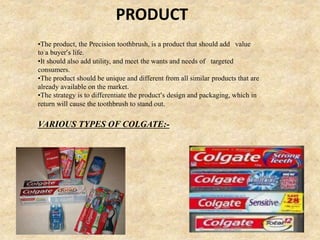
PRODUCT
•The product, the Precision toothbrush, is a product that should add value
to a buyer’s life.
•It should also add utility, and meet the wants and needs of targeted
consumers.
•The product should be unique and different from all similar products that are
already available on the market.
•The strategy is to differentiate the product’s design and packaging, which in
return will cause the toothbrush to stand out.
VARIOUS TYPES OF COLGATE:-
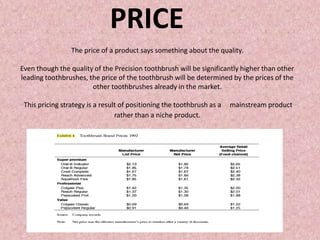
The price of a product says something about the quality.
Even though the quality of the Precision toothbrush will be significantly higher than other
leading toothbrushes, the price of the toothbrush will be determined by the prices of the
other toothbrushes already in the market.
This pricing strategy is a result of positioning the toothbrush as a mainstream product
rather than a niche product.
PRICE
Place represents the location where a product can be purchased.
The most important part of marketing is how a product will get from the
seller to the buyer.
Many products go through a channel of distribution, which involves
manufacturers, wholesalers, retailers, and consumers.
The distribution strategy proposed for the Precision toothbrush is through
dentists, plastic surgeons, drug stores, grocery stores, large retail stores, and
department stores.
The product is available in the all India market, including semi-urban & rural
markets which are their primary focus.
PLACE
Product promotion is communication spread through advertising, Publicity and sales promotion.
Promotion represents all of the communication that marketers use in the market.
We suggest that Colgate-Palmolive advertise their products by using commercial, magazine ads,
the radio, ads that are to be placed in dentist offices, billboards, and the sides of buses.
Advertising is done to promote new products, remind consumers of existing products, and also
promote the image of the company at hand. We also suggested that Colgate offer special
coupons and rebates through their other products, and also food products.
Also, Colgate could benefit from the usage of in-store displays.
Most of the promotional activities would be T.V. media.
T.V., FM radio for urban population.
Promotion towards rural population also.
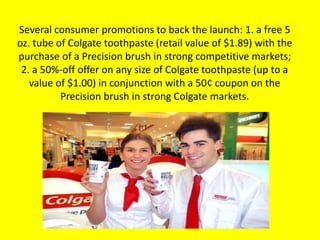
Several consumer promotions to back the launch: 1. a free 5
oz. tube of Colgate toothpaste (retail value of $1.89) with the
purchase of a Precision brush in strong competitive markets;
2. a 50%-off offer on any size of Colgate toothpaste (up to a
value of $1.00) in conjunction with a 50¢ coupon on the
Precision brush in strong Colgate markets.
COMMUNICATION
AND PROMOTION
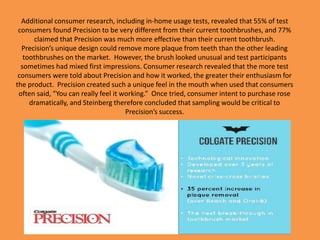
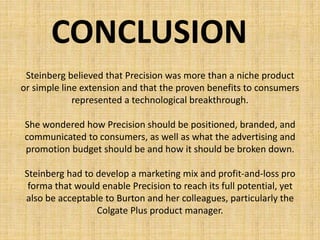
Additional consumer research, including in-home usage tests, revealed that 55% of test
consumers found Precision to be very different from their current toothbrushes, and 77%
claimed that Precision was much more effective than their current toothbrush.
Precision’s unique design could remove more plaque from teeth than the other leading
toothbrushes on the market. However, the brush looked unusual and test participants
sometimes had mixed first impressions. Consumer research revealed that the more test
consumers were told about Precision and how it worked, the greater their enthusiasm for
the product. Precision created such a unique feel in the mouth when used that consumers
often said, “You can really feel it working.” Once tried, consumer intent to purchase rose
dramatically, and Steinberg therefore concluded that sampling would be critical to
Precision’s success.
Steinberg believed that Precision was more than a niche product
or simple line extension and that the proven benefits to consumers
represented a technological breakthrough.
She wondered how Precision should be positioned, branded, and
communicated to consumers, as well as what the advertising and
promotion budget should be and how it should be broken down.
Steinberg had to develop a marketing mix and profit-and-loss pro
forma that would enable Precision to reach its full potential, yet
also be acceptable to Burton and her colleagues, particularly the
Colgate Plus product manager.
CONCLUSION
SUBMITTED BY:-
ABHINAV SAHNI
DAV COLLEGE,CHANDIGARH

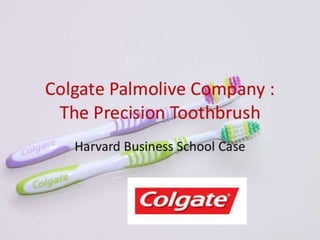
Colgate palmolive

  • 2.
    PRESENTATION CONTENTS:- • Companybackground • U.S. toothbrush market • Product segments • Consumer behavior • Competition • The Precision Marketing mix • Conclusion
  • 3.
    THE NEED TOSTUDY THIS CASE:- • To analyze the Consumer Behavior of that time period. • To get a deep understanding of how CP achieved this position in market. • To summarize the profits gained by the company. • To understand the market competition faced by the Colgate Precision Toothbrush.
  • 4.
    WHAT IS COLGATEPRECISION:- • A new product, toothbrush launched by CP in August 1992 . • Developed over a period of 3 years SUSAN STEINBERG (Precision Product Manager). • The person who managed the entire product development process. • Responsible for recommending the POSITIONING , BRANDING and COMMUNICATION strategies.
  • 5.
    PEOPLE INVOLVED IN NEWPRODUCT LAUNCH:- • Susan Steinberg – Product Manager • Nigel Burton – Division General Manager • Ruben Mark – CP’s C.E.O.
  • 6.
    COMPANY’S BACKGROUND:- CP –A Global Leader in Household & Personal Care Products:
  • 7.
  • 9.
    THE FIVE YEAR PLAN:- •To launch new products . • To continue focus on CORE CONSUMER PRODUCTS. • To improve efficiency in manufacturing & distribution. • To enter into new geographic markets.
  • 11.
    CONSUMER BEHAVIOUR:- CP’s ConsumerResearch indicated that the Baby Boom Generation Consumers were NOW becoming more CONCERNED about the HEALTH OF THEIR GUMS AS OPPOSED TO CAVITY PREVENTION and were WILLING TO PAY A PREMIUM FOR NEW PRODUCTS ADRESSING THIS ISSUE.
  • 13.
  • 14.
    PRODUCT SEGMENTATION:- The industry executiveshad divided the toothbrush category into following segments : 1. Value. 2. Professional. 3. Super – Premium.
  • 20.
  • 21.
    TELEVISION & ADVERTISING COPYSTRATEGIES & EXECUTIONS
  • 22.
  • 23.
  • 24.
  • 25.
    DISTRIBUTION • In 1992,22% of all toothbrushes were expected to be distributed to consumers by dentists. • Manufacturer margins on toothbrush sales through dentists were less than half those achieved through normal retail distribution . • Exhibit 13 summarizes toothbrush retail distribution trends by volume and value.
  • 28.
    PRODUCT CUSTOMER WANTS ANDNEEDS PRICE COST TO SATISFY PLACE CONVIENCE TO BUY PROMOTION COMMUNICATION MARKETING MIX
  • 29.
    PRODUCT •The product, thePrecision toothbrush, is a product that should add value to a buyer’s life. •It should also add utility, and meet the wants and needs of targeted consumers. •The product should be unique and different from all similar products that are already available on the market. •The strategy is to differentiate the product’s design and packaging, which in return will cause the toothbrush to stand out. VARIOUS TYPES OF COLGATE:-
  • 30.
    The price ofa product says something about the quality. Even though the quality of the Precision toothbrush will be significantly higher than other leading toothbrushes, the price of the toothbrush will be determined by the prices of the other toothbrushes already in the market. This pricing strategy is a result of positioning the toothbrush as a mainstream product rather than a niche product. PRICE
  • 31.
    Place represents thelocation where a product can be purchased. The most important part of marketing is how a product will get from the seller to the buyer. Many products go through a channel of distribution, which involves manufacturers, wholesalers, retailers, and consumers. The distribution strategy proposed for the Precision toothbrush is through dentists, plastic surgeons, drug stores, grocery stores, large retail stores, and department stores. The product is available in the all India market, including semi-urban & rural markets which are their primary focus. PLACE
  • 32.
    Product promotion iscommunication spread through advertising, Publicity and sales promotion. Promotion represents all of the communication that marketers use in the market. We suggest that Colgate-Palmolive advertise their products by using commercial, magazine ads, the radio, ads that are to be placed in dentist offices, billboards, and the sides of buses. Advertising is done to promote new products, remind consumers of existing products, and also promote the image of the company at hand. We also suggested that Colgate offer special coupons and rebates through their other products, and also food products. Also, Colgate could benefit from the usage of in-store displays. Most of the promotional activities would be T.V. media. T.V., FM radio for urban population. Promotion towards rural population also.
  • 34.
    Several consumer promotionsto back the launch: 1. a free 5 oz. tube of Colgate toothpaste (retail value of $1.89) with the purchase of a Precision brush in strong competitive markets; 2. a 50%-off offer on any size of Colgate toothpaste (up to a value of $1.00) in conjunction with a 50¢ coupon on the Precision brush in strong Colgate markets.
  • 35.
  • 36.
    Additional consumer research,including in-home usage tests, revealed that 55% of test consumers found Precision to be very different from their current toothbrushes, and 77% claimed that Precision was much more effective than their current toothbrush. Precision’s unique design could remove more plaque from teeth than the other leading toothbrushes on the market. However, the brush looked unusual and test participants sometimes had mixed first impressions. Consumer research revealed that the more test consumers were told about Precision and how it worked, the greater their enthusiasm for the product. Precision created such a unique feel in the mouth when used that consumers often said, “You can really feel it working.” Once tried, consumer intent to purchase rose dramatically, and Steinberg therefore concluded that sampling would be critical to Precision’s success.
  • 39.
    Steinberg believed thatPrecision was more than a niche product or simple line extension and that the proven benefits to consumers represented a technological breakthrough. She wondered how Precision should be positioned, branded, and communicated to consumers, as well as what the advertising and promotion budget should be and how it should be broken down. Steinberg had to develop a marketing mix and profit-and-loss pro forma that would enable Precision to reach its full potential, yet also be acceptable to Burton and her colleagues, particularly the Colgate Plus product manager. CONCLUSION
  • 40.