COGNITIVISM
A LEARNING THEORY
DEFINITION
 Cognitivism is a theory in psychology that focuses on how the
mind receives, processes, organizes, stores and retrieves
information.(Brain based learning)
 Replaced Behaviorism in 1960.
 Proposed by Jean Piaget
 Derived from Latin word, 'cognoscere' , meaning knowing and
information.
Schemas and process of information
storage
 Mental structures or cognitive frameworks that guide the encoding of
new information and facilitate its integration into existing knowledge
structures.
 The information storage can be of several stages:
 Initially processed in Short Term Memory where it is temporarily held
and actively worked on.
 Effective encoding happens when meaningful associations occur in
short term memory and it is transferred to Long Term Memory.
 The organized information in long term memory forms cognitive
structures called schema.
Cognitive map
 The cognitive map represents the sum of all the learning
that have been encountered so far. When the learner
learns new things , cognitive map are redrawn.
 It is a mental picture or representation that a person
creates in their mind to understand, organize and
remember information about places, relationships or
concepts. The learner is given more importance in
Cognitive learning.
Example
 Cognitive map-Knowing the route from your home to
school without needing directions.
 Schema -Consider how a young child develop a
schema for a horse. They know that a horse is large and
has hair, four legs, and a tail. When the child encounters
a cow, they might initially call it a horse. Once the child
is told that it is a cow, they will modify their existing
schema and create a schema for a cow.
Bandura – Social Learning Theory
* Learning through observation & modeling.
* Internal processes: attention, retention, reproduction, motivation.
* Shifted focus from behavior to mental processing.
Gestalt views of learning
 Learning as insight & holistic perception.
 Emphasis on patterns, relationships, and problem-
solving.
 Foundation for concepts like schema & mental maps.
Kurt Levin's Field Theory of Learning
 Behavior = function of person + environment.
 Learning shaped by goals, motivation, and life space.
 Stressed context, prior knowledge and learner’s perspective.
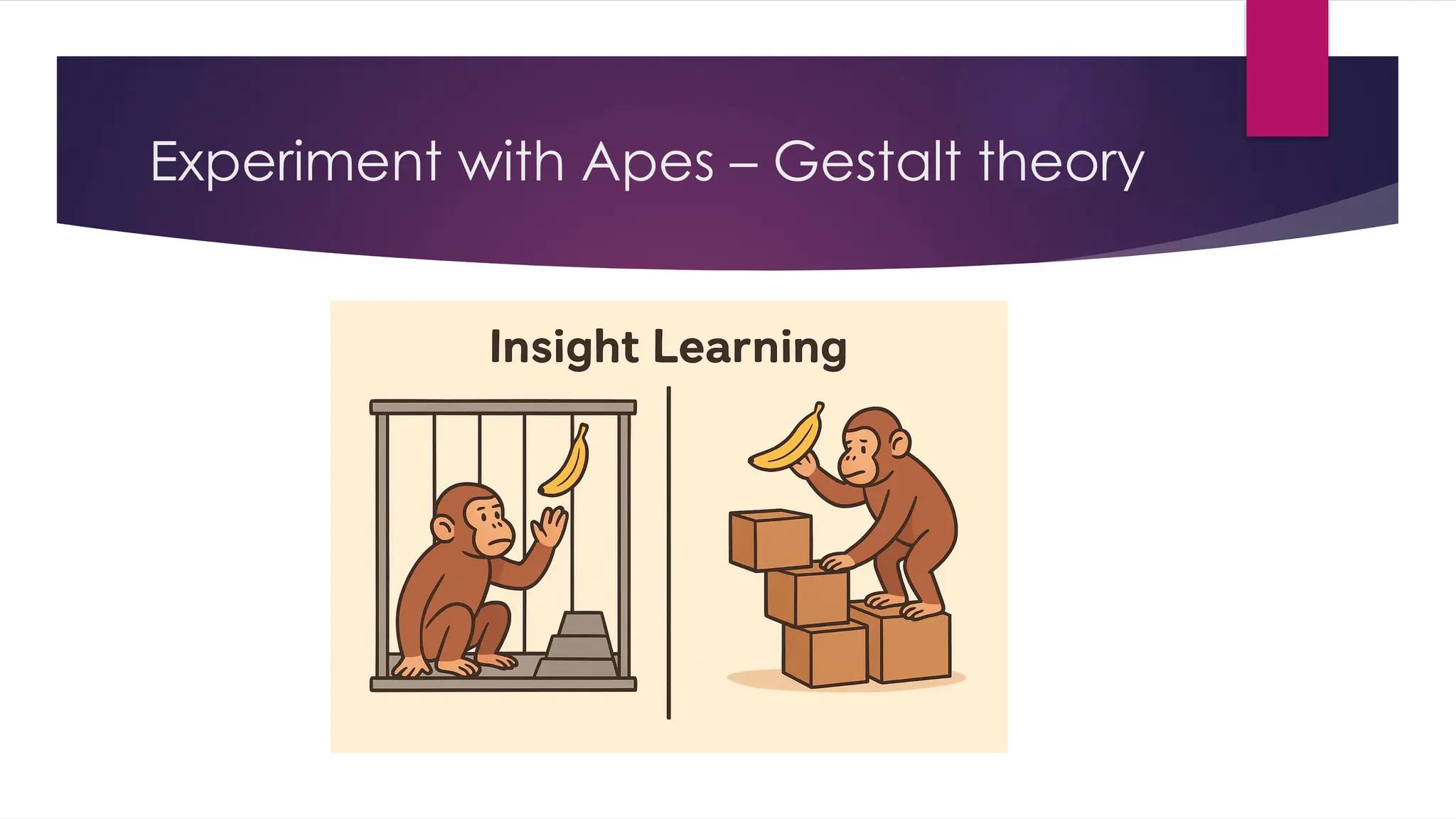
Experiment with Apes – Gestalt theory
Explanation
 Conducted by Wolfgang Köhler, a Gestalt psychologist.
Setup: A chimpanzee (Sultan) placed in a cage with a banana out of
reach and sticks/boxes inside. Initial attempts of Sultan was jumping
and it failed.
 Sudden solution: Sultan stacked boxes to reach the banana.
 Significance: Proved that learning is not just trial-and-error (behaviorism)
but also involves thinking, problem-solving, and cognition.
 Contribution: Strong evidence supporting cognitivism in learning theory.
Role of teachers and learners
 Teachers – facilitators of learning , design
activities to stimulate cognitive processes ,
provide guidance.
 Learners – critical thinking , reflection,
metacognition.
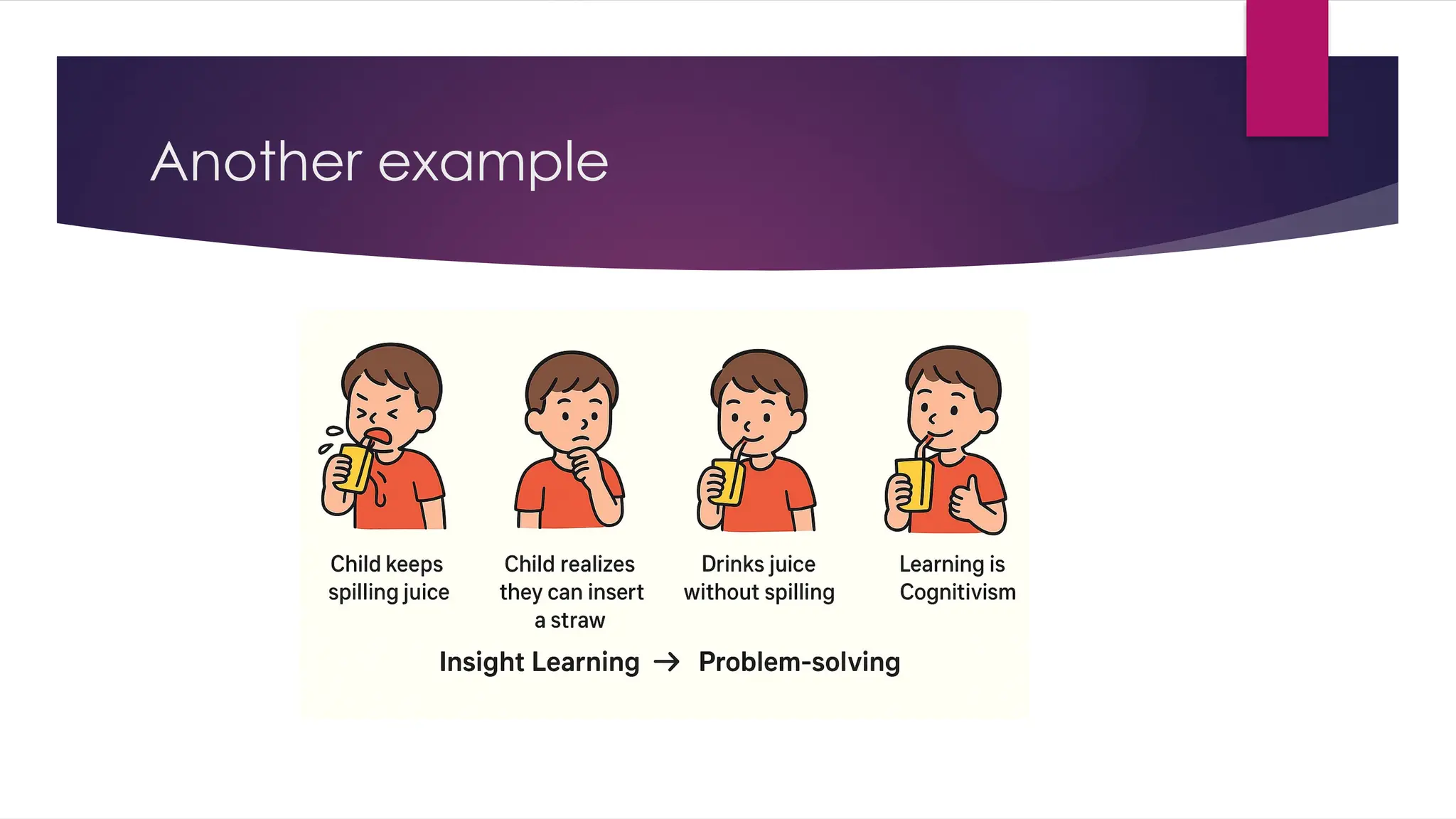
Another example
Major Contributors of Cognitivism
 Jean Piaget – Known for cognitive
development theory
 Lev Vygotsky - Zone of Proximal Development
 Jerome Bruner - Discovery learning, Scaffolding.
 David Ausubel - Meaningful verbal learning.
Important works
 Jean Piaget -'The Language and Thought of the
child'(1923),The Child's conception of the world(1929)
 Lev Vygotsky – Thought and Language (1934),Mind in
Society(1978)
 Jerome Bruner- The Process of Education (1960), Toward
a Theory of Instruction(1966)
 David Ausubel – Educational Psychology(1968),The
Psychology of Meaningful Verbal Learning(1963)
Advantages
 Promotes Metacognition
 Supporting long term retention
 Encourages active learning
 Improves problem solving skills
 Focus on understanding
 Applicable across subjects
Limitations
 Ignores emotions and motivation in learning.
 Overemphasis on the mind.
 Difficult to apply directly in real classroom
situations.
 Neglects cultural and individual differences in
thinking.
 Gives less importance to practice and
observable behavior.

THANK YOU

Cognitivism is a learning theory in Psychology.

  • 1.
  • 2.
    DEFINITION  Cognitivism isa theory in psychology that focuses on how the mind receives, processes, organizes, stores and retrieves information.(Brain based learning)  Replaced Behaviorism in 1960.  Proposed by Jean Piaget  Derived from Latin word, 'cognoscere' , meaning knowing and information.
  • 3.
    Schemas and processof information storage  Mental structures or cognitive frameworks that guide the encoding of new information and facilitate its integration into existing knowledge structures.  The information storage can be of several stages:  Initially processed in Short Term Memory where it is temporarily held and actively worked on.  Effective encoding happens when meaningful associations occur in short term memory and it is transferred to Long Term Memory.  The organized information in long term memory forms cognitive structures called schema.
  • 4.
    Cognitive map  Thecognitive map represents the sum of all the learning that have been encountered so far. When the learner learns new things , cognitive map are redrawn.  It is a mental picture or representation that a person creates in their mind to understand, organize and remember information about places, relationships or concepts. The learner is given more importance in Cognitive learning.
  • 5.
    Example  Cognitive map-Knowingthe route from your home to school without needing directions.  Schema -Consider how a young child develop a schema for a horse. They know that a horse is large and has hair, four legs, and a tail. When the child encounters a cow, they might initially call it a horse. Once the child is told that it is a cow, they will modify their existing schema and create a schema for a cow.
  • 6.
    Bandura – SocialLearning Theory * Learning through observation & modeling. * Internal processes: attention, retention, reproduction, motivation. * Shifted focus from behavior to mental processing.
  • 7.
    Gestalt views oflearning  Learning as insight & holistic perception.  Emphasis on patterns, relationships, and problem- solving.  Foundation for concepts like schema & mental maps.
  • 8.
    Kurt Levin's FieldTheory of Learning  Behavior = function of person + environment.  Learning shaped by goals, motivation, and life space.  Stressed context, prior knowledge and learner’s perspective.
  • 9.
    Experiment with Apes– Gestalt theory
  • 10.
    Explanation  Conducted byWolfgang Köhler, a Gestalt psychologist. Setup: A chimpanzee (Sultan) placed in a cage with a banana out of reach and sticks/boxes inside. Initial attempts of Sultan was jumping and it failed.  Sudden solution: Sultan stacked boxes to reach the banana.  Significance: Proved that learning is not just trial-and-error (behaviorism) but also involves thinking, problem-solving, and cognition.  Contribution: Strong evidence supporting cognitivism in learning theory.
  • 11.
    Role of teachersand learners  Teachers – facilitators of learning , design activities to stimulate cognitive processes , provide guidance.  Learners – critical thinking , reflection, metacognition.
  • 12.
  • 13.
    Major Contributors ofCognitivism  Jean Piaget – Known for cognitive development theory  Lev Vygotsky - Zone of Proximal Development  Jerome Bruner - Discovery learning, Scaffolding.  David Ausubel - Meaningful verbal learning.
  • 14.
    Important works  JeanPiaget -'The Language and Thought of the child'(1923),The Child's conception of the world(1929)  Lev Vygotsky – Thought and Language (1934),Mind in Society(1978)  Jerome Bruner- The Process of Education (1960), Toward a Theory of Instruction(1966)  David Ausubel – Educational Psychology(1968),The Psychology of Meaningful Verbal Learning(1963)
  • 15.
    Advantages  Promotes Metacognition Supporting long term retention  Encourages active learning  Improves problem solving skills  Focus on understanding  Applicable across subjects
  • 16.
    Limitations  Ignores emotionsand motivation in learning.  Overemphasis on the mind.  Difficult to apply directly in real classroom situations.  Neglects cultural and individual differences in thinking.  Gives less importance to practice and observable behavior.
  • 17.