BIAS
Cognitive
By Group No.1 – Knight Riders
What is Cognitive
Bias?
Cognitive bias is a systematic thought process
caused by the tendency of the human brain to
simplify information processing through a filter
of personal experience and preferences.
Essentially, cognitive biases help humans find
mental shortcuts to assist in the navigation of
daily life, but may often cause irrational
interpretations and judgments.
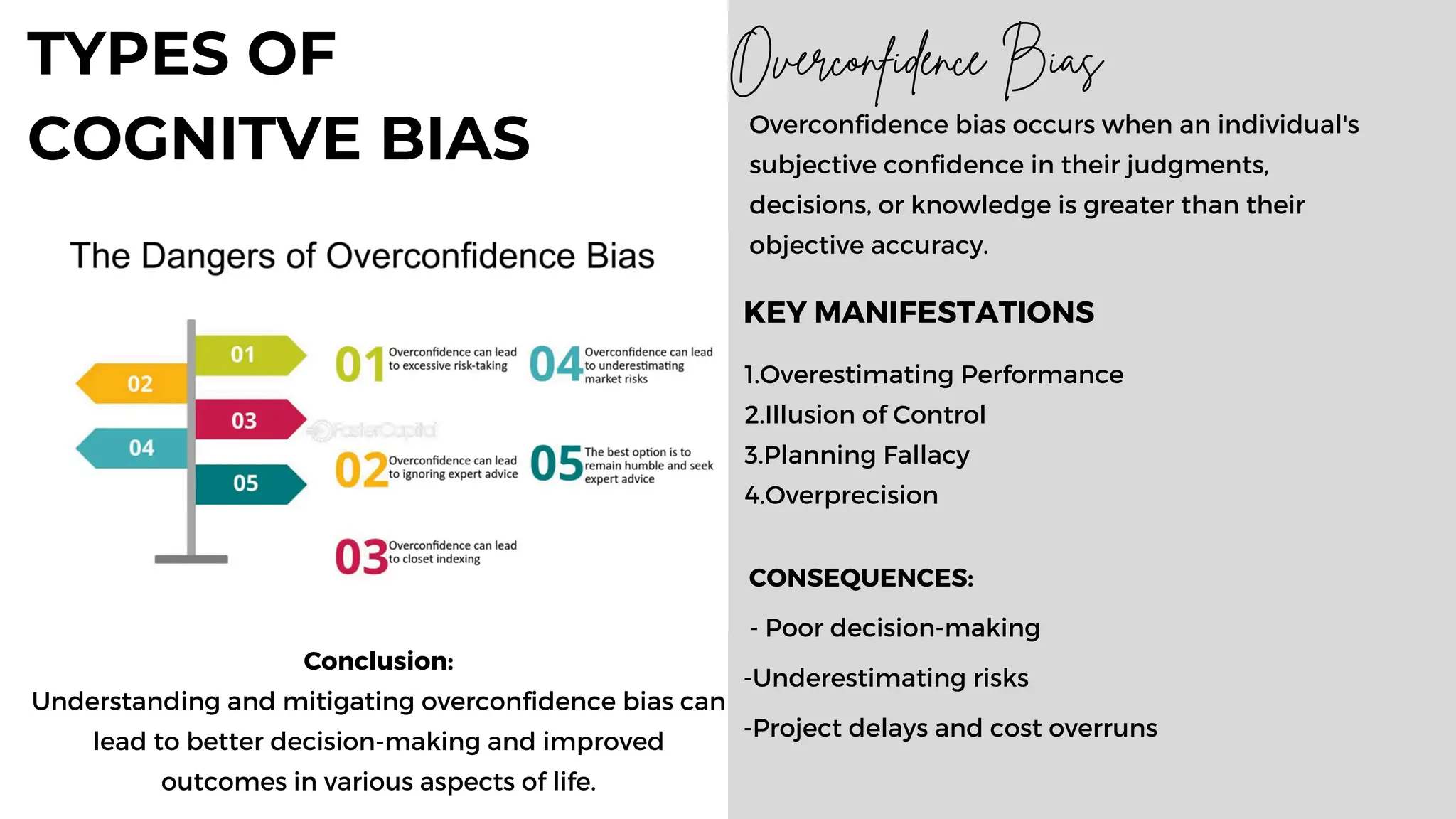
Overconfidence bias occurs when an individual's
subjective confidence in their judgments,
decisions, or knowledge is greater than their
objective accuracy.
Conclusion:
Understanding and mitigating overconfidence bias can
lead to better decision-making and improved
outcomes in various aspects of life.
KEY MANIFESTATIONS
CONSEQUENCES:
- Poor decision-making
-Underestimating risks
-Project delays and cost overruns
1.Overestimating Performance
2.Illusion of Control
3.Planning Fallacy
4.Overprecision
TYPES OF
COGNITVE BIAS
Overconfidence Bias
TYPES OF
COGNITVE BIAS
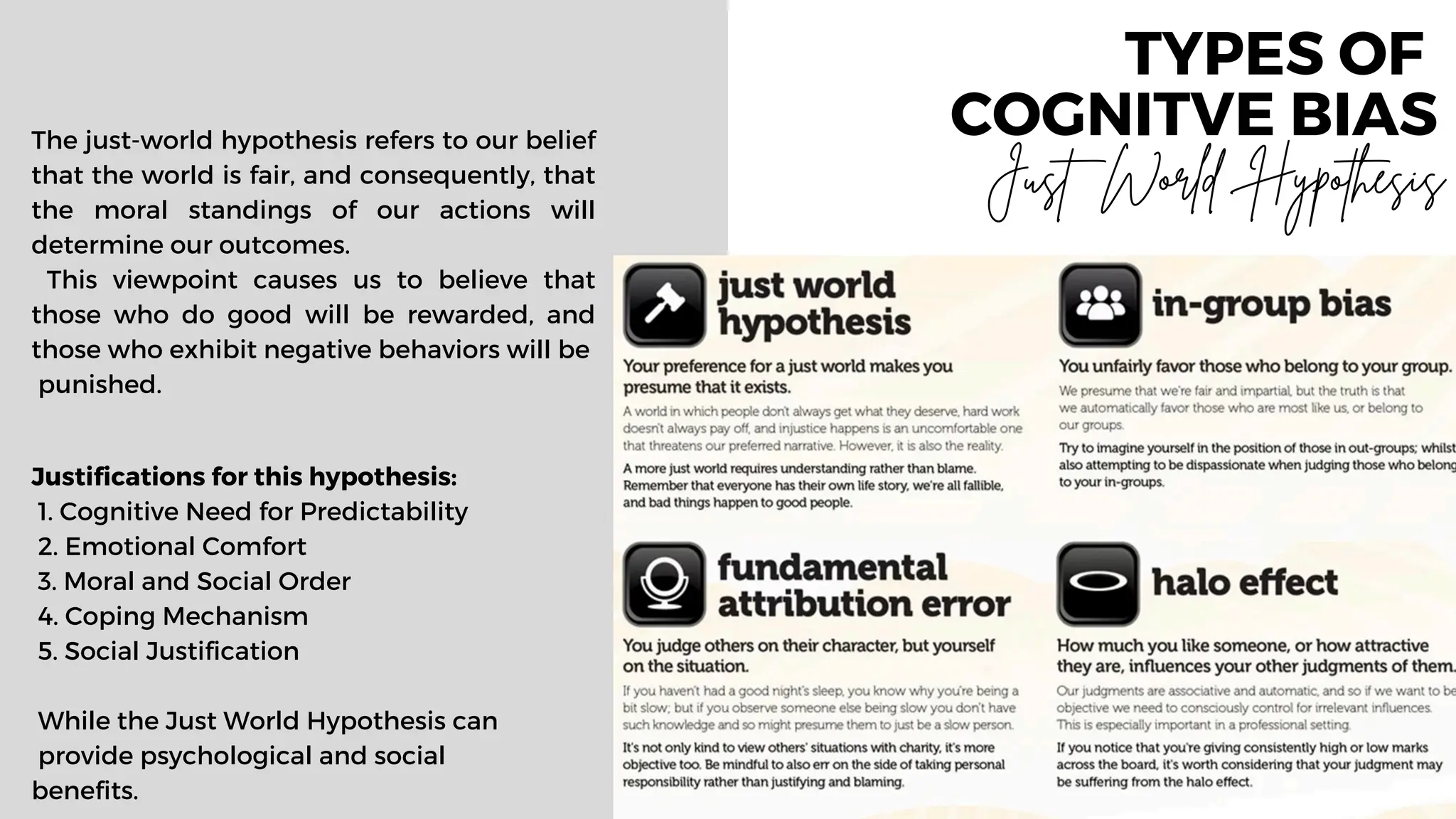
The just-world hypothesis refers to our belief
that the world is fair, and consequently, that
the moral standings of our actions will
determine our outcomes.
This viewpoint causes us to believe that
those who do good will be rewarded, and
those who exhibit negative behaviors will be
punished.
Justifications for this hypothesis:
1. Cognitive Need for Predictability
2. Emotional Comfort
3. Moral and Social Order
4. Coping Mechanism
5. Social Justification
While the Just World Hypothesis can
provide psychological and social
benefits.
Just World Hypothesis
In-Group Bias
TYPES OF
COGNITVE BIAS
In-group bias (also known as in-group
favoritism) is the tendency for people to give
preferential treatment to others who belong
to the same group that they do.
his bias shows up even when people are put
into groups randomly, making group
membership effectively meaningless.
It often stems from a natural inclination
to seek belonging and affiliation
with like minded individuals
Graphics Designing
It can lead to discrimination, prejudice and inequality also
impacting decision making areas such as hiring, promotions
and resource allocation.
Addressing in group bias requires a collective effort to foster
understanding, respect, and collaboration across diverse
social identities.
TYPES OF
COGNITVE BIAS
Negativity Bias
The negativity bias is a cognitive bias that
results in adverse events having a more
significant impact on our psychological state
than positive events.
Negativity bias occurs even when adverse
events and positive events are of the same
magnitude, meaning we feel negative events
more intensely.
Why it is important?
•Decision-Making
We should be aware of the negativity bias as it can significantly impact our decision-making ability.
•Motivation
Psychological research suggests that negativity bias impacts our motivation and ability to complete tasks.
TYPES OF
COGNITVE BIAS
Survivorship Bias
Survivorship bias occurs when we focus only on the surviving
data points, neglecting those that were lost.
•This can lead to skewed conclusions and flawed decision-
making. It is essential to recognize and address survivorship
bias to ensure accurate analysis.
•Survivorship bias can distort our understanding of success
and failure, leading to misguided strategies and unrealistic
expectations.
•By ignoring failed data points, we risk making
decisions based on incomplete and biased
information, ultimately impacting our bottom line.
Conclusion
Understanding and addressing survivorship
bias is essential for accurate data analysis and
informed decisionmaking.
Lorem ipsum dolor sit amet, consectetur
adipiscing elit, sed do eiusmod tempor incididunt
ut labore et dolore magna aliqua.
TYPES OF
COGNITVE BIAS
Sunk Cost Fallacy
The Sunk Cost Fallacy is our tendency to follow through
on something that we’ve already invested heavily in (be
it time, money, effort, emotional energy, etc.), even
when giving up is clearly a better idea.
The sunk cost fallacy is when people continue to
invest time, money, or effort into something simply
because they have already invested a lot into it, even
if it’s no longer a good idea.
•Why it is important?
As observed through the various examples in this article,
the sunk cost fallacy impacts many aspects of our daily
lives, as well as bigger decisions that have long-term
effects.
•How to avoid it?
While it is difficult to overcome cognitive fallacies, if we
are aware of the sunk cost fallacy, we can try to focus on
current and future costs and benefits instead of past
commitments.
TYPES OF
COGNITIVE BIAS
The hindsight bias describes our tendency to look
back at an unpredictable event and think it was
easily predictable. It is also called the “knew-it-all-
along” effect.
This cognitive bias can affect judgments and
decision-making, leading to overconfidence in
one's ability to predict events and potentially
impacting learning and the evaluation of decisions.
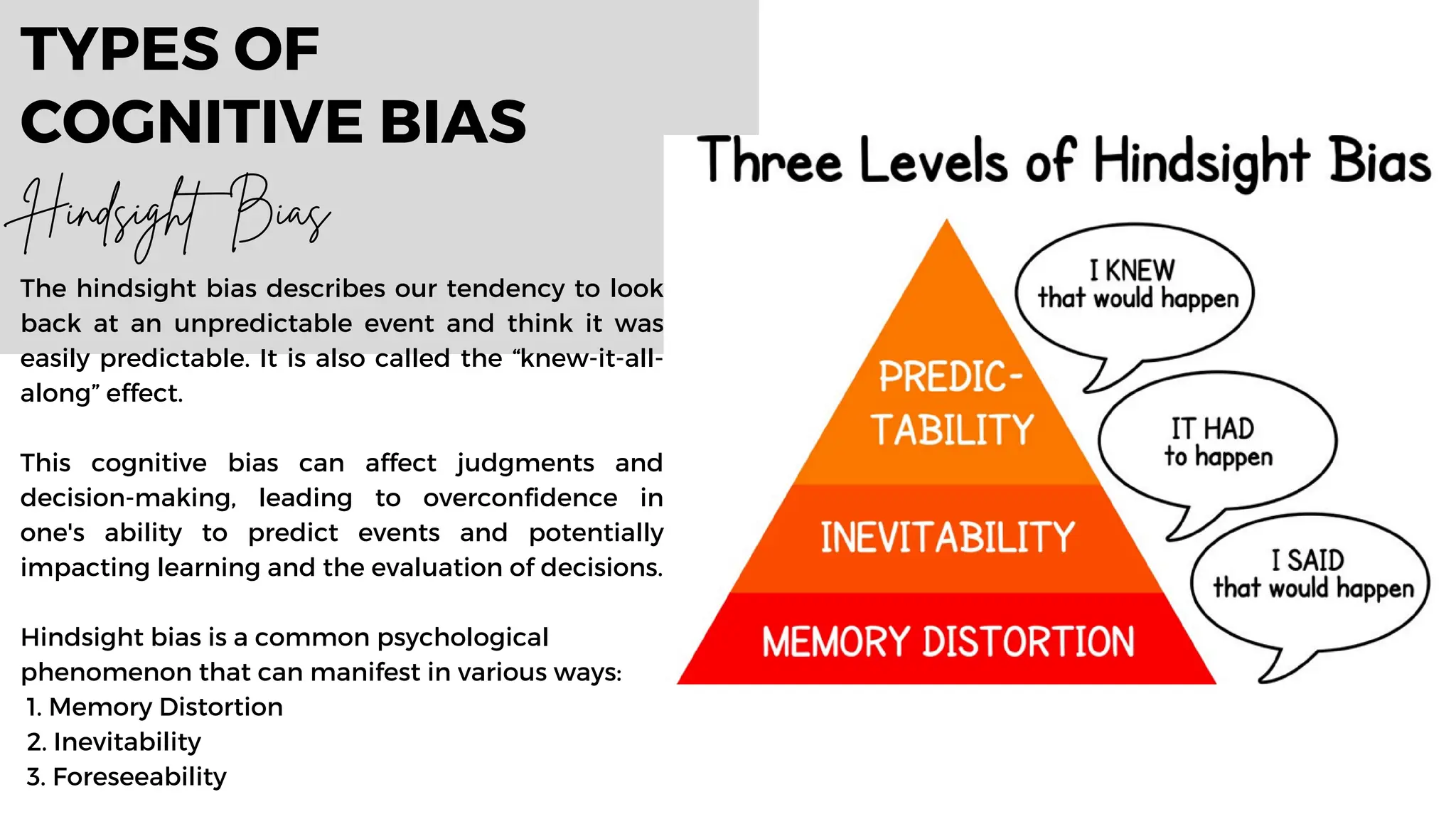
Hindsight bias is a common psychological
phenomenon that can manifest in various ways:
1. Memory Distortion
2. Inevitability
3. Foreseeability
Hindsight Bias
Lorem ipsum dolor sit amet, consectetur
adipiscing elit, sed do eiusmod.
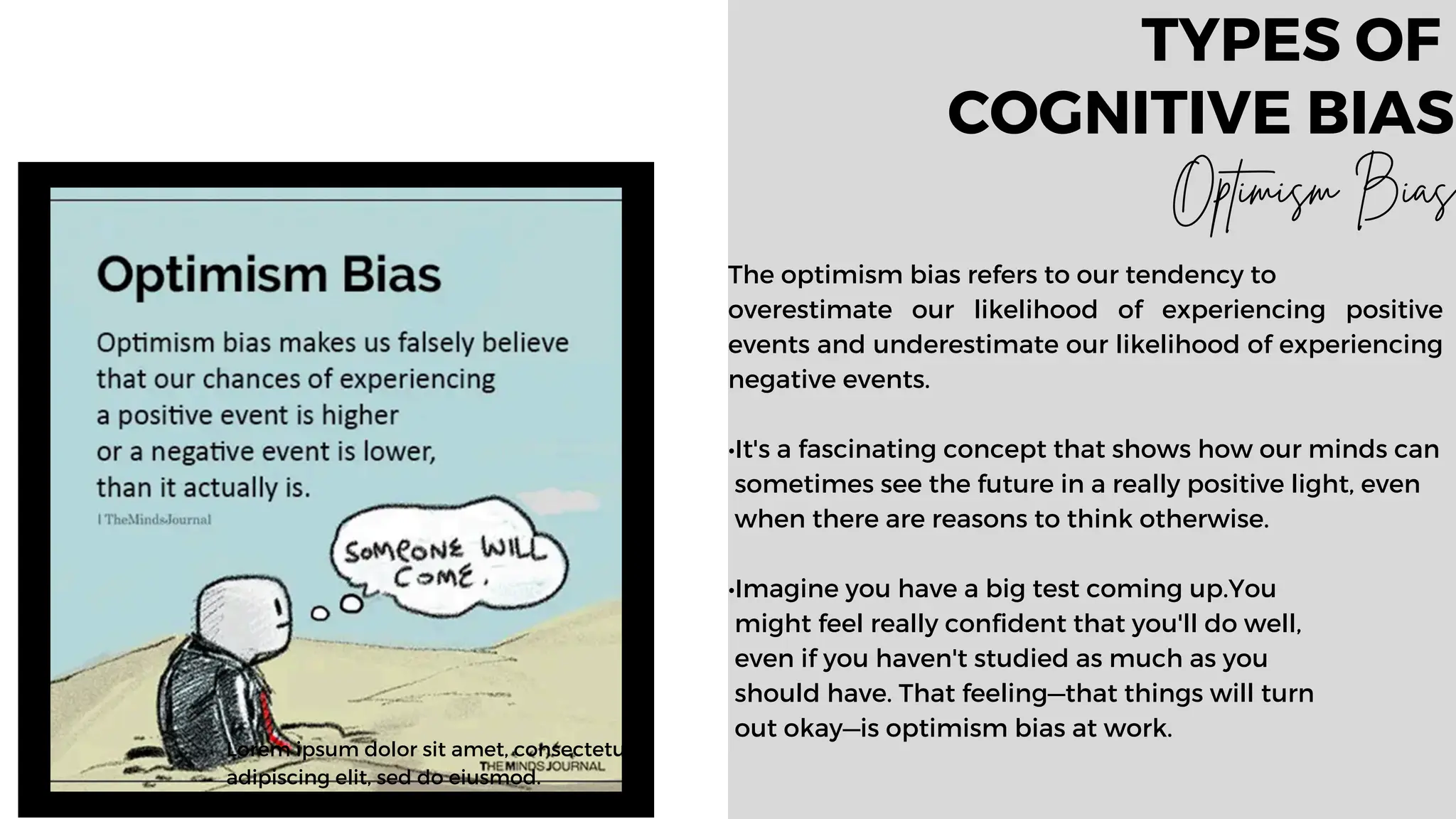
The optimism bias refers to our tendency to
overestimate our likelihood of experiencing positive
events and underestimate our likelihood of experiencing
negative events.
•It's a fascinating concept that shows how our minds can
sometimes see the future in a really positive light, even
when there are reasons to think otherwise.
•Imagine you have a big test coming up.You
might feel really confident that you'll do well,
even if you haven't studied as much as you
should have. That feeling—that things will turn
out okay—is optimism bias at work.
TYPES OF
COGNITIVE BIAS
Optimism Bias
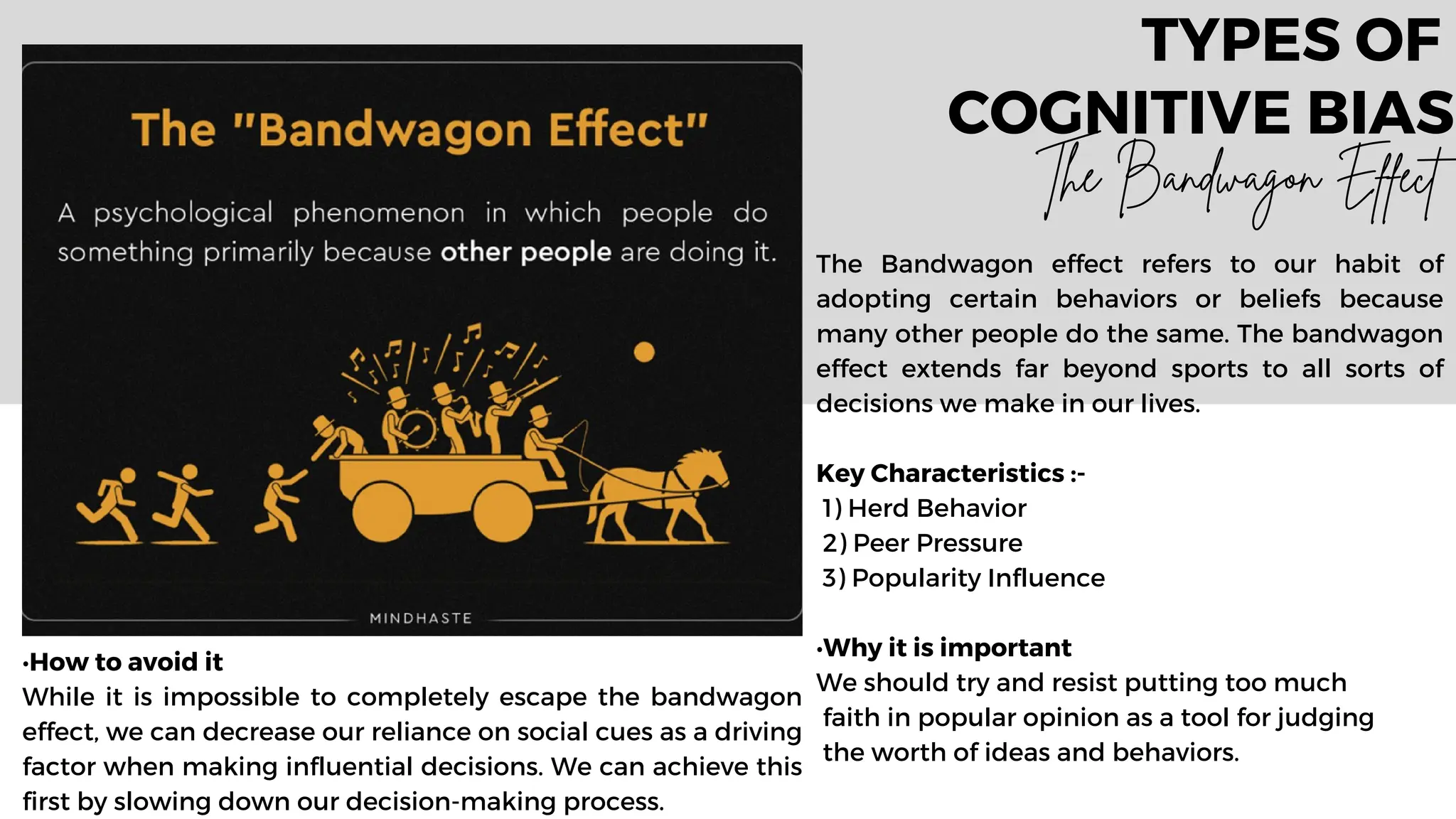
The Bandwagon effect refers to our habit of
adopting certain behaviors or beliefs because
many other people do the same. The bandwagon
effect extends far beyond sports to all sorts of
decisions we make in our lives.
Key Characteristics :-
1) Herd Behavior
2) Peer Pressure
3) Popularity Influence
•Why it is important
We should try and resist putting too much
faith in popular opinion as a tool for judging
the worth of ideas and behaviors.
TYPES OF
COGNITIVE BIAS
The Bandwagon Effect
•How to avoid it
While it is impossible to completely escape the bandwagon
effect, we can decrease our reliance on social cues as a driving
factor when making influential decisions. We can achieve this
first by slowing down our decision-making process.
FROM :- Knight Riders
THANK
YOU

Creative and Minimal Portfolio Presentation (1).pdf

  • 1.
  • 2.
    What is Cognitive Bias? Cognitivebias is a systematic thought process caused by the tendency of the human brain to simplify information processing through a filter of personal experience and preferences. Essentially, cognitive biases help humans find mental shortcuts to assist in the navigation of daily life, but may often cause irrational interpretations and judgments.
  • 3.
    Overconfidence bias occurswhen an individual's subjective confidence in their judgments, decisions, or knowledge is greater than their objective accuracy. Conclusion: Understanding and mitigating overconfidence bias can lead to better decision-making and improved outcomes in various aspects of life. KEY MANIFESTATIONS CONSEQUENCES: - Poor decision-making -Underestimating risks -Project delays and cost overruns 1.Overestimating Performance 2.Illusion of Control 3.Planning Fallacy 4.Overprecision TYPES OF COGNITVE BIAS Overconfidence Bias
  • 4.
    TYPES OF COGNITVE BIAS Thejust-world hypothesis refers to our belief that the world is fair, and consequently, that the moral standings of our actions will determine our outcomes. This viewpoint causes us to believe that those who do good will be rewarded, and those who exhibit negative behaviors will be punished. Justifications for this hypothesis: 1. Cognitive Need for Predictability 2. Emotional Comfort 3. Moral and Social Order 4. Coping Mechanism 5. Social Justification While the Just World Hypothesis can provide psychological and social benefits. Just World Hypothesis
  • 5.
    In-Group Bias TYPES OF COGNITVEBIAS In-group bias (also known as in-group favoritism) is the tendency for people to give preferential treatment to others who belong to the same group that they do. his bias shows up even when people are put into groups randomly, making group membership effectively meaningless. It often stems from a natural inclination to seek belonging and affiliation with like minded individuals Graphics Designing It can lead to discrimination, prejudice and inequality also impacting decision making areas such as hiring, promotions and resource allocation. Addressing in group bias requires a collective effort to foster understanding, respect, and collaboration across diverse social identities.
  • 6.
    TYPES OF COGNITVE BIAS NegativityBias The negativity bias is a cognitive bias that results in adverse events having a more significant impact on our psychological state than positive events. Negativity bias occurs even when adverse events and positive events are of the same magnitude, meaning we feel negative events more intensely. Why it is important? •Decision-Making We should be aware of the negativity bias as it can significantly impact our decision-making ability. •Motivation Psychological research suggests that negativity bias impacts our motivation and ability to complete tasks.
  • 7.
    TYPES OF COGNITVE BIAS SurvivorshipBias Survivorship bias occurs when we focus only on the surviving data points, neglecting those that were lost. •This can lead to skewed conclusions and flawed decision- making. It is essential to recognize and address survivorship bias to ensure accurate analysis. •Survivorship bias can distort our understanding of success and failure, leading to misguided strategies and unrealistic expectations. •By ignoring failed data points, we risk making decisions based on incomplete and biased information, ultimately impacting our bottom line. Conclusion Understanding and addressing survivorship bias is essential for accurate data analysis and informed decisionmaking.
  • 8.
    Lorem ipsum dolorsit amet, consectetur adipiscing elit, sed do eiusmod tempor incididunt ut labore et dolore magna aliqua. TYPES OF COGNITVE BIAS Sunk Cost Fallacy The Sunk Cost Fallacy is our tendency to follow through on something that we’ve already invested heavily in (be it time, money, effort, emotional energy, etc.), even when giving up is clearly a better idea. The sunk cost fallacy is when people continue to invest time, money, or effort into something simply because they have already invested a lot into it, even if it’s no longer a good idea. •Why it is important? As observed through the various examples in this article, the sunk cost fallacy impacts many aspects of our daily lives, as well as bigger decisions that have long-term effects. •How to avoid it? While it is difficult to overcome cognitive fallacies, if we are aware of the sunk cost fallacy, we can try to focus on current and future costs and benefits instead of past commitments.
  • 9.
    TYPES OF COGNITIVE BIAS Thehindsight bias describes our tendency to look back at an unpredictable event and think it was easily predictable. It is also called the “knew-it-all- along” effect. This cognitive bias can affect judgments and decision-making, leading to overconfidence in one's ability to predict events and potentially impacting learning and the evaluation of decisions. Hindsight bias is a common psychological phenomenon that can manifest in various ways: 1. Memory Distortion 2. Inevitability 3. Foreseeability Hindsight Bias
  • 10.
    Lorem ipsum dolorsit amet, consectetur adipiscing elit, sed do eiusmod. The optimism bias refers to our tendency to overestimate our likelihood of experiencing positive events and underestimate our likelihood of experiencing negative events. •It's a fascinating concept that shows how our minds can sometimes see the future in a really positive light, even when there are reasons to think otherwise. •Imagine you have a big test coming up.You might feel really confident that you'll do well, even if you haven't studied as much as you should have. That feeling—that things will turn out okay—is optimism bias at work. TYPES OF COGNITIVE BIAS Optimism Bias
  • 11.
    The Bandwagon effectrefers to our habit of adopting certain behaviors or beliefs because many other people do the same. The bandwagon effect extends far beyond sports to all sorts of decisions we make in our lives. Key Characteristics :- 1) Herd Behavior 2) Peer Pressure 3) Popularity Influence •Why it is important We should try and resist putting too much faith in popular opinion as a tool for judging the worth of ideas and behaviors. TYPES OF COGNITIVE BIAS The Bandwagon Effect •How to avoid it While it is impossible to completely escape the bandwagon effect, we can decrease our reliance on social cues as a driving factor when making influential decisions. We can achieve this first by slowing down our decision-making process.
  • 12.
    FROM :- KnightRiders THANK YOU