CODING YESTERDAY’S NOMENCLATURE TODAY®


         CATARACT SURGERY
            ICD-9 CM/PCS
           ICD-10 CM/PCS
CATARACT SURGERY
INDICATIONS FOR
OPERATION: The patient is a 73
year-old with painless progressive
loss of vision in the right eye. The
patient was noted to have difficulty
with activities of daily living due to
the decreased vision. The risks,
benefits and alternatives to cataract
surgery were explained to the patient
to include hemorrhage, infection,
inflammation, residual refractive
error, need for additional surgery, loss
of vision, loss of eyeball, death,
and/or complications from cataract
surgery. The patient desired to
proceed with the operation to help
improve the vision in the right eye.
Description of Procedure
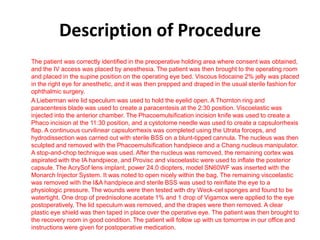
The patient was correctly identified in the preoperative holding area where consent was obtained,
and the IV access was placed by anesthesia. The patient was then brought to the operating room
and placed in the supine position on the operating eye bed. Viscous lidocaine 2% jelly was placed
in the right eye for anesthetic, and it was then prepped and draped in the usual sterile fashion for
ophthalmic surgery.
A Lieberman wire lid speculum was used to hold the eyelid open. A Thornton ring and
paracentesis blade was used to create a paracentesis at the 2:30 position. Viscoelastic was
injected into the anterior chamber. The Phacoemulsification incision knife was used to create a
Phaco incision at the 11:30 position, and a cystotome needle was used to create a capsulorrhexis
flap. A continuous curvilinear capsulorrhexis was completed using the Utrata forceps, and
hydrodissection was carried out with sterile BSS on a blunt-tipped cannula. The nucleus was then
sculpted and removed with the Phacoemulsification handpiece and a Chang nucleus manipulator.
A stop-and-chop technique was used. After the nucleus was removed, the remaining cortex was
aspirated with the IA handpiece, and Provisc and viscoelastic were used to inflate the posterior
capsule. The AcrySof lens implant, power 24.0 diopters, model SN60WF was inserted with the
Monarch Injector System. It was noted to open nicely within the bag. The remaining viscoelastic
was removed with the I&A handpiece and sterile BSS was used to reinflate the eye to a
physiologic pressure. The wounds were then tested with dry Weck-cel sponges and found to be
watertight. One drop of prednisolone acetate 1% and 1 drop of Vigamox were applied to the eye
postoperatively. The lid speculum was removed, and the drapes were then removed. A clear
plastic eye shield was then taped in place over the operative eye. The patient was then brought to
the recovery room in good condition. The patient will follow up with us tomorrow in our office and
instructions were given for postoperative medication.
Transition to ICD-10
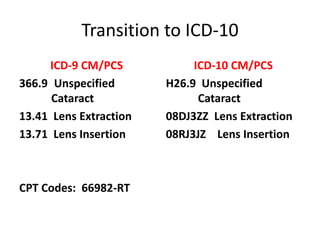
     ICD-9 CM/PCS            ICD-10 CM/PCS
366.9 Unspecified       H26.9 Unspecified
      Cataract                Cataract
13.41 Lens Extraction   08DJ3ZZ Lens Extraction
13.71 Lens Insertion    08RJ3JZ Lens Insertion


CPT Codes: 66982-RT
Evaluation of Coding
•   An operative report and video demonstration was sent out to 200 healthcare professionals
    asking their input on the coding for the procedure “phacoemulsification cataract extraction
    with intraocular lens implantation of the right eye.” Of the 200 requests for input, a
    sufficient sample was taken from the inputs to draw my conclusion. This is one of the first
    and easiest outpatient surgery procedures a medical coder will learn to code using ICD-9
    CM/PCS. The purpose of this project is to demonstrate how the coding of even the
    simplest coding scenarios can prove challenging in both ICD-9 CM/PCS and ICD-10
    CM/PCS when the coding guidelines are not known and the documentation is incomplete. It
    would appear that all relevant information was provided to result in the correct diagnosis
    and procedure code assignments depicted in the scenario. Unfortunately, this proves not
    to be the case. Congratulations to those who found the discrepancies and were able to
    identify them.
•   First, let us begin with the ICD-9 CM and ICD-10 CM assignment codes, 366.9 and H26.9.
    Based on some of your responses, the coder was left to assume that the cataract was
    senile based on the patient’s age. Therefore, it was suggested that the cataract be coded
    to senile. This is a documentation issue that should be addressed with the physician. The
    physician should be informed that the type of cataract should be documented so that the
    hospital can maintain quality control of data for use within and outside the hospital, ensure
    accurate coding, and maximum reimbursement. ICD-10 CM was developed to have as a
    feature greater specificity and clinical detail which assist in providing information for
    clinical decision making and outcome research. Documentation is the key to the success
    of this outcome.
Evaluation of Coding
•   Next, the ICD-9 and ICD-10 PCS assignment codes received a variety of responses. The one that stands
    out the most is the ICD-10 PCS coding. In the scenario, ICD-10 PCS codes 08DJ3ZZ and 08RJ3JZ were
    used. The majority agreed with this code assignment with others believing the procedure should require
    one ICD-10 PCS code. The latter is the correct response. In educating your coders, remind them that it is
    the natural inclination to assign two codes because there are two codes assigned in ICD-9. The
    procedure should be coded to replacement only, not as an extraction and insertion. ICD-10 defines
    replacement as the putting in or on biological or synthetic material that physically takes the place and/or
    function of all or a portion of a body. Examples include: phacoemulsification of cataract with intraocular
    lens implantation; hip hemiarthroplasty, open; and excision of abdominal aorta with Gore-Tex graft
    replacement, open. Education in the area of root operations and what they entail is the key to accurate
    code assignment.
•   Lastly, some were confident enough to question the CPT assignment. Although, the CPT code is not the
    focus of the coding, it does lead to another area that can affect code assignment and that is the coder’s
    individual interpretation. The CPT code 66982 is described as the extracapsular cataract removal with
    insertion of intraocular lens prosthesis, manual or mechanical technique, complex requiring devices or
    techniques not generally used in routine cataract surgery or performed on patients in the ambylogenic
    development stage. In the scenario, a Monarch Injector System was used during the procedure, some
    may argue that the Monarch Injector System is not routinely used in the procedure. The hospital should
    establish what is considered complex in the coding of cataract extraction and lens insertion.
•   I hope this project has outlined the importance of continued education and training in the areas of ICD-10
    CM/PCS coding and clinical documentation improvement. The continual practice and policy
    implementation of guidelines surrounding these issues should be ongoing and at the forefront of every
    health care providers organizational strategy.
Coding Yesterday’s Nomenclature Today®


                   Phone: 404-992-8984
                   E-Fax: 678-805-4919
                   P.O. Box 3019
                   Decatur, GA 30031

Coding Yesterday's Nomenclature Today

  • 1.
    CODING YESTERDAY’S NOMENCLATURETODAY® CATARACT SURGERY ICD-9 CM/PCS ICD-10 CM/PCS
  • 2.
    CATARACT SURGERY INDICATIONS FOR OPERATION:The patient is a 73 year-old with painless progressive loss of vision in the right eye. The patient was noted to have difficulty with activities of daily living due to the decreased vision. The risks, benefits and alternatives to cataract surgery were explained to the patient to include hemorrhage, infection, inflammation, residual refractive error, need for additional surgery, loss of vision, loss of eyeball, death, and/or complications from cataract surgery. The patient desired to proceed with the operation to help improve the vision in the right eye.
  • 3.
    Description of Procedure Thepatient was correctly identified in the preoperative holding area where consent was obtained, and the IV access was placed by anesthesia. The patient was then brought to the operating room and placed in the supine position on the operating eye bed. Viscous lidocaine 2% jelly was placed in the right eye for anesthetic, and it was then prepped and draped in the usual sterile fashion for ophthalmic surgery. A Lieberman wire lid speculum was used to hold the eyelid open. A Thornton ring and paracentesis blade was used to create a paracentesis at the 2:30 position. Viscoelastic was injected into the anterior chamber. The Phacoemulsification incision knife was used to create a Phaco incision at the 11:30 position, and a cystotome needle was used to create a capsulorrhexis flap. A continuous curvilinear capsulorrhexis was completed using the Utrata forceps, and hydrodissection was carried out with sterile BSS on a blunt-tipped cannula. The nucleus was then sculpted and removed with the Phacoemulsification handpiece and a Chang nucleus manipulator. A stop-and-chop technique was used. After the nucleus was removed, the remaining cortex was aspirated with the IA handpiece, and Provisc and viscoelastic were used to inflate the posterior capsule. The AcrySof lens implant, power 24.0 diopters, model SN60WF was inserted with the Monarch Injector System. It was noted to open nicely within the bag. The remaining viscoelastic was removed with the I&A handpiece and sterile BSS was used to reinflate the eye to a physiologic pressure. The wounds were then tested with dry Weck-cel sponges and found to be watertight. One drop of prednisolone acetate 1% and 1 drop of Vigamox were applied to the eye postoperatively. The lid speculum was removed, and the drapes were then removed. A clear plastic eye shield was then taped in place over the operative eye. The patient was then brought to the recovery room in good condition. The patient will follow up with us tomorrow in our office and instructions were given for postoperative medication.
  • 4.
    Transition to ICD-10 ICD-9 CM/PCS ICD-10 CM/PCS 366.9 Unspecified H26.9 Unspecified Cataract Cataract 13.41 Lens Extraction 08DJ3ZZ Lens Extraction 13.71 Lens Insertion 08RJ3JZ Lens Insertion CPT Codes: 66982-RT
  • 5.
    Evaluation of Coding • An operative report and video demonstration was sent out to 200 healthcare professionals asking their input on the coding for the procedure “phacoemulsification cataract extraction with intraocular lens implantation of the right eye.” Of the 200 requests for input, a sufficient sample was taken from the inputs to draw my conclusion. This is one of the first and easiest outpatient surgery procedures a medical coder will learn to code using ICD-9 CM/PCS. The purpose of this project is to demonstrate how the coding of even the simplest coding scenarios can prove challenging in both ICD-9 CM/PCS and ICD-10 CM/PCS when the coding guidelines are not known and the documentation is incomplete. It would appear that all relevant information was provided to result in the correct diagnosis and procedure code assignments depicted in the scenario. Unfortunately, this proves not to be the case. Congratulations to those who found the discrepancies and were able to identify them. • First, let us begin with the ICD-9 CM and ICD-10 CM assignment codes, 366.9 and H26.9. Based on some of your responses, the coder was left to assume that the cataract was senile based on the patient’s age. Therefore, it was suggested that the cataract be coded to senile. This is a documentation issue that should be addressed with the physician. The physician should be informed that the type of cataract should be documented so that the hospital can maintain quality control of data for use within and outside the hospital, ensure accurate coding, and maximum reimbursement. ICD-10 CM was developed to have as a feature greater specificity and clinical detail which assist in providing information for clinical decision making and outcome research. Documentation is the key to the success of this outcome.
  • 6.
    Evaluation of Coding • Next, the ICD-9 and ICD-10 PCS assignment codes received a variety of responses. The one that stands out the most is the ICD-10 PCS coding. In the scenario, ICD-10 PCS codes 08DJ3ZZ and 08RJ3JZ were used. The majority agreed with this code assignment with others believing the procedure should require one ICD-10 PCS code. The latter is the correct response. In educating your coders, remind them that it is the natural inclination to assign two codes because there are two codes assigned in ICD-9. The procedure should be coded to replacement only, not as an extraction and insertion. ICD-10 defines replacement as the putting in or on biological or synthetic material that physically takes the place and/or function of all or a portion of a body. Examples include: phacoemulsification of cataract with intraocular lens implantation; hip hemiarthroplasty, open; and excision of abdominal aorta with Gore-Tex graft replacement, open. Education in the area of root operations and what they entail is the key to accurate code assignment. • Lastly, some were confident enough to question the CPT assignment. Although, the CPT code is not the focus of the coding, it does lead to another area that can affect code assignment and that is the coder’s individual interpretation. The CPT code 66982 is described as the extracapsular cataract removal with insertion of intraocular lens prosthesis, manual or mechanical technique, complex requiring devices or techniques not generally used in routine cataract surgery or performed on patients in the ambylogenic development stage. In the scenario, a Monarch Injector System was used during the procedure, some may argue that the Monarch Injector System is not routinely used in the procedure. The hospital should establish what is considered complex in the coding of cataract extraction and lens insertion. • I hope this project has outlined the importance of continued education and training in the areas of ICD-10 CM/PCS coding and clinical documentation improvement. The continual practice and policy implementation of guidelines surrounding these issues should be ongoing and at the forefront of every health care providers organizational strategy.
  • 7.
    Coding Yesterday’s NomenclatureToday® Phone: 404-992-8984 E-Fax: 678-805-4919 P.O. Box 3019 Decatur, GA 30031