Farheen Rahman
 The main genre we are focusing on is horror. Horror
films are further divided into sub genres including
supernatural, psychological, comedy, zombie,
slasher, teen etc.
 Our films will fall into the sub genre of supernatural
horror.
 Most horror films are usually
located in a detached house
in a secluded area or it takes
place in other isolated
locations such as near a
forest, a cemetery or an
abandoned amusement
park.These places are
chosen so the protagonist
can be seen as vulnerable
and are unable to seek help
from anyone.
 This is one of the most important aspects to creating a
specific mood for the scene. It helps promote certain
emotions to the audience. Some of the common
conventions include long suspenseful notes often help
contrast with short sharp notes to shock the audience,
extreme but intentional pitch tones and isolated
instruments used before a key event occurs.
 The typical music used in horror movies varies depending
on the character. If there are children present in the movie
then they might add a lullaby.They might keep the
original lullaby song or they might distort it to make it
slower and creepier.
 Common sounds in horror movies includes wind howling,
screams, doors slamming, floor creaking etc.
 The antagonists in horror films are usually ghosts,
vampires, zombies, witches and clowns etc.
 The protagonists usually consist of a happy, white, all
American family. Sometimes its focused more on the child
or a parent.They usually move into a new house and
discover something evil about it or they have a
troubled/dark past that follows them and bothers them.
 Or the protagonist is usually a group of friends, usually
teenagers. Each teenager has a different personality for
example one may be brave while another is constantly
worried and scared. One might not care about what
happens and seems laid back while another comes up with
plans to “get them out” or to help them “survive”.
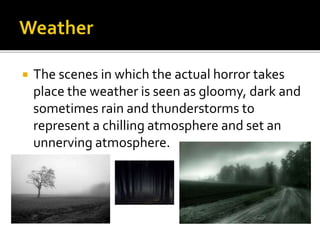
 The scenes in which the actual horror takes
place the weather is seen as gloomy, dark and
sometimes rain and thunderstorms to
represent a chilling atmosphere and set an
unnerving atmosphere.
 Good vs evil
 Psychopaths, sociopaths, serial killers,
demons, ghosts, poltergeist
 Kidnapping, stalking, revenge, haunting
 Religious beliefs, exorcisms
 The classic narrative structure of the Horror genre has to have a protagonist
within the film. Horror is based upon conflict and problems the main
characters face
 From the main list of characters, several character types are chosen for a
horror film: the heroine/hero, the evil "monster" and the supporting
characters. In theWoman In Black film, the protagonist character/hero is
Arthur Kipps, and the villain is the woman in black
 Horror films try to connect with the audience. Some narratives, typically seen
in the sub-genre of slasher films, are very common and unoriginal when it
comes to the film plot/storyline. For example, the film would revolve around
the story of a killer that had a traumatic childhood past or even psychotic
mental issues.Thus, ending up killing people at random, or with some type of
reasoning that may be irrational.Within this stereotypical narrative, the
characters are usually teenagers, most of them are killed leaving one or two
left
 The fate of this the one left to survive, who may be referred to as the hero
tends to be left unknown.
 Common camera angles include canted angles
to show distortion and help the audience see
what the scene is trying to connote.
 Common shots include hand held shots
especially when a character is running to show
how intense the scene is and make the audience
feel like they are physically experiencing it and
to make them feel involved.
 They also use a lot of extreme close ups on the
protagonists face to show their emotions and to
build up tension in a scene.
 The main colours associated with horror is black, white
and red.
 Black is used as it connotes darkness and creates and
unsettling mood. Most horror movies that are located in
isolated areas are usually dark for example a scene in a
dark alleyway or a haunted house. Antagonist usually
dress in black or white to show that they are dark and to
blend in with items we associate with fear such as
shadows.
 When a character is dressed in white it shows death as
ghosts are stereotypically seen as white.
 Red is seen a lot especially in slasher movies as there is a
lot of blood and red signifies danger.
 Typical props used include: knives, masks, chainsaws, toys
etc.
Some stereotypical events that happen includes:
 A character falling over and hurting themselves
which leads to them being unable to run from
antagonist.
 A door slamming, blocking the protagonists
path.
 The vehicle they need for escaping doesn’t start
or the tires have been slashed.
 Running upstairs rather than running out of the
house.
 Someone becomes possessed

Codes and conventions

  • 1.
  • 2.
     The maingenre we are focusing on is horror. Horror films are further divided into sub genres including supernatural, psychological, comedy, zombie, slasher, teen etc.  Our films will fall into the sub genre of supernatural horror.
  • 3.
     Most horrorfilms are usually located in a detached house in a secluded area or it takes place in other isolated locations such as near a forest, a cemetery or an abandoned amusement park.These places are chosen so the protagonist can be seen as vulnerable and are unable to seek help from anyone.
  • 4.
     This isone of the most important aspects to creating a specific mood for the scene. It helps promote certain emotions to the audience. Some of the common conventions include long suspenseful notes often help contrast with short sharp notes to shock the audience, extreme but intentional pitch tones and isolated instruments used before a key event occurs.  The typical music used in horror movies varies depending on the character. If there are children present in the movie then they might add a lullaby.They might keep the original lullaby song or they might distort it to make it slower and creepier.  Common sounds in horror movies includes wind howling, screams, doors slamming, floor creaking etc.
  • 5.
     The antagonistsin horror films are usually ghosts, vampires, zombies, witches and clowns etc.  The protagonists usually consist of a happy, white, all American family. Sometimes its focused more on the child or a parent.They usually move into a new house and discover something evil about it or they have a troubled/dark past that follows them and bothers them.  Or the protagonist is usually a group of friends, usually teenagers. Each teenager has a different personality for example one may be brave while another is constantly worried and scared. One might not care about what happens and seems laid back while another comes up with plans to “get them out” or to help them “survive”.
  • 6.
     The scenesin which the actual horror takes place the weather is seen as gloomy, dark and sometimes rain and thunderstorms to represent a chilling atmosphere and set an unnerving atmosphere.
  • 7.
     Good vsevil  Psychopaths, sociopaths, serial killers, demons, ghosts, poltergeist  Kidnapping, stalking, revenge, haunting  Religious beliefs, exorcisms
  • 8.
     The classicnarrative structure of the Horror genre has to have a protagonist within the film. Horror is based upon conflict and problems the main characters face  From the main list of characters, several character types are chosen for a horror film: the heroine/hero, the evil "monster" and the supporting characters. In theWoman In Black film, the protagonist character/hero is Arthur Kipps, and the villain is the woman in black  Horror films try to connect with the audience. Some narratives, typically seen in the sub-genre of slasher films, are very common and unoriginal when it comes to the film plot/storyline. For example, the film would revolve around the story of a killer that had a traumatic childhood past or even psychotic mental issues.Thus, ending up killing people at random, or with some type of reasoning that may be irrational.Within this stereotypical narrative, the characters are usually teenagers, most of them are killed leaving one or two left  The fate of this the one left to survive, who may be referred to as the hero tends to be left unknown.
  • 9.
     Common cameraangles include canted angles to show distortion and help the audience see what the scene is trying to connote.  Common shots include hand held shots especially when a character is running to show how intense the scene is and make the audience feel like they are physically experiencing it and to make them feel involved.  They also use a lot of extreme close ups on the protagonists face to show their emotions and to build up tension in a scene.
  • 10.
     The maincolours associated with horror is black, white and red.  Black is used as it connotes darkness and creates and unsettling mood. Most horror movies that are located in isolated areas are usually dark for example a scene in a dark alleyway or a haunted house. Antagonist usually dress in black or white to show that they are dark and to blend in with items we associate with fear such as shadows.  When a character is dressed in white it shows death as ghosts are stereotypically seen as white.  Red is seen a lot especially in slasher movies as there is a lot of blood and red signifies danger.  Typical props used include: knives, masks, chainsaws, toys etc.
  • 11.
    Some stereotypical eventsthat happen includes:  A character falling over and hurting themselves which leads to them being unable to run from antagonist.  A door slamming, blocking the protagonists path.  The vehicle they need for escaping doesn’t start or the tires have been slashed.  Running upstairs rather than running out of the house.  Someone becomes possessed