Code of Conduct
for Victorian Public
Sector Employees
Describes how we are expected to behave
towards the Victorian Government, community and
colleagues
May be supplemented by information in:
• Legislation
• Industrial agreements
• Awards
• Policies
• Procedures
Failing to comply with the code may be misconduct
What is the code of conduct?
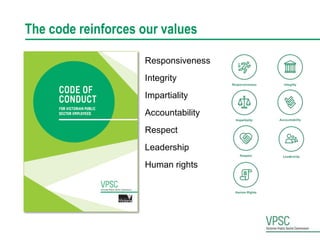
Responsiveness
Integrity
Impartiality
Accountability
Respect
Leadership
Human rights
The code reinforces our values
Why is a shared understanding
of the values important?
Encourages high performance
Gives organisations the competitive edge
Provides organisational clarity in moments of crisis
Creates an organisation with increased agility and creativity
Enables strategic organisational learning and accelerated employee
capability and performance
Collins, J & Porras, J 1994, Built to last: Successful habits of visionary companies
Demonstrating responsiveness
Advising Government
Remaining apolitical
Services to the community
Contributing to improvements
Demonstrating integrity
Honesty at work
Using powers at work
Financial probity
Official information
Public comment
Reporting unethical
behaviour
Conflict of interest
Other employment
Public trust
Criminal offences
Drugs and alcohol
Demonstrating impartiality
Decisions and advice
Gifts and benefits
Acting fairly
Implementing government
policies and programs
Demonstrating accountability
Working to clear objectives
Being responsible for decisions and
actions
Work resources
Open to scrutiny
Ability to meet essential requirements
Compliance with legislation
Demonstrating respect
Fair and objective treatment
Privacy and confidentiality
Maintaining confidentiality
Equity and diversity
Improving outcomes
Demonstrating leadership
Leading by example
Managing staff
Supporting others
Demonstrating human rights
Understanding human rights
Making decisions and providing
advice consistent with human rights
Implementing human rights
Protecting human rights
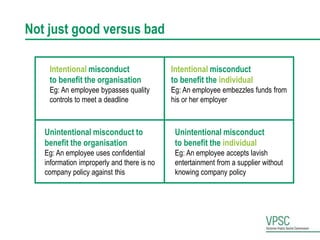
Not just good versus bad
Intentional misconduct
to benefit the organisation
Eg: An employee bypasses quality
controls to meet a deadline
Intentional misconduct
to benefit the individual
Eg: An employee embezzles funds from
his or her employer
Unintentional misconduct to
benefit the organisation
Eg: An employee uses confidential
information improperly and there is no
company policy against this
Unintentional misconduct
to benefit the individual
Eg: An employee accepts lavish
entertainment from a supplier without
knowing company policy
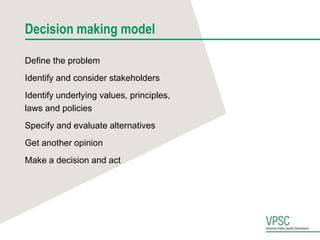
Decision making model
Define the problem
Identify and consider stakeholders
Identify underlying values, principles,
laws and policies
Specify and evaluate alternatives
Get another opinion
Make a decision and act
Where to go for further information
A trusted colleague
Your manager
Human resource manager
Victorian Ombudsman: www.ombudsman.vic.gov.au
Equal Opportunity and Human Rights Commission:
www.humanrightscommission.vic.gov.au
Victorian Public Sector Commission: www.vpsc.vic.gov.au
What to do next
Read the code of conduct
Lead your team in discussing a workplace problem in your next team
meeting
Start a discussion about the values the next time you have to make a
major decision
Examine your own behaviour and challenge misconduct in the
workplace
Speak to HR about how you can get involved in developing a values
based organisation
Code of Conduct
for Victorian Public
Sector Employees

Code-of-Conduct-Sample-Presentation.pptx

  • 1.
    Code of Conduct forVictorian Public Sector Employees
  • 2.
    Describes how weare expected to behave towards the Victorian Government, community and colleagues May be supplemented by information in: • Legislation • Industrial agreements • Awards • Policies • Procedures Failing to comply with the code may be misconduct What is the code of conduct?
  • 3.
  • 4.
    Why is ashared understanding of the values important? Encourages high performance Gives organisations the competitive edge Provides organisational clarity in moments of crisis Creates an organisation with increased agility and creativity Enables strategic organisational learning and accelerated employee capability and performance Collins, J & Porras, J 1994, Built to last: Successful habits of visionary companies
  • 5.
    Demonstrating responsiveness Advising Government Remainingapolitical Services to the community Contributing to improvements
  • 6.
    Demonstrating integrity Honesty atwork Using powers at work Financial probity Official information Public comment Reporting unethical behaviour Conflict of interest Other employment Public trust Criminal offences Drugs and alcohol
  • 7.
    Demonstrating impartiality Decisions andadvice Gifts and benefits Acting fairly Implementing government policies and programs
  • 8.
    Demonstrating accountability Working toclear objectives Being responsible for decisions and actions Work resources Open to scrutiny Ability to meet essential requirements Compliance with legislation
  • 9.
    Demonstrating respect Fair andobjective treatment Privacy and confidentiality Maintaining confidentiality Equity and diversity Improving outcomes
  • 10.
    Demonstrating leadership Leading byexample Managing staff Supporting others
  • 11.
    Demonstrating human rights Understandinghuman rights Making decisions and providing advice consistent with human rights Implementing human rights Protecting human rights
  • 12.
    Not just goodversus bad Intentional misconduct to benefit the organisation Eg: An employee bypasses quality controls to meet a deadline Intentional misconduct to benefit the individual Eg: An employee embezzles funds from his or her employer Unintentional misconduct to benefit the organisation Eg: An employee uses confidential information improperly and there is no company policy against this Unintentional misconduct to benefit the individual Eg: An employee accepts lavish entertainment from a supplier without knowing company policy
  • 13.
    Decision making model Definethe problem Identify and consider stakeholders Identify underlying values, principles, laws and policies Specify and evaluate alternatives Get another opinion Make a decision and act
  • 14.
    Where to gofor further information A trusted colleague Your manager Human resource manager Victorian Ombudsman: www.ombudsman.vic.gov.au Equal Opportunity and Human Rights Commission: www.humanrightscommission.vic.gov.au Victorian Public Sector Commission: www.vpsc.vic.gov.au
  • 15.
    What to donext Read the code of conduct Lead your team in discussing a workplace problem in your next team meeting Start a discussion about the values the next time you have to make a major decision Examine your own behaviour and challenge misconduct in the workplace Speak to HR about how you can get involved in developing a values based organisation
  • 16.
    Code of Conduct forVictorian Public Sector Employees

Editor's Notes

  • #2 Welcome to our organisation.
  • #3 The code of conduct is binding and describes the behaviours expected of us as public sector workers. It may be supplemented by other information. Check with your manager or HR to see what other guidelines apply to your work. You might like to mention those that apply in your organisation. The behaviours described in the code are so important to our work that acting otherwise could be regarded as misconduct.
  • #4 As public sector workers we perform an important role. But it’s not only about what we do, it’s about how we do it, and this is where the public sector values come into play. They define how we interact with the community, with Government and with each other. They ask us to show leadership and to treat each other fairly and reasonably. Each section of the code is devoted to one of the seven Victorian public sector values.
  • #5 But why are values important? They guide our strategies, policies, practices and behaviours. They send a consistent message to our colleagues and other stakeholders. They remove ambiguity. They define what is important to us. Researchers such as Collins and Porras have found that values can inspire discretionary effort, particularly when there is a good ‘cultural fit’ between the organisation and its employees. People are working together in a common cause. But we must see the relevance of the values to our work for this to happen. We must know what the values mean in practice. People pick up on signals, both big and small, about how to behave at work so any behaviour that is inconsistent with the values should be stopped. Recruitment, induction and performance management can help to reinforce the values and build understanding of them.
  • #6 Now let’s consider each of the values in turn. Each section of the code has: a legal definition a description of what that means in practice (points shown) a description of the behaviours involved For example the code says that demonstrating responsiveness means: impartially advising the Government of the day and understanding the implications of that advice on government policy remaining apolitical when interacting with Ministers, members of parliament and parliamentary committees providing the community with services in an equitable, prompt and professional manner contributing to improvements in the way work is performed A case study has been provided for each value. Choose one or more for discussion. Click on the link to the case study if you wish.
  • #7 Demonstrating integrity means: being honest, open and transparent at work using powers responsibly complying with proper financial management principles treating official information confidentially limiting public comment to the facts reporting unethical behaviour to an appropriate authority declaring and avoiding conflicts of interest engaging in other employment only when it doesn’t conflict with the public sector role always acting in a way that sustains public trust disclosing any relevant criminal offences not allowing the consumption of drugs or alcohol to affect work Click on the link to the case study if you wish
  • #8 Demonstrating impartiality means: making sound decisions and advice not seeking or accepting gifts or benefits that could influence actions using fair criteria in making decisions implementing policies and programs equitably Click on the link to the case study if you wish
  • #9 Demonstrating accountability means: working to clear objectives accepting responsibility for the decisions and actions taken using work resources effectively keeping records that are open to scrutiny reporting any inability to meet the essential requirements of the job understanding and complying with all relevant legislation Click on the link to the case study if you wish
  • #10 Demonstrating respect means: treating others fairly and objectively keeping private information confidential and not misusing it protecting colleagues from discrimination, harassment and bullying working collaboratively to improve customer service Click on the link to the case study if you wish
  • #11 Demonstrating leadership means: being a positive role model providing a safe, encouraging and supportive work environment for staff supporting and guiding others in their work Click on the link to the case study if you wish
  • #12 Demonstrating human rights means: understanding how the Human Rights Charter applies to your work making decisions, providing advice and delivering services consistently with the Charter reporting any suspected human rights breaches Click on the link to the case study if you wish
  • #13 Not all misconduct is intentional or for private gain. Sometimes we do not even realise that our behaviour is considered misconduct. For example someone might unintentionally benefit the organisation by gathering information that is considered confidential. Or someone might do something to benefit themselves, while not realising that their conduct is considered wrong. However sometimes misconduct is intentional. For example someone may intentionally bypass normal organisational protocols to obtain a quicker outcome or steal money or resources to benefit themselves.
  • #14 This model outlines the steps to follow in making decisions. Wherever possible decisions should also be made public and in collaboration with others. This is because considering diverse interests and perspectives when making a decision increases the credibility of the process and reduces the suspicion of bias. Read the steps aloud.
  • #15 Fill out this slide before the start of the session with contact details appropriate for your audience or organisation. You may like to contact one or more of these people if you want more information about the code or want to discuss a workplace problem or want to report misconduct.
  • #16 Today was an introduction to the code of conduct, the Victorian public sector values and the behaviours that support them. There are lots of ways you can put the code into practice. Here are some. Can you suggest other ways?
  • #17 Read the case study aloud, ask the audience for a response and then click to show the questions. Ask their opinion again. Calls are sometimes referred to the wrong person. Most customers will understand if you politely explain the mistake and promise to ring them back with the correct information. Giving incomplete or incorrect information can cause dissatisfaction particularly if it wastes the customers’ time or money or prevents them from receiving the right goods or services. You might like to mention some key statistics from either the People Matter Survey or your own climate survey. Being responsive is important to public sector workers. 96% of respondents to the 2014 People Matter Survey said their workgroup strives to satisfy customers.
  • #18 Read the case study aloud, ask the audience for a response and then click to show the questions. Ask their opinion again. Fraud is a crime that should be reported to the organisation’s Protected Disclosure Coordinator or to IBAC (the Independent Broad-based Anti-corruption Commission). Failing to do so could mean that the corrupt behaviour continues without investigation and public money is wasted. Gina could make a protected complaint orally or in writing, in person or anonymously. Her complaint should set out the specific allegations as well as the grounds for those allegations, and include copies of any supporting documents. Under the Protected Disclosures Act 2012, Gina is protected from reprisal for making a protected disclosure. Her manager is liable to a penalty of a maximum of $36,400 (240 penalty units) and/or two years imprisonment for threatening her with dismissal. You might like to mention some key statistics from either the People Matter Survey or your own climate survey. Having integrity is important to public sector workers. 86% of respondents to the 2014 People Matter Survey said their colleagues are honest, open and transparent in their dealings.
  • #19 Read the case study aloud, ask the audience for a response and then click to show the questions. Ask their opinion again. Hugh is a member of a committee not the primary decision maker. However he must still act and be seen to act impartially. Accepting the bottle of wine could give the impression that he is open to being influenced even if he is not. It could discredit the awards program and his organisation. You might like to mention some key statistics from either the People Matter Survey or your own climate survey. Being impartial is important to public sector workers. 86% of respondents to the 2014 People Matter Survey said their organisation has procedures and systems that promote objective decision-making.
  • #20 Read the case study aloud, ask the audience for a response and then click to show the questions. Ask their opinion again. Gary is not managing his time well. He is giving priority to his emails rather than deciding on what is important to be done first. He will have agreed on a work program with his manager but still needs to respond to changing priorities. The 54 emails he receives will be of differing importance and should not be given automatic priority over other tasks. You might like to mention some key statistics from either the People Matter Survey or your own climate survey. Being accountable is important to public sector workers. 83% of respondents to the 2014 People Matter Survey said their workgroup uses time and resources efficiently.
  • #21 Read the case study aloud, ask the audience for a response and then click to show the questions. Ask their opinion again. By dismissing Rebecca’s ideas, her colleagues are discouraging her from contributing to the team’s work. Collaborating with colleagues and being open to their ideas and concerns will make the team’s work more robust. You might like to mention some key statistics from either the People Matter Survey or your own climate survey. Showing respect is important to public sector workers. 86% of respondents to the 2014 People Matter Survey said their manager listens to what they have to say. 86% said colleagues treat each other with respect.
  • #22 Read the case study aloud, ask the audience for a response and then click to show the questions. Ask their opinion again. Ideally Barry should feel comfortable discussing his work program with his manager. He may need more time or resources to complete his work or he made need coaching on ways to work more effectively. You might like to mention some key statistics from either the People Matter Survey or your own climate survey. Showing leadership is important to public sector workers. 76% of respondents to the 2014 People Matter Survey said senior managers model the values.
  • #23 Read the case study aloud, ask the audience for a response and then click to show the questions. Ask their opinion again. The majority of Victorian laws, procedures and policies protect rights enshrined in the Human Rights Charter. The Charter says Meg has the right to equality, particularly the right to equal protection under the law. She also has a right to freedom from forced work. It appears that Meg is being discriminated against because she is a parent and a woman. The Equal Opportunity Act 2010 outlaws this type of discrimination. You might like to mention some key statistics from either the People Matter Survey or your own climate survey. Human rights are important to public sector workers. 95% of respondents to the 2014 People Matter Survey said human rights are valued in their workgroup.
  • #24 Thank you for your time. Are there any questions?