Startup Terminology 101
A List of frequently used startup expressions, to get you
familiarized.
1
Email: info@codecloud.meTwitter: @CodeCloudmeWebsite: www.codecloud.me
Created by: Luke J. Fitzpatrick @iamwormify
A List of Common Words
Used in Startups:
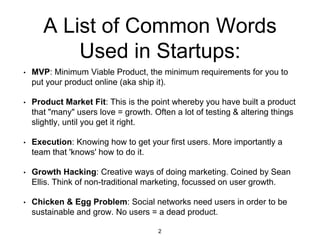
• MVP: Minimum Viable Product, the minimum requirements for you to
put your product online (aka ship it).
• Product Market Fit: This is the point whereby you have built a product
that "many" users love = growth. Often a lot of testing & altering things
slightly, until you get it right.
• Execution: Knowing how to get your first users. More importantly a
team that 'knows' how to do it.
• Growth Hacking: Creative ways of doing marketing. Coined by Sean
Ellis. Think of non-traditional marketing, focussed on user growth.
• Chicken & Egg Problem: Social networks need users in order to be
sustainable and grow. No users = a dead product.
2
A List of Common Words
Used in Startups:
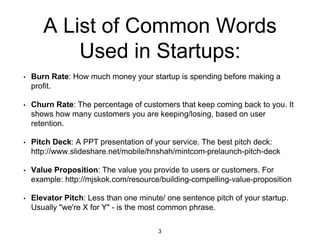
• Burn Rate: How much money your startup is spending before making a
profit.
• Churn Rate: The percentage of customers that keep coming back to you. It
shows how many customers you are keeping/losing, based on user
retention.
• Pitch Deck: A PPT presentation of your service. The best pitch deck:
http://www.slideshare.net/mobile/hnshah/mintcom-prelaunch-pitch-deck
• Value Proposition: The value you provide to users or customers. For
example: http://mjskok.com/resource/building-compelling-value-proposition
• Elevator Pitch: Less than one minute/ one sentence pitch of your startup.
Usually "we're X for Y" - is the most common phrase.
3
A List of Common Words
Used in Startups
• Conversion Rate: This can be either, the % of users signing up/ the % of
payable users.
• A/B Testing: Testing different variants of a landing page (this is a sign up
page before launching). Can also be used for testing Adwords campaigns,
book covers, colors, pricing etc.
• Pivot: Can be either - changing your product slightly OR changing your
market segments.
• The Lean Startup: A book that created a startup movement based on
strong product testing, by Eric Ries.
• The TechCrunch Trough of Sorrow: Developed by Andrew Chen, link:
http://andrewchen.co/after-the-techcrunch-bump-life-in-the-trough-of-
sorrow/
4
A List of Common Words
Used in Startups
• User Acquisition Strategy: Put simply, how do you plan to get your first
users? For example: word-of-mouth (organic growth), Adwords etc.
• User Acquisition Cost: The $ cost value to acquire your users. In
simplicity, advertising/ marketing cost.
• Business Model: How will you make money? Often enough, what startups
think, and what they do is totally different. Think freemium, SaSS (Software
as a service), subscription based etc.
• Freemium: Giving your service away for free and plan to profit in the future.
• Pricing Structure: How much do you plan to charge per user/ per
customer. Do you offer tiered payment structures with multiple plans - like
SaSS?
5
A List of Common Words
Used in Startups:
• Pre-accelerator: An accelerator that focuses on the ideas validation stage.
Usually lasts for 4-8 weeks.
• Accelerator: A 3-4 month training program for startups. Startups receive an
investment, mentors and other benefits. Y Combinator (YC), is regarded as
the best.
• Incubator: Uses an external management team to give advice. Takes a
larger equity percentage than an accelerator and often the duration of the
program is much longer.
• VC: Venture Capitalist's are investors that invest a large amount over $500K
USD.
• Angel: Angel investors are investors that invest a small amount often
between $10-20K USD.
6
A List of Common Words
Used in Startups:
• Market Segment: Dividing a market into small markets (cohorts).
• Cohort: This means, customer segments. For example, age cohorts
aged 21-25, female cohorts in New Jersey etc.
• LTV: Lifetime Value of a customer. Think, how long will they use, and
continue to use your service in years. The longer, the better. Put
simply, the amount of yearly revenue you get from one customer.
• Product Differentiation: How does your product differ from your
competitors?
• Product Defensibility: What will you do to protect your product? For
example, are you protected by a patent? How will you react to
competitors and future competitors?
7
A List of Common Words
Used in Startups:
• Equity: Think of a startup like a big pizza. It starts off in slices, gets smaller
and smaller when someone takes a bite. Equity refers to the % ownership
someone holds in a company. Tip read Slicing Pie, by Mike Moyer & read-up
on Paul Graham's views on founders' equity.
• Vested Equity: You get equity over time in small percentages. This prevents
people leaving, (should) motivate people to work harder to attain company
goals. Standard in startup contracts.
• Cliff: Linked to vested equity. A cliff is a specific time period set as a trial. For
example, one year, three years etc. It protects the company to an extent.
• Company Structure: LLC, C Corp, S Corp. Tip: If you're in the U.S, register in
Delaware, all startups do.
• Stake: The percentage ownership someone has in your company.
8
A List of Common Words
Used in Startups:
• Valuation: How much investors "believe" your startup is worth? David S. Rose
shares a lot of insightful content on Quora about investments & valuation.
• Exit Strategy: Do you plan to sell your company? Which company will buy it?
Will you get an IPO, and go public?
• Go-to-Market Strategy: How you plan get your users and grow your service?
For example: StartupLister -> BetaList -> Product Hunt -> TC
• Validation: Think "The Lean Startup", go out & survey potential users to find
out if they want your solution. Another way, can you verify that users will pay?
• Scalability: The ability to add on more services OR expand to other markets.
Tip: your first version should be minimalistic giving you room to grow.
9
Don't worry, this may seem
confusing at first. Most first-time
tech founders don't know all of this.
They learn it on the way :)
10
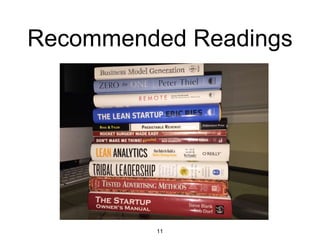
Recommended Readings
11
And Start Building Awesome Apps With Others
Sign up: www.codecloud.me
12
13

Startup Terms, A Breakdown For Everyone

  • 1.
    Startup Terminology 101 AList of frequently used startup expressions, to get you familiarized. 1 Email: info@codecloud.meTwitter: @CodeCloudmeWebsite: www.codecloud.me Created by: Luke J. Fitzpatrick @iamwormify
  • 2.
    A List ofCommon Words Used in Startups: • MVP: Minimum Viable Product, the minimum requirements for you to put your product online (aka ship it). • Product Market Fit: This is the point whereby you have built a product that "many" users love = growth. Often a lot of testing & altering things slightly, until you get it right. • Execution: Knowing how to get your first users. More importantly a team that 'knows' how to do it. • Growth Hacking: Creative ways of doing marketing. Coined by Sean Ellis. Think of non-traditional marketing, focussed on user growth. • Chicken & Egg Problem: Social networks need users in order to be sustainable and grow. No users = a dead product. 2
  • 3.
    A List ofCommon Words Used in Startups: • Burn Rate: How much money your startup is spending before making a profit. • Churn Rate: The percentage of customers that keep coming back to you. It shows how many customers you are keeping/losing, based on user retention. • Pitch Deck: A PPT presentation of your service. The best pitch deck: http://www.slideshare.net/mobile/hnshah/mintcom-prelaunch-pitch-deck • Value Proposition: The value you provide to users or customers. For example: http://mjskok.com/resource/building-compelling-value-proposition • Elevator Pitch: Less than one minute/ one sentence pitch of your startup. Usually "we're X for Y" - is the most common phrase. 3
  • 4.
    A List ofCommon Words Used in Startups • Conversion Rate: This can be either, the % of users signing up/ the % of payable users. • A/B Testing: Testing different variants of a landing page (this is a sign up page before launching). Can also be used for testing Adwords campaigns, book covers, colors, pricing etc. • Pivot: Can be either - changing your product slightly OR changing your market segments. • The Lean Startup: A book that created a startup movement based on strong product testing, by Eric Ries. • The TechCrunch Trough of Sorrow: Developed by Andrew Chen, link: http://andrewchen.co/after-the-techcrunch-bump-life-in-the-trough-of- sorrow/ 4
  • 5.
    A List ofCommon Words Used in Startups • User Acquisition Strategy: Put simply, how do you plan to get your first users? For example: word-of-mouth (organic growth), Adwords etc. • User Acquisition Cost: The $ cost value to acquire your users. In simplicity, advertising/ marketing cost. • Business Model: How will you make money? Often enough, what startups think, and what they do is totally different. Think freemium, SaSS (Software as a service), subscription based etc. • Freemium: Giving your service away for free and plan to profit in the future. • Pricing Structure: How much do you plan to charge per user/ per customer. Do you offer tiered payment structures with multiple plans - like SaSS? 5
  • 6.
    A List ofCommon Words Used in Startups: • Pre-accelerator: An accelerator that focuses on the ideas validation stage. Usually lasts for 4-8 weeks. • Accelerator: A 3-4 month training program for startups. Startups receive an investment, mentors and other benefits. Y Combinator (YC), is regarded as the best. • Incubator: Uses an external management team to give advice. Takes a larger equity percentage than an accelerator and often the duration of the program is much longer. • VC: Venture Capitalist's are investors that invest a large amount over $500K USD. • Angel: Angel investors are investors that invest a small amount often between $10-20K USD. 6
  • 7.
    A List ofCommon Words Used in Startups: • Market Segment: Dividing a market into small markets (cohorts). • Cohort: This means, customer segments. For example, age cohorts aged 21-25, female cohorts in New Jersey etc. • LTV: Lifetime Value of a customer. Think, how long will they use, and continue to use your service in years. The longer, the better. Put simply, the amount of yearly revenue you get from one customer. • Product Differentiation: How does your product differ from your competitors? • Product Defensibility: What will you do to protect your product? For example, are you protected by a patent? How will you react to competitors and future competitors? 7
  • 8.
    A List ofCommon Words Used in Startups: • Equity: Think of a startup like a big pizza. It starts off in slices, gets smaller and smaller when someone takes a bite. Equity refers to the % ownership someone holds in a company. Tip read Slicing Pie, by Mike Moyer & read-up on Paul Graham's views on founders' equity. • Vested Equity: You get equity over time in small percentages. This prevents people leaving, (should) motivate people to work harder to attain company goals. Standard in startup contracts. • Cliff: Linked to vested equity. A cliff is a specific time period set as a trial. For example, one year, three years etc. It protects the company to an extent. • Company Structure: LLC, C Corp, S Corp. Tip: If you're in the U.S, register in Delaware, all startups do. • Stake: The percentage ownership someone has in your company. 8
  • 9.
    A List ofCommon Words Used in Startups: • Valuation: How much investors "believe" your startup is worth? David S. Rose shares a lot of insightful content on Quora about investments & valuation. • Exit Strategy: Do you plan to sell your company? Which company will buy it? Will you get an IPO, and go public? • Go-to-Market Strategy: How you plan get your users and grow your service? For example: StartupLister -> BetaList -> Product Hunt -> TC • Validation: Think "The Lean Startup", go out & survey potential users to find out if they want your solution. Another way, can you verify that users will pay? • Scalability: The ability to add on more services OR expand to other markets. Tip: your first version should be minimalistic giving you room to grow. 9
  • 10.
    Don't worry, thismay seem confusing at first. Most first-time tech founders don't know all of this. They learn it on the way :) 10
  • 11.
  • 12.
    And Start BuildingAwesome Apps With Others Sign up: www.codecloud.me 12
  • 13.