COCOMO
Constructive Cost Model
Software Engineering
1
Cost Estimation
Cost estimation in software engineering is typically concerned with the financial
spend on the efforts to develop and test the software, this can also include
requirements review, maintenance, training, managing and buying extra equipment,
servers and software.
2
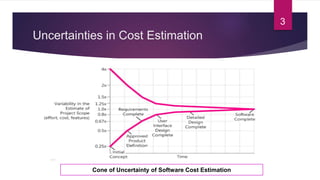
Uncertainties in Cost Estimation
3
Cone of Uncertainty of Software Cost Estimation
COCOMO- Introduction
The constructive cost model was developed by Barry W. Boehm in the late 1970s and published in Boehm's
1981 book Software Engineering Economics as a model for estimating effort, cost, and schedule for software
projects.
It is also sometimes referred to as COCOMO 81.
This model estimates total efforts in terms of person-month of technical project staff.
The effort estimate includes development, management and support tasks.
4
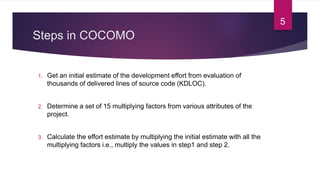
Steps in COCOMO
1. Get an initial estimate of the development effort from evaluation of
thousands of delivered lines of source code (KDLOC).
2. Determine a set of 15 multiplying factors from various attributes of the
project.
3. Calculate the effort estimate by multiplying the initial estimate with all the
multiplying factors i.e., multiply the values in step1 and step 2.
5
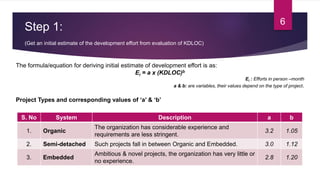
Step 1:
(Get an initial estimate of the development effort from evaluation of KDLOC)
The formula/equation for deriving initial estimate of development effort is as:
Ei = a x (KDLOC)b
Ei : Efforts in person –month
a & b: are variables, their values depend on the type of project.
Project Types and corresponding values of ‘a’ & ‘b’
S. No System Description a b
1. Organic
The organization has considerable experience and
requirements are less stringent.
3.2 1.05
2. Semi-detached Such projects fall in between Organic and Embedded. 3.0 1.12
3. Embedded
Ambitious & novel projects, the organization has very little or
no experience.
2.8 1.20
6
Step 1: contd….
(Get an initial estimate of the development effort from evaluation of KDLOC)
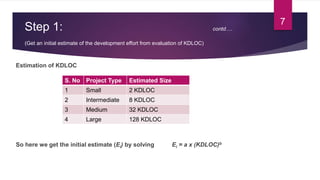
Estimation of KDLOC
So here we get the initial estimate (Ei) by solving Ei = a x (KDLOC)b
S. No Project Type Estimated Size
1 Small 2 KDLOC
2 Intermediate 8 KDLOC
3 Medium 32 KDLOC
4 Large 128 KDLOC
7
Step 2:
(Determine a set of 15 multiplying factors from various attributes of the project.)
8
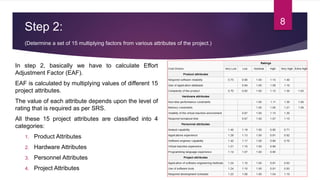
In step 2, basically we have to calculate Effort
Adjustment Factor (EAF).
EAF is calculated by multiplying values of different 15
project attributes.
The value of each attribute depends upon the level of
rating that is required as per SRS.
All these 15 project attributes are classified into 4
categories:
1. Product Attributes
2. Hardware Attributes
3. Personnel Attributes
4. Project Attributes
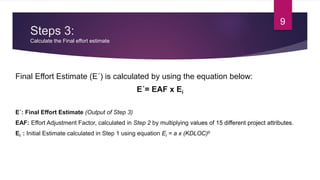
Steps 3:
Calculate the Final effort estimate
Final Effort Estimate (E´) is calculated by using the equation below:
E´= EAF x Ei
E´: Final Effort Estimate (Output of Step 3)
EAF: Effort Adjustment Factor, calculated in Step 2 by multiplying values of 15 different project attributes.
Ei : Initial Estimate calculated in Step 1 using equation Ei = a x (KDLOC)b
9

COCOMO.pptx

  • 1.
  • 2.
    Cost Estimation Cost estimationin software engineering is typically concerned with the financial spend on the efforts to develop and test the software, this can also include requirements review, maintenance, training, managing and buying extra equipment, servers and software. 2
  • 3.
    Uncertainties in CostEstimation 3 Cone of Uncertainty of Software Cost Estimation
  • 4.
    COCOMO- Introduction The constructivecost model was developed by Barry W. Boehm in the late 1970s and published in Boehm's 1981 book Software Engineering Economics as a model for estimating effort, cost, and schedule for software projects. It is also sometimes referred to as COCOMO 81. This model estimates total efforts in terms of person-month of technical project staff. The effort estimate includes development, management and support tasks. 4
  • 5.
    Steps in COCOMO 1.Get an initial estimate of the development effort from evaluation of thousands of delivered lines of source code (KDLOC). 2. Determine a set of 15 multiplying factors from various attributes of the project. 3. Calculate the effort estimate by multiplying the initial estimate with all the multiplying factors i.e., multiply the values in step1 and step 2. 5
  • 6.
    Step 1: (Get aninitial estimate of the development effort from evaluation of KDLOC) The formula/equation for deriving initial estimate of development effort is as: Ei = a x (KDLOC)b Ei : Efforts in person –month a & b: are variables, their values depend on the type of project. Project Types and corresponding values of ‘a’ & ‘b’ S. No System Description a b 1. Organic The organization has considerable experience and requirements are less stringent. 3.2 1.05 2. Semi-detached Such projects fall in between Organic and Embedded. 3.0 1.12 3. Embedded Ambitious & novel projects, the organization has very little or no experience. 2.8 1.20 6
  • 7.
    Step 1: contd…. (Getan initial estimate of the development effort from evaluation of KDLOC) Estimation of KDLOC So here we get the initial estimate (Ei) by solving Ei = a x (KDLOC)b S. No Project Type Estimated Size 1 Small 2 KDLOC 2 Intermediate 8 KDLOC 3 Medium 32 KDLOC 4 Large 128 KDLOC 7
  • 8.
    Step 2: (Determine aset of 15 multiplying factors from various attributes of the project.) 8 In step 2, basically we have to calculate Effort Adjustment Factor (EAF). EAF is calculated by multiplying values of different 15 project attributes. The value of each attribute depends upon the level of rating that is required as per SRS. All these 15 project attributes are classified into 4 categories: 1. Product Attributes 2. Hardware Attributes 3. Personnel Attributes 4. Project Attributes
  • 9.
    Steps 3: Calculate theFinal effort estimate Final Effort Estimate (E´) is calculated by using the equation below: E´= EAF x Ei E´: Final Effort Estimate (Output of Step 3) EAF: Effort Adjustment Factor, calculated in Step 2 by multiplying values of 15 different project attributes. Ei : Initial Estimate calculated in Step 1 using equation Ei = a x (KDLOC)b 9