COBIT
Syed munib ali (11b-023-bs)
Sajid karim (11b-027-bs)
USMAN INSTITUTE OF TECHNOLOGY
INTRODUCTION TO INFORMATION SYSTEM AUDIT
Instructor:Engr Abdul Rehman Mehmood
INTRODUCTION TO COBIT
 Introduced in 1996, Control Objectives for Information and Technology (CobiT) is
the single most revolutionary concept introduced by ISACA in recent years.
 COBIT, which stands for Control Objectives for Information and Related
Technology , was published by the Information Systems Audit and Control
Foundation in 1996 and updated in 1998 and 2000.
 COBIT is a comprehensive internal control framework specifically pertaining to
internal control issues associated with information technology (IT).
IT GOVERNANCE IS THE KEY ISSUE
Enterprises are sacrificing
money, productivity and
competitive advantage by not
implementing effective IT
governance
Executives need a better way to:
–Direct IT for optimal advantage
–Measure the value provided by IT
–Manage IT-related risks
PURPOSE
1. What is the purpose of COBIT?
The purpose of COBIT is to provide management and business
process owners with an information technology (IT)
governance model that helps in delivering value from IT and
understanding and managing the risks associated with
IT. COBIT helps bridge the gaps amongst business
requirements, control needs and technical issues. It is a control
model to meet the needs of IT governance and ensure the
integrity of information and information systems.
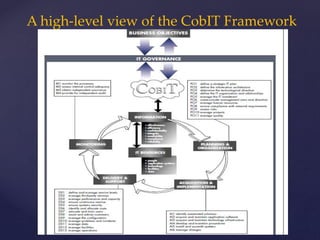
A high-level view of the CobIT Framework
COBIT BUSINESS BENEFITS
• More effective tools for IT to support business goals
• More transparent and predictable full life-cycle IT costs
• More timely and reliable information from IT
• Higher quality IT services and more successful projects
• More effective management of IT-related risks
RISK IT
Risk is a natural part of the business landscape.
If left unmanaged, the uncertainty can spread like weeds.
If managed effectively, losses can be avoided and benefits obtained.
While COBIT provides a set of controls to mitigate IT
risk, Risk IT provides a framework for enterprises to
identify, govern and manage IT risk. Simply put, COBIT
provides the means of risk management; Risk IT
provides the ends. Enterprises who have adopted (or are
planning to adopt) COBIT as their IT governance
framework can use Risk IT to enhance risk management.
GETTING STARTED
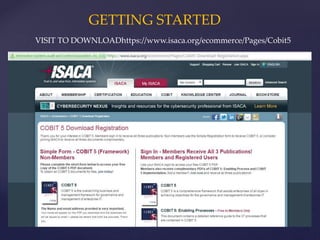
VISIT TO DOWNLOADhttps://www.isaca.org/ecommerce/Pages/Cobit5

Cobit

  • 1.
    COBIT Syed munib ali(11b-023-bs) Sajid karim (11b-027-bs) USMAN INSTITUTE OF TECHNOLOGY INTRODUCTION TO INFORMATION SYSTEM AUDIT Instructor:Engr Abdul Rehman Mehmood
  • 2.
    INTRODUCTION TO COBIT Introduced in 1996, Control Objectives for Information and Technology (CobiT) is the single most revolutionary concept introduced by ISACA in recent years.  COBIT, which stands for Control Objectives for Information and Related Technology , was published by the Information Systems Audit and Control Foundation in 1996 and updated in 1998 and 2000.  COBIT is a comprehensive internal control framework specifically pertaining to internal control issues associated with information technology (IT).
  • 3.
    IT GOVERNANCE ISTHE KEY ISSUE Enterprises are sacrificing money, productivity and competitive advantage by not implementing effective IT governance Executives need a better way to: –Direct IT for optimal advantage –Measure the value provided by IT –Manage IT-related risks
  • 4.
    PURPOSE 1. What isthe purpose of COBIT? The purpose of COBIT is to provide management and business process owners with an information technology (IT) governance model that helps in delivering value from IT and understanding and managing the risks associated with IT. COBIT helps bridge the gaps amongst business requirements, control needs and technical issues. It is a control model to meet the needs of IT governance and ensure the integrity of information and information systems.
  • 5.
    A high-level viewof the CobIT Framework
  • 6.
    COBIT BUSINESS BENEFITS •More effective tools for IT to support business goals • More transparent and predictable full life-cycle IT costs • More timely and reliable information from IT • Higher quality IT services and more successful projects • More effective management of IT-related risks
  • 7.
    RISK IT Risk isa natural part of the business landscape. If left unmanaged, the uncertainty can spread like weeds. If managed effectively, losses can be avoided and benefits obtained. While COBIT provides a set of controls to mitigate IT risk, Risk IT provides a framework for enterprises to identify, govern and manage IT risk. Simply put, COBIT provides the means of risk management; Risk IT provides the ends. Enterprises who have adopted (or are planning to adopt) COBIT as their IT governance framework can use Risk IT to enhance risk management.
  • 8.
    GETTING STARTED VISIT TODOWNLOADhttps://www.isaca.org/ecommerce/Pages/Cobit5