Coaching in the Corporate Landscape
Kim Morgan, Owner and Director of Barefoot Coaching Ltd
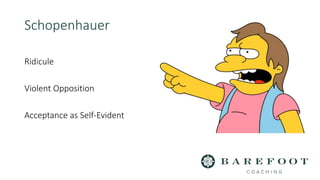
Schopenhauer
Ridicule
Violent Opposition
Acceptance as Self-Evident
Violent Opposition
Lack of clear definition
Lack of regulation
Coach confusion
No success measures
No fit with business objectives
Telephone number fees!
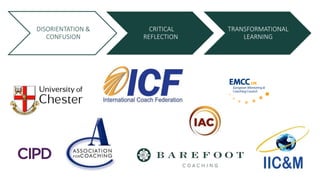
DISORIENTATION &
CONFUSION
CRITICAL
REFLECTION
TRANSFORMATIONAL
LEARNING
Nearly!
Coaching is certainly a maturing industry.
Acceptance as self-evident?
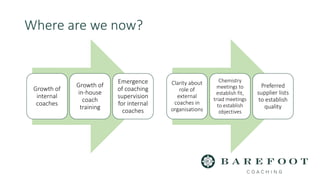
Growth of
internal
coaches
Growth of
in-house
coach
training
Emergence
of coaching
supervision
for internal
coaches
Clarity about
role of
external
coaches in
organisations
Chemistry
meetings to
establish fit,
triad meetings
to establish
objectives
Preferred
supplier lists
to establish
quality
Where are we now?
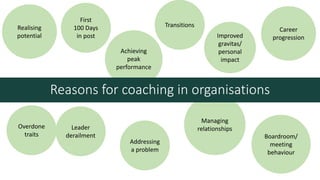
Leader
derailment
Transitions
Career
progression
First
100 Days
in post
Realising
potential
Achieving
peak
performance
Overdone
traits Boardroom/
meeting
behaviour
Managing
relationships
Addressing
a problem
Improved
gravitas/
personal
impact
Reasons for coaching in organisations
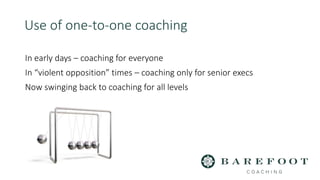
In early days – coaching for everyone
In “violent opposition” times – coaching only for senior execs
Now swinging back to coaching for all levels
Use of one-to-one coaching
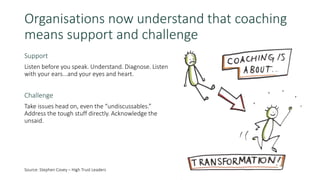
Support
Listen before you speak. Understand. Diagnose. Listen
with your ears...and your eyes and heart.
Challenge
Take issues head on, even the “undiscussables.”
Address the tough stuff directly. Acknowledge the
unsaid.
Source: Stephen Covey – High Trust Leaders
Organisations now understand that coaching
means support and challenge
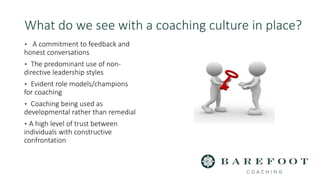
What do we see with a coaching culture in place?
▪ A commitment to feedback and
honest conversations
▪ The predominant use of non-
directive leadership styles
▪ Evident role models/champions
for coaching
▪ Coaching being used as
developmental rather than remedial
▪ A high level of trust between
individuals with constructive
confrontation
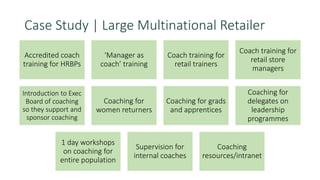
Coach training for
retail store
managers
Coach training for
retail trainers
‘Manager as
coach’ training
Accredited coach
training for HRBPs
Coaching for
delegates on
leadership
programmes
Coaching for grads
and apprentices
Coaching for
women returners
Introduction to Exec
Board of coaching
so they support and
sponsor coaching
Coaching
resources/intranet
Supervision for
internal coaches
1 day workshops
on coaching for
entire population
Case Study | Large Multinational Retailer
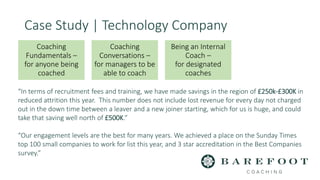
Case Study | Technology Company
“In terms of recruitment fees and training, we have made savings in the region of £250k-£300K in
reduced attrition this year. This number does not include lost revenue for every day not charged
out in the down time between a leaver and a new joiner starting, which for us is huge, and could
take that saving well north of £500K.”
“Our engagement levels are the best for many years. We achieved a place on the Sunday Times
top 100 small companies to work for list this year, and 3 star accreditation in the Best Companies
survey.”
Coaching
Fundamentals –
for anyone being
coached
Coaching
Conversations –
for managers to be
able to coach
Being an Internal
Coach –
for designated
coaches
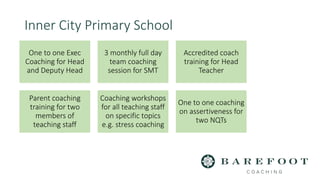
Inner City Primary School
One to one Exec
Coaching for Head
and Deputy Head
3 monthly full day
team coaching
session for SMT
Accredited coach
training for Head
Teacher
Parent coaching
training for two
members of
teaching staff
Coaching workshops
for all teaching staff
on specific topics
e.g. stress coaching
One to one coaching
on assertiveness for
two NQTs
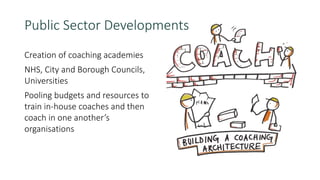
Creation of coaching academies
NHS, City and Borough Councils,
Universities
Pooling budgets and resources to
train in-house coaches and then
coach in one another’s
organisations
Public Sector Developments
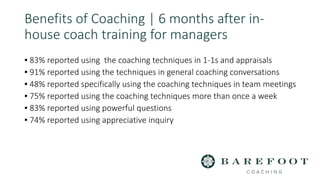
Benefits of Coaching | 6 months after in-
house coach training for managers
▪ 83% reported using the coaching techniques in 1-1s and appraisals
▪ 91% reported using the techniques in general coaching conversations
▪ 48% reported specifically using the coaching techniques in team meetings
▪ 75% reported using the coaching techniques more than once a week
▪ 83% reported using powerful questions
▪ 74% reported using appreciative inquiry
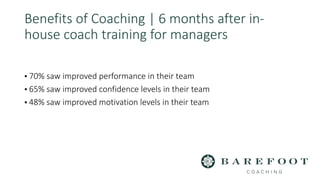
Benefits of Coaching | 6 months after in-
house coach training for managers
▪ 70% saw improved performance in their team
▪ 65% saw improved confidence levels in their team
▪ 48% saw improved motivation levels in their team
“Coaching produced a 529% return on investment and significant
intangible benefits to the business. Including the financial benefits from
employee retention, coaching boosted the overall ROI to 788%. The
study provided powerful new insights into how to maximize the business
impact from executive coaching.”
Return on Investment | The “Holy Grail” of
Coaching in Organisations
Merrill Anderson
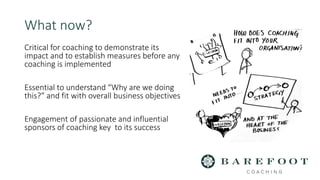
Critical for coaching to demonstrate its
impact and to establish measures before any
coaching is implemented
Essential to understand “Why are we doing
this?” and fit with overall business objectives
Engagement of passionate and influential
sponsors of coaching key to its success
What now?
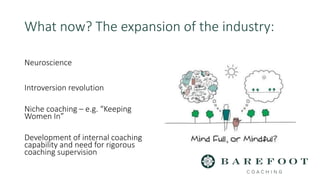
What now? The expansion of the industry:
Neuroscience
Introversion revolution
Niche coaching – e.g. “Keeping
Women In”
Development of internal coaching
capability and need for rigorous
coaching supervision
“The art of progress is to preserve order
amid change and change amid order.”
Alfred North Whitehead
Kim Morgan
Director of Barefoot Coaching Ltd
@BarefootCoaches
www.barefootcoaching.co.uk Available now on Amazon

Coaching in the corporate landscape

  • 1.
    Coaching in theCorporate Landscape Kim Morgan, Owner and Director of Barefoot Coaching Ltd
  • 2.
  • 3.
    Violent Opposition Lack ofclear definition Lack of regulation Coach confusion No success measures No fit with business objectives Telephone number fees!
  • 4.
  • 5.
    Nearly! Coaching is certainlya maturing industry. Acceptance as self-evident?
  • 6.
    Growth of internal coaches Growth of in-house coach training Emergence ofcoaching supervision for internal coaches Clarity about role of external coaches in organisations Chemistry meetings to establish fit, triad meetings to establish objectives Preferred supplier lists to establish quality Where are we now?
  • 7.
    Leader derailment Transitions Career progression First 100 Days in post Realising potential Achieving peak performance Overdone traitsBoardroom/ meeting behaviour Managing relationships Addressing a problem Improved gravitas/ personal impact Reasons for coaching in organisations
  • 8.
    In early days– coaching for everyone In “violent opposition” times – coaching only for senior execs Now swinging back to coaching for all levels Use of one-to-one coaching
  • 9.
    Support Listen before youspeak. Understand. Diagnose. Listen with your ears...and your eyes and heart. Challenge Take issues head on, even the “undiscussables.” Address the tough stuff directly. Acknowledge the unsaid. Source: Stephen Covey – High Trust Leaders Organisations now understand that coaching means support and challenge
  • 10.
    What do wesee with a coaching culture in place? ▪ A commitment to feedback and honest conversations ▪ The predominant use of non- directive leadership styles ▪ Evident role models/champions for coaching ▪ Coaching being used as developmental rather than remedial ▪ A high level of trust between individuals with constructive confrontation
  • 11.
    Coach training for retailstore managers Coach training for retail trainers ‘Manager as coach’ training Accredited coach training for HRBPs Coaching for delegates on leadership programmes Coaching for grads and apprentices Coaching for women returners Introduction to Exec Board of coaching so they support and sponsor coaching Coaching resources/intranet Supervision for internal coaches 1 day workshops on coaching for entire population Case Study | Large Multinational Retailer
  • 12.
    Case Study |Technology Company “In terms of recruitment fees and training, we have made savings in the region of £250k-£300K in reduced attrition this year. This number does not include lost revenue for every day not charged out in the down time between a leaver and a new joiner starting, which for us is huge, and could take that saving well north of £500K.” “Our engagement levels are the best for many years. We achieved a place on the Sunday Times top 100 small companies to work for list this year, and 3 star accreditation in the Best Companies survey.” Coaching Fundamentals – for anyone being coached Coaching Conversations – for managers to be able to coach Being an Internal Coach – for designated coaches
  • 13.
    Inner City PrimarySchool One to one Exec Coaching for Head and Deputy Head 3 monthly full day team coaching session for SMT Accredited coach training for Head Teacher Parent coaching training for two members of teaching staff Coaching workshops for all teaching staff on specific topics e.g. stress coaching One to one coaching on assertiveness for two NQTs
  • 14.
    Creation of coachingacademies NHS, City and Borough Councils, Universities Pooling budgets and resources to train in-house coaches and then coach in one another’s organisations Public Sector Developments
  • 15.
    Benefits of Coaching| 6 months after in- house coach training for managers ▪ 83% reported using the coaching techniques in 1-1s and appraisals ▪ 91% reported using the techniques in general coaching conversations ▪ 48% reported specifically using the coaching techniques in team meetings ▪ 75% reported using the coaching techniques more than once a week ▪ 83% reported using powerful questions ▪ 74% reported using appreciative inquiry
  • 16.
    Benefits of Coaching| 6 months after in- house coach training for managers ▪ 70% saw improved performance in their team ▪ 65% saw improved confidence levels in their team ▪ 48% saw improved motivation levels in their team
  • 17.
    “Coaching produced a529% return on investment and significant intangible benefits to the business. Including the financial benefits from employee retention, coaching boosted the overall ROI to 788%. The study provided powerful new insights into how to maximize the business impact from executive coaching.” Return on Investment | The “Holy Grail” of Coaching in Organisations Merrill Anderson
  • 18.
    Critical for coachingto demonstrate its impact and to establish measures before any coaching is implemented Essential to understand “Why are we doing this?” and fit with overall business objectives Engagement of passionate and influential sponsors of coaching key to its success What now?
  • 19.
    What now? Theexpansion of the industry: Neuroscience Introversion revolution Niche coaching – e.g. “Keeping Women In” Development of internal coaching capability and need for rigorous coaching supervision
  • 20.
    “The art ofprogress is to preserve order amid change and change amid order.” Alfred North Whitehead
  • 21.
    Kim Morgan Director ofBarefoot Coaching Ltd @BarefootCoaches www.barefootcoaching.co.uk Available now on Amazon

Editor's Notes

  • #13 ATTRITION Feb 2014: - 23% Feb 2015 – 15%