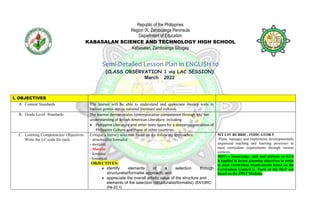
Republic of the Philippines
Region IX, Zamboanga Peninsula
Department of Education
KABASALAN SCIENCE AND TECHNOLOGY HIGH SCHOOL
Kabasalan, Zamboanga Sibugay
Semi-Detailed Lesson Plan in ENGLISH 10
(CLASS OBSERVATION 1 via LAC SESSION)
March 2022
I. OBJECTIVES
A. Content Standards The learner will be able to understand and appreciate literary texts in
various genres across national literature and cultures.
B. Grade Level Standards The learner demonstrates communicative competence through his/ her
understanding of British-American Literature, including
 Philippine Literature and other texts types for a deeper appreciation of
Philippine Culture and those of other countries.
C. Learning Competencies/ Objectives
Write the LC code for each.
Critique a literary selection based on the following approaches:
- structuralist/formalist
- moralist
- Marxist
- feminist
- historical
OBJECTIVES:
 identify elements of a selection through
structuralist/formalist approach; and
 appreciate the overall artistic value of the structure and
elements of the selection (structuralist/formalist) (EN10RC-
IIIa-22.1)
MT I-IV RUBRIC, INDICATOR 5
-Plans, manages and implements developmentally
sequenced teaching and learning processes to
meet curriculum requirements through various
contexts.
MOV--- Knowledge, skill and attitude or KSA
is applied in lesson planning objectives in order
to meet curriculum requirements based on the
Curriculum Guide/CG. Parts of the DLP are
based on the PPST Modules
II. CONTENT/TOPIC Literary genres, traditions and forms from different national literature and
cultures, namely, Asian, Anglo-American, European, Latin American, and
African
 The Necklace by Guy de Maupassant
II. LEARNING RESOURCES
A. References
1. Teacher’s Guide pages
2. Learner’s Materials pages
3. Textbook pages
4. Additional Materials from Learning
Resource
B. Other Learning Resources Activity sheets, flash cards, pictures, smart TV, laptop, power point
presentation
http://www.supersummary.com
https://www.google.com/imghp?hl=en
https://www.edutopia.org/blog/22-
IV. PROCEDURES
A. Reviewing previous lesson or
presenting the new lesson
 Preliminary Activities (Daily Routine)
Prayer
Greetings
Attendance Checking through CHART
Setting of the Classroom (Observe health protocol)
 Present “Good Morning” greetings from different foreign
languages and Filipino Dialect
MT I-IV RUBRIC, INDICATOR 1
-Applies knowledge of content within and
across curriculum teaching areas.
MOV-A quick discussion of foreign
language and Filipino Dialect is integrated
in this part
MELC: Natutukoy ang mga kahulugan at
kabuluhan ng mga konseptong pangwika
(F11PT-1a-85)
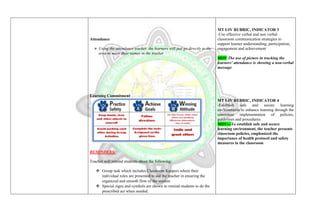
Attendance
 Using the attendance tracker, the learners will just go directly to the
area to move their names in the tracker
Learning Commitment
REMINDERS:
Teacher will remind students about the following:
 Group task which includes Classroom Keepers where their
individual roles are presented to aid the teacher in ensuring the
organized and smooth flow of the session
 Special signs and symbols are shown to remind students to do the
prescribed act when needed.
MT I-IV RUBRIC, INDICATOR 3
-Use effective verbal and non verbal
classroom communication strategies to
support learner understanding, participation,
engagement and achievement
MOV The use of picture in tracking the
learners' attendance is showing a non-verbal
message
MT I-IV RUBRIC, INDICATOR 4
-Establish safe and secure learning
environments to enhance learning through the
consistent implementation of policies,
guidelines and procedures.
MOV---To establish safe and secure
learning environment, the teacher presents
classroom policies, emphasized the
importance of health protocol and safety
measures in the classroom
 Proper arrangement of seats and tables in ensuring the comfort and
safety of students.
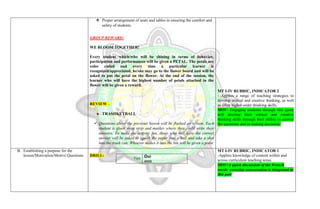
GROUP REWARD:
WE BLOOM TOGETHER!
Every student which/who will be shining in terms of behavior,
participation and performances will be given a PETAL. The petals are
color coded and every time a particular learner is
recognized/appreciated, he/she may go to the flower board and will be
asked to put the petal on the flower. At the end of the session, the
learner who will have the highest number of petals attached in the
flower will be given a reward.
REVIEW –
TRASHKETBALL
 Questions about the previous lesson will be flashed on screen. Each
student is given meta strip and marker where they could write their
answers. To make the activity fun, those who will have the correct
answer will be asked to squish the paper into a ball and take a shot
into the trash can. Whoever makes it into the bin will be given a point
MT I-IV RUBRIC, INDICATOR 2
- Applies a range of teaching strategies to
develop critical and creative thinking, as well
as other higher-order thinking skills.
MOV- Engaging students through this game
will develop their critical and creative
thinking skills through their ability to answer
the questions and in making decisions.
B. Establishing a purpose for the
lesson/Motivation/Motive Questions DRILL:
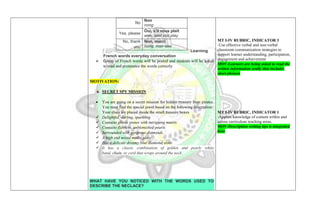
Yes Oui
wee
MT I-IV RUBRIC, INDICATOR 1
-Applies knowledge of content within and
across curriculum teaching areas.
MOV-A quick discussion of the French
words everyday conversation is integrated in
this part
No
Non
nong
Yes, please
Oui, s'il vous plait
wee, seel voo play
No, thank
you
Non, merci
nong, mair-see
Learning
French words everyday conversation
 Group of French words will be posted and students will be asked
to read and pronounce the words correctly
MOTIVATION:
SECRET SPY MISSION
 You are going on a secret mission for hidden treasure from pirates.
You must find the special jewel based on the following description:
Your clues are placed inside the small treasure boxes
 Delightful, darling, sparkling
 Contains glossy stones with intriguing matrix
 Contains flawless, unblemished pearls
 Surrounded with gorgeous diamonds
 A high end mixed media piece
 Has a delicate dreamy blue diamond stone
 It has a classic combination of golden and pearly white
band, chain, or cord that wraps around the neck
WHAT HAVE YOU NOTICED WITH THE WORDS USED TO
DESCRIBE THE NECLACE?
MT I-IV RUBRIC, INDICATOR 3
-Use effective verbal and non-verbal
classroom communication strategies to
support learner understanding, participation,
engagement and achievement
MOV-Learners are being asked to read the
written information orally that includes
short phrases
MT I-IV RUBRIC, INDICATOR 1
-Applies knowledge of content within and
across curriculum teaching areas.
MOV-Description writing tips is integrated
here
Instead of using simple descriptive words, the use of connotative
language is evident. These words cause the reader to feel emotion.
The emotional sense of a certain customer in when buying jewelry
attaches to a piece is what makes him or her buy the product
C. Presenting examples/instances of the
new lesson Pre-Reading:
CRYSTAL BALL PREDICTION
Based on the activities that we have just done, what do you
think is the TITLE of the Story that we will reading today?
Teacher will be flashing the following questions:
 For you, what does a necklace symbolize?
 What is the connection of a necklace in our diverse culture?
 For the Subanen and Tausog Tribe, how significant are the jewelry
or accessories to you?
Discussion on the jewellery’s purposes and symbolic meaning from
culture to culture
MT I-IV RUBRIC, INDICATOR 7
-Adapt and use culturally appropriate teaching
strategies to address the needs of learners
from indigenous groups.
MOV-The identified learners who belong to
the indigenous group are given opportunity
to express themselves orally regarding their
own tribe.
MT I-IV RUBRIC, INDICATOR 1
-Applies knowledge of content within and
across curriculum teaching areas.
MOV-The concept on contemporary arts and
fashion is being integrated here
A necklace is an article of jewelry that is worn around the neck.
Necklaces may have been one of the earliest types of adornment worn
by humans.[1]
They often serve ceremonial, religious, magical,
or funerary purposes and are also used as symbols of wealth and
status, given that they are commonly made of precious metals and
stones.
source: WIKIPEDIA
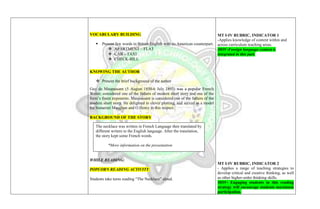
VOCABULARY BUILDING
 Present few words in British English with its American counterpart.
 APARTMENT – FLAT
 CAB – TAXI
 CHECK-BILL
KNOWING THE AUTHOR
 Present the brief background of the author
Guy de Maupassant (5 August 1850-6 July 1893) was a popular French
Writer, considered one of the fathers of modern short story and one of the
form’s finest exponents. Maupassant is considered one of the fathers of the
modern short story. He delighted in clever plotting, and served as a model
for Somerset Maughan and O.Henry in this respect.
BACKGROUND OF THE STORY
WHILE READING:
POPCORN READING ACTIVITY:
Students take turns reading “The Necklace” aloud.
MT I-IV RUBRIC, INDICATOR 1
-Applies knowledge of content within and
across curriculum teaching areas.
MOV-Foreign language context is
integrated in this part.
MT I-IV RUBRIC, INDICATOR 2
- Applies a range of teaching strategies to
develop critical and creative thinking, as well
as other higher-order thinking skills.
MOV- Engaging students in this reading
strategy will encourage students maximum
participation.
The necklace was written in French Language then translated by
different writers to the English language. After the translation,
the story kept some French words.
*More information on the presentation
D. Discussing new concepts and
practicing new skills #1
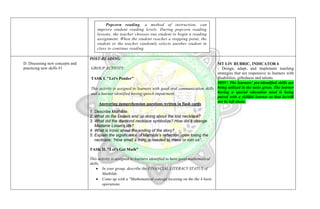
POST-READING:
GROUP ACTIVITY:
TASK I. "Let's Ponder"
This activity is assigned to learners with good oral communication skills
and a learner identified having speech impairment.
Answering comprehension questions written in flash cards
1. Describe Mathilde.
2. What do the Loisels end up doing about the lost necklace?
3. What did the diamond necklace symbolize? How did it change
Madame Loisel’s life?
4. What is ironic about the ending of the story?
5. Explain the significance of Mathilde’s reflection upon losing the
necklace: “How small a thing is needed to make or ruin us”.
TASK II. "Let's Get Math"
This activity is assigned to learners identified to have good mathematical
skills.
 In your group, describe the FINANCIAL LITERACY STATUS of
Mathilde.
 Come up with a "Mathematical concept focusing on the the 4 basic
operations.
MT I-IV RUBRIC, INDICATOR 6
- Design, adapt, and implement teaching
strategies that are responsive to learners with
disabilities, giftedness and talents.
MOV- The learners' pre-identified skills are
being utilized in the tasks given. The learner
having a special education need is being
paired with a skillful learner so that he/will
not be left alone.
Popcorn reading, a method of instruction, can
improve student reading levels. During popcorn reading
lessons, the teacher chooses one student to begin a reading
assignment. When the student reaches a stopping point, the
student or the teacher randomly selects another student in
class to continue reading.
D. Discussing new concepts and
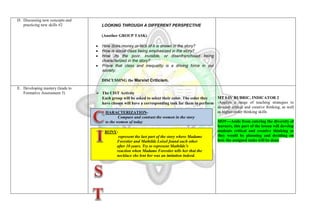
practicing new skills #2 LOOKING THROUGH A DIFFERENT PERSPECTIVE
(Another GROUP TASK)
 How does money or lack of it is shown in the story?
 How is social class being emphasized in the story?
 How do the poor, invisible, or disenfranchised being
characterized in the story?
 Prove that class and inequality is a driving force in our
society.
DISCUSSING the Marxist Criticism.
E. Developing mastery (leads to
Formative Assessment 3)  The CIST Activity
Each group will be asked to select their color. The color they
have chosen will have a corresponding task for them to perform
MT I-IV RUBRIC, INDICATOR 2
-Applies a range of teaching strategies to
develop critical and creative thinking, as well
as higher-order thinking skills
MOV---Aside from catering the diversity of
learners, this part of the lesson will develop
students critical and creative thinking as
they would be planning and deciding on
how the assigned tasks will be done
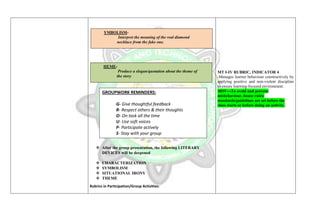
HARACTERIZATION-
Compare and contrast the women in the story
to the women of today
RONY-
represent the last part of the story where Madame
Forestier and Mathilde Loisel found each other
after 10 years. Try to represent Mathilde’s
reaction when Madame Forestier tells her that the
necklace she lent her was an imitation indeed.
 After the group presentation, the following LITERARY
DEVICES will be deepened
 CHARACTERIZATION
 SYMBOLISM
 SITUATIONAL IRONY
 THEME
Rubrics in Participation/Group Activities:
MT I-IV RUBRIC, INDICATOR 4
-Manages learner behaviour constructively by
applying positive and non-violent discipline
to ensure learning-focused environment.
MOV---To avoid and prevent
misbehaviour, house rules/
standards/guidelines are set before the
class starts or before doing an activity.
GROUPWORK REMINDERS:
G- Give thoughtful feedback
R- Respect others & their thoughts
O- On task all the time
U- Use soft voices
P- Participate actively
S- Stay with your group
YMBOLISM-
Interpret the meaning of the real diamond
necklace from the fake one.
HEME-
Produce a slogan/quotation about the theme of
the story
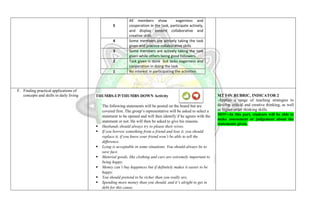
5
All members show eagerness and
cooperation in the task, participate actively,
and display evident collaborative and
creative skills
4 Some members are actively taking the task
given and practice collaborative skills
3 Some members are actively taking the task
given while others being good followers
2 Task given is done but lacks eagerness and
cooperation in doing the task
1 No interest in participating the activities
F. Finding practical applications of
concepts and skills in daily living THUMBS-UP/THUMBS DOWN Activity
The following statements will be posted on the board but are
covered first. The group’s representative will be asked to select a
statement to be opened and will then identify if he agrees with the
statement or not. He will then be asked to give his reasons.
 Husbands should always try to please their wives.
 If you borrow something from a friend and lose it, you should
replace it, if you know your friend won’t be able to tell the
difference.
 Lying is acceptable in some situations. You should always lie to
save face.
 Material goods, like clothing and cars are extremely important to
being happy.
 Money can’t buy happiness but if definitely makes it easier to be
happy.
 You should pretend to be richer than you really are,
 Spending more money than you should, and it’s alright to get in
debt for this cause.
MT I-IV RUBRIC, INDICATOR 2
-Applies a range of teaching strategies to
develop critical and creative thinking, as well
as higher-order thinking skills.
MOV--In this part, students will be able to
make assessment or judgement about the
statements given.
 Some people deserve to be at the bottom of society.
 Women have the same opportunities today as they did in the past.
G. Making generalizations and
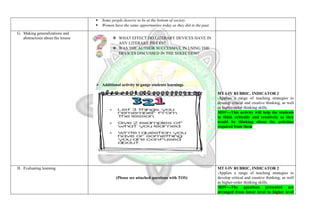
abstractions about the lesson  WHAT EFFECT DO LITERARY DEVICES HAVE IN
ANY LITERARY PIECES?
 WAS THE AUTHOR SUCCESSFUL IN USING THE
DEVICES DISCUSSED IN THE SEKECTION?
 Additional activity to gauge students learnings
MT I-IV RUBRIC, INDICATOR 2
-Applies a range of teaching strategies to
develop critical and creative thinking, as well
as higher-order thinking skills.
MOV---This activity will help the students
to think critically and creatively as they
would be thinking about the activities
required from them
H. Evaluating learning
(Please see attached questions with TOS)
MT I-IV RUBRIC, INDICATOR 2
-Applies a range of teaching strategies to
develop critical and creative thinking, as well
as higher-order thinking skills.
MOV---The questions presented are
arranged from lower level to higher level
thinking skills. Students are challenged to
think critically.
I. Additional activities for application
or remediation
WRITING LITERARY ANALYSIS
Assess the effectiveness of the literary piece that you have just read
following the format:
 Introduction
 Summary
 Analysis
 Conclusion
MT I-IV RUBRIC, INDICATOR 2
-Applies a range of teaching strategies to
develop critical and creative thinking, as well
as higher-order thinking skills.
MOV---This activity will help the students
to think critically and creatively as they
would be analyzing the text deeply.
V. REMARKS
VI. REFLECTION
A. No. of learners who earned 80% in the
evaluation
B. No. of learners who require additional
activities for remediation
C. Did the remedial lessons work? No. of
learners who have caught up with the
lesson
D. No. of learners who continue to require
remediation
E. Which of my teaching strategies worked
well? Why did these work?
F. What difficulties did I encounter which
my principal or supervisor can help me
solve?
G. What innovation or localized materials
did I use/discover which I wish to share
with other teachers?
JENNIFER J. SIMYUNN
Master Teacher 1
PEER OBSERVERS:
1. ________________________________________
2. ________________________________________
3. ________________________________________
4. ________________________________________
5. ________________________________________
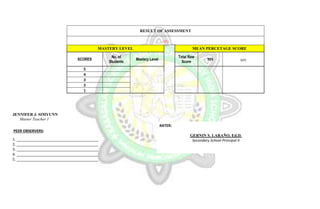
RESULT OF ASSESSMENT
CO 2
MASTERY LEVEL MEAN PERCETAGE SCORE
SCORES
No. of
Students
Mastery Level
Total Raw
Score
MS MPS
5
4
3
2
1
RATER:
GERNIN S. LARAÑO, Ed.D.
Secondary School Principal II

CO1 March 2022 FINAL.docx

  • 1.
    Republic of thePhilippines Region IX, Zamboanga Peninsula Department of Education KABASALAN SCIENCE AND TECHNOLOGY HIGH SCHOOL Kabasalan, Zamboanga Sibugay Semi-Detailed Lesson Plan in ENGLISH 10 (CLASS OBSERVATION 1 via LAC SESSION) March 2022 I. OBJECTIVES A. Content Standards The learner will be able to understand and appreciate literary texts in various genres across national literature and cultures. B. Grade Level Standards The learner demonstrates communicative competence through his/ her understanding of British-American Literature, including  Philippine Literature and other texts types for a deeper appreciation of Philippine Culture and those of other countries. C. Learning Competencies/ Objectives Write the LC code for each. Critique a literary selection based on the following approaches: - structuralist/formalist - moralist - Marxist - feminist - historical OBJECTIVES:  identify elements of a selection through structuralist/formalist approach; and  appreciate the overall artistic value of the structure and elements of the selection (structuralist/formalist) (EN10RC- IIIa-22.1) MT I-IV RUBRIC, INDICATOR 5 -Plans, manages and implements developmentally sequenced teaching and learning processes to meet curriculum requirements through various contexts. MOV--- Knowledge, skill and attitude or KSA is applied in lesson planning objectives in order to meet curriculum requirements based on the Curriculum Guide/CG. Parts of the DLP are based on the PPST Modules
  • 2.
    II. CONTENT/TOPIC Literarygenres, traditions and forms from different national literature and cultures, namely, Asian, Anglo-American, European, Latin American, and African  The Necklace by Guy de Maupassant II. LEARNING RESOURCES A. References 1. Teacher’s Guide pages 2. Learner’s Materials pages 3. Textbook pages 4. Additional Materials from Learning Resource B. Other Learning Resources Activity sheets, flash cards, pictures, smart TV, laptop, power point presentation http://www.supersummary.com https://www.google.com/imghp?hl=en https://www.edutopia.org/blog/22- IV. PROCEDURES A. Reviewing previous lesson or presenting the new lesson  Preliminary Activities (Daily Routine) Prayer Greetings Attendance Checking through CHART Setting of the Classroom (Observe health protocol)  Present “Good Morning” greetings from different foreign languages and Filipino Dialect MT I-IV RUBRIC, INDICATOR 1 -Applies knowledge of content within and across curriculum teaching areas. MOV-A quick discussion of foreign language and Filipino Dialect is integrated in this part MELC: Natutukoy ang mga kahulugan at kabuluhan ng mga konseptong pangwika (F11PT-1a-85)
  • 3.
    Attendance  Using theattendance tracker, the learners will just go directly to the area to move their names in the tracker Learning Commitment REMINDERS: Teacher will remind students about the following:  Group task which includes Classroom Keepers where their individual roles are presented to aid the teacher in ensuring the organized and smooth flow of the session  Special signs and symbols are shown to remind students to do the prescribed act when needed. MT I-IV RUBRIC, INDICATOR 3 -Use effective verbal and non verbal classroom communication strategies to support learner understanding, participation, engagement and achievement MOV The use of picture in tracking the learners' attendance is showing a non-verbal message MT I-IV RUBRIC, INDICATOR 4 -Establish safe and secure learning environments to enhance learning through the consistent implementation of policies, guidelines and procedures. MOV---To establish safe and secure learning environment, the teacher presents classroom policies, emphasized the importance of health protocol and safety measures in the classroom
  • 4.
     Proper arrangementof seats and tables in ensuring the comfort and safety of students. GROUP REWARD: WE BLOOM TOGETHER! Every student which/who will be shining in terms of behavior, participation and performances will be given a PETAL. The petals are color coded and every time a particular learner is recognized/appreciated, he/she may go to the flower board and will be asked to put the petal on the flower. At the end of the session, the learner who will have the highest number of petals attached in the flower will be given a reward. REVIEW – TRASHKETBALL  Questions about the previous lesson will be flashed on screen. Each student is given meta strip and marker where they could write their answers. To make the activity fun, those who will have the correct answer will be asked to squish the paper into a ball and take a shot into the trash can. Whoever makes it into the bin will be given a point MT I-IV RUBRIC, INDICATOR 2 - Applies a range of teaching strategies to develop critical and creative thinking, as well as other higher-order thinking skills. MOV- Engaging students through this game will develop their critical and creative thinking skills through their ability to answer the questions and in making decisions. B. Establishing a purpose for the lesson/Motivation/Motive Questions DRILL: Yes Oui wee MT I-IV RUBRIC, INDICATOR 1 -Applies knowledge of content within and across curriculum teaching areas. MOV-A quick discussion of the French words everyday conversation is integrated in this part
  • 5.
    No Non nong Yes, please Oui, s'ilvous plait wee, seel voo play No, thank you Non, merci nong, mair-see Learning French words everyday conversation  Group of French words will be posted and students will be asked to read and pronounce the words correctly MOTIVATION: SECRET SPY MISSION  You are going on a secret mission for hidden treasure from pirates. You must find the special jewel based on the following description: Your clues are placed inside the small treasure boxes  Delightful, darling, sparkling  Contains glossy stones with intriguing matrix  Contains flawless, unblemished pearls  Surrounded with gorgeous diamonds  A high end mixed media piece  Has a delicate dreamy blue diamond stone  It has a classic combination of golden and pearly white band, chain, or cord that wraps around the neck WHAT HAVE YOU NOTICED WITH THE WORDS USED TO DESCRIBE THE NECLACE? MT I-IV RUBRIC, INDICATOR 3 -Use effective verbal and non-verbal classroom communication strategies to support learner understanding, participation, engagement and achievement MOV-Learners are being asked to read the written information orally that includes short phrases MT I-IV RUBRIC, INDICATOR 1 -Applies knowledge of content within and across curriculum teaching areas. MOV-Description writing tips is integrated here
  • 6.
    Instead of usingsimple descriptive words, the use of connotative language is evident. These words cause the reader to feel emotion. The emotional sense of a certain customer in when buying jewelry attaches to a piece is what makes him or her buy the product C. Presenting examples/instances of the new lesson Pre-Reading: CRYSTAL BALL PREDICTION Based on the activities that we have just done, what do you think is the TITLE of the Story that we will reading today? Teacher will be flashing the following questions:  For you, what does a necklace symbolize?  What is the connection of a necklace in our diverse culture?  For the Subanen and Tausog Tribe, how significant are the jewelry or accessories to you? Discussion on the jewellery’s purposes and symbolic meaning from culture to culture MT I-IV RUBRIC, INDICATOR 7 -Adapt and use culturally appropriate teaching strategies to address the needs of learners from indigenous groups. MOV-The identified learners who belong to the indigenous group are given opportunity to express themselves orally regarding their own tribe. MT I-IV RUBRIC, INDICATOR 1 -Applies knowledge of content within and across curriculum teaching areas. MOV-The concept on contemporary arts and fashion is being integrated here A necklace is an article of jewelry that is worn around the neck. Necklaces may have been one of the earliest types of adornment worn by humans.[1] They often serve ceremonial, religious, magical, or funerary purposes and are also used as symbols of wealth and status, given that they are commonly made of precious metals and stones. source: WIKIPEDIA
  • 7.
    VOCABULARY BUILDING  Presentfew words in British English with its American counterpart.  APARTMENT – FLAT  CAB – TAXI  CHECK-BILL KNOWING THE AUTHOR  Present the brief background of the author Guy de Maupassant (5 August 1850-6 July 1893) was a popular French Writer, considered one of the fathers of modern short story and one of the form’s finest exponents. Maupassant is considered one of the fathers of the modern short story. He delighted in clever plotting, and served as a model for Somerset Maughan and O.Henry in this respect. BACKGROUND OF THE STORY WHILE READING: POPCORN READING ACTIVITY: Students take turns reading “The Necklace” aloud. MT I-IV RUBRIC, INDICATOR 1 -Applies knowledge of content within and across curriculum teaching areas. MOV-Foreign language context is integrated in this part. MT I-IV RUBRIC, INDICATOR 2 - Applies a range of teaching strategies to develop critical and creative thinking, as well as other higher-order thinking skills. MOV- Engaging students in this reading strategy will encourage students maximum participation. The necklace was written in French Language then translated by different writers to the English language. After the translation, the story kept some French words. *More information on the presentation
  • 8.
    D. Discussing newconcepts and practicing new skills #1 POST-READING: GROUP ACTIVITY: TASK I. "Let's Ponder" This activity is assigned to learners with good oral communication skills and a learner identified having speech impairment. Answering comprehension questions written in flash cards 1. Describe Mathilde. 2. What do the Loisels end up doing about the lost necklace? 3. What did the diamond necklace symbolize? How did it change Madame Loisel’s life? 4. What is ironic about the ending of the story? 5. Explain the significance of Mathilde’s reflection upon losing the necklace: “How small a thing is needed to make or ruin us”. TASK II. "Let's Get Math" This activity is assigned to learners identified to have good mathematical skills.  In your group, describe the FINANCIAL LITERACY STATUS of Mathilde.  Come up with a "Mathematical concept focusing on the the 4 basic operations. MT I-IV RUBRIC, INDICATOR 6 - Design, adapt, and implement teaching strategies that are responsive to learners with disabilities, giftedness and talents. MOV- The learners' pre-identified skills are being utilized in the tasks given. The learner having a special education need is being paired with a skillful learner so that he/will not be left alone. Popcorn reading, a method of instruction, can improve student reading levels. During popcorn reading lessons, the teacher chooses one student to begin a reading assignment. When the student reaches a stopping point, the student or the teacher randomly selects another student in class to continue reading.
  • 9.
    D. Discussing newconcepts and practicing new skills #2 LOOKING THROUGH A DIFFERENT PERSPECTIVE (Another GROUP TASK)  How does money or lack of it is shown in the story?  How is social class being emphasized in the story?  How do the poor, invisible, or disenfranchised being characterized in the story?  Prove that class and inequality is a driving force in our society. DISCUSSING the Marxist Criticism. E. Developing mastery (leads to Formative Assessment 3)  The CIST Activity Each group will be asked to select their color. The color they have chosen will have a corresponding task for them to perform MT I-IV RUBRIC, INDICATOR 2 -Applies a range of teaching strategies to develop critical and creative thinking, as well as higher-order thinking skills MOV---Aside from catering the diversity of learners, this part of the lesson will develop students critical and creative thinking as they would be planning and deciding on how the assigned tasks will be done HARACTERIZATION- Compare and contrast the women in the story to the women of today RONY- represent the last part of the story where Madame Forestier and Mathilde Loisel found each other after 10 years. Try to represent Mathilde’s reaction when Madame Forestier tells her that the necklace she lent her was an imitation indeed.
  • 10.
     After thegroup presentation, the following LITERARY DEVICES will be deepened  CHARACTERIZATION  SYMBOLISM  SITUATIONAL IRONY  THEME Rubrics in Participation/Group Activities: MT I-IV RUBRIC, INDICATOR 4 -Manages learner behaviour constructively by applying positive and non-violent discipline to ensure learning-focused environment. MOV---To avoid and prevent misbehaviour, house rules/ standards/guidelines are set before the class starts or before doing an activity. GROUPWORK REMINDERS: G- Give thoughtful feedback R- Respect others & their thoughts O- On task all the time U- Use soft voices P- Participate actively S- Stay with your group YMBOLISM- Interpret the meaning of the real diamond necklace from the fake one. HEME- Produce a slogan/quotation about the theme of the story
  • 11.
    5 All members showeagerness and cooperation in the task, participate actively, and display evident collaborative and creative skills 4 Some members are actively taking the task given and practice collaborative skills 3 Some members are actively taking the task given while others being good followers 2 Task given is done but lacks eagerness and cooperation in doing the task 1 No interest in participating the activities F. Finding practical applications of concepts and skills in daily living THUMBS-UP/THUMBS DOWN Activity The following statements will be posted on the board but are covered first. The group’s representative will be asked to select a statement to be opened and will then identify if he agrees with the statement or not. He will then be asked to give his reasons.  Husbands should always try to please their wives.  If you borrow something from a friend and lose it, you should replace it, if you know your friend won’t be able to tell the difference.  Lying is acceptable in some situations. You should always lie to save face.  Material goods, like clothing and cars are extremely important to being happy.  Money can’t buy happiness but if definitely makes it easier to be happy.  You should pretend to be richer than you really are,  Spending more money than you should, and it’s alright to get in debt for this cause. MT I-IV RUBRIC, INDICATOR 2 -Applies a range of teaching strategies to develop critical and creative thinking, as well as higher-order thinking skills. MOV--In this part, students will be able to make assessment or judgement about the statements given.
  • 12.
     Some peopledeserve to be at the bottom of society.  Women have the same opportunities today as they did in the past. G. Making generalizations and abstractions about the lesson  WHAT EFFECT DO LITERARY DEVICES HAVE IN ANY LITERARY PIECES?  WAS THE AUTHOR SUCCESSFUL IN USING THE DEVICES DISCUSSED IN THE SEKECTION?  Additional activity to gauge students learnings MT I-IV RUBRIC, INDICATOR 2 -Applies a range of teaching strategies to develop critical and creative thinking, as well as higher-order thinking skills. MOV---This activity will help the students to think critically and creatively as they would be thinking about the activities required from them H. Evaluating learning (Please see attached questions with TOS) MT I-IV RUBRIC, INDICATOR 2 -Applies a range of teaching strategies to develop critical and creative thinking, as well as higher-order thinking skills. MOV---The questions presented are arranged from lower level to higher level
  • 13.
    thinking skills. Studentsare challenged to think critically. I. Additional activities for application or remediation WRITING LITERARY ANALYSIS Assess the effectiveness of the literary piece that you have just read following the format:  Introduction  Summary  Analysis  Conclusion MT I-IV RUBRIC, INDICATOR 2 -Applies a range of teaching strategies to develop critical and creative thinking, as well as higher-order thinking skills. MOV---This activity will help the students to think critically and creatively as they would be analyzing the text deeply. V. REMARKS VI. REFLECTION A. No. of learners who earned 80% in the evaluation B. No. of learners who require additional activities for remediation C. Did the remedial lessons work? No. of learners who have caught up with the lesson D. No. of learners who continue to require remediation E. Which of my teaching strategies worked well? Why did these work? F. What difficulties did I encounter which my principal or supervisor can help me solve? G. What innovation or localized materials did I use/discover which I wish to share with other teachers?
  • 14.
    JENNIFER J. SIMYUNN MasterTeacher 1 PEER OBSERVERS: 1. ________________________________________ 2. ________________________________________ 3. ________________________________________ 4. ________________________________________ 5. ________________________________________ RESULT OF ASSESSMENT CO 2 MASTERY LEVEL MEAN PERCETAGE SCORE SCORES No. of Students Mastery Level Total Raw Score MS MPS 5 4 3 2 1 RATER: GERNIN S. LARAÑO, Ed.D. Secondary School Principal II