

Web of Science
discovery starts here
Amine Triki.
Consultant on Information Resources for Science
Products Specialist
Web of Science
discovery starts here
• Find what is essential to your research
• Identify the most recent and influential papers in the field
• Use the power of citations to establish links between
publications and subjects
• Identify key opinion leaders in the field and find potential
collaborators
• Find the relevant journals and conferences to present
your research
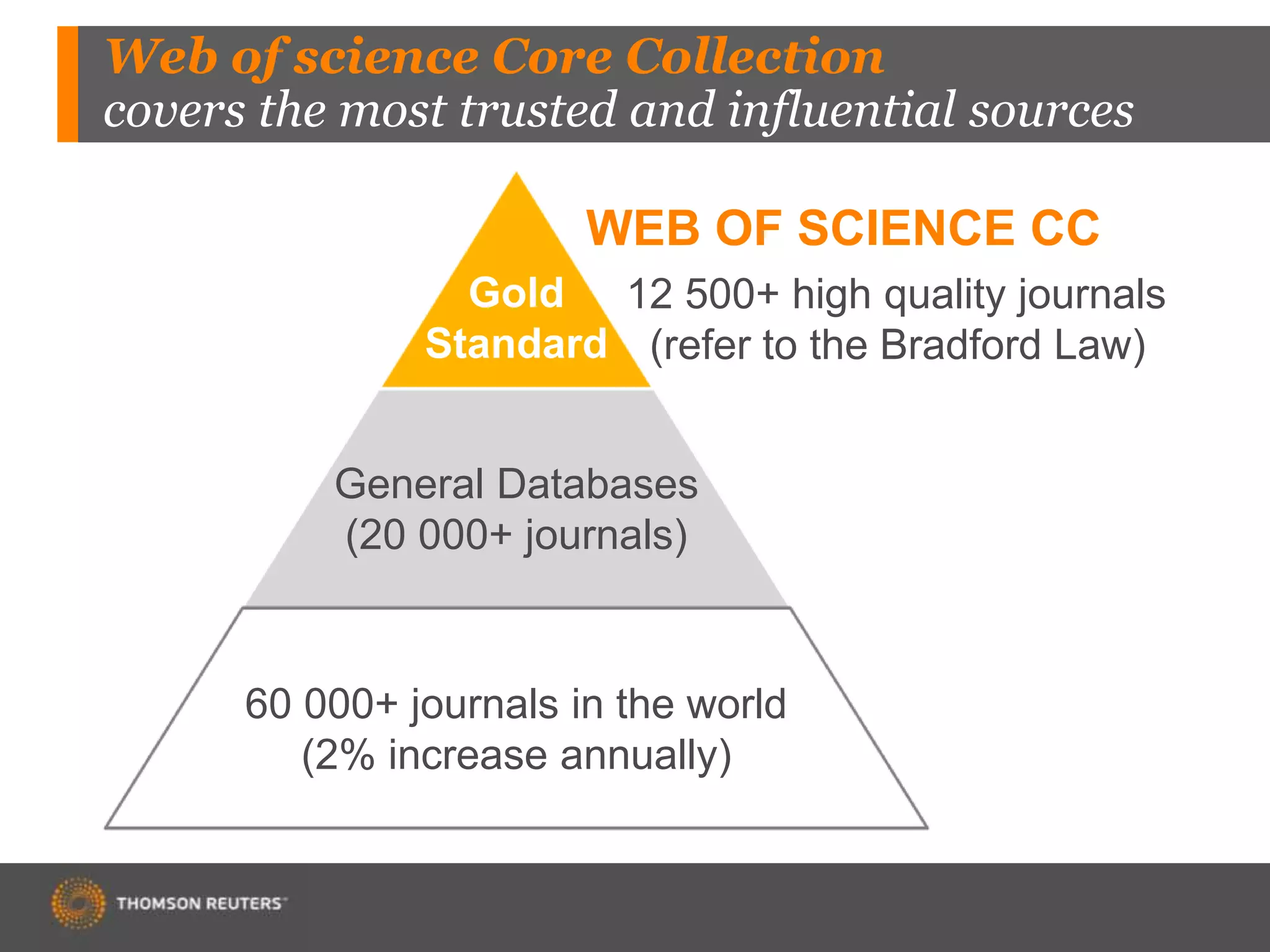
Web of science Core Collection
covers the most trusted and influential sources
60 000+ journals in the world
(2% increase annually)
General Databases
(20 000+ journals)
Gold
Standard
12 500+ high quality journals
(refer to the Bradford Law)
WEB OF SCIENCE CC
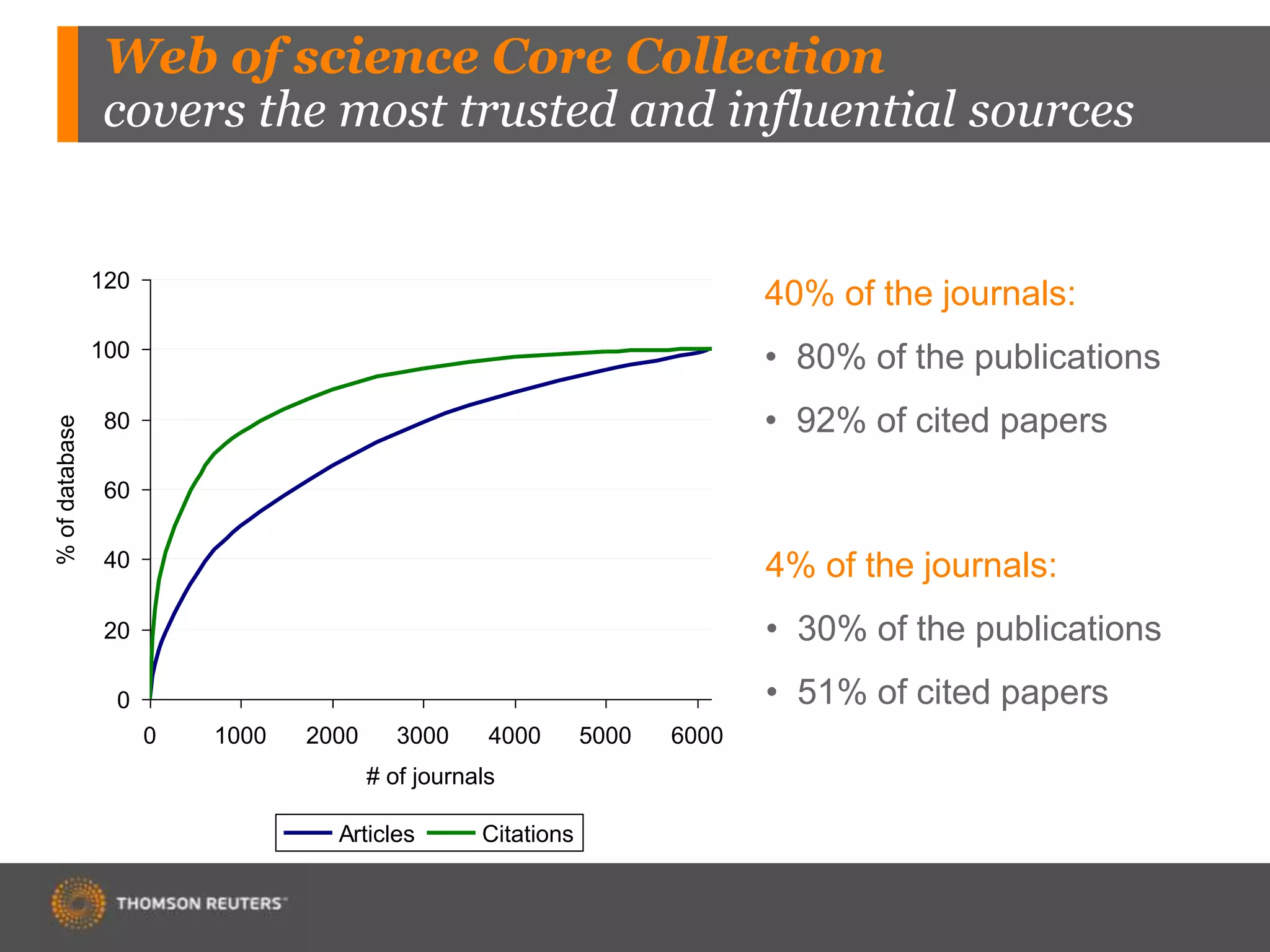
Web of science Core Collection
covers the most trusted and influential sources
0
20
40
60
80
100
120
0 1000 2000 3000 4000 5000 6000
# of journals
%ofdatabase
Articles Citations
40% of the journals:
• 80% of the publications
• 92% of cited papers
4% of the journals:
• 30% of the publications
• 51% of cited papers
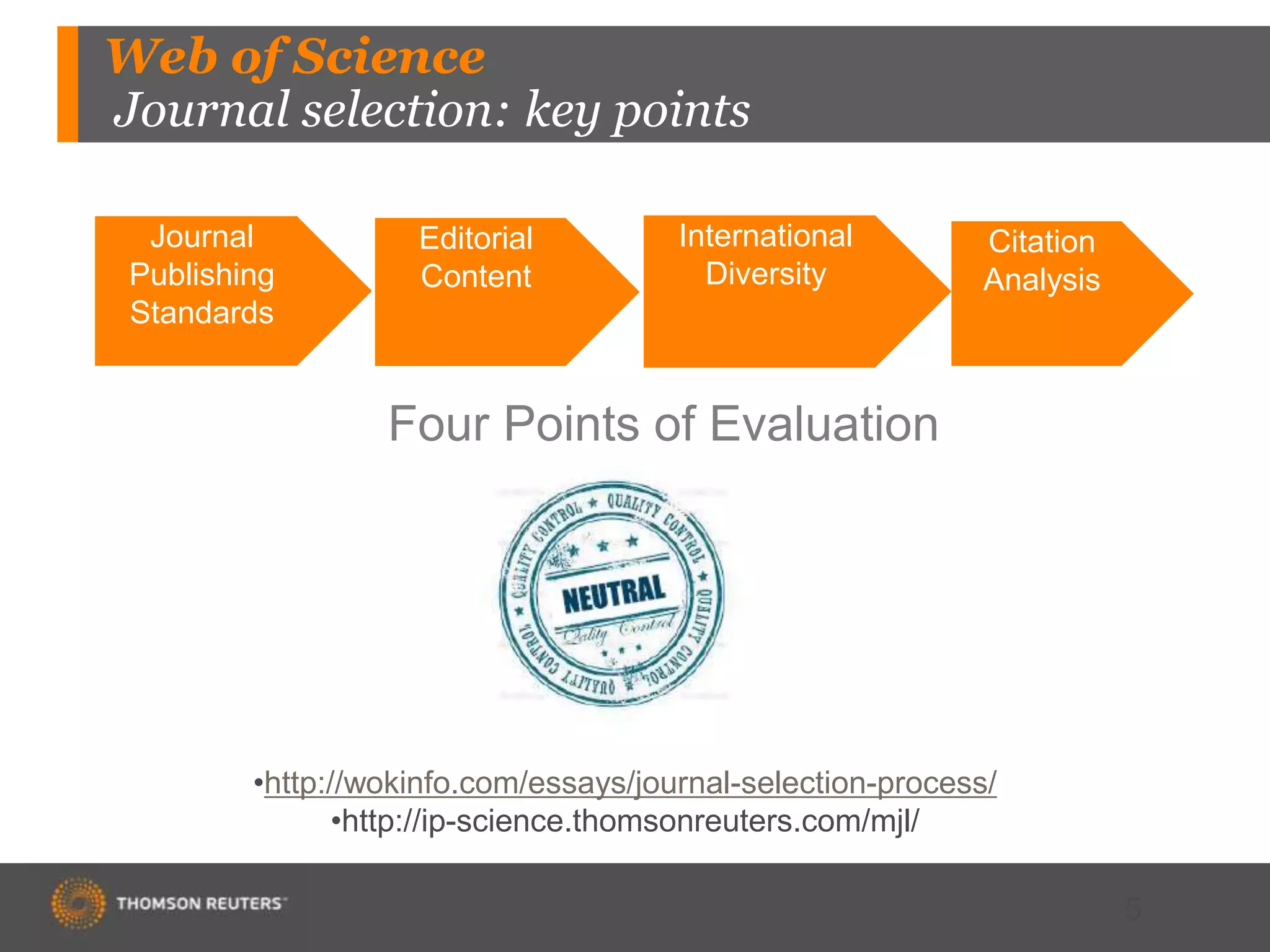
Web of Science
Journal selection: key points
Journal
Publishing
Standards
Editorial
Content
International
Diversity
Citation
Analysis
Four Points of Evaluation
5
•http://wokinfo.com/essays/journal-selection-process/
•http://ip-science.thomsonreuters.com/mjl/
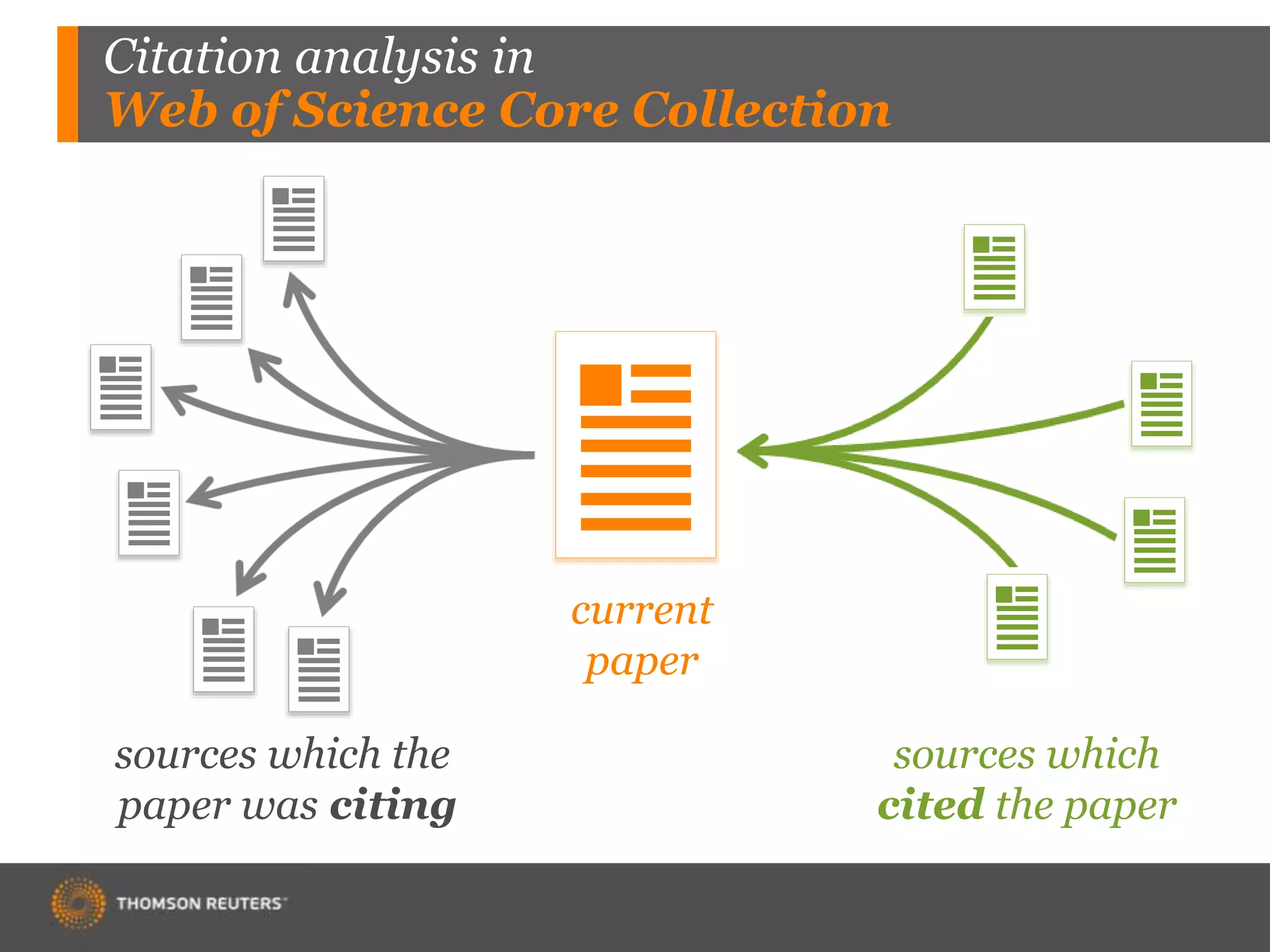
current
paper
sources which the
paper was citing
sources which
cited the paper
Citation analysis in
Web of Science Core Collection
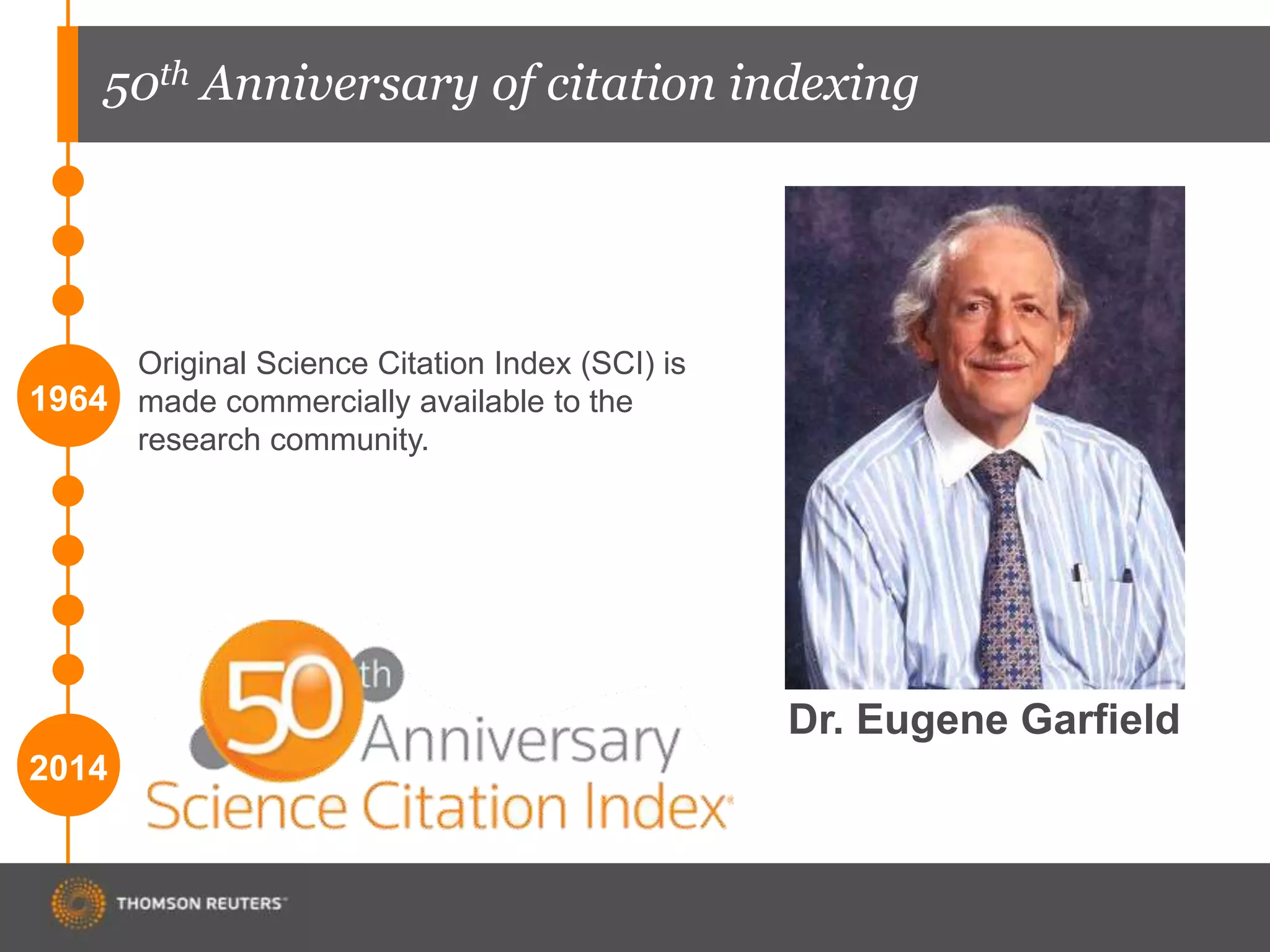
50th Anniversary of citation indexing
1964
Original Science Citation Index (SCI) is
made commercially available to the
research community.
2014
Dr. Eugene Garfield
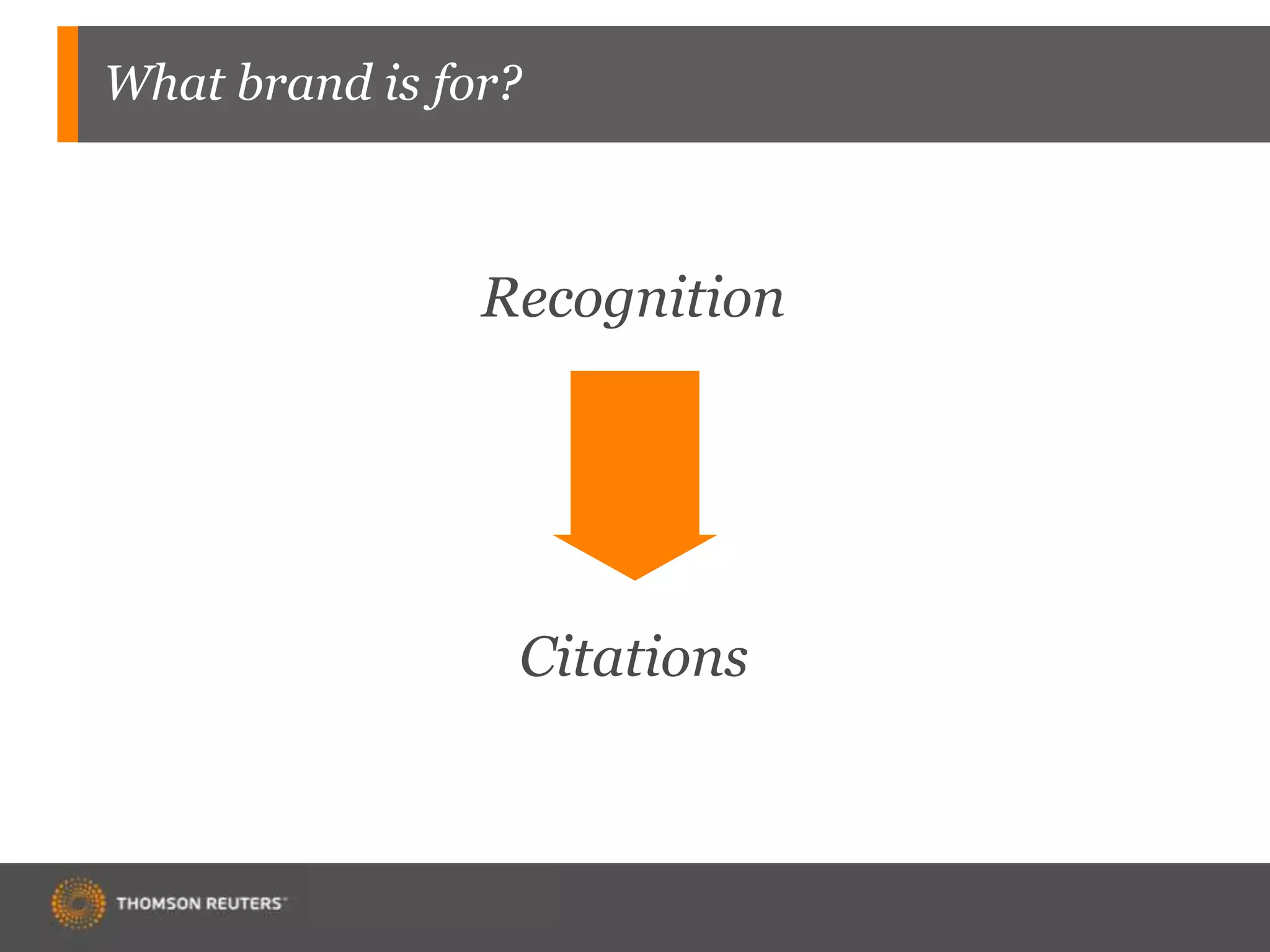
What brand is for?
Recognition
Citations
Your research is the basis
of your personal brand
webofscience.com
Web of Science
Core Collection
SCIE – backfiles 1900+
SSCI – backfiles 1900+
AHCI – backfiles 1975+
CPCI – backfiles 1990+
BkCI – backfiles 2005+
IC/CCR – backfiles 1840+
Data Citation Index
backfiles 1900+
Zoological Records
backfiles 1864+
Derwent Innovations Index
backfiles 1963+
CABI
backfiles 1910+
FSTA
backfiles 1969+
Inspec
backfiles 1898+
MEDLINE
backfiles 1950+
BIOSIS Citation Index
backfiles 1926+
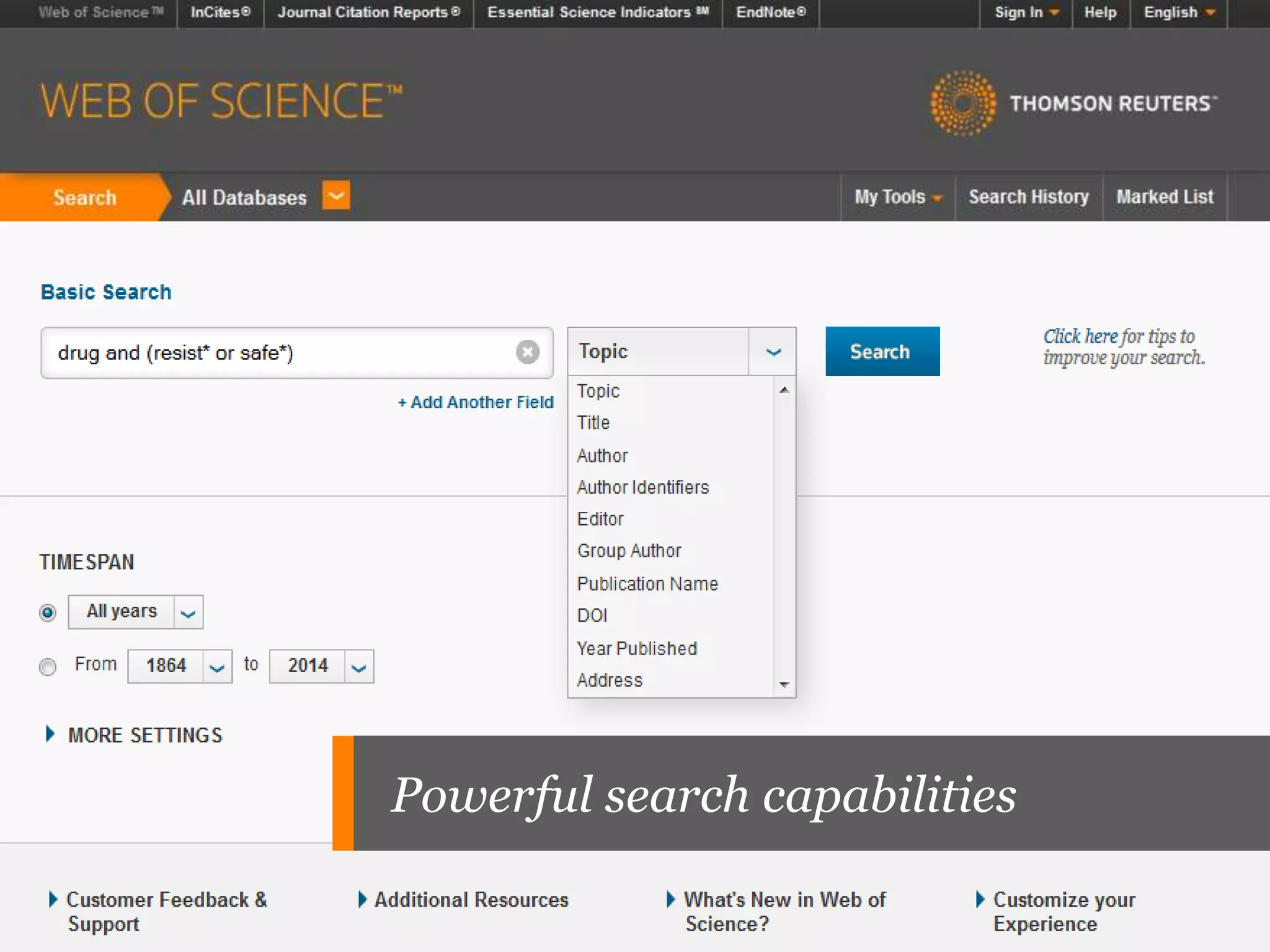
Powerful search capabilities
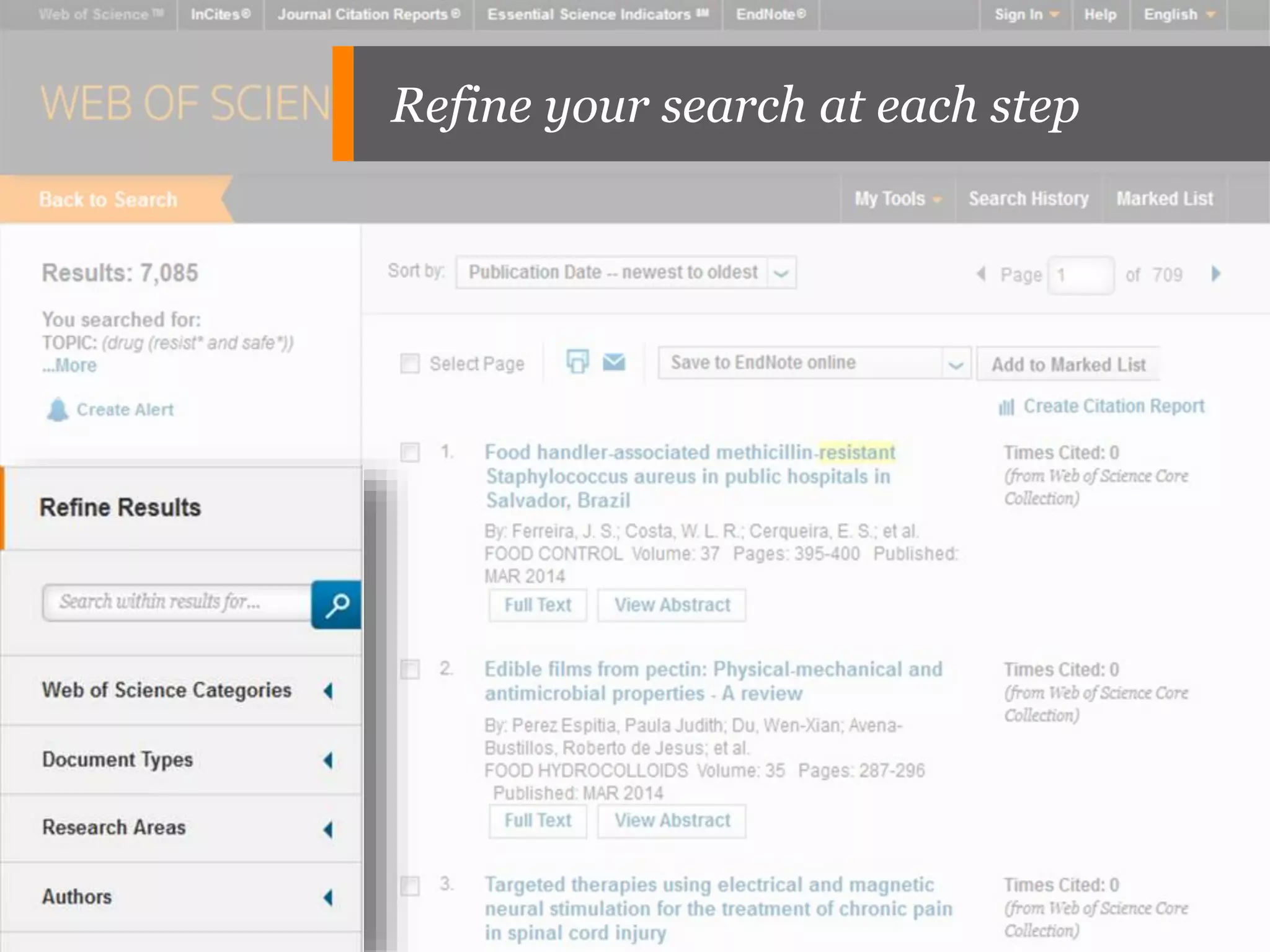
Refine your search at each step
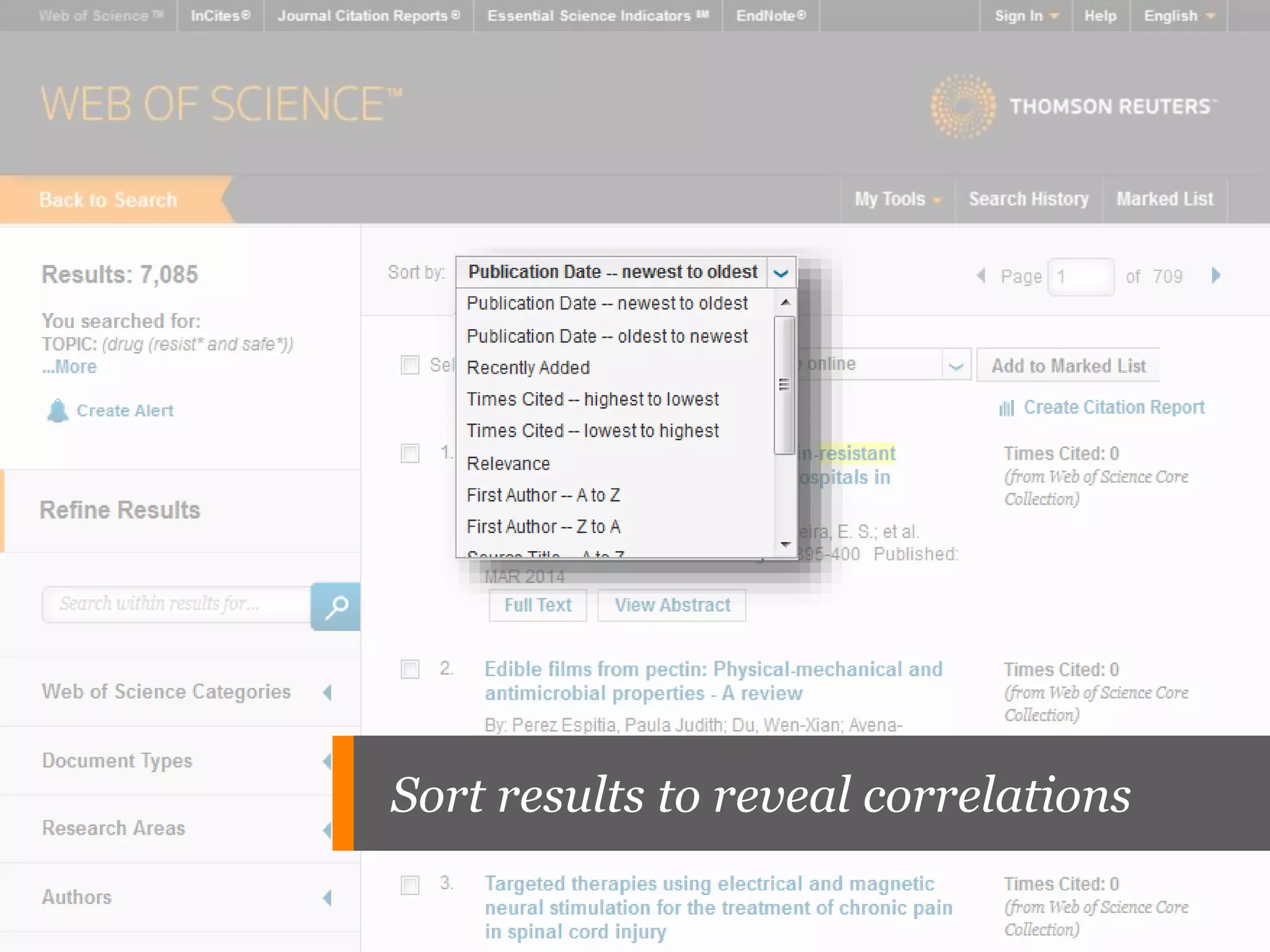
Sort results to reveal correlations
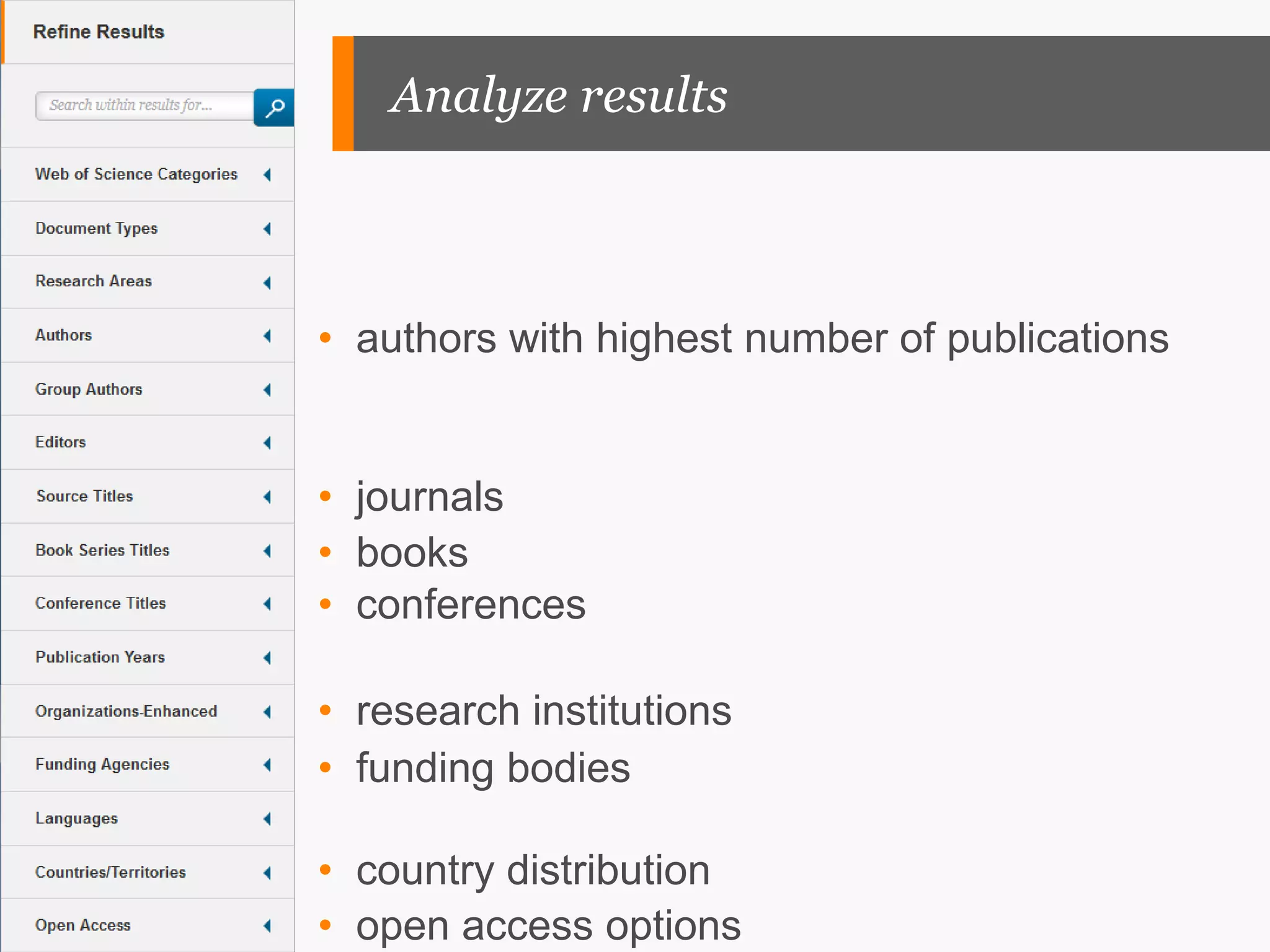
• authors with highest number of publications
• research institutions
• country distribution
• journals
• conferences
• books
• funding bodies
• open access options
Analyze results
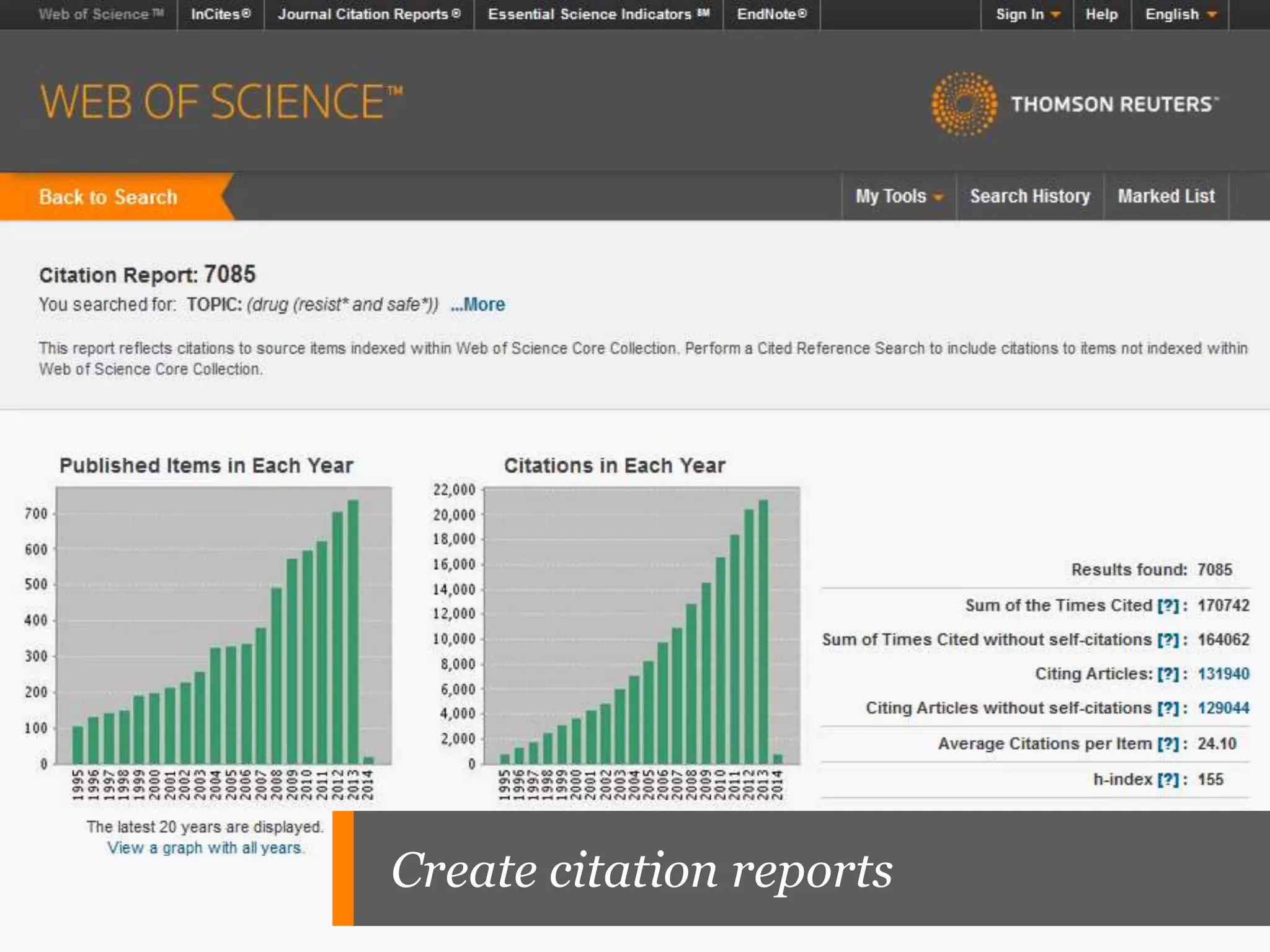
Create citation reports
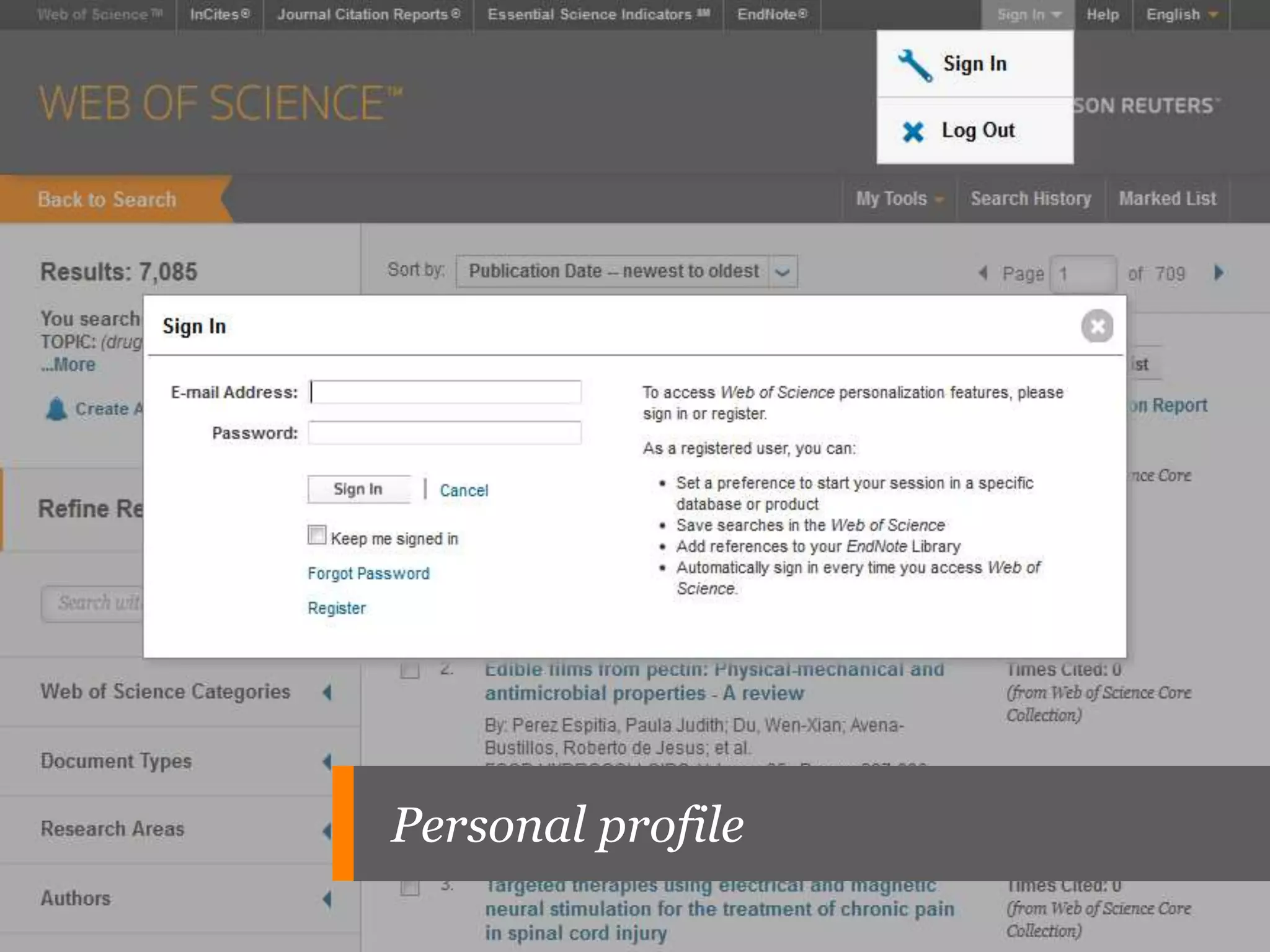
Personal profile
Web of Science
discovery starts here
• Find what is essential to your research
• Identify the most recent and influential papers in the field
• Use the power of citations to establish links between
publications and subjects
• Identify key opinion leaders in the field and find potential
collaborators
• Find the relevant journals and conferences to present
your research
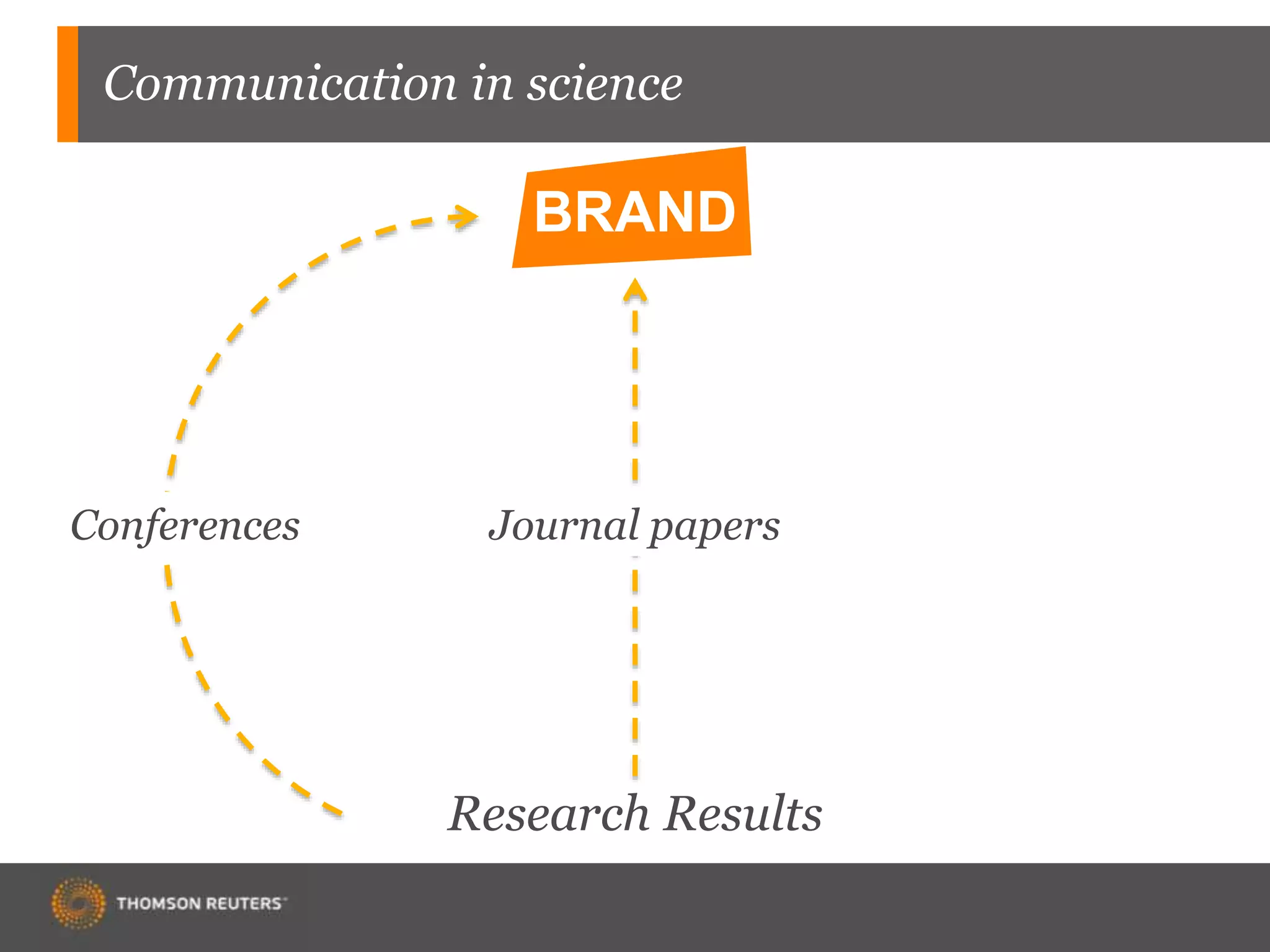
Research Results
BRAND
Conferences Journal papers
Communication in science
Q&A and Useful Links
wokinfo.com
youtube.com/WoSTraining

CNUDST Workshops - web of science

  • 1.
    Web of Science discoverystarts here Amine Triki. Consultant on Information Resources for Science Products Specialist
  • 2.
    Web of Science discoverystarts here • Find what is essential to your research • Identify the most recent and influential papers in the field • Use the power of citations to establish links between publications and subjects • Identify key opinion leaders in the field and find potential collaborators • Find the relevant journals and conferences to present your research
  • 3.
    Web of scienceCore Collection covers the most trusted and influential sources 60 000+ journals in the world (2% increase annually) General Databases (20 000+ journals) Gold Standard 12 500+ high quality journals (refer to the Bradford Law) WEB OF SCIENCE CC
  • 4.
    Web of scienceCore Collection covers the most trusted and influential sources 0 20 40 60 80 100 120 0 1000 2000 3000 4000 5000 6000 # of journals %ofdatabase Articles Citations 40% of the journals: • 80% of the publications • 92% of cited papers 4% of the journals: • 30% of the publications • 51% of cited papers
  • 5.
    Web of Science Journalselection: key points Journal Publishing Standards Editorial Content International Diversity Citation Analysis Four Points of Evaluation 5 •http://wokinfo.com/essays/journal-selection-process/ •http://ip-science.thomsonreuters.com/mjl/
  • 6.
    current paper sources which the paperwas citing sources which cited the paper Citation analysis in Web of Science Core Collection
  • 7.
    50th Anniversary ofcitation indexing 1964 Original Science Citation Index (SCI) is made commercially available to the research community. 2014 Dr. Eugene Garfield
  • 9.
    What brand isfor? Recognition Citations
  • 10.
    Your research isthe basis of your personal brand
  • 11.
  • 12.
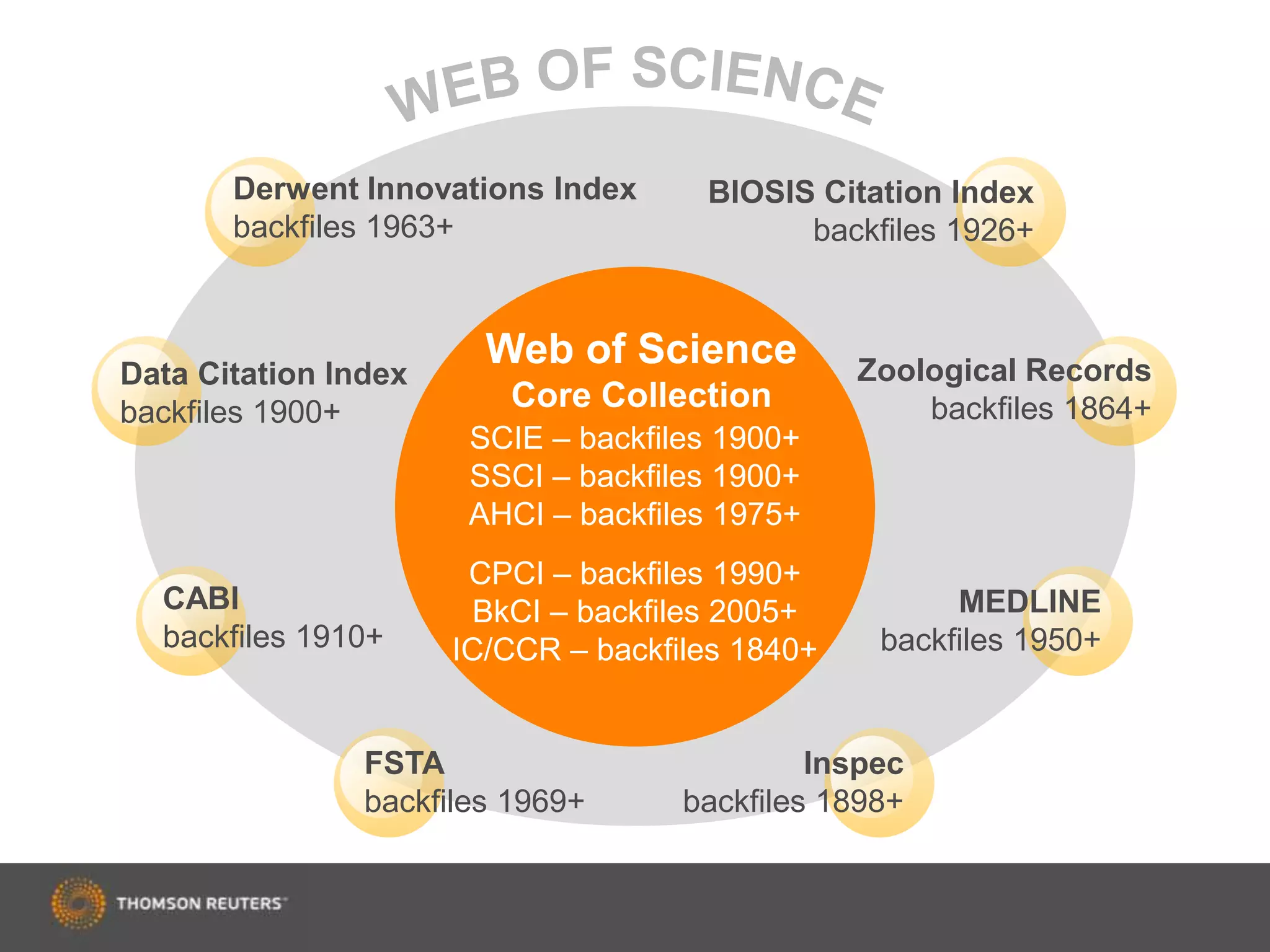
    Web of Science CoreCollection SCIE – backfiles 1900+ SSCI – backfiles 1900+ AHCI – backfiles 1975+ CPCI – backfiles 1990+ BkCI – backfiles 2005+ IC/CCR – backfiles 1840+ Data Citation Index backfiles 1900+ Zoological Records backfiles 1864+ Derwent Innovations Index backfiles 1963+ CABI backfiles 1910+ FSTA backfiles 1969+ Inspec backfiles 1898+ MEDLINE backfiles 1950+ BIOSIS Citation Index backfiles 1926+
  • 13.
  • 14.
    Refine your searchat each step
  • 15.
    Sort results toreveal correlations
  • 16.
    • authors withhighest number of publications • research institutions • country distribution • journals • conferences • books • funding bodies • open access options Analyze results
  • 17.
  • 18.
  • 19.
    Web of Science discoverystarts here • Find what is essential to your research • Identify the most recent and influential papers in the field • Use the power of citations to establish links between publications and subjects • Identify key opinion leaders in the field and find potential collaborators • Find the relevant journals and conferences to present your research
  • 20.
    Research Results BRAND Conferences Journalpapers Communication in science
  • 21.
    Q&A and UsefulLinks wokinfo.com youtube.com/WoSTraining

Editor's Notes

  • #6 The Journal Selection Process has four main components. We examine over all Publishing Standards, Editorial Content, International Diversity appropriate to the journal’s target audience, and Citation Analysis. Under Publishing Standards > are basic features such as timeliness of publication ( All journals must be publishing on time at either the issue or article level), adherence to international editorial conventions, appropriate inclusion of English language content, and, of course, Peer Review. Peer Review is essential for all journals publishing original research. We are always in search of novel Editorial Content > seeking to enrich subject coverage in Web of Science. International Diversity > that is appropriate for the subject and the journal’s target audience is important. For journals publishing research targeted at the international scholarly community, we hope to see broad international diversity among the authors and editorial advisory board members. This requirement is modified accordingly for journals that target a regional or national audience. Citation analysis > at the level of the journal or, in the case of brand new publications, at the level of contributing authors and editorial advisory board members, is key. There are many ways to check for importance and influence and Citation Impact is prominent among them. At the journal level we estimate Impact Factor and look at total citations. For contributing authors and editors we check citations to their prior work. We are building a citation index and seek to include those journals that participate in the discourse on a particular topic by way of citation exchange. Note also, that citation analysis is always done relative to the editorial context of the journal. Likewise, we do not compare the citation performance of a purely regional journal with an international journal in the same subject area. The more specific the context, the more useful are citation analyses. All of these points are important to us. We cannot, for example, move forward with a journal that is unable to produce issues or post articles in a timely manner. We are reluctant to accept journals that publish more or less derivative studies or that report on a topic of international interest without adequate international representation of results. And we are less interested in journals that have relatively poor uptake in the surrounding literature by way of citation.
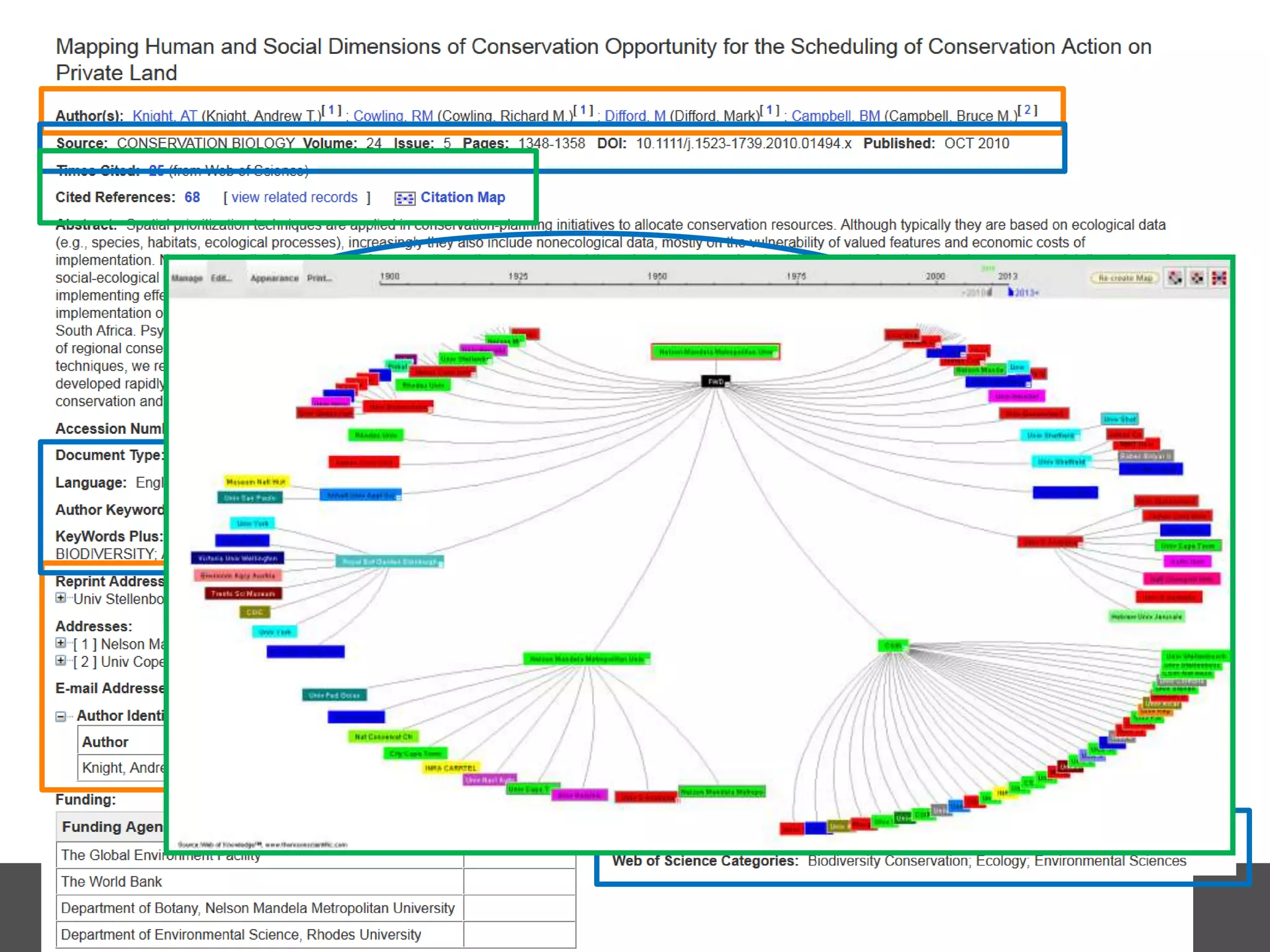
  • #7 The MOST IMPORTANT thing we do that sets us apart from other tools is the fact that we index cited references For a given article, we don’t just capture the title, authors’ names, and abstract  we also capture the entire bibliography/works cited list, References are: Searchable and navigable  you can easily move from one point in the literature to another to determine how highly cited a paper is and answer the question– “how has this paper influenced future research?” In terms of coverage, our philosophy is to index the cream of the crop of scholarship: Multidisciplinary–covers basic folklore to robotics. International in scope: indexes journals published in over 45 languages Influential– It is not our intention to index every single journal ever published in the world  we have a team of experts whose job it is to be constantly analyze and assess the literature to determine which publications are the most important in each field of research– which are the most influential, most cited journals
  • #8 Dr Eugene Garfield, the founder of ISI, in 1955 published a paper in the journal Science that exposed the concept of citation indexing to a wide audience within the scientific community. This paper communicated a philosophy that is the core of the Web of Science (and Web of Knowledge for that matter) today – the provision of links between published works on a multidisciplinary scale. A resource for driving discovery.
  • #9 WHY IS THIS VALUABLE TO THE SCIENTIFIC COMMUNITY/TO RESEARCHERS? Because it allows to draw the complete picture, prior art. Allows you to move forward and backward in time, discovering relationships between published works as determined by the articles authors Find new, unknown information based on older, known information Track use of your research or a competitor’s research Backward through “Cited References” Uses cited references as subject terms Explore hidden connections between research papers. Citations symbolize the association of scientific ideas. Taking into account citations is very important because they show how others use a work in subsequent research and therefore can give us valuable clues as to how/and in which direction science is evolving in given fields. .