Thermal Type AMPs:
Electric Discharge Machining (EDM)- working Principle-equipments-
Process Parameters-Surface Finish and MRR- electrode / Tool – Power
and control CircuitsTool Wear – Dielectric – Flushing – Wire cut EDM –
Applications- Micro-EDM, Micro-WEDM.
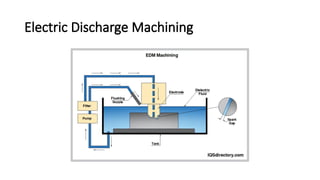
Electric Discharge Machining
Introduction
• Definition: Electric Discharge Machining (EDM) is a non-traditional
manufacturing process that removes material from a workpiece
through a series of controlled electrical discharges.
• Purpose: EDM is primarily used to machine hard metals or materials
that are difficult to machine using conventional methods.
• Key Feature: EDM works by creating sparks between an electrode and
the workpiece, removing material in the process without physical
contact.
• Applications: Commonly used in tool and die making, aerospace,
automotive, and electronics industries.
Procedure
• Setup: Position the electrode and workpiece within the dielectric fluid.
• Generate Voltage: Apply voltage between the electrode and workpiece to create
an electric field.
• Sparking: As voltage increases, a spark jumps between the electrode and
workpiece, eroding the workpiece.
• Material Removal: Each spark erodes a tiny part of the workpiece, leaving a
precise shape.
• Repetition: The spark discharge process is repeated thousands of times per
second to shape the material accurately.
• Cooling and Flushing: The dielectric fluid cools the process and flushes away the
debris.
Advantages of EDM
• High Precision: Ideal for creating intricate shapes and complex geometries
with high accuracy.
• No Physical Contact: Reduces tool wear and is suitable for fragile or delicate
materials.
• Hard Material Machining: Easily machines hard metals, such as titanium,
Inconel, and tungsten carbide, that are challenging with traditional methods.
• Minimal Burr Formation: Produces a smooth surface finish with minimal
burrs.
• Flexibility in Shapes: Can machine complex internal shapes, sharp edges,
and intricate cavities.
Disadvantages of EDM
• Slow Material Removal Rate: EDM is a slower process compared to
traditional machining methods.
• High Power Consumption: Consumes significant electrical power,
making it costly for large production runs.
• Limited to Conductive Materials: Only conductive materials can be
machined, limiting its application.
• Tool Wear: Although contactless, the electrode can experience wear
over time, especially in die-sinking EDM.
• Surface Hardening: The process can create a thin heat-affected zone,
leading to surface hardening, which may require additional processing.
Applications
• Aerospace Industry: Creating turbine blades and precise engine parts.
• Automotive Industry: Manufacturing intricate molds and dies for
components.
• Medical Field: Producing complex, precise parts for surgical
equipment.
• Electronics: Creating fine, detailed parts for electronic devices and
connectors.
Power and Control Circuits
• Introduction: Power and control circuits are fundamental to the EDM
process. They regulate the discharge energy, spark frequency, and
pulse duration, ensuring precise control over the material removal
rate.
• Function: The power circuit supplies high-frequency electrical pulses,
while the control circuit adjusts these parameters based on the
material properties and desired surface finish.
• Importance: Effective control circuits enable consistent, accurate
material removal and prevent over-cutting or overheating, which can
lead to unwanted tool wear or poor surface finish.
Tool Wear
• Introduction: Tool wear refers to the gradual erosion of the EDM
electrode (tool) during the machining process.
• Causes: Tool wear occurs due to continuous spark discharges that
gradually erode the electrode material, particularly during long
machining sessions.
• Impact: Excessive tool wear can reduce precision, increase
operational costs, and affect the tool's lifespan, requiring frequent
adjustments or replacement to maintain accuracy.
Dielectric
• Introduction: In EDM, a dielectric fluid (usually deionized water or oil)
serves as an insulator and coolant, critical for stable and efficient
machining.
• Function: The dielectric fluid controls the spark gap, quenches the
spark to avoid excessive heat, and flushes away debris from the
machining area.
• Benefits: Using a dielectric fluid improves machining accuracy,
maintains electrode lifespan, and reduces the risk of short-circuiting
and overheating.
Flushing
• Introduction: Flushing is the process of circulating dielectric fluid
through the machining area to remove debris and maintain a stable
spark gap.
• Purpose: Effective flushing prevents debris from building up in the
gap, which could cause arcing, surface damage, or inconsistent
machining.
• Methods: There are various flushing techniques, including side
flushing, jet flushing, and through-hole flushing, each suited to
different machining situations and electrode geometries.
Wire Cut EDM
• Introduction: Wire Cut EDM, also known as WEDM, is a type of EDM
that uses a thin, electrically charged wire as the cutting tool.
• Process: The wire moves along a predetermined path, creating
precise cuts and intricate shapes without contacting the workpiece
directly.
• Applications: Wire Cut EDM is ideal for producing complex parts,
contours, and cavities in hard materials, making it widely used in die-
making, aerospace, and medical device manufacturing.
Micro-EDM
• Introduction: Micro-EDM is an advanced form of EDM designed for
creating extremely small, detailed features with high precision,
usually in the micrometer range.
• Process: Micro-EDM uses specialized, smaller electrodes to achieve
high accuracy and is suitable for machining miniature components
and fine details.
• Applications: This technology is popular in industries like
microelectronics, medical devices, and watchmaking, where fine
details and small dimensions are essential.
Micro-WEDM
• Introduction: Micro-WEDM is a variant of Wire EDM tailored for
micromachining applications, allowing for intricate cuts on a very
small scale.
• Process: It uses an ultra-thin wire, often below 50 microns, to achieve
extremely high precision cuts, ideal for components with complex
geometries and tight tolerances.
• Applications: Micro-WEDM is extensively used in electronics,
micromechanics, and biomedical engineering, where accuracy at
micro-level scales is crucial for component functionality.

3_Thermal Type AMPs-non conventional Machining process.pptx

  • 1.
    Thermal Type AMPs: ElectricDischarge Machining (EDM)- working Principle-equipments- Process Parameters-Surface Finish and MRR- electrode / Tool – Power and control CircuitsTool Wear – Dielectric – Flushing – Wire cut EDM – Applications- Micro-EDM, Micro-WEDM.
  • 2.
  • 3.
    Introduction • Definition: ElectricDischarge Machining (EDM) is a non-traditional manufacturing process that removes material from a workpiece through a series of controlled electrical discharges. • Purpose: EDM is primarily used to machine hard metals or materials that are difficult to machine using conventional methods. • Key Feature: EDM works by creating sparks between an electrode and the workpiece, removing material in the process without physical contact. • Applications: Commonly used in tool and die making, aerospace, automotive, and electronics industries.
  • 4.
    Procedure • Setup: Positionthe electrode and workpiece within the dielectric fluid. • Generate Voltage: Apply voltage between the electrode and workpiece to create an electric field. • Sparking: As voltage increases, a spark jumps between the electrode and workpiece, eroding the workpiece. • Material Removal: Each spark erodes a tiny part of the workpiece, leaving a precise shape. • Repetition: The spark discharge process is repeated thousands of times per second to shape the material accurately. • Cooling and Flushing: The dielectric fluid cools the process and flushes away the debris.
  • 5.
    Advantages of EDM •High Precision: Ideal for creating intricate shapes and complex geometries with high accuracy. • No Physical Contact: Reduces tool wear and is suitable for fragile or delicate materials. • Hard Material Machining: Easily machines hard metals, such as titanium, Inconel, and tungsten carbide, that are challenging with traditional methods. • Minimal Burr Formation: Produces a smooth surface finish with minimal burrs. • Flexibility in Shapes: Can machine complex internal shapes, sharp edges, and intricate cavities.
  • 6.
    Disadvantages of EDM •Slow Material Removal Rate: EDM is a slower process compared to traditional machining methods. • High Power Consumption: Consumes significant electrical power, making it costly for large production runs. • Limited to Conductive Materials: Only conductive materials can be machined, limiting its application. • Tool Wear: Although contactless, the electrode can experience wear over time, especially in die-sinking EDM. • Surface Hardening: The process can create a thin heat-affected zone, leading to surface hardening, which may require additional processing.
  • 7.
    Applications • Aerospace Industry:Creating turbine blades and precise engine parts. • Automotive Industry: Manufacturing intricate molds and dies for components. • Medical Field: Producing complex, precise parts for surgical equipment. • Electronics: Creating fine, detailed parts for electronic devices and connectors.
  • 8.
    Power and ControlCircuits • Introduction: Power and control circuits are fundamental to the EDM process. They regulate the discharge energy, spark frequency, and pulse duration, ensuring precise control over the material removal rate. • Function: The power circuit supplies high-frequency electrical pulses, while the control circuit adjusts these parameters based on the material properties and desired surface finish. • Importance: Effective control circuits enable consistent, accurate material removal and prevent over-cutting or overheating, which can lead to unwanted tool wear or poor surface finish.
  • 9.
    Tool Wear • Introduction:Tool wear refers to the gradual erosion of the EDM electrode (tool) during the machining process. • Causes: Tool wear occurs due to continuous spark discharges that gradually erode the electrode material, particularly during long machining sessions. • Impact: Excessive tool wear can reduce precision, increase operational costs, and affect the tool's lifespan, requiring frequent adjustments or replacement to maintain accuracy.
  • 10.
    Dielectric • Introduction: InEDM, a dielectric fluid (usually deionized water or oil) serves as an insulator and coolant, critical for stable and efficient machining. • Function: The dielectric fluid controls the spark gap, quenches the spark to avoid excessive heat, and flushes away debris from the machining area. • Benefits: Using a dielectric fluid improves machining accuracy, maintains electrode lifespan, and reduces the risk of short-circuiting and overheating.
  • 11.
    Flushing • Introduction: Flushingis the process of circulating dielectric fluid through the machining area to remove debris and maintain a stable spark gap. • Purpose: Effective flushing prevents debris from building up in the gap, which could cause arcing, surface damage, or inconsistent machining. • Methods: There are various flushing techniques, including side flushing, jet flushing, and through-hole flushing, each suited to different machining situations and electrode geometries.
  • 12.
    Wire Cut EDM •Introduction: Wire Cut EDM, also known as WEDM, is a type of EDM that uses a thin, electrically charged wire as the cutting tool. • Process: The wire moves along a predetermined path, creating precise cuts and intricate shapes without contacting the workpiece directly. • Applications: Wire Cut EDM is ideal for producing complex parts, contours, and cavities in hard materials, making it widely used in die- making, aerospace, and medical device manufacturing.
  • 13.
    Micro-EDM • Introduction: Micro-EDMis an advanced form of EDM designed for creating extremely small, detailed features with high precision, usually in the micrometer range. • Process: Micro-EDM uses specialized, smaller electrodes to achieve high accuracy and is suitable for machining miniature components and fine details. • Applications: This technology is popular in industries like microelectronics, medical devices, and watchmaking, where fine details and small dimensions are essential.
  • 14.
    Micro-WEDM • Introduction: Micro-WEDMis a variant of Wire EDM tailored for micromachining applications, allowing for intricate cuts on a very small scale. • Process: It uses an ultra-thin wire, often below 50 microns, to achieve extremely high precision cuts, ideal for components with complex geometries and tight tolerances. • Applications: Micro-WEDM is extensively used in electronics, micromechanics, and biomedical engineering, where accuracy at micro-level scales is crucial for component functionality.