Manatee County
Comprehensive Maintenance Plan (CMP)
for
Traffic Control Devices
Presented by:
Aaron Burkett
Traffic Operations Division Manager
Cory Miles
Traffic Control Technician Supervisor
Michael Chesley
Traffic Signs and Markings Supervisor
April 19, 2016
1
Introductions
• Aaron Burkett
• Traffic Operations Division Manager
• 17 years experience in Traffic Operations
• Cory Miles
• Traffic Control Supervisor
• 12 years experience in Public Works and Traffic Signal Maintenance
• Michael Chesley
• Traffic Signs and Marking Supervisor
• 12 years experience in Traffic Sign and Pavement Marking
Maintenance
2
Presentation Objectives
3
• History/ Development
• What is the CMP
• CMP Overview
• Challenges/ Opportunities
• Lessons Learned
• Peer Review
• Traffic Operations Division
About Us
Our Core Mission
Past Maintenance Practices
• Impetus for CMP Development
Plan
Organization
New Systems
Support
Economy
History/ Development
4
What is the CMP ???
5
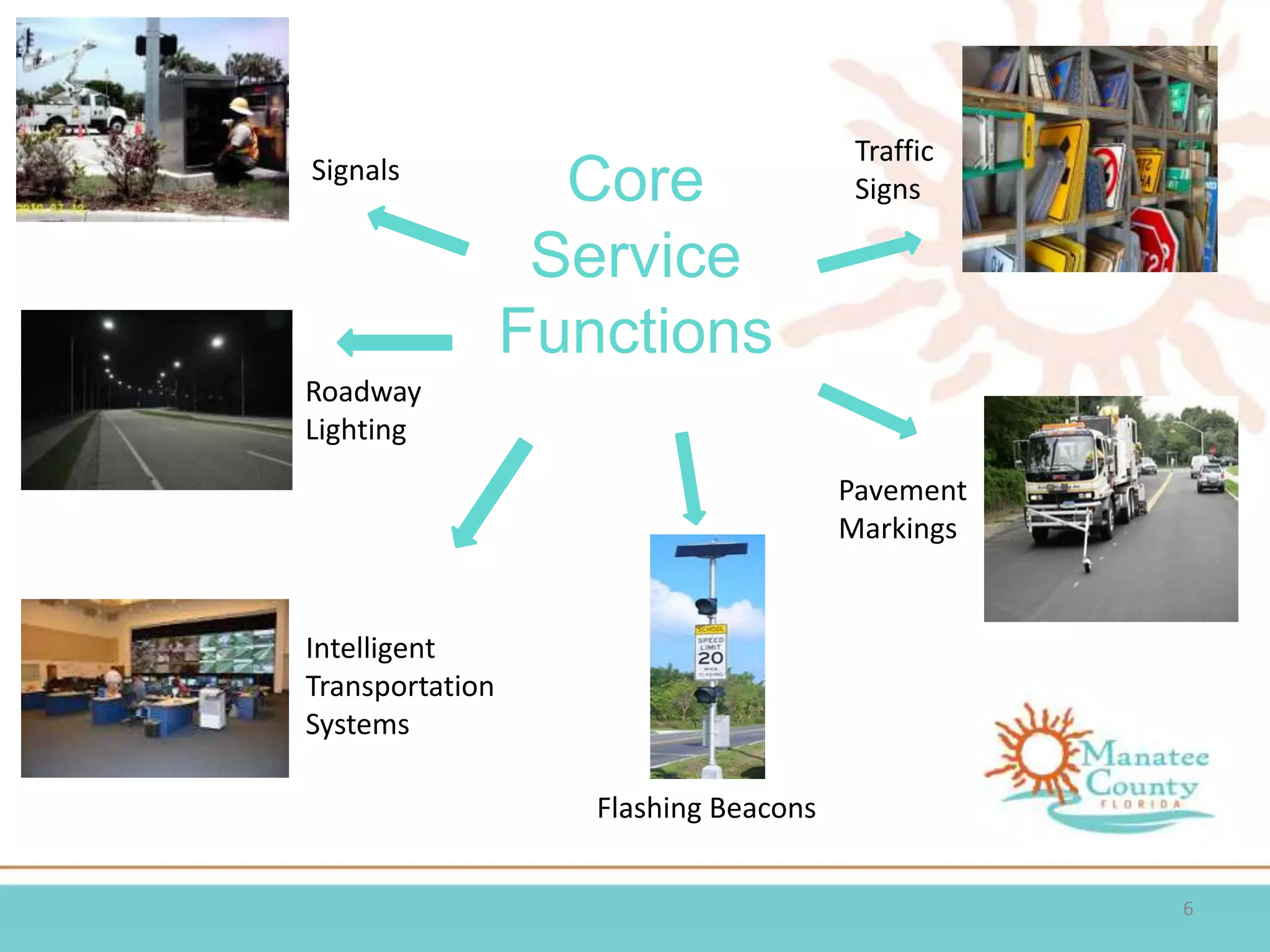
 The Comprehensive Maintenance Plan
(CMP) is a living document comprised of
various supporting documents which serve
to define our Core Service Functions and
identify the procedures, tasks and objectives
required to accomplish our mission.
 It is based on the strategy of attaining a high
level of accountability by outlining a
methodical and measureable approach to
maintenance.
6
Core
Service
Functions
Signals
Roadway
Lighting
Intelligent
Transportation
Systems
Flashing Beacons
Traffic
Signs
Pavement
Markings
CMP Overview -
Core Service Function Components
7
• Maintenance Procedure Outline
o Scope of Services
o Inventory Procedures
o Inspection Procedures
o Maintenance Priorities
o Maintenance Procedures
• Supporting Documents
CMP Overview - Scope of Services
• A Scope of Services is outlined within
each Core Service Function
• It defines the general parameters of that
maintenance function to include who it
serves, what it does, when, why and how.
8
Example Scope of Services: Traffic Signal CSF
9
Maintenance Procedure Outline
1. Scope of Services:
The Traffic Operations Division provides preventive and reactive maintenance services for all County
owned signalized intersections located within unincorporated areas of Manatee County.
These same services are also provided for signalized intersections located within FDOT right-of-way
and within the districts of the City of Palmetto, City of Holmes Beach and City of Bradenton Beach.
The Division provides services to maintain all traffic signal assemblies and associated components to
include, but not limited to, all underground and above ground traffic signal supports, components,
electrical and electronic devices, signals, signs, operating hardware and software.
The Division is responsible to maintain all service records and reports and produce these records
upon request.
Traffic Operations Division staff are trained and resourced to provide immediate response for any
after-hours traffic signal problem that may occur 24 hours a day, seven days a week to include
weekends and holidays.
The Division is required to implement this maintenance program to ensure proper maintenance and
operation of traffic control devices in accordance with all applicable standards, codes, policies,
procedures and maintenance agreements.
The Division shall ensure acceptable levels of service and quality control are maintained.
Annual maintenance objectives are developed each year and a static copy is maintained within the
Supporting Documents section of the manual.
CMP Overview – Inventory Procedures
10
• Data collection
• Spreadsheets
• GIS
• Cityworks/ Storeroom
Example Inventory Procedures
11
1. Inventory Procedures
 Accurate and up to date Traffic Signal Inventories shall be maintained on a continual basis.
 Field and Warehouse Inventory Snapshots shall be taken every 6 months and archived.
 An intersection folder shall be maintained on the Traffic Division Share Drive for the purposes of
maintaining specific intersection documents and related data.
 Detailed inventory information including, but not limited to; location, ID number, quantity, type,
ownership, installation date, configuration, software, model, brand, asset number, plans,
drawings, as built documents and other related source documentation shall be maintained within
each folder.
 The Traffic Inspector shall collect all field inventory data during project inspections and annual
inspection procedures.
 The Traffic Inspector shall update the intersection folder for each location accordingly.
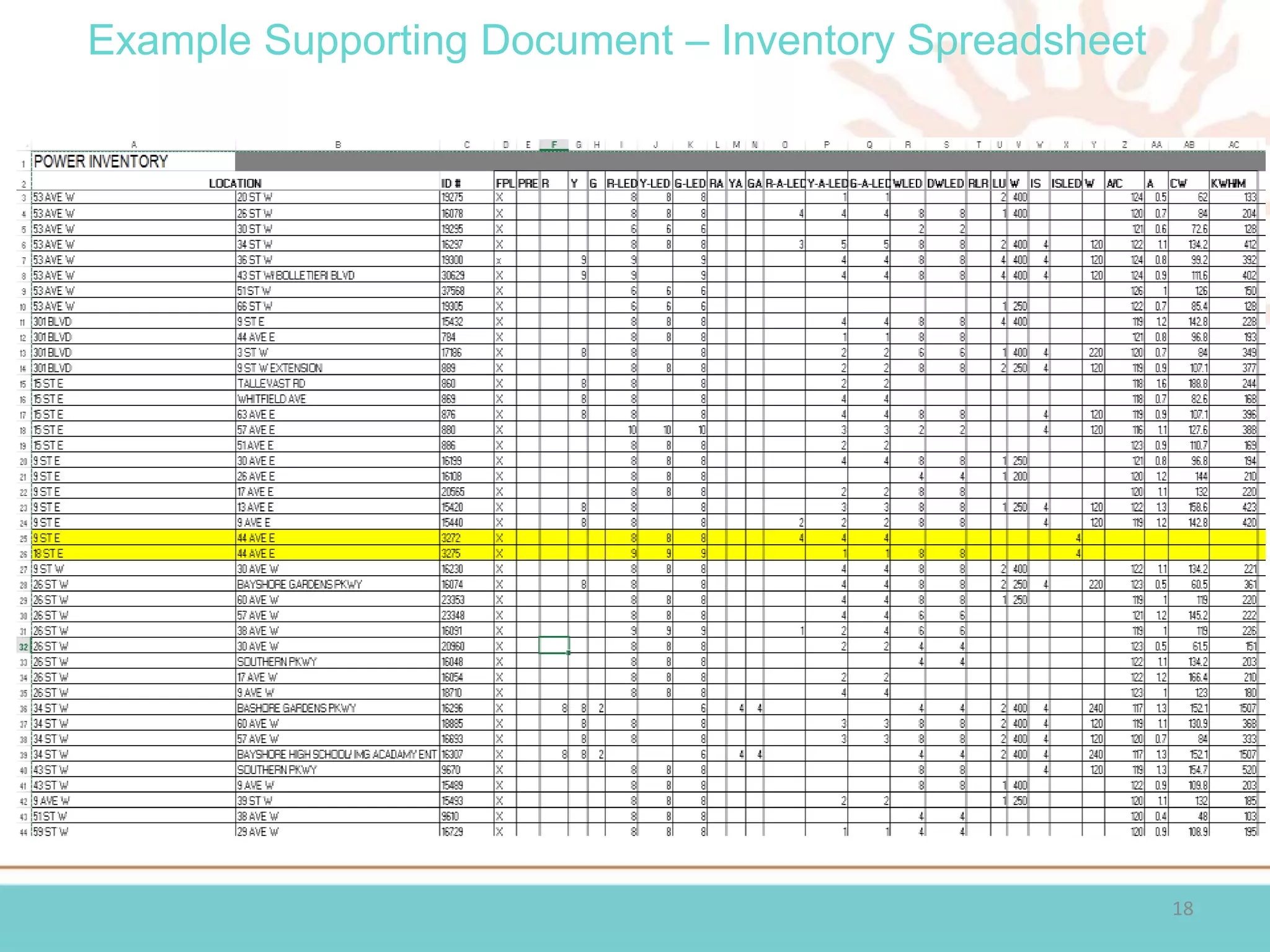
 The Traffic Inspector shall maintain and continually update an Inventory Excel spreadsheet
summarizing all Traffic Signal Inventories data. (See attached Inventory Spreadsheet)
 Traffic Signal ‘As Built’ documents to include shop drawings shall be filed within the appropriate
intersection folder. A copy shall be provide to the Utilities Department staff for the purposes of
updating the GIS Utility layer to enable effective locate services.
 Field and Warehouse material inventories shall be maintained to include specific material types,
quantities, part numbers, Clerk of Court asset ID numbers, costs, vendors and warehouse
locations.
CMP Overview – Inspection Procedures
12
• Frequency
• Process
• Documentation
• Project Inspections
Example Inspection Procedures
13
1. Inspection Procedures
 Each traffic signal shall receive a preventive maintenance inspection at least one time annually by
the Traffic Inspector.
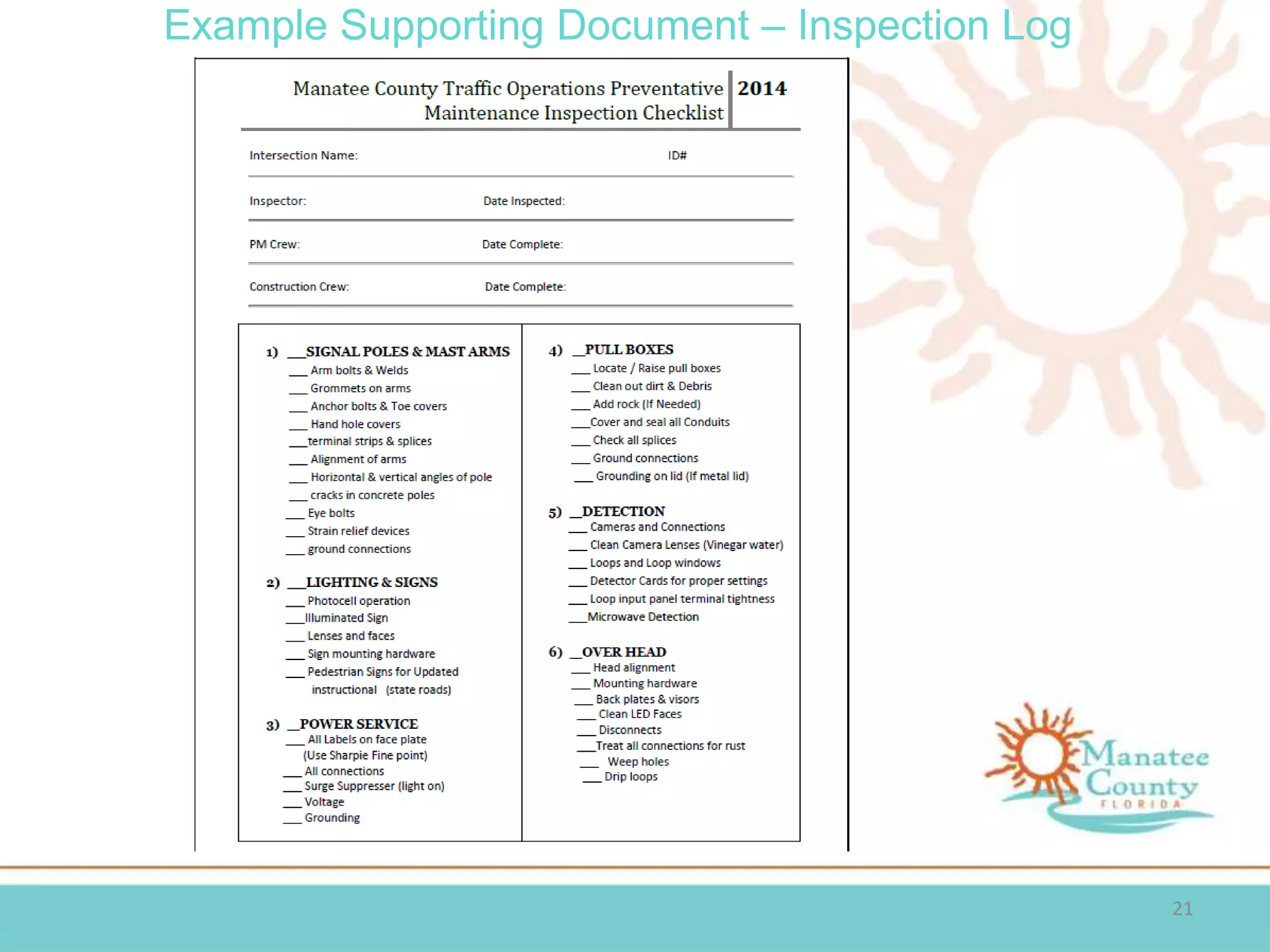
 A Traffic Signal Inspection Log is maintained and is used to track the location, time and date of
inspection and the inspectors’ name.
 A Traffic Signal Inspection Form shall be filled out during each traffic signal inspection for each
location.
 All deficiencies found during the inspection shall be noted on the traffic signal inspection form and
a copy of the form shall be provided to the Supervisor.
 The Supervisor shall review the inspection forms and prioritize repairs with the maintenance crew
accordingly.
 All inspection and maintenance activities shall be recorded on Cityworks daily worksheets. These
worksheets shall be processed daily to ensure all information is recorded within the Cityworks
database.
 All inspection and maintenance activities performed on Non County owned infrastructure shall be
coordinated with the infrastructure owner prior to scheduling work.
 Inspections of new infrastructure relating to CIP or Developer projects shall be scheduled and
performed as needed. The Traffic Inspector shall coordinate all inspection activities with the
Traffic Design Division.
 Completed Inspection Forms shall be scanned and filed in the appropriate intersection folder.
CMP Overview – Maintenance Priorities
14
• Inspection results
• Safety considerations
• Roadway functional classification (i.e.
thoroughfares and evacuation routes first)
• Traffic volumes
• Device type, age and condition
• Infrastructure Life Cycles
• Ownership
CMP Overview – Maintenance Procedures
15
• Preventive (Light/ Heavy)
• Reactive
• Design
• Programmed
Example Maintenance Procedures
16
 Traffic Signal Maintenance is categorized by type;
o Preventive, (Light/ Heavy)
o Reactive,
o Design
o Programmed
 The Division prioritizes tasks and assigns crews to support each maintenance type based on current needs, available resources and the maintenance priorities identified within this manual.
 Each crew shall consist of a minimum of 2 Technicians for safety.
 (Light) Preventive maintenance is performed on a daily basis. A Preventive Maintenance Crew is assigned each day (as needs and resources permit) to perform routine preventive
maintenance services to traffic signals. This crew performs light maintenance in accordance with the inspection items contained within the Traffic Signal Inspection Form. The crew corrects
minor punch list items noted by the Traffic Inspector. This crew may respond to trouble calls as needed.
 The crew documents on the Traffic Signal Inspection form corrective action taken for punch list items, any items not completed and date PM was performed then submits the form the
Supervisor to process. Once all items noted on the form are corrected it is then archived within the Intersection Share Drive Folder.
 Heavy maintenance items noted on the Traffic Signal Inspection Form are prioritized and scheduled as needed. This includes items such as Traffic Signal Mast Arm (TSMA) inspection
punch list items.
 Heavy Maintenance includes intersection overhaul work, heavy maintenance items found during inspections by the Traffic Inspector, special requests for signal work and reactive trouble
calls as needed.
 Reactive maintenance needs are assigned as needs and resources dictate.
 Design Maintenance includes special project requests for installation of new equipment or modification of existing equipment to improve performance or safety. These tasks shall be
prioritized and scheduled as resources, funding dictate.
 Programmed maintenance encompasses tasks which are specific to a type of device which requires special attention due to the nature of the device, scale of the project or recurring
needs.
 Programmed maintenance items include weekly detector maintenance, illuminated street name sign maintenance, audible pedestrian signal maintenance, uninterruptible power supply
maintenance, MMU testing maintenance and others.
 Crews are assigned programmed maintenance tasks as needs, resources and maintenance schedules dictate.
 Specific procedures and schedules for programmed maintenance items are outlined within the Task Process Worksheets.
 All activities for each crew to include labor, equipment and material shall be noted on a daily work ticket for each project or location and submitted on a daily basis.
 To ensure safety and quality Task Process Analysis Worksheets have been developed for each traffic signal maintenance task within City Works.
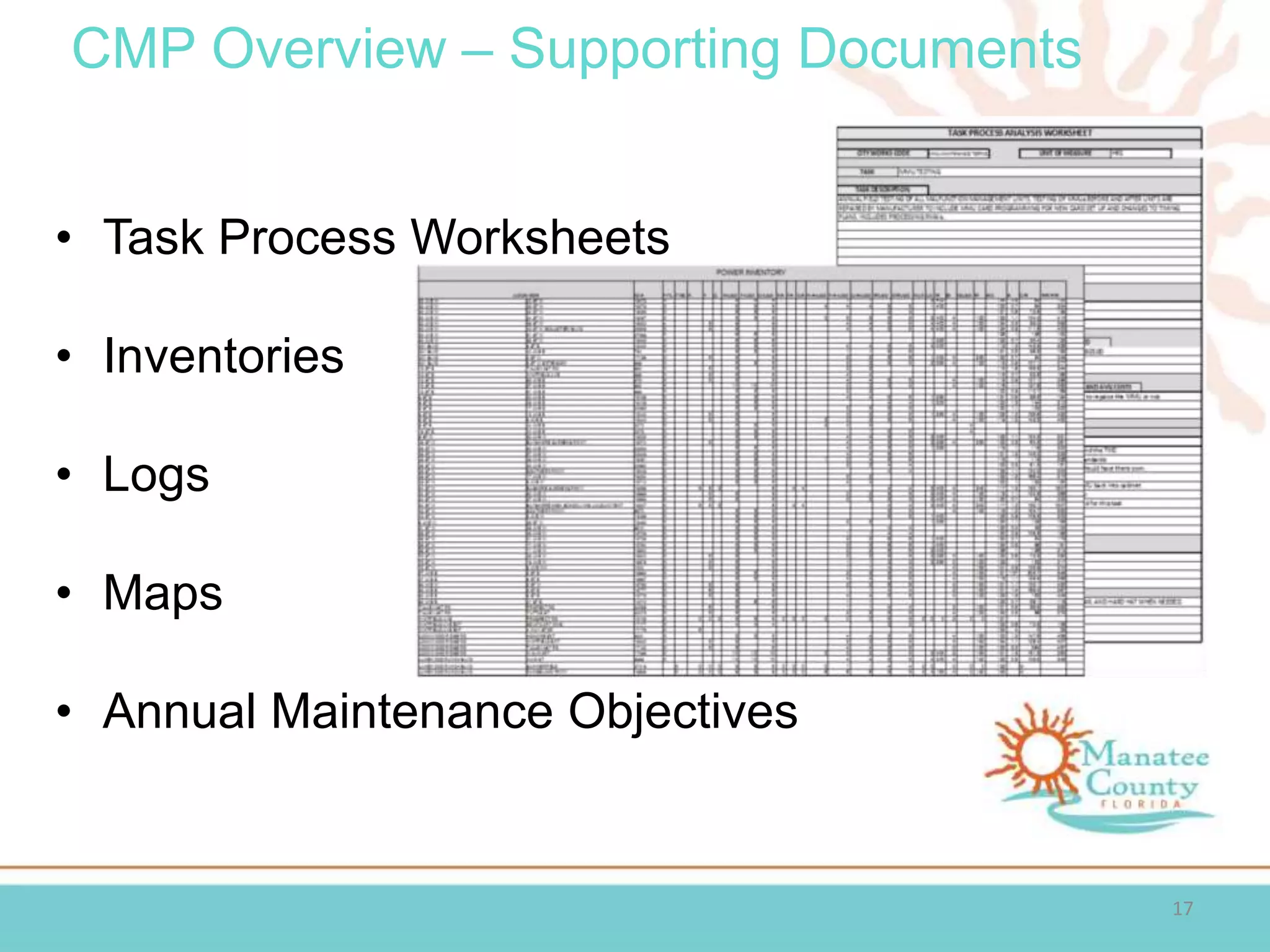
• Task Process Worksheets
• Inventories
• Logs
• Maps
• Annual Maintenance Objectives
CMP Overview – Supporting Documents
17
Example Supporting Document – Inventory Spreadsheet
18
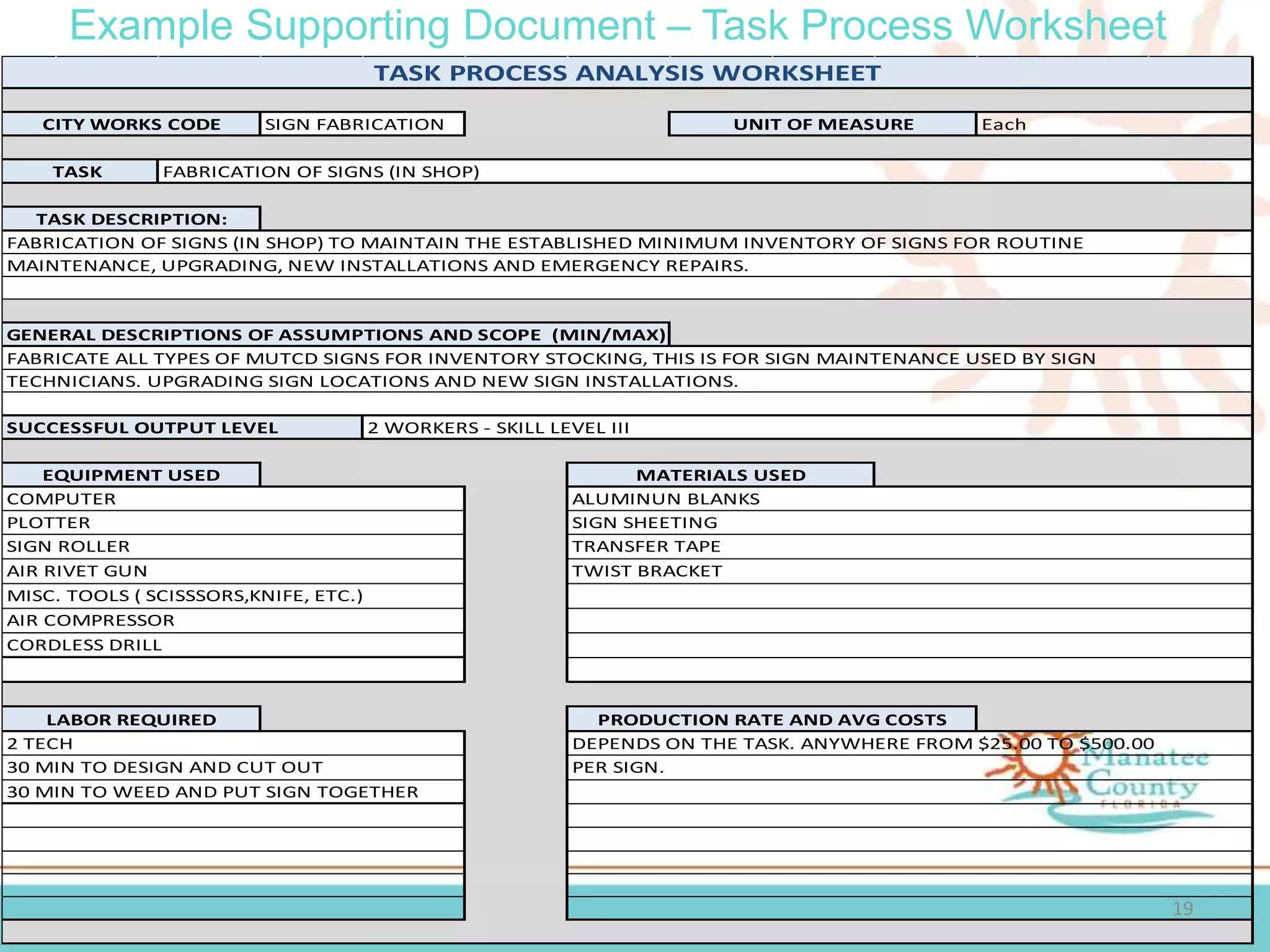
Example Supporting Document – Task Process Worksheet
19
PLOTTER SIGN SHEETING
AIR RIVET GUN
MISC. TOOLS ( SCISSSORS,KNIFE, ETC.)
TWIST BRACKET
EQUIPMENT USED MATERIALS USED
GENERAL DESCRIPTIONS OF ASSUMPTIONS AND SCOPE (MIN/MAX)
FABRICATE ALL TYPES OF MUTCD SIGNS FOR INVENTORY STOCKING, THIS IS FOR SIGN MAINTENANCE USED BY SIGN
TECHNICIANS. UPGRADING SIGN LOCATIONS AND NEW SIGN INSTALLATIONS.
SUCCESSFUL OUTPUT LEVEL 2 WORKERS - SKILL LEVEL III
COMPUTER ALUMINUN BLANKS
TASK PROCESS ANALYSIS WORKSHEET
CITY WORKS CODE SIGN FABRICATION UNIT OF MEASURE Each
TASK FABRICATION OF SIGNS (IN SHOP)
TASK DESCRIPTION:
FABRICATION OF SIGNS (IN SHOP) TO MAINTAIN THE ESTABLISHED MINIMUM INVENTORY OF SIGNS FOR ROUTINE
MAINTENANCE, UPGRADING, NEW INSTALLATIONS AND EMERGENCY REPAIRS.
SIGN ROLLER TRANSFER TAPE
LABOR REQUIRED PRODUCTION RATE AND AVG COSTS
AIR COMPRESSOR
CORDLESS DRILL
2 TECH DEPENDS ON THE TASK. ANYWHERE FROM $25.00 TO $500.00
30 MIN TO DESIGN AND CUT OUT PER SIGN.
30 MIN TO WEED AND PUT SIGN TOGETHER
20
1
2
3
4
5
6
7
8
9
10
TASK PROCESS/ STEPS
RECEIVE SIGN REQUEST
DESIGN SIGN (SEE ATTACHEMENT)
CUT OUT SIGN
WEED SIGN
MAINTAIN STOCK INVENTORY OF SIGNS
TRANSFER SIGN TO ALUM BLANK
REMOVE TRANSFER TAPE
STREET MARKER ASSEMBLY: AFTER APPLYING TO ALUM BLANKS POP RIVET END OF BLANKS TOGETHER.
PUT SIDE STREET ON TWIST BRACKET FIRST THEN ON STREET ON TOP OF TWIST BRACKET.
QUALITY CONTROL REQUIREMENTS
APPLY TRANSFER TAPE
CHECK FOR EVEN BORDERS
STRAIGHT LETTERS
CLEAN EDGES
WORDS ARE SPELLED CORRECTLY
SAFETY CONSIDERATIONS
DO NOT CUT YOUR SELF WHEN WEEDING SIGN AND TRIMMING AROUND ALUM BLANK.
Example Supporting Document – Inspection Log
21
Example Supporting Document – GIS Layer Map
22
Recap- What is the CMP ?
23
Living Maintenance Plan Document
Comprised of Several Source Documents
Defines Each Core Service Function (CSF)
Defines Procedures, Tasks and Objectives for Each CSF
– Challenges
• Creating a Scalable Solution
• Staff Buy In/ Support
• Resources
• Building the System
– Opportunities
• Creative Funding Options
• Change in the Culture of Public Works (ACE)
• Changes Leadership/ Staff
• Technology
Challenges / Opportunities
24
• Strategize then plan
• Use resources creatively
• Don’t over commit staff
• Define Program Measures early
• Stick to the plan
• Be ready to change the plan
Lessons Learned
25
Manatee County
Comprehensive Maintenance Plan
for
Traffic Control Devices
• Questions??
26

Cmp presentation 3 21-16

  • 1.
    Manatee County Comprehensive MaintenancePlan (CMP) for Traffic Control Devices Presented by: Aaron Burkett Traffic Operations Division Manager Cory Miles Traffic Control Technician Supervisor Michael Chesley Traffic Signs and Markings Supervisor April 19, 2016 1
  • 2.
    Introductions • Aaron Burkett •Traffic Operations Division Manager • 17 years experience in Traffic Operations • Cory Miles • Traffic Control Supervisor • 12 years experience in Public Works and Traffic Signal Maintenance • Michael Chesley • Traffic Signs and Marking Supervisor • 12 years experience in Traffic Sign and Pavement Marking Maintenance 2
  • 3.
    Presentation Objectives 3 • History/Development • What is the CMP • CMP Overview • Challenges/ Opportunities • Lessons Learned • Peer Review
  • 4.
    • Traffic OperationsDivision About Us Our Core Mission Past Maintenance Practices • Impetus for CMP Development Plan Organization New Systems Support Economy History/ Development 4
  • 5.
    What is theCMP ??? 5  The Comprehensive Maintenance Plan (CMP) is a living document comprised of various supporting documents which serve to define our Core Service Functions and identify the procedures, tasks and objectives required to accomplish our mission.  It is based on the strategy of attaining a high level of accountability by outlining a methodical and measureable approach to maintenance.
  • 6.
  • 7.
    CMP Overview - CoreService Function Components 7 • Maintenance Procedure Outline o Scope of Services o Inventory Procedures o Inspection Procedures o Maintenance Priorities o Maintenance Procedures • Supporting Documents
  • 8.
    CMP Overview -Scope of Services • A Scope of Services is outlined within each Core Service Function • It defines the general parameters of that maintenance function to include who it serves, what it does, when, why and how. 8
  • 9.
    Example Scope ofServices: Traffic Signal CSF 9 Maintenance Procedure Outline 1. Scope of Services: The Traffic Operations Division provides preventive and reactive maintenance services for all County owned signalized intersections located within unincorporated areas of Manatee County. These same services are also provided for signalized intersections located within FDOT right-of-way and within the districts of the City of Palmetto, City of Holmes Beach and City of Bradenton Beach. The Division provides services to maintain all traffic signal assemblies and associated components to include, but not limited to, all underground and above ground traffic signal supports, components, electrical and electronic devices, signals, signs, operating hardware and software. The Division is responsible to maintain all service records and reports and produce these records upon request. Traffic Operations Division staff are trained and resourced to provide immediate response for any after-hours traffic signal problem that may occur 24 hours a day, seven days a week to include weekends and holidays. The Division is required to implement this maintenance program to ensure proper maintenance and operation of traffic control devices in accordance with all applicable standards, codes, policies, procedures and maintenance agreements. The Division shall ensure acceptable levels of service and quality control are maintained. Annual maintenance objectives are developed each year and a static copy is maintained within the Supporting Documents section of the manual.
  • 10.
    CMP Overview –Inventory Procedures 10 • Data collection • Spreadsheets • GIS • Cityworks/ Storeroom
  • 11.
    Example Inventory Procedures 11 1.Inventory Procedures  Accurate and up to date Traffic Signal Inventories shall be maintained on a continual basis.  Field and Warehouse Inventory Snapshots shall be taken every 6 months and archived.  An intersection folder shall be maintained on the Traffic Division Share Drive for the purposes of maintaining specific intersection documents and related data.  Detailed inventory information including, but not limited to; location, ID number, quantity, type, ownership, installation date, configuration, software, model, brand, asset number, plans, drawings, as built documents and other related source documentation shall be maintained within each folder.  The Traffic Inspector shall collect all field inventory data during project inspections and annual inspection procedures.  The Traffic Inspector shall update the intersection folder for each location accordingly.  The Traffic Inspector shall maintain and continually update an Inventory Excel spreadsheet summarizing all Traffic Signal Inventories data. (See attached Inventory Spreadsheet)  Traffic Signal ‘As Built’ documents to include shop drawings shall be filed within the appropriate intersection folder. A copy shall be provide to the Utilities Department staff for the purposes of updating the GIS Utility layer to enable effective locate services.  Field and Warehouse material inventories shall be maintained to include specific material types, quantities, part numbers, Clerk of Court asset ID numbers, costs, vendors and warehouse locations.
  • 12.
    CMP Overview –Inspection Procedures 12 • Frequency • Process • Documentation • Project Inspections
  • 13.
    Example Inspection Procedures 13 1.Inspection Procedures  Each traffic signal shall receive a preventive maintenance inspection at least one time annually by the Traffic Inspector.  A Traffic Signal Inspection Log is maintained and is used to track the location, time and date of inspection and the inspectors’ name.  A Traffic Signal Inspection Form shall be filled out during each traffic signal inspection for each location.  All deficiencies found during the inspection shall be noted on the traffic signal inspection form and a copy of the form shall be provided to the Supervisor.  The Supervisor shall review the inspection forms and prioritize repairs with the maintenance crew accordingly.  All inspection and maintenance activities shall be recorded on Cityworks daily worksheets. These worksheets shall be processed daily to ensure all information is recorded within the Cityworks database.  All inspection and maintenance activities performed on Non County owned infrastructure shall be coordinated with the infrastructure owner prior to scheduling work.  Inspections of new infrastructure relating to CIP or Developer projects shall be scheduled and performed as needed. The Traffic Inspector shall coordinate all inspection activities with the Traffic Design Division.  Completed Inspection Forms shall be scanned and filed in the appropriate intersection folder.
  • 14.
    CMP Overview –Maintenance Priorities 14 • Inspection results • Safety considerations • Roadway functional classification (i.e. thoroughfares and evacuation routes first) • Traffic volumes • Device type, age and condition • Infrastructure Life Cycles • Ownership
  • 15.
    CMP Overview –Maintenance Procedures 15 • Preventive (Light/ Heavy) • Reactive • Design • Programmed
  • 16.
    Example Maintenance Procedures 16 Traffic Signal Maintenance is categorized by type; o Preventive, (Light/ Heavy) o Reactive, o Design o Programmed  The Division prioritizes tasks and assigns crews to support each maintenance type based on current needs, available resources and the maintenance priorities identified within this manual.  Each crew shall consist of a minimum of 2 Technicians for safety.  (Light) Preventive maintenance is performed on a daily basis. A Preventive Maintenance Crew is assigned each day (as needs and resources permit) to perform routine preventive maintenance services to traffic signals. This crew performs light maintenance in accordance with the inspection items contained within the Traffic Signal Inspection Form. The crew corrects minor punch list items noted by the Traffic Inspector. This crew may respond to trouble calls as needed.  The crew documents on the Traffic Signal Inspection form corrective action taken for punch list items, any items not completed and date PM was performed then submits the form the Supervisor to process. Once all items noted on the form are corrected it is then archived within the Intersection Share Drive Folder.  Heavy maintenance items noted on the Traffic Signal Inspection Form are prioritized and scheduled as needed. This includes items such as Traffic Signal Mast Arm (TSMA) inspection punch list items.  Heavy Maintenance includes intersection overhaul work, heavy maintenance items found during inspections by the Traffic Inspector, special requests for signal work and reactive trouble calls as needed.  Reactive maintenance needs are assigned as needs and resources dictate.  Design Maintenance includes special project requests for installation of new equipment or modification of existing equipment to improve performance or safety. These tasks shall be prioritized and scheduled as resources, funding dictate.  Programmed maintenance encompasses tasks which are specific to a type of device which requires special attention due to the nature of the device, scale of the project or recurring needs.  Programmed maintenance items include weekly detector maintenance, illuminated street name sign maintenance, audible pedestrian signal maintenance, uninterruptible power supply maintenance, MMU testing maintenance and others.  Crews are assigned programmed maintenance tasks as needs, resources and maintenance schedules dictate.  Specific procedures and schedules for programmed maintenance items are outlined within the Task Process Worksheets.  All activities for each crew to include labor, equipment and material shall be noted on a daily work ticket for each project or location and submitted on a daily basis.  To ensure safety and quality Task Process Analysis Worksheets have been developed for each traffic signal maintenance task within City Works.
  • 17.
    • Task ProcessWorksheets • Inventories • Logs • Maps • Annual Maintenance Objectives CMP Overview – Supporting Documents 17
  • 18.
    Example Supporting Document– Inventory Spreadsheet 18
  • 19.
    Example Supporting Document– Task Process Worksheet 19 PLOTTER SIGN SHEETING AIR RIVET GUN MISC. TOOLS ( SCISSSORS,KNIFE, ETC.) TWIST BRACKET EQUIPMENT USED MATERIALS USED GENERAL DESCRIPTIONS OF ASSUMPTIONS AND SCOPE (MIN/MAX) FABRICATE ALL TYPES OF MUTCD SIGNS FOR INVENTORY STOCKING, THIS IS FOR SIGN MAINTENANCE USED BY SIGN TECHNICIANS. UPGRADING SIGN LOCATIONS AND NEW SIGN INSTALLATIONS. SUCCESSFUL OUTPUT LEVEL 2 WORKERS - SKILL LEVEL III COMPUTER ALUMINUN BLANKS TASK PROCESS ANALYSIS WORKSHEET CITY WORKS CODE SIGN FABRICATION UNIT OF MEASURE Each TASK FABRICATION OF SIGNS (IN SHOP) TASK DESCRIPTION: FABRICATION OF SIGNS (IN SHOP) TO MAINTAIN THE ESTABLISHED MINIMUM INVENTORY OF SIGNS FOR ROUTINE MAINTENANCE, UPGRADING, NEW INSTALLATIONS AND EMERGENCY REPAIRS. SIGN ROLLER TRANSFER TAPE LABOR REQUIRED PRODUCTION RATE AND AVG COSTS AIR COMPRESSOR CORDLESS DRILL 2 TECH DEPENDS ON THE TASK. ANYWHERE FROM $25.00 TO $500.00 30 MIN TO DESIGN AND CUT OUT PER SIGN. 30 MIN TO WEED AND PUT SIGN TOGETHER
  • 20.
    20 1 2 3 4 5 6 7 8 9 10 TASK PROCESS/ STEPS RECEIVESIGN REQUEST DESIGN SIGN (SEE ATTACHEMENT) CUT OUT SIGN WEED SIGN MAINTAIN STOCK INVENTORY OF SIGNS TRANSFER SIGN TO ALUM BLANK REMOVE TRANSFER TAPE STREET MARKER ASSEMBLY: AFTER APPLYING TO ALUM BLANKS POP RIVET END OF BLANKS TOGETHER. PUT SIDE STREET ON TWIST BRACKET FIRST THEN ON STREET ON TOP OF TWIST BRACKET. QUALITY CONTROL REQUIREMENTS APPLY TRANSFER TAPE CHECK FOR EVEN BORDERS STRAIGHT LETTERS CLEAN EDGES WORDS ARE SPELLED CORRECTLY SAFETY CONSIDERATIONS DO NOT CUT YOUR SELF WHEN WEEDING SIGN AND TRIMMING AROUND ALUM BLANK.
  • 21.
    Example Supporting Document– Inspection Log 21
  • 22.
    Example Supporting Document– GIS Layer Map 22
  • 23.
    Recap- What isthe CMP ? 23 Living Maintenance Plan Document Comprised of Several Source Documents Defines Each Core Service Function (CSF) Defines Procedures, Tasks and Objectives for Each CSF
  • 24.
    – Challenges • Creatinga Scalable Solution • Staff Buy In/ Support • Resources • Building the System – Opportunities • Creative Funding Options • Change in the Culture of Public Works (ACE) • Changes Leadership/ Staff • Technology Challenges / Opportunities 24
  • 25.
    • Strategize thenplan • Use resources creatively • Don’t over commit staff • Define Program Measures early • Stick to the plan • Be ready to change the plan Lessons Learned 25
  • 26.
    Manatee County Comprehensive MaintenancePlan for Traffic Control Devices • Questions?? 26