International Journal of Trend in Scientific Research and Development, Volume 1(4), ISSN: 2456-6470
www.ijtsrd.com
737
IJTSRD | May - June 2017
Available Online@www.ijtsrd.com
Clustered Genetic Algorithm to solve Multidimensional
Knapsack Problem
Dr. Prabha Shreeraj Nair
Dean Research
Tulsiramji Gayakwade Patil College of Engineering and Technology, Nagpur
ABSTRACT
Genetic Algorithm (GA) has emerged as a powerful
tool to discover optimal for multidimensional
knapsack problem (MDKP). Multidimensional
knapsack problem has recognized as NP-hard problem
whose applications in many areas like project
selection, capital budgeting, loading problems, cutting
stock etc. Attempts has made to develop cluster
genetic algorithm (CGA) by mean of modified
selection and modified crossover operators of GA.
Clustered genetic algorithm consist of (1) fuzzy
roulette wheel selection for individual selection to
form the mating pool (2) A different kind of crossover
operator which employ hierarchical clustering method
to form two clusters from individuals of mating pool.
CGA performance has examined against GA with
respect to 30 benchmark problems for multi-
dimensional knapsack. Experimental results show that
CGA has significant improvement over GA in relation
to discover optimal and CPU running time. The data
set for MDKP is available at
http://people.brunel.ac.uk/
mastjjb/jeb/orlib/files/mknap2.txt
Keywords: Multidimensional knapsack problem,
Genetic algo-rithm, Fitness function, Crossover,
Mutation
1 INTRODUCTION
Multidimensional knapsack problem is one of the
famous problem in applied mathematics belongs to
NP- hard combi-natorial optimization [1]. This
problem modeling has applied in several project
selection and capital budgeting areas [2-4]. Meirier
developed more mechanisms from real word practice
to combine models of capital budgeting with novels,
and practically applicable technique for evaluation of
project [5]. They developed scenario dependent
capital budgeting model that have MDKP as a
subproblem associated with constraint of generalized
upper bound (GUB). Capital budgeting emerged as
key challenge for not for profits multihospital
healthcare units in United States. D.N. Kleinmuntz
and C.E. Kleinmuntz developed a framework for
capital budeting which used MDKP formulations [6].
MDKP have been employed to model prob-lems like
investment policy in tourism area of developing
country [7], database allocation and processor
allocation in distributed computing environments [8],
groceries delivery in vehicles with multiple
compartments [9], cutting stock [10], loading
problems [11] and approval voting [12]. Currently,
MDKP has been applied in modeling of daily
management of remote satellite like SPOT, which
consisted in deciding each day what photographs will
be attempted the next day [13].
Multidimensional knapsack problem is described by n
objects and m knapsacks. Each knapsack has a
capacity dj (j = 1; 2; 3:::m). A number of binary
variables xi (i = 1; 2; 3::n) are used, that is set to 1 if
ith
object is chosen to inset in knapsacks otherwise it
is set to 0. Each object has a profit value pi (i = 1; 2;
3::n) and a weight wij corresponding to knapsacks.
Thus mathematically this optimization problem can be
modeled as :
The goal of MDKP is to insert a subset of objects into
knapsacks that obtain maximum profit without
International Journal of Trend in Scientific Research and Development (IJTSRD) ISSN: 2456-6470
738
IJTSRD | May - June 2017
Available Online@www.ijtsrd.com
capacity viola-tion of knapsacks. This characteristic
reveal this problem has all nonnegative entries. More
specifically, we can say pi > 0,
Rest of the paper is structured as follows. Genetic
algorithm for MDKP is described in Section II.
Section III give the overview of related work for
MDKP in domain of genetic algorithm. Section IV
explain CGA to solve multidimensional knapsack
problem. Experimental environments and results are
given in Section V. At last conclusion is made in
section VI.
II. GENETIC ALGORITHM FOR
MULTIDIMENSIONAL KNAPSACK
PROBLEM
Genetic algorithm is computation optimization
technique which mimic the evolutionary principle i.e.
fittest individual will survive in each generation. GA
is guided by three main operation: selection, crossover
and mutation. Individuals re-production are governed
by crossover and mutation operation. Selection
operation choose fittest individuals from population to
form mating pool. Algorithm run as follow : A set of
random individuals are produced which serve as the
initial population of GA. The individual can be
expressed in real number, binary number, integer
number, character based on nature of problem. MDKP
uses the binary representation. Individual goodness
measurement is estimated through fitness function.
MDKP fitness function is maximize the objective
function.
Algorithm 1 Genetic Algorithm (GA)
Initialize the control parameters ;
Initialize randomly N individuals as initial
population P
(G); while stopping criterion(s) doesn’t meet do
i. Choose individuals to create mating pool
via selection operator.
ii.Produce new individuals via crossover
operator.
iii. Mutate obtained individuals using mutation
operator.
iv. Evaluate fitness value of new individuals.
v. Add new individuals with population.
vi. Sort population with respect to fitness
value.
vii. Choose top N individuals as population of
next generation.
end while
Return the fittest individual as the solution.
Every individual are transformed from one generation
to next generation depending on fitness value i.e
individual with high fitness value has high probability
to participate in upcoming generation. GA employee
crossover operator for exploration and mutation
operator for exploitation. MDKP uses one point
crossover and random mutation. Number of crossover
operations are govern through crossover rate while
number of mutation operations are govern through
mutation rate. A cycle of GA comprise of applying
GA operations i.e. evaluation, reproduction, crossover
and mutation. Each generation produce a set of
individuals. GA termination return the fittest
individual as solution. The details of GA operators i.e
selection, crossover, and mutation are explained in
[14].
III. RELATED WORK
J.P. Martin and C.B Neto and M.K. Crocomo made
compar-ison among four linkage learning based
genetic algorithm for multidimensional knapsack
problem namely, extended com-pact genetic
algorithm (eCGA), bayesian optimization algo-rithm
(BOA) with detection graphs, BOA with community
detection and linkage tree genetic algorithm (LTGA)
[15]. eCGA and LTGA have better exploration and
exploitation capabilities than BOA versions with
small size population (N=100) and produce better
quality solutions for MDKPs. All algorithms with
large population size produce approxi-mately similar
quality solutions for MDKPs but these have different
running time and function evaluations. When con-
sider solutions quality, functions evaluations and
International Journal of Trend in Scientific Research and Development (IJTSRD) ISSN: 2456
IJTSRD | May - June 2017
Available Online@www.ijtsrd.com
running time of algorithms, BOA versions have better
running time than eCGA and LTGA. It is very
difficult to make comparison for computational time
between eCGA and LTGA because these have
different reproduction operators.
Khuri, Back and Heitkotter proposed a GA f
MDKP [16]. Algorithm allowed breeding and
participation of infeasi-ble solutions during search. In
this GA, reproduction proceeds by combining the
partial information from all element of population. A
test suite with few problems were used to test t
GA; only moderate quality solutions were produced.
Hoff, Lokentangen and Mittet proposed a GA with
proper tuned parameters and search mechanisms in
which only feasible solutions were allowed during
search [17]. This GA discovered optimal for 54
problems out a suite of 55 problems.
Rudolph and Sprave proposed a GA in which
selection of parent is not unrestricted as in standard
GA but is restricted be-tween neighboring solutions
[18]. In their GA every infeasible solutions were
penalized as GA of Khursi, Back and Heitkotter
The premier component of this GA be solutions local
interaction with in a spatial structured population and
self ad-justed controlling mechanism of selection
pressure. P. C. Chu and J.E. Beasley proposed
heuristic dependent GA for MDKP [19].
heuristic operator was employed which work with
problem specific knowledge. Heuristic operator
repaired infeasible solutions and algorithm discover
optimal solution among feasible solutions. C. Cota
and J.M. Troya proposed another GA which have an
improvement mechanism whose objective is to
convert infeasible solutions in search space to feasible
solutions [20]. Experimental results were better to
basic GA, but not as good as Chu and Beasley’s GA
results.
IV. CLUSTERED GENETIC ALGORI
MULTIDMENSIONAL KNAPSACK PROBLEM
In this work, clustered genetic algorithm is developed
for multidimensional knapsack problem. CGA is
explained in algorithm 2. CGA uses an advanced
selection method which employee fuzzy and roulette
wheel selection called fuzzy roulette wheel selection.
Selection mechanism always choose first individual
and assigned it to first partition of roulette wheel.
International Journal of Trend in Scientific Research and Development (IJTSRD) ISSN: 2456
me of algorithms, BOA versions have better
running time than eCGA and LTGA. It is very
difficult to make comparison for computational time
between eCGA and LTGA because these have
Khuri, Back and Heitkotter proposed a GA for 0/1
Algorithm allowed breeding and
ble solutions during search. In
this GA, reproduction proceeds by combining the
partial information from all element of population. A
test suite with few problems were used to test this
GA; only moderate quality solutions were produced.
Hoff, Lokentangen and Mittet proposed a GA with
proper tuned parameters and search mechanisms in
which only feasible solutions were allowed during
search [17]. This GA discovered optimal for 54
Rudolph and Sprave proposed a GA in which
selection of parent is not unrestricted as in standard
tween neighboring solutions
[18]. In their GA every infeasible solutions were
Back and Heitkotter [16].
The premier component of this GA be solutions local
interaction with in a spatial structured population and
justed controlling mechanism of selection
pressure. P. C. Chu and J.E. Beasley proposed
[19]. In their GA
heuristic operator was employed which work with
problem specific knowledge. Heuristic operator
repaired infeasible solutions and algorithm discover
optimal solution among feasible solutions. C. Cota
A which have an
improvement mechanism whose objective is to
convert infeasible solutions in search space to feasible
solutions [20]. Experimental results were better to
basic GA, but not as good as Chu and Beasley’s GA
CLUSTERED GENETIC ALGORITHM FOR
MULTIDMENSIONAL KNAPSACK PROBLEM
In this work, clustered genetic algorithm is developed
for multidimensional knapsack problem. CGA is
explained in algorithm 2. CGA uses an advanced
selection method which employee fuzzy and roulette
n called fuzzy roulette wheel selection.
Selection mechanism always choose first individual
and assigned it to first partition of roulette wheel.
Partition size is relative to fitness value. Next
similarity value between first individual and
remaining individuals are estimated. The individual
with highest similarity value occupy the second
partition of roulette wheel. This procedure repeat until
all individuals are allocated to partition in roulette
wheel. Figure 1 show the 4 individuals in binary
representation and procedure of assigning individual
to the partition of roulette wheel. Then mechanism
determined overlapping area between adjacent
individuals. Overlapping area size is correlated by
similarity value between adjacent individuals. In
mating pool formation, a random number is
generated. After for each individual membership
degree to which generated number belongs is
calculated. Individual with highest membership
degree is selected. This process repeat until mating
pool size is equal to population siz
the fuzzy roulette wheel selection mechanism for 4
individuals in Figure 1.
Fig. 1: Procedure of assigning individual to partition
of roulette wheel .
CGA adopt a special crossover operator which uses
the hierarchical algorithm to
Individuals in the mating pool are divided into two
clusters using hierarchical clustering algorithm. In the
hierarchical algorithm, single linkage procedure given
in eq (2) is apply to estimate similarity between the
two clusters.
Fig. 2: Fuzzy roulette wheel
S(X; Y ) = M AX fs(x; y)g
x2X;y2Y
International Journal of Trend in Scientific Research and Development (IJTSRD) ISSN: 2456-6470
739
Partition size is relative to fitness value. Next
similarity value between first individual and
viduals are estimated. The individual
with highest similarity value occupy the second
partition of roulette wheel. This procedure repeat until
all individuals are allocated to partition in roulette
wheel. Figure 1 show the 4 individuals in binary
ation and procedure of assigning individual
to the partition of roulette wheel. Then mechanism
determined overlapping area between adjacent
individuals. Overlapping area size is correlated by
similarity value between adjacent individuals. In
rmation, a random number is
generated. After for each individual membership
degree to which generated number belongs is
calculated. Individual with highest membership
degree is selected. This process repeat until mating
pool size is equal to population size. Figure 2 show
the fuzzy roulette wheel selection mechanism for 4
Fig. 1: Procedure of assigning individual to partition
of roulette wheel .
CGA adopt a special crossover operator which uses
the hierarchical algorithm to form clusters.
Individuals in the mating pool are divided into two
clusters using hierarchical clustering algorithm. In the
hierarchical algorithm, single linkage procedure given
in eq (2) is apply to estimate similarity between the
2: Fuzzy roulette wheel.
S(X; Y ) = M AX fs(x; y)g (4)
x2X;y2Y
International Journal of Trend in Scientific Research and Development (IJTSRD) ISSN: 2456-6470
740
IJTSRD | May - June 2017
Available Online@www.ijtsrd.com
Where X and Y are two clusters and s(x,y) stand for
similarity between individuals x and y. A pair of
offsprings are generated by mating of a random parent
from first cluster and a random parent from second
cluster. One point crossover operator is employed.
This step is continued N/2-1 times. Random mutation
is performed for each offspring to keep diversity and
to defeat the problem of premature convergence.
Fig. 3: Selection of parent pair for crossover.
Fig. 4: One point crossover.
V. EXPERIMENTAL RESULTS AND
DISCUSSION
To show CGA is better technique to GA, experiments
has carried out over 30 standard problems for
multidimensional knapsack.
Algorithm 2 Clustered Genetic Algorithm (CGA)
Initialize the control parameters ;
Initialize randomly N individuals as initial
population P (G); while stopping criterion(s)
doesn’t meet do
i.Choose individuals to create mating pool via
fuzzy roulette wheel selection operator.
ii. Create two clusters of individuals using
hierarchical clustering algorithm .
iii. (iii)Produce new individuals by using
crossover operator with a random parent
from cluster 1 and a random parent from
cluster 2.
iv. Mutate obtained individuals using mutation
operator.
v.Evaluate fitness value of new individuals.
vi. Add new individuals with population.
vii. Sort population with respect to fitness value.
viii. Choose top N individuals as population of
next generation.
end while
Return the fittest individual as the solution.
A. Experimental Environment
GA and CGA depict in previous section were imple-
mentd for multidimensional Knapsack. Experiments
were de-signed to estimate average mean error and
average mean execution time for GA and CGA. Data
set for multidimen-sional knapsack is available at
http://people.brunel.ac.uk/ mas-
tjjb/jeb/orlib/files/mknap2.txt. Crossover rate CR =
0.7 and mutation rate MR = 0.01. The experiments
were conducted on 7th generation intel core i-7-7700k
processor (4.2 GHz) and coded in c++ whose
compilation is done using Dev c++ compiler.
Fig. 5: Error comparision between GA and CGA.
International Journal of Trend in Scientific Research and Development (IJTSRD) ISSN: 2456-6470
741
IJTSRD | May - June 2017
Available Online@www.ijtsrd.com
B. Results and Analysis
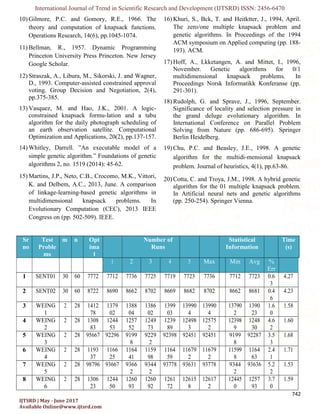
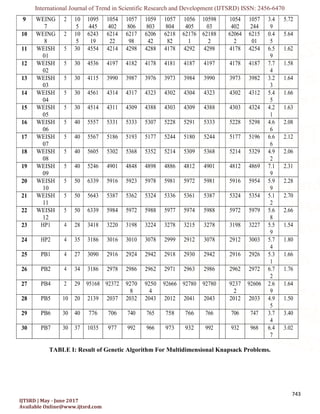
Experimental results of GA and CGA for MDKPs are
given in Table I and Table II respectively. Column 1
denote instance no and column 2 represent MDKP,
column 3 and 4 show number of knapsacks and
number of objects corresponding to problem, columns
5 denotes the optimal value, columns 6-10 keeps the
output value of five run, simulation statical
information is given in columns 11-14 and column 15
show mean time taken in execution. GA and CGA has
average mean error 4.49% and 1.764% respectively
while GA and CGA has average mean execution time
2.34 seconds and 2.34 seconds respectively. CGA has
considerable less average mean error in comparison of
GA but CGA has slightly higher average mean
execution time in comparison of GA. Figure 5 plot the
average mean error against the problem instance and
Figure 6 plot the average mean execution time against
the problem instance.
Fig. 6: CPU running time comparison between GA
and CGA.
VI. CONCLUSION AND FUTURE WORK
This paper addressed multidimensional knapsack
problem via the cluster genetic algorithm to find
optimal. CGA employ the fuzzy roulette selection
mechanism for individual selection to form mating
pool. CGA adopts a special kind of crossover operator
in which uses hierarchical clustering algorithm to
form two clusters from mating pool. A pair of
offspring is generated by mating of a random parent
from first cluster and a random parent from second
cluster. CGA performance has examined against GA
w.r.t 30 standard MDKPs over two criterion i.e
average mean error and average mean execution time.
As GA and CGA experimental results are shown,
CGA has better performance than GA for MDKP. A
comparative study of different mutation operators
with CGA will be studied in the future work.
REFERENCES
1) Weingartner, H.M. and Ness, D.N., 1967.
Methods for the solution of the multidimensional
0/1 knapsack problem. Operations Research,
15(1), pp.83-103.
2) Petersen, C.C., 1967. Computational experience
with variants of the Balas algorithm applied to the
selection of R&D projects. Management Science,
13(9), pp.736-750.
3) Weingartner, H.M., 1974. Mathematical
programming and the analysis of capital budgeting
problems. London: Kershaw.
4) McMillan, C. and Plaine, D.R., 1973. Resource
allocation via 01 pro-gramming. Decision
Sciences, 4, pp.119-132.
5) Meier, H., Christofides, N. and Salkin, G., 2001.
Capital budgeting under uncertaintyan integrated
approach using contingent claims analysis and
integer programming. Operations Research, 49(2),
pp.196-206.
6) Kleinmuntz, D.N. and Kleinmuntz, C.E., 2001.
Multiobjective capital budgeting in not-for-profit
hospitals and healthcare systems. unpublished
paper, October.
7) Gearing, C.E., Swart, W.W. and Var, T., 1973.
Determining the opti-mal investment policy for
the tourism sector of a developing country.
Management science, 20(4-part-i), pp.487-497.
8) Gavish, B. and Pirkul, H., 1982. Allocation of
databases and processors in a distributed
computing system. Management of Distributed
Data Processing, 31, pp.215-231.
9) Chajakis, E. and Guignard, M., 1992, October. A
model for delivery of groceries in vehicle with
multiple compartments and Lagrangean approx-
imation schemes. In Proceedings of Congreso
Latino Ibero-Americano de Investigacin de
Operaciones e Ingeniera de Sistemas.
International Journal of Trend in Scientific Research and Development (IJTSRD) ISSN: 2456-6470
742
IJTSRD | May - June 2017
Available Online@www.ijtsrd.com
10) Gilmore, P.C. and Gomory, R.E., 1966. The
theory and computation of knapsack functions.
Operations Research, 14(6), pp.1045-1074.
11) Bellman, R., 1957. Dynamic Programming
Princeton University Press Princeton. New Jersey
Google Scholar.
12) Straszak, A., Libura, M., Sikorski, J. and Wagner,
D., 1993. Computer-assisted constrained approval
voting. Group Decision and Negotiation, 2(4),
pp.375-385.
13) Vasquez, M. and Hao, J.K., 2001. A logic-
constrained knapsack formu-lation and a tabu
algorithm for the daily photograph scheduling of
an earth observation satellite. Computational
Optimization and Applications, 20(2), pp.137-157.
14) Whitley, Darrell. ”An executable model of a
simple genetic algorithm.” Foundations of genetic
algorithms 2, no. 1519 (2014): 45-62.
15) Martins, J.P., Neto, C.B., Crocomo, M.K., Vittori,
K. and Delbem, A.C., 2013, June. A comparison
of linkage-learning-based genetic algorithms in
multidimensional knapsack problems. In
Evolutionary Computation (CEC), 2013 IEEE
Congress on (pp. 502-509). IEEE.
16) Khuri, S., Bck, T. and Heitktter, J., 1994, April.
The zero/one multiple knapsack problem and
genetic algorithms. In Proceedings of the 1994
ACM symposium on Applied computing (pp. 188-
193). ACM.
17) Hoff, A., Lkketangen, A. and Mittet, I., 1996,
November. Genetic algorithms for 0/1
multidimensional knapsack problems. In
Proceedings Norsk Informatikk Konferanse (pp.
291-301).
18) Rudolph, G. and Sprave, J., 1996, September.
Significance of locality and selection pressure in
the grand deluge evolutionary algorithm. In
International Conference on Parallel Problem
Solving from Nature (pp. 686-695). Springer
Berlin Heidelberg.
19) Chu, P.C. and Beasley, J.E., 1998. A genetic
algorithm for the multidi-mensional knapsack
problem. Journal of heuristics, 4(1), pp.63-86.
20) Cotta, C. and Troya, J.M., 1998. A hybrid genetic
algorithm for the 01 multiple knapsack problem.
In Artificial neural nets and genetic algorithms
(pp. 250-254). Springer Vienna.
Sr
no
Test
Proble
ms
m n Opt
ima
l
Number of
Runs
Statistical
Information
Time
(s)
1 2 3 4 5 Max Min Avg %
Err
1 SENT01 30 60 7772 7712 7736 7725 7719 7723 7736 7712 7723 0.6
3
4.27
2 SENT02 30 60 8722 8690 8662 8702 8669 8682 8702 8662 8681 0.4
6
4.23
3 WEING
1
2 28 1412
78
1379
02
1388
04
1386
02
1399
03
13990
4
13990
4
13790
2
1390
23
1.6
0
1.58
4 WEING
2
2 28 1308
83
1244
53
1257
52
1249
73
1239
89
12498
3
12575
2
12398
9
1248
30
4.6
2
1.60
5 WEING
3
2 28 95667 92296 9199
8
9229
2
92398 92451 92451 9199
8
92287 3.5
3
1.68
6 WEING
4
2 28 1193
37
1166
25
1164
41
1159
98
1164
59
11679
2
11679
2
11599
8
1164
63
2.4
1
1.71
7 WEING
5
2 28 98796 93667 9366
2
9344
2
93778 93631 93778 9344
2
93636 5.2
2
1.53
8 WEING
6
2 28 1306
23
1244
50
1260
93
1260
92
1261
72
12615
8
12617
2
12445
0
1257
93
3.7
0
1.59
International Journal of Trend in Scientific Research and Development (IJTSRD) ISSN: 2456-6470
743
IJTSRD | May - June 2017
Available Online@www.ijtsrd.com
9 WEING
7
2 10
5
1095
445
1054
402
1057
806
1059
803
1057
804
1056
405
10598
03
1054
402
1057
244
3.4
9
5.72
10 WEING
8
2 10
5
6243
19
6214
22
6217
98
6206
42
6218
82
62176
1
62188
2
62064
2
6215
01
0.4
5
5.64
11 WEISH
01
5 30 4554 4214 4298 4288 4178 4292 4298 4178 4254 6.5
9
1.62
12 WEISH
02
5 30 4536 4197 4182 4178 4181 4187 4197 4178 4187 7.7
4
1.58
13 WEISH
03
5 30 4115 3990 3987 3976 3973 3984 3990 3973 3982 3.2
3
1.64
14 WEISH
04
5 30 4561 4314 4317 4323 4302 4304 4323 4302 4312 5.4
5
1.66
15 WEISH
05
5 30 4514 4311 4309 4388 4303 4309 4388 4303 4324 4.2
1
1.63
16 WEISH
06
5 40 5557 5331 5333 5307 5228 5291 5333 5228 5298 4.6
6
2.08
17 WEISH
07
5 40 5567 5186 5193 5177 5244 5180 5244 5177 5196 6.6
6
2.12
18 WEISH
08
5 40 5605 5302 5368 5352 5214 5309 5368 5214 5329 4.9
2
2.06
19 WEISH
09
5 40 5246 4901 4848 4898 4886 4812 4901 4812 4869 7.1
9
2.31
20 WEISH
10
5 50 6339 5916 5923 5978 5981 5972 5981 5916 5954 5.9
9
2.28
21 WEISH
11
5 50 5643 5387 5362 5324 5336 5361 5387 5324 5354 5.1
2
2.70
22 WEISH
12
5 50 6339 5984 5972 5988 5977 5974 5988 5972 5979 5.6
8
2.66
23 HP1 4 28 3418 3220 3198 3224 3278 3215 3278 3198 3227 5.5
9
1.54
24 HP2 4 35 3186 3016 3010 3078 2999 2912 3078 2912 3003 5.7
4
1.80
25 PB1 4 27 3090 2916 2924 2942 2918 2930 2942 2916 2926 5.3
1
1.66
26 PB2 4 34 3186 2978 2986 2962 2971 2963 2986 2962 2972 6.7
2
1.76
27 PB4 2 29 95168 92372 9270
8
9250
4
92666 92780 92780 9237
2
92606 2.6
9
1.64
28 PB5 10 20 2139 2037 2032 2043 2012 2041 2043 2012 2033 4.9
5
1.50
29 PB6 30 40 776 706 740 765 758 766 766 706 747 3.7
4
3.40
30 PB7 30 37 1035 977 992 966 973 932 992 932 968 6.4
7
3.02
TABLE I: Result of Genetic Algorithm For Multidimensional Knapsack Problems.
International Journal of Trend in Scientific Research and Development (IJTSRD) ISSN: 2456-6470
744
IJTSRD | May - June 2017
Available Online@www.ijtsrd.com
Sr
no
Test
Proble
ms
m n Opt
ima
l
Number of
Runs
Statistical
Information
Time
(s)
1 2 3 4 5 Ma
x
Min Avg %Er
r
1 SENT01 30 60 7772 7762 7746 7758 7752 7747 776
2
7746 7754 0.23 4.95
2 SENT02 30 60 8722 8712 8707 8705 8716 8710 871
6
8705 8710 0.14 4.89
3 WEING1 2 28 1412
78
1401
77
1401
83
1401
96
1401
78
14077
1
140
771
14017
7
1403
01
0.69 1.83
4 WEING2 2 28 1308
83
1278
62
1278
04
1281
08
1279
03
12799
3
127
993
12780
4
1279
934
2.25 1.82
5 WEING3 2 28 95667 94570 9458
2
9444
8
94684 94556 945
82
9444
8
94568 1.15 1.85
6 WEING4 2 28 1193
37
1179
82
1179
47
1178
92
1179
32
11794
2
117
982
11789
2
1179
39
1.17 1.92
7 WEING5 2 28 98796 96694 9670
2
9688
4
96879 96861 968
79
9669
4
96804 2.02 1.77
8 WEING6 2 28 1306
23
1285
03
1286
64
1287
04
1286
30
12863
9
128
704
12850
3
1286
28
1.53 1.91
9 WEING7 2 10
5
1095
445
1074
998
1076
681
1075
662
1074
552
1073
902
107
668
1
1073
902
1075
159
1.85 6.10
10 WEING8 2 10
5
6243
19
6231
10
6229
90
6231
84
6232
08
62311
3
623
208
62299
0
6231
21
0.19 6.08
11 WEISH01 5 30 4554 4428 4462 4448 4436 4461 446
2
4428 4447 2.35 1.93
12 WEISH02 5 30 4536 4402 4398 4372 4410 4403 440
3
4372 4397 3.06 1.87
13 WEISH03 5 30 4115 4083 4076 4083 4071 4082 408
3
4071 4079 0.87 1.90
14 WEISH04 5 30 4561 4461 4448 4457 4434 4445 446
1
4434 4449 2.46 1.92
15 WEISH05 5 30 4514 4476 4487 4462 4462 4468 448
7
4462 4452 1.00 1.87
16 WEISH06 5 40 5557 5441 5436 5392 5446 5463 546
3
5392 5436 2.18 2.44
17 WEISH07 5 40 5567 5395 5407 5437 5437 5414 543
7
5395 5392 2.83 2.52
18 WEISH08 5 40 5605 5518 5507 5532 5522 5536 553
6
5507 5523 1.46 2.38
19 WEISH09 5 40 5246 5076 5084 5102 5078 5080 510
2
5076 5084 3.09 2.68
20 WEISH10 5 50 6339 6201 6198 6182 6180 6184 620
1
6180 6189 2.37 2.76
21 WEISH11 5 50 5643 5558 5537 5529 5568 5568 556
8
5529 5552 1.61 3.07
22 WEISH12 5 50 6339 6236 6199 6214 6208 6233 623
6
6199 6218 1.91 3.02
International Journal of Trend in Scientific Research and Development (IJTSRD) ISSN: 2456-6470
745
IJTSRD | May - June 2017
Available Online@www.ijtsrd.com
23 HP1 4 28 3418 3368 3332 3357 3362 3341 336
8
3332 3352 1.93 1.82
24 HP2 4 35 3186 3109 3112 3106 3104 3114 311
4
3104 3109 2.42 2.12
25 PB1 4 27 3090 3012 3001 3017 3005 3015 301
7
3001 3010 2.58 1.93
26 PB2 4 34 3186 3094 3088 3116 3098 3089 309
8
3088 3097 2.79 2.06
27 PB4 2 29 95168 94207 9399
8
9410
6
94103 94111 942
07
9399
8
94105 1.12 1.89
28 PB5 10 20 2139 2099 2111 2104 2106 2115 211
5
2099 2107 1.50 1.76
29 PB6 30 40 776 763 758 759 766 769 769 758 763 1.68 3.87
30 PB7 30 37 1035 1008 1017 1012 1006 1002 101
7
1002 1009 2.51 3.49
TABLE II: Result of Clustered Genetic Algorithm for Multidimensional Knapsack Problems.

Clustered Genetic Algorithm to solve Multidimensional Knapsack Problem

  • 1.
    International Journal ofTrend in Scientific Research and Development, Volume 1(4), ISSN: 2456-6470 www.ijtsrd.com 737 IJTSRD | May - June 2017 Available Online@www.ijtsrd.com Clustered Genetic Algorithm to solve Multidimensional Knapsack Problem Dr. Prabha Shreeraj Nair Dean Research Tulsiramji Gayakwade Patil College of Engineering and Technology, Nagpur ABSTRACT Genetic Algorithm (GA) has emerged as a powerful tool to discover optimal for multidimensional knapsack problem (MDKP). Multidimensional knapsack problem has recognized as NP-hard problem whose applications in many areas like project selection, capital budgeting, loading problems, cutting stock etc. Attempts has made to develop cluster genetic algorithm (CGA) by mean of modified selection and modified crossover operators of GA. Clustered genetic algorithm consist of (1) fuzzy roulette wheel selection for individual selection to form the mating pool (2) A different kind of crossover operator which employ hierarchical clustering method to form two clusters from individuals of mating pool. CGA performance has examined against GA with respect to 30 benchmark problems for multi- dimensional knapsack. Experimental results show that CGA has significant improvement over GA in relation to discover optimal and CPU running time. The data set for MDKP is available at http://people.brunel.ac.uk/ mastjjb/jeb/orlib/files/mknap2.txt Keywords: Multidimensional knapsack problem, Genetic algo-rithm, Fitness function, Crossover, Mutation 1 INTRODUCTION Multidimensional knapsack problem is one of the famous problem in applied mathematics belongs to NP- hard combi-natorial optimization [1]. This problem modeling has applied in several project selection and capital budgeting areas [2-4]. Meirier developed more mechanisms from real word practice to combine models of capital budgeting with novels, and practically applicable technique for evaluation of project [5]. They developed scenario dependent capital budgeting model that have MDKP as a subproblem associated with constraint of generalized upper bound (GUB). Capital budgeting emerged as key challenge for not for profits multihospital healthcare units in United States. D.N. Kleinmuntz and C.E. Kleinmuntz developed a framework for capital budeting which used MDKP formulations [6]. MDKP have been employed to model prob-lems like investment policy in tourism area of developing country [7], database allocation and processor allocation in distributed computing environments [8], groceries delivery in vehicles with multiple compartments [9], cutting stock [10], loading problems [11] and approval voting [12]. Currently, MDKP has been applied in modeling of daily management of remote satellite like SPOT, which consisted in deciding each day what photographs will be attempted the next day [13]. Multidimensional knapsack problem is described by n objects and m knapsacks. Each knapsack has a capacity dj (j = 1; 2; 3:::m). A number of binary variables xi (i = 1; 2; 3::n) are used, that is set to 1 if ith object is chosen to inset in knapsacks otherwise it is set to 0. Each object has a profit value pi (i = 1; 2; 3::n) and a weight wij corresponding to knapsacks. Thus mathematically this optimization problem can be modeled as : The goal of MDKP is to insert a subset of objects into knapsacks that obtain maximum profit without
  • 2.
    International Journal ofTrend in Scientific Research and Development (IJTSRD) ISSN: 2456-6470 738 IJTSRD | May - June 2017 Available Online@www.ijtsrd.com capacity viola-tion of knapsacks. This characteristic reveal this problem has all nonnegative entries. More specifically, we can say pi > 0, Rest of the paper is structured as follows. Genetic algorithm for MDKP is described in Section II. Section III give the overview of related work for MDKP in domain of genetic algorithm. Section IV explain CGA to solve multidimensional knapsack problem. Experimental environments and results are given in Section V. At last conclusion is made in section VI. II. GENETIC ALGORITHM FOR MULTIDIMENSIONAL KNAPSACK PROBLEM Genetic algorithm is computation optimization technique which mimic the evolutionary principle i.e. fittest individual will survive in each generation. GA is guided by three main operation: selection, crossover and mutation. Individuals re-production are governed by crossover and mutation operation. Selection operation choose fittest individuals from population to form mating pool. Algorithm run as follow : A set of random individuals are produced which serve as the initial population of GA. The individual can be expressed in real number, binary number, integer number, character based on nature of problem. MDKP uses the binary representation. Individual goodness measurement is estimated through fitness function. MDKP fitness function is maximize the objective function. Algorithm 1 Genetic Algorithm (GA) Initialize the control parameters ; Initialize randomly N individuals as initial population P (G); while stopping criterion(s) doesn’t meet do i. Choose individuals to create mating pool via selection operator. ii.Produce new individuals via crossover operator. iii. Mutate obtained individuals using mutation operator. iv. Evaluate fitness value of new individuals. v. Add new individuals with population. vi. Sort population with respect to fitness value. vii. Choose top N individuals as population of next generation. end while Return the fittest individual as the solution. Every individual are transformed from one generation to next generation depending on fitness value i.e individual with high fitness value has high probability to participate in upcoming generation. GA employee crossover operator for exploration and mutation operator for exploitation. MDKP uses one point crossover and random mutation. Number of crossover operations are govern through crossover rate while number of mutation operations are govern through mutation rate. A cycle of GA comprise of applying GA operations i.e. evaluation, reproduction, crossover and mutation. Each generation produce a set of individuals. GA termination return the fittest individual as solution. The details of GA operators i.e selection, crossover, and mutation are explained in [14]. III. RELATED WORK J.P. Martin and C.B Neto and M.K. Crocomo made compar-ison among four linkage learning based genetic algorithm for multidimensional knapsack problem namely, extended com-pact genetic algorithm (eCGA), bayesian optimization algo-rithm (BOA) with detection graphs, BOA with community detection and linkage tree genetic algorithm (LTGA) [15]. eCGA and LTGA have better exploration and exploitation capabilities than BOA versions with small size population (N=100) and produce better quality solutions for MDKPs. All algorithms with large population size produce approxi-mately similar quality solutions for MDKPs but these have different running time and function evaluations. When con- sider solutions quality, functions evaluations and
  • 3.
    International Journal ofTrend in Scientific Research and Development (IJTSRD) ISSN: 2456 IJTSRD | May - June 2017 Available Online@www.ijtsrd.com running time of algorithms, BOA versions have better running time than eCGA and LTGA. It is very difficult to make comparison for computational time between eCGA and LTGA because these have different reproduction operators. Khuri, Back and Heitkotter proposed a GA f MDKP [16]. Algorithm allowed breeding and participation of infeasi-ble solutions during search. In this GA, reproduction proceeds by combining the partial information from all element of population. A test suite with few problems were used to test t GA; only moderate quality solutions were produced. Hoff, Lokentangen and Mittet proposed a GA with proper tuned parameters and search mechanisms in which only feasible solutions were allowed during search [17]. This GA discovered optimal for 54 problems out a suite of 55 problems. Rudolph and Sprave proposed a GA in which selection of parent is not unrestricted as in standard GA but is restricted be-tween neighboring solutions [18]. In their GA every infeasible solutions were penalized as GA of Khursi, Back and Heitkotter The premier component of this GA be solutions local interaction with in a spatial structured population and self ad-justed controlling mechanism of selection pressure. P. C. Chu and J.E. Beasley proposed heuristic dependent GA for MDKP [19]. heuristic operator was employed which work with problem specific knowledge. Heuristic operator repaired infeasible solutions and algorithm discover optimal solution among feasible solutions. C. Cota and J.M. Troya proposed another GA which have an improvement mechanism whose objective is to convert infeasible solutions in search space to feasible solutions [20]. Experimental results were better to basic GA, but not as good as Chu and Beasley’s GA results. IV. CLUSTERED GENETIC ALGORI MULTIDMENSIONAL KNAPSACK PROBLEM In this work, clustered genetic algorithm is developed for multidimensional knapsack problem. CGA is explained in algorithm 2. CGA uses an advanced selection method which employee fuzzy and roulette wheel selection called fuzzy roulette wheel selection. Selection mechanism always choose first individual and assigned it to first partition of roulette wheel. International Journal of Trend in Scientific Research and Development (IJTSRD) ISSN: 2456 me of algorithms, BOA versions have better running time than eCGA and LTGA. It is very difficult to make comparison for computational time between eCGA and LTGA because these have Khuri, Back and Heitkotter proposed a GA for 0/1 Algorithm allowed breeding and ble solutions during search. In this GA, reproduction proceeds by combining the partial information from all element of population. A test suite with few problems were used to test this GA; only moderate quality solutions were produced. Hoff, Lokentangen and Mittet proposed a GA with proper tuned parameters and search mechanisms in which only feasible solutions were allowed during search [17]. This GA discovered optimal for 54 Rudolph and Sprave proposed a GA in which selection of parent is not unrestricted as in standard tween neighboring solutions [18]. In their GA every infeasible solutions were Back and Heitkotter [16]. The premier component of this GA be solutions local interaction with in a spatial structured population and justed controlling mechanism of selection pressure. P. C. Chu and J.E. Beasley proposed [19]. In their GA heuristic operator was employed which work with problem specific knowledge. Heuristic operator repaired infeasible solutions and algorithm discover optimal solution among feasible solutions. C. Cota A which have an improvement mechanism whose objective is to convert infeasible solutions in search space to feasible solutions [20]. Experimental results were better to basic GA, but not as good as Chu and Beasley’s GA CLUSTERED GENETIC ALGORITHM FOR MULTIDMENSIONAL KNAPSACK PROBLEM In this work, clustered genetic algorithm is developed for multidimensional knapsack problem. CGA is explained in algorithm 2. CGA uses an advanced selection method which employee fuzzy and roulette n called fuzzy roulette wheel selection. Selection mechanism always choose first individual and assigned it to first partition of roulette wheel. Partition size is relative to fitness value. Next similarity value between first individual and remaining individuals are estimated. The individual with highest similarity value occupy the second partition of roulette wheel. This procedure repeat until all individuals are allocated to partition in roulette wheel. Figure 1 show the 4 individuals in binary representation and procedure of assigning individual to the partition of roulette wheel. Then mechanism determined overlapping area between adjacent individuals. Overlapping area size is correlated by similarity value between adjacent individuals. In mating pool formation, a random number is generated. After for each individual membership degree to which generated number belongs is calculated. Individual with highest membership degree is selected. This process repeat until mating pool size is equal to population siz the fuzzy roulette wheel selection mechanism for 4 individuals in Figure 1. Fig. 1: Procedure of assigning individual to partition of roulette wheel . CGA adopt a special crossover operator which uses the hierarchical algorithm to Individuals in the mating pool are divided into two clusters using hierarchical clustering algorithm. In the hierarchical algorithm, single linkage procedure given in eq (2) is apply to estimate similarity between the two clusters. Fig. 2: Fuzzy roulette wheel S(X; Y ) = M AX fs(x; y)g x2X;y2Y International Journal of Trend in Scientific Research and Development (IJTSRD) ISSN: 2456-6470 739 Partition size is relative to fitness value. Next similarity value between first individual and viduals are estimated. The individual with highest similarity value occupy the second partition of roulette wheel. This procedure repeat until all individuals are allocated to partition in roulette wheel. Figure 1 show the 4 individuals in binary ation and procedure of assigning individual to the partition of roulette wheel. Then mechanism determined overlapping area between adjacent individuals. Overlapping area size is correlated by similarity value between adjacent individuals. In rmation, a random number is generated. After for each individual membership degree to which generated number belongs is calculated. Individual with highest membership degree is selected. This process repeat until mating pool size is equal to population size. Figure 2 show the fuzzy roulette wheel selection mechanism for 4 Fig. 1: Procedure of assigning individual to partition of roulette wheel . CGA adopt a special crossover operator which uses the hierarchical algorithm to form clusters. Individuals in the mating pool are divided into two clusters using hierarchical clustering algorithm. In the hierarchical algorithm, single linkage procedure given in eq (2) is apply to estimate similarity between the 2: Fuzzy roulette wheel. S(X; Y ) = M AX fs(x; y)g (4) x2X;y2Y
  • 4.
    International Journal ofTrend in Scientific Research and Development (IJTSRD) ISSN: 2456-6470 740 IJTSRD | May - June 2017 Available Online@www.ijtsrd.com Where X and Y are two clusters and s(x,y) stand for similarity between individuals x and y. A pair of offsprings are generated by mating of a random parent from first cluster and a random parent from second cluster. One point crossover operator is employed. This step is continued N/2-1 times. Random mutation is performed for each offspring to keep diversity and to defeat the problem of premature convergence. Fig. 3: Selection of parent pair for crossover. Fig. 4: One point crossover. V. EXPERIMENTAL RESULTS AND DISCUSSION To show CGA is better technique to GA, experiments has carried out over 30 standard problems for multidimensional knapsack. Algorithm 2 Clustered Genetic Algorithm (CGA) Initialize the control parameters ; Initialize randomly N individuals as initial population P (G); while stopping criterion(s) doesn’t meet do i.Choose individuals to create mating pool via fuzzy roulette wheel selection operator. ii. Create two clusters of individuals using hierarchical clustering algorithm . iii. (iii)Produce new individuals by using crossover operator with a random parent from cluster 1 and a random parent from cluster 2. iv. Mutate obtained individuals using mutation operator. v.Evaluate fitness value of new individuals. vi. Add new individuals with population. vii. Sort population with respect to fitness value. viii. Choose top N individuals as population of next generation. end while Return the fittest individual as the solution. A. Experimental Environment GA and CGA depict in previous section were imple- mentd for multidimensional Knapsack. Experiments were de-signed to estimate average mean error and average mean execution time for GA and CGA. Data set for multidimen-sional knapsack is available at http://people.brunel.ac.uk/ mas- tjjb/jeb/orlib/files/mknap2.txt. Crossover rate CR = 0.7 and mutation rate MR = 0.01. The experiments were conducted on 7th generation intel core i-7-7700k processor (4.2 GHz) and coded in c++ whose compilation is done using Dev c++ compiler. Fig. 5: Error comparision between GA and CGA.
  • 5.
    International Journal ofTrend in Scientific Research and Development (IJTSRD) ISSN: 2456-6470 741 IJTSRD | May - June 2017 Available Online@www.ijtsrd.com B. Results and Analysis Experimental results of GA and CGA for MDKPs are given in Table I and Table II respectively. Column 1 denote instance no and column 2 represent MDKP, column 3 and 4 show number of knapsacks and number of objects corresponding to problem, columns 5 denotes the optimal value, columns 6-10 keeps the output value of five run, simulation statical information is given in columns 11-14 and column 15 show mean time taken in execution. GA and CGA has average mean error 4.49% and 1.764% respectively while GA and CGA has average mean execution time 2.34 seconds and 2.34 seconds respectively. CGA has considerable less average mean error in comparison of GA but CGA has slightly higher average mean execution time in comparison of GA. Figure 5 plot the average mean error against the problem instance and Figure 6 plot the average mean execution time against the problem instance. Fig. 6: CPU running time comparison between GA and CGA. VI. CONCLUSION AND FUTURE WORK This paper addressed multidimensional knapsack problem via the cluster genetic algorithm to find optimal. CGA employ the fuzzy roulette selection mechanism for individual selection to form mating pool. CGA adopts a special kind of crossover operator in which uses hierarchical clustering algorithm to form two clusters from mating pool. A pair of offspring is generated by mating of a random parent from first cluster and a random parent from second cluster. CGA performance has examined against GA w.r.t 30 standard MDKPs over two criterion i.e average mean error and average mean execution time. As GA and CGA experimental results are shown, CGA has better performance than GA for MDKP. A comparative study of different mutation operators with CGA will be studied in the future work. REFERENCES 1) Weingartner, H.M. and Ness, D.N., 1967. Methods for the solution of the multidimensional 0/1 knapsack problem. Operations Research, 15(1), pp.83-103. 2) Petersen, C.C., 1967. Computational experience with variants of the Balas algorithm applied to the selection of R&D projects. Management Science, 13(9), pp.736-750. 3) Weingartner, H.M., 1974. Mathematical programming and the analysis of capital budgeting problems. London: Kershaw. 4) McMillan, C. and Plaine, D.R., 1973. Resource allocation via 01 pro-gramming. Decision Sciences, 4, pp.119-132. 5) Meier, H., Christofides, N. and Salkin, G., 2001. Capital budgeting under uncertaintyan integrated approach using contingent claims analysis and integer programming. Operations Research, 49(2), pp.196-206. 6) Kleinmuntz, D.N. and Kleinmuntz, C.E., 2001. Multiobjective capital budgeting in not-for-profit hospitals and healthcare systems. unpublished paper, October. 7) Gearing, C.E., Swart, W.W. and Var, T., 1973. Determining the opti-mal investment policy for the tourism sector of a developing country. Management science, 20(4-part-i), pp.487-497. 8) Gavish, B. and Pirkul, H., 1982. Allocation of databases and processors in a distributed computing system. Management of Distributed Data Processing, 31, pp.215-231. 9) Chajakis, E. and Guignard, M., 1992, October. A model for delivery of groceries in vehicle with multiple compartments and Lagrangean approx- imation schemes. In Proceedings of Congreso Latino Ibero-Americano de Investigacin de Operaciones e Ingeniera de Sistemas.
  • 6.
    International Journal ofTrend in Scientific Research and Development (IJTSRD) ISSN: 2456-6470 742 IJTSRD | May - June 2017 Available Online@www.ijtsrd.com 10) Gilmore, P.C. and Gomory, R.E., 1966. The theory and computation of knapsack functions. Operations Research, 14(6), pp.1045-1074. 11) Bellman, R., 1957. Dynamic Programming Princeton University Press Princeton. New Jersey Google Scholar. 12) Straszak, A., Libura, M., Sikorski, J. and Wagner, D., 1993. Computer-assisted constrained approval voting. Group Decision and Negotiation, 2(4), pp.375-385. 13) Vasquez, M. and Hao, J.K., 2001. A logic- constrained knapsack formu-lation and a tabu algorithm for the daily photograph scheduling of an earth observation satellite. Computational Optimization and Applications, 20(2), pp.137-157. 14) Whitley, Darrell. ”An executable model of a simple genetic algorithm.” Foundations of genetic algorithms 2, no. 1519 (2014): 45-62. 15) Martins, J.P., Neto, C.B., Crocomo, M.K., Vittori, K. and Delbem, A.C., 2013, June. A comparison of linkage-learning-based genetic algorithms in multidimensional knapsack problems. In Evolutionary Computation (CEC), 2013 IEEE Congress on (pp. 502-509). IEEE. 16) Khuri, S., Bck, T. and Heitktter, J., 1994, April. The zero/one multiple knapsack problem and genetic algorithms. In Proceedings of the 1994 ACM symposium on Applied computing (pp. 188- 193). ACM. 17) Hoff, A., Lkketangen, A. and Mittet, I., 1996, November. Genetic algorithms for 0/1 multidimensional knapsack problems. In Proceedings Norsk Informatikk Konferanse (pp. 291-301). 18) Rudolph, G. and Sprave, J., 1996, September. Significance of locality and selection pressure in the grand deluge evolutionary algorithm. In International Conference on Parallel Problem Solving from Nature (pp. 686-695). Springer Berlin Heidelberg. 19) Chu, P.C. and Beasley, J.E., 1998. A genetic algorithm for the multidi-mensional knapsack problem. Journal of heuristics, 4(1), pp.63-86. 20) Cotta, C. and Troya, J.M., 1998. A hybrid genetic algorithm for the 01 multiple knapsack problem. In Artificial neural nets and genetic algorithms (pp. 250-254). Springer Vienna. Sr no Test Proble ms m n Opt ima l Number of Runs Statistical Information Time (s) 1 2 3 4 5 Max Min Avg % Err 1 SENT01 30 60 7772 7712 7736 7725 7719 7723 7736 7712 7723 0.6 3 4.27 2 SENT02 30 60 8722 8690 8662 8702 8669 8682 8702 8662 8681 0.4 6 4.23 3 WEING 1 2 28 1412 78 1379 02 1388 04 1386 02 1399 03 13990 4 13990 4 13790 2 1390 23 1.6 0 1.58 4 WEING 2 2 28 1308 83 1244 53 1257 52 1249 73 1239 89 12498 3 12575 2 12398 9 1248 30 4.6 2 1.60 5 WEING 3 2 28 95667 92296 9199 8 9229 2 92398 92451 92451 9199 8 92287 3.5 3 1.68 6 WEING 4 2 28 1193 37 1166 25 1164 41 1159 98 1164 59 11679 2 11679 2 11599 8 1164 63 2.4 1 1.71 7 WEING 5 2 28 98796 93667 9366 2 9344 2 93778 93631 93778 9344 2 93636 5.2 2 1.53 8 WEING 6 2 28 1306 23 1244 50 1260 93 1260 92 1261 72 12615 8 12617 2 12445 0 1257 93 3.7 0 1.59
  • 7.
    International Journal ofTrend in Scientific Research and Development (IJTSRD) ISSN: 2456-6470 743 IJTSRD | May - June 2017 Available Online@www.ijtsrd.com 9 WEING 7 2 10 5 1095 445 1054 402 1057 806 1059 803 1057 804 1056 405 10598 03 1054 402 1057 244 3.4 9 5.72 10 WEING 8 2 10 5 6243 19 6214 22 6217 98 6206 42 6218 82 62176 1 62188 2 62064 2 6215 01 0.4 5 5.64 11 WEISH 01 5 30 4554 4214 4298 4288 4178 4292 4298 4178 4254 6.5 9 1.62 12 WEISH 02 5 30 4536 4197 4182 4178 4181 4187 4197 4178 4187 7.7 4 1.58 13 WEISH 03 5 30 4115 3990 3987 3976 3973 3984 3990 3973 3982 3.2 3 1.64 14 WEISH 04 5 30 4561 4314 4317 4323 4302 4304 4323 4302 4312 5.4 5 1.66 15 WEISH 05 5 30 4514 4311 4309 4388 4303 4309 4388 4303 4324 4.2 1 1.63 16 WEISH 06 5 40 5557 5331 5333 5307 5228 5291 5333 5228 5298 4.6 6 2.08 17 WEISH 07 5 40 5567 5186 5193 5177 5244 5180 5244 5177 5196 6.6 6 2.12 18 WEISH 08 5 40 5605 5302 5368 5352 5214 5309 5368 5214 5329 4.9 2 2.06 19 WEISH 09 5 40 5246 4901 4848 4898 4886 4812 4901 4812 4869 7.1 9 2.31 20 WEISH 10 5 50 6339 5916 5923 5978 5981 5972 5981 5916 5954 5.9 9 2.28 21 WEISH 11 5 50 5643 5387 5362 5324 5336 5361 5387 5324 5354 5.1 2 2.70 22 WEISH 12 5 50 6339 5984 5972 5988 5977 5974 5988 5972 5979 5.6 8 2.66 23 HP1 4 28 3418 3220 3198 3224 3278 3215 3278 3198 3227 5.5 9 1.54 24 HP2 4 35 3186 3016 3010 3078 2999 2912 3078 2912 3003 5.7 4 1.80 25 PB1 4 27 3090 2916 2924 2942 2918 2930 2942 2916 2926 5.3 1 1.66 26 PB2 4 34 3186 2978 2986 2962 2971 2963 2986 2962 2972 6.7 2 1.76 27 PB4 2 29 95168 92372 9270 8 9250 4 92666 92780 92780 9237 2 92606 2.6 9 1.64 28 PB5 10 20 2139 2037 2032 2043 2012 2041 2043 2012 2033 4.9 5 1.50 29 PB6 30 40 776 706 740 765 758 766 766 706 747 3.7 4 3.40 30 PB7 30 37 1035 977 992 966 973 932 992 932 968 6.4 7 3.02 TABLE I: Result of Genetic Algorithm For Multidimensional Knapsack Problems.
  • 8.
    International Journal ofTrend in Scientific Research and Development (IJTSRD) ISSN: 2456-6470 744 IJTSRD | May - June 2017 Available Online@www.ijtsrd.com Sr no Test Proble ms m n Opt ima l Number of Runs Statistical Information Time (s) 1 2 3 4 5 Ma x Min Avg %Er r 1 SENT01 30 60 7772 7762 7746 7758 7752 7747 776 2 7746 7754 0.23 4.95 2 SENT02 30 60 8722 8712 8707 8705 8716 8710 871 6 8705 8710 0.14 4.89 3 WEING1 2 28 1412 78 1401 77 1401 83 1401 96 1401 78 14077 1 140 771 14017 7 1403 01 0.69 1.83 4 WEING2 2 28 1308 83 1278 62 1278 04 1281 08 1279 03 12799 3 127 993 12780 4 1279 934 2.25 1.82 5 WEING3 2 28 95667 94570 9458 2 9444 8 94684 94556 945 82 9444 8 94568 1.15 1.85 6 WEING4 2 28 1193 37 1179 82 1179 47 1178 92 1179 32 11794 2 117 982 11789 2 1179 39 1.17 1.92 7 WEING5 2 28 98796 96694 9670 2 9688 4 96879 96861 968 79 9669 4 96804 2.02 1.77 8 WEING6 2 28 1306 23 1285 03 1286 64 1287 04 1286 30 12863 9 128 704 12850 3 1286 28 1.53 1.91 9 WEING7 2 10 5 1095 445 1074 998 1076 681 1075 662 1074 552 1073 902 107 668 1 1073 902 1075 159 1.85 6.10 10 WEING8 2 10 5 6243 19 6231 10 6229 90 6231 84 6232 08 62311 3 623 208 62299 0 6231 21 0.19 6.08 11 WEISH01 5 30 4554 4428 4462 4448 4436 4461 446 2 4428 4447 2.35 1.93 12 WEISH02 5 30 4536 4402 4398 4372 4410 4403 440 3 4372 4397 3.06 1.87 13 WEISH03 5 30 4115 4083 4076 4083 4071 4082 408 3 4071 4079 0.87 1.90 14 WEISH04 5 30 4561 4461 4448 4457 4434 4445 446 1 4434 4449 2.46 1.92 15 WEISH05 5 30 4514 4476 4487 4462 4462 4468 448 7 4462 4452 1.00 1.87 16 WEISH06 5 40 5557 5441 5436 5392 5446 5463 546 3 5392 5436 2.18 2.44 17 WEISH07 5 40 5567 5395 5407 5437 5437 5414 543 7 5395 5392 2.83 2.52 18 WEISH08 5 40 5605 5518 5507 5532 5522 5536 553 6 5507 5523 1.46 2.38 19 WEISH09 5 40 5246 5076 5084 5102 5078 5080 510 2 5076 5084 3.09 2.68 20 WEISH10 5 50 6339 6201 6198 6182 6180 6184 620 1 6180 6189 2.37 2.76 21 WEISH11 5 50 5643 5558 5537 5529 5568 5568 556 8 5529 5552 1.61 3.07 22 WEISH12 5 50 6339 6236 6199 6214 6208 6233 623 6 6199 6218 1.91 3.02
  • 9.
    International Journal ofTrend in Scientific Research and Development (IJTSRD) ISSN: 2456-6470 745 IJTSRD | May - June 2017 Available Online@www.ijtsrd.com 23 HP1 4 28 3418 3368 3332 3357 3362 3341 336 8 3332 3352 1.93 1.82 24 HP2 4 35 3186 3109 3112 3106 3104 3114 311 4 3104 3109 2.42 2.12 25 PB1 4 27 3090 3012 3001 3017 3005 3015 301 7 3001 3010 2.58 1.93 26 PB2 4 34 3186 3094 3088 3116 3098 3089 309 8 3088 3097 2.79 2.06 27 PB4 2 29 95168 94207 9399 8 9410 6 94103 94111 942 07 9399 8 94105 1.12 1.89 28 PB5 10 20 2139 2099 2111 2104 2106 2115 211 5 2099 2107 1.50 1.76 29 PB6 30 40 776 763 758 759 766 769 769 758 763 1.68 3.87 30 PB7 30 37 1035 1008 1017 1012 1006 1002 101 7 1002 1009 2.51 3.49 TABLE II: Result of Clustered Genetic Algorithm for Multidimensional Knapsack Problems.