Customer UpdateCloud computing is an evolution in thinking, technology, and the way we consume IT resources. There are no magic beans here, but some real opportunities now and in the future, particularly for enterprises that can’t afford big-ticket, in-house solutions.
Cloud ComputingEric Neumann
Cloud Computing
Cloud ComputingSpending on IT cloud services will triple in the next 5 years, reaching $42 billion and capturing 25% of IT spending growth in 2012We predict that by 2012, 80 percent of Fortune 1000 enterprises will be paying for some cloud computing services, and 30 percent will be paying for cloud computing infrastructure services.By 2012, 20 percent of businesses will own no IT assets.
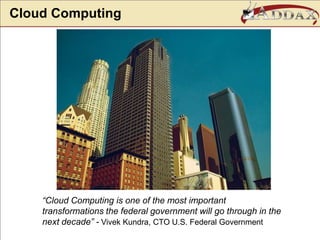
Cloud Computing“Cloud Computing is one of the most important transformations the federal government will go through in the next decade” - Vivek Kundra, CTO U.S. Federal Government
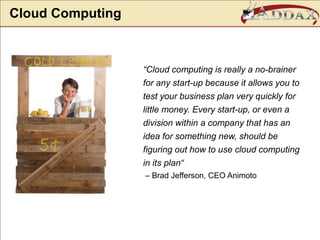
Cloud Computing“Cloud computing is really a no-brainer for any start-up because it allows you to test your business plan very quickly for little money. Every start-up, or even a division within a company that has an idea for something new, should be figuring out how to use cloud computing in its plan“ – Brad Jefferson, CEO Animoto
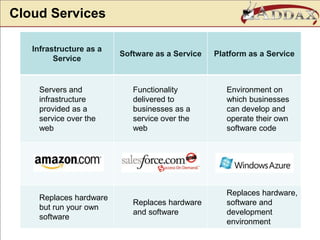
Cloud Services
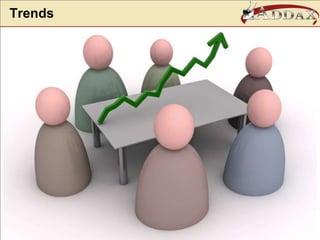
Trends
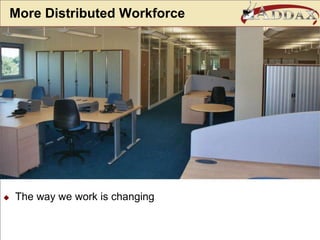
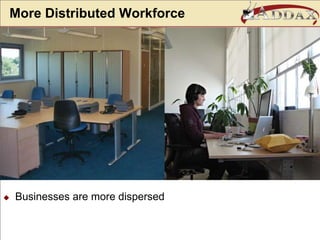
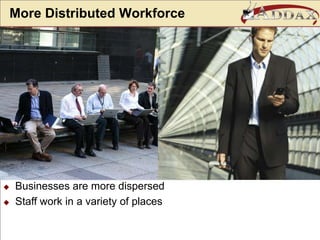
More Distributed WorkforceThe way we work is changingMore Distributed WorkforceBusinesses are more dispersedMore Distributed WorkforceBusinesses are more dispersed
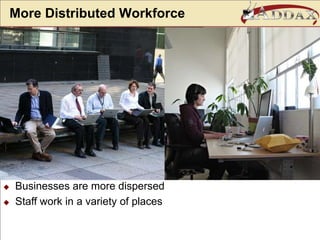
Staff work in a variety of places More Distributed WorkforceBusinesses are more dispersed
Staff work in a variety of places
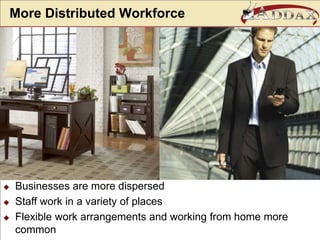
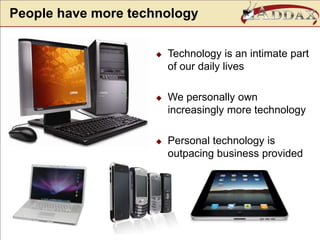
Flexible work arrangements and working from home more commonPeople have more technologyTechnology is an intimate part of our daily lives
We personally own increasingly more technology
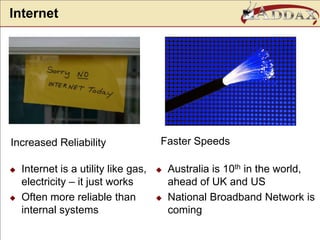
Personal technology is outpacing business providedInternetFaster SpeedsIncreased ReliabilityAustralia is 10th in the world, ahead of UK and US
National Broadband Network is coming
Internet is a utility like gas, electricity – it just works
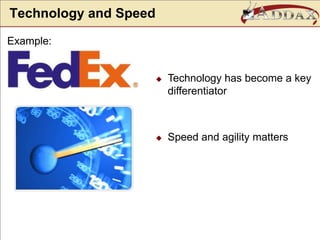
Often more reliable than internal systemsTechnology and SpeedExample:Technology has become a key differentiator
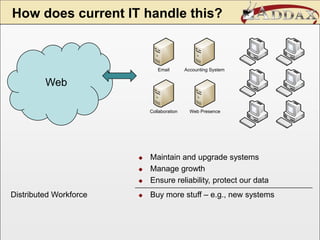
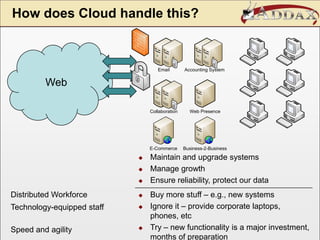
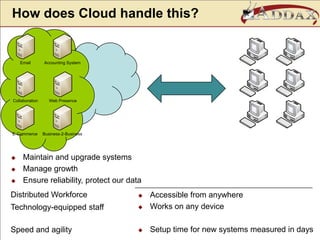
Speed and agility mattersHow does current IT handle this?WebMaintain and upgrade systems
Manage growth
Ensure reliability, protect our data
Buy more stuff – e.g., new systemsDistributed Workforce
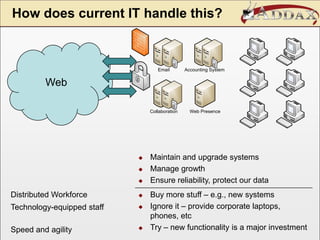
How does current IT handle this?WebMaintain and upgrade systems
Manage growth
Ensure reliability, protect our data
Buy more stuff – e.g., new systems
Ignore it – provide corporate laptops, phones, etc
Try – new functionality is a major investmentDistributed WorkforceTechnology-equipped staffSpeed and agility

Cloudstuff

  • 1.
    Customer UpdateCloud computingis an evolution in thinking, technology, and the way we consume IT resources. There are no magic beans here, but some real opportunities now and in the future, particularly for enterprises that can’t afford big-ticket, in-house solutions.
  • 2.
  • 3.
  • 4.
    Cloud ComputingSpending onIT cloud services will triple in the next 5 years, reaching $42 billion and capturing 25% of IT spending growth in 2012We predict that by 2012, 80 percent of Fortune 1000 enterprises will be paying for some cloud computing services, and 30 percent will be paying for cloud computing infrastructure services.By 2012, 20 percent of businesses will own no IT assets.
  • 5.
    Cloud Computing“Cloud Computingis one of the most important transformations the federal government will go through in the next decade” - Vivek Kundra, CTO U.S. Federal Government
  • 6.
    Cloud Computing“Cloud computingis really a no-brainer for any start-up because it allows you to test your business plan very quickly for little money. Every start-up, or even a division within a company that has an idea for something new, should be figuring out how to use cloud computing in its plan“ – Brad Jefferson, CEO Animoto
  • 7.
  • 8.
  • 9.
    More Distributed WorkforceTheway we work is changingMore Distributed WorkforceBusinesses are more dispersedMore Distributed WorkforceBusinesses are more dispersed
  • 10.
    Staff work ina variety of places More Distributed WorkforceBusinesses are more dispersed
  • 11.
    Staff work ina variety of places More Distributed WorkforceBusinesses are more dispersed
  • 12.
    Staff work ina variety of places
  • 13.
    Flexible work arrangementsand working from home more commonPeople have more technologyTechnology is an intimate part of our daily lives
  • 14.
    We personally ownincreasingly more technology
  • 15.
    Personal technology isoutpacing business providedInternetFaster SpeedsIncreased ReliabilityAustralia is 10th in the world, ahead of UK and US
  • 16.
  • 17.
    Internet is autility like gas, electricity – it just works
  • 18.
    Often more reliablethan internal systemsTechnology and SpeedExample:Technology has become a key differentiator
  • 19.
    Speed and agilitymattersHow does current IT handle this?WebMaintain and upgrade systems
  • 20.
  • 21.
  • 22.
    Buy more stuff– e.g., new systemsDistributed Workforce
  • 23.
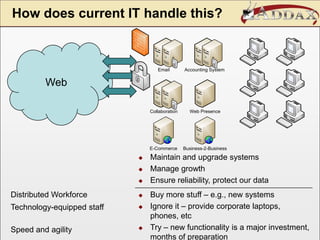
    How does currentIT handle this?WebMaintain and upgrade systems
  • 24.
  • 25.
  • 26.
    Buy more stuff– e.g., new systems
  • 27.
    Ignore it –provide corporate laptops, phones, etc
  • 28.
    Try – newfunctionality is a major investmentDistributed WorkforceTechnology-equipped staffSpeed and agility

Editor's Notes

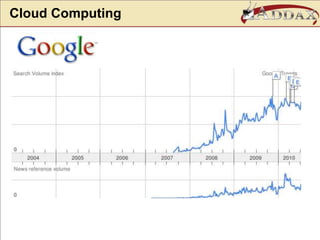
  • #4 Ask the question to the audience as to who has used Google to search on “Cloud Computing”?
  • #5 Highlight key concepts; separate to individual slides
  • #6 Highlight key concepts; separate to individual slides
  • #7 Highlight key concepts; separate to individual slides
  • #10 The way we work is changing. Business-wide staff are increasingly dispersed.The internet gives us far more reach to do business in wider regions.As a result groups and teams no longer adhere to geographic organisation.Customers, suppliers and staff demand a more flexible schedule – 9 to 5 is fading.
  • #11 The way we work is changing. Business-wide staff are increasingly dispersed.The internet gives us far more reach to do business in wider regions.As a result groups and teams no longer adhere to geographic organisation.Customers, suppliers and staff demand a more flexible schedule – 9 to 5 is fading.
  • #12 The way we work is changing. Business-wide staff are increasingly dispersed.The internet gives us far more reach to do business in wider regions.As a result groups and teams no longer adhere to geographic organisation.Customers, suppliers and staff demand a more flexible schedule – 9 to 5 is fading.
  • #13 How many people work from home?How many of you have problems working with distributed teams?The way we work is changing. Business-wide staff are increasingly dispersed.The internet gives us far more reach to do business in wider regions.As a result groups and teams no longer adhere to geographic organisation.Customers, suppliers and staff demand a more flexible schedule – 9 to 5 is fading.
  • #14 The way we work is changing. Business-wide staff are increasingly dispersed.The internet gives us far more reach to do business in wider regions.As a result groups and teams no longer adhere to geographic organisation.Customers, suppliers and staff demand a more flexible schedule – 9 to 5 is fading.
  • #15 Who here has laptops?Who here has Practically everyone has a computer.Most of these are laptops.I can’t remember the last time I met someone who doesn’t own an iPhone or Blackberry.The increase in sophistication of technology we personally own is outpacing what businesses can cost effectively provide.Who has an iPad? The epitome of cloud computing
  • #16 Increased reliability – Most businesses have internet connections that are far more reliable than their internal systems.Increased reliance – without a web presence, without B2B communication, without internet access, without email, many businesses stop.40.7% believe the NBN will greatly enable their business' ability to leverage technology and improve productivity / customer satisfaction…IDC research.
  • #17 Technology a key differentiator – Technology is used as a competitive advantage in business in real and tangible ways. Attracting and retaining customers - FedEx tracking / Jim Barksdale as an example-increasing the flow of knowledge within the organisation-making more informed decisions.Speed and agility matters – The primary benefit of technology boils down to speed and agility. That is what new solutions strive to offer.
  • #18 Bandwidth arrow different colour
  • #21 Speed and agility – time to get up and running, etc
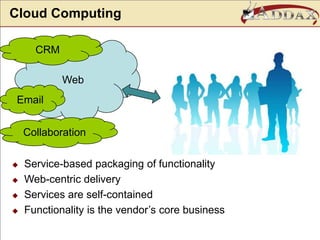
  • #23 Service-based packaging of functionality – e.g., web based applications, backup and recovery, disaster recovery