1
SnapLogic Elastic Integration
June 2014
2
Agenda
 What’s Driving the Adoption of iPaaS in the Enterprise?
 Introducing SnapLogic Elastic Integration
 SnapLogic Customers in Action
 Next Steps
3
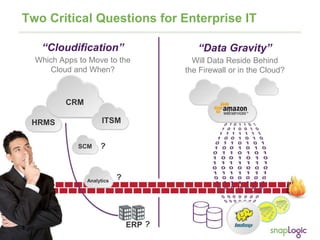
Two Critical Questions for Enterprise IT
CRM
HRMS ITSM
ERP
SCM
Analytics
“Cloudification”
Which Apps to Move to the
Cloud and When?
“Data Gravity”
Will Data Reside Behind
the Firewall or in the Cloud?
4
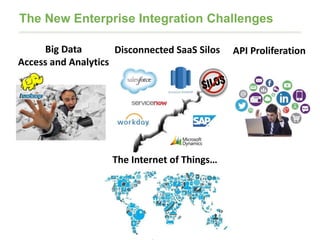
The New Enterprise Integration Challenges
Big Data
Access and Analytics
API ProliferationDisconnected SaaS Silos
The Internet of Things…
5
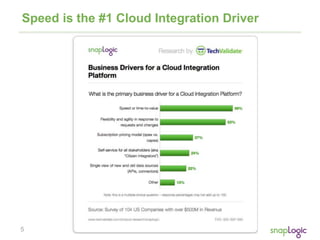
Speed is the #1 Cloud Integration Driver
6
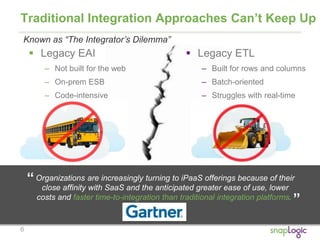
Traditional Integration Approaches Can’t Keep Up
 Legacy EAI
– Not built for the web
– On-prem ESB
– Code-intensive
 Legacy ETL
– Built for rows and columns
– Batch-oriented
– Struggles with real-time
Organizations are increasingly turning to iPaaS offerings because of their
close affinity with SaaS and the anticipated greater ease of use, lower
costs and faster time-to-integration than traditional integration platforms.
.
““
Known as “The Integrator’s Dilemma”
7
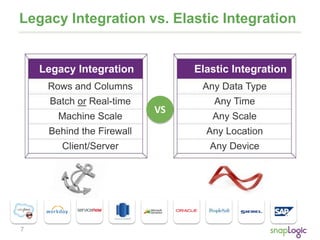
Legacy Integration vs. Elastic Integration
Legacy Integration Elastic Integration
Rows and Columns
Batch or Real-time
Machine Scale
Behind the Firewall
Client/Server
Any Data Type
Any Time
Any Scale
Any Location
Any Device
VS
8
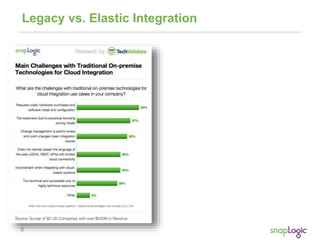
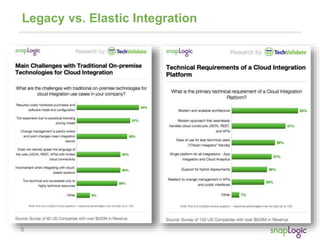
Legacy vs. Elastic Integration
9
Legacy vs. Elastic Integration
10
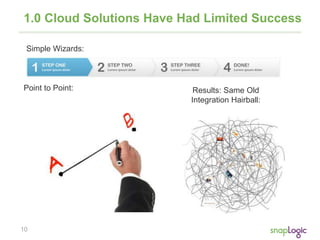
1.0 Cloud Solutions Have Had Limited Success
Results: Same Old
Integration Hairball:
Point to Point:
Simple Wizards:
11
Agenda
 What’s Driving the Adoption of iPaaS in the Enterprise?
 Introducing SnapLogic Elastic Integration
 SnapLogic Customers in Action
 Next Steps
12
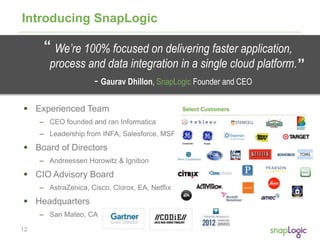
Introducing SnapLogic
 Experienced Team
– CEO founded and ran Informatica
– Leadership from INFA, Salesforce, MSFT
 Board of Directors
– Andreessen Horowitz & Ignition
 CIO Advisory Board
– AstraZenica, Cisco, Clorox, EA, Netflix
 Headquarters
– San Mateo, CA
We’re 100% focused on delivering faster application,
process and data integration in a single cloud platform.
- Gaurav Dhillon, SnapLogic Founder and CEO
““
13
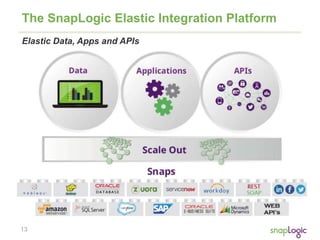
The SnapLogic Elastic Integration Platform
Elastic Data, Apps and APIs
14
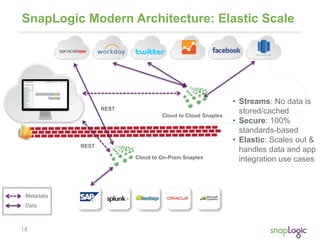
SnapLogic Modern Architecture: Elastic Scale
Cloud to On-Prem Snaplex
REST
Cloud to Cloud Snaplex
• Streams: No data is
stored/cached
• Secure: 100%
standards-based
• Elastic: Scales out &
handles data and app
integration use cases
REST
Metadata
Data
15
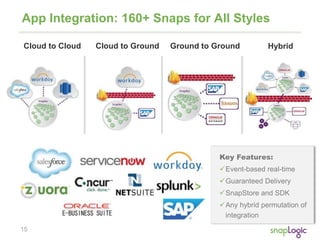
App Integration: 160+ Snaps for All Styles
HybridCloud to Ground Ground to GroundCloud to Cloud
Key Features:
Event-based real-time
Guaranteed Delivery
SnapStore and SDK
Any hybrid permutation of
integration
16
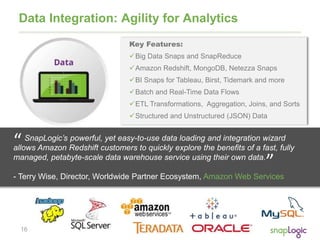
Key Features:
Big Data Snaps and SnapReduce
Amazon Redshift, MongoDB, Netezza Snaps
BI Snaps for Tableau, Birst, Tidemark and more
Batch and Real-Time Data Flows
ETL Transformations, Aggregation, Joins, and Sorts
Structured and Unstructured (JSON) Data
Data Integration: Agility for Analytics
SnapLogic’s powerful, yet easy-to-use data loading and integration wizard
allows Amazon Redshift customers to quickly explore the benefits of a fast, fully
managed, petabyte-scale data warehouse service using their own data.
- Terry Wise, Director, Worldwide Partner Ecosystem, Amazon Web Services
“ “
17
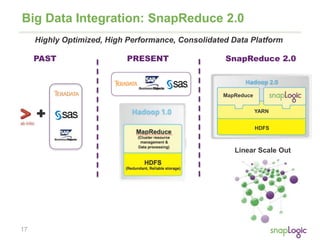
Big Data Integration: SnapReduce 2.0
Highly Optimized, High Performance, Consolidated Data Platform
PAST PRESENT SnapReduce 2.0
MapReduce
YARN
HDFS
Linear Scale Out
18
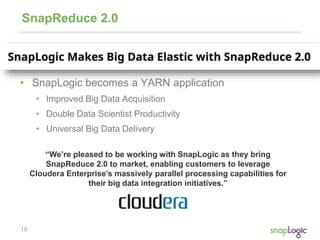
SnapReduce 2.0
• SnapLogic becomes a YARN application
• Improved Big Data Acquisition
• Double Data Scientist Productivity
• Universal Big Data Delivery
“We’re pleased to be working with SnapLogic as they bring
SnapReduce 2.0 to market, enabling customers to leverage
Cloudera Enterprise’s massively parallel processing capabilities for
their big data integration initiatives.”
19
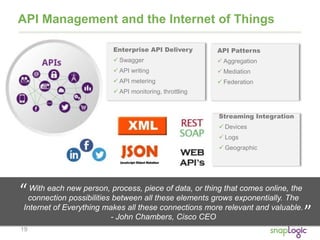
API Management and the Internet of Things
Enterprise API Delivery
 Swagger
 API writing
 API metering
 API monitoring, throttling
API Patterns
 Aggregation
 Mediation
 Federation
Streaming Integration
 Devices
 Logs
 Geographic
“With each new person, process, piece of data, or thing that comes online, the
connection possibilities between all these elements grows exponentially. The
Internet of Everything makes all these connections more relevant and valuable.
- John Chambers, Cisco CEO
“
20
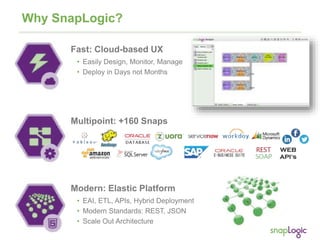
Why SnapLogic?
Multipoint: +160 Snaps
Modern: Elastic Platform
• EAI, ETL, APIs, Hybrid Deployment
• Modern Standards: REST, JSON
• Scale Out Architecture
Fast: Cloud-based UX
• Easily Design, Monitor, Manage
• Deploy in Days not Months
21
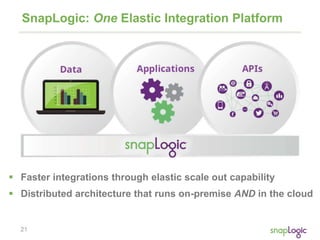
SnapLogic: One Elastic Integration Platform
“ Faster integrations through elastic scale out capability
 Distributed architecture that runs on-premise AND in the cloud
22
Agenda
 What’s Driving the Adoption of iPaaS in the Enterprise?
 Introducing SnapLogic Elastic Integration
 SnapLogic Customers in Action
 Next Steps
23
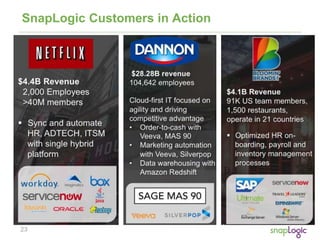
SnapLogic Customers in Action
24 24
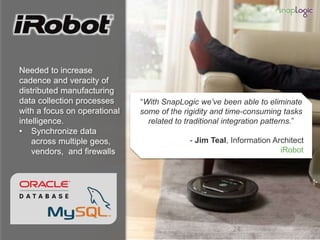
Needed to increase
cadence and veracity of
distributed manufacturing
data collection processes
with a focus on operational
intelligence.
• Synchronize data
across multiple geos,
vendors, and firewalls
“With SnapLogic we’ve been able to eliminate
some of the rigidity and time-consuming tasks
related to traditional integration patterns.”
- Jim Teal, Information Architect
iRobot
25
The Challenges We Faced
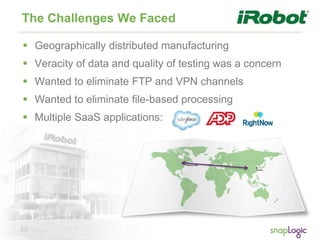
 Geographically distributed manufacturing
 Veracity of data and quality of testing was a concern
 Wanted to eliminate FTP and VPN channels
 Wanted to eliminate file-based processing
 Multiple SaaS applications:
26
Options Considered
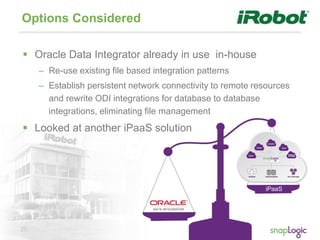
 Oracle Data Integrator already in use in-house
– Re-use existing file based integration patterns
– Establish persistent network connectivity to remote resources
and rewrite ODI integrations for database to database
integrations, eliminating file management
 Looked at another iPaaS solution
iPaaS
27
Why SnapLogic?
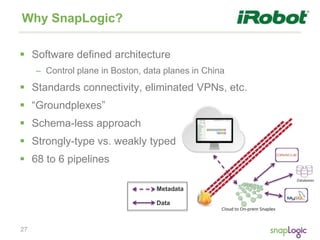
 Software defined architecture
– Control plane in Boston, data planes in China
 Standards connectivity, eliminated VPNs, etc.
 “Groundplexes”
 Schema-less approach
 Strongly-type vs. weakly typed
 68 to 6 pipelines
Metadata
Data
28
Next Steps with SnapLogic
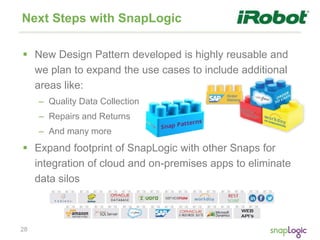
 New Design Pattern developed is highly reusable and
we plan to expand the use cases to include additional
areas like:
– Quality Data Collection
– Repairs and Returns
– And many more
 Expand footprint of SnapLogic with other Snaps for
integration of cloud and on-premises apps to eliminate
data silos
29
Discussion
@SnapLogic
Facebook/SnapLogic
www.SnapLogic.com
30
Next Steps
1. Download the white paper
1. Visit www.snaplogic.com/resources
for case studies, videos, data sheets,
webinars, etc.
1. Contact us for a custom demonstration
www.SnapLogic.com

Cloud-Con: Integration & Web APIs

  • 1.
  • 2.
    2 Agenda  What’s Drivingthe Adoption of iPaaS in the Enterprise?  Introducing SnapLogic Elastic Integration  SnapLogic Customers in Action  Next Steps
  • 3.
    3 Two Critical Questionsfor Enterprise IT CRM HRMS ITSM ERP SCM Analytics “Cloudification” Which Apps to Move to the Cloud and When? “Data Gravity” Will Data Reside Behind the Firewall or in the Cloud?
  • 4.
    4 The New EnterpriseIntegration Challenges Big Data Access and Analytics API ProliferationDisconnected SaaS Silos The Internet of Things…
  • 5.
    5 Speed is the#1 Cloud Integration Driver
  • 6.
    6 Traditional Integration ApproachesCan’t Keep Up  Legacy EAI – Not built for the web – On-prem ESB – Code-intensive  Legacy ETL – Built for rows and columns – Batch-oriented – Struggles with real-time Organizations are increasingly turning to iPaaS offerings because of their close affinity with SaaS and the anticipated greater ease of use, lower costs and faster time-to-integration than traditional integration platforms. . ““ Known as “The Integrator’s Dilemma”
  • 7.
    7 Legacy Integration vs.Elastic Integration Legacy Integration Elastic Integration Rows and Columns Batch or Real-time Machine Scale Behind the Firewall Client/Server Any Data Type Any Time Any Scale Any Location Any Device VS
  • 8.
  • 9.
  • 10.
    10 1.0 Cloud SolutionsHave Had Limited Success Results: Same Old Integration Hairball: Point to Point: Simple Wizards:
  • 11.
    11 Agenda  What’s Drivingthe Adoption of iPaaS in the Enterprise?  Introducing SnapLogic Elastic Integration  SnapLogic Customers in Action  Next Steps
  • 12.
    12 Introducing SnapLogic  ExperiencedTeam – CEO founded and ran Informatica – Leadership from INFA, Salesforce, MSFT  Board of Directors – Andreessen Horowitz & Ignition  CIO Advisory Board – AstraZenica, Cisco, Clorox, EA, Netflix  Headquarters – San Mateo, CA We’re 100% focused on delivering faster application, process and data integration in a single cloud platform. - Gaurav Dhillon, SnapLogic Founder and CEO ““
  • 13.
    13 The SnapLogic ElasticIntegration Platform Elastic Data, Apps and APIs
  • 14.
    14 SnapLogic Modern Architecture:Elastic Scale Cloud to On-Prem Snaplex REST Cloud to Cloud Snaplex • Streams: No data is stored/cached • Secure: 100% standards-based • Elastic: Scales out & handles data and app integration use cases REST Metadata Data
  • 15.
    15 App Integration: 160+Snaps for All Styles HybridCloud to Ground Ground to GroundCloud to Cloud Key Features: Event-based real-time Guaranteed Delivery SnapStore and SDK Any hybrid permutation of integration
  • 16.
    16 Key Features: Big DataSnaps and SnapReduce Amazon Redshift, MongoDB, Netezza Snaps BI Snaps for Tableau, Birst, Tidemark and more Batch and Real-Time Data Flows ETL Transformations, Aggregation, Joins, and Sorts Structured and Unstructured (JSON) Data Data Integration: Agility for Analytics SnapLogic’s powerful, yet easy-to-use data loading and integration wizard allows Amazon Redshift customers to quickly explore the benefits of a fast, fully managed, petabyte-scale data warehouse service using their own data. - Terry Wise, Director, Worldwide Partner Ecosystem, Amazon Web Services “ “
  • 17.
    17 Big Data Integration:SnapReduce 2.0 Highly Optimized, High Performance, Consolidated Data Platform PAST PRESENT SnapReduce 2.0 MapReduce YARN HDFS Linear Scale Out
  • 18.
    18 SnapReduce 2.0 • SnapLogicbecomes a YARN application • Improved Big Data Acquisition • Double Data Scientist Productivity • Universal Big Data Delivery “We’re pleased to be working with SnapLogic as they bring SnapReduce 2.0 to market, enabling customers to leverage Cloudera Enterprise’s massively parallel processing capabilities for their big data integration initiatives.”
  • 19.
    19 API Management andthe Internet of Things Enterprise API Delivery  Swagger  API writing  API metering  API monitoring, throttling API Patterns  Aggregation  Mediation  Federation Streaming Integration  Devices  Logs  Geographic “With each new person, process, piece of data, or thing that comes online, the connection possibilities between all these elements grows exponentially. The Internet of Everything makes all these connections more relevant and valuable. - John Chambers, Cisco CEO “
  • 20.
    20 Why SnapLogic? Multipoint: +160Snaps Modern: Elastic Platform • EAI, ETL, APIs, Hybrid Deployment • Modern Standards: REST, JSON • Scale Out Architecture Fast: Cloud-based UX • Easily Design, Monitor, Manage • Deploy in Days not Months
  • 21.
    21 SnapLogic: One ElasticIntegration Platform “ Faster integrations through elastic scale out capability  Distributed architecture that runs on-premise AND in the cloud
  • 22.
    22 Agenda  What’s Drivingthe Adoption of iPaaS in the Enterprise?  Introducing SnapLogic Elastic Integration  SnapLogic Customers in Action  Next Steps
  • 23.
  • 24.
    24 24 Needed toincrease cadence and veracity of distributed manufacturing data collection processes with a focus on operational intelligence. • Synchronize data across multiple geos, vendors, and firewalls “With SnapLogic we’ve been able to eliminate some of the rigidity and time-consuming tasks related to traditional integration patterns.” - Jim Teal, Information Architect iRobot
  • 25.
    25 The Challenges WeFaced  Geographically distributed manufacturing  Veracity of data and quality of testing was a concern  Wanted to eliminate FTP and VPN channels  Wanted to eliminate file-based processing  Multiple SaaS applications:
  • 26.
    26 Options Considered  OracleData Integrator already in use in-house – Re-use existing file based integration patterns – Establish persistent network connectivity to remote resources and rewrite ODI integrations for database to database integrations, eliminating file management  Looked at another iPaaS solution iPaaS
  • 27.
    27 Why SnapLogic?  Softwaredefined architecture – Control plane in Boston, data planes in China  Standards connectivity, eliminated VPNs, etc.  “Groundplexes”  Schema-less approach  Strongly-type vs. weakly typed  68 to 6 pipelines Metadata Data
  • 28.
    28 Next Steps withSnapLogic  New Design Pattern developed is highly reusable and we plan to expand the use cases to include additional areas like: – Quality Data Collection – Repairs and Returns – And many more  Expand footprint of SnapLogic with other Snaps for integration of cloud and on-premises apps to eliminate data silos
  • 29.
  • 30.
    30 Next Steps 1. Downloadthe white paper 1. Visit www.snaplogic.com/resources for case studies, videos, data sheets, webinars, etc. 1. Contact us for a custom demonstration www.SnapLogic.com

Editor's Notes

  • #4 This is the editable slide
  • #7 This need for both cloud integration power and the need for speed and simplicity has lead to an “Integrator’s Dilemma” for many of the IT organizations we talk to today. The good news is there’s now an awareness that without the right approach to integration, the promise of SaaS and cloud computing will not be met. The bad news is that their existing legacy middleware technologies were conceptualized and built before the SMAC stack became an enterprise reality – Social, Mobile, Analytics/Big Data and Cloud Computing. When it comes to Legacy Enterprise App Integration tools, “buses don’t fly.” On-premises enterprise service bus (ESB) are known to be brittle and code-intensive. They were designed to speak XML and SOAP, not the more modern web protocols like JSON and REST. They weren’t designed to run at cloud speed. When it comes to Legacy Extract, Transformation and Loading tools, they’re great for large batches of structured data – rows and columns. This works well for initial migrations and periodic data loading requirements, but customers inevitably want both real-time and batch application and data integration capabilities. According to a recent Gartner report, “read the quote on the slide” http://www.snaplogic.com/dilemma . 
  • #11 1.0 Cloud Solutions have had limited success. They were either built to only be run by the line of business, with simple wizards and limited power and ability to handle complex requirements. Or they were were designed to address only point to point integrations use cases. The result has been some initial traction but limited enterprise adoption and success. One of the primary reasons is that they result into the same brittle integration hairball that we saw in the on-premise integration world.
  • #13 The SnapLogic approach is to deliver a single, unified platform that is built for the cloud era and designed to handle multiple styles of integration: Application, data and process integration. SnapLogic was founded in 2006 by Gaurav Dhillon, who co-founded Informatica in the early ‘90s and ran that company for 12 years. Our management team has deep enterprise and SaaS roots, the board consists of representation from our 2 primary VC partners: Andreesen and Ignition and we have a world-class CIO advisory board consisting of CIOs from AZ, Cisco, Clorox and Netflix. http://www.snaplogic.com/about-us/leadership
  • #15 Orchestrations, schedules, connections and security details are managed by the cloud-based Designer, Manager and Monitoring Dashboard. The Snaplex streams data between applications and data sources, and can run in the cloud or behind the firewall. We like to say that the SnapLogic Integration Cloud “respects data gravity.” If most of your apps that are being integrated in the cloud, why would you want your integration to run behind the firewall? On the other hand, if you’re primarily integrating SaaS apps with on-premises databases and applications like SAP and Oracle, you’ll mostly likely want to run the Snaplex as close to the data as possible. The Snaplex is a self-upgrading execution grid that streams data between applications, databases, files, social and big data sources. When running in the cloud, the Snaplex is able to scale up and down elastically based on the volume of data being processed or the latency requirements of the integration flow. The Snaplex can also be configured to run behind the firewall for hybrid deployments involving on-premise enterprise applications. The Snaplex allows data and process flows to be triggered based on events or scheduled jobs, called via REST APIs, or invoked programmatically via the SnAPI. No data is stored or cached in the SnapLogic Integration Cloud. It streams data. It is 100% standards based and elastically scales out to meet your capacity requirements.
  • #18 Massively parallel computation capabilities Linear scale out Data co-location optimizes data computations
  • #20 http://www.gartner.com/newsroom/id/2636073 http://blogs.cisco.com/news/internet-of-everything-2/
  • #21 Beyond addressing multiple integration styles with a single platform, there are 3 primary differentiators that we deliver: Faster Integration Multi-point Orchestration And a Modern, Elastic platform that allow you to scale out as you need more capacity. Before we go through a demonstration of the SnapLogic Integration Cloud, I’d like to provide an overview of each of these capabilities.
  • #25 iRobot – data sync across geo regions and multiple firewalls, MySQL, Oracle htthttp://www.irobot.com/us