Cloud Application Adoption Challenges
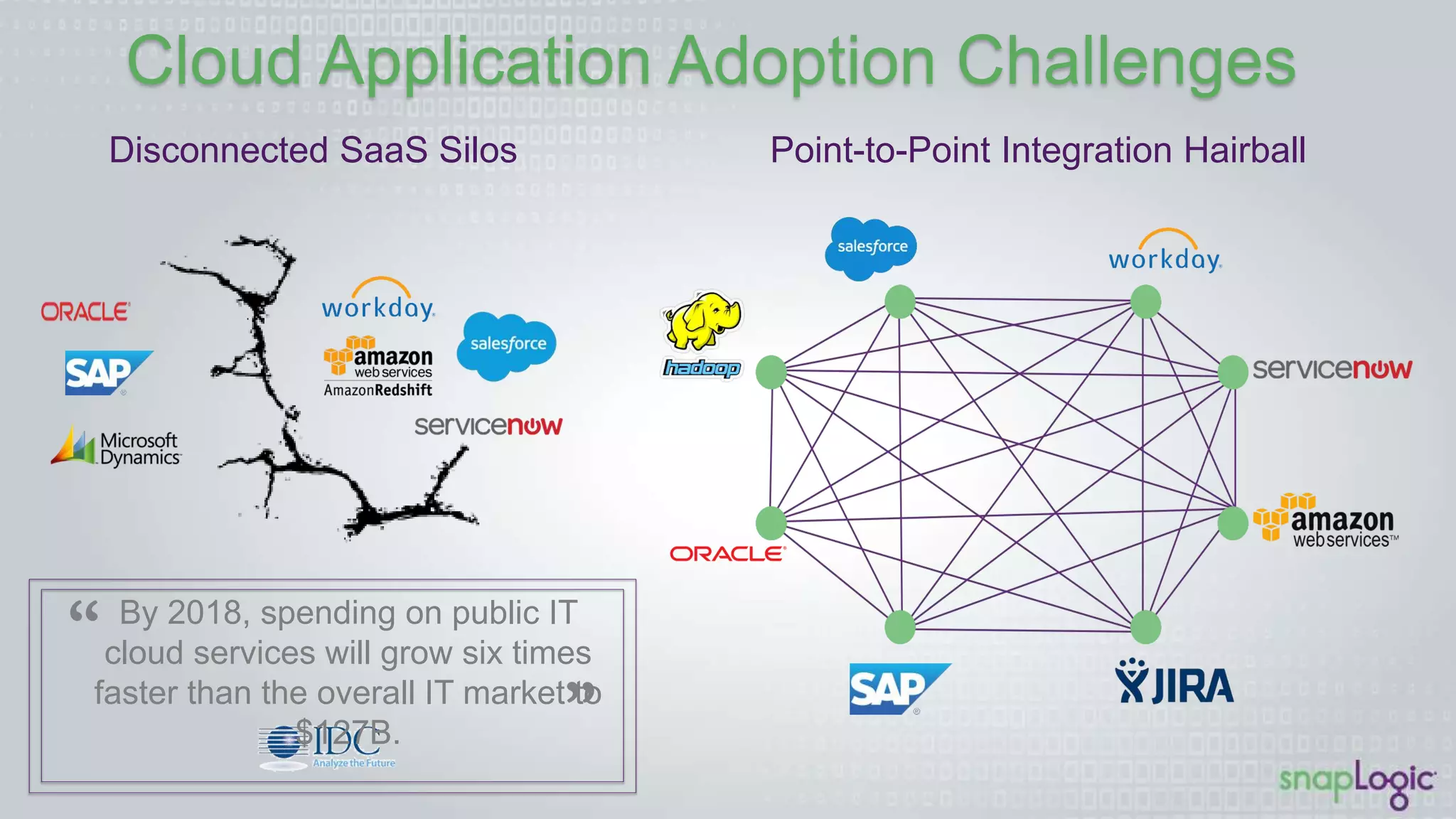
Disconnected SaaS Silos! Point-to-Point Integration Hairball!
By 2018, spending on public IT cloud
services will grow six times faster than
the overall IT market to $127B.
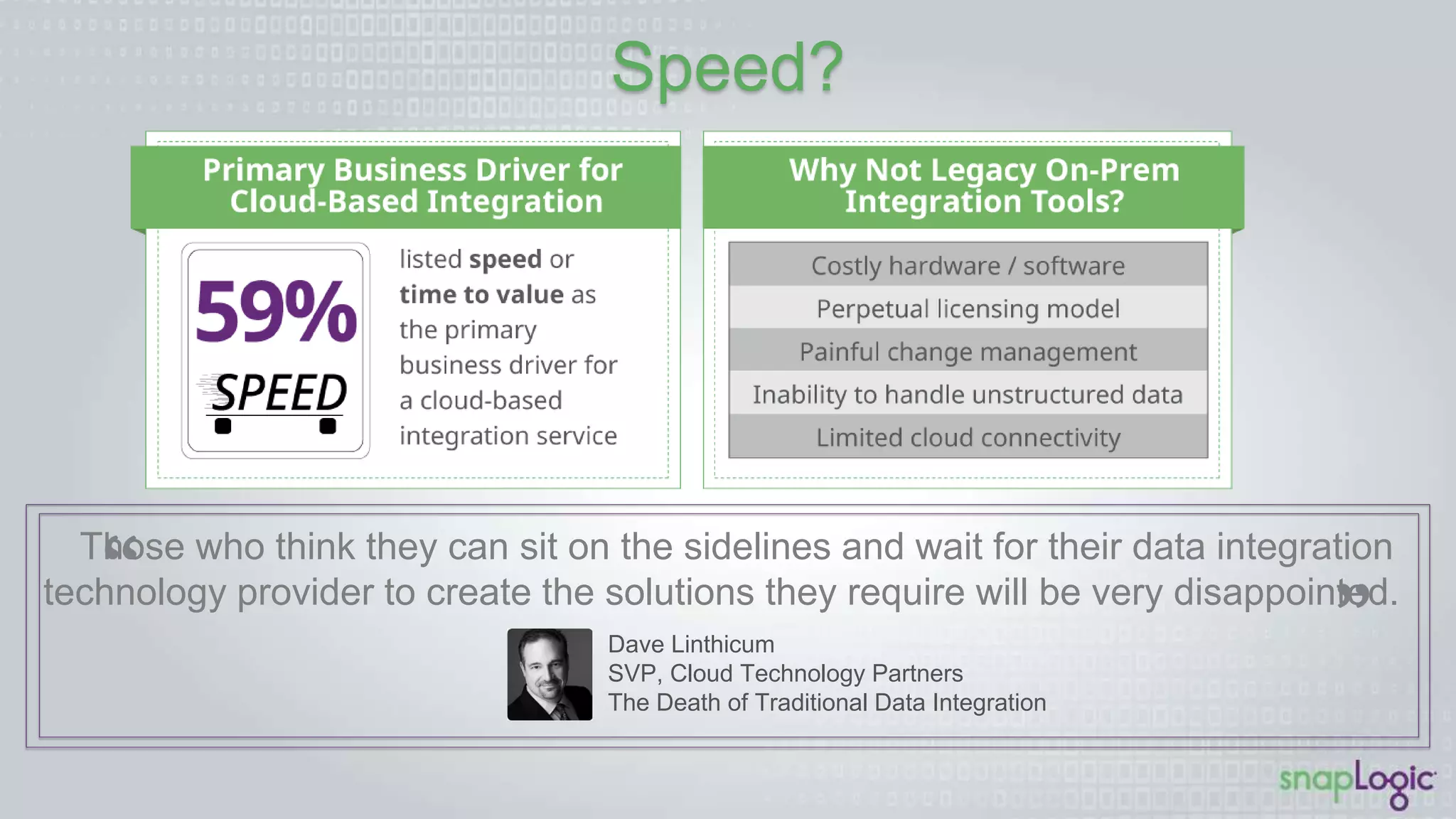
CanYour Integration Run at Cloud Speed?
Those who think they can sit on the sidelines and wait for their data integration
technology provider to create the solutions they require will be very disappointed.
Dave Linthicum
SVP, Cloud Technology Partners
The Death of Traditional Data Integration
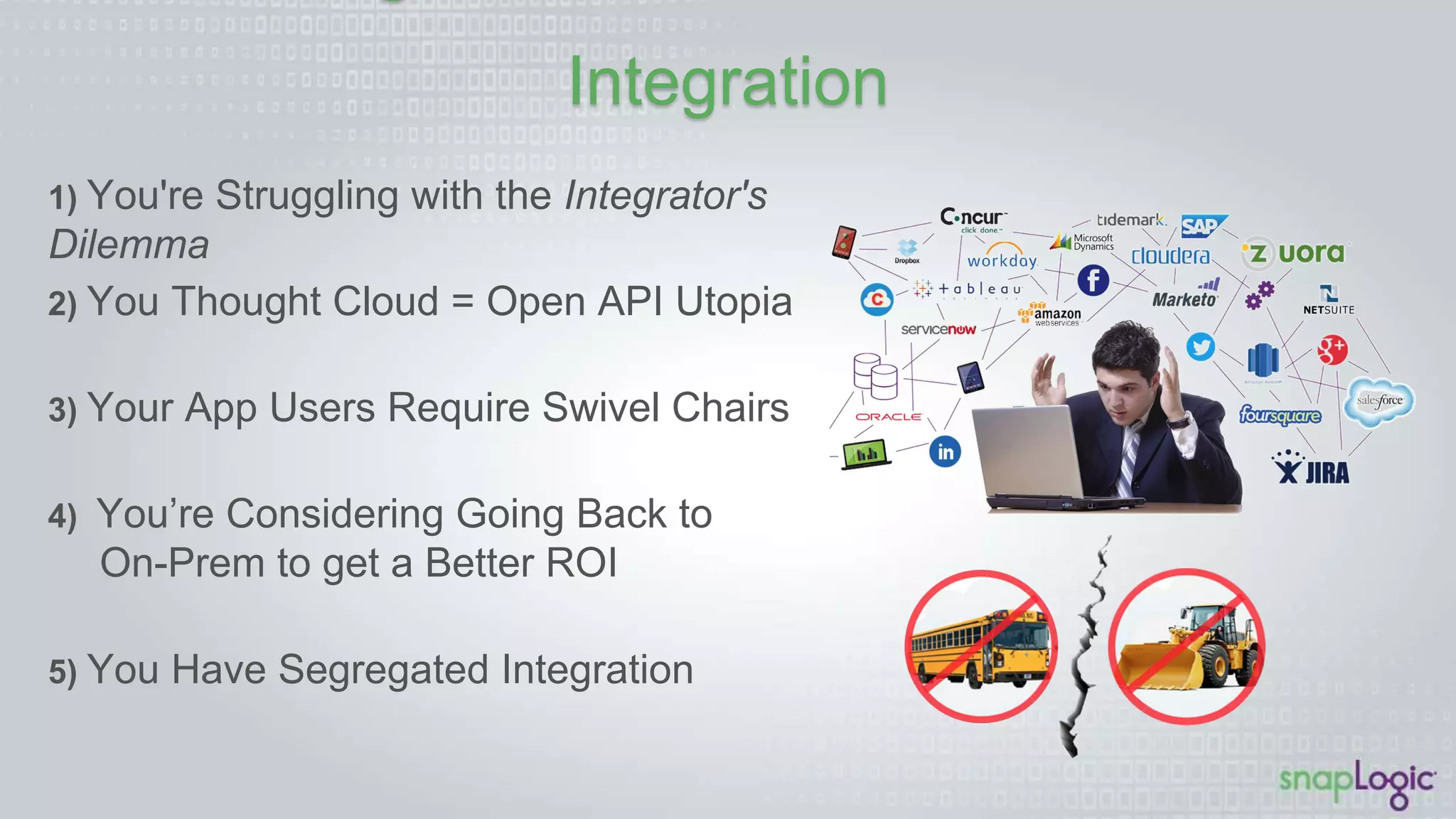
5 SignsYou Need Better Cloud Integration
1) You're Struggling with the Integrator's Dilemma
2) You Thought Cloud = Open API Utopia
5) You Have Segregated Integration
3) Your App Users Require Swivel Chairs
4) You’re Considering Going Back to
On-Prem to get a Better ROI
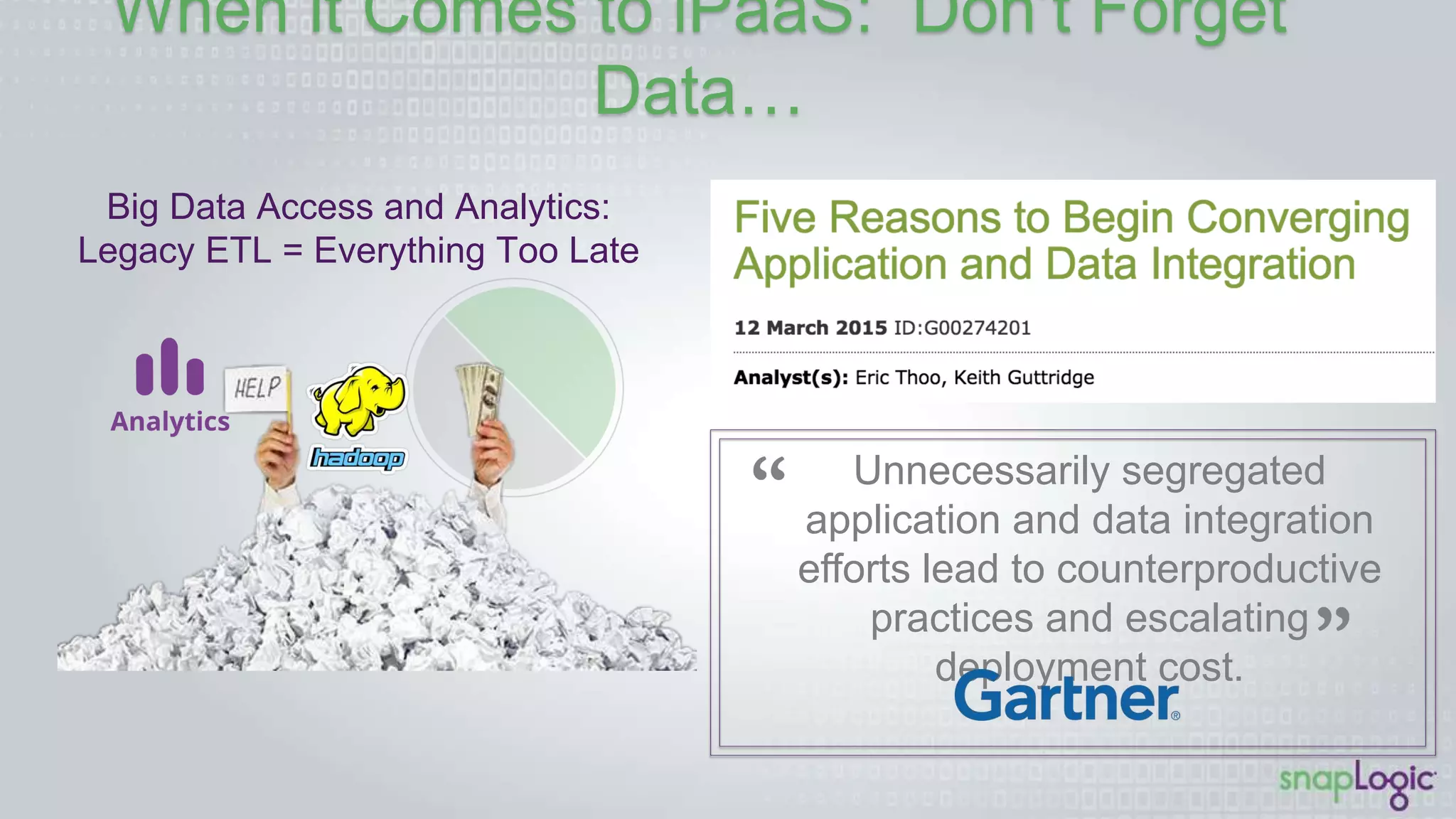
When it Comes to iPaaS: Don’t Forget Data…
Unnecessarily segregated application
and data integration efforts lead to
counterproductive practices and
escalating deployment cost.
Big Data Access and Analytics:!
Legacy ETL = Everything Too Late!
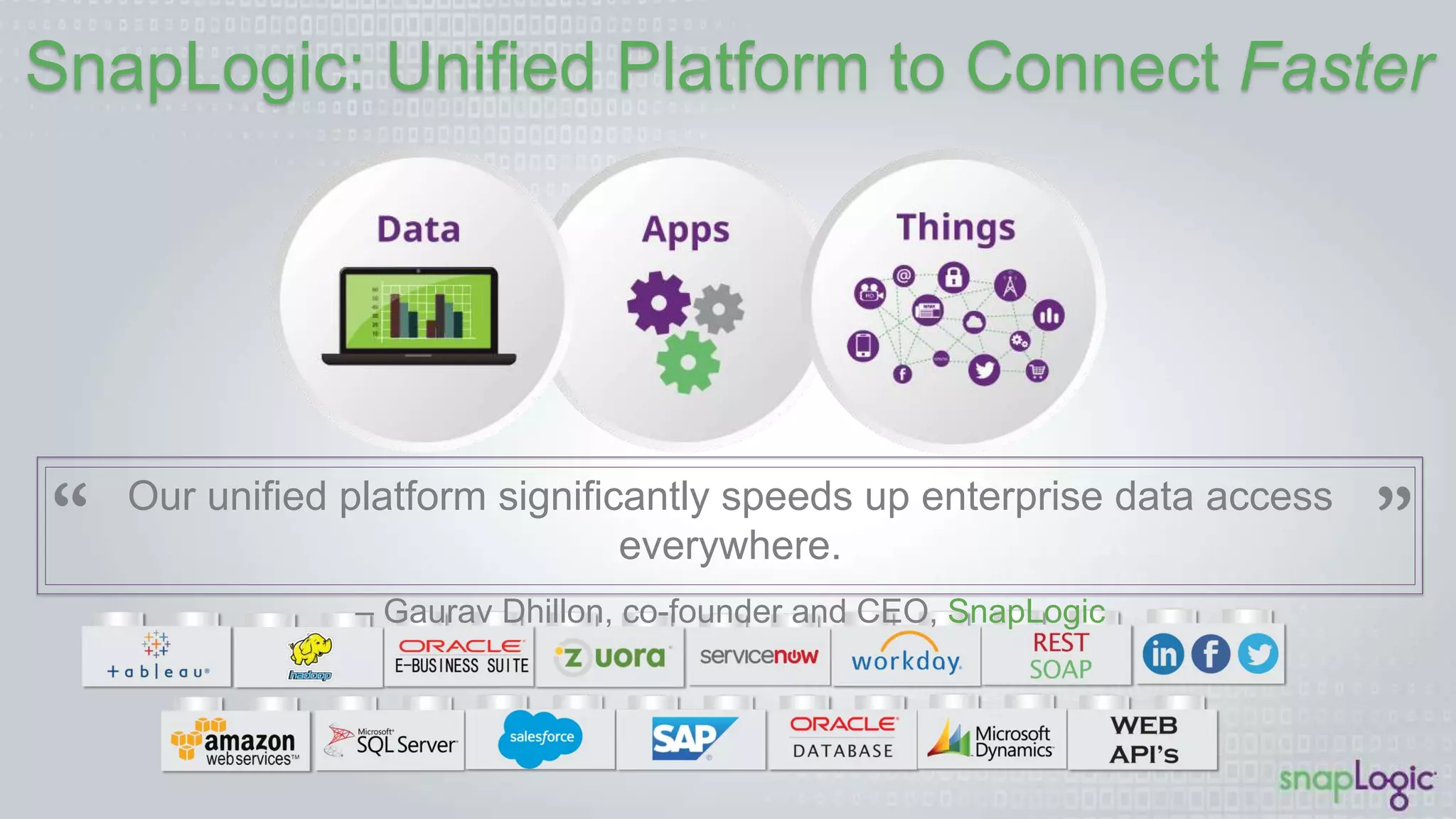
SnapLogic: Unified Platform to Connect Faster
Our unified platform significantly speeds up enterprise data access everywhere.
– Gaurav Dhillon, co-founder and CEO, SnapLogic
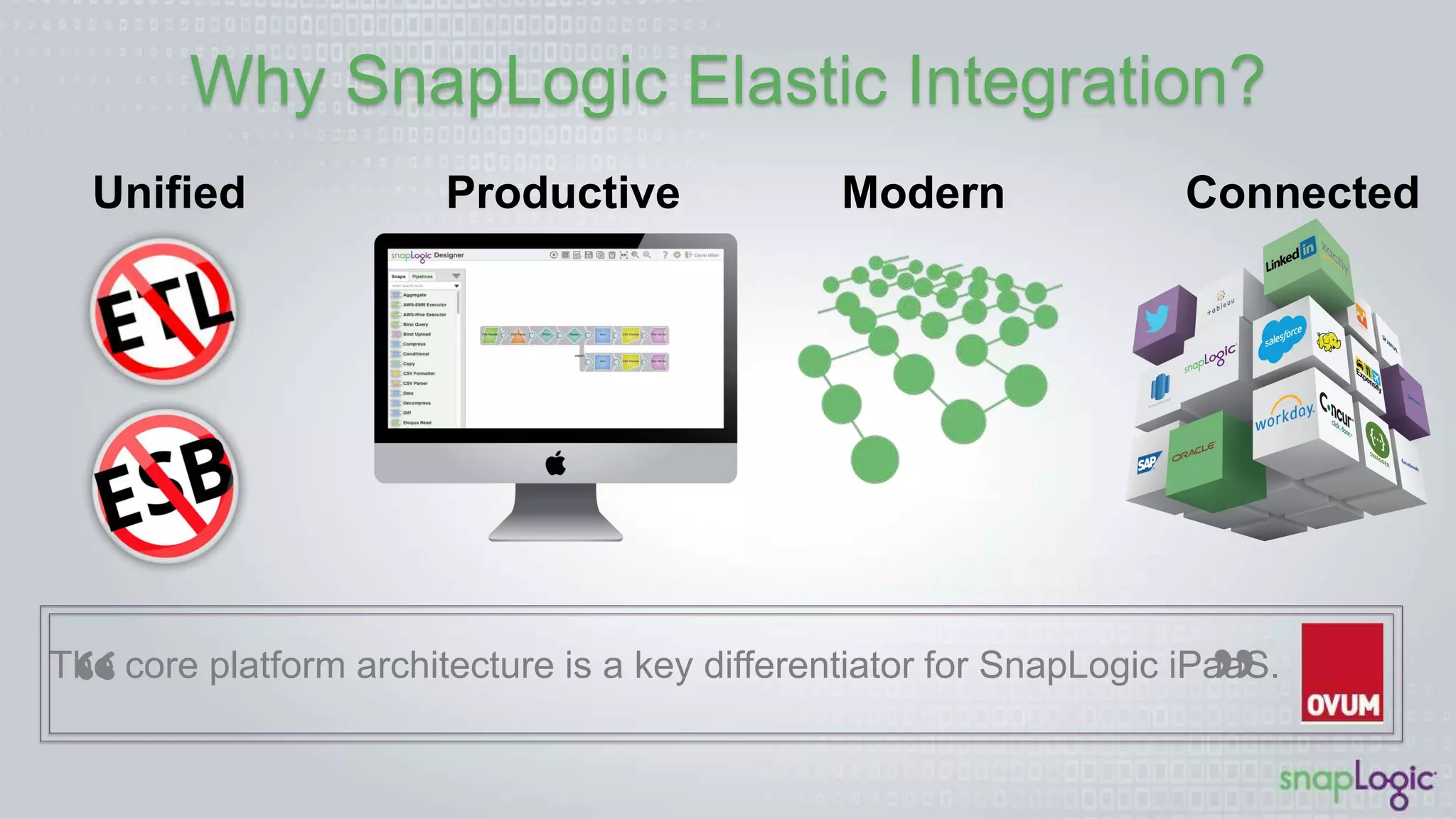
Why SnapLogic Elastic Integration?
Modern ConnectedProductiveUnified
The core platform architecture is a key differentiator for SnapLogic iPaaS.
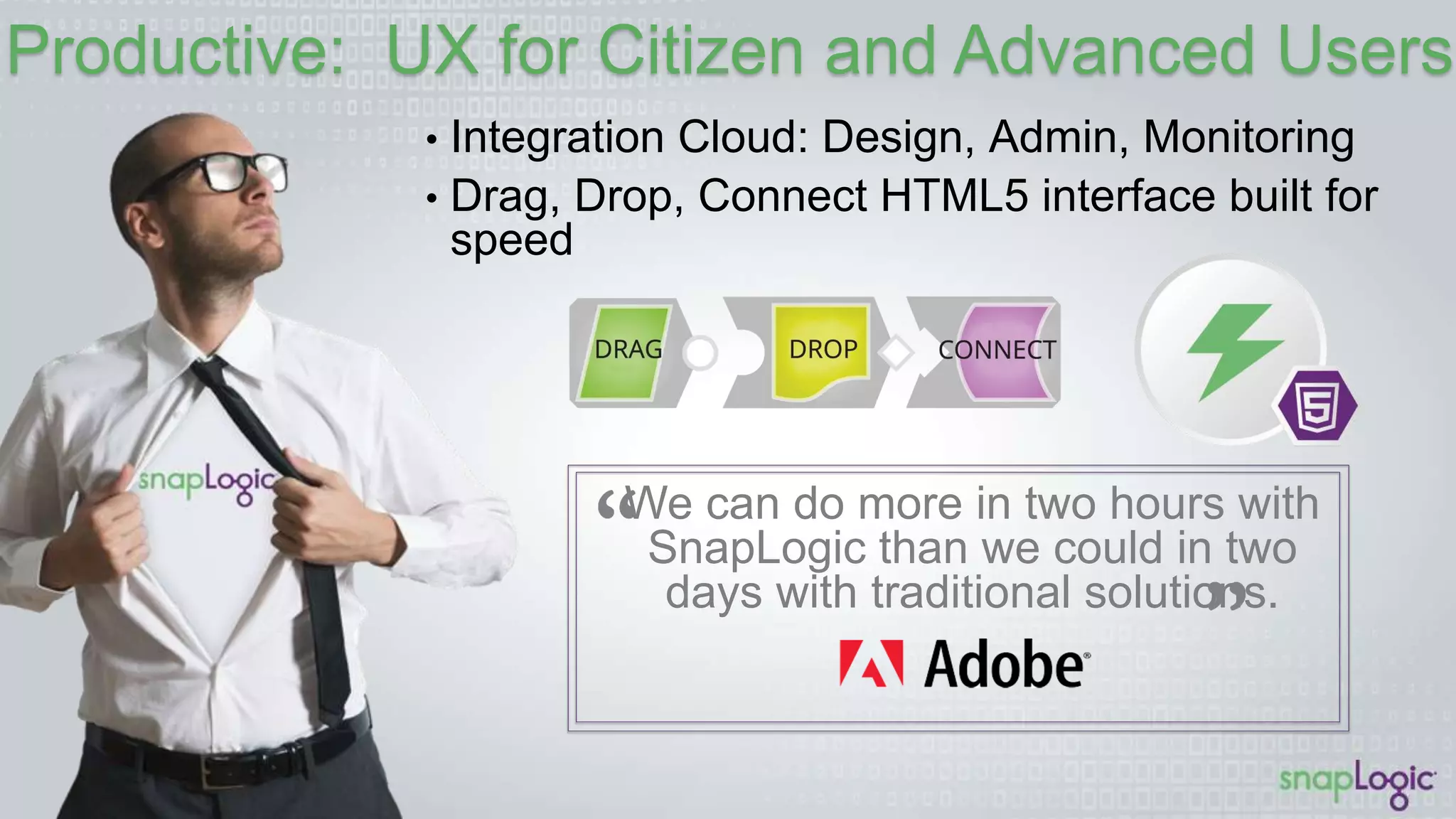
Productive: UX for Citizen and Advanced Users
We can do more in two hours with
SnapLogic than we could in two days
with traditional solutions.
•  Integration Cloud: Design, Admin, Monitoring
•  Drag, Drop, Connect HTML5 interface built for speed
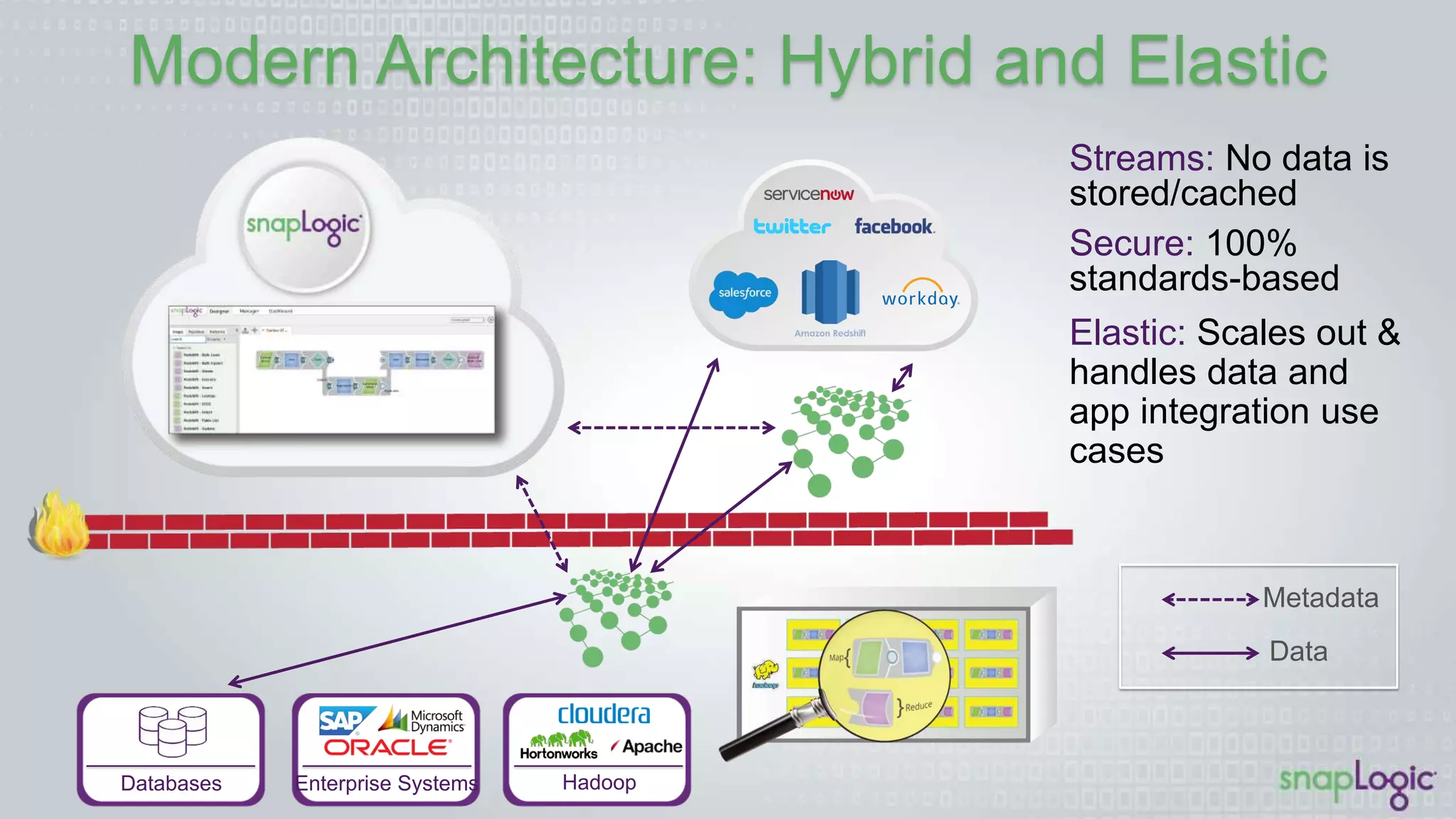
Modern Architecture: Hybrid and Elastic
Streams: No data is
stored/cached
Secure: 100%
standards-based
Elastic: Scales out &
handles data and app
integration use cases
Metadata
Data
Databases Enterprise Systems Hadoop
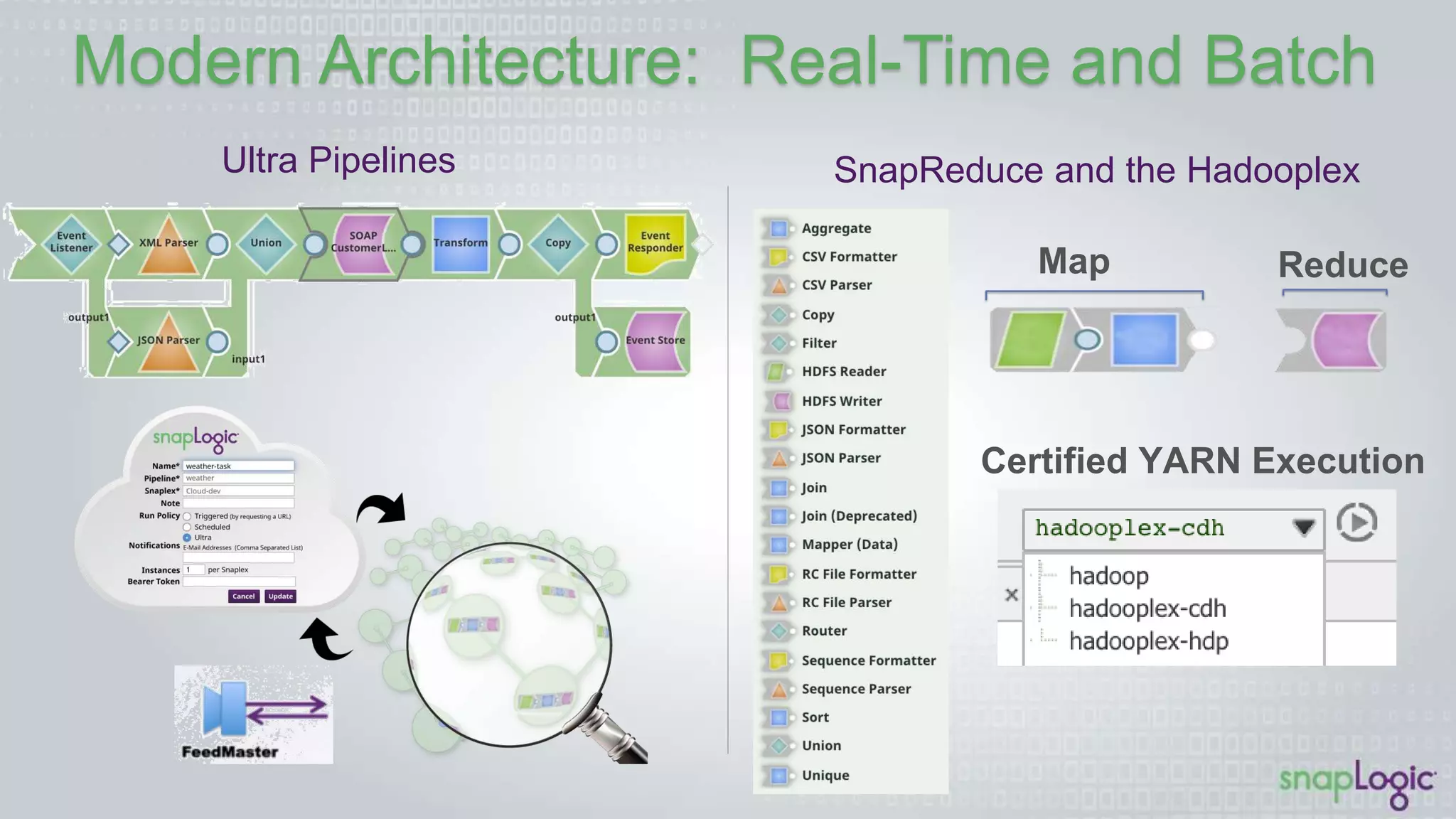
Modern Architecture: Real-Time and Batch
Ultra Pipelines SnapReduce and the Hadooplex
Map Reduce
Certified YARN Execution
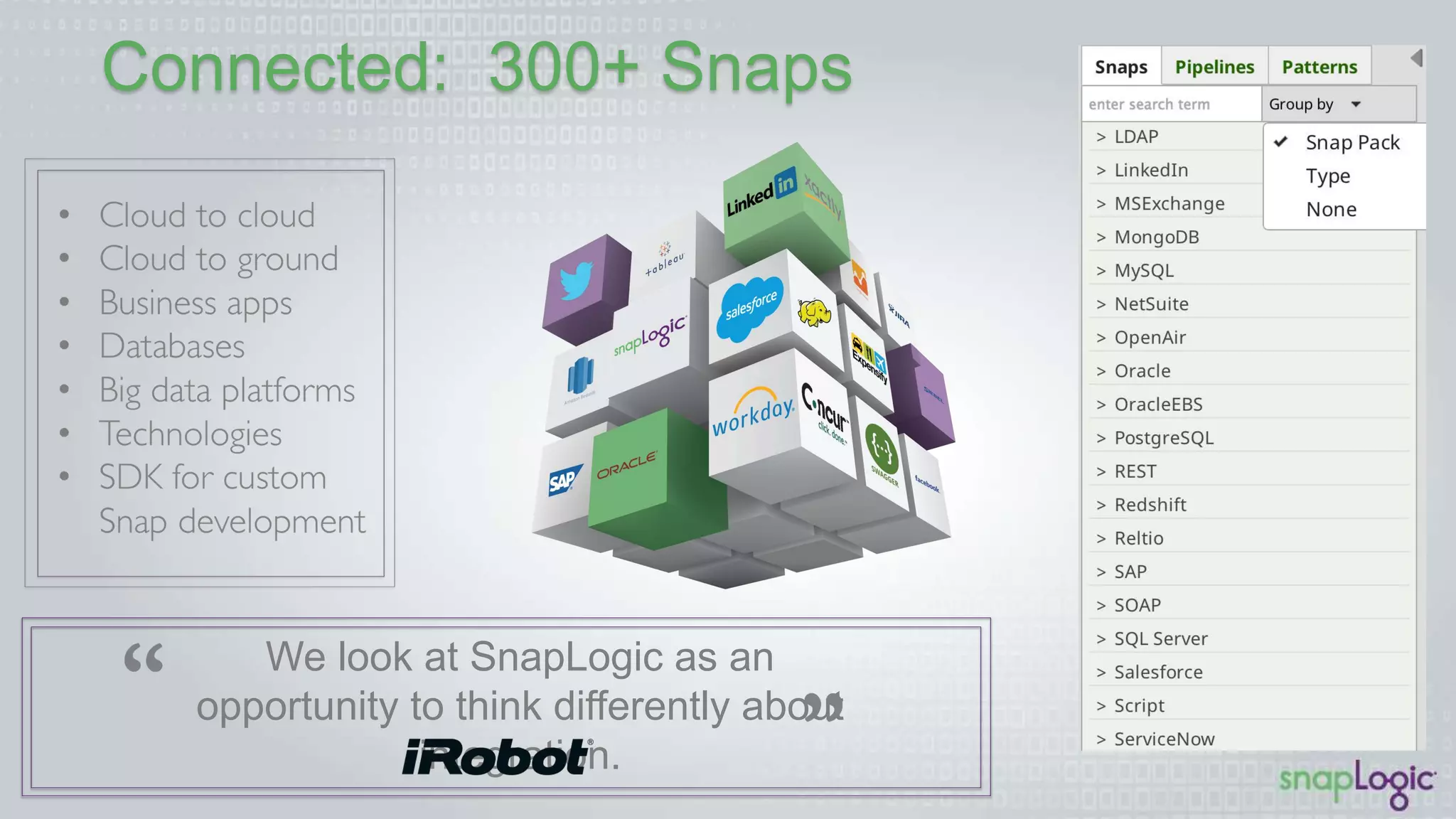
Connected: 300+ Snaps
We look at SnapLogic as an opportunity to
think differently about integration.
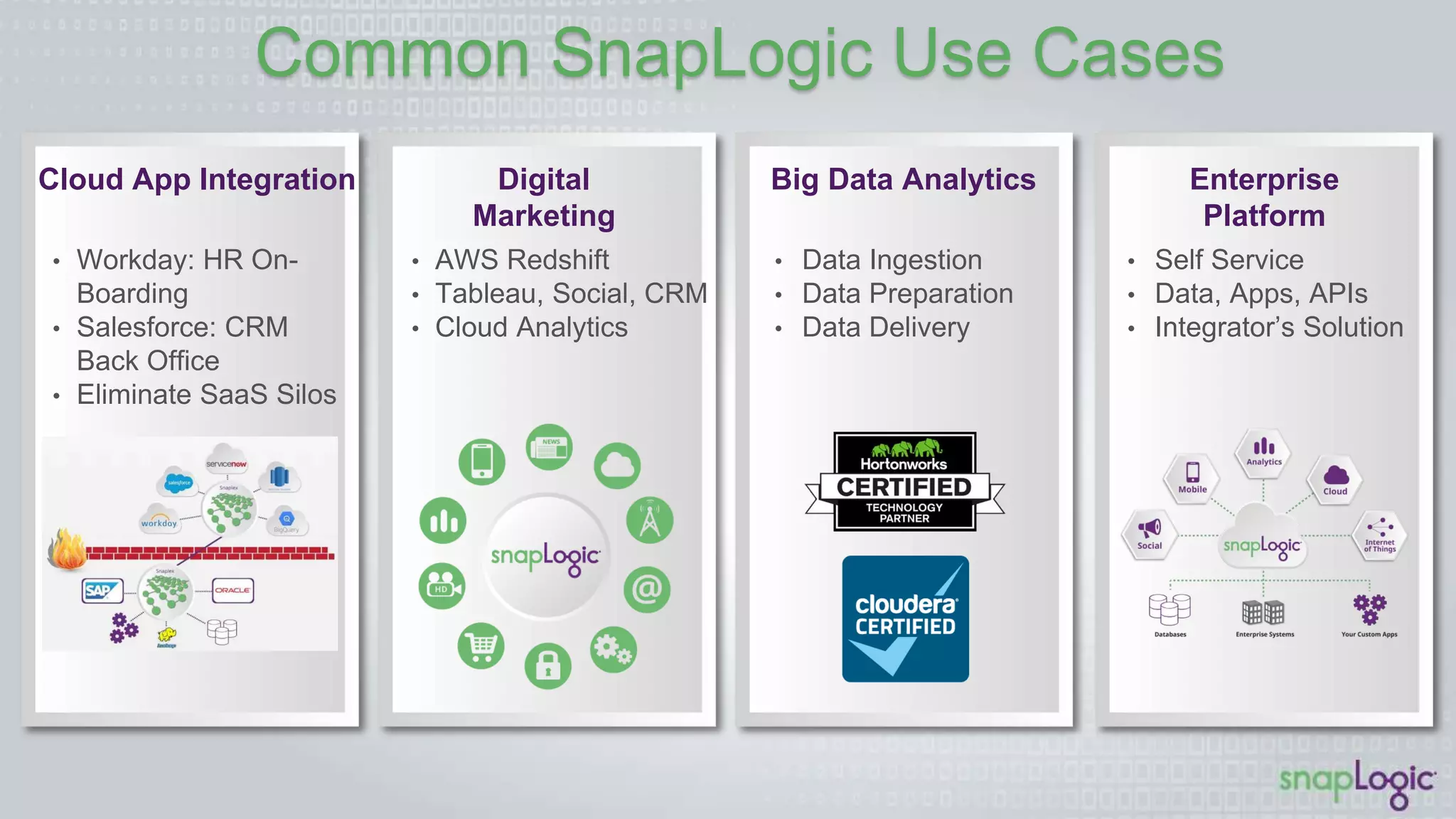
Common SnapLogic Use Cases
Cloud App
Integration
•  Workday: HR On-
Boarding
•  Salesforce: CRM Back
Office
•  Eliminate SaaS Silos
Digital
Marketing
•  AWS Redshift
•  Tableau, Social, CRM
•  Cloud Analytics
Big Data
Analytics
Enterprise
Platform
•  Data Ingestion
•  Data Preparation
•  Data Delivery
•  Self Service
•  Data, Apps, APIs
•  Integrator’s Solution
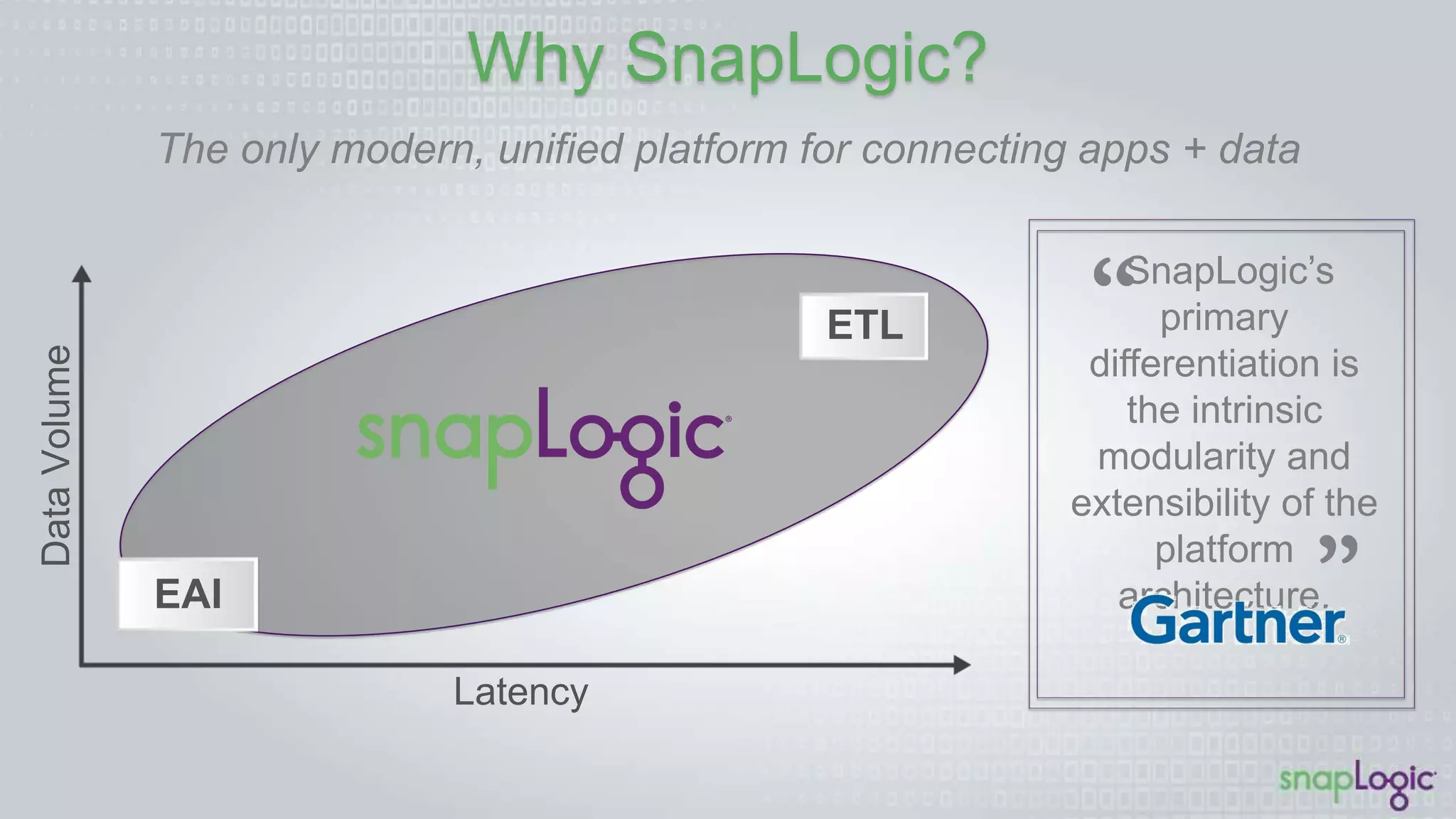
Why SnapLogic?
The only modern, unified platform for connecting apps + data
DataVolume
Latency
EAI
SnapLogic’s
primary
differentiation is the
intrinsic modularity
and extensibility of
the platform
architecture.
ETL
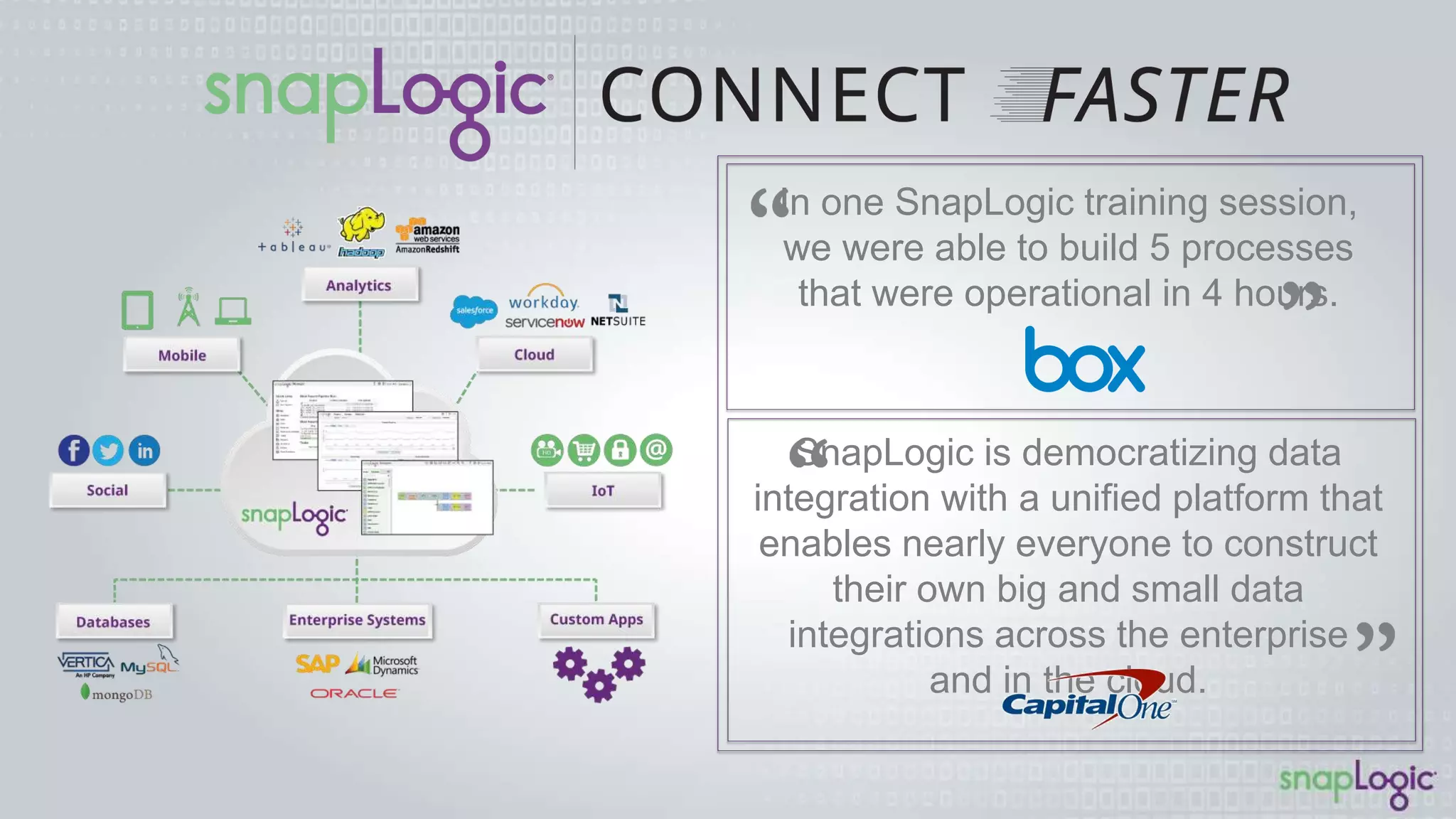
In one SnapLogic training session, we
were able to build 5 processes that
were operational in 4 hours.
SnapLogic is democratizing data
integration with a unified platform that
enables nearly everyone to construct
their own big and small data integrations
across the enterprise and in the cloud.
Discussion
@SnapLogic
Facebook.com/SnapLogic
Plus.google.com/+SnapLogic
www.snaplogic.com/connect-faster

Cloud Con 2015 - Integration & Web APIs

  • 2.
    Cloud Application AdoptionChallenges Disconnected SaaS Silos! Point-to-Point Integration Hairball! By 2018, spending on public IT cloud services will grow six times faster than the overall IT market to $127B.
  • 3.
    CanYour Integration Runat Cloud Speed? Those who think they can sit on the sidelines and wait for their data integration technology provider to create the solutions they require will be very disappointed. Dave Linthicum SVP, Cloud Technology Partners The Death of Traditional Data Integration
  • 4.
    5 SignsYou NeedBetter Cloud Integration 1) You're Struggling with the Integrator's Dilemma 2) You Thought Cloud = Open API Utopia 5) You Have Segregated Integration 3) Your App Users Require Swivel Chairs 4) You’re Considering Going Back to On-Prem to get a Better ROI
  • 5.
    When it Comesto iPaaS: Don’t Forget Data… Unnecessarily segregated application and data integration efforts lead to counterproductive practices and escalating deployment cost. Big Data Access and Analytics:! Legacy ETL = Everything Too Late!
  • 6.
    SnapLogic: Unified Platformto Connect Faster Our unified platform significantly speeds up enterprise data access everywhere. – Gaurav Dhillon, co-founder and CEO, SnapLogic
  • 7.
    Why SnapLogic ElasticIntegration? Modern ConnectedProductiveUnified The core platform architecture is a key differentiator for SnapLogic iPaaS.
  • 8.
    Productive: UX forCitizen and Advanced Users We can do more in two hours with SnapLogic than we could in two days with traditional solutions. •  Integration Cloud: Design, Admin, Monitoring •  Drag, Drop, Connect HTML5 interface built for speed
  • 9.
    Modern Architecture: Hybridand Elastic Streams: No data is stored/cached Secure: 100% standards-based Elastic: Scales out & handles data and app integration use cases Metadata Data Databases Enterprise Systems Hadoop
  • 10.
    Modern Architecture: Real-Timeand Batch Ultra Pipelines SnapReduce and the Hadooplex Map Reduce Certified YARN Execution
  • 11.
    Connected: 300+ Snaps Welook at SnapLogic as an opportunity to think differently about integration.
  • 12.
    Common SnapLogic UseCases Cloud App Integration •  Workday: HR On- Boarding •  Salesforce: CRM Back Office •  Eliminate SaaS Silos Digital Marketing •  AWS Redshift •  Tableau, Social, CRM •  Cloud Analytics Big Data Analytics Enterprise Platform •  Data Ingestion •  Data Preparation •  Data Delivery •  Self Service •  Data, Apps, APIs •  Integrator’s Solution
  • 13.
    Why SnapLogic? The onlymodern, unified platform for connecting apps + data DataVolume Latency EAI SnapLogic’s primary differentiation is the intrinsic modularity and extensibility of the platform architecture. ETL
  • 14.
    In one SnapLogictraining session, we were able to build 5 processes that were operational in 4 hours. SnapLogic is democratizing data integration with a unified platform that enables nearly everyone to construct their own big and small data integrations across the enterprise and in the cloud.
  • 15.

Editor's Notes

  • #2 Welcome to this introduction to SnapLogic. At SnapLogic, our mission is to help enterprise IT organizations and the business connect faster. Whether it’s cloud applications, big data, APIs and the Internet of Things, companies like Adobe, Cisco, GE and Target run our unified integration platform as a service (iPaaS) to accelerate cloud application and big data adoption and ensure a maximum return on their investments.
  • #3 By 2018, spending on public IT cloud services will grow six times faster than the overall IT market to $127B. The two primary integration challenges we see today are Cloud and Big Data. Disconnected SaaS silos as enterprise IT organizations embrace best-of-breed cloud applications and need to ensure that these systems are aligned with end-to-end business processes. The risk is that they become LOB-led silos of fragmented, untrustworthy data, which leads to low adoption and ROI, not to mention missed revenue opportunities. An example is new-employee on-boarding for Workday customers, a process that touches many systems including payroll, email, LDAP and back-office financials. Another example is quote to cash for CRM customers, who need to ensure users have a single view of customers and products, regardless of where the data lives. The 2nd major challenge we’re seeing is around Hadoop, noSQL and the changing data infrastructure needed to power modern analytics initiatives. Whether it’s big data volumes, variety of new sources, or the velocity that data is now expected to be streaming in real-time between systems and to analytical business users and data scientists, traditional enterprise data warehousing technologies and methodologies were not built to support the modern enterprise. http://www.idc.com/getdoc.jsp?containerId=prUS25219014 IDC predicts that spending on public IT cloud services will jump at a compound annual growth rate 22.8 percent over the next five years to $127 billion. That total is about six times the growth rate of the overall IT market, IDC reckons. http://www.forbes.com/sites/louiscolumbus/2015/03/22/56-of-enterprises-will-increase-their-investment-in-big-data-over-the-next-three-years/
  • #4 When we talk to customers about why not their existing integration tools for modern requirements, the #1 driver we hear for re-thinking the integration layer is speed. As you modernize your IT infrastructure, it’s essential that your data and application integration technology is a gateway to the cloud and big data, not a roadblock. Gartner not only highlights the need for speed, they also point to integration scale and flexibility as essential when it comes to being able to manage today’s requirements.
  • #7 SnapLogic is the industry’s first unified data and application integration platform as a service (iPaaS). Our vision is to help enterprise IT organizations and lines of business to connect faster and we're working with enterprise IT organizations who are re-thinking their data, application and API integration layer. Customers like Adobe, Cisco, Target, GE are finding that they are able to do these things as much as 5x faster by using a modern integration platform that is built to handle both streaming and batch-oriented big data integration. Founded by Gaurav Dhillon, who also founded and ran Informatica for 12 years, taking the company through a successful IPO. SnapLogic is backed by Ignition Partners and Andreeson Horowitz and our management team is world class. We’re based in San Mateo, California and we have offices in Colorado, Boston and New York with plans to expand to Europe later in 2015.
  • #8 There are 4 primary reasons companies choose SnapLogic to connect faster. We’re a unified platform for data and application integration Our productive user experience is designed to enable so-called “citizen integrators” and advanced users to accelerate time to value. Our modern architecture is built for web scale, with a hybrid architecture that respects data gravity. We have 300+ connectors, called Snaps, to small and big data sources, cloud and on-prem business applications, virtually any data, app, API technology you can think of. Before we discuss use cases and dive into a custom demonstration based on your requirements, I’ll review each of these in a little more detail. Ovum quote – SnapLogic SWOT assessment March 2015: http://campaigns.snaplogic.com/rs/snaplogic/images/assessment-snaplogic-elastic-integration-platform.pdf
  • #9 When we talk about connecting faster, a bit part of that is the productivity gains that our customers tell us about. Integration is a hard problem to solve, and we’re focused on simplifying it as much as possible with a very easy to use, drag and drop design interface for both citizen and advanced integrators. As you can see from Adobe, who has over 100 users of SnapLogic today, they’re able to do more in 2 hours with our cloud integration service than they could do in 2 days with traditional solutions.
  • #10 Here is an example of what a SnapLogic deployment looks like. The Integration Cloud does not store your data. It’s metadata only. Once a pipeline is executed, it looks for the associated Snaplex or Hadoplex. The plex, scale out adding more nodes as needed. We like to say that SnapLogic “respects data gravity” and runs as close to the data as need be. If you are integrating only cloud applications, it would make no sense to run your integrations behind the firewall. Similarly, if you’re doing ground to ground or cloud to ground, you may want to run your Snaplex on Window or Linux servers. Note that the dotted line is sending instructions via metadata to the plex, which is waiting to run. The solid line indicates how data movies bi-directionally between systems. The yellow box is an example of the Hadooplex running pipelines and scale out across multiple nodes in a Hadoop cluster. Reference: http://www.snaplogic.com/security
  • #11 The last thing I wanted to cover in terms of the SnapLogic modern architecture goes back to our ability to handle both real-time, low-latency integration requirements as well as big data volume, variety and velocity. On the left side of the slide is an example of an Ultra Pipeline, which delivers low-latency processing. It is essentially a “listening” configuration that allows you to go beyond scheduled and triggered tasks. With Ultra Pipelines, the pipeline is “always on” so that processing sub-second for most use cases. In the demonstration, you’ll see how each pipeline can be turned into an API, which opens our platform up to even more use cases. Reference: http://www.snaplogic.com/ultra-pipelines On the right side of the slide is a bit more detail on what we call “SnapReduce” and the Hadooplex. With SnapReduce, you’re able to generate complex MapReduce code behind the scenes and get what we call, “Hadoop for Humans.” SnapLogic has been certified by major Apache Hadoop distribution vendors like Cloudera and Hortonworks as a YARN application. The screenshot shows you how easy it is to run your SnapReduce pipelines on Hadoop. Reference: http://www.snaplogic.com/solutions/big-data-integration
  • #12 And finally, Connected. You’ll see in the demonstration the breadth and depth of our Snaps. We have over 300 Snaps and a Snap Development Kit (SDK) for building custom Snaps. Reference: http://www.snaplogic.com/snaps
  • #13 I want to take a few minutes talking about a few common SnapLogic use cases before a demonstration as this will help us further clarify your specific requirements. Here are 4 use cases: Cloud application integration – our most common use case today Digital marketing initiatives that are powered by new cloud analytics strategies. Big data analytics, powered by Hadoop and Spark And an enterprise platform deployment that spans multiple data and application integration use cases.