Attaining Excellence in
Big Data Integration
Attaining Excellence in
Big Data Integration
Webinar
Agenda
Mark Smith
CEO  

Chief Research Officer
Darren Cunningham
VP Marketing, SnapLogic
•  Big Data Drivers and Challenges
•  Re-Thinking Big Data Integration
•  SnapLogic Big Data Integration
•  Next Steps
Poll Question #1 Results
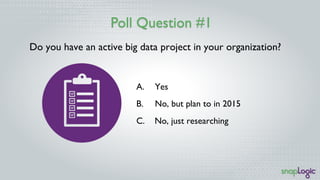
Do you have an active big data project in your organization?
A.  Yes…………………………....47%
B.  No, but plan to in 2015……...20%
C.  No, just researching……….....33%
Big Data Priorities and Drivers
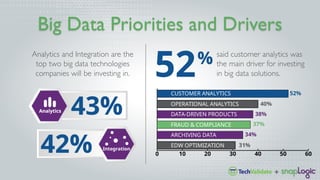
Analytics and Integration are the
top two big data technologies
companies will be investing in.
said customer analytics was
the main driver for investing
in big data solutions.
+
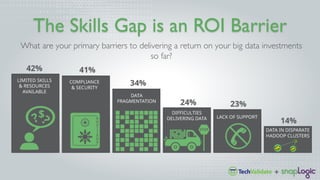
The Skills Gap is an ROI Barrier
What are your primary barriers to delivering a return on your big data investments
so far?
+
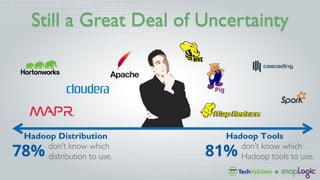
Still a Great Deal of Uncertainty
don’t know which
distribution to use.
don’t know which
Hadoop tools to use.78% 81%
Hadoop Distribution Hadoop Tools
+
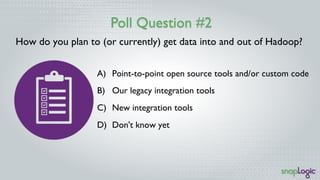
Poll Question #2
How do you plan to (or currently) get data into and out of Hadoop?
A)  Point-to-point open source tools and/or
custom code………………………..20%
B)  Our legacy integration tools….......….7%
C)  New integration tools……………...13%
D)  Don't know yet…………………….60%
© 2015 Ventana Research8 © 2015 Ventana Research
Attaining Excellence in
Big Data Integration
Mark Smith
CEO  Chief Research Officer
Ventana Research
March 4, 2015
© 2015 Ventana Research9 © 2015 Ventana Research9 © 2015 Ventana Research9
Big Data Requires New Thinking
© 2015 Ventana Research10 © 2015 Ventana Research10
Challenge of Effective Big Data Integration
Inefficient Processes
• Use data-based business insights to
improve competitiveness.
• Our research finds that more than
half (55%) of organizations are only
somewhat confident or not at all
confident in their ability to process
large volumes of data.
• Even more (58%) doubt their ability
to process data that arrives at high
velocity.
Source: Ventana Research Big Data Integration Benchmark Research
© 2015 Ventana Research11 © 2015 Ventana Research11 © 2015 Ventana Research11
Increase Agility
• Organizations waste significant
amounts of time on data integration-
related tasks.
• More than one-third (37%) of
organizations need data hourly or
daily, and another one in four need it
available in real time.
• Integration capabilities need to be
flexible enough to deliver cycles of
processing to satisfy an array of
different needs.
Evaluate Efficiency of Processes Best Practice #1
Source: Ventana Research Big Data Integration Benchmark Research
© 2015 Ventana Research12 © 2015 Ventana Research12 © 2015 Ventana Research12
Assess Environment
• Only one-third of organizations are
satisfied with their current
technology.
• More than half of organizations
said their current infrastructure is
not fast enough or flexible enough;
almost half said the technology is
simply inadequate.
• About half of organizations turn to
their existing database or data
integration vendor.
Examine New Approaches Best Practice #2
Source: Ventana Research Big Data Integration Benchmark Research
© 2015 Ventana Research13 © 2015 Ventana Research13 © 2015 Ventana Research13
Dedicated Approach
• Our research shows that what
matters most in selecting big data
integration technology are its
usability and reliability.
• The top three factors driving big
data integration are:
- business improvement (by 54%)
- analytics and BI initiatives (46%)
- improvement in the quality of
business processes (40%).
Evaluate Technology Needs Best Practice #3
Source: Ventana Research Big Data Integration Benchmark Research
© 2015 Ventana Research14 © 2015 Ventana Research14 © 2015 Ventana Research14
Focus on Purpose
• Our research shows that using
dedicated data integration improves
integration processes.
• However, currently only 12 percent
of organizations use dedicated
technology for this purpose.
• Our research shows that high
numbers of organizations use or
plan soon to use Hadoop (48%) and
other NoSQL approaches (38%).
Investigate Dedicated Technology Best Practice #4
Source: Ventana Research Big Data Integration Benchmark Research
© 2015 Ventana Research15 © 2015 Ventana Research15 © 2015 Ventana Research15
Best Practice #5
Gain Value from Data
• More than half of organizations
(56%) that use big data
integration technology said they
have improved their activities and
processes by using it.
• But your acquisition and
deployment should address your
organization’s needs, so pinpoint
the areas of business in which
investment can help.
Gain Benefits that Outweigh Costs
Source: Ventana Research Big Data Integration Benchmark Research
© 2015 Ventana Research16 © 2015 Ventana Research16 © 2015 Ventana Research16
Access Data Anywhere
• Our research finds more than quarter
of organizations have deployed big
data integration software in the cloud.
• One-third (35%) of organizations are
integrating cloud-based systems with
those on-premises.
• Nearly two-thirds (64%) have cloud-
based business applications - an
important data source for big data.
Cloud Playing an Increasing Role
Source: Ventana Research Big Data Integration Benchmark Research
© 2015 Ventana Research17 © 2015 Ventana Research17 © 2015 Ventana Research17 © 2015 Ventana Research
Big Data Requires Integration
© 2015 Ventana Research18 © 2015 Ventana Research18 © 2015 Ventana Research18
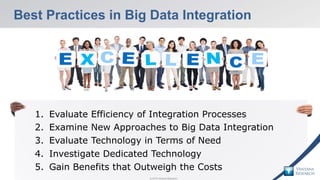
1.  Evaluate Efficiency of Integration Processes
2.  Examine New Approaches to Big Data Integration
3.  Evaluate Technology in Terms of Need
4.  Investigate Dedicated Technology
5.  Gain Benefits that Outweigh the Costs
© 2015 Ventana Research
Best Practices in Big Data Integration
© 2015 Ventana Research19 © 2015 Ventana Research19
Mark Smith – Contact Information
Twitter
@marksmithvr
LinkedIn
http://www.linkedin.com/in/markallensmith
Analyst Perspectives
http://marksmith.ventanaresearch.com
Community and Web Site
http://www.ventanaresearch.com
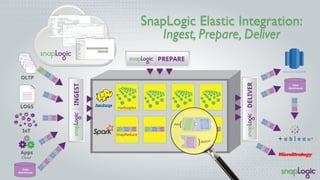
SnapLogic Elastic Integration:
Ingest, Prepare, Deliver
Big Data Integration in a Snap
@SnapLogic
Facebook.com/SnapLogic
Plus.google.com/+SnapLogic
Learn more at!
www.SnapLogic.com!
!

Webinar: Attaining Excellence in Big Data Integration

  • 1.
    Attaining Excellence in BigData Integration Attaining Excellence in Big Data Integration Webinar
  • 2.
    Agenda Mark Smith CEO Chief Research Officer Darren Cunningham VP Marketing, SnapLogic •  Big Data Drivers and Challenges •  Re-Thinking Big Data Integration •  SnapLogic Big Data Integration •  Next Steps
  • 3.
    Poll Question #1Results Do you have an active big data project in your organization? A.  Yes…………………………....47% B.  No, but plan to in 2015……...20% C.  No, just researching……….....33%
  • 4.
    Big Data Prioritiesand Drivers Analytics and Integration are the top two big data technologies companies will be investing in. said customer analytics was the main driver for investing in big data solutions. +
  • 5.
    The Skills Gapis an ROI Barrier What are your primary barriers to delivering a return on your big data investments so far? +
  • 6.
    Still a GreatDeal of Uncertainty don’t know which distribution to use. don’t know which Hadoop tools to use.78% 81% Hadoop Distribution Hadoop Tools +
  • 7.
    Poll Question #2 Howdo you plan to (or currently) get data into and out of Hadoop? A)  Point-to-point open source tools and/or custom code………………………..20% B)  Our legacy integration tools….......….7% C)  New integration tools……………...13% D)  Don't know yet…………………….60%
  • 8.
    © 2015 VentanaResearch8 © 2015 Ventana Research Attaining Excellence in Big Data Integration Mark Smith CEO Chief Research Officer Ventana Research March 4, 2015
  • 9.
    © 2015 VentanaResearch9 © 2015 Ventana Research9 © 2015 Ventana Research9 Big Data Requires New Thinking
  • 10.
    © 2015 VentanaResearch10 © 2015 Ventana Research10 Challenge of Effective Big Data Integration Inefficient Processes • Use data-based business insights to improve competitiveness. • Our research finds that more than half (55%) of organizations are only somewhat confident or not at all confident in their ability to process large volumes of data. • Even more (58%) doubt their ability to process data that arrives at high velocity. Source: Ventana Research Big Data Integration Benchmark Research
  • 11.
    © 2015 VentanaResearch11 © 2015 Ventana Research11 © 2015 Ventana Research11 Increase Agility • Organizations waste significant amounts of time on data integration- related tasks. • More than one-third (37%) of organizations need data hourly or daily, and another one in four need it available in real time. • Integration capabilities need to be flexible enough to deliver cycles of processing to satisfy an array of different needs. Evaluate Efficiency of Processes Best Practice #1 Source: Ventana Research Big Data Integration Benchmark Research
  • 12.
    © 2015 VentanaResearch12 © 2015 Ventana Research12 © 2015 Ventana Research12 Assess Environment • Only one-third of organizations are satisfied with their current technology. • More than half of organizations said their current infrastructure is not fast enough or flexible enough; almost half said the technology is simply inadequate. • About half of organizations turn to their existing database or data integration vendor. Examine New Approaches Best Practice #2 Source: Ventana Research Big Data Integration Benchmark Research
  • 13.
    © 2015 VentanaResearch13 © 2015 Ventana Research13 © 2015 Ventana Research13 Dedicated Approach • Our research shows that what matters most in selecting big data integration technology are its usability and reliability. • The top three factors driving big data integration are: - business improvement (by 54%) - analytics and BI initiatives (46%) - improvement in the quality of business processes (40%). Evaluate Technology Needs Best Practice #3 Source: Ventana Research Big Data Integration Benchmark Research
  • 14.
    © 2015 VentanaResearch14 © 2015 Ventana Research14 © 2015 Ventana Research14 Focus on Purpose • Our research shows that using dedicated data integration improves integration processes. • However, currently only 12 percent of organizations use dedicated technology for this purpose. • Our research shows that high numbers of organizations use or plan soon to use Hadoop (48%) and other NoSQL approaches (38%). Investigate Dedicated Technology Best Practice #4 Source: Ventana Research Big Data Integration Benchmark Research
  • 15.
    © 2015 VentanaResearch15 © 2015 Ventana Research15 © 2015 Ventana Research15 Best Practice #5 Gain Value from Data • More than half of organizations (56%) that use big data integration technology said they have improved their activities and processes by using it. • But your acquisition and deployment should address your organization’s needs, so pinpoint the areas of business in which investment can help. Gain Benefits that Outweigh Costs Source: Ventana Research Big Data Integration Benchmark Research
  • 16.
    © 2015 VentanaResearch16 © 2015 Ventana Research16 © 2015 Ventana Research16 Access Data Anywhere • Our research finds more than quarter of organizations have deployed big data integration software in the cloud. • One-third (35%) of organizations are integrating cloud-based systems with those on-premises. • Nearly two-thirds (64%) have cloud- based business applications - an important data source for big data. Cloud Playing an Increasing Role Source: Ventana Research Big Data Integration Benchmark Research
  • 17.
    © 2015 VentanaResearch17 © 2015 Ventana Research17 © 2015 Ventana Research17 © 2015 Ventana Research Big Data Requires Integration
  • 18.
    © 2015 VentanaResearch18 © 2015 Ventana Research18 © 2015 Ventana Research18 1.  Evaluate Efficiency of Integration Processes 2.  Examine New Approaches to Big Data Integration 3.  Evaluate Technology in Terms of Need 4.  Investigate Dedicated Technology 5.  Gain Benefits that Outweigh the Costs © 2015 Ventana Research Best Practices in Big Data Integration
  • 19.
    © 2015 VentanaResearch19 © 2015 Ventana Research19 Mark Smith – Contact Information Twitter @marksmithvr LinkedIn http://www.linkedin.com/in/markallensmith Analyst Perspectives http://marksmith.ventanaresearch.com Community and Web Site http://www.ventanaresearch.com
  • 20.
  • 21.
    Big Data Integrationin a Snap @SnapLogic Facebook.com/SnapLogic Plus.google.com/+SnapLogic Learn more at! www.SnapLogic.com! !

Editor's Notes

  • #2 Clean this up
  • #3 Move speakers onto this slide.
  • #5 The graphics from the infographic. No need for the “repeated header copy”
  • #6 Take away the “Barrier” copy
  • #7 Maybe move Hadoop Distr. And Hadoop tools to the bottom make more clear its left and right.
  • #9 Five Best Practices in Modern Marketing Planning to Achieve Your Objectives Marketing is notorious for developing their plans in isolation. With increasing pressure to deliver business value, great marketing teams are laser focused on aligning their activities to corporate objectives and revenue targets. In this webinar, we'll show you how best-run modern marketing organizations are able to align targets and drive growth while managing budgets within a few percent of target, and answer key questions like: How are we planning our activities against our target? How can we ensure our marketing campaigns, programs and tactics are aligned with revenue growth? 5 best practices in marketing planning used by best-in-class enterprise organizations How you can build marketing plans aligned to business objectives and global campaign initiatives How you can measure the impact of marketing investments, and reallocate spend to high performing programs (including what-if scenario plans to determine investment priorities)
  • #10 As the volume of an organization’s data grows, so does the need to integrate, process and understand it. Organizations need to integrate and make business sense of data stored not only internally but in cloud computing environments and on the Internet.   Unfortunately, many of the technologies and methods being used aren’t up to the challenge. Perhaps in recognition of this inadequacy, more than three-fourths (78%) of organizations participating in our research said automating the integration of large volumes of data is important or very important. Increasingly today, to be able to extract business insights that enable people to make smart decisions they are turning to the technology known as big data.   This e-book is based on Ventana Research’s benchmark research on big data integration and is intended to provide insight into the nature and value of best practices to optimize integration processes and technology. As the volume of an organization’s data grows, so does the need to integrate, process and understand it. Organizations need to integrate and make business sense of data stored not only internally but in cloud computing environments and on the Internet.   Unfortunately, many of the technologies and methods being used aren’t up to the challenge. Perhaps in recognition of this inadequacy, more than three-fourths (78%) of organizations participating in our research said automating the integration of large volumes of data is important or very important. Increasingly today, to be able to extract business insights that enable people to make smart decisions they are turning to the technology known as big data.   This e-book is based on Ventana Research’s benchmark research on big data integration and is intended to provide insight into the nature and value of best practices to optimize integration processes and technology.
  • #11 Being able to use data-based business insights improves competitiveness. But processing larger volumes of heterogeneous data manually or using legacy tools to derive those insights is slow and risks creating errors that undermine the value of the information and confidence in it. Our research finds that more than half (55%) of organizations are only somewhat confident or not at all confident in their ability to process large volumes of data, and even more (58%) doubt their ability to process data that arrives at high velocity.   There’s also widespread dissatisfaction with the data integration technology currently in use, with most organizations finding it too slow and hard to build and maintain. Takeaway: Using inefficient processes and tools for big data integration can undermine business effectiveness.
  • #12 Evaluate the Efficiency of Your Integration Processes Our research finds that organizations waste significant amounts of time on data integration-related tasks, particularly reviewing data for quality and consistency and preparing it for integration. These tasks are prime candidates for automation that can streamline big data integration.   Efficiency in data integration is essential to support marketplace agility. More than one-third (37%) of organizations need data hourly or daily, and another one in four need it available in real time. It therefore is critical that an organization’s big data integration capability be flexible enough to deliver cycles of processing to satisfy an array of different needs. Today fewer than half can do so.   Takeaway: Ensure that your data integration processes are both fast and flexible enough to satisfy business needs.
  • #13 Examine New Approaches to Big Data Integration Today the most used tools for managing and integrating big data are relational databases and flat files. However, only one-third of organizations are satisfied with their current technology. More than half of organizations said their current infrastructure is not fast enough or flexible enough; almost half said the technology is simply inadequate. Yet many are reluctant to move forward, saying big data technologies are too complex and cost is a barrier. When they do, about half of organizations turn to their existing database or data integration vendor. This approach may seem simplest, but ultimately tools purpose-designed for big data will be more efficient and useful. For example, some systems now support semi-structured and unstructured data and native JavaScript Object Notation (JSON) for data interchange. Takeaway: Big data technology is evolving, so it may not be wise to assume existing suppliers can best meet your needs. Assess carefully.  
  • #14 Evaluate Technology in Terms of Need Big data integration can be a challenge, given the many sources, huge volumes and cycle times required. Choosing automation technology that can adapt to your needs today and in the future is critical.   Organizations must integrate documents and Web pages, external sources and streams of data as well as internal data from customers and transactions. The right tools can prepare all of these for integration processing. Our research shows that what matters most in selecting big data integration technology are its usability and reliability. The top three factors driving big data integration are: business improvement initiatives (by 54%) wider analytics and BI initiatives (46%) improvement in the quality of business processes (40%). Takeaway: Ensure that your evaluation of big data integration is comprehensive and considers the array of needs across business and IT.
  • #15 Investigate Dedicated Technology   Our research shows that using dedicated data integration technology improves integration activities and processes. However, currently only 12 percent of organizations use dedicated technology for this purpose. In addition: 39 percent said they will begin to use it within a year 46 percent intend to use such technology but do not know when they will do so. When you begin your investigation, look for tools that are easily used by a range of business professionals, not just IT experts. Tools being considered should be designed for big data, as our research shows that substantial numbers of organizations use or plan soon to use Hadoop (48%) and other NoSQL approaches (38%). Don’t foreclose options for your organization. Takeaway: Use the technology best suited for big data integration and worthy of investment.
  • #16 Gain Benefits that Outweigh Costs More than half of organizations (56%) that use big data integration technology said they have improved their activities and processes by using it. They cited several benefits achieved, most often making more information available. But your acquisition and deployment should address your organization’s needs, so pinpoint the areas of business in which investment can help. Research participants most often chose IT (57%), customer service (44%), operations (43%) and marketing (40%). Takeaway: Know what benefits your investment will deliver by examining the impacts of investments on specific business units and IT and the resulting value.
  • #17 The Cloud is Playing an Increasing Role The business use of the cloud for applications, systems and data storage continues to grow, driven largely by cost and convenience. Our research finds that more than one-quarter of organizations have deployed big data integration software in the cloud, one-third (35%) of organizations are integrating cloud-based systems with those on-premises and nearly two-thirds (64%) said that cloud-based business applications are an important data source for their big data integration efforts ­– the most frequently cited external data source. And just accessing data in traditional batch cycles isn’t the best way to utilize cloud data sources. Using cloud- and Internet-resident data can mean working with data cycling at different timing frequencies; loose coupling and late binding may be better methods for integration. Takeaway: Assess whether your organization’s approach to the cloud is optimal for big data integration.
  • #18 Big Data Requires Integration   Big data is a big deal for today’s business. Unfortunately most organizations are not well prepared to integrate the rapidly proliferating volumes of data. Poor integration cuts off timely access to actionable insights.   Every organization should develop a comprehensive strategy for managing data and turning it into actionable information – a strategy that should incorporate the integration and processing of big data and subsequent application of analytics to the data. Capable technology tools can facilitate this, making the integration smoother and faster and helping to produce better guidance.   Ventana Research believes that companies well equipped for big data integration operate more effectively. Evaluating dedicated technology designed for this new generation of requirements is a first step to increasing agility in business.   Graphic: Something about accomplishment, satisfaction to represent a positive perspective on use of technology for big data integration.