OpenStack Primer 
What is OpenStack? 
OpenStack is the world’s leading open cloud infrastructure 
platform. An open-source project initiated by Rackspace and 
NASA, it’s a global collaboration between developers and 
cloud experts to build a solution that’s fast to deploy, simple 
to develop and manage, massively scalable, and free from 
vendor lock-in. 
How is OpenStack different from other cloud 
infrastructure software? 
The OpenStack project is about openness and 
collaboration, bringing together people and organisations 
with the same philosophy to work together with full 
transparency. That openness extends to platforms, too. 
While some vendors are strong in either public or private 
clouds, OpenStack covers both. It has the support of over 
150 companies, including HP, IBM, RackSpace and more. 
What does Open Cloud mean exactly? 
A truly open cloud has a few key strengths. It uses 
open-source code that anyone can run, build on and 
contribute to, and has a lively developer community driving 
it forward. Design and development are transparent 
processes, with plans and code available for public review. 
It’s based on open standards, without patents and other 
commercial restrictions, and it spans different cloud 
architectures, so it can be easily ported if need be. 
These factors combine to make open clouds far easier than 
many people think. Rather than doing it all on your own, a 
platform like OpenStack has a community of thousands of 
individuals and hundreds of companies ready to share their 
services and experience, and they’re all invested in keeping 
the platform open, secure and reliable. OpenStack has the 
largest ecosystem of tools, solutions and service providers. 
What is Canonical’s involvement with OpenStack? 
Canonical is a Platinum Member of the OpenStack 
Foundation, and was the first company to commercially 
distribute and support OpenStack. Ubuntu is the reference 
operating system for OpenStack deployments, making 
it the easiest way to build an OpenStack cloud, and since 
2011 the latest version has been included in every Ubuntu 
release. The release schedules of the two projects are 
synchronised, ensuring that OpenStack updates and 
releases are immediately available on widely deployed 
releases of Ubuntu. 
Does Canonical have its own OpenStack distribution? 
How does it differ from others? 
Technically yes, but Canonical’s OpenStack distribution 
(called ‘Ubuntu OpenStack’) is so close to the original 
distribution that it’s not differentiated as such. Ubuntu 
with OpenStack just works. Most important is Ubuntu’s 
status as the reference operating system, the one the 
developers of OpenStack use every day. That means 
whenever a new update is published for OpenStack, 
it will be tested and published for Ubuntu straight 
away – something no other operating system can claim. 
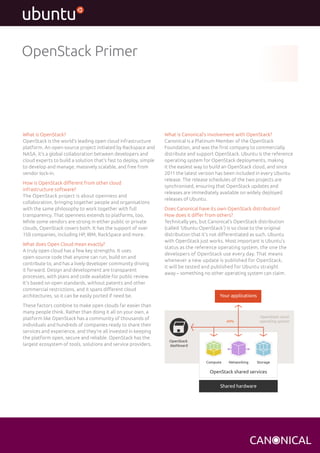
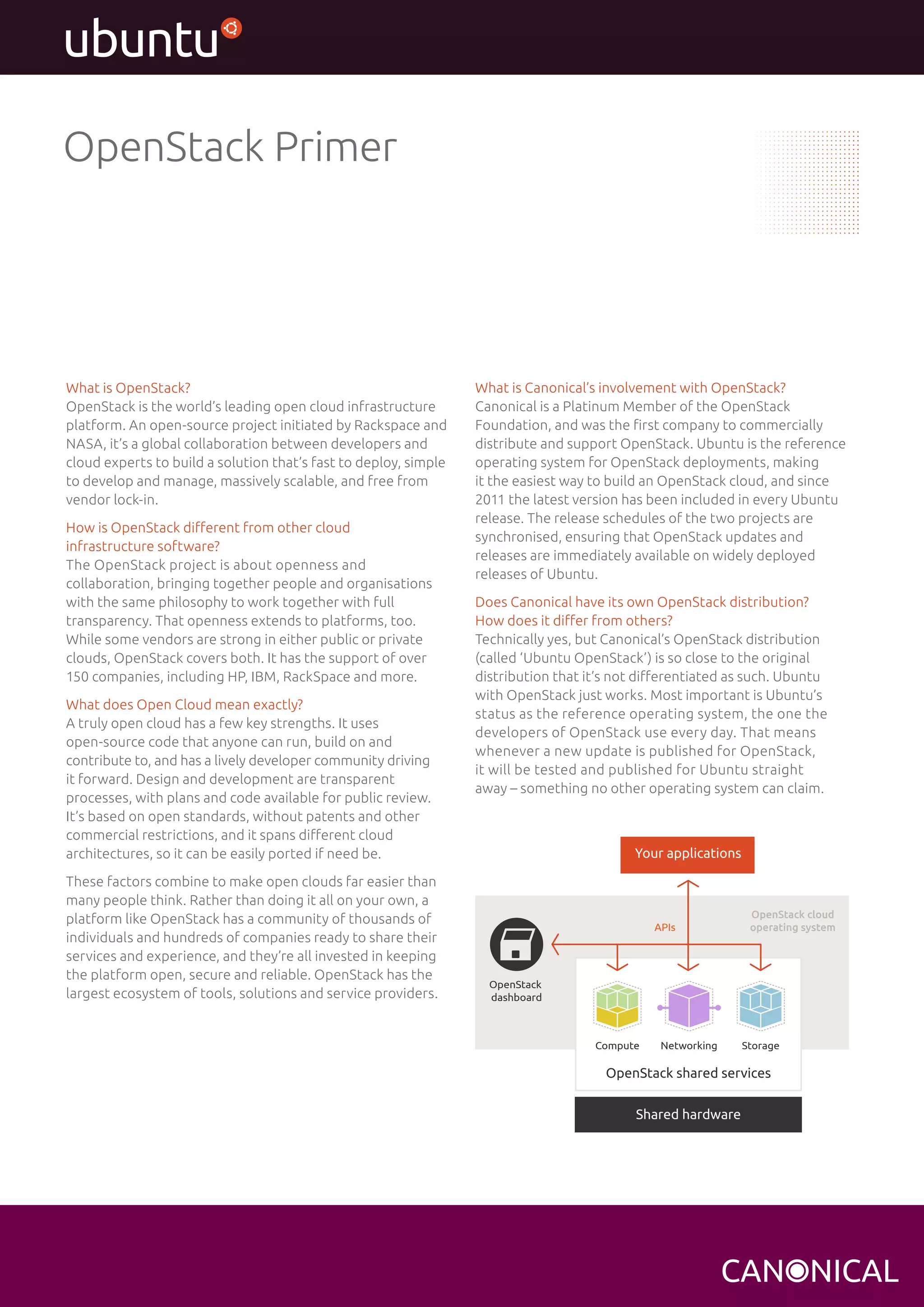
Compute Networking Storage 
OpenStack shared services 
Shared hardware 
OpenStack cloud 
operating system 
OpenStack 
dashboard 
Your applications 
APIs
What does OpenStack consist of? 
OpenStack consists of a series of interrelated projects 
delivering the necessary components of a cloud 
infrastructure. 
OpenStack Compute provisions and manages large 
numbers of virtual machines to offer on-demand 
computing resources. 
OpenStack Block Storage or Object Storage allow 
for effective scale-out storage needs to be met, with a 
variety of options to meet the complexity of a project. 
OpenStack Networking is a pluggable, scalable and 
API-driven system for managing networks and IP addresses. 
Shared services span all three, addressing identity 
and image management, and integration with other 
OpenStack components and external systems. 
The OpenStack Dashboard provides a web interface 
for administrators to control all of the above. 
Can I run an OpenStack cloud alongside my existing, 
proprietary one? 
Technically, yes. Many of our customers choose to build 
an OpenStack cloud alongside an existing, proprietary 
cloud. Typical reasons are: reducing vendor lock-in, being 
able to scale out without restrictions on capacity or 
proportional increases in pricing, testing the latest cloud 
technologies, which are almost always available on open 
platforms first, among others. The exact details of whether 
and how your existing cloud can work alongside an 
OpenStack cloud will vary depending on your existing 
technology and requirements. If you are interested in 
building an OpenStack cloud, please get in touch and our 
experts will advise you: ubuntu.com/cloud/contact-us 
How do I get started with OpenStack? 
The wiki pages at wiki.openstack.org contain installation 
instructions and links to all sorts of helpful guides, FAQs, 
mailing lists and IRC channels. The Ask OpenStack page can 
help if your question hasn’t been answered elsewhere, and 
Launchpad is the place to submit and view known bugs. 
How can Canonical help with my OpenStack cloud 
deployment on Ubuntu? 
Through our Jumpstart service, Canonical will build you 
a private cloud on your own hardware over the course 
of five days. An on-site Canonical services engineer will 
design and deploy the infrastructure, deal with group and 
security requirements, assess storage needs, and develop 
a personalised strategy for ongoing management. 
It’s all the hard work done for you in under a week. 
From there, you’ll want the Ubuntu Advantage professional 
package with its Landscape systems management tool. 
With a choice of several levels, companies can get 24/7 
support and access to the experts to keep the cloud running 
smoothly. For more information on Jumpstart, please visit: 
ubuntu.com/cloud/cloud-tools/jumpstart 
What companies have you worked with on building 
OpenStack clouds? 
We’ve worked with many large companies and the list 
is growing all the time. Four of the world’s largest telcos 
are currently implementing a cloud on Ubuntu OpenStack 
with support from experts at Canonical. 
In these deployments we can work with a company’s 
existing datacentres, help them choose the right cloud 
infrastructure for their expansion needs, and even run 
trials on a test cloud to evaluate the potential benefits. 
They want cost-effective, scalable, robust IT, and our 
custom-built clouds give them all that and more, including 
the ability to have one OS – Ubuntu – running across the 
whole enterprise, from servers to staff desktops. 
Where can I find out more? 
For information on Ubuntu OpenStack: ubuntu.com/cloud 
To speak to us about building and supporting your 
OpenStack cloud: ubuntu.com/cloud/contact-us 
For information on support packages and Landscape for 
systems management: ubuntu.com/cloud/management 
Ask about our other publications: 
• Top Questions about Juju 
• Top Questions about MAAS 
• Running a public cloud on Ubuntu OpenStack 
• Landscape for cloud 
© Canonical Limited 2013. Ubuntu, Kubuntu, Canonical and their associated logos are the registered trademarks of Canonical Limited. All other 
trademarks are the properties of their respective owners. Any information referred to in this document may change without notice and Canonical will 
not be held responsible for any such changes. UbuntuKylin is a registered trade mark for CCN and Canonical is the exclusive provider of UbuntuKylin. 
Canonical Limited, Registered in England and Wales, Company number 110334C 
Registered Office: One Circular Road, Douglas, Isle of Man IM1 1SB VAT Registration: GB 003 2322 47 (CM-0023)

Cloud Ubuntu Open Stack Primer

  • 1.
    OpenStack Primer Whatis OpenStack? OpenStack is the world’s leading open cloud infrastructure platform. An open-source project initiated by Rackspace and NASA, it’s a global collaboration between developers and cloud experts to build a solution that’s fast to deploy, simple to develop and manage, massively scalable, and free from vendor lock-in. How is OpenStack different from other cloud infrastructure software? The OpenStack project is about openness and collaboration, bringing together people and organisations with the same philosophy to work together with full transparency. That openness extends to platforms, too. While some vendors are strong in either public or private clouds, OpenStack covers both. It has the support of over 150 companies, including HP, IBM, RackSpace and more. What does Open Cloud mean exactly? A truly open cloud has a few key strengths. It uses open-source code that anyone can run, build on and contribute to, and has a lively developer community driving it forward. Design and development are transparent processes, with plans and code available for public review. It’s based on open standards, without patents and other commercial restrictions, and it spans different cloud architectures, so it can be easily ported if need be. These factors combine to make open clouds far easier than many people think. Rather than doing it all on your own, a platform like OpenStack has a community of thousands of individuals and hundreds of companies ready to share their services and experience, and they’re all invested in keeping the platform open, secure and reliable. OpenStack has the largest ecosystem of tools, solutions and service providers. What is Canonical’s involvement with OpenStack? Canonical is a Platinum Member of the OpenStack Foundation, and was the first company to commercially distribute and support OpenStack. Ubuntu is the reference operating system for OpenStack deployments, making it the easiest way to build an OpenStack cloud, and since 2011 the latest version has been included in every Ubuntu release. The release schedules of the two projects are synchronised, ensuring that OpenStack updates and releases are immediately available on widely deployed releases of Ubuntu. Does Canonical have its own OpenStack distribution? How does it differ from others? Technically yes, but Canonical’s OpenStack distribution (called ‘Ubuntu OpenStack’) is so close to the original distribution that it’s not differentiated as such. Ubuntu with OpenStack just works. Most important is Ubuntu’s status as the reference operating system, the one the developers of OpenStack use every day. That means whenever a new update is published for OpenStack, it will be tested and published for Ubuntu straight away – something no other operating system can claim. Compute Networking Storage OpenStack shared services Shared hardware OpenStack cloud operating system OpenStack dashboard Your applications APIs
  • 2.
    What does OpenStackconsist of? OpenStack consists of a series of interrelated projects delivering the necessary components of a cloud infrastructure. OpenStack Compute provisions and manages large numbers of virtual machines to offer on-demand computing resources. OpenStack Block Storage or Object Storage allow for effective scale-out storage needs to be met, with a variety of options to meet the complexity of a project. OpenStack Networking is a pluggable, scalable and API-driven system for managing networks and IP addresses. Shared services span all three, addressing identity and image management, and integration with other OpenStack components and external systems. The OpenStack Dashboard provides a web interface for administrators to control all of the above. Can I run an OpenStack cloud alongside my existing, proprietary one? Technically, yes. Many of our customers choose to build an OpenStack cloud alongside an existing, proprietary cloud. Typical reasons are: reducing vendor lock-in, being able to scale out without restrictions on capacity or proportional increases in pricing, testing the latest cloud technologies, which are almost always available on open platforms first, among others. The exact details of whether and how your existing cloud can work alongside an OpenStack cloud will vary depending on your existing technology and requirements. If you are interested in building an OpenStack cloud, please get in touch and our experts will advise you: ubuntu.com/cloud/contact-us How do I get started with OpenStack? The wiki pages at wiki.openstack.org contain installation instructions and links to all sorts of helpful guides, FAQs, mailing lists and IRC channels. The Ask OpenStack page can help if your question hasn’t been answered elsewhere, and Launchpad is the place to submit and view known bugs. How can Canonical help with my OpenStack cloud deployment on Ubuntu? Through our Jumpstart service, Canonical will build you a private cloud on your own hardware over the course of five days. An on-site Canonical services engineer will design and deploy the infrastructure, deal with group and security requirements, assess storage needs, and develop a personalised strategy for ongoing management. It’s all the hard work done for you in under a week. From there, you’ll want the Ubuntu Advantage professional package with its Landscape systems management tool. With a choice of several levels, companies can get 24/7 support and access to the experts to keep the cloud running smoothly. For more information on Jumpstart, please visit: ubuntu.com/cloud/cloud-tools/jumpstart What companies have you worked with on building OpenStack clouds? We’ve worked with many large companies and the list is growing all the time. Four of the world’s largest telcos are currently implementing a cloud on Ubuntu OpenStack with support from experts at Canonical. In these deployments we can work with a company’s existing datacentres, help them choose the right cloud infrastructure for their expansion needs, and even run trials on a test cloud to evaluate the potential benefits. They want cost-effective, scalable, robust IT, and our custom-built clouds give them all that and more, including the ability to have one OS – Ubuntu – running across the whole enterprise, from servers to staff desktops. Where can I find out more? For information on Ubuntu OpenStack: ubuntu.com/cloud To speak to us about building and supporting your OpenStack cloud: ubuntu.com/cloud/contact-us For information on support packages and Landscape for systems management: ubuntu.com/cloud/management Ask about our other publications: • Top Questions about Juju • Top Questions about MAAS • Running a public cloud on Ubuntu OpenStack • Landscape for cloud © Canonical Limited 2013. Ubuntu, Kubuntu, Canonical and their associated logos are the registered trademarks of Canonical Limited. All other trademarks are the properties of their respective owners. Any information referred to in this document may change without notice and Canonical will not be held responsible for any such changes. UbuntuKylin is a registered trade mark for CCN and Canonical is the exclusive provider of UbuntuKylin. Canonical Limited, Registered in England and Wales, Company number 110334C Registered Office: One Circular Road, Douglas, Isle of Man IM1 1SB VAT Registration: GB 003 2322 47 (CM-0023)