Presented by:
Developing Hybrid Cloud
Applications
Oct 2015
@dancberg
Daniel Berg
IBM Distinguished Engineer
Cloud Foundation & DevOps
2
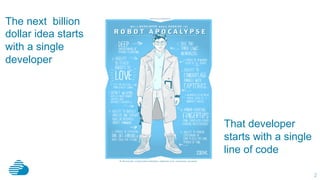
The next billion
dollar idea starts
with a single
developer
That developer
starts with a single
line of code
3
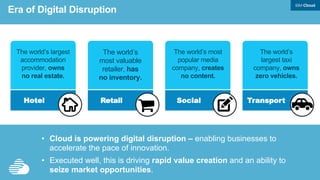
•  Cloud is powering digital disruption – enabling businesses to
accelerate the pace of innovation.
•  Executed well, this is driving rapid value creation and an ability to
seize market opportunities.
Hotel Retail Social Transport
The world’s largest
accommodation
provider, owns
no real estate.
The world’s
most valuable
retailer, has
no inventory.
The world’s most
popular media
company, creates
no content.
The world’s
largest taxi
company, owns
zero vehicles.
Era of Digital Disruption
4
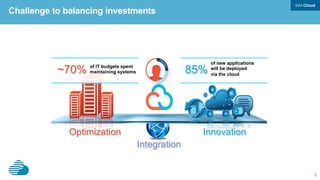
InnovationOptimization
of new applications
will be deployed
via the cloud
of IT budgets spent
maintaining systems~70% 85%
Integration
Challenge to balancing investments
5
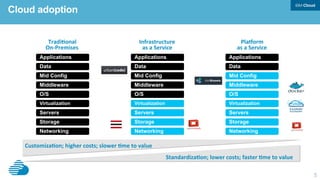
Cloud adoption
Networking Networking
Storage Storage
Servers Servers
Virtualization Virtualization
O/S O/S
Middleware Middleware
Mid Config Mid Config
Data Data
Applications Applications
Tradi&onal		
On-Premises	
Infrastructure	
as	a	Service	
Customiza&on;	higher	costs;	slower	&me	to	value	
Standardiza&on;	lower	costs;	faster	&me	to	value	
Networking
Storage
Servers
Virtualization
O/S
Middleware
Mid Config
Data
Applications
Pla>orm	
as	a	Service
6
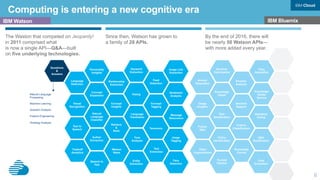
Computing is entering a new cognitive era
Relationship
Extraction
Questions
&
Answers
Language
Detection
Personality
Insights
Keyword
Extraction
Image Link
Extraction
Feed
Detection
Visual
Recognition
Concept
Expansion
Concept
Insights
Dialog
Sentiment
Analysis
Text to
Speech
Tradeoff
Analytics
Natural
Language
Classifier
Author
Extraction
Speech to
Text
Retrieve
&
Rank
Watson
News
Language
Translation
Entity
Extraction
Tone
Analyzer
Concept
Tagging
Taxonomy
Text
Extraction
Message
Resonance
Image
Tagging
Face
Detection
Answer
Generation
Usage
Insights
Fusion
Q&A
Video
Augmentation
Decision
Optimization
Knowledge
Graph
Risk
Stratification
Policy
Identification
Emotion
Analysis
Decision
Support
Criteria
Classification
Knowledge
Canvas
Easy
Adaptation
Knowledge
Studio
Service
Statistical
Dialog
Q&A
Qualification
Factoid
Pipeline
Case
Evaluation
The Waston that competed on Jeopardy!
in 2011 comprised what
is now a single API—Q&A—built
on five underlying technologies.
Since then, Watson has grown to
a family of 28 APIs.
By the end of 2016, there will
be nearly 50 Watson APIs—
with more added every year.
Natural Language
Processing
Machine Learning
Question Analysis
Feature Engineering
Ontology Analysis
IBM Watson IBM Bluemix
7
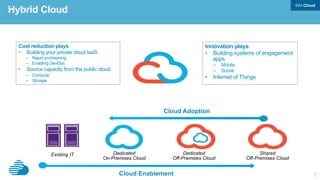
Cost reduction plays
•  Building your private cloud IaaS
–  Rapid provisioning
–  Enabling DevOps
•  Source capacity from the public cloud
–  Compute
–  Storage
Hybrid Cloud
Innovation plays
•  Building systems of engagement
apps
–  Mobile
–  Social
•  Internet of Things
Shared
Off-Premises Cloud
Dedicated
On-Premises Cloud
Existing IT Dedicated
Off-Premises Cloud
Cloud Enablement
Cloud Adoption
8
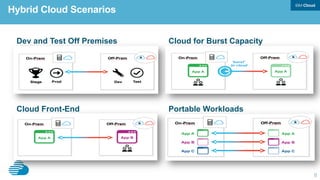
Hybrid Cloud Scenarios
Dev and Test Off Premises Cloud for Burst Capacity
Cloud Front-End Portable Workloads
9
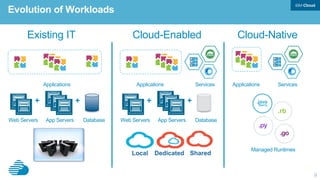
Evolution of Workloads
Existing IT
App Servers
+ +
DatabaseWeb Servers
Applications
Cloud-Enabled
App Servers
+ +
DatabaseWeb Servers
Applications
DedicatedLocal Shared
Services
Cloud-Native
ServicesApplications
Managed Runtimes
Cloud Enabled
11
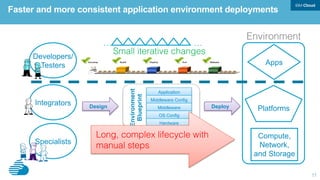
Faster and more consistent application environment deployments
Developers/
Testers
Integrators
Specialists
Compute,
Network,
and Storage
Platforms
Apps
Environment!
Application
Middleware Config
Middleware
OS Config
Hardware
Environment
Blueprint
Design Deploy
Long, complex lifecycle with
manual steps!
Small iterative changes!
…! …!
12
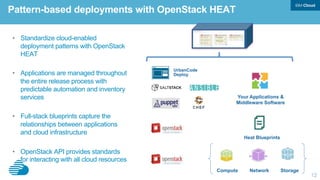
•  Standardize cloud-enabled
deployment patterns with OpenStack
HEAT
•  Applications are managed throughout
the entire release process with
predictable automation and inventory
services
•  Full-stack blueprints capture the
relationships between applications
and cloud infrastructure
•  OpenStack API provides standards
for interacting with all cloud resources
Pattern-based deployments with OpenStack HEAT
Heat Blueprints
UrbanCode
Deploy
Compute Network Storage
Your Applications &
Middleware Software
13
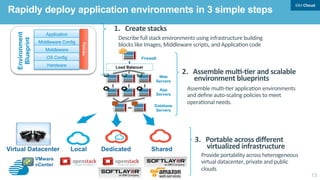
Rapidly deploy application environments in 3 simple steps
Provide	portability	across	heterogeneous	
virtual	datacenter,	private	and	public	
clouds	
3.  Portable	across	different	
virtualized	infrastructure	
Assemble	mul8-8er	applica8on	environments	
and	define	auto-scaling	policies	to	meet	
opera8onal	needs.	
2.  Assemble	mul&-&er	and	scalable	
environment	blueprints	
1.  Create	stacks	
Load Balancer
Web
Servers
App
Servers
Database
Servers
Firewall
Describe	full	stack	environments	using	infrastructure	building	
blocks	like	Images,	Middleware	scripts,	and	Applica8on	code		
VMware
vCenter
Private
Application
Middleware Config
Middleware
OS Config
Hardware
Environment
Blueprint
Policies
DedicatedLocalVirtual Datacenter Shared
Cloud Native
15
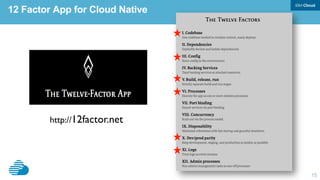
12 Factor App for Cloud Native
http://12factor.net
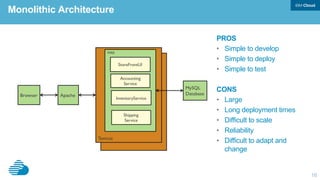
16
PROS
•  Simple to develop
•  Simple to deploy
•  Simple to test
CONS
•  Large
•  Long deployment times
•  Difficult to scale
•  Reliability
•  Difficult to adapt and
change
Monolithic Architecture
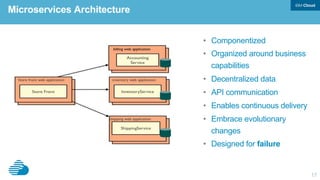
17
•  Componentized
•  Organized around business
capabilities
•  Decentralized data
•  API communication
•  Enables continuous delivery
•  Embrace evolutionary
changes
•  Designed for failure
Microservices Architecture
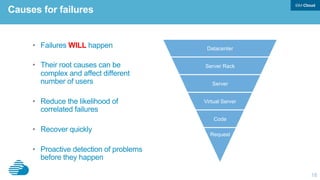
18
•  Failures WILL happen
•  Their root causes can be
complex and affect different
number of users
•  Reduce the likelihood of
correlated failures
•  Recover quickly
•  Proactive detection of problems
before they happen
Causes for failures
Datacenter
Server Rack
Server
Virtual Server
Code
Request
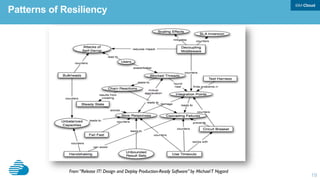
19
Patterns of Resiliency
From “Release IT! Design and Deploy Production-Ready Software” by MichaelT Nygard
20
Ø Simple services but complex distributed systems
Ø IT overhead
Ø  Configuration management
Ø  HA/DR for each service
Ø  Capacity requirements are dramatically higher
Ø  High degree of automation is required
Ø Asynchronous communication nature is difficult
Ø DevOps skills are a must
Microservices do have a cost
21
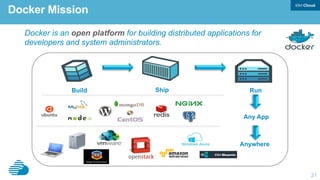
Docker Mission
Docker is an open platform for building distributed applications for
developers and system administrators.
Build Ship Run
Anywhere
Any App
22
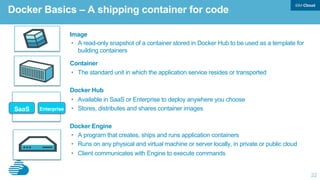
Image
•  A read-only snapshot of a container stored in Docker Hub to be used as a template for
building containers
Container
•  The standard unit in which the application service resides or transported
Docker Hub
•  Available in SaaS or Enterprise to deploy anywhere you choose
•  Stores, distributes and shares container images
Docker Engine
•  A program that creates, ships and runs application containers
•  Runs on any physical and virtual machine or server locally, in private or public cloud
•  Client communicates with Engine to execute commands
Docker Basics – A shipping container for code
SaaS Enterprise
2323
App	
A	


Hypervisor (Type 2)
Host OS
Server


Guest	
OS	


Bins/	
Libs	


App	
A’	


Guest	
OS	


Bins/	
Libs	


App	
B	


Guest	
OS	


Bins/	
Libs	


VM	


Guest	
OS	


Guest	
OS	


AppA’
Host OS
Server
Bins/Libs
AppA
Bins/Libs
AppB
AppB’
AppB’
AppB’
Container
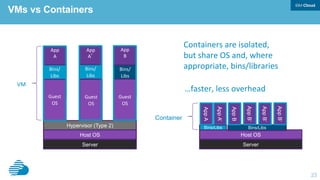
Containers	are	isolated,	
but	share	OS	and,	where	
appropriate,	bins/libraries	
	
…faster,	less	overhead	
VMs vs Containers
24
25
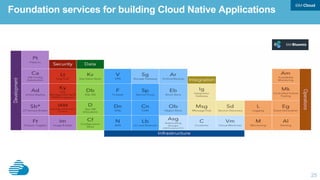
Foundation services for building Cloud Native Applications
26
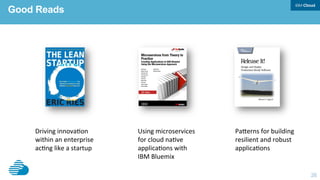
Good Reads
Driving	innova8on	
within	an	enterprise	
ac8ng	like	a	startup	
PaKerns	for	building	
resilient	and	robust	
applica8ons	
Using	microservices	
for	cloud	na8ve	
applica8ons	with	
IBM	Bluemix
Delivery
Patterns
28
29
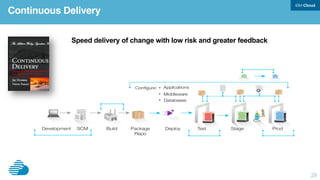
Continuous Delivery
Speed delivery of change with low risk and greater feedback
30
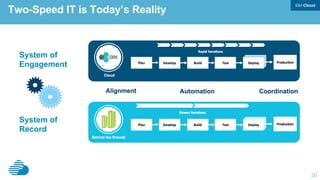
Two-Speed IT is Today’s Reality
System of
Engagement
System of
Record
31
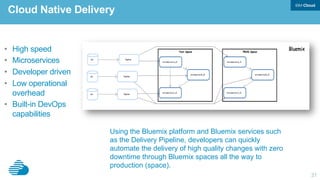
Using the Bluemix platform and Bluemix services such
as the Delivery Pipeline, developers can quickly
automate the delivery of high quality changes with zero
downtime through Bluemix spaces all the way to
production (space).
Cloud Native Delivery
•  High speed
•  Microservices
•  Developer driven
•  Low operational
overhead
•  Built-in DevOps
capabilities
32
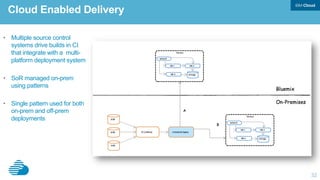
Cloud Enabled Delivery
•  Multiple source control
systems drive builds in CI
that integrate with a multi-
platform deployment system
•  SoR managed on-prem
using patterns
•  Single pattern used for both
on-prem and off-prem
deployments
33
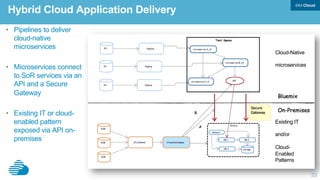
Hybrid Cloud Application Delivery
•  Pipelines to deliver
cloud-native
microservices
•  Microservices connect
to SoR services via an
API and a Secure
Gateway
•  Existing IT or cloud-
enabled pattern
exposed via API on-
premises
Cloud-Native
microservices
Existing IT
and/or
Cloud-
Enabled
Patterns
34
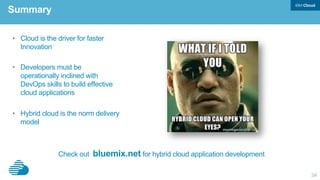
•  Cloud is the driver for faster
Innovation
•  Developers must be
operationally inclined with
DevOps skills to build effective
cloud applications
•  Hybrid cloud is the norm delivery
model
Summary
Check out bluemix.net for hybrid cloud application development
THANK YOU
@dancberg

Developing Hybrid Cloud Applications

  • 1.
    Presented by: Developing HybridCloud Applications Oct 2015 @dancberg Daniel Berg IBM Distinguished Engineer Cloud Foundation & DevOps
  • 2.
    2 The next billion dollaridea starts with a single developer That developer starts with a single line of code
  • 3.
    3 •  Cloud ispowering digital disruption – enabling businesses to accelerate the pace of innovation. •  Executed well, this is driving rapid value creation and an ability to seize market opportunities. Hotel Retail Social Transport The world’s largest accommodation provider, owns no real estate. The world’s most valuable retailer, has no inventory. The world’s most popular media company, creates no content. The world’s largest taxi company, owns zero vehicles. Era of Digital Disruption
  • 4.
    4 InnovationOptimization of new applications willbe deployed via the cloud of IT budgets spent maintaining systems~70% 85% Integration Challenge to balancing investments
  • 5.
    5 Cloud adoption Networking Networking StorageStorage Servers Servers Virtualization Virtualization O/S O/S Middleware Middleware Mid Config Mid Config Data Data Applications Applications Tradi&onal On-Premises Infrastructure as a Service Customiza&on; higher costs; slower &me to value Standardiza&on; lower costs; faster &me to value Networking Storage Servers Virtualization O/S Middleware Mid Config Data Applications Pla>orm as a Service
  • 6.
    6 Computing is enteringa new cognitive era Relationship Extraction Questions & Answers Language Detection Personality Insights Keyword Extraction Image Link Extraction Feed Detection Visual Recognition Concept Expansion Concept Insights Dialog Sentiment Analysis Text to Speech Tradeoff Analytics Natural Language Classifier Author Extraction Speech to Text Retrieve & Rank Watson News Language Translation Entity Extraction Tone Analyzer Concept Tagging Taxonomy Text Extraction Message Resonance Image Tagging Face Detection Answer Generation Usage Insights Fusion Q&A Video Augmentation Decision Optimization Knowledge Graph Risk Stratification Policy Identification Emotion Analysis Decision Support Criteria Classification Knowledge Canvas Easy Adaptation Knowledge Studio Service Statistical Dialog Q&A Qualification Factoid Pipeline Case Evaluation The Waston that competed on Jeopardy! in 2011 comprised what is now a single API—Q&A—built on five underlying technologies. Since then, Watson has grown to a family of 28 APIs. By the end of 2016, there will be nearly 50 Watson APIs— with more added every year. Natural Language Processing Machine Learning Question Analysis Feature Engineering Ontology Analysis IBM Watson IBM Bluemix
  • 7.
    7 Cost reduction plays • Building your private cloud IaaS –  Rapid provisioning –  Enabling DevOps •  Source capacity from the public cloud –  Compute –  Storage Hybrid Cloud Innovation plays •  Building systems of engagement apps –  Mobile –  Social •  Internet of Things Shared Off-Premises Cloud Dedicated On-Premises Cloud Existing IT Dedicated Off-Premises Cloud Cloud Enablement Cloud Adoption
  • 8.
    8 Hybrid Cloud Scenarios Devand Test Off Premises Cloud for Burst Capacity Cloud Front-End Portable Workloads
  • 9.
    9 Evolution of Workloads ExistingIT App Servers + + DatabaseWeb Servers Applications Cloud-Enabled App Servers + + DatabaseWeb Servers Applications DedicatedLocal Shared Services Cloud-Native ServicesApplications Managed Runtimes
  • 10.
  • 11.
    11 Faster and moreconsistent application environment deployments Developers/ Testers Integrators Specialists Compute, Network, and Storage Platforms Apps Environment! Application Middleware Config Middleware OS Config Hardware Environment Blueprint Design Deploy Long, complex lifecycle with manual steps! Small iterative changes! …! …!
  • 12.
    12 •  Standardize cloud-enabled deploymentpatterns with OpenStack HEAT •  Applications are managed throughout the entire release process with predictable automation and inventory services •  Full-stack blueprints capture the relationships between applications and cloud infrastructure •  OpenStack API provides standards for interacting with all cloud resources Pattern-based deployments with OpenStack HEAT Heat Blueprints UrbanCode Deploy Compute Network Storage Your Applications & Middleware Software
  • 13.
    13 Rapidly deploy applicationenvironments in 3 simple steps Provide portability across heterogeneous virtual datacenter, private and public clouds 3.  Portable across different virtualized infrastructure Assemble mul8-8er applica8on environments and define auto-scaling policies to meet opera8onal needs. 2.  Assemble mul&-&er and scalable environment blueprints 1.  Create stacks Load Balancer Web Servers App Servers Database Servers Firewall Describe full stack environments using infrastructure building blocks like Images, Middleware scripts, and Applica8on code VMware vCenter Private Application Middleware Config Middleware OS Config Hardware Environment Blueprint Policies DedicatedLocalVirtual Datacenter Shared
  • 14.
  • 15.
    15 12 Factor Appfor Cloud Native http://12factor.net
  • 16.
    16 PROS •  Simple todevelop •  Simple to deploy •  Simple to test CONS •  Large •  Long deployment times •  Difficult to scale •  Reliability •  Difficult to adapt and change Monolithic Architecture
  • 17.
    17 •  Componentized •  Organizedaround business capabilities •  Decentralized data •  API communication •  Enables continuous delivery •  Embrace evolutionary changes •  Designed for failure Microservices Architecture
  • 18.
    18 •  Failures WILLhappen •  Their root causes can be complex and affect different number of users •  Reduce the likelihood of correlated failures •  Recover quickly •  Proactive detection of problems before they happen Causes for failures Datacenter Server Rack Server Virtual Server Code Request
  • 19.
    19 Patterns of Resiliency From“Release IT! Design and Deploy Production-Ready Software” by MichaelT Nygard
  • 20.
    20 Ø Simple services butcomplex distributed systems Ø IT overhead Ø  Configuration management Ø  HA/DR for each service Ø  Capacity requirements are dramatically higher Ø  High degree of automation is required Ø Asynchronous communication nature is difficult Ø DevOps skills are a must Microservices do have a cost
  • 21.
    21 Docker Mission Docker isan open platform for building distributed applications for developers and system administrators. Build Ship Run Anywhere Any App
  • 22.
    22 Image •  A read-onlysnapshot of a container stored in Docker Hub to be used as a template for building containers Container •  The standard unit in which the application service resides or transported Docker Hub •  Available in SaaS or Enterprise to deploy anywhere you choose •  Stores, distributes and shares container images Docker Engine •  A program that creates, ships and runs application containers •  Runs on any physical and virtual machine or server locally, in private or public cloud •  Client communicates with Engine to execute commands Docker Basics – A shipping container for code SaaS Enterprise
  • 23.
    2323 App A Hypervisor (Type 2) HostOS Server Guest OS Bins/ Libs App A’ Guest OS Bins/ Libs App B Guest OS Bins/ Libs VM Guest OS Guest OS AppA’ Host OS Server Bins/Libs AppA Bins/Libs AppB AppB’ AppB’ AppB’ Container Containers are isolated, but share OS and, where appropriate, bins/libraries …faster, less overhead VMs vs Containers
  • 24.
  • 25.
    25 Foundation services forbuilding Cloud Native Applications
  • 26.
  • 27.
  • 28.
  • 29.
    29 Continuous Delivery Speed deliveryof change with low risk and greater feedback
  • 30.
    30 Two-Speed IT isToday’s Reality System of Engagement System of Record
  • 31.
    31 Using the Bluemixplatform and Bluemix services such as the Delivery Pipeline, developers can quickly automate the delivery of high quality changes with zero downtime through Bluemix spaces all the way to production (space). Cloud Native Delivery •  High speed •  Microservices •  Developer driven •  Low operational overhead •  Built-in DevOps capabilities
  • 32.
    32 Cloud Enabled Delivery • Multiple source control systems drive builds in CI that integrate with a multi- platform deployment system •  SoR managed on-prem using patterns •  Single pattern used for both on-prem and off-prem deployments
  • 33.
    33 Hybrid Cloud ApplicationDelivery •  Pipelines to deliver cloud-native microservices •  Microservices connect to SoR services via an API and a Secure Gateway •  Existing IT or cloud- enabled pattern exposed via API on- premises Cloud-Native microservices Existing IT and/or Cloud- Enabled Patterns
  • 34.
    34 •  Cloud isthe driver for faster Innovation •  Developers must be operationally inclined with DevOps skills to build effective cloud applications •  Hybrid cloud is the norm delivery model Summary Check out bluemix.net for hybrid cloud application development
  • 35.