A Novel Approach for Robot
Grasping based on Cloud
Presented by: Mr Krishna Kangane
Miss. Nikita Jadhav
Mr. Abhijeet Tote
Mr. Atul Sathe
Guide: Ms. Neelima Ambekar
Matoshri College of Engineering and Research Centre, Nasik.
Contents
Introduction
Scope of Project
Literature Survey
System Architecture
Flowchart
System Requirements
Advantages and Disadvantages
Applications
Conclusion and Future Scope
References
Introduction
Cloud
Cloud Robot and Automation
systems
Cloud robotics based on major
points
Scope of project
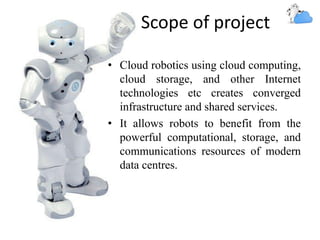
• Cloud robotics using cloud computing,
cloud storage, and other Internet
technologies etc creates converged
infrastructure and shared services.
• It allows robots to benefit from the
powerful computational, storage, and
communications resources of modern
data centres.
Literature Survey
Sr.
No.
Year Author Name Paper Title Work Done
1. 1994 K. Goldberg Beyond the web: Excavating the real
world viamosaic
The first Industrial
robot was connected to
the Web with an
intuitive graphical user
interface that allowed
visitors
to tele operate the robot
via any nternet browser
2. 1997 M.Inaba et.al Remote-brained robots Described
the advantages of remote
computing for robot
control
Literature Survey (Contd.)
3. 2009 M. Waibel Robert Robert project was
announced
4. 2010 M. Tenorth Representing and exchanging
knowledge about
actions, objects, environments
Cloud Robotics
5. 2012 P. C. Evans and
M. Annunziata,
Pushing the boundaries
of minds and machines General
Electric
General Electric
introduced the term
“Industrial Internet
6 2013 V.
Chandrasekaran
and M. I. Jordan
Computational and statistical tradeoffs
via convex relaxation
Data sharing
statistics
7 2014 W. Beksi and N.
Papanikolopoulos
Point cloud culling for robot vision
tasks under communication constraints
Robot vision for
image grasping.
Architecture
Online Phase:
Architecture (Contd.)
Offline Phase
Flowchart
Requirements
Willow Garage PR2 robot with on-
board colour and depth cameras.
Google goggles image recognition
system
Point Cloud Library (PCL)
Open Robotics Automation Virtual
Environment (OpenRave).
Advantages
Make the robot smarter.
Longer battery life.
Invisible software and
hardware upgrade
Access to vast amount of
data
Removes overheads for
maintenance and updates
Reduces dependence on
custom middleware.
Disadvantages
Data privacy and security
Environmental security
Ethic Problems
Applications
SLAM
Grasping
Navigation
Conclusion
It allows the deployment of inexpensive
robots with low computation power and
memory requirements by working on the
communications network and the elastic
computing resources offered by the
cloud infrastructure
Cloud robotics allows robots to share
computation resources, information and
data with each other, and to access new
knowledge and skills not learned by
themselves.
Future Scope
The connectivity inherent in the Cloud raises a range of
privacy and security concerns.
On the technical front, new algorithms and methods are
needed to cope with time-varying network latency and
Quality-of-Service.
New algorithms are also needed that scale to the size of Big
Data, which often contain dirty data that requires new
approaches to clean or sample effectively
References
• Stephan Gammeter, Alexander Gassmann, Lukas Bossard,
Till Quack, and Luc Van Gool, ”Server- side Object
Recognition and Client-side Object Tracking for Mobile
Augmented Reality.”, In IEEE Computer Society
Conference on Computer Vision and Pattern Recognition,
number C, pages 1–8. IEEE, June 2010.
• Rajesh Arumugam, V.R. Enti, Liu Bingbing, Wu Xiaojun,
Krish- namoorthy Baskaran, F.F. Kong, A.S. Kumar, K.D.
Meng, and G.W. Kit. DavinCi, ”A Cloud Computing
Framework for Service Robots”, In IEEE International
Conference on Robotics and Automation, pages 3084–
3089. IEEE, 2010.
• Y. Hirano, K. Kitahama, and S. Yoshizawa. “Image-based
Object Recognition and Dexterous Hand/Arm Motion
Planning Using RRTs for Grasping in Cluttered Scene”. In
IEEE/RSJ International Conference on Intelligent Robots
and Systems, pages 2041–2046. IEEE, 2005.
References(contd.)
• Ben Kehoe, Dmitry Berenson, and Ken Goldberg, “Toward
Cloud-based Grasping with Uncertainty in Shape:
Estimating Lower Bounds on Achieving Force Closure with
Zero-slip Push Grasps” In IEEE International Conference on
Robotics and Automation, pages 576– 583. IEEE, May 2012.
Any Questions???
A novel Approch for Robot Grasping on cloud

A novel Approch for Robot Grasping on cloud

  • 1.
    A Novel Approachfor Robot Grasping based on Cloud Presented by: Mr Krishna Kangane Miss. Nikita Jadhav Mr. Abhijeet Tote Mr. Atul Sathe Guide: Ms. Neelima Ambekar Matoshri College of Engineering and Research Centre, Nasik.
  • 2.
    Contents Introduction Scope of Project LiteratureSurvey System Architecture Flowchart System Requirements Advantages and Disadvantages Applications Conclusion and Future Scope References
  • 3.
    Introduction Cloud Cloud Robot andAutomation systems Cloud robotics based on major points
  • 4.
    Scope of project •Cloud robotics using cloud computing, cloud storage, and other Internet technologies etc creates converged infrastructure and shared services. • It allows robots to benefit from the powerful computational, storage, and communications resources of modern data centres.
  • 5.
    Literature Survey Sr. No. Year AuthorName Paper Title Work Done 1. 1994 K. Goldberg Beyond the web: Excavating the real world viamosaic The first Industrial robot was connected to the Web with an intuitive graphical user interface that allowed visitors to tele operate the robot via any nternet browser 2. 1997 M.Inaba et.al Remote-brained robots Described the advantages of remote computing for robot control
  • 6.
    Literature Survey (Contd.) 3.2009 M. Waibel Robert Robert project was announced 4. 2010 M. Tenorth Representing and exchanging knowledge about actions, objects, environments Cloud Robotics 5. 2012 P. C. Evans and M. Annunziata, Pushing the boundaries of minds and machines General Electric General Electric introduced the term “Industrial Internet 6 2013 V. Chandrasekaran and M. I. Jordan Computational and statistical tradeoffs via convex relaxation Data sharing statistics 7 2014 W. Beksi and N. Papanikolopoulos Point cloud culling for robot vision tasks under communication constraints Robot vision for image grasping.
  • 7.
  • 8.
  • 9.
  • 10.
    Requirements Willow Garage PR2robot with on- board colour and depth cameras. Google goggles image recognition system Point Cloud Library (PCL) Open Robotics Automation Virtual Environment (OpenRave).
  • 11.
    Advantages Make the robotsmarter. Longer battery life. Invisible software and hardware upgrade Access to vast amount of data Removes overheads for maintenance and updates Reduces dependence on custom middleware.
  • 12.
    Disadvantages Data privacy andsecurity Environmental security Ethic Problems
  • 13.
  • 14.
    Conclusion It allows thedeployment of inexpensive robots with low computation power and memory requirements by working on the communications network and the elastic computing resources offered by the cloud infrastructure Cloud robotics allows robots to share computation resources, information and data with each other, and to access new knowledge and skills not learned by themselves.
  • 15.
    Future Scope The connectivityinherent in the Cloud raises a range of privacy and security concerns. On the technical front, new algorithms and methods are needed to cope with time-varying network latency and Quality-of-Service. New algorithms are also needed that scale to the size of Big Data, which often contain dirty data that requires new approaches to clean or sample effectively
  • 16.
    References • Stephan Gammeter,Alexander Gassmann, Lukas Bossard, Till Quack, and Luc Van Gool, ”Server- side Object Recognition and Client-side Object Tracking for Mobile Augmented Reality.”, In IEEE Computer Society Conference on Computer Vision and Pattern Recognition, number C, pages 1–8. IEEE, June 2010. • Rajesh Arumugam, V.R. Enti, Liu Bingbing, Wu Xiaojun, Krish- namoorthy Baskaran, F.F. Kong, A.S. Kumar, K.D. Meng, and G.W. Kit. DavinCi, ”A Cloud Computing Framework for Service Robots”, In IEEE International Conference on Robotics and Automation, pages 3084– 3089. IEEE, 2010. • Y. Hirano, K. Kitahama, and S. Yoshizawa. “Image-based Object Recognition and Dexterous Hand/Arm Motion Planning Using RRTs for Grasping in Cluttered Scene”. In IEEE/RSJ International Conference on Intelligent Robots and Systems, pages 2041–2046. IEEE, 2005.
  • 17.
    References(contd.) • Ben Kehoe,Dmitry Berenson, and Ken Goldberg, “Toward Cloud-based Grasping with Uncertainty in Shape: Estimating Lower Bounds on Achieving Force Closure with Zero-slip Push Grasps” In IEEE International Conference on Robotics and Automation, pages 576– 583. IEEE, May 2012.
  • 18.