Cloud Computing
An overview of cloud computing concepts, models, services,
architecture, applications, and security.
Security Challenges in
Cloud Computing
Cloud computing faces security
challenges like data breaches,
account hijacking, insecure
APIs, and insider threats.
Addressing these is critical to
protect sensitive information.
Introduction to Cloud
Computing
Cloud computing is the
delivery of computing services
over the internet.
It enables on-demand access to
resources like servers, storage,
and applications without direct
active management by the
user.
Cloud Computing Services
Cloud services include
computing power, storage,
databases, networking,
software, analytics, and
intelligence.
These services help businesses
innovate and scale efficiently.
References and Further
Reading
For more information, explore
resources from leading cloud
providers and academic
publications.
Stay updated with the latest
cloud computing
advancements.
Cloud Deployment
Models
Public Cloud: Services offered
over the public internet and
available to anyone.
Private Cloud: Cloud
infrastructure operated solely
for a single organization.
Hybrid Cloud: Combines public
and private clouds to allow
data and applications sharing.
Future Trends in Cloud
Computing
Emerging trends include edge
computing, AI integration,
serverless architectures, and
enhanced security protocols.
These trends will shape the
evolution of cloud services.
Key Characteristics of
Cloud Computing
Cloud computing offers on-demand
self-service, broad network access,
resource pooling, rapid elasticity, and
measured service.
These features make cloud
computing flexible and scalable for
various users.
Applications of Cloud
Computing
Cloud computing supports various
applications such as data backup,
disaster recovery, web hosting, big
data analytics, and IoT.
It enables flexible and cost-effective
solutions across industries.
Thank You
Thank you for your attention.
Feel free to ask questions or discuss
cloud computing topics further.
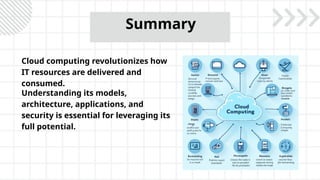
Summary
Cloud computing revolutionizes how
IT resources are delivered and
consumed.
Understanding its models,
architecture, applications, and
security is essential for leveraging its
full potential.
Cloud Computing
Architecture
Cloud architecture consists of front-
end platforms, back-end platforms,
cloud-based delivery, and a network.
It enables seamless interaction
between users and cloud services.
Benefits of Cloud
Computing
Cloud computing offers cost savings,
scalability, flexibility, and
accessibility.
It allows organizations to focus on
core business activities while
leveraging advanced technology.
Additional Security Practices
Multi-factor authentication and identity management. Multi-factor authentication and identity management.
Additional Architecture Components
Cloud-based delivery: Services and applications. Cloud-based delivery: Services and applications.
Cloud Service Models
Infrastructure as a Service
(IaaS): Provides virtualized
computing resources over
the internet.
Infrastructure as a Service
(IaaS): Provides virtualized
computing resources over
the internet.
More Cloud Service
Models
Software as a Service (SaaS): Delivers software applications over
the internet.
Software as a Service (SaaS): Delivers software applications over
the internet.
Cloud in Business and
Education
Business: Enhances collaboration, reduces IT costs, and
improves scalability.
Business: Enhances collaboration, reduces IT costs, and
improves scalability.
Components of Cloud
Architecture
Front-end: User
interface and
client devices.
Front-end: User
interface and
client devices.
Cloud Security Measures
Data encryption
and secure access
controls.
Data encryption
and secure access
controls.
THANK YOU

Cloud Computing and It's Architecture.pptx

  • 1.
    Cloud Computing An overviewof cloud computing concepts, models, services, architecture, applications, and security.
  • 2.
    Security Challenges in CloudComputing Cloud computing faces security challenges like data breaches, account hijacking, insecure APIs, and insider threats. Addressing these is critical to protect sensitive information.
  • 3.
    Introduction to Cloud Computing Cloudcomputing is the delivery of computing services over the internet. It enables on-demand access to resources like servers, storage, and applications without direct active management by the user.
  • 4.
    Cloud Computing Services Cloudservices include computing power, storage, databases, networking, software, analytics, and intelligence. These services help businesses innovate and scale efficiently.
  • 5.
    References and Further Reading Formore information, explore resources from leading cloud providers and academic publications. Stay updated with the latest cloud computing advancements.
  • 6.
    Cloud Deployment Models Public Cloud:Services offered over the public internet and available to anyone. Private Cloud: Cloud infrastructure operated solely for a single organization. Hybrid Cloud: Combines public and private clouds to allow data and applications sharing.
  • 7.
    Future Trends inCloud Computing Emerging trends include edge computing, AI integration, serverless architectures, and enhanced security protocols. These trends will shape the evolution of cloud services.
  • 8.
    Key Characteristics of CloudComputing Cloud computing offers on-demand self-service, broad network access, resource pooling, rapid elasticity, and measured service. These features make cloud computing flexible and scalable for various users.
  • 9.
    Applications of Cloud Computing Cloudcomputing supports various applications such as data backup, disaster recovery, web hosting, big data analytics, and IoT. It enables flexible and cost-effective solutions across industries.
  • 10.
    Thank You Thank youfor your attention. Feel free to ask questions or discuss cloud computing topics further.
  • 11.
    Summary Cloud computing revolutionizeshow IT resources are delivered and consumed. Understanding its models, architecture, applications, and security is essential for leveraging its full potential.
  • 12.
    Cloud Computing Architecture Cloud architectureconsists of front- end platforms, back-end platforms, cloud-based delivery, and a network. It enables seamless interaction between users and cloud services.
  • 13.
    Benefits of Cloud Computing Cloudcomputing offers cost savings, scalability, flexibility, and accessibility. It allows organizations to focus on core business activities while leveraging advanced technology.
  • 14.
    Additional Security Practices Multi-factorauthentication and identity management. Multi-factor authentication and identity management.
  • 15.
    Additional Architecture Components Cloud-baseddelivery: Services and applications. Cloud-based delivery: Services and applications.
  • 16.
    Cloud Service Models Infrastructureas a Service (IaaS): Provides virtualized computing resources over the internet. Infrastructure as a Service (IaaS): Provides virtualized computing resources over the internet.
  • 17.
    More Cloud Service Models Softwareas a Service (SaaS): Delivers software applications over the internet. Software as a Service (SaaS): Delivers software applications over the internet.
  • 18.
    Cloud in Businessand Education Business: Enhances collaboration, reduces IT costs, and improves scalability. Business: Enhances collaboration, reduces IT costs, and improves scalability.
  • 19.
    Components of Cloud Architecture Front-end:User interface and client devices. Front-end: User interface and client devices.
  • 20.
    Cloud Security Measures Dataencryption and secure access controls. Data encryption and secure access controls.
  • 21.