Introduction to Cloud
Computing
Cloud computing revolutionizes the way businesses process and store
data. It offers scalable and flexible solutions for organizations, reducing
infrastructure costs and allowing for seamless collaboration. With its
emphasis on accessibility and efficiency, cloud computing has become
integral to modern technological advancements.
by Kevin Chauhan
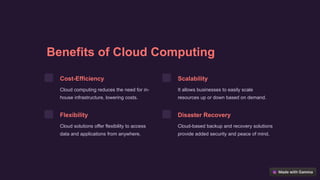
Benefits of Cloud Computing
Cost-Efficiency
Cloud computing reduces the need for in-
house infrastructure, lowering costs.
Scalability
It allows businesses to easily scale
resources up or down based on demand.
Flexibility
Cloud solutions offer flexibility to access
data and applications from anywhere.
Disaster Recovery
Cloud-based backup and recovery solutions
provide added security and peace of mind.
Cloud Service Models (IaaS, PaaS,
SaaS)
Infrastructure as a
Service (IaaS)
Provides virtualized
computing resources over the
internet. Users can rent IT
infrastructure like virtual
machines, storage, and
networks on a pay-as-you-go
basis.
Platform as a Service
(PaaS)
Offers a platform allowing
customers to develop, run,
and manage applications
without dealing with the
complexity of building and
maintaining infrastructure.
Software as a Service
(SaaS)
Delivers software applications
over the internet on a
subscription basis. Users can
access and use the software
via a web browser without
needing to install or maintain
it.
Cloud Deployment Models
Public Cloud
Public cloud services are
delivered over the internet
and are open for use by the
general public or a large
industry group. They are cost-
effective and scalable.
Private Cloud
Private clouds are dedicated
to a single organization and
can offer more control,
security, and customization.
They can be located on-
premises or off-premises.
Hybrid Cloud
A combination of public and
private clouds, allowing data
and applications to be shared
between them. This model
provides flexibility and cost
savings.
Cloud Computing Architecture
Cloud computing architecture refers to the
components and structure of cloud-based
systems. It includes servers, storage,
networking, and virtualization technologies.
The architecture also encompasses the design
of cloud applications, data centers, and the
overall infrastructure layout.
Cloud Security and Privacy
Data Encryption
Protecting sensitive information
with strong encryption
algorithms.
Security Measures
Implementing robust security
protocols and access controls.
Privacy Standards
Adhering to strict privacy
regulations and compliance
requirements.
Cloud Storage and Data Management
Secure Data Storage
Efficient data management with
advanced encryption and
cutting-edge server
infrastructure.
Backup and Recovery
Reliable data backup and
seamless recovery processes
for uninterrupted business
operations.
Efficient Data Analytics
Advanced data integration and
visualization for efficient data
analytics and management.
Cloud Networking and
Virtualization
Network Virtualization
Virtualizing network resources to optimize performance and improve
scalability.
Software-Defined Networking (SDN)
Utilizing software to manage and control network infrastructure dynamically.
Virtual Private Cloud (VPC)
Creating isolated and secure virtual networks within a public cloud
environment.
Cloud Migration and Management
Migration Strategies
Understand lift-and-shift, re-platforming, and
re-architecting approaches.
Challenges
Address the complexities of data migration
and legacy system integration.
Cost Optimization
Explore cost-effective management and
resource allocation in the cloud.
Monitoring and Governance
Implement robust monitoring and governance
frameworks for cloud infrastructure.
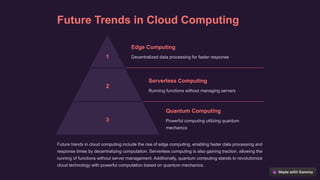
Future Trends in Cloud Computing
1
Edge Computing
Decentralized data processing for faster response
2
Serverless Computing
Running functions without managing servers
3
Quantum Computing
Powerful computing utilizing quantum
mechanics
Future trends in cloud computing include the rise of edge computing, enabling faster data processing and
response times by decentralizing computation. Serverless computing is also gaining traction, allowing the
running of functions without server management. Additionally, quantum computing stands to revolutionize
cloud technology with powerful computation based on quantum mechanics.

Cloud-Computing Training Course By Apponix Technologies

  • 1.
    Introduction to Cloud Computing Cloudcomputing revolutionizes the way businesses process and store data. It offers scalable and flexible solutions for organizations, reducing infrastructure costs and allowing for seamless collaboration. With its emphasis on accessibility and efficiency, cloud computing has become integral to modern technological advancements. by Kevin Chauhan
  • 2.
    Benefits of CloudComputing Cost-Efficiency Cloud computing reduces the need for in- house infrastructure, lowering costs. Scalability It allows businesses to easily scale resources up or down based on demand. Flexibility Cloud solutions offer flexibility to access data and applications from anywhere. Disaster Recovery Cloud-based backup and recovery solutions provide added security and peace of mind.
  • 3.
    Cloud Service Models(IaaS, PaaS, SaaS) Infrastructure as a Service (IaaS) Provides virtualized computing resources over the internet. Users can rent IT infrastructure like virtual machines, storage, and networks on a pay-as-you-go basis. Platform as a Service (PaaS) Offers a platform allowing customers to develop, run, and manage applications without dealing with the complexity of building and maintaining infrastructure. Software as a Service (SaaS) Delivers software applications over the internet on a subscription basis. Users can access and use the software via a web browser without needing to install or maintain it.
  • 4.
    Cloud Deployment Models PublicCloud Public cloud services are delivered over the internet and are open for use by the general public or a large industry group. They are cost- effective and scalable. Private Cloud Private clouds are dedicated to a single organization and can offer more control, security, and customization. They can be located on- premises or off-premises. Hybrid Cloud A combination of public and private clouds, allowing data and applications to be shared between them. This model provides flexibility and cost savings.
  • 5.
    Cloud Computing Architecture Cloudcomputing architecture refers to the components and structure of cloud-based systems. It includes servers, storage, networking, and virtualization technologies. The architecture also encompasses the design of cloud applications, data centers, and the overall infrastructure layout.
  • 6.
    Cloud Security andPrivacy Data Encryption Protecting sensitive information with strong encryption algorithms. Security Measures Implementing robust security protocols and access controls. Privacy Standards Adhering to strict privacy regulations and compliance requirements.
  • 7.
    Cloud Storage andData Management Secure Data Storage Efficient data management with advanced encryption and cutting-edge server infrastructure. Backup and Recovery Reliable data backup and seamless recovery processes for uninterrupted business operations. Efficient Data Analytics Advanced data integration and visualization for efficient data analytics and management.
  • 8.
    Cloud Networking and Virtualization NetworkVirtualization Virtualizing network resources to optimize performance and improve scalability. Software-Defined Networking (SDN) Utilizing software to manage and control network infrastructure dynamically. Virtual Private Cloud (VPC) Creating isolated and secure virtual networks within a public cloud environment.
  • 9.
    Cloud Migration andManagement Migration Strategies Understand lift-and-shift, re-platforming, and re-architecting approaches. Challenges Address the complexities of data migration and legacy system integration. Cost Optimization Explore cost-effective management and resource allocation in the cloud. Monitoring and Governance Implement robust monitoring and governance frameworks for cloud infrastructure.
  • 10.
    Future Trends inCloud Computing 1 Edge Computing Decentralized data processing for faster response 2 Serverless Computing Running functions without managing servers 3 Quantum Computing Powerful computing utilizing quantum mechanics Future trends in cloud computing include the rise of edge computing, enabling faster data processing and response times by decentralizing computation. Serverless computing is also gaining traction, allowing the running of functions without server management. Additionally, quantum computing stands to revolutionize cloud technology with powerful computation based on quantum mechanics.