Cloud Computing
Presented By :
Priyanshu Srivastava
Outline of the talk :
What is Cloud Computing?
History of Cloud Computing
Components of Cloud Computing
Service Model
Application of Cloud Computing
Types of Cloud Computing
Advantages of Cloud Computing
Disadvantages of Cloud Computing
What is Cloud Computing?
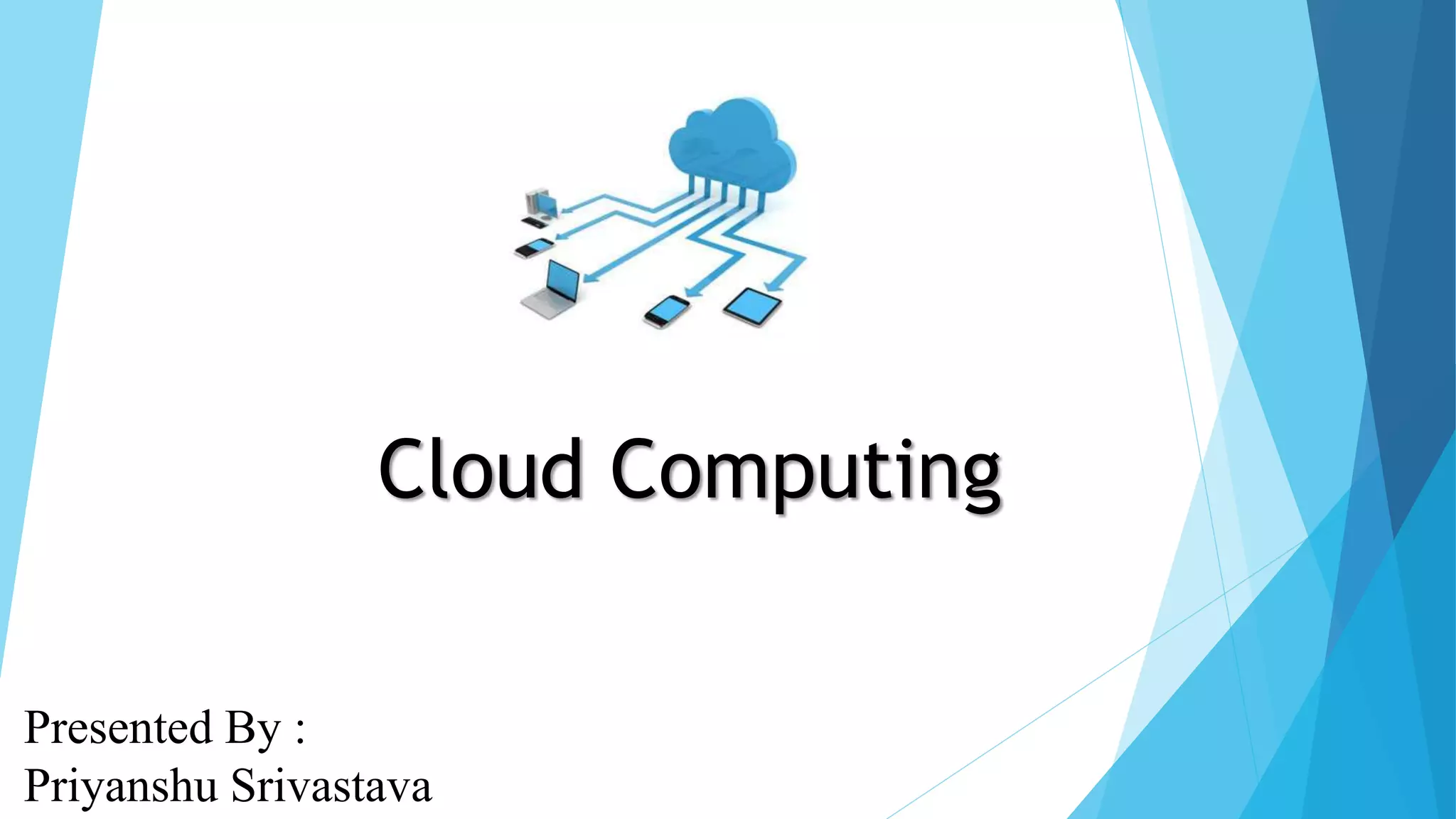
Cloud computing is a technology that uses the internet and
central remote servers to maintain data and applications.
Cloud computing allows consumers and businesses to use
applications without installation and access their personal
files at any computer with internet access.
User do not have or need knowledge, control, ownership in
the computer infrastructure.
A simple example of cloud computing is Yahoo email or
Gmail etc.
History of Cloud Computing :
At around in 1961, John MacCharty suggested in a speech at MIT that
computing can be sold like a utility, just like a water or electricity.
In 1999, Salesforce.com started delivering of applications to users using
a simple website. The applications were delivered to enterprises over the
Internet, and this way the dream of computing sold as utility were true.
In 2002, Amazon started Amazon Web Services, providing services like
storage, computation and even human intelligence.
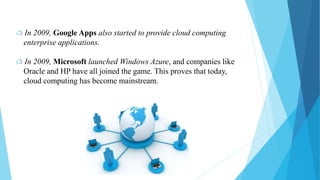
In 2009, Google Apps also started to provide cloud computing
enterprise applications.
In 2009, Microsoft launched Windows Azure, and companies like
Oracle and HP have all joined the game. This proves that today,
cloud computing has become mainstream.
Components of Cloud Computing :
There are three basic components of cloud computing :
Client computers : Clients are the device that the end user interact
with cloud.
Distributed Servers : Often servers are in geographically different
places, but server acts as if they are working
next to each other.
Data Centers : It is collection of servers where application is placed
and is accessed via internet.
Service Model :
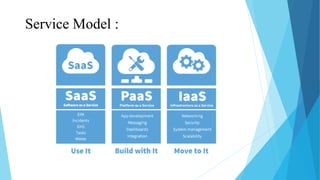
SaaS(Software as a service): Required software, Operating
system & network is provided.
PaaS(Platform as service): Operating system and network is
provided
IaaS(Infrastructure as a service): Just Network is provided
Service Model :
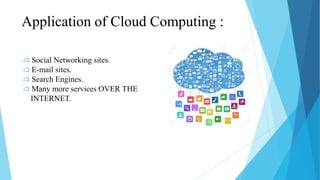
Application of Cloud Computing :
Social Networking sites.
E-mail sites.
Search Engines.
Many more services OVER THE
INTERNET.
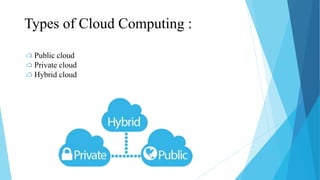
Types of Cloud Computing :
Public cloud
Private cloud
Hybrid cloud
Advantages of Cloud Computing :
Cost Savings
Reliability
Flexible capacity
Improved mobility
Do more with less
No hardware required
Disadvantages of Cloud Computing :
Possible Downtime
Security Issues
Require High Speed Internet connection
No Redundancy
Bandwidth issue
Reference by :
www.techopedia.com
www.salesforce.com
www.tutorialspoint.com
www.google.com
THANK YOU

Cloud computing

  • 1.
    Cloud Computing Presented By: Priyanshu Srivastava
  • 2.
    Outline of thetalk : What is Cloud Computing? History of Cloud Computing Components of Cloud Computing Service Model Application of Cloud Computing Types of Cloud Computing Advantages of Cloud Computing Disadvantages of Cloud Computing
  • 3.
    What is CloudComputing? Cloud computing is a technology that uses the internet and central remote servers to maintain data and applications. Cloud computing allows consumers and businesses to use applications without installation and access their personal files at any computer with internet access. User do not have or need knowledge, control, ownership in the computer infrastructure. A simple example of cloud computing is Yahoo email or Gmail etc.
  • 4.
    History of CloudComputing : At around in 1961, John MacCharty suggested in a speech at MIT that computing can be sold like a utility, just like a water or electricity. In 1999, Salesforce.com started delivering of applications to users using a simple website. The applications were delivered to enterprises over the Internet, and this way the dream of computing sold as utility were true. In 2002, Amazon started Amazon Web Services, providing services like storage, computation and even human intelligence.
  • 5.
    In 2009, GoogleApps also started to provide cloud computing enterprise applications. In 2009, Microsoft launched Windows Azure, and companies like Oracle and HP have all joined the game. This proves that today, cloud computing has become mainstream.
  • 6.
    Components of CloudComputing : There are three basic components of cloud computing : Client computers : Clients are the device that the end user interact with cloud. Distributed Servers : Often servers are in geographically different places, but server acts as if they are working next to each other. Data Centers : It is collection of servers where application is placed and is accessed via internet.
  • 7.
  • 8.
    SaaS(Software as aservice): Required software, Operating system & network is provided. PaaS(Platform as service): Operating system and network is provided IaaS(Infrastructure as a service): Just Network is provided Service Model :
  • 9.
    Application of CloudComputing : Social Networking sites. E-mail sites. Search Engines. Many more services OVER THE INTERNET.
  • 10.
    Types of CloudComputing : Public cloud Private cloud Hybrid cloud
  • 11.
    Advantages of CloudComputing : Cost Savings Reliability Flexible capacity Improved mobility Do more with less No hardware required
  • 12.
    Disadvantages of CloudComputing : Possible Downtime Security Issues Require High Speed Internet connection No Redundancy Bandwidth issue
  • 13.
  • 14.