CLOUD COMPUTING
  TECHNOLOGY


       SUBMITTED BY
       Manpreet Kaur
       1209197
       B.Tech.(C.S.E.) 7th Semester
Overview
 Cloud computing definition
 Cloud computing definition
 Cloud computing technology
 Cloud computing technology
 Cloud computing types
 Cloud computing types
 Cloud computing’s brother buzzwords
 Pros and Cons of cloud computing
Cloud computing definition
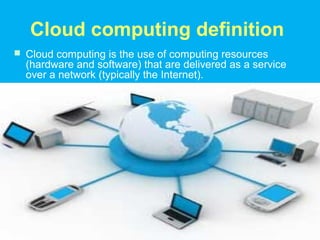
 Cloud computing is the use of computing resources
  (hardware and software) that are delivered as a service
  over a network (typically the Internet).
Cloud Computing Technology
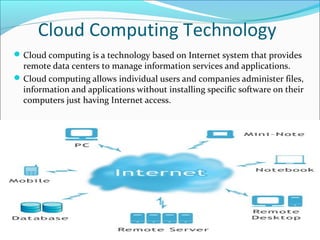
 Cloud computing is a technology based on Internet system that provides
  remote data centers to manage information services and applications.
 Cloud computing allows individual users and companies administer files,
  information and applications without installing specific software on their
  computers just having Internet access.
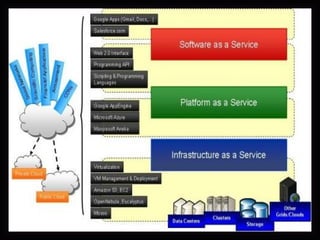
Cloud computing providers offer their services according to
three fundamental models:

 Infrastructure as a service (IaaS)
 platform as a service (PaaS)
 software as a service (SaaS)

   where IaaS is the most basic and each higher model
abstracts from the details of the lower models.
Infrastructure as a service (IaaS)
 In this most basic cloud service model, cloud
  providers offer computers, as physical or more often
  as virtual machines, and other resources.
 IaaS refers not to a machine that does all the work, but
  simply to a facility given to businesses that offers
  users the leverage of extra storage space in servers
  and data centers.
 Examples are: Amazon Cloud Formation , Rackspace
  Cloud, Terremark and Google Compute Engine.
Platform as a service (PaaS)
 In the PaaS model, cloud providers deliver a
  computing platform typically including operating
  system, programming language execution
  environment, database, and web server.
 Examples are: Amazon Elastic Beanstalk, Heroku,
  EngineYard, Mendix, Google App Engine, Microsoft
  Azure and OrangeScape
Software as a service (SaaS)
 In this model, cloud providers install and operate
  application software in the cloud and cloud users
  access the software from cloud clients.
 It is common to refer to special types of cloud based
  application software with a similar naming convention:
  desktop as a service, business process as a service,
  test environment as a service, communication as a
  service.
 Examples are: Google Apps, innkeypos, Quickbooks
  Online, Limelight Video Platform, Salesforce.com and
  Microsoft Office 365.
Cloud computing impact
 As a result, cloud computing has the potential to
  upend the software industry entirely, as applications
  are purchased, licensed and run over the network
  instead of a user's desktop.
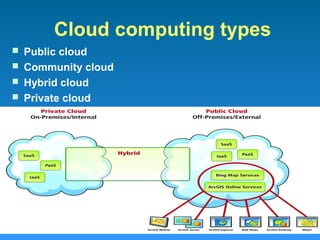
Cloud computing types
 Public cloud
 Community cloud
 Hybrid cloud
 Private cloud
Cloud computing’s brother
                buzzwords
 Cloud computing is becoming one of the next industry buzz
    words. And it has more or less relation with these words:
   Grid computing
   Distributed computing
   Utility computing
   Virtualization
   Computer cluster.
Grid computing
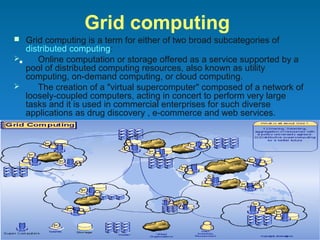
 Grid computing is a term for either of two broad subcategories of
   distributed computing:
    Online computation or storage offered as a service supported by a
   pool of distributed computing resources, also known as utility
   computing, on-demand computing, or cloud computing.
     The creation of a "virtual supercomputer" composed of a network of
   loosely-coupled computers, acting in concert to perform very large
   tasks and it is used in commercial enterprises for such diverse
   applications as drug discovery , e-commerce and web services.
Distributed Computing
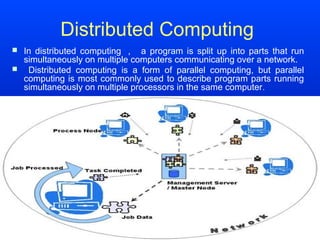
 In distributed computing , a program is split up into parts that run
  simultaneously on multiple computers communicating over a network.
 Distributed computing is a form of parallel computing, but parallel
  computing is most commonly used to describe program parts running
  simultaneously on multiple processors in the same computer .
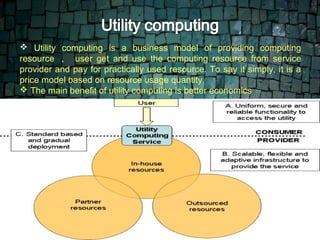
 Utility computing is a business model of providing computing
 .
 resource , user get and use the computing resource from service
 provider and pay for practically used resource. To say it simply, it is a
 price model based on resource usage quantity.
  The main benefit of utility computing is better economics
Comparison of Utility Computing
      and Cloud Computing
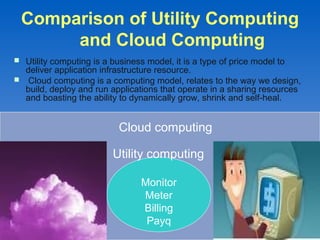
 Utility computing is a business model, it is a type of price model to
  deliver application infrastructure resource.
 Cloud computing is a computing model, relates to the way we design,
  build, deploy and run applications that operate in a sharing resources
  and boasting the ability to dynamically grow, shrink and self-heal.


                           Cloud computing

                         Utility computing

                                 Monitor
                                 Meter
                                 Billing
                                  Payq
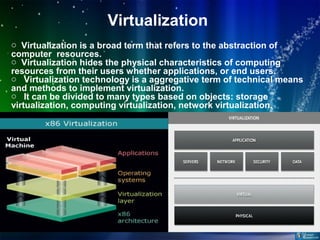
Virtualization
o Virtualization is a broad term that refers to the abstraction of
computer resources.
o Virtualization hides the physical characteristics of computing
resources from their users whether applications, or end users.
o Virtualization technology is a aggregative term of technical means
and methods to implement virtualization.
o It can be divided to many types based on objects: storage
virtualization, computing virtualization, network virtualization.
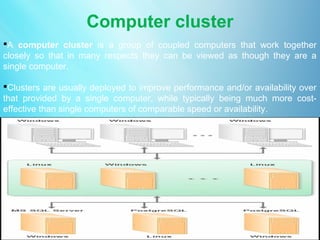
Computer cluster
A computer cluster is a group of coupled computers that work together
closely so that in many respects they can be viewed as though they are a
single computer.

Clusters are usually deployed to improve performance and/or availability over
that provided by a single computer, while typically being much more cost-
effective than single computers of comparable speed or availability .
Pros of cloud computing
 Cost Efficient
 Almost Unlimited Storage
 Backup and Recovery
 Automatic Software Integration
 Easy Access to Information
 Quick Deployment
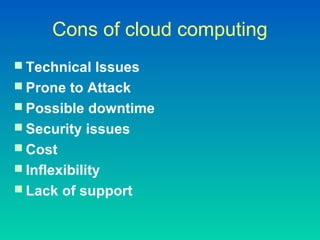
Cons of cloud computing
 Technical Issues
 Prone to Attack
 Possible downtime
 Security issues
 Cost
 Inflexibility
 Lack of support
Cloud computing

Cloud computing

  • 1.
    CLOUD COMPUTING TECHNOLOGY SUBMITTED BY Manpreet Kaur 1209197 B.Tech.(C.S.E.) 7th Semester
  • 2.
    Overview  Cloud computingdefinition  Cloud computing definition  Cloud computing technology  Cloud computing technology  Cloud computing types  Cloud computing types  Cloud computing’s brother buzzwords  Cloud computing’s brother buzzwords  Pros and Cons of cloud computing  Pros and Cons of cloud computing
  • 3.
    Cloud computing definition Cloud computing is the use of computing resources (hardware and software) that are delivered as a service over a network (typically the Internet).
  • 4.
    Cloud Computing Technology Cloud computing is a technology based on Internet system that provides remote data centers to manage information services and applications.  Cloud computing allows individual users and companies administer files, information and applications without installing specific software on their computers just having Internet access.
  • 5.
    Cloud computing providersoffer their services according to three fundamental models:  Infrastructure as a service (IaaS)  platform as a service (PaaS)  software as a service (SaaS) where IaaS is the most basic and each higher model abstracts from the details of the lower models.
  • 7.
    Infrastructure as aservice (IaaS)  In this most basic cloud service model, cloud providers offer computers, as physical or more often as virtual machines, and other resources.  IaaS refers not to a machine that does all the work, but simply to a facility given to businesses that offers users the leverage of extra storage space in servers and data centers.  Examples are: Amazon Cloud Formation , Rackspace Cloud, Terremark and Google Compute Engine.
  • 8.
    Platform as aservice (PaaS)  In the PaaS model, cloud providers deliver a computing platform typically including operating system, programming language execution environment, database, and web server.  Examples are: Amazon Elastic Beanstalk, Heroku, EngineYard, Mendix, Google App Engine, Microsoft Azure and OrangeScape
  • 9.
    Software as aservice (SaaS)  In this model, cloud providers install and operate application software in the cloud and cloud users access the software from cloud clients.  It is common to refer to special types of cloud based application software with a similar naming convention: desktop as a service, business process as a service, test environment as a service, communication as a service.  Examples are: Google Apps, innkeypos, Quickbooks Online, Limelight Video Platform, Salesforce.com and Microsoft Office 365.
  • 10.
    Cloud computing impact As a result, cloud computing has the potential to upend the software industry entirely, as applications are purchased, licensed and run over the network instead of a user's desktop.
  • 11.
    Cloud computing types Public cloud  Community cloud  Hybrid cloud  Private cloud
  • 12.
    Cloud computing’s brother buzzwords  Cloud computing is becoming one of the next industry buzz words. And it has more or less relation with these words:  Grid computing  Distributed computing  Utility computing  Virtualization  Computer cluster.
  • 13.
    Grid computing  Gridcomputing is a term for either of two broad subcategories of distributed computing:  Online computation or storage offered as a service supported by a pool of distributed computing resources, also known as utility computing, on-demand computing, or cloud computing.  The creation of a "virtual supercomputer" composed of a network of loosely-coupled computers, acting in concert to perform very large tasks and it is used in commercial enterprises for such diverse applications as drug discovery , e-commerce and web services.
  • 14.
    Distributed Computing  Indistributed computing , a program is split up into parts that run simultaneously on multiple computers communicating over a network.  Distributed computing is a form of parallel computing, but parallel computing is most commonly used to describe program parts running simultaneously on multiple processors in the same computer .
  • 15.
     Utility computingis a business model of providing computing  . resource , user get and use the computing resource from service provider and pay for practically used resource. To say it simply, it is a price model based on resource usage quantity.  The main benefit of utility computing is better economics
  • 16.
    Comparison of UtilityComputing and Cloud Computing  Utility computing is a business model, it is a type of price model to deliver application infrastructure resource.  Cloud computing is a computing model, relates to the way we design, build, deploy and run applications that operate in a sharing resources and boasting the ability to dynamically grow, shrink and self-heal. Cloud computing Utility computing Monitor Meter Billing Payq
  • 17.
    Virtualization o Virtualization isa broad term that refers to the abstraction of computer resources. o Virtualization hides the physical characteristics of computing resources from their users whether applications, or end users. o Virtualization technology is a aggregative term of technical means and methods to implement virtualization. o It can be divided to many types based on objects: storage virtualization, computing virtualization, network virtualization.
  • 18.
    Computer cluster A computercluster is a group of coupled computers that work together closely so that in many respects they can be viewed as though they are a single computer. Clusters are usually deployed to improve performance and/or availability over that provided by a single computer, while typically being much more cost- effective than single computers of comparable speed or availability .
  • 19.
    Pros of cloudcomputing  Cost Efficient  Almost Unlimited Storage  Backup and Recovery  Automatic Software Integration  Easy Access to Information  Quick Deployment
  • 20.
    Cons of cloudcomputing  Technical Issues  Prone to Attack  Possible downtime  Security issues  Cost  Inflexibility  Lack of support

Editor's Notes

  • #7 www.cloudcomputingchina.com www.cloudcomputingchina.com [email_address]
  • #14 www.cloudcomputingchina.com www.cloudcomputingchina.com [email_address]