© 2018 IDERA, Inc. All rights reserved.
LINUX, CONTAINERS, AND SQL SERVER—
GET READY FOR BIG DATA CLUSTERS IN
SQL SERVER
Joey D’Antoni
05 December 2018
Joey D’Antoni
Joey has over 20 years of experience with a wide
variety of data platforms, in both Fortune 50
companies as well as smaller organizations
He is a frequent speaker on database administration,
big data, and career management
MVP, MCSE BI and Data Platform
VMWare vExpert
He is the co-president of the Philadelphia SQL Server
User’s Group
He wants you to make sure you can restore your
data
Why Now?
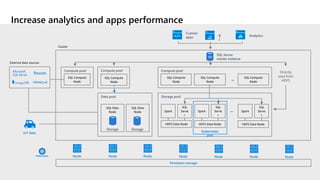
Increase analytics and apps performance
Compute pool
SQL Compute
Node
SQL Compute
Node
SQL Compute
Node
…
Compute pool
SQL Compute
Node
IoT data
Directly
read from
HDFS
Persistent storage
…
Storage pool
SQL
Serve
r
Spark
HDFS Data Node
SQL
Serve
r
Spark
HDFS Data Node
SQL
Serve
r
Spark
HDFS Data Node
Kubernetes
pod
Analytics
Custom
apps B
I
SQL Server
master instance
Node Node Node Node Node Node Node
SQL
Data pool
SQL Data
Node
SQL Data
Node
Compute pool
SQL Compute
Node
Storage Storage
Simplified deployment with
containers & Kubernetes
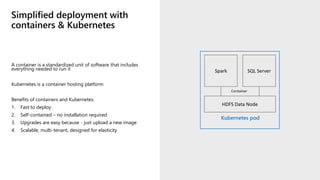
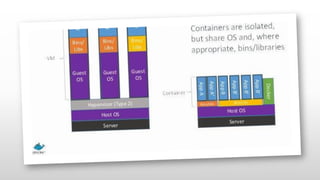
A container is a standardized unit of software that includes
everything needed to run it
Kubernetes is a container hosting platform
Benefits of containers and Kubernetes:
1. Fast to deploy
2. Self-contained – no installation required
3. Upgrades are easy because - just upload a new image
4. Scalable, multi-tenant, designed for elasticity
Kubernetes pod
SQL Server
HDFS Data Node
Spark
Concepts
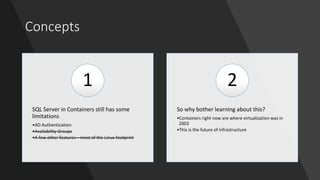
SQL Server in Containers still has some
limitations
•AD Authentication
•Availability Groups
•A few other features—most of the Linux footprint
1
So why bother learning about this?
•Containers right now are where virtualization was in
2003
•This is the future of infrastructure
2
Agenda
• What Are Containers?
• Storage Persistence
• What is Kubernetes?
• SQL Server and Kubernetes
• The Future?
Benefits of Containers
• Containers are faster to deploy than VMs
• Fully software defined
• Containers themselves are ephemeral
• Storage is persisted
• Better density than VMs
• Lower performance overhead than a VM
• Built natively around cloud services
If Containers Are Ephemeral What About my Data
All container platforms allow for
some measure of persisted storage
This is the notion of separating
data from compute which has
always been hard in RDBMS
SQL Server and Docker Demo
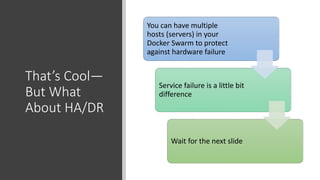
That’s Cool—
But What
About HA/DR
You can have multiple
hosts (servers) in your
Docker Swarm to protect
against hardware failure
Service failure is a little bit
difference
Wait for the next slide
Introducing Kubernetes
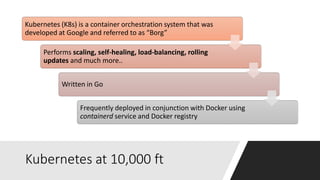
Kubernetes at 10,000 ft
Kubernetes (K8s) is a container orchestration system that was
developed at Google and referred to as “Borg”
Performs scaling, self-healing, load-balancing, rolling
updates and much more..
Written in Go
Frequently deployed in conjunction with Docker using
containerd service and Docker registry
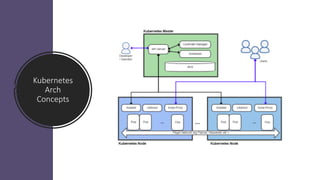
Kubernetes
Arch
Concepts
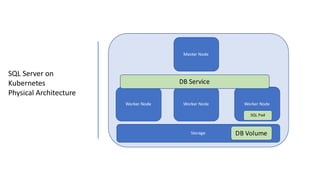
SQL Server on
Kubernetes
Physical Architecture
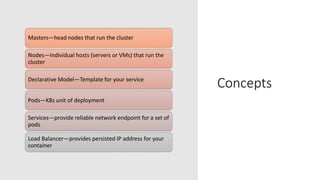
Concepts
Masters—head nodes that run the cluster
Nodes—Individual hosts (servers or VMs) that run the
cluster
Declarative Model—Template for your service
Pods—K8s unit of deployment
Services—provide reliable network endpoint for a set of
pods
Load Balancer—provides persisted IP address for your
container
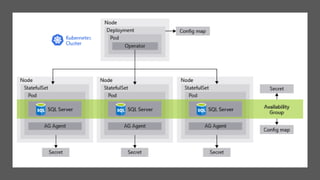
SQL Server and
Kubernetes
Demo
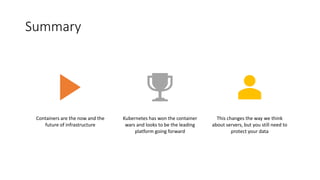
Summary
Containers are the now and the
future of infrastructure
Kubernetes has won the container
wars and looks to be the leading
platform going forward
This changes the way we think
about servers, but you still need to
protect your data
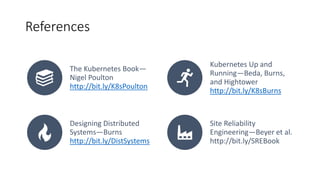
References
The Kubernetes Book—
Nigel Poulton
http://bit.ly/K8sPoulton
Kubernetes Up and
Running—Beda, Burns,
and Hightower
http://bit.ly/K8sBurns
Designing Distributed
Systems—Burns
http://bit.ly/DistSystems
Site Reliability
Engineering—Beyer et al.
http://bit.ly/SREBook
22© 2017 IDERA, Inc. All rights reserved. Proprietary and confidential.
THANKS!
Any questions?
You can find me at:
@jdanton
joeydantoni.com
joey@dcac.co

Geek Sync | Linux, Containers, and SQL Server—Get Ready for Big Data Clusters in SQL Server

  • 1.
    © 2018 IDERA,Inc. All rights reserved. LINUX, CONTAINERS, AND SQL SERVER— GET READY FOR BIG DATA CLUSTERS IN SQL SERVER Joey D’Antoni 05 December 2018
  • 2.
    Joey D’Antoni Joey hasover 20 years of experience with a wide variety of data platforms, in both Fortune 50 companies as well as smaller organizations He is a frequent speaker on database administration, big data, and career management MVP, MCSE BI and Data Platform VMWare vExpert He is the co-president of the Philadelphia SQL Server User’s Group He wants you to make sure you can restore your data
  • 3.
  • 4.
    Increase analytics andapps performance Compute pool SQL Compute Node SQL Compute Node SQL Compute Node … Compute pool SQL Compute Node IoT data Directly read from HDFS Persistent storage … Storage pool SQL Serve r Spark HDFS Data Node SQL Serve r Spark HDFS Data Node SQL Serve r Spark HDFS Data Node Kubernetes pod Analytics Custom apps B I SQL Server master instance Node Node Node Node Node Node Node SQL Data pool SQL Data Node SQL Data Node Compute pool SQL Compute Node Storage Storage
  • 5.
    Simplified deployment with containers& Kubernetes A container is a standardized unit of software that includes everything needed to run it Kubernetes is a container hosting platform Benefits of containers and Kubernetes: 1. Fast to deploy 2. Self-contained – no installation required 3. Upgrades are easy because - just upload a new image 4. Scalable, multi-tenant, designed for elasticity Kubernetes pod SQL Server HDFS Data Node Spark
  • 6.
    Concepts SQL Server inContainers still has some limitations •AD Authentication •Availability Groups •A few other features—most of the Linux footprint 1 So why bother learning about this? •Containers right now are where virtualization was in 2003 •This is the future of infrastructure 2
  • 7.
    Agenda • What AreContainers? • Storage Persistence • What is Kubernetes? • SQL Server and Kubernetes • The Future?
  • 9.
    Benefits of Containers •Containers are faster to deploy than VMs • Fully software defined • Containers themselves are ephemeral • Storage is persisted • Better density than VMs • Lower performance overhead than a VM • Built natively around cloud services
  • 10.
    If Containers AreEphemeral What About my Data All container platforms allow for some measure of persisted storage This is the notion of separating data from compute which has always been hard in RDBMS
  • 11.
    SQL Server andDocker Demo
  • 12.
    That’s Cool— But What AboutHA/DR You can have multiple hosts (servers) in your Docker Swarm to protect against hardware failure Service failure is a little bit difference Wait for the next slide
  • 13.
  • 14.
    Kubernetes at 10,000ft Kubernetes (K8s) is a container orchestration system that was developed at Google and referred to as “Borg” Performs scaling, self-healing, load-balancing, rolling updates and much more.. Written in Go Frequently deployed in conjunction with Docker using containerd service and Docker registry
  • 15.
  • 16.
  • 18.
    Concepts Masters—head nodes thatrun the cluster Nodes—Individual hosts (servers or VMs) that run the cluster Declarative Model—Template for your service Pods—K8s unit of deployment Services—provide reliable network endpoint for a set of pods Load Balancer—provides persisted IP address for your container
  • 19.
  • 20.
    Summary Containers are thenow and the future of infrastructure Kubernetes has won the container wars and looks to be the leading platform going forward This changes the way we think about servers, but you still need to protect your data
  • 21.
    References The Kubernetes Book— NigelPoulton http://bit.ly/K8sPoulton Kubernetes Up and Running—Beda, Burns, and Hightower http://bit.ly/K8sBurns Designing Distributed Systems—Burns http://bit.ly/DistSystems Site Reliability Engineering—Beyer et al. http://bit.ly/SREBook
  • 22.
    22© 2017 IDERA,Inc. All rights reserved. Proprietary and confidential. THANKS! Any questions? You can find me at: @jdanton joeydantoni.com joey@dcac.co