Teachers, this is your quick-start guide to model text-
coding and annotating today.
The slides are intended to be presented directly to
your students. Feel free to use them as a script, or riff
on them if you are comfortable doing so.
Tips and suggestions are in the notes section of each
slide.
This quick-start guide is to be presented after the
Before Reading Quick-Start Guide.
For the complete program and bonus material, visit:
https://www.picklesandbooks.com/
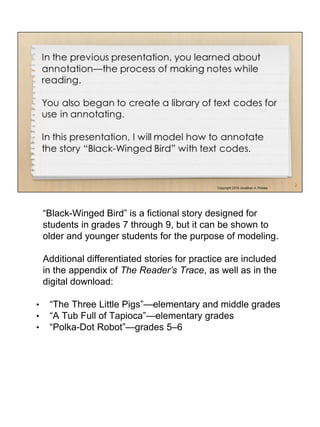
“Black-Winged Bird” is a fictional story designed for
students in grades 7 through 9, but it can be shown to
older and younger students for the purpose of modeling.
Additional differentiated stories for practice are included
in the appendix of The Reader’s Trace, as well as in the
digital download:
• “The Three Little Pigs”—elementary and middle grades
• “A Tub Full of Tapioca”—elementary grades
• “Polka-Dot Robot”—grades 5–6
Drive this point home! Put this quote on your bulletin board
for all students to see!
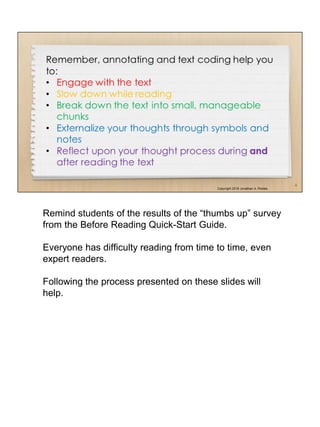
Remind students of the results of the “thumbs up” survey
from the Before Reading Quick-Start Guide.
Everyone has difficulty reading from time to time, even
expert readers.
Following the process presented on these slides will
help.
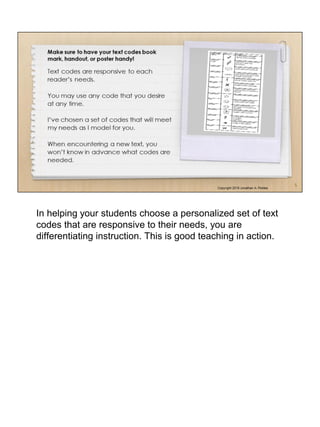
In helping your students choose a personalized set of text
codes that are responsive to their needs, you are
differentiating instruction. This is good teaching in action.
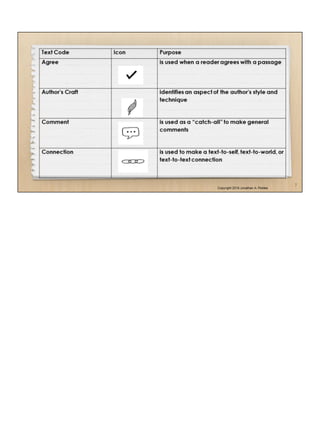
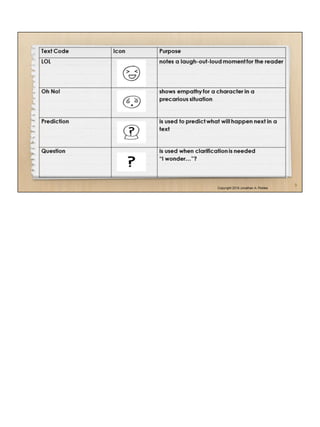
The codes I’ve chosen include reading reactions,
strategies, and a few literary elements.
This set is unique to me and meets my needs for
annotating this short story.
Play this out as if you were reading and annotating the
story for the first time. It will feel more genuine and less of
an academic exercise.
A sample bookmark and a margin-adjusted copy of
“Black-Winged Bird” are included for download with The
Reader’s Trace.
Annotation does not ensure that students “get it,” even if
that may be your ultimate goal. It does provide an
opportunity for students to engage with a text on a deep
level. Students will slow down, read manageable chunks
of text, and think about what they’ve read. Couple this
with the focus topic (conflict), and they should be set up
for success.
Allowing the students to struggle with a passage, along
with providing the necessary tools for completing the
task, is the most effective and powerful way to break
through confusion, achieve meaningful insight, and foster
a new habit.
Make a list with your students on the chalkboard or
bulletin board and leave it up for the remainder of this
exercise.
I’ll use the direct annotation method where, I write directly
on the text.
If I did not have a personal copy, I could use sticky notes
to avoid defacing the text.
Read the story and then the think-aloud. Feel free to riff
on the material as necessary, but keep your time
constraints in mind.
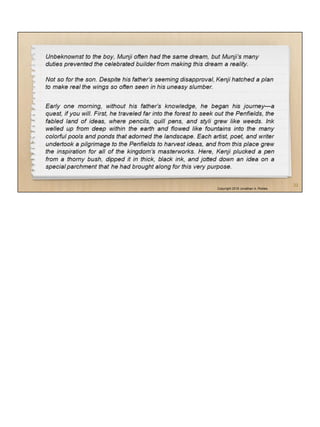
This slide is an example of what your directly annotated
copy of the text might look like.
Simple and effective.
Have your students participate in this activity.
It may be wise to have chosen seat partners in advance
for the sake of expediency.
Following the trail of your thoughts is metacognition. Make
sure to read chapters 3 through 5 of The Reader’s Trace
for more on the benefits of metacognitive activities.
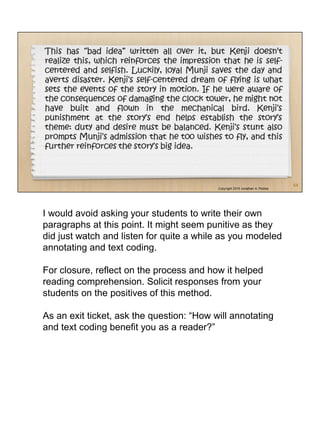
I would avoid asking your students to write their own
paragraphs at this point. It might seem punitive as they
did just watch and listen for quite a while as you modeled
annotating and text coding.
For closure, reflect on the process and how it helped
reading comprehension. Solicit responses from your
students on the positives of this method.
As an exit ticket, ask the question: “How will annotating
and text coding benefit you as a reader?”
I would avoid asking your students to write their own
paragraphs at this point. It might seem punitive as they
did just watch and listen for quite a while as you modeled
annotating and text coding.
For closure, reflect on the process and how it helped
reading comprehension. Solicit responses from your
students on the positives of this method.
As an exit ticket, ask the question: “How will annotating
and text coding benefit you as a reader?”
As you and your students embark on new reading
adventures, make sure to have an ample supply of
highlighters and sticky notes on hand for annotating.
You may even require that your students purchase these
supplies so that they are always on hand (especially if you
assign reading homework or independent reading outside
the classroom.
*Important note*
To use the final presentation (After Reading Quick-Start
Guide), your students must have text-coded and annotated
a full-length novel or chapter book.
In addition, your students must have kept their annotations
on sticky notes in the book and they should have collected
at least thirty annotations each.
I will respond as best I can!

Close Reading with Annotations and Text Codes: During Reading

  • 1.
    Teachers, this isyour quick-start guide to model text- coding and annotating today. The slides are intended to be presented directly to your students. Feel free to use them as a script, or riff on them if you are comfortable doing so. Tips and suggestions are in the notes section of each slide. This quick-start guide is to be presented after the Before Reading Quick-Start Guide. For the complete program and bonus material, visit: https://www.picklesandbooks.com/
  • 2.
    “Black-Winged Bird” isa fictional story designed for students in grades 7 through 9, but it can be shown to older and younger students for the purpose of modeling. Additional differentiated stories for practice are included in the appendix of The Reader’s Trace, as well as in the digital download: • “The Three Little Pigs”—elementary and middle grades • “A Tub Full of Tapioca”—elementary grades • “Polka-Dot Robot”—grades 5–6
  • 3.
    Drive this pointhome! Put this quote on your bulletin board for all students to see!
  • 4.
    Remind students ofthe results of the “thumbs up” survey from the Before Reading Quick-Start Guide. Everyone has difficulty reading from time to time, even expert readers. Following the process presented on these slides will help.
  • 5.
    In helping yourstudents choose a personalized set of text codes that are responsive to their needs, you are differentiating instruction. This is good teaching in action.
  • 6.
    The codes I’vechosen include reading reactions, strategies, and a few literary elements. This set is unique to me and meets my needs for annotating this short story. Play this out as if you were reading and annotating the story for the first time. It will feel more genuine and less of an academic exercise.
  • 11.
    A sample bookmarkand a margin-adjusted copy of “Black-Winged Bird” are included for download with The Reader’s Trace.
  • 12.
    Annotation does notensure that students “get it,” even if that may be your ultimate goal. It does provide an opportunity for students to engage with a text on a deep level. Students will slow down, read manageable chunks of text, and think about what they’ve read. Couple this with the focus topic (conflict), and they should be set up for success. Allowing the students to struggle with a passage, along with providing the necessary tools for completing the task, is the most effective and powerful way to break through confusion, achieve meaningful insight, and foster a new habit.
  • 13.
    Make a listwith your students on the chalkboard or bulletin board and leave it up for the remainder of this exercise.
  • 14.
    I’ll use thedirect annotation method where, I write directly on the text. If I did not have a personal copy, I could use sticky notes to avoid defacing the text.
  • 15.
    Read the storyand then the think-aloud. Feel free to riff on the material as necessary, but keep your time constraints in mind.
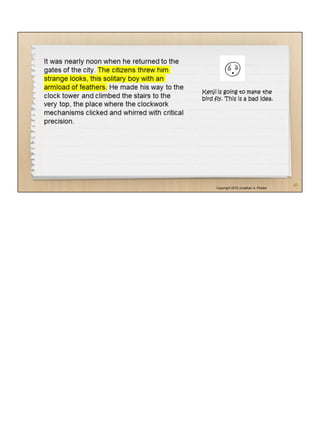
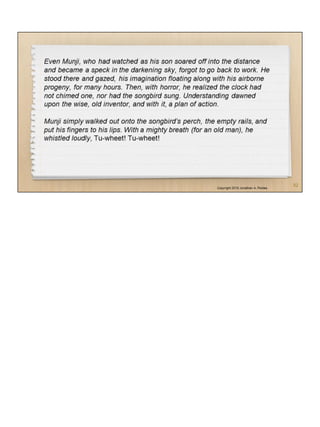
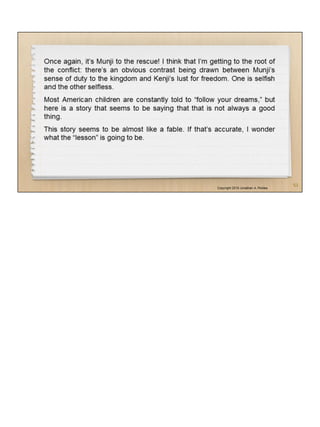
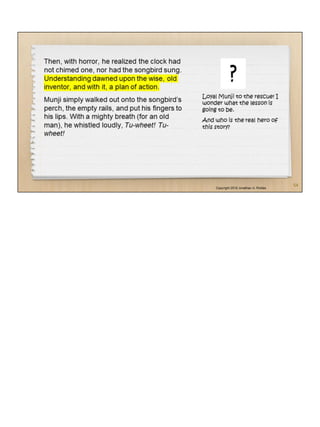
  • 16.
    This slide isan example of what your directly annotated copy of the text might look like.
  • 17.
  • 22.
    Have your studentsparticipate in this activity.
  • 24.
    It may bewise to have chosen seat partners in advance for the sake of expediency.
  • 61.
    Following the trailof your thoughts is metacognition. Make sure to read chapters 3 through 5 of The Reader’s Trace for more on the benefits of metacognitive activities.
  • 63.
    I would avoidasking your students to write their own paragraphs at this point. It might seem punitive as they did just watch and listen for quite a while as you modeled annotating and text coding. For closure, reflect on the process and how it helped reading comprehension. Solicit responses from your students on the positives of this method. As an exit ticket, ask the question: “How will annotating and text coding benefit you as a reader?”
  • 64.
    I would avoidasking your students to write their own paragraphs at this point. It might seem punitive as they did just watch and listen for quite a while as you modeled annotating and text coding. For closure, reflect on the process and how it helped reading comprehension. Solicit responses from your students on the positives of this method. As an exit ticket, ask the question: “How will annotating and text coding benefit you as a reader?”
  • 65.
    As you andyour students embark on new reading adventures, make sure to have an ample supply of highlighters and sticky notes on hand for annotating. You may even require that your students purchase these supplies so that they are always on hand (especially if you assign reading homework or independent reading outside the classroom. *Important note* To use the final presentation (After Reading Quick-Start Guide), your students must have text-coded and annotated a full-length novel or chapter book. In addition, your students must have kept their annotations on sticky notes in the book and they should have collected at least thirty annotations each.
  • 66.
    I will respondas best I can!