Clinical trial protocol design
Presented by
SUMAN DHAURIA
REG NO- AU/2023/0010563
ROLL NO- PG/06/MPHARMP/2023/012
MPHARM (PHARMACEUTICS),1ST SEM ,1ST YEAR
1
 Introduction
 Overview of clinical trail development
 Classification of clinical research design
 Members involve in clinical trail protocol design
 Elements of a protocol
 Conclusion
 References
2
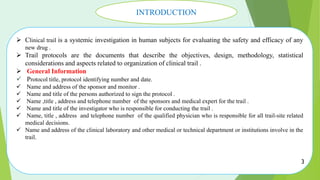
INTRODUCTION
 Clinical trail is a systemic investigation in human subjects for evaluating the safety and efficacy of any
new drug .
 Trail protocols are the documents that describe the objectives, design, methodology, statistical
considerations and aspects related to organization of clinical trail .
 General Information
 Protocol title, protocol identifying number and date.
 Name and address of the sponsor and monitor .
 Name and title of the persons authorized to sign the protocol .
 Name ,title , address and telephone number of the sponsors and medical expert for the trail .
 Name and title of the investigator who is responsible for conducting the trail .
 Name, title , address and telephone number of the qualified physician who is responsible for all trail-site related
medical decisions.
 Name and address of the clinical laboratory and other medical or technical department or institutions involve in the
trail.
3
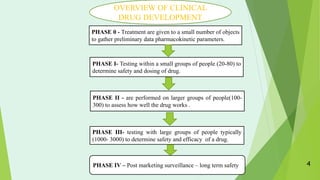
OVERVIEW OF CLINICAL
DRUG DEVELOPMENT
PHASE 0 - Treatment are given to a small number of objects
to gather preliminary data pharmacokinetic parameters.
PHASE I- Testing within a small groups of people (20-80) to
determine safety and dosing of drug.
PHASE II - are performed on larger groups of people(100-
300) to assess how well the drug works .
PHASE III- testing with large groups of people typically
(1000- 3000) to determine safety and efficacy of a drug.
PHASE IV – Post marketing surveillance – long term safety 4
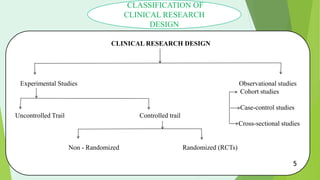
CLINICAL RESEARCH DESIGN
Experimental Studies Observational studies
Cohort studies
Case-control studies
Uncontrolled Trail Controlled trail
Cross-sectional studies
Non - Randomized Randomized (RCTs)
CLASSIFICATION OF
CLINICAL RESEARCH
DESIGN
5
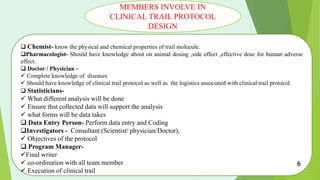
MEMBERS INVOLVE IN
CLINICAL TRAIL PROTOCOL
DESIGN
 Chemist- know the physical and chemical properties of trail molecule.
Pharmacologist- Should have knowledge about on animal dosing ,side effect ,effective dose for human adverse
effect.
 Doctor / Physician –
 Complete knowledge of diseases
 Should have knowledge of clinical trail protocol as well as the logistics associated with clinical trail protocol.
 Statisticians-
 What different analysis will be done
 Ensure that collected data will support the analysis
 what forms will be data takes
 Data Entry Person- Perform data entry and Coding
Investigators - Consultant (Scientist/ physician/Doctor),
 Objectives of the protocol
 Program Manager-
Final writer
 co-ordination with all team member
 Execution of clinical trail
6
ELEMENTS OF A
PROTOCOL:A CHECKLIST
 Title page- provide the full title of the trail , including if possible, a precise description of the trail
objective.
Table of contents- It has main heading , subheading, and appropriate page number.
 Introduction- include the description of the specific diagnosis and special subject characteristics for
each disease to be investigated.
 Bibliography- all important reference should be sited appropriately.
 Objective- to evaluate the efficacy and safety of medication X VS medication Y in ( diagnosis of the
disease ) as found in outpatient population .
 General - Contains a condensed summary of the protocol.
 Risks - is based on preclinical research in animals : the pharmacology and toxicology of the new drug is
establish before being brought forward for trails in human.
 Confidentiality- If the subject getting enrolled for clinical trail his or her confidentiality should not
compromised.
 Materials and Methods -
Establish the number of subjects that must complete the trail and be a part of final statistical analysis.
 include a age range, gender, subject inclusion criteria ,subject exclusion criteria, trail procedures.
7
 Trial Drugs – Include a complete description of the medication , lot number ,generic and brand name
used in the trail.
 Assignment of trail drugs – two things must be establish
 Outline the method of randomization so that procedure is clear.
 make certain that the method of randomization is truly random so that a valid conclusion can be drawn.
 Dosage range- Describe the dosage range to be used in the trail.
 Dosage schedule – addresses when appropriate amount of drug are to be administered : once daily
,twice daily , every 4 hours , three times daily or given in the morning or evening
 Administration of trail drugs – describe how the drug is to be administered to or taken by the subject :
with meals , before or after meals, with liquids or dissolved in specific juice .
 Labeling of the trail drugs – proper labeling of the medication is very important throughout the trail.
 Duration of the drug treatment – while protocol designing it becomes important to establish how
long a drug should be evaluated to establish its efficacy and safety.
 Concomitant medications – all the records of the concomitant medication should be recorded in case
report form.
 Case report forms- all the data on an individual subject during the course of clinical trail is recorded
on a subjects CRF.
 Laboratory Assessments – through laboratory assessments the review of the data and safety of a drug
can be assessed and measured. 8
 Adverse experiences - all adverse experiences occurring in the trail must be reported on the drug
reaction record provided in the subject case report forms .
 Statistical handling of data- must be final before an investigational trial begins.
 Overall Duration of the trail – the maximum allowable time required by an investigators to
complete the evaluation of all subjects into the trail should be clearly stated .
 Institutional review board – a recognized and certified IRB must review the proposed clinical
research protocol to determine the safety and anticipated benefits to subjects.
 Informed constant – ensure that no experimentation is carried out on people who are unaware to
participate in an investigational clinical program.
 Monitoring – typically called clinical research associate who confirmed that all necessary information
on the CRF has been recorded.
 Location of the trail- list the investigators(s) and address(s), telephone number(s) , where the trail is
to be conducted.
 Location of the laboratory testing facilities- list of the names , addresses and telephone numbers of
all test laboratories involved in the trail.
 Investigators obligations- written assurance form that agrees to conduct clinical trail according to
protocol design .
 Signature page- a provide space for investigators signature and date the agreement is signed
 Amendments . 9
CONCLUSION
Many approaches and different styles are useful in the development and preparation of a sound clinical
research trail protocol . The foregoing guidelines can be modified to suit the applicants needs and
objectives . No matter which patch is mapped out, it is imperative that investigators abide by the final
protocol. Strict adherence to a well- designed protocol will result in research projects that reflect the stated
objectives in the required amount of time leading to successful and definitive conclusions.
10
1
1. Richard A. Guarino , Clinical Research protocols: Oxford pharmaceutical Resources , Inc, Totowa, New Jersey ,
USA 1984; 224- 245 .
REFERENCES
11
12

CLINICAL TRIAL PROTOCOL DESIGN ppt presentation.pptx

  • 1.
    Clinical trial protocoldesign Presented by SUMAN DHAURIA REG NO- AU/2023/0010563 ROLL NO- PG/06/MPHARMP/2023/012 MPHARM (PHARMACEUTICS),1ST SEM ,1ST YEAR 1
  • 2.
     Introduction  Overviewof clinical trail development  Classification of clinical research design  Members involve in clinical trail protocol design  Elements of a protocol  Conclusion  References 2
  • 3.
    INTRODUCTION  Clinical trailis a systemic investigation in human subjects for evaluating the safety and efficacy of any new drug .  Trail protocols are the documents that describe the objectives, design, methodology, statistical considerations and aspects related to organization of clinical trail .  General Information  Protocol title, protocol identifying number and date.  Name and address of the sponsor and monitor .  Name and title of the persons authorized to sign the protocol .  Name ,title , address and telephone number of the sponsors and medical expert for the trail .  Name and title of the investigator who is responsible for conducting the trail .  Name, title , address and telephone number of the qualified physician who is responsible for all trail-site related medical decisions.  Name and address of the clinical laboratory and other medical or technical department or institutions involve in the trail. 3
  • 4.
    OVERVIEW OF CLINICAL DRUGDEVELOPMENT PHASE 0 - Treatment are given to a small number of objects to gather preliminary data pharmacokinetic parameters. PHASE I- Testing within a small groups of people (20-80) to determine safety and dosing of drug. PHASE II - are performed on larger groups of people(100- 300) to assess how well the drug works . PHASE III- testing with large groups of people typically (1000- 3000) to determine safety and efficacy of a drug. PHASE IV – Post marketing surveillance – long term safety 4
  • 5.
    CLINICAL RESEARCH DESIGN ExperimentalStudies Observational studies Cohort studies Case-control studies Uncontrolled Trail Controlled trail Cross-sectional studies Non - Randomized Randomized (RCTs) CLASSIFICATION OF CLINICAL RESEARCH DESIGN 5
  • 6.
    MEMBERS INVOLVE IN CLINICALTRAIL PROTOCOL DESIGN  Chemist- know the physical and chemical properties of trail molecule. Pharmacologist- Should have knowledge about on animal dosing ,side effect ,effective dose for human adverse effect.  Doctor / Physician –  Complete knowledge of diseases  Should have knowledge of clinical trail protocol as well as the logistics associated with clinical trail protocol.  Statisticians-  What different analysis will be done  Ensure that collected data will support the analysis  what forms will be data takes  Data Entry Person- Perform data entry and Coding Investigators - Consultant (Scientist/ physician/Doctor),  Objectives of the protocol  Program Manager- Final writer  co-ordination with all team member  Execution of clinical trail 6
  • 7.
    ELEMENTS OF A PROTOCOL:ACHECKLIST  Title page- provide the full title of the trail , including if possible, a precise description of the trail objective. Table of contents- It has main heading , subheading, and appropriate page number.  Introduction- include the description of the specific diagnosis and special subject characteristics for each disease to be investigated.  Bibliography- all important reference should be sited appropriately.  Objective- to evaluate the efficacy and safety of medication X VS medication Y in ( diagnosis of the disease ) as found in outpatient population .  General - Contains a condensed summary of the protocol.  Risks - is based on preclinical research in animals : the pharmacology and toxicology of the new drug is establish before being brought forward for trails in human.  Confidentiality- If the subject getting enrolled for clinical trail his or her confidentiality should not compromised.  Materials and Methods - Establish the number of subjects that must complete the trail and be a part of final statistical analysis.  include a age range, gender, subject inclusion criteria ,subject exclusion criteria, trail procedures. 7
  • 8.
     Trial Drugs– Include a complete description of the medication , lot number ,generic and brand name used in the trail.  Assignment of trail drugs – two things must be establish  Outline the method of randomization so that procedure is clear.  make certain that the method of randomization is truly random so that a valid conclusion can be drawn.  Dosage range- Describe the dosage range to be used in the trail.  Dosage schedule – addresses when appropriate amount of drug are to be administered : once daily ,twice daily , every 4 hours , three times daily or given in the morning or evening  Administration of trail drugs – describe how the drug is to be administered to or taken by the subject : with meals , before or after meals, with liquids or dissolved in specific juice .  Labeling of the trail drugs – proper labeling of the medication is very important throughout the trail.  Duration of the drug treatment – while protocol designing it becomes important to establish how long a drug should be evaluated to establish its efficacy and safety.  Concomitant medications – all the records of the concomitant medication should be recorded in case report form.  Case report forms- all the data on an individual subject during the course of clinical trail is recorded on a subjects CRF.  Laboratory Assessments – through laboratory assessments the review of the data and safety of a drug can be assessed and measured. 8
  • 9.
     Adverse experiences- all adverse experiences occurring in the trail must be reported on the drug reaction record provided in the subject case report forms .  Statistical handling of data- must be final before an investigational trial begins.  Overall Duration of the trail – the maximum allowable time required by an investigators to complete the evaluation of all subjects into the trail should be clearly stated .  Institutional review board – a recognized and certified IRB must review the proposed clinical research protocol to determine the safety and anticipated benefits to subjects.  Informed constant – ensure that no experimentation is carried out on people who are unaware to participate in an investigational clinical program.  Monitoring – typically called clinical research associate who confirmed that all necessary information on the CRF has been recorded.  Location of the trail- list the investigators(s) and address(s), telephone number(s) , where the trail is to be conducted.  Location of the laboratory testing facilities- list of the names , addresses and telephone numbers of all test laboratories involved in the trail.  Investigators obligations- written assurance form that agrees to conduct clinical trail according to protocol design .  Signature page- a provide space for investigators signature and date the agreement is signed  Amendments . 9
  • 10.
    CONCLUSION Many approaches anddifferent styles are useful in the development and preparation of a sound clinical research trail protocol . The foregoing guidelines can be modified to suit the applicants needs and objectives . No matter which patch is mapped out, it is imperative that investigators abide by the final protocol. Strict adherence to a well- designed protocol will result in research projects that reflect the stated objectives in the required amount of time leading to successful and definitive conclusions. 10
  • 11.
    1 1. Richard A.Guarino , Clinical Research protocols: Oxford pharmaceutical Resources , Inc, Totowa, New Jersey , USA 1984; 224- 245 . REFERENCES 11
  • 12.