Presented by-
Mr.Nitin R. Kale
M.Pharm 1st Year
Subject: P’colgical & toxicological screening method-2
Rajarshi Shahu College Of Pharmacy, Buldana.
1/15
CONTENT
Clinical trial
Trial protocol
Content of trial protocol
Investigator
Responsibilties of investigator
2/15
CLINICAL TRIAL
 Clinical trial means a systemic study of new drugs in human being
(subject) to generate data to determine pharmacological actions,
adverse effect and safety & efficacy of new drug.
 Clinical trial generate high quality data for healthcare decision
making.
 In clinical trial random assignment of volunteer to control group or
group receiving the experimental therapy in optimal method.
3/15
TRIAL PROTOCOL
 Protocol, a written predefined procedures method of conducting
experiments.
 It describe the rational for the trial.
 Therapeutic effect.
 Types of clinical trial
phase-1
phase-2
phase-3
phase-4 (post marketing surveillance)
4/15
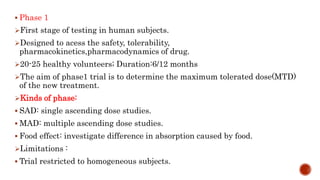
 Phase 1
First stage of testing in human subjects.
Designed to acess the safety, tolerability,
pharmacokinetics,pharmacodynamics of drug.
20-25 healthy volunteers; Duration:6/12 months
The aim of phase1 trial is to determine the maximum tolerated dose(MTD)
of the new treatment.
Kinds of phase:
 SAD: single ascending dose studies.
 MAD: multiple ascending dose studies.
 Food effect: investigate difference in absorption caused by food.
Limitations :
 Trial restricted to homogeneous subjects.
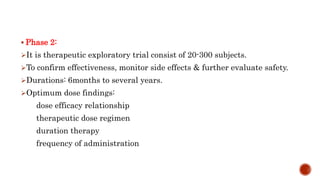
 Phase 2:
It is therapeutic exploratory trial consist of 20-300 subjects.
To confirm effectiveness, monitor side effects & further evaluate safety.
Durations: 6months to several years.
Optimum dose findings:
dose efficacy relationship
therapeutic dose regimen
duration therapy
frequency of administration
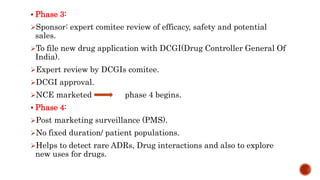
 Phase 3:
Sponsor: expert comitee review of efficacy, safety and potential
sales.
To file new drug application with DCGI(Drug Controller General Of
India).
Expert review by DCGIs comitee.
DCGI approval.
NCE marketed phase 4 begins.
 Phase 4:
Post marketing surveillance (PMS).
No fixed duration/ patient populations.
Helps to detect rare ADRs, Drug interactions and also to explore
new uses for drugs.
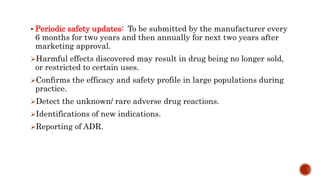
 Periodic safety updates: To be submitted by the manufacturer every
6 months for two years and then annually for next two years after
marketing approval.
Harmful effects discovered may result in drug being no longer sold,
or restricted to certain uses.
Confirms the efficacy and safety profile in large populations during
practice.
Detect the unknown/ rare adverse drug reactions.
Identifications of new indications.
Reporting of ADR.
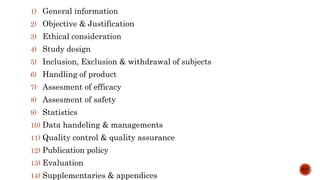
1) General information
2) Objective & Justification
3) Ethical consideration
4) Study design
5) Inclusion, Exclusion & withdrawal of subjects
6) Handling of product
7) Assesment of efficacy
8) Assesment of safety
9) Statistics
10) Data handeling & managements
11) Quality control & quality assurance
12) Publication policy
13) Evaluation
14) Supplementaries & appendices
5/15
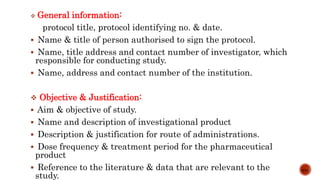
 General information:
protocol title, protocol identifying no. & date.
 Name & title of person authorised to sign the protocol.
 Name, title address and contact number of investigator, which
responsible for conducting study.
 Name, address and contact number of the institution.
 Objective & Justification:
 Aim & objective of study.
 Name and description of investigational product
 Description & justification for route of administrations.
 Dose frequency & treatment period for the pharmaceutical
product
 Reference to the literature & data that are relevant to the
study.
6/15
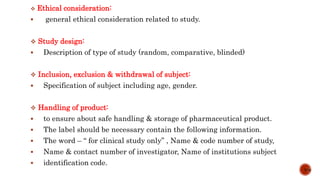
 Ethical consideration:
 general ethical consideration related to study.
 Study design:
 Description of type of study (random, comparative, blinded)
 Inclusion, exclusion & withdrawal of subject:
 Specification of subject including age, gender.
 Handling of product:
 to ensure about safe handling & storage of pharmaceutical product.
 The label should be necessary contain the following information.
 The word – “ for clinical study only” , Name & code number of study,
 Name & contact number of investigator, Name of institutions subject
 identification code.
7/15
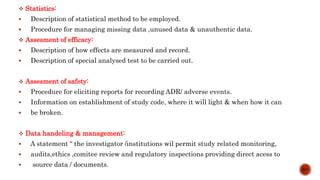
 Statistics:
 Description of statistical method to be employed.
 Procedure for managing missing data ,unused data & unauthentic data.
 Assesment of efficacy:
 Description of how effects are measured and record.
 Description of special analysed test to be carried out.
 Assesment of safety:
 Procedure for eliciting reports for recording ADR/ adverse events.
 Information on establishment of study code, where it will light & when how it can
 be broken.
 Data handeling & management:
 A statement “ the investigator /institutions wil permit study related monitoring,
 audits,ethics ,comitee review and regulatory inspections providing direct acess to
 source data / documents.
8/15
 Quality control & Quality assurance:
 A meticulous and specified plan for various steps & procedures for
purpose of controlling and monitor the study effectively.
 Specifications and instruction for anticipated deviation from protocol.
 Allocation of duties and responsibility with research team and then
coordination.
 Finance & Insurance:
 All financial aspects of conducting and reporting a study arranged
budget mode out.
 How expenditure should be distributed , e.g. payment to budget
refining express of studies, purchase for apparatus, payment for
investigator.
9/15
 Publication policy:
 A publication agreement should be described in protocol.
 Evaluation:
 A specified account for new response to be evaluated
 Methods of computations & calculations of effects.
 Description of how to deal with respect about withdrawn / out of study.
 Supplements & Appendices:
Documents should be appended with protocol.
 Information to study subjects and providing it.
 Instructions to staff.
 Description of special procedures.
10/15
INVESTIGATOR
INFORMATION
 An investigator – a person who is responsible for conducting clinical
trial site.
 If a trial is conducted by a team of individuals, then the investigator
is the responsible leader of the team and called the principle
investigator.
 Investigator should be qualified, educated, trained, experienced.
 Show all the up-to-date document to IRB/IEC.
 Familiar with investigational products and their use.
 Aware and comply GCP applied regulatory reqirements.
11/15
RESPONSIBILITY OF AN
INVESTIGATOR
 Adequate resources :
To ensure that all the person who assiting with the trial informed
about “protocol, investigational product and trial related duties and
functions.”
To arrange adequate number of qualified staff and cacilities for the
trial.
Medical care of trial subject:
Ensure that adequate medical care will provided for any ADRs
during trial.
Informed the subjects about all the risk and health problem which
can occurred during the trial before they join the trial. 12/15
 IRB/IEC approval:
IRB/IEC approval of protocol and informed consent form before
initiation of study.
Be familiar with any national law that may impact study design.
Funding policies and the rules.
Human tissues ( storage, use, transfer to another institutionsor
other country.
Investigatinal product:
It should be handled in appropriate manner.
Packed,label and stored in correct form.
The dose recoed should be maintained.
Includes dates, quantities, batch/serial number, unique code
numbers.
13/15
Informed consent of trail subject:
Obtained informed consent form from patients or parents of minor patients.
To ensure patient understand the study.
On going and interactive process between the research team and patient.
14/15
Thank You….!
15/15

clinical protocol & investigator information.pptx by Nitin Kale

  • 1.
    Presented by- Mr.Nitin R.Kale M.Pharm 1st Year Subject: P’colgical & toxicological screening method-2 Rajarshi Shahu College Of Pharmacy, Buldana. 1/15
  • 2.
    CONTENT Clinical trial Trial protocol Contentof trial protocol Investigator Responsibilties of investigator 2/15
  • 3.
    CLINICAL TRIAL  Clinicaltrial means a systemic study of new drugs in human being (subject) to generate data to determine pharmacological actions, adverse effect and safety & efficacy of new drug.  Clinical trial generate high quality data for healthcare decision making.  In clinical trial random assignment of volunteer to control group or group receiving the experimental therapy in optimal method. 3/15
  • 4.
    TRIAL PROTOCOL  Protocol,a written predefined procedures method of conducting experiments.  It describe the rational for the trial.  Therapeutic effect.  Types of clinical trial phase-1 phase-2 phase-3 phase-4 (post marketing surveillance) 4/15
  • 5.
     Phase 1 Firststage of testing in human subjects. Designed to acess the safety, tolerability, pharmacokinetics,pharmacodynamics of drug. 20-25 healthy volunteers; Duration:6/12 months The aim of phase1 trial is to determine the maximum tolerated dose(MTD) of the new treatment. Kinds of phase:  SAD: single ascending dose studies.  MAD: multiple ascending dose studies.  Food effect: investigate difference in absorption caused by food. Limitations :  Trial restricted to homogeneous subjects.
  • 6.
     Phase 2: Itis therapeutic exploratory trial consist of 20-300 subjects. To confirm effectiveness, monitor side effects & further evaluate safety. Durations: 6months to several years. Optimum dose findings: dose efficacy relationship therapeutic dose regimen duration therapy frequency of administration
  • 7.
     Phase 3: Sponsor:expert comitee review of efficacy, safety and potential sales. To file new drug application with DCGI(Drug Controller General Of India). Expert review by DCGIs comitee. DCGI approval. NCE marketed phase 4 begins.  Phase 4: Post marketing surveillance (PMS). No fixed duration/ patient populations. Helps to detect rare ADRs, Drug interactions and also to explore new uses for drugs.
  • 8.
     Periodic safetyupdates: To be submitted by the manufacturer every 6 months for two years and then annually for next two years after marketing approval. Harmful effects discovered may result in drug being no longer sold, or restricted to certain uses. Confirms the efficacy and safety profile in large populations during practice. Detect the unknown/ rare adverse drug reactions. Identifications of new indications. Reporting of ADR.
  • 9.
    1) General information 2)Objective & Justification 3) Ethical consideration 4) Study design 5) Inclusion, Exclusion & withdrawal of subjects 6) Handling of product 7) Assesment of efficacy 8) Assesment of safety 9) Statistics 10) Data handeling & managements 11) Quality control & quality assurance 12) Publication policy 13) Evaluation 14) Supplementaries & appendices 5/15
  • 10.
     General information: protocoltitle, protocol identifying no. & date.  Name & title of person authorised to sign the protocol.  Name, title address and contact number of investigator, which responsible for conducting study.  Name, address and contact number of the institution.  Objective & Justification:  Aim & objective of study.  Name and description of investigational product  Description & justification for route of administrations.  Dose frequency & treatment period for the pharmaceutical product  Reference to the literature & data that are relevant to the study. 6/15
  • 11.
     Ethical consideration: general ethical consideration related to study.  Study design:  Description of type of study (random, comparative, blinded)  Inclusion, exclusion & withdrawal of subject:  Specification of subject including age, gender.  Handling of product:  to ensure about safe handling & storage of pharmaceutical product.  The label should be necessary contain the following information.  The word – “ for clinical study only” , Name & code number of study,  Name & contact number of investigator, Name of institutions subject  identification code. 7/15
  • 12.
     Statistics:  Descriptionof statistical method to be employed.  Procedure for managing missing data ,unused data & unauthentic data.  Assesment of efficacy:  Description of how effects are measured and record.  Description of special analysed test to be carried out.  Assesment of safety:  Procedure for eliciting reports for recording ADR/ adverse events.  Information on establishment of study code, where it will light & when how it can  be broken.  Data handeling & management:  A statement “ the investigator /institutions wil permit study related monitoring,  audits,ethics ,comitee review and regulatory inspections providing direct acess to  source data / documents. 8/15
  • 13.
     Quality control& Quality assurance:  A meticulous and specified plan for various steps & procedures for purpose of controlling and monitor the study effectively.  Specifications and instruction for anticipated deviation from protocol.  Allocation of duties and responsibility with research team and then coordination.  Finance & Insurance:  All financial aspects of conducting and reporting a study arranged budget mode out.  How expenditure should be distributed , e.g. payment to budget refining express of studies, purchase for apparatus, payment for investigator. 9/15
  • 14.
     Publication policy: A publication agreement should be described in protocol.  Evaluation:  A specified account for new response to be evaluated  Methods of computations & calculations of effects.  Description of how to deal with respect about withdrawn / out of study.  Supplements & Appendices: Documents should be appended with protocol.  Information to study subjects and providing it.  Instructions to staff.  Description of special procedures. 10/15
  • 15.
    INVESTIGATOR INFORMATION  An investigator– a person who is responsible for conducting clinical trial site.  If a trial is conducted by a team of individuals, then the investigator is the responsible leader of the team and called the principle investigator.  Investigator should be qualified, educated, trained, experienced.  Show all the up-to-date document to IRB/IEC.  Familiar with investigational products and their use.  Aware and comply GCP applied regulatory reqirements. 11/15
  • 16.
    RESPONSIBILITY OF AN INVESTIGATOR Adequate resources : To ensure that all the person who assiting with the trial informed about “protocol, investigational product and trial related duties and functions.” To arrange adequate number of qualified staff and cacilities for the trial. Medical care of trial subject: Ensure that adequate medical care will provided for any ADRs during trial. Informed the subjects about all the risk and health problem which can occurred during the trial before they join the trial. 12/15
  • 17.
     IRB/IEC approval: IRB/IECapproval of protocol and informed consent form before initiation of study. Be familiar with any national law that may impact study design. Funding policies and the rules. Human tissues ( storage, use, transfer to another institutionsor other country. Investigatinal product: It should be handled in appropriate manner. Packed,label and stored in correct form. The dose recoed should be maintained. Includes dates, quantities, batch/serial number, unique code numbers. 13/15
  • 18.
    Informed consent oftrail subject: Obtained informed consent form from patients or parents of minor patients. To ensure patient understand the study. On going and interactive process between the research team and patient. 14/15
  • 19.