Has social media
impacted charity
work and
fundraising?
By William French
Photo:	Morguefile	Photographer:	Prawny
It is estimated that over 2
billion people were using
some sort of social
network in 2015.1
Photo:	Morguefile	Photographer:	LiaLeslie
No More Barriers
“Social networks have removed
all the communication and
interaction barriers, and now
one can communicate his/her
perception and thoughts over a
variety of topics.”2
Photo:	Morguefile	Photographer:	Seemann
“Social technologies can
empower anyone to have a
positive impact on the
society by creating
networking effects and
initiating community
engagement.”3
Photo:	Morguefile	Photographer:	JoeysPhotos
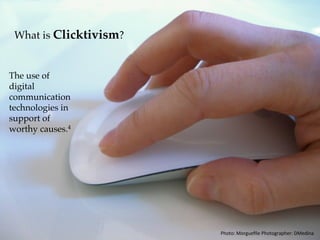
What is Clicktivism?
The use of
digital
communication
technologies in
support of
worthy causes.4
Photo:	Morguefile	Photographer:	DMedina
So is Clicktivism a good thing?
In 2014, 2.6 million UNICEF Tap Project
participants from the U.S., Australia, South
Korea, China, Germany and 20 other
countries across the globe generated more
than a million dollars in clean water
funding. More than 350,000 referrals to the
Tap mobile site came through Facebook.4
Photo:	Morguefile	Photographer:	Prawny
Or is Clicktivism a bad thing?
However, of the 70% who said they used
digital media to learn about changes they
can make in their lives to create positive
social or environmental change, only 25%
made changes.5
Photo:	Morguefile	Photographer:	Prawny
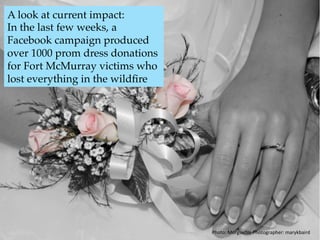
A look at current impact:
In the last few weeks, a
Facebook campaign produced
over 1000 prom dress donations
for Fort McMurray victims who
lost everything in the wildfire.6
Photo:	Morguefile	Photographer:	marykbaird
Past Success:
The ALS ice bucket challenge
was a viral sensation that
increased donations for ALS by
approximately 800%.7
Photo:	Morguefile	Photographer:	Jason	Gillman
Photo:	Morguefile	Photographer:	svklimkin	
Not only does social media give a
charity a wider audience, it has
become a cost-cutting tool to replace
more traditional/costly fundraising
methods (door-to-door campaigning ,
holding events, etc.)8
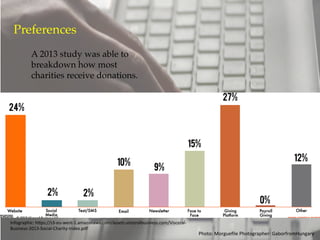
Preferences
A 2013 study was able to
breakdown how most
charities receive
donations.9
Photo:	Morguefile	Photographer:	GaborfromHungary	
Infographic:	hCps://s3-eu-west-1.amazonaws.com/assets.visceralbusiness.com/Visceral-
Business-2013-Social-Charity-Index.pdf
While national average income
has declined, the top 100 charities
saw an increase in their income
represented by per online
supporter (a “like”) from $3,914
to $1,032.10
Photo:	Morguefile	Photographer:	Melodi2
Photo:	Morguefile	Photographer:	hotblack	
The Issue: Converting
supporters into donors
In 2014 UNICEF Sweden
launched a campaign called
“Likes don’t save lives” in an
attempt to address the issue of
people being “aware” but not
actually contributing.11
Converting
supporters into
donors – but is this
actually an issue?
It was found in a recent
study that 57% of
respondents followed a
charity on Twitter/
Facebook but only 8%
actually donated.12
Photo:	Morguefile	Photographer:	Prawny
Photo:	Morguefile	Photographer:	mockingbird	
Are people even seeing
the posts?
Twitter has a click-
through rate of
about 1.6% per
tweet.13
Counter
“76% of all internet users are
using some sort of social
media.”14
That’s simply too big of a market
to ignore.
Photo:	Morguefile	Photographer:	Prawny
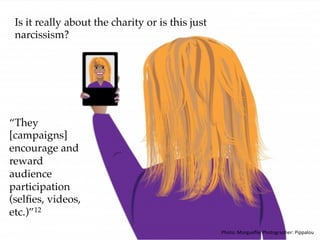
Is it really about the charity or is this just our own
narcissism?
Photo:	Morguefile	Photographer:	Pippalou	
“They
[campaigns]
encourage and
reward
audience
participation
(selfies, videos,
etc.)”15
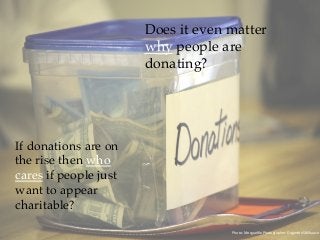
Does it even matter
why people are
donating?
Photo:	Morguefile	Photographer:	DogertonSkillhause	
If donations are on
the rise then who
cares if people just
want to appear
charitable?
Photo:	Morguefile	Photographer:	Jamierodriguez37	
We’ve explored
arguments both sides of
the coin on this issue.
But we need a
conclusion
So what’s the verdict?
While traditional methods for fundraising
may not be completely obsolete, it would be
foolish to ignore the benefits of the
connected universe. While not all exposure
translates to donations, you can’t argue
donations have increased.
Photo:	Morguefile	Photographer:	Prawny
Works Cited
1.  "Number of Worldwide Social Network Users 2010-2019 |
Statistic." Statista. Statista, 2016. Web.
2.  Kingston, Ali. "Positive and Negative Effects of Social Media on
Society."LinkedIn. LinkedIn, 31 Oct. 2015. Web.
3.  Bresciani, Sabrina, and Andreas Schmeil. "Social Media Platforms for
Social Good." Queen's University, 2013. Web.
4.  Stern, Caryl M. "In Praise of Clicktivism." The Huffington Post.
TheHuffingtonPost.com, 31 May 2015. Web.
5.  Kielburger, Craig, and Marc Kielburger. "A Click Is Not Enough to Have
Impact on World." Canoe.com. Canoe.com, 10 Apr. 2015. Web.
6.  Phillips, Catherine. "Prom Dress Donations Pour in for Graduating Fort
McMurray Students." The Globe and Mail. The Globe and Mail, 12 May
2016. Web.
7.  Sharma, Ritu. "Stop Pouring Ice on Clicktivism." The Huffington Post.
TheHuffingtonPost.com, 20 Oct. 2014. Web.
8.  "Social Media – What Is Right for You?" Marketing for Nonprofits.
Marketing for Nonprofits, 21 Feb. 2013. Web.
Works Cited
9.   "The 2013 Social Charity Index." Visceral Business, Oct. 2013. Web.
10.  McCrossan, Anne. "Authentic Audiences Give Smaller Charities an
Advantage on Social Media." The Guardian. Guardian News and Media, 19
Sept. 2013. Web.
11.  Amar, Zoe. "Five Social Media Charity Campaigns You Need to Know
about." The Guardian. Guardian News and Media, 03 Apr. 2014. Web.
12.  "How Social Media Has Changed Charities Forever." Koozaicom How Social
Media Has Changed Charities Forever Comments. Koozai, 23 Oct. 2014. Web.
13.  Collins, Matt. "It's Time for Charities to Stop Wasting Money on Social
Media." The Guardian. Guardian News and Media, 11 Mar. 2016. Web.
14.  Miranda, Carlos. "Telling Charities to Step Away from Social Media Is
Short-sighted." The Guardian. Guardian News and Media, 17 Mar. 2016.
Web.
15.  Waylan, Brad. "Social Media's Role in Modern Charity." Social Media Today.
N.p., 01 Oct. 2015. Web.

Flipbook

  • 1.
    Has social media impactedcharity work and fundraising? By William French Photo: Morguefile Photographer: Prawny
  • 2.
    It is estimatedthat over 2 billion people were using some sort of social network in 2015.1 Photo: Morguefile Photographer: LiaLeslie
  • 3.
    No More Barriers “Socialnetworks have removed all the communication and interaction barriers, and now one can communicate his/her perception and thoughts over a variety of topics.”2 Photo: Morguefile Photographer: Seemann
  • 4.
    “Social technologies can empoweranyone to have a positive impact on the society by creating networking effects and initiating community engagement.”3 Photo: Morguefile Photographer: JoeysPhotos
  • 5.
    What is Clicktivism? Theuse of digital communication technologies in support of worthy causes.4 Photo: Morguefile Photographer: DMedina
  • 6.
    So is Clicktivisma good thing? In 2014, 2.6 million UNICEF Tap Project participants from the U.S., Australia, South Korea, China, Germany and 20 other countries across the globe generated more than a million dollars in clean water funding. More than 350,000 referrals to the Tap mobile site came through Facebook.4 Photo: Morguefile Photographer: Prawny
  • 7.
    Or is Clicktivisma bad thing? However, of the 70% who said they used digital media to learn about changes they can make in their lives to create positive social or environmental change, only 25% made changes.5 Photo: Morguefile Photographer: Prawny
  • 8.
    A look atcurrent impact: In the last few weeks, a Facebook campaign produced over 1000 prom dress donations for Fort McMurray victims who lost everything in the wildfire.6 Photo: Morguefile Photographer: marykbaird
  • 9.
    Past Success: The ALSice bucket challenge was a viral sensation that increased donations for ALS by approximately 800%.7 Photo: Morguefile Photographer: Jason Gillman
  • 10.
    Photo: Morguefile Photographer: svklimkin Not only doessocial media give a charity a wider audience, it has become a cost-cutting tool to replace more traditional/costly fundraising methods (door-to-door campaigning , holding events, etc.)8
  • 11.
    Preferences A 2013 studywas able to breakdown how most charities receive donations.9 Photo: Morguefile Photographer: GaborfromHungary Infographic: hCps://s3-eu-west-1.amazonaws.com/assets.visceralbusiness.com/Visceral- Business-2013-Social-Charity-Index.pdf
  • 12.
    While national averageincome has declined, the top 100 charities saw an increase in their income represented by per online supporter (a “like”) from $3,914 to $1,032.10 Photo: Morguefile Photographer: Melodi2
  • 13.
    Photo: Morguefile Photographer: hotblack The Issue: Converting supportersinto donors In 2014 UNICEF Sweden launched a campaign called “Likes don’t save lives” in an attempt to address the issue of people being “aware” but not actually contributing.11
  • 14.
    Converting supporters into donors –but is this actually an issue? It was found in a recent study that 57% of respondents followed a charity on Twitter/ Facebook but only 8% actually donated.12 Photo: Morguefile Photographer: Prawny
  • 15.
    Photo: Morguefile Photographer: mockingbird Are people evenseeing the posts? Twitter has a click- through rate of about 1.6% per tweet.13
  • 16.
    Counter “76% of allinternet users are using some sort of social media.”14 That’s simply too big of a market to ignore. Photo: Morguefile Photographer: Prawny
  • 17.
    Is it reallyabout the charity or is this just our own narcissism? Photo: Morguefile Photographer: Pippalou “They [campaigns] encourage and reward audience participation (selfies, videos, etc.)”15
  • 18.
    Does it evenmatter why people are donating? Photo: Morguefile Photographer: DogertonSkillhause If donations are on the rise then who cares if people just want to appear charitable?
  • 19.
    Photo: Morguefile Photographer: Jamierodriguez37 We’ve explored arguments bothsides of the coin on this issue. But we need a conclusion
  • 20.
    So what’s theverdict? While traditional methods for fundraising may not be completely obsolete, it would be foolish to ignore the benefits of the connected universe. While not all exposure translates to donations, you can’t argue donations have increased. Photo: Morguefile Photographer: Prawny
  • 21.
    Works Cited 1.  "Numberof Worldwide Social Network Users 2010-2019 | Statistic." Statista. Statista, 2016. Web. 2.  Kingston, Ali. "Positive and Negative Effects of Social Media on Society."LinkedIn. LinkedIn, 31 Oct. 2015. Web. 3.  Bresciani, Sabrina, and Andreas Schmeil. "Social Media Platforms for Social Good." Queen's University, 2013. Web. 4.  Stern, Caryl M. "In Praise of Clicktivism." The Huffington Post. TheHuffingtonPost.com, 31 May 2015. Web. 5.  Kielburger, Craig, and Marc Kielburger. "A Click Is Not Enough to Have Impact on World." Canoe.com. Canoe.com, 10 Apr. 2015. Web. 6.  Phillips, Catherine. "Prom Dress Donations Pour in for Graduating Fort McMurray Students." The Globe and Mail. The Globe and Mail, 12 May 2016. Web. 7.  Sharma, Ritu. "Stop Pouring Ice on Clicktivism." The Huffington Post. TheHuffingtonPost.com, 20 Oct. 2014. Web. 8.  "Social Media – What Is Right for You?" Marketing for Nonprofits. Marketing for Nonprofits, 21 Feb. 2013. Web.
  • 22.
    Works Cited 9.   "The2013 Social Charity Index." Visceral Business, Oct. 2013. Web. 10.  McCrossan, Anne. "Authentic Audiences Give Smaller Charities an Advantage on Social Media." The Guardian. Guardian News and Media, 19 Sept. 2013. Web. 11.  Amar, Zoe. "Five Social Media Charity Campaigns You Need to Know about." The Guardian. Guardian News and Media, 03 Apr. 2014. Web. 12.  "How Social Media Has Changed Charities Forever." Koozaicom How Social Media Has Changed Charities Forever Comments. Koozai, 23 Oct. 2014. Web. 13.  Collins, Matt. "It's Time for Charities to Stop Wasting Money on Social Media." The Guardian. Guardian News and Media, 11 Mar. 2016. Web. 14.  Miranda, Carlos. "Telling Charities to Step Away from Social Media Is Short-sighted." The Guardian. Guardian News and Media, 17 Mar. 2016. Web. 15.  Waylan, Brad. "Social Media's Role in Modern Charity." Social Media Today. N.p., 01 Oct. 2015. Web.