THE BUILDING BLOCK OF NEW
VIRTUAL WORLD
Guided by, Submitted by,
Smitha K M C.N.Rinshad
S7 ECE
Roll no.13
 Claytronics is a programmable matter whose primary
function is to organize itself into the shape of an object
and render its outer surface to match the visual
appearance of that object.
 Programmable matter is a proposed digital material
having computation,sensing, actuation and display as
continuous properties active over its whole extent.
 Claytronics is made up of individual components, called
catoms.
 Each catom is a self-contained unit with a CPU.
 Objects featuring these catoms can be radically altered in
form and function.
 Chairs can be instantly moulded to precisely suit the
individual.
 Many vehicles now make use of claytronics.
 Car surfaces can change colour at the touch of a button or
they can self-heal: fixing bumps, scratches and other
damage.
 A technology to create synthetic reality with which human
interaction is possible.
 Combines nanoscale robotics and computer science to
create individual nanometer-scale computers called
claytronic atoms, or catoms.
 Catoms can interact with each other to form tangible 3-D
objects that a user can interact with. This idea is more
broadly referred to as programmable matter.
 Think of “HOLODECK” of ‘Star-Trek’ or the holographic
projector in Avatar. They are all interactive.
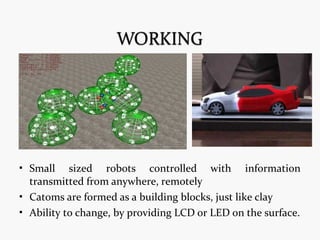
 Small sized robots controlled with information
transmitted from anywhere, remotely
 Catoms are formed as a building blocks, just like clay
 Ability to change, by providing LCD or LED on the surface.
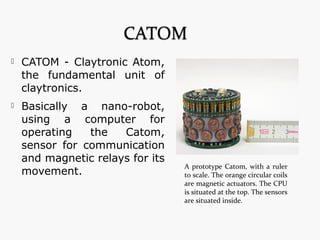
 CATOM - Claytronic Atom,
the fundamental unit of
claytronics.
 Basically a nano-robot,
using a computer for
operating the Catom,
sensor for communication
and magnetic relays for its
movement.
A prototype Catom, with a ruler
to scale. The orange circular coils
are magnetic actuators. The CPU
is situated at the top. The sensors
are situated inside.
 The catoms are controlled by the computer which
is inside it and with help of other hardware it
moves according to program, causing the
effective macroscopic movement.
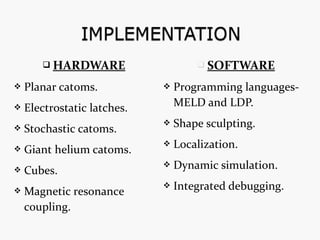
 HARDWARE
 Planar catoms.
 Electrostatic latches.
 Stochastic catoms.
 Giant helium catoms.
 Cubes.
 Magnetic resonance
coupling.
 SOFTWARE
 Programming languages-
MELD and LDP.
 Shape sculpting.
 Localization.
 Dynamic simulation.
 Integrated debugging.
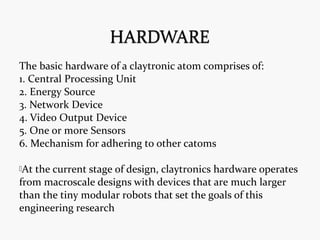
The basic hardware of a claytronic atom comprises of:
1. Central Processing Unit
2. Energy Source
3. Network Device
4. Video Output Device
5. One or more Sensors
6. Mechanism for adhering to other catoms
At the current stage of design, claytronics hardware operates
from macroscale designs with devices that are much larger
than the tiny modular robots that set the goals of this
engineering research
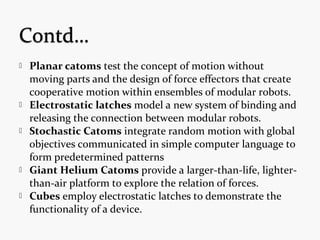
 Planar catoms test the concept of motion without
moving parts and the design of force effectors that create
cooperative motion within ensembles of modular robots.
 Electrostatic latches model a new system of binding and
releasing the connection between modular robots.
 Stochastic Catoms integrate random motion with global
objectives communicated in simple computer language to
form predetermined patterns
 Giant Helium Catoms provide a larger-than-life, lighter-
than-air platform to explore the relation of forces.
 Cubes employ electrostatic latches to demonstrate the
functionality of a device.
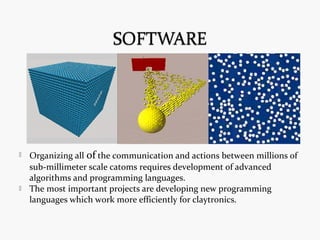
 Organizing all of the communication and actions between millions of
sub-millimeter scale catoms requires development of advanced
algorithms and programming languages.
 The most important projects are developing new programming
languages which work more efficiently for claytronics.
o The goal of a claytronics matrix is to dynamically form
three dimensional shapes.
oLanguages to program a matrix require a more abbreviated
syntax and style of command than normal programming
languages such as C++ and Java.
oThe Carnegie Mellon-Intel Claytronics Research Project has
created two new programming languages:
oMeld
oLocally Distributed predicates(LDP).
 Meld is a declarative language, a logic programming
language originally designed for programming overlay
networks.
 By using logic programming, the code for an ensemble of
robots can be written from a global perspective.
 This dramatically simplifies the thought process for
programming the movement of a claytronics matrix.
 LDP is a reactive programming language.
 It has been used to trigger debugging in the earlier
research.
 With the addition of language that enables the
programmer to build operations in the development of the
shape of the matrix.
 It can operate on fixed-size.
 A program that addresses a fixed-size module rather than
the entire ensemble.
 LDP further provides a means of matching distributed
patterns.
Planar Catoms are the closest step to creating catoms that,
without any moving parts, will create motion, a fundamental
objective in Claytronics research.
 The self-actuating, cylinder-shaped planar catom tests
concepts of motion, power distribution, data transfer and
communication that will be eventually incorporated into
ensembles of nano-scale robots. It provides a testbed for the
architecture of micro-electro-mechanical systems for self-
actuation in modular robotic devices. Employing magnetic
force to generate motion, its operations as a research
instrument build a bridge to a scale of engineering that will
make it possible to manufacture self-actuating nano-system
devices.
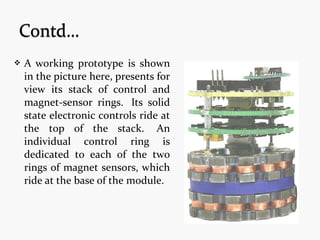
 A working prototype is shown
in the picture here, presents for
view its stack of control and
magnet-sensor rings. Its solid
state electronic controls ride at
the top of the stack. An
individual control ring is
dedicated to each of the two
rings of magnet sensors, which
ride at the base of the module.
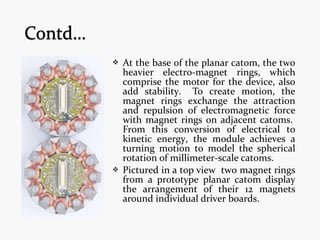
 At the base of the planar catom, the two
heavier electro-magnet rings, which
comprise the motor for the device, also
add stability. To create motion, the
magnet rings exchange the attraction
and repulsion of electromagnetic force
with magnet rings on adjacent catoms.
From this conversion of electrical to
kinetic energy, the module achieves a
turning motion to model the spherical
rotation of millimeter-scale catoms.
 Pictured in a top view two magnet rings
from a prototype planar catom display
the arrangement of their 12 magnets
around individual driver boards.
 The motion of this two Catom can be made possible by
sequentially attraction and repulsion of the consecutive
magnets.
 A catom sustains a clockwise or counter-clockwise motion
by a continuous transfer of electro-magnetic force to
achieve the opposite motion in the other catom.
 In the current design, the catoms are only able to move in
two dimensions relative to each other. Future catoms will be
required to move in three dimensions relative to each other.
 Another major design challenge will be developing a
genderless unary connector for the catoms in order to keep
reconfiguration time at a minimum.
 To create such nano-robot or catoms of millimeter scale by
fabrication process.
 In case of software view we need enormous computing
power-which is largely unfamiliar to present day technology.
 To create such an easy algorithm that can work in real time
without any error.
 Realize Synthetic Reality, throgh sel assembling robots.
 Change the way we interact with each other and machines.
 3D TV , where we can see as well as touch things.
 Virtual meetings
 Surgery
 Once fully developed and functional, this advanced
technology would highly be beneficial, not only to the
scientific class of people but also to the common man.
 It would help users to carry around a lump of claytronics
in their pockets that can reshape into any object.
 From scientific perspective, this technology would enable
engineers to work remotely.
 It may help scientists learn how to efficiently manage
networks of millions of computers. It will also advance our
understanding of nanotechnology.
JOURNALS:
[1] C. Mirkin. Programming the Assembly of Two- and Three-
Dimensional Architectures with DNA and Nanoscale Inorganic Building
Blocks. Inorg. Chem., 39:2258–72, 2000.
[2] S. Murata, H. Kurokawa, and S. Kokaji. Self-assembling machine. In
International Conference on Robotics and Automation, pages 441–448,
San Diego, CA., May 1994.
[3] S. Murata, H. Kurokawa, E. Yoshida, K. Tomita, and S. Kokaji. A 3d
selfreconfigurable structure. In Proc. of the IEEE International Conf. on
Robotics and Automation, pages 432–439, Leuven, Belgium, May 1998.
[4] Radhika Nagpal. Programmable Self-Assembly: Constructing Global
Shape using Biologically-inspired Local Inter- actions and Origami
Mathematics. PhD thesis, MIT Department of Electrical Engineering and
Computer Science, June 2001.
THANK YOU
Claytronics

Claytronics

  • 1.
    THE BUILDING BLOCKOF NEW VIRTUAL WORLD Guided by, Submitted by, Smitha K M C.N.Rinshad S7 ECE Roll no.13
  • 3.
     Claytronics isa programmable matter whose primary function is to organize itself into the shape of an object and render its outer surface to match the visual appearance of that object.  Programmable matter is a proposed digital material having computation,sensing, actuation and display as continuous properties active over its whole extent.  Claytronics is made up of individual components, called catoms.  Each catom is a self-contained unit with a CPU.
  • 4.
     Objects featuringthese catoms can be radically altered in form and function.  Chairs can be instantly moulded to precisely suit the individual.  Many vehicles now make use of claytronics.  Car surfaces can change colour at the touch of a button or they can self-heal: fixing bumps, scratches and other damage.
  • 5.
     A technologyto create synthetic reality with which human interaction is possible.  Combines nanoscale robotics and computer science to create individual nanometer-scale computers called claytronic atoms, or catoms.  Catoms can interact with each other to form tangible 3-D objects that a user can interact with. This idea is more broadly referred to as programmable matter.  Think of “HOLODECK” of ‘Star-Trek’ or the holographic projector in Avatar. They are all interactive.
  • 6.
     Small sizedrobots controlled with information transmitted from anywhere, remotely  Catoms are formed as a building blocks, just like clay  Ability to change, by providing LCD or LED on the surface.
  • 7.
     CATOM -Claytronic Atom, the fundamental unit of claytronics.  Basically a nano-robot, using a computer for operating the Catom, sensor for communication and magnetic relays for its movement. A prototype Catom, with a ruler to scale. The orange circular coils are magnetic actuators. The CPU is situated at the top. The sensors are situated inside.
  • 8.
     The catomsare controlled by the computer which is inside it and with help of other hardware it moves according to program, causing the effective macroscopic movement.
  • 9.
     HARDWARE  Planarcatoms.  Electrostatic latches.  Stochastic catoms.  Giant helium catoms.  Cubes.  Magnetic resonance coupling.  SOFTWARE  Programming languages- MELD and LDP.  Shape sculpting.  Localization.  Dynamic simulation.  Integrated debugging.
  • 10.
    The basic hardwareof a claytronic atom comprises of: 1. Central Processing Unit 2. Energy Source 3. Network Device 4. Video Output Device 5. One or more Sensors 6. Mechanism for adhering to other catoms At the current stage of design, claytronics hardware operates from macroscale designs with devices that are much larger than the tiny modular robots that set the goals of this engineering research
  • 11.
     Planar catomstest the concept of motion without moving parts and the design of force effectors that create cooperative motion within ensembles of modular robots.  Electrostatic latches model a new system of binding and releasing the connection between modular robots.  Stochastic Catoms integrate random motion with global objectives communicated in simple computer language to form predetermined patterns  Giant Helium Catoms provide a larger-than-life, lighter- than-air platform to explore the relation of forces.  Cubes employ electrostatic latches to demonstrate the functionality of a device.
  • 12.
     Organizing allof the communication and actions between millions of sub-millimeter scale catoms requires development of advanced algorithms and programming languages.  The most important projects are developing new programming languages which work more efficiently for claytronics.
  • 13.
    o The goalof a claytronics matrix is to dynamically form three dimensional shapes. oLanguages to program a matrix require a more abbreviated syntax and style of command than normal programming languages such as C++ and Java. oThe Carnegie Mellon-Intel Claytronics Research Project has created two new programming languages: oMeld oLocally Distributed predicates(LDP).
  • 14.
     Meld isa declarative language, a logic programming language originally designed for programming overlay networks.  By using logic programming, the code for an ensemble of robots can be written from a global perspective.  This dramatically simplifies the thought process for programming the movement of a claytronics matrix.
  • 15.
     LDP isa reactive programming language.  It has been used to trigger debugging in the earlier research.  With the addition of language that enables the programmer to build operations in the development of the shape of the matrix.  It can operate on fixed-size.  A program that addresses a fixed-size module rather than the entire ensemble.  LDP further provides a means of matching distributed patterns.
  • 16.
    Planar Catoms arethe closest step to creating catoms that, without any moving parts, will create motion, a fundamental objective in Claytronics research.  The self-actuating, cylinder-shaped planar catom tests concepts of motion, power distribution, data transfer and communication that will be eventually incorporated into ensembles of nano-scale robots. It provides a testbed for the architecture of micro-electro-mechanical systems for self- actuation in modular robotic devices. Employing magnetic force to generate motion, its operations as a research instrument build a bridge to a scale of engineering that will make it possible to manufacture self-actuating nano-system devices.
  • 17.
     A workingprototype is shown in the picture here, presents for view its stack of control and magnet-sensor rings. Its solid state electronic controls ride at the top of the stack. An individual control ring is dedicated to each of the two rings of magnet sensors, which ride at the base of the module.
  • 18.
     At thebase of the planar catom, the two heavier electro-magnet rings, which comprise the motor for the device, also add stability. To create motion, the magnet rings exchange the attraction and repulsion of electromagnetic force with magnet rings on adjacent catoms. From this conversion of electrical to kinetic energy, the module achieves a turning motion to model the spherical rotation of millimeter-scale catoms.  Pictured in a top view two magnet rings from a prototype planar catom display the arrangement of their 12 magnets around individual driver boards.
  • 19.
     The motionof this two Catom can be made possible by sequentially attraction and repulsion of the consecutive magnets.  A catom sustains a clockwise or counter-clockwise motion by a continuous transfer of electro-magnetic force to achieve the opposite motion in the other catom.
  • 20.
     In thecurrent design, the catoms are only able to move in two dimensions relative to each other. Future catoms will be required to move in three dimensions relative to each other.  Another major design challenge will be developing a genderless unary connector for the catoms in order to keep reconfiguration time at a minimum.  To create such nano-robot or catoms of millimeter scale by fabrication process.  In case of software view we need enormous computing power-which is largely unfamiliar to present day technology.  To create such an easy algorithm that can work in real time without any error.
  • 21.
     Realize SyntheticReality, throgh sel assembling robots.  Change the way we interact with each other and machines.  3D TV , where we can see as well as touch things.  Virtual meetings  Surgery
  • 22.
     Once fullydeveloped and functional, this advanced technology would highly be beneficial, not only to the scientific class of people but also to the common man.  It would help users to carry around a lump of claytronics in their pockets that can reshape into any object.  From scientific perspective, this technology would enable engineers to work remotely.  It may help scientists learn how to efficiently manage networks of millions of computers. It will also advance our understanding of nanotechnology.
  • 23.
    JOURNALS: [1] C. Mirkin.Programming the Assembly of Two- and Three- Dimensional Architectures with DNA and Nanoscale Inorganic Building Blocks. Inorg. Chem., 39:2258–72, 2000. [2] S. Murata, H. Kurokawa, and S. Kokaji. Self-assembling machine. In International Conference on Robotics and Automation, pages 441–448, San Diego, CA., May 1994. [3] S. Murata, H. Kurokawa, E. Yoshida, K. Tomita, and S. Kokaji. A 3d selfreconfigurable structure. In Proc. of the IEEE International Conf. on Robotics and Automation, pages 432–439, Leuven, Belgium, May 1998. [4] Radhika Nagpal. Programmable Self-Assembly: Constructing Global Shape using Biologically-inspired Local Inter- actions and Origami Mathematics. PhD thesis, MIT Department of Electrical Engineering and Computer Science, June 2001.
  • 24.