

CLASSROOM
MANAGEMENT
KIDS UNDER 7 YEARS
• hearing and experiencing lots of English
• learn through doing and playing
• learn vocabulary unconsciously and incidentally
• love playing with language sounds, imitating, and
  making funny noises
• are not able to organize their learning
• May not be able to read or write in their mother
  tongue
• Grammar will develop gradually on its own
Caretaker Talk
• Repeat phrases and earlier
  e.g. Teacher : Look! Your shoes. Yes, your shoes…..your shoes
• React positively to what children say even if words
  are not complete or perfectly pronounced
  e.g. Children : Sus…sus….    Teacher : Yes, shoes
• Keep children’s attention by asking them questions
  e.g. Teacher : And he brings us what? He brings …? He brings…..?
• Add to/or improve what children say
  e.g. Children : Chocolate eggs   Teacher : Do you like chocolate eggs?
CHILDREN BETWEEN
    7 AND 12 YEARS
• are learning to read and write in their own
  language
• are developing as thinkers
• understand the difference between the real and
  imaginary
• can work with others
So, what activities can
      you do with them?
•   Read English stories
•   Do reading games
•   Explain simple things
•   Model of language use
•   Creative writing
•   Organized activities : telling stories,
    puppet show, or short drama
Explain simple things
• A pen is something for writing
• A soap is something for taking a bath
• A chair is something for sitting
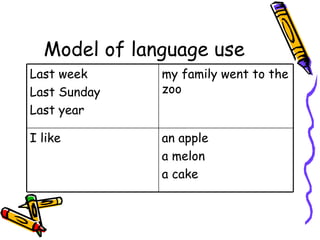
Model of language use
Last week     my family went to the
Last Sunday   zoo
Last year

I like        an apple
              a melon
              a cake
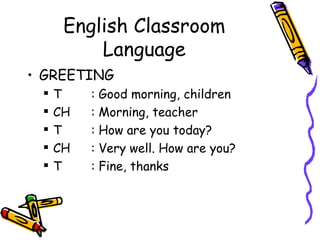
English Classroom
          Language
• GREETING
    T    :   Good morning, children
    CH   :   Morning, teacher
    T    :   How are you today?
    CH   :   Very well. How are you?
    T    :   Fine, thanks
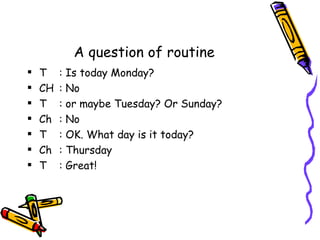
A question of routine
   T    :   Is today Monday?
   CH   :   No
   T    :   or maybe Tuesday? Or Sunday?
   Ch   :   No
   T    :   OK. What day is it today?
   Ch   :   Thursday
   T    :   Great!
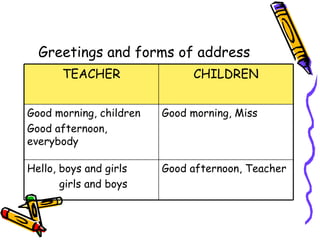
Greetings and forms of address
       TEACHER                CHILDREN


Good morning, children   Good morning, Miss
Good afternoon,
everybody

Hello, boys and girls    Good afternoon, Teacher
       girls and boys
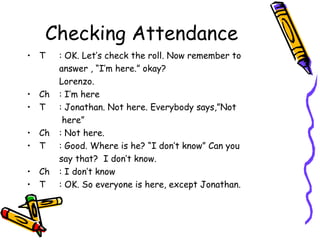
Checking Attendance
• T    : OK. Let’s check the roll. Now remember to
       answer , “I’m here.” okay?
       Lorenzo.
• Ch   : I’m here
• T    : Jonathan. Not here. Everybody says,”Not
        here”
• Ch   : Not here.
• T    : Good. Where is he? “I don’t know” Can you
       say that? I don’t know.
• Ch   : I don’t know
• T    : OK. So everyone is here, except Jonathan.
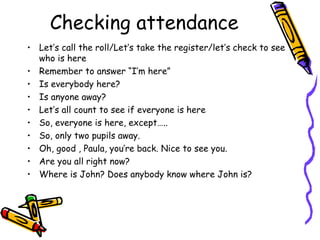
Checking attendance
• Let’s call the roll/Let’s take the register/let’s check to see
  who is here
• Remember to answer “I’m here”
• Is everybody here?
• Is anyone away?
• Let’s all count to see if everyone is here
• So, everyone is here, except…..
• So, only two pupils away.
• Oh, good , Paula, you’re back. Nice to see you.
• Are you all right now?
• Where is John? Does anybody know where John is?
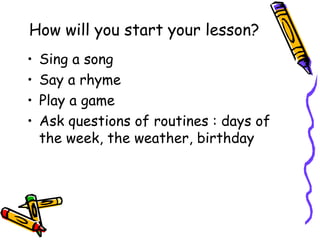
How will you start your lesson?
•   Sing a song
•   Say a rhyme
•   Play a game
•   Ask questions of routines : days of
    the week, the weather, birthday
Exercise on giving instruction
•   Get your books and pencils out
•   Pick your pencils up
•   Put all your things away
•   Put your pencils down
•   Swap your book to your friend’s
•   Turn back to your friend
•   Turn back to face the front
•   Stand up, please
•   Put your hands up
•   Sit down, etc.
Making Discipline
•   Back to your seat, John.
•   Get your book, Ani.
•   Stop talking to your friend.
•   Be silent, please.
Ending Your Lesson
What do your children normally do
  after your English lesson?
 Stay in the same room?
 Go to another lesson in a different
  room?
 Have a break?
 Go home?
How will you end the lesson
• Ok. That’s all for now.
• Right. Pick up all your things, and put
  the books in your back.
• That’s all for today. On Monday,
  there will be more.
• OK. It’s break time. So you can go
  out to play. But first- line up quietly
  by the door.

Classroom management

  • 1.
  • 2.
    KIDS UNDER 7YEARS • hearing and experiencing lots of English • learn through doing and playing • learn vocabulary unconsciously and incidentally • love playing with language sounds, imitating, and making funny noises • are not able to organize their learning • May not be able to read or write in their mother tongue • Grammar will develop gradually on its own
  • 3.
    Caretaker Talk • Repeatphrases and earlier e.g. Teacher : Look! Your shoes. Yes, your shoes…..your shoes • React positively to what children say even if words are not complete or perfectly pronounced e.g. Children : Sus…sus…. Teacher : Yes, shoes • Keep children’s attention by asking them questions e.g. Teacher : And he brings us what? He brings …? He brings…..? • Add to/or improve what children say e.g. Children : Chocolate eggs Teacher : Do you like chocolate eggs?
  • 4.
    CHILDREN BETWEEN 7 AND 12 YEARS • are learning to read and write in their own language • are developing as thinkers • understand the difference between the real and imaginary • can work with others
  • 5.
    So, what activitiescan you do with them? • Read English stories • Do reading games • Explain simple things • Model of language use • Creative writing • Organized activities : telling stories, puppet show, or short drama
  • 6.
    Explain simple things •A pen is something for writing • A soap is something for taking a bath • A chair is something for sitting
  • 7.
    Model of languageuse Last week my family went to the Last Sunday zoo Last year I like an apple a melon a cake
  • 8.
    English Classroom Language • GREETING  T : Good morning, children  CH : Morning, teacher  T : How are you today?  CH : Very well. How are you?  T : Fine, thanks
  • 9.
    A question ofroutine  T : Is today Monday?  CH : No  T : or maybe Tuesday? Or Sunday?  Ch : No  T : OK. What day is it today?  Ch : Thursday  T : Great!
  • 10.
    Greetings and formsof address TEACHER CHILDREN Good morning, children Good morning, Miss Good afternoon, everybody Hello, boys and girls Good afternoon, Teacher girls and boys
  • 11.
    Checking Attendance • T : OK. Let’s check the roll. Now remember to answer , “I’m here.” okay? Lorenzo. • Ch : I’m here • T : Jonathan. Not here. Everybody says,”Not here” • Ch : Not here. • T : Good. Where is he? “I don’t know” Can you say that? I don’t know. • Ch : I don’t know • T : OK. So everyone is here, except Jonathan.
  • 12.
    Checking attendance • Let’scall the roll/Let’s take the register/let’s check to see who is here • Remember to answer “I’m here” • Is everybody here? • Is anyone away? • Let’s all count to see if everyone is here • So, everyone is here, except….. • So, only two pupils away. • Oh, good , Paula, you’re back. Nice to see you. • Are you all right now? • Where is John? Does anybody know where John is?
  • 13.
    How will youstart your lesson? • Sing a song • Say a rhyme • Play a game • Ask questions of routines : days of the week, the weather, birthday
  • 14.
    Exercise on givinginstruction • Get your books and pencils out • Pick your pencils up • Put all your things away • Put your pencils down • Swap your book to your friend’s • Turn back to your friend • Turn back to face the front • Stand up, please • Put your hands up • Sit down, etc.
  • 15.
    Making Discipline • Back to your seat, John. • Get your book, Ani. • Stop talking to your friend. • Be silent, please.
  • 16.
    Ending Your Lesson Whatdo your children normally do after your English lesson?  Stay in the same room?  Go to another lesson in a different room?  Have a break?  Go home?
  • 17.
    How will youend the lesson • Ok. That’s all for now. • Right. Pick up all your things, and put the books in your back. • That’s all for today. On Monday, there will be more. • OK. It’s break time. So you can go out to play. But first- line up quietly by the door.